"These astronomical texts clearly indicate a much longer Persian era than indicated by the Bible and traditional Jewish chronology, and match precisely with Ptolemy's chronology." — Alexander Hool, defender of the traditional count, who holds that these texts were later altered, 20141
"The Bible does not state that the Medeo-Persian period spanned 52 years." — Mitchell First, 19972
"I would rather leave a good question open than risk giving a wrong answer." — Rabbi Shimon Schwab, withdrawing his own solution, 19913
Summary
The Jewish calendar counts years from creation, and its year 5787 began in September 2026.4 The count behind that number comes from Seder Olam Rabbah, a Hebrew chronology of the second century AD that the Talmud credits to Rabbi Yose ben Halafta.5 Seder Olam gives the Persian empire 52 years and three kings. Historians give it 207 years, from 539 to 332 BC, and more than ten kings.2 The difference moves the destruction of Solomon's Temple from 587 or 586 BC to about 423 BC. This article asks which count the evidence supports, and why the two differ.
- The short count is the standard rabbinic count, and it is a reading of Daniel. Mitchell First writes that it "is viewed by all authorities as implicit in the accepted Jewish count from creation".2 Rabbi Yose counts Daniel's seventy weeks as 490 years between the two destructions of the Temple: 70 years of ruin and 420 of the Second Temple.2 The three kings come from Daniel 11:2. No record of the Persian kings is cited.
- The long count rests on documents written under the Persian kings. Babylonian business tablets carry regnal years up to 36 for Darius I, 41 for Artaxerxes I and 46 for Artaxerxes II.666 Artaxerxes III carved six royal generations in stone.7 A Jewish garrison in Egypt dated contracts by Persian kings across 69 years. Thucydides, Herodotus and Xenophon lived under these kings and name them.
- Both counts use the same Seleucid era, so they agree from 312 BC onward. All the missing years must come out of the time before that.
- The eclipses fit only the conventional dates. Babylonian scribes recorded 38 lunar eclipses as seen under Persian kings. At the conventional dates all 38 fall on a real eclipse visible from Babylon. Moved 165 years later, none does. A shift of 167 years puts 28 of 38 back in an eclipse season, which is a weak test. When the eclipse must also be of the same kind and at the same time of night, 167 years scores 4 of 38.8
- The defenders grant the evidence or leave it out. Chaim Heifetz, as presented by Brad Aaronson, makes the later kings second names of earlier ones, and says the only records of the period are Greek stories and Jewish tradition. Rabbi Shimon Schwab proposed in 1962 that the sages hid the years, and withdrew the proposal in 1991. Josephus, Azariah de' Rossi, Mitchell First and the Encyclopaedia Judaica all hold the long count.
- Alexander Hool's defence is the fullest, and his book was read in full. He accepts the 207 years, the ten kings and the tablets. He has Alexander defeat Darius I in 317 BC, puts the later kings beside the Greeks 171 years after their conventional dates, and holds that the records were altered after 160 BC. His best argument is a test of nineteen double-dated papyri, and his arithmetic is right: 15 of 19 fit his dates to the day, against 9 of 19 on the conventional dates. About one shift in sixteen does as well by chance, or one in thirty on the twelve papyri whose dates are fully preserved, and the fit needs the Egyptian calendar to have jumped 43 days. The Canopus Decree of 238 BC shows that the calendar had not jumped. A papyrus he cites himself names a Persian governor of Judah in what would be 236 BC, and five eclipses in the Greek historians do not exist at his dates.9101112
- Four of Hool's points are narrowed and still open. Seder Olam's 34 years end where the tablets of Darius I end, to within about a month. There are three ordinary ways to reach the 34, no text decides between them, and on two of them the match is a coincidence of about one in ten. So it is weak evidence for Hool, a factor of ten at the outside. The Uruk King List has a "Nidin-Bel" before a Darius, and nobody has identified him. Hool's own reading of that tablet is excluded on the published text, which nobody on this project has checked against a photograph. The leap years of Darius I fit the later 19-year pattern if they are moved three years, and the list of leap years cannot tell that from the ordinary reading. One receipt is dated to the twelfth month of Darius's year 36, three months after the first tablets of Xerxes, and it is explained only by a parallel. None of the four outweighs the documents above. Part 6 says what would settle each.
- No source shows that the rabbis shortened the count to move Daniel 9 away from Jesus. The earliest form of the charge found for this article is from the tenth century, and it ran both ways. Christians have made the same kind of cut. Martin Anstey in 1913 and Philip Mauro in 1923 removed about 80 years from the Persian period to make Daniel 9 end at the crucifixion.
- The Bible gives no total for the Persian period. The short count is an interpretation, and rejecting it contradicts no verse.
Weak points of the case made here. The eclipse tablets are later copies, and some of their regnal labels are restored by editors. The last three Persian reigns, 28 years in all, had no business tablets in the standard list of 1942. The eclipse test uses computed times as a stand-in for the times on each tablet. On one test, the day-count of the Elephantine papyri, Hool's dates fit better than the conventional dates, and what decides against him there is a single inscription. His printed tables could not be read, and Heifetz's Hebrew article was not obtained. Daniel 11:2 reads most naturally as a short list of kings. Every live dispute about the Persian kings, added together, moves dates by about five years. The short count needs about 165.
Verdict. The Persian period lasted about 207 years, and the First Temple fell in 587 or 586 BC. The traditional count is a second-century reading of Daniel, held in good faith, and the evidence is against it. Hool's revision is the most serious attempt to save it. It fails on dated documents, several of which he cites himself.
Part 1: What the traditional chronology says
The scheme in its own words
Seder Olam covers the years after the exile in chapters 28 to 30. Mitchell First sums up its scheme in four points: 52 years from the fall of Babylon to the Greeks, one Median and three Persian kings, 34 years from the start of the rebuilding of the Temple to the Greeks, and 420 years for the Second Temple.2
- The kings. Chapter 28 quotes Daniel 11:2 and names them: "this is Koresh, Ahashverosh, and Daryavesh who built the Temple. And why does Scripture say 'and the fourth', (He is the) fourth from (the one of) Madai."2 Koresh is Cyrus, Ahashverosh is Ahasuerus, Daryavesh is Darius, and Madai is Media. The Median king is Darius the Mede, who gets one year.13
- Their years. Chapter 29 counts "Three years of Cyrus, fourteen of Ahasuerus, two of Darius. In the second year of Darius, the Temple was rebuilt". It calls Cyrus's three years "truncated", meaning incomplete.13
- Darius is Artaxerxes. Ezra and Nehemiah name a king Artaxerxes who reigned at least 32 years.14 Chapter 30 makes him the same man as Darius: "Daryavesh is Artahshasta, the entire (institution of) kingship was called Artahshasta. And you find for Persia only three kings, and for Media one".2 The Talmud repeats the identification and adds a play on words. The king was called Cyrus, Koresh, "because he was a virtuous [kasher] king".5
- The total. The same chapter gives all the kings of Media and Persia 52 years.13
- The Second Temple. "Rabbi Yose says: The kingdom of Persia, during the time of the Temple, (existed) 34 years; the kingdom of Greece, 180; the kingdom of the House of the Hasmoneans, 103; the kingdom of Herod, 103."2 The four numbers add up to 420.
- Ezra, a year after the Temple. Chapter 29 has the Temple finished in the sixth year of Darius, and then: "at that time in the coming year Ezra came up from Babylon". The verse it quotes puts that journey "in the seventh year of King Artaxerxes".13 So the sixth year of Darius and the seventh of Artaxerxes are consecutive years of one king. The Talmud counts the same way. Rav Ashi says that "Those six years from the time the Second Temple was built until Ezra ascended to Eretz Yisrael and sanctified the land are not counted", and cites a teaching that "At that same time in the following year Ezra ascended from Babylonia".5 The identification is used as chronology. It is more than a play on words.
- The end of prophecy. Chapter 30 names Alexander of Macedon, gives him twelve years, and says the prophets prophesied "until here".13 Milikowsky reads that line as the work's own boundary. At this point, he writes, "prophecy stopped and leadership passed to the elders and wise men."15
The Talmud adopts all of it. Tractate Yoma says the Second Temple "stood for four hundred and twenty years".5 Avodah Zarah repeats Rabbi Yose's four numbers, and Arakhin uses the 420 years to work out the sabbatical years.5 Rashi and Maimonides follow.5 The short count is fringe among historians. Within rabbinic Judaism it is the received count.
The numbers run through the rest of rabbinic literature. The Tosefta gives the first building 410 years and the last 420.5 Arakhin puts the question outright: "Now, for how many years did the Second Temple stand? It stood for 420 years."5 Megillah works out the seventy years of exile from the reigns of the kings of Babylon, "Forty-five years of Nebuchadnezzar, and twenty-three of Evil-merodach", and gives Ahasuerus fourteen years, which Rava calls "partial years".5 The cuneiform Uruk King List gives Evil-merodach two years.16 None of these passages mentions Jesus or Christians. They use the numbers for sabbatical law, vows, the dating of contracts and preaching.
How old the text is
Chaim Milikowsky, who edited the critical text, dates the core of Seder Olam before Rabbi Yose, who "gave it its form and shape" in the middle of the second century.15 He judges the lines that hold the 34, 180, 103 and 103 to be a later addition.15 The 52 years, the three kings and the 70 plus 420 stand in the older body of the work.
The Talmud credits the work to Rabbi Yose on the word of Rabbi Yohanan, a sage of the third century: "Who is the tanna who taught Seder Olam? It is Rabbi Yosei." It also keeps the man and the book apart. Where a ruling of his conflicts with the book, the answer is that he "taught Seder Olam but he does not maintain in accordance with its ruling here."5 Milikowsky reaches a like result from the text: "R. Yose's role was one of a transmitter and glossator." He holds that the book "has at its core a single unified work which was authored by one person or, at the most, by a small group of persons", that it "has been preserved in some twenty manuscripts and was first printed in Mantua, 1513", and that a date as late as the third century "is not supported by the evidence."15
The older view, in the Encyclopaedia Judaica, is that "The work in its present form has gone through many hands", and that Rabbi Yose "probably had access to old traditions" shared with Demetrius, a Jewish chronographer of the third century BC. It suggests that the last chapter's summary of later history "may be an epitome of a large section shortened by some later editor uninterested in post-biblical history."17 It also credits the book with the count that Jews still use: "Seder Olam Rabbah was the first to establish the era" from the creation of the world.17 The book's own horizon is the revolt of Bar Kokhba. Its last chapter counts the years from the war of Vespasian down to "the war of Ben Koziba".13
The Mantua edition of 1513 prints 250 years for Media and Persia where the manuscripts read 52, and many later printings copy it.2 The 250 is no trace of an older and longer Jewish count.
The Warsaw edition of 1904, which the common online copy reproduces, has a second trap. Its base text gives the Second Temple 410 years, and the editor's brackets correct that to 420.13 A reader who copies that edition without its brackets prints wrong numbers.
The dates, in plain arithmetic
The Talmud dates the fall of the Second Temple to the year 3828 from creation.5 Take away 420 years for the Second Temple and 70 for the exile, and the First Temple fell in the year 3338. Edgar Frank's table of rabbinic dates gives the same two numbers.18
Turning those years into BC and AD depends on how the first year of the count is labelled, so writers print different dates for the same tradition.
| How year one is labelled | Second Temple falls | First Temple falls | Used by |
|---|---|---|---|
| As on today's Jewish calendar | AD 68 | 423 BC | Encyclopaedia Judaica; Berel Wein |
| One year later, the epoch Hool calls Vayad | AD 69 | 422 BC | Alexander Hool, who also allows AD 70 |
| Adam's first year counted as year zero | AD 70 | 421 BC | Edgar Frank; Brad Aaronson; First's tables |
| 490 subtracted from 70 as if a year zero lay between 1 BC and AD 1 | AD 70 | 420 BC | an arithmetic slip |
On today's calendar the year 3828 ended in AD 68, which the Encyclopaedia Judaica calls a "contradiction to the accepted chronology that it took place in the year 70".17 Wein prints 423 BC on that basis.19 Frank argued in 1956 that Seder Olam counted Adam's first year as year zero, so that "their year 3828 corresponds with 3830", which is AD 70.18 Aaronson follows him and gets "421 BCE (not 420 -- there is no year zero between 1 BCE and 1 CE)".20 Hool uses a third epoch and gets AD 69.1 He puts the building of the Second Temple in 352 BC, and the 422 BC in the table is this article's sum of that year and the seventy years of ruin before it.21 Hool does not insist on AD 69. His twelfth chapter reaches that year by four counts and then notes that for Rashi and the Tosafists "the Temple stood for 420 full years and the destruction of the Second Temple actually took place in the 421st year." In that case, he writes, "each one of the above counts would lead us" to AD 70, "in line with the conventional sources."21 That chapter is no argument against the long count. It concerns the same one-year question as the rest of this section.
The spread comes from labels. Maimonides wrote that the count of years starts from the new moon before Adam, "which was in the second year of the creation."5 So the year that one writer calls 3828 another calls 3829 or 3830. Sheldon Epstein, Bernard Dickman and Yonah Wilamowsky set the three systems side by side and conclude: "Any one of these 3 systems can be used interchangeably as long as it is made clear what the initial frame of reference is."22 Frank's thesis was that the Talmud "fixed the time of the burning of the Second Temple correctly in the year 70 C.E." He found few rabbinic writers who read it so: "The only Rabbinical sources within 1500 years, as far as this writer was able to find, which did not err as to the destruction year were Maimonides, two Karaite inscriptions and perhaps Tobia ben Eliezer".18 Schwab's revised table of 1991 prints the year as 3830, beside 70 CE.3 Mitchell First reports the commoner usage, in which "the date implicit in rabbinic chronology for the destruction of the Second Temple is 68 CE (or, less frequently, 69 CE)."2
This two-year question is not the 165-year one, and Frank kept them apart. He lists "Contradiction between the data in Jewish chronology and established ancient history" among the subjects he will not discuss. He adds in a note: "It is a well known fact, for instance, that the First Temple was destroyed in 586 and the Second consecrated in 516 BCE and destroyed in 70 CE."18 The scholar on whom the defenders rely for the year 421 BC took 586 BC for a fact.
So the gap at the First Temple is 163 to 166 years, measured from 587 or 586 BC. First puts the difference at "about 154 to 169 years" depending on which period is measured.2
Part 2: Where the short count comes from
Daniel 9 supplies the total
Seder Olam names its source. Rabbi Yose reads the seventy weeks of Daniel 9:24 as 490 years between the two destructions, "70 years in its destroyed state and 420 years in its built state".2 In the Talmud the sage Abaye asks whether the time of the destruction was not known in advance, and quotes the verse: "Seventy sevens are decreed upon your people and upon your sacred city".5
The Gemara does not let Abaye's point stand. Even granting the verse, it asks, "And still, did we know on which day" the Temple would fall?5
Seder Olam also divides the weeks. The first seven "are those they spent in the exile", the sixty-two "are those they spent in the Land", and the last week was spent partly in the land and partly outside it.13 Rashi, in the eleventh century, reads the chapter the same way. The seventy weeks run "from the day of the first destruction in the days of Zedekiah until it will be [destroyed] the second time." The anointed one of verse 25 is Cyrus: "Time will be given from the day of the destruction until the coming of Cyrus, king of Persia". The anointed one who is cut off is "Agrippa, the king of Judea, who was ruling at the time of the destruction", and the word, Rashi adds, "is purely an expression of a prince and a dignitary." The one who makes a covenant in verse 27 is Titus.5 Saadia Gaon, in the tenth century, split the number differently and kept the same two ends: "In our opinion that is to be interpreted as meaning 490 years", made up of 49 years from the exile to the rebuilding and "the 434 years of the existence of the edifice" of the Second Temple. Those two make 483, one week of years short of the whole.23
First draws the conclusion: "the fact that both the book of Daniel and SO express chronologies with 490-year periods points strongly to the conclusion that the 490-year period of the latter was derived from the former."2
The 34 years for Persia then follow by subtraction, as First reconstructs it. Start with 490. Take away 70 for the exile, about 380 from the Seleucid era to the fall of the Temple, and 6 from Alexander to the Seleucid era, a figure Rabbi Yose gives in the Talmud.5 That leaves 34. First calls the figure "so inexplicable that it can only be reasonably explained as being the result of the subtraction".2 He reports that Azariah de' Rossi in the 1570s and Heinrich Guggenheimer in the twentieth century explained it the same way.2
No record of the Persian kings stands behind the numbers. First again: "There is no evidence that any type of system of reckoning was used by the Jews during the Persian period that would have enabled an accurate record of the length of the Persian period to have been kept and passed down."2 The Encyclopaedia Judaica calls the result an error: "The most significant confusion in Yose's calculation is the compression of the Persian period". It adds that Rabbi Yose, like other rabbis, believed that Zerubbabel, Ezra, Nehemiah and Simeon the Just "were all contemporaries".17
The right figures existed in Rabbi Yose's own century, in the king list that Ptolemy used. First doubts that a rabbi would have gone looking for it: "it is doubtful that the author of the SO chronology would have viewed this non-Jewish source as reliable enough to warrant the effort needed to obtain it."2
Azariah de' Rossi gave much the same account of the sages' reasoning in the 1570s, as First reports it. The sages "may have been influenced by the short Persian period implied" in Daniel 11:2. They may have held that Daniel 9:24 fixed 490 years from the start of the exile to the end of the Second Temple. And having chosen the short period, "they forced themselves to ignore the contradictory evidence from Nehemiah 12:10-11 regarding the line of high priests". De' Rossi did not call this an error. He thought the sages wished to fix one firm tradition, and First writes that "De Rossi views this goal as having been a praiseworthy one".2
The scheme shows its seams. In the Talmud Rava has Ahasuerus count "five years of Darius and Cyrus", where Seder Olam gives Darius the Mede one year and Cyrus three.5 A harmony built from verses would be expected to have loose joints of this kind. A record of reigns would not.
Daniel 11 supplies the kings
Daniel 11:2 is the short count's best text: "Three more kings will arise for Persia. Then a fourth king will be unusually rich, more so than all who preceded him." The next verse brings "a powerful king", who is Alexander.14 First, who rejects the short count, concedes the point: "The simplest understanding of the verse is that it refers to four Persian kings."2 Aaronson presses it: "Daniel 11:2 presents quite a problem for the conventional chronology".24
A Christian who reads Daniel as sixth-century prophecy has the same verse to explain. The usual answer is that the verse names the first kings and does not say that no others reigned. The fourth is marked out by his war on Greece, which fits Xerxes. That answer is possible. It is less natural than the short reading. First states the answer and its cost. "One can postulate that Daniel 11:2 only intended an enumeration of some of the Persian kings, e.g., the first few, or the mightiest, or the ones whose reigns were of consequence for the Jews." But then "a gap in time almost always must be postulated between the Persian kings referred to at Daniel 11:2 and the" mighty king of the next verse.2
The verse also cuts against the short count. Its fourth king "will stir up everyone against the kingdom of Greece."14 That fits Xerxes, who invaded Greece in 480 BC. In Seder Olam the fourth king is the Darius who rebuilt the Temple and then lost to Alexander, and the Persian wars against Greece have no place in the scheme. Each modern defender has to find them one. Heifetz moves Salamis into the reign of Nebuchadnezzar. Hool puts Xerxes after Alexander.
Ezra cuts the other way. Ezra 4:5–7 names Cyrus, Darius, Ahasuerus and Artaxerxes in turn, and Ezra 6:14 says the Temple was finished "by the command of Cyrus and Darius and Artaxerxes king of Persia".14 Seder Olam must make Artaxerxes a second name for Darius. First calls that reading "very difficult in light of Ezra 6:14, which refers to both Daryavesh and Artahshasta and clearly implies that the two are separate kings".2
Aaronson answers the passage in Ezra 4 from the layout of the Hebrew text: "That this was not a single passage listing four kings in order of succession is clear from the fact that the Masorah begins a new parsha between verses 6 and 7".24 A paragraph break does not change the order of the names, and Ezra 6:14 puts Darius and Artaxerxes side by side in one phrase.
The thirty-two years of Artaxerxes in Nehemiah decide nothing either way. Artaxerxes I reigned 41 years and Artaxerxes II reigned 46. Inside Seder Olam's own scheme the Darius who is also Artaxerxes has 36.
Was the count shortened to hide Jesus?
A page on bible.ca, the website run by Steve Rudd, calls Seder Olam "a corrupt chronology by Rabbi Yose ben Halafta invented 140-160 AD that dates creation to 3761 BC with the primary goal of disconnecting Jesus Christ as the Jewish Messiah".25 The page spells the charge out. "Seder Olam must erase 167 of their own Jewish History to make the 70 weeks of Daniel fit their new, non-biblical interpretation", and this was done "in order to disconnect the 70 weeks prophecy of Daniel 9:24-27 from ending the year Jesus was crucified in 33 AD." It gives the true span as "587 BC + 70 AD = 657 years".25 That sum is one year too many, since no year zero lies between 1 BC and AD 1. The same page charges that "the Jews systematically adjusted the chronological numbers in their Hebrew Tanakh".25 That is a separate question, about the ages in Genesis, and it is treated in Old Testament Text and Chronology.
The page cites no source for the motive, and the research for this article found none. Five facts stand against the charge.
- The texts give their own reasons. Seder Olam and the Talmud argue from Daniel 9, Daniel 11 and Ezra 6:14. These passages never mention Jesus or Christians. They end the 490 years at the fall of the Temple, which their own age had lived through. J. Paul Tanner, who defends the messianic reading of Daniel 9, quotes Roger Beckwith: after AD 70 "it was natural to tie the end of the seventy weeks to A.D. 70".26 Tanner finds the same reading in a Jew who wrote before Seder Olam: "From several statements made by Josephus, it seems clear that he viewed the fulfillment of the prophecy in the events leading up to A.D. 70". Tanner's quarrel with Seder Olam is over its numbers, which "are simply unacceptable to modern historians". It is not over its motive.26
- The count looks older than the debate. Milikowsky puts the core of Seder Olam before Rabbi Yose. Tanner finds one brief remark on the seventy weeks in the Epistle of Barnabas, and then "no extended discussion of this prophecy has been found in Christian literature before the late second century A.D."26
- The earliest form of the charge found here is about eight centuries later, and it runs both ways. Saadia Gaon, who died in 942, accused Christians of adding years. They hold, he wrote, "that the government of the Persians over Palestine existed for a period of something like 300 years before that of the Greeks and that the number of their kings during this period was seventeen".23 First reports that Saadia also answered a Christian claim that the Jews had removed the same years.2 About AD 1000 the Muslim scholar al-Biruni recorded the Christian reproach. His version concerns the age of the world, and Daniel 9 is not named: "according to the doctrine of the Jews, the time between Adam and Alexander is 3,448 years, whilst, according to the Christian doctrine, it is 5,180 years."2727 Saadia's own case was made from Daniel. He wrote that "it was impossible that between the time of the government of Babylon and that of the Greeks more than four Persian kings should have ruled over Palestine", and he took the anointed one who is cut off to be "every anointed priest" and no one person.23
- Jews who think the cut was deliberate give Jewish motives. Schwab proposed obedience to the command in Daniel 12:4 to seal the book. First answered him: "there is no evidence in SO to suggest that preventing messianic calculations was a concern of this work."2 Sheldon Epstein, Bernard Dickman and Yonah Wilamowsky proposed in 2006 that the sages "wanted the completion of the Mishnah to occur approximately 2000 years after the start of the Torah period".22 They accept what follows: "If this meant chronologically shortchanging the time of the second Temple, so be it." On their view the Jewish year 5766 was really 5962.22 First's judgment on Schwab's theory applies to all of these: "there is no reason to seriously consider such a suggestion when other far less speculative suggestions are available".2
- Isaac Newton blamed other messiahs. Newton read Daniel 9 of Christ, and still explained the short count by Jewish hopes for Theudas, Judas of Galilee "and at length to Barchochab".28 He gave no rabbinic text for that, so it is a conjecture too. Newton sets out the rabbinic numbers fairly, and then puts them aside: "These accounts being very imperfect, it was necessary to have recourse to the records of the Greeks and Latines, and to the Canon recited by Ptolemy".28
None of this proves that no rabbi ever welcomed the result. It shows that the charge has no source behind it and should not be repeated as fact.
Part 3: The evidence for a long Persian period
Dated tablets, king by king
Babylonian scribes dated receipts and contracts by the day, month and year of the reigning king. In 1942 Richard Parker and Waldo Dubberstein listed the first and last dated tablet of every reign. The table sets the reign lengths in Ptolemy's king list beside the highest year on a document written at the time.29
| King | Years in Ptolemy's list | Highest year on a dated document | Source |
|---|---|---|---|
| Cyrus | 9 | 9, August 530 BC | 6 |
| Cambyses | 8 | 8, April 522 | 6 |
| Darius I | 36 | 36, November 486 | 6 |
| Xerxes | 21 | 20 on a Persepolis tablet; 21 on an Elephantine papyrus, January 464 | 6 |
| Artaxerxes I | 41 | 41, December 424 | 6 |
| Darius II | 19 | 13 on tablets; 17 on an Elephantine papyrus | 306 |
| Artaxerxes II | 46 | 46, November 359, the numeral slightly damaged | 6 |
| Artaxerxes III | 21 | none in 1942; a later tablet records his death in year 21 | 31 |
| Arses | 2 | none in 1942; the same tablet has his year 1 | 31 |
| Darius III | 4 | none certain in 1942; a later tablet has years 3 and 4 | 32 |
The list adds up to 207 years. From the first tablet of Cyrus in October 539 to the last of Artaxerxes II in November 359 is 180 years of documents dated by Persian kings. Seder Olam allows 52 for the whole empire.
The chain has no slack at either end. The Babylonian chronicle puts the fall of Babylon on 13 October 539 BC, and Parker and Dubberstein add: "Interestingly enough, the last tablet dated to Nabunaid from Uruk is dated the day after Babylon fell to Cyrus." The usurper Bardiya, who held the throne for part of 522 BC, has tablets of his own from April of that year.6 At the far end, Alexander "was recognized in Babylon after Gaugamela in October? 331", and when tablets came to be dated by Seleucus "the first year of the king was officially reckoned as having begun on New Year's Day, April 3, 311".6 Nowhere in the chain can 165 years be taken out without removing kings who have tablets.
The tablets catch one king following another. Two are dated "41st year, accession year, 12th month" of "Darius, king of lands". Parker and Dubberstein explain that "the scribes began to write the accustomed '41' and then, remembering that a new king was ruling, merely added 'accession year'".6 So a Darius followed a king who had reigned 41 years. In Seder Olam the only Darius who follows another Persian king follows Ahasuerus, who reigned 14.
How many tablets there are
No one has published a count of every tablet dated to a Persian king. The counts that exist are by archive.
| Archive | Size | Reigns covered | Source |
|---|---|---|---|
| Persepolis Fortification | remains of about 15,000 to 18,000 documents | Darius I, years 13 to 28 | 33 |
| Persepolis Treasury | 140 published texts | Darius I year 30 to Artaxerxes I year 7 | 33 |
| Murašû family, Nippur | under 868 texts, probably about 730 | Artaxerxes I year 10 to Artaxerxes II year 1 | 3434 |
| Babylonian archives closed by 484 BC | about 51,000 tablets in 136 archives | Neo-Babylonian kings to Xerxes year 2 | 35 |
The last row is not a Persian count. Those archives begin under Nabopolassar and Nebuchadnezzar, and Caroline Waerzeggers does not divide them by reign. The Persepolis figure counts documents, and not every one carries a year. So "tens of thousands of dated Persian tablets" is more than the sources say. What they do say is narrower and still enough. The two Persepolis archives run from year 13 of Darius I to year 7 of Artaxerxes I, which is 509 to 457 BC. That is 52 years of records from one palace under three kings in a row. Seder Olam gives the whole empire 52 years.36
The thin stretch, and what filled it
The 1942 list is frank about its weak end. Of Artaxerxes III: "No contemporary cuneiform documents help to establish his twenty-one years of rule". Of Arses: "No contemporary evidence is available for his rule of two years".6 For these last 28 years the authors leaned on Ptolemy and two astronomical texts.
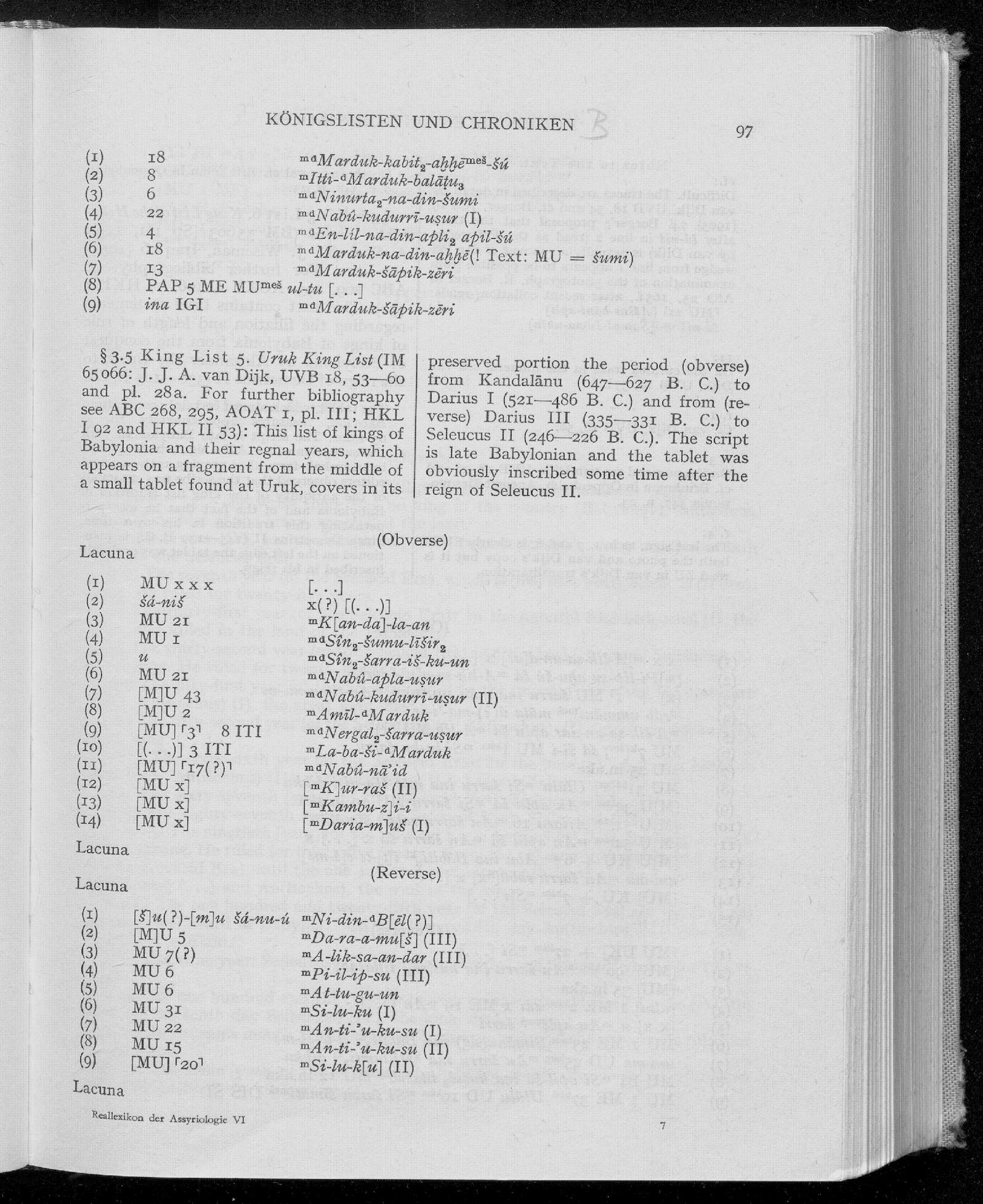
Tablets edited since then name those kings. BM 71537, a table of solar eclipses, notes under a 21st year: "Month VI, Umakuš died. Aršu, his son, sat on the throne."31 Umakuš is Ochus, the birth name of Artaxerxes III. Aršu is Arses. A second tablet reads "Accession year of Umakuš, who is called? Darius", in the cell after an eclipse of a 41st year.37 That is Darius II, who followed Artaxerxes I. The Greek doctor Ctesias, who served at the Persian court, agrees: "Ochus became king and changed his name to Dariaeus."38 A third tablet runs "Year 3, Darius", then year 4, then "Year 9, Alexander".32
The same tablets hold more. BM 71537 has "Year 1 of Umakuš" at the head of the reign, and under his twentieth year it describes an eclipse of the sun that Huber counts as "the only clearly observed eclipse" on the fragment, that of 4 September 339 BC.39 The tablet with the years of Darius and Alexander describes an eclipse of the moon in Alexander's ninth year in which "all of it was covered."32 Another eclipse table breaks off its astronomy to record the death of an earlier king: "Xerxes - his son killed him."40
So the scribes knew two kings called Ochus, one who followed a king of 41 years and one who died in his own 21st year, and a Darius just before Alexander. None of Seder Olam's kings died in a 21st year and left the throne to a son named Arses.
The kings' own inscriptions
In building inscriptions at Susa and Hamadan, Artaxerxes II calls himself son of Darius, son of Artaxerxes, son of Xerxes, son of Darius, son of Hystaspes, and adds: "This palace Darius my great-great-grandfather built; later under Artaxerxes my grandfather it was burned".7 Artaxerxes III carved the same descent at Persepolis with himself added.7 That makes six royal generations from Darius I. Five steps from father to son, at even 20 years each, take 100 years.
Aaronson's reply to these texts is that they may be forged, as Part 5 reports. That claim has more to explain than one stone. The descent in the Susa text stands in lines that are not restored, and the Hamadan text repeats it. The Persepolis text of Artaxerxes III exists in four copies, and "all four copies have identical orthography".77 The same order of kings then appears on Babylonian tablets and in Greek writers, which do not depend on the inscriptions or on one another.
Persepolis, Elephantine and Egypt
- Persepolis. The clay archives of the Persian capital run from the eleventh year of Darius I until, in George Cameron's words, they "cease quite suddenly with the last months of the fifth year of Artaxerxes I, in 459 B.C."41 That is about 50 years.
- How the Persepolis tablets were assigned. The tablets "were discovered in 1936-38 in the southeastern part of the Persepolis Terrace", in the ground where they had lain. That answers the claim that Alexander destroyed the Persian records. Their king was argued for, and was not assumed. The years on the Fortification tablets ran from the eleventh to the twenty-eighth, so "they could be assigned to any one of three Persian kings whose reigns exceeded twenty-eight years". They were given to Darius I because one of them quotes "the words of Darius I as he orders a hundred sheep to be given to his daughter Artystone". Seals passed from one reign to the next: "a seal ostensibly belonging to Xerxes continued to be used in the reign of Artaxerxes I."41
- Elephantine. A Jewish garrison on the Nile dated its contracts by Persian kings from the 15th year of Xerxes, 471 BC, to the third year of Artaxerxes II, 402 BC.42 That is 69 years. Many carry two dates, one by the moon and one by the Egyptian calendar, so the day can be found by astronomy. A petition of "the 17th year of Darius the king" names "Johanan the high priest" and the "sons of Sanballat governor of Samaria", who are known from Nehemiah. It recalls the time "when Cambyses came into Egypt", a king absent from Seder Olam's list.30
- The order of the Elephantine archive. Heifetz assigns the Darius of these papyri to the first king of that name. The archive's own order is against him. Contracts of an Artaxerxes come first, then contracts of a Darius, then contracts of a second Artaxerxes, and the double dates fix each to its year.42 The petition says the temple was destroyed "in the 14th year of Darius the king, when Arsames departed and went to the king". Cowley drew a conclusion for the Bible: "Since Bigvai was viceroy in 408, it is evident that Nehemiah was either dead or superseded by him at that date." So the thirty-second year of Artaxerxes in Nehemiah 13:6 belongs to Artaxerxes I and is 433 BC.30
- Egypt. The priest Manetho, writing about 280 BC, gives the Persian kings of Egypt as "Darius, son of Hystaspēs, for 36 years", "Xerxēs the Great, for 21 years" and "Artaxerxēs, for 41 years".43 His work survives only in Christian summaries, so his numbers may have been adjusted.
- Manetho's two Persian dynasties. The full list has Cambyses, who "in the fifth year of his kingship over the Persians became king of Egypt, and ruled for 6 years", then Darius, Xerxes, Artabanus for seven months, Artaxerxes, a second Xerxes for two months, Sogdianus for seven months, and a second Darius for 19 years. A later dynasty has Ochus, who "in the twentieth year of his kingship over the Persians became king of Egypt, and ruled for 2 years", then Arses for three years and a third Darius for four.43 Native Egyptian dynasties stand between the two. So an Egyptian list has two separate Persian periods and three kings called Darius. It gives Arses three years where Ptolemy's list gives two, a difference of one year.
The Greeks who lived through it
Thucydides fought in the war he describes. He reports that Athenian envoys "heard there of the death of King Artaxerxes, son of Xerxes", in the seventh winter of the war, and he copies a treaty dated "In the thirteenth year of the reign of Darius".44 His next summer opens with an eclipse of the sun, which NASA's catalogue puts on 21 March 424 BC.45 Herodotus, writing after 430 BC, knows "Dareios the son of Hystaspes and Xerxes the son of Dareios and Artoxerxes the son of Xerxes, three generations following upon one another".46 Xenophon marched in 401 BC for the younger son of a Darius against the elder son, Artaxerxes.47
These writers can be multiplied. Thucydides has Themistocles send "a letter to King Artaxerxes, Xerxes's son, who had just come to the throne".44 His count of war years hangs on three eclipses: of the sun in the first summer, of the sun again in the eighth, and "an eclipse of the moon, which was then at the full", at Syracuse in the nineteenth.4444 NASA's catalogues have all three, on 3 August 431, 21 March 424 and 27 August 413 BC.12 Herodotus tells of envoys from Argos at Susa who asked "Artoxerxes the son of Xerxes" whether the friendship made with Xerxes still held.46 Ctesias, as Photius sums him up, has "Artoxerxes" die "after having reigned forty-two years", then Ochus, and then "Arsaces, who succeeded him, changed his name to Artoxerxes."38 Arrian dates Gaugamela by the Athenian year: it "was fought in the archonship of Aristophanes at Athens, in the month Pyanepsion".48
How far are these independent of the tablets? Thucydides and Xenophon were Athenians who took part in the events and dated them by Greek calendars. Herodotus had Persian informants, and his date is fixed by Thucydides. Ctesias lived at the Persian court. His numbers are poor, since he gives Darius II 35 years where the tablets and Ptolemy give 19, but his errors make the reigns longer. Arrian wrote under the Roman empire from the accounts of Alexander's officers. None of them used a Babylonian king list, and none used Ptolemy.
On Seder Olam's count the Persian empire began about 369 BC.2 Each of these men describes Persian kings who reigned before that year, and Thucydides and Herodotus also wrote before it.
The Seleucid era pins the gap
From the Maccabees onward Jews dated contracts by the Seleucid era, which counts from 312/311 BC. The rabbinic count is locked to it. The Jewish Encyclopedia gives the equation: "1 after Destruction of Temple = 3829 A.M. = 381 Sel."49 So the two chronologies agree from 312 BC onward, apart from the one or two years of Part 1. All of the missing years lie before that date. About 154 lie between the rebuilding of the Temple and Alexander, and about 15 between Alexander and the Seleucid era.50
The Talmud gives the rule for turning one count into the other. A man who has lost count of the years since the destruction should ask a scribe what year he writes on contracts, "And let him add 20 years to the number". For the count from creation he should "add forty-eight to the number".5 The second rule sets the start of the scribes' count 3,448 years after creation. That is the figure al-Biruni reports as the Jewish total from Adam to Alexander.27 Maimonides ties the three counts together for his own day: "this year which is the 1107 year after the destruction, which is the 1487th year according to the reckoning of legal documents".5 Seder Olam itself notes the practice. After its count of the Second Temple it adds that in the Diaspora documents are dated by the reckoning of the Greeks.13
1 Maccabees dates by the same era. Antiochus IV came to the throne "in the hundred and thirty and seventh year of the kingdom of the Greeks" and died "in the hundred forty and ninth year". Jewish independence is dated to "the hundred and seventieth year."51 The era stayed in use for a very long time. The Jewish Encyclopedia says its abolition "is attributed to David ibn Abi Zimrah about 1511, but it still remains in use among the Yemenite Jews".49 A count that was written on contracts every year for eighteen centuries is hard to shift. That is why the two chronologies cannot differ after 312 BC.
Ptolemy's king list is a witness, and the case does not rest on it
Defenders of the short count say the 207 years rest on Claudius Ptolemy, an astronomer of the second century AD. They rest on the documents above, and his list agrees with them. The article on how the dates of the Hebrew kings are known treats the list, the planetary diary VAT 4956 and Robert Newton's charge of 1977 that Ptolemy made up observations. Newton's own verdict was that "any error in Ptolemy's list is no more than a few years for dates after -603".52 The Persian period lies wholly after that year.
Ptolemy cites three Babylonian eclipses of the Persian period by king and year: one in the seventh year of Cambyses, and two under Darius I, in his twentieth and thirty-first years.53 Each falls on a real eclipse at the conventional date, in 523, 502 and 491 BC.8 The first does not rest on Ptolemy. Toomer notes that "For this eclipse (alone of those preserved in Almagest) there is also an extant cuneiform report", and Huber, who edits that tablet, writes that "The eclipse of -522 July occurs in the Almagest (V,14), with the correct magnitude: one half of the diameter."39 Horn and Wood made the wider point in 1954: the dates in Ptolemy's list "can be checked astronomically by nineteen lunar eclipses ranging over nine" centuries.42
Newton's charge is worth quoting in full, because the defenders quote half of it. Taken alone, he wrote, the list "is useless in the study of chronology", and all dependence on it must be removed. Then: "Luckily, the later part of his king list has independent verification." He tested it against two Babylonian tablets and found "quite strong confirmation that Ptolemy's list is correct for Nebuchadrezzar, and reasonable confirmation for Kambyses".52 The charge of fraud was itself answered. Owen Gingerich quoted Newton's verdict that Ptolemy "is the most successful fraud in the history of science", and replied: "When Newton and Einstein are generally considered frauds, I shall have to include Ptolemy also."54
Where the conventional dates are soft, and by how much
Each row below is an uncertainty that a defender of the short count could fairly raise. Each is sized in years, to set beside the 165 that the short count needs.
| Weak point | What bears on it | Size |
|---|---|---|
| Artaxerxes III, Arses and Darius III had no business tablets in the list of 1942 | Tablets edited since then name all three and count their years. Arses has two years in Ptolemy's list and three in Manetho. Darius III has four years in Egypt and five in Babylonia. | one year each436 |
| Darius II had no Babylonian business documents for his years 14 to 19 | Elephantine papyri date his years 14 and 17 | about one year306 |
| The accession of Artaxerxes I | A papyrus equates year 21 of Xerxes with the accession year of Artaxerxes in January 464 BC, so years counted the Jewish way could start in 465 or 464 | one year6 |
| The death of Artaxerxes I | Thucydides puts the news in the winter of 425/424 BC. Tablets name the king until December 424. | under one year446 |
| The thirteenth year of Darius in Thucydides, in the winter of 412/411 BC | It fits a count of the Egyptian kind from 424/423 BC and is one year high on a Babylonian count | one year44 |
| The usurpers of 522 and 521 BC, and the shared rule of Cyrus and Cambyses in 530 | Tablets date each of them | under one year each6 |
| Hool's gap of three years between Darius I and Xerxes | The last tablet of Darius I is of November 486 BC and the first of Xerxes is of December 486 | none on the tablets66 |
| The list of high priests, if Jaddua met Alexander | Strained, at 40 to 45 years a generation. Ordinary if Jaddua served under Darius II. | a strain on one story in Josephus, and no gap in years55 |
| Most eclipse texts are later copies | Stated by their editor | no number; a question about copying39 |
| The fall in Babylonian documents after 484 BC | Two revolts and the closing of archives | fewer documents, and no missing years35 |
The rows that have a size add up to about five years. The one weak point that grew under scrutiny in 1942, the thin record of the last three kings, has since been filled by tablets that name those kings and count their years.
Part 4: The eclipse shift test
The question
Babylonian astronomers recorded eclipses of the moon and filed them by the king's year. Peter Huber and Salvo De Meis edited every such report in 2004. Thirty-eight of the eclipses filed under Persian kings are marked as watched and seen, from 23 April 537 BC to 20 September 331 BC.39 NASA's catalogue gives the date, size and place of every lunar eclipse of those centuries.56
If the Persian period really stood 165 years later, the records should fall on real eclipses when they are moved 165 years later. This project ran that test.8 Each record was moved later by a whole number of years, from 1 to 250, and the test asked whether an eclipse was visible from Babylon near the new date.
The script was first tried on cases with known answers. At the conventional dates it finds all 38 eclipses. It also finds the three eclipses that Ptolemy cites from the reigns of Cambyses and Darius I, as numbers 03574, 03629 and 03654 of NASA's catalogue. The computed times can bear the weight. Colin Humphreys and Graeme Waddington report that for eclipses of this age "the probable error in a calculated eclipse time 2000 years ago is typically 5 minutes".57
The test keeps every reign and moves the whole period. That is close to Hool's model. He moves the kings from Xerxes to Darius III by 171 years, the kings down to Darius I by 168 and Alexander by 13. Seder Olam and Heifetz shrink the period instead. That is harder to fit, so for them the test is generous.
The result
| Years moved later | Eclipse at the nearest full moon | Eclipse within 30 days | Same kind and same time of night |
|---|---|---|---|
| 0, the conventional dates | 38 of 38 | 38 | 38 |
| 152 | 0 | 0 | 0 |
| 160 | 0 | 24 | 0 |
| 163 | 0 | 0 | 0 |
| 164 | 0 | 0 | 0 |
| 165 | 0 | 0 | 0 |
| 166 | 0 | 19 | 1 |
| 167 | 27 | 28 | 4 |
| 168 | 10 | 11 | 1 |
| 171 | 0 | 0 | 0 |
| 172 | 0 | 0 | 0 |
How to read it
Full moons come 29.5 days apart. A window of 15 days each way holds the nearest full moon and no other. On that test no shift from 159 to 166 years scores above zero.
A window of 30 days lets the neighbouring full moons in. Then 160 years scores 24 of 38, which is 63%, and 166 years scores 50%. A shift of 167 years scores 71 to 74% at every window. These scores do not mean the short count half works. Eclipses come in seasons about six months apart, and some shifts bring the seasons back into step. After 167 years, 2,066 lunar months almost equal 2,242 returns of the moon to the point where its path crosses the sun's. A wrong shift picked at random scores 8% on the narrow window and 16% on the wide one.
The same thing happens at 65, 159 and 195 years, for the same reason. It does not happen at 165. As for the conventional dates, they score 38 of 38, and no wrong shift from 1 to 250 years scores above 28 of 38 at any window. No odds are worked out from the 8% average. The hits are not independent, because a shift that brings one eclipse season back into step brings many back at once.
A season match is a weak test, because it asks only whether some eclipse happened near the date. The tablets say more. The record for the sixth year of Artaxerxes III reads "After 23° total", then "it set eclipsed. The eclipse was red." The computed eclipse of 22 November 353 BC was total, and its end fell below Babylon's horizon.39 An eclipse 167 years later comes at another hour and has another size. At that shift the time of night moves by 4.7 hours on average, and totals turn into partials.
So the last column is the one that counts. It asks for an eclipse of the same kind, total or partial, whose middle falls within an hour and a half of the same local time. On that test, with the 30-day window, 167 years scores 4 of 38, 166 and 168 score 1 each, and 165 scores none. The best wrong shift anywhere from 1 to 250 years is 243, which scores 7 of the 36 records that stay inside NASA's catalogue. The average wrong shift scores about 1%.
The shift each defender needs
- Seder Olam as printed on Jewish calendars, with 423 BC: 163 or 164 years.
- Heifetz through Aaronson, with 421 BC: 165 or 166. Kravitz and Wein also say 166.258
- Schwab: 165 in 1962 and 168 in 1991.2
- Hool: 168 in his title, which is his shift for Darius I and the kings before him. The kings from Xerxes onward move "exactly 171 years later", and 171 is nine times nineteen.21 Kenner's summary puts Hool's last king, Darius III, in 164–159 BC, about 171 years after the conventional 336–330.59
None of these scores above 1 of 38 in the last column.
A second check from Egypt
The Elephantine papyri give the day of the lunar month beside a date in the Egyptian calendar of 365 days. Move one 165 years later and the moon is 12.1 days out of phase.60 This check is weaker. The two calendars come back into step every 25 years, so about one shift in nine passes it, and 161 and 164 years are among them. Both score zero on the eclipses.
At Hool's 171 years the moon is 12.7 days out of phase.61 He grants this himself and repairs it by supposing that the Egyptian calendar was later moved by 42 or 43 days. With that jump allowed, his dates fit the papyri to the day better than the conventional dates do. Part 6 gives the numbers and the evidence on the jump.
The tablet that needs no calculation
Huber describes the largest eclipse compilation as "a kind of spreadsheet with 38 rows and 24 columns", in which each column is one saros, a cycle of 18 years. One fragment holds both ends of a row. Its bottom row "begins with the (unobservable) eclipse of -730 April 9 in column 1 and ends with the eclipse of -316 Dec. 13 in column 24."39 The clay reads "Year 1 of Mukīn-zēri" at one end and "Year 2 of Antigonos" at the other.62 That is 23 steps of 18 years, 414 years in all, counted by the eclipse cycle and by no king list. The Persian period lies inside it, and 165 years cannot come out unless columns come out.
Huber gives the size of the whole table: it was "originally covering 24 Saros cycles, that is 24 x 38 = 912 lunar eclipse possibilities or 24 x 18 = 432 years." He takes its source to be the night-by-night diaries, which were "probably the source material for all other text categories."39 Hool's book does not mention this tablet, and neither does Aaronson's account of Heifetz.
What the test does not show
- It uses the computed time and size of the conventional eclipse as a stand-in for the words on each tablet, because Huber found that the two agree.
- It moves all 38 records by the same amount. It was not run reign by reign.
- Against the schemes that shrink the period it needs no scan. Among the 38, the records filed under single kings run from year 7 to year 45 of Artaxerxes II, 22 to 41 of Artaxerxes I, 3 to 21 of Xerxes, 2 to 18 of Darius II, 6 to 12 of Artaxerxes III, and 1 to 4 of Cambyses and 2 to 5 of Darius III. Those spans add up to 103 years, and the whole period is supposed to be 52.39 This count leans on the regnal labels, some of which are restored from the tablet's layout.
Part 5: Defenders, critics and the Christian parallel
Chaim Heifetz, through Brad Aaronson
Heifetz published his case in Hebrew in 1991. That article was not obtained, so his case is given here in the words of Aaronson, who was translating him. Aaronson names the model: "It was Velikovsky's work which inspired Dr. Chaim S. Heifetz to attempt the same for Persian history."20
First describes the method. Heifetz chose "to accept the framework of the Persian period found in the rabbinic sources as the correct one and attempt to integrate the data regarding the Persian period found in the Greek sources into this framework." He "argues that the discoveries of archaeology do not provide an independent verification of the chronology constructed from the works of the Greek historians because the archaeologists only begin their work of interpretation after assuming that the conventional chronology is the correct one." And he "suggests that some of the archaeological finds may be forgeries."2
The Greeks, on this account, "did not realize that Artaxerxes was a title used by all kings of Persia and Media". Darius son of Hystaspes "was the last king of Persia", and "the kings who supposedly reigned after him were no more than alternate names for the kings of Persia and Media up until his time".20 Many of the wars with Greece that the Greeks date to Xerxes, Salamis among them, are moved back into the reign of Nebuchadnezzar.20 The whole case stands on one premise: "the only records of the Persian period are the Greek stories and Jewish tradition."20
That premise is false. The tablets, papyri and inscriptions of Part 3 were written under the Persian kings. The royal inscriptions name Artaxerxes son of Xerxes and Artaxerxes son of Darius as different men. When First put the inscription of Artaxerxes III to him, Aaronson answered that such texts "are notable for 'barbarisms, both of grammar and orthography'", and he pointed to two other inscriptions which, he said, were later found to be forgeries.24 Bad grammar marks a late text. It does not mark a false pedigree, and Kent records that "all four copies have identical orthography".7 The answer is aimed at the inscriptions alone. It leaves the Babylonian tablets, the papyri and the Greek historians untouched.
First had put the case against Heifetz in a sentence. The inscription of Artaxerxes III, he wrote, "alone confirms the identity and order of the Persian kings all the way from Darius I" to that king. In the same letter he offered his own account of the short count: "Or perhaps they were trying to create a chronology which had a 490 year period as one of its elements". Aaronson's reply adds that "not a single inscription found at Persepolis had any content to speak of -- only royal titles."24 A royal title that names five forefathers in order is the content at issue. The two inscriptions that Aaronson calls forgeries are those of Arsames and Ariaramnes, forefathers of Darius I. Whatever is true of them, they are not the texts of Artaxerxes II and III.
The scheme reaches the papyri too. Aaronson writes that "Heifetz has shown that the Darius during whose reign these letters were written was Darius the Persian, the Artaxerxes of Ezra and Nehemiah." He quotes the letter about Passover from the fifth year of a Darius and calls it "the actual piece of reed paper written upon by Hanani, a year before the Second Temple was dedicated."20 That letter carries no double date, so it cannot be tested alone. Cowley gave the reason for placing it under the second Darius: "This must be Darius II, since Yedoniah, who is addressed evidently as head of the community, holds the same position in no. 30", the petition of year 17.30 Part 3 shows why the order of that archive forbids Heifetz's reading.
Behind the scheme stands a rule of faith, and Aaronson states it openly: "For Torah Jews, who possess emunat chachamim, there is no question that Chazal are more trustworthy than Herodotus and company." The Hebrew phrase means trust in the sages. In his reply to First he puts it as a question: "if we cannot believe Chazal on matters of historical fact, how can we believe them about anything?" He also grants what would follow if the evidence were sound: "if the conventional Persian chronology was based upon solid evidence, something like Rabbi Schwab's theory might be a kind of fallback position."20
Alexander Eterman, who had worked on the same problem in the late 1980s, found that Heifetz must "squeeze the 150 years of Greek history between the Persian wars and Alexander's campaigns into 92 years".63
Eterman gives Heifetz's own dates. "Scientific chronology holds that the Battle of Karkemish and the Battle of Gaugamela were separated by 605-331=274 years. According to the Jewish reconstruction of history, the two events are separated by 433-318=117 years." Eterman had tried to shorten Greek chronology himself and found that "it is a matter of a chronological shift of about twenty years at the most." His verdict: "the Greek 5th century is virtually invincible."63 His argument uses no Babylonian source. Eterman also reports the evidence Heifetz offers for joining the kings. It is two Greek notices of a Median revolt: Herodotus says the Medes "revolted against Darius", and Xenophon writes of "the year in which the Medes seceded from Darius the King of Persia". Heifetz takes them for one event under one Darius. Eterman answers that Xenophon's notice belongs to 409 BC, after Herodotus was dead.63
First surveyed every Jewish response to the problem that he could find, down to 1995. His contents pages number 41 that hold the conventional chronology right and Seder Olam in error, and 14 that hold both right by emending or rereading Seder Olam.2 Seventeen side with Seder Olam against the historians, Heifetz and Aaronson among them. He found that few of the seventeen had weighed the evidence they were rejecting: "Of the seventeen responses in category A, only four (Ibn Shalosh, Feder, Heifetz, and Aaronson) refer to any of these writings", meaning Herodotus, Ctesias, Manetho and Ptolemy. And "only two (Heifetz and Aaronson) show that the authors were aware that the chronology constructed from the ancient Greek and Egyptian sources is confirmed by cuneiform inscriptions from the ancient Persian palaces."2
Alexander Hool
Hool makes a different claim. In his own words, "the core of the discrepancy between Ptolemy and traditional Jewish history does not lie in the duration of the Persian era, nor in the number of kings that reigned therein."1 He grants the 207 years, the ten kings and "literally thousands of economic, private and administrative clay tablets".1 His claim is that Alexander "actually defeated Darius I", and that "the latter Persian era actually existed alongside the Greek era." He holds that the astronomical diaries "are later copies made to conform with an erroneous chronology."1
The evidence for ten kings does not touch Hool. The tests of absolute date do. His whole book was read for this article, and Part 6 takes its thirty-three arguments one by one. In short:
- Eclipses. His shifts of 168 and 171 years score 1 and 0 of 38 in Part 4. Five eclipses reported by Herodotus, Thucydides and Arrian also vanish at his dates.
- Papyri. His test of the Elephantine double dates is sound arithmetic, and it fits his dates better than the conventional ones. It needs the Egyptian calendar to have jumped 43 days. The Canopus Decree of 238 BC shows that it had not. The petition among the same papyri names a Persian governor of Judah in what would be 236 BC on his dates.
- Gaugamela. The Babylonian diary for 331 BC records a total eclipse of the moon. In the same month it records a battle in which "the troops of the king deserted him", and then "Alexander, king of the world" at Babylon.64 Arrian, who drew on Alexander's officers, puts "an eclipse of the moon nearly total" before the battle.48 The eclipse records of Darius I fall 160 to 170 years earlier.53 The diary fragment does not preserve the Persian king's name. Hool moves Alexander's victory 13 years later, and no eclipse of the moon falls near 20 September 318 BC.12 The diary also fixes its own year by more than the eclipse. It notes "The 21st, equinox; I did not watch", and it reports that "Jupiter was in Scorpius".64 The editors date it to 331 BC on that evidence.
Hool's answer to the diaries is "an elaborately planned and mathematically calculated deception" carried out after 160 BC, in which diaries were destroyed and the rest amended.21 He infers it from thirteen "extra" years in the early Greek period, and the article he cites for those years shows how the two king lists are reconciled.65 Yossi Kenner, who reviewed the book chapter by chapter and quotes its plan at length, concludes: "we see no evidence of a forgery, we see no motive for a forgery, and we don't have any suspects with the capabilities to carry out a forgery."5959
The book carries an approbation by Rabbi Yisroel Belsky, who takes the forgery as shown: "The correct way is the way of the author who has exposed the forgeries of the “historians” and has revealed the certainty of the words of those who master our holy Torah."1 Rabbi Anthony Manning, who teaches the question to Orthodox adults, is more guarded: "Rabbi Hool's suggestions are speculative, but his evidence is thorough and it will be interesting to see if his work is subjected to academic analysis."19
Bentzion Kravitz on Daniel 9
Kravitz, of Jews for Judaism, reads the seventy weeks as "490 years that span from the destruction of the First Temple to the Destruction of the second Temple".58 He grants a gap of 166 years with the historians and answers that "Jewish record keeping is more reliable and consistent concerning these events."58 He calls Artaxerxes "a Persian title of royalty".58 He never prints the date 420 BC that is often credited to him.
His reading of the chapter is Rashi's. The seventy years of exile are "52 years until Cyrus and 18 additional years to dedicate the second Temple". The anointed prince after seven weeks is Cyrus, and the anointed one who is cut off is "sacrifices, last Jewish priest and king".58 His ground for trusting the Jewish count is that "Babylonian calendars changed arbitrarily with every new Babylonian king".58 They did not. Scribes numbered each king's years, and the months and leap years ran on from king to king. That is why eclipses filed by regnal year can be found in a modern catalogue.
Kravitz meets the Christian count from 444 BC by denying its year of 360 days: "according to Jewish tradition and scriptures there is no such thing as a prophetic year of 360 days."58 That dispute belongs to the article on Daniel 9.
Only his starting point needs the short count. From 587 or 586 BC to AD 70 is 655 or 656 years.
Shimon Schwab
Could it be, Schwab asked, "that some form of historical amnesia had taken possession of the collective memory of an entire people?"3 In 1962 he proposed that the sages removed the years on purpose.2 The revised essay of 1991 says they "'covered up' a certain historic period", in obedience to the command of Daniel 12:4 to seal the book.3 Its epilogue then withdrew the proposal. The traditional count, he wrote, "is sacred territory which only fools do not fear to tread upon".3 His reasons in the epilogue were mostly religious: that no one had the right to uncover what the sages hid, and that 168 added years would upset the reckoning of the new moon and the count toward the end of the sixth millennium. He did not claim that the short count fits the historical evidence. He left the question open.
Schwab stated the problem at its full size, as few defenders do. The Second Temple, he wrote, "must have existed for no less than 586 years instead of the 420 years given by tradition. This amounts to a discrepancy of over 165 years when compared with our Jewish way of reckoning!" He counted "at least nine Persian kings beginning with Cyrus until the beginning of the Greek Era, during a period of well over 200 years".3 He found the number 165 in the Hebrew word for sealing in Daniel 12:4, whose letters add up to it.2 By 1991 his figure was 168.
The epilogue lists his doubts by letter. "History" is either true or false. "There is no middle ground." If the sages hid the years by divine command, "who has the right to uncover the carefully concealed secret?" The long building of the Temple that his theory needed "is totally unproven". A friend had shown him that the reckoning of the new moon "could not be reconciled with the addition of 168" years. And: "We are now counting the year 5751, and if we add 168 years, the real date for this year would be 5919, which leaves only 81 years till the end of the 6th millennium. This is most frightening". He ends with a saying from the Talmud: "Just as I was awarded for the research, so shall I be awarded for the retraction".3 The stakes he names are Jewish ones, the calendar and the six thousand years. The same epilogue cites Saadia Gaon, for whom it was the Christians who had "inserted over one hundred years and 17 additional kings in their history books, in order to place the founder of Christianity into a fitting historical context."3
One of his reasons was mistaken. Josephus, he wrote, "makes no mention of a large interval between Ezra and the Greek period."3 Josephus does, in effect. He puts Ezra under Xerxes and names three more kings before Alexander, as the next section shows.
Jews who accept the long count
- Josephus, about AD 94, names Cambyses, the Magi, Darius son of Hystaspes, Xerxes, "Cyrus, whom the Greeks called Artaxerxes", a second Artaxerxes and "Darius, the last king".66 He gives the Second Temple "six hundred and thirty-nine years and forty-five days", which is 32 to 50 years too many, and he omits three kings.672 He errs long where Seder Olam errs short. He shows that a Jewish priest before Rabbi Yose knew a longer list. First counts him the only one: "The only Jewish source from the Tannaitic or Amoraic periods that expresses the view that the Persian period was a protracted one is Josephus." First also lists his faults. He "mentions only seven of the Persian kings", and he "erroneously places Ezra and Nehemiah in the reign of Xerxes".2
- Azariah de' Rossi "disproved the acknowledged system of Jewish chronology" in the 1570s, in Salo Baron's words. Many Italian Jews, Baron writes, "were revolted by some of his unorthodox conclusions and they afterwards forbade the reading of his work by Jews without the special permission of a rabbinic court."68 Two of his witnesses were forgeries of the fifteenth century, so his conclusion was sounder than some of his evidence.2 One of his arguments was theological, and it bears on Hool: "the same king who had done so much for the construction of the Second Temple could not have been delivered by God into the hands of his enemies." Baron counts that among his naive opinions. He kept the rest of the traditional framework. "He expressly states as assured historical facts" the 480 years from the Exodus to the First Temple and the seventy years of exile.68
- Mitchell First wrote in 1997 that "the conventional chronology is the correct one".2
- Epstein, Dickman and Wilamowsky wrote in Ḥakirah in 2006 that rejecting the historical records fails, because "there is a substantial amount of available historical evidence that is difficult to refute."22 They sort the answers into three: the historians are wrong, the Talmud is wrong, or "the Talmud purposely manipulated the dating to achieve some important objective." They take the third.22
- Berel Wein changed sides, and says why. In lectures of 1984, as First reports them, he took the conventional chronology as correct, and "states that he himself has no answer to the problem and that we will have to wait for Elijah to explain what happened."2 His history of 1995 prints the traditional dates. As Manning quotes it: "It is the combination of my faith in the collective memory of the Jewish people and the convenience of following such a dating system that has led me to adopt this time sequence system in this book."19
- Those who decline the question. Manning reports that "The Chazon Ish rejects the legitimacy of looking at any outside literature on this issue beyond that of Chazal." Of the Maharal of Prague he writes: "He regards de Rossi's work as almost heretical and insists that the only proper approach to such matters of the calendar is to rely entirely on our Mesora and Kabbala".19 These are positions about what may be consulted. They are not claims about the tablets.
Christians who did the same thing
Martin Anstey began Daniel's 483 years at the first year of Cyrus and ended them at the crucifixion in AD 30. That, he wrote, "leaves only 123 years instead of the 205 given in Ptolemy's Canon", so he moved Cyrus from 536 to 454 BC. He said of Ptolemy, "He is not corroborated", and he put the choice as one "between the Heathen Astrologer and the Hebrew Prophet."69 Philip Mauro followed him in 1923. Ptolemy's Persian period, Mauro wrote, "is about eighty years too long", and eclipses "are of no value whatever for the purpose".70
Anstey called witnesses against Ptolemy: "He is contradicted, both by the Persian National Traditions preserved in Firdusi, by the Jewish National Traditions preserved in the Sedar Olam, and by the writings of Josephus." So a Christian chronologist enlisted Seder Olam. He took its figures from Humphrey Prideaux, as a table: Darius the Mede 1 year, Cyrus 3, Cambyses 16, and "Darius (whom they will have to be the son of Esther) 32", which makes 52. The Jews, Prideaux reported, "will have it that this was the Darius whom Alexander the Great conquered".69 That is the thesis Hool now defends. Anstey then set Seder Olam aside in its turn. "The Jews shortened it to 52 years", he wrote, and "originally they reckoned about 123 years", which was his own figure.69 Mauro went further. Ptolemy "does not even pretend to have had any facts as to the length of the Persian period", and "there is no chronology in existence of the period from Cyrus to Christ except in the Bible." He credited the 52 years to "Jewish traditions in the days of Christ".70 No source puts the 52 years that early. Their first witness is Seder Olam, in the second century, and the one Jewish historian of the first century, Josephus, has a longer count.
A later writer of the same school rejected the step on which Anstey's scheme turns. Anstey made Darius and Artaxerxes one king by reading "and" as "even" in Ezra 6:14. Floyd Nolen Jones was told by a Hebraist that the construction "admittedly is possible". He then consulted more than twenty versions and found that "not one translator or team of translators rendered" the Hebrew word that way.71 That is Seder Olam's reading of the verse, tried again and refused by a Christian chronologist.
The method is Seder Olam's: fix the two ends of Daniel's weeks, then cut the Persian period to fit. The cut is half the size, and the same evidence is against it. Ptolemy is corroborated by every tablet in Part 3. Moved 82 years later, the 38 eclipses of Part 4 score 0 at the nearest full moon and 1 of 38 on the strict test.
What follows for Daniel 9
The Bible gives the years of several Persian kings and never gives a total. So the short count is a reading of Daniel 9 and 11. It is not a statement of Scripture, and a reader who rejects it contradicts no verse.
Two readings of Daniel 9 need a short Persian period: the rabbinic one from destruction to destruction, and Anstey's from Cyrus to the cross. Both fail on the evidence. Readings that count from a decree of Artaxerxes I use the conventional dates, which hold to within a year. Those readings are argued in Daniel 9 and the Seventy Weeks, and the date of the book in When Was the Book of Daniel Written?. This article settles only the chronology beneath them.
Part 6: Alexander Hool's case, argument by argument
Hool's book is the fullest defence of the traditional count in print. Its first two sections hold thirty-three arguments about the Persian period. This part states each one from his own text, with the page, and then gives the evidence that bears on it.21 The whole book was read for this purpose.
The outcome, in four lines:
- His best argument is sound arithmetic. Nineteen double-dated papyri fit his dates to the day better than they fit the conventional dates. The fit needs the Egyptian calendar to have been moved 43 days. A dated Egyptian decree of 238 BC shows that it was not moved.
- His case for a forgery rests on thirteen years that are not there. The article he cites for them reconciles the two king lists.
- Documents he cites himself exclude the overlap. They put a Persian governor in Judah, a Persian accession year in Samaria and Persian officers at Elephantine in years when his model has Greek kings there.
- Four of his points have no full answer yet. They are named at the end of this part.
The model in his own words
Hool sums up: "Alexander the Great defeated Darius I and not Darius III. The defeat took place in the year 317 B.C.E. Three years later, in 314 B.C.E., Xerxes the son of Darius, rose to the throne of a diminished Persian Empire, which continued for over 150 years."21 The kings from Xerxes onward reigned "exactly 171 years later than stipulated by conventional chronology". The kings before Alexander "were likewise antedated 168 years".21 So the 168 years of his title are 13 years taken out of the early Greek period and 155 years of Persian kings reigning beside the Greeks.
That is a third chronology. Seder Olam gives Persia 34 years during the Temple and then Greece 180, with no Persian king beside the Greeks. The opening he uses is real. Mitchell First notes that "SO never states what precise event comprises the demarcation between the Medeo-Persian period and the Greek period."2 Hool agrees that Seder Olam is silent. What happened outside the land of Israel, he writes, "is not discussed by Seder Olam because it was not related to the Jewish people."21 He keeps Seder Olam's totals and adds a Persian kingdom of about 155 years that no rabbinic source mentions.
He states the evidence against himself fairly. His third chapter sets out the sources for the conventional count, and its account of the astronomical diaries ends: "All known data fit in with the conventional chronology." Later he grants that "The evidence for the conventional chronology seems airtight."21
The double-dated papyri: his strongest argument
What he argues. The Jewish garrison at Elephantine dated many contracts twice, once by the Babylonian month and once by the Egyptian. Hool takes nineteen of them. He grants at the start that on his dating "the Egyptian dates should be approximately forty-two days further behind in the Julian year", and adds: "It therefore seems that these documents support the conventional chronology." His way out is that the tables of the Egyptian calendar assume it was never altered, and "A simple reform during the Greek period" would remove the forty days.21
So he sets the Egyptian calendar free by a constant and tests only the intervals between the papyri. With the first papyrus fixed, how many of the other eighteen fall on the right day of a Babylonian month? On the conventional dates he counts 7. On his own dates, with the fifteenth year of Xerxes in 300 BC, he reports "15 documents match" and "3 documents Babylonian date one day ahead", and he puts the three down to contracts written after sunset.21 The conventional result, he says, is what a wrong period gives: "these results match precisely with the average results found in fifty other periods taken at random", while "None of the fifty other periods yield such matching" as his. Matching like his "would not be expected to be found for at least 950 years".21 He calls the papyri a "mathematical proof", and adds that "the possibility that these papyri have been falsified in some way is inconceivable".21
His arithmetic is right. This project repeated the test with its own calculation of the Babylonian calendar.9 The calculator was checked against two things it had not seen. Its new moons fall within 20 minutes of 692 solar eclipses in NASA's catalogue. Its month beginnings agree with the Babylon column of Sacha Stern's published table of these papyri for 19 papyri of 19.72
| Test | Conventional dates | Hool's dates, 171 years later |
|---|---|---|
| Exact matches of 18 with the first papyrus fixed, as Hool reports | 7 | 15 |
| The same test, this project's calculation | 8 | 14 |
| Exact matches of 19 on the best single constant | 9 | 15 |
On this test his dating fits better than the conventional dating. It would be wrong to reply that one free adjustment can always repair one uniform shift. A constant can bring the moon's average phase back into line. It cannot make nineteen papyri agree to the day, because that depends on which months had 29 days and which had 30.
The fit is a one-in-sixteen event. The same calculation was run at every shift of a whole number of lunar months within 570 years either way, 14,101 shifts in all. Of those, 6.3% score as well as his dates. That is one in sixteen. Among shifts of whole 19-year cycles, six of 61 do as well: 475 and 76 years earlier, and 57, 171, 304 and 437 years later. His figure of 950 years is 19 multiplied by his fifty trials, which assumes the rarity it sets out to show.
The figure moves with the choices made, and the lead does not. The count was repeated with one thing changed at a time.10 Seven of the nineteen dates are emended, partly restored or a month out in the month name. On the twelve that are fully preserved his dates fit 11 and the conventional dates fit 7, and one shift in thirty does as well. With the crescent watched for from Elephantine his dates fit 16 of 19, and one shift in 26 does as well. With the visibility rule a degree stricter his dates fit 13 and the conventional dates 11, and one shift in five does as well. So one in sixteen is a middle value. His dates keep the lead in every version except under the two crudest rules tried, where the two datings come out within one papyrus of each other. Two things limit what the lead shows. Allow one day either side, which the computed calendar's own uncertainty warrants, and both datings fit all nineteen papyri, as do three shifts in four. And by the standard Hool applies to his own misses, exact or one day ahead, the conventional dates fit 15 of 19 with nothing adjusted and his dates fit 18, a score that one shift in three reaches.
His control sample is fifty months in a row. The "fifty other periods taken at random" are defined in his appendix as "fifty successive periods (one month apart, i.e. y+1, y+2, etc)".21 This project's run of those fifty gives a best score of 15, at 41 months, and a score of 14 at one month, which equals the 14 that the same calculation gives his own dates. His printed tables could not be read, so where his fifty columns differ from that run is not known.
The ruler is coarse. The test compares papyri with a calculated calendar. Hool infers from Parker and Dubberstein that "only a very small percentage of them are" uncertain.21 The first edition of their book gives the figure: "70 per cent of all the dates in our tables are astronomically correct to the day, while the remaining 30 per cent may be off by one day."6 Siegfried Horn and Lynn Wood checked the tables against dated tablets: "Of 73 such 30-day months thus attested, 15 are given a length of only 29 days in the tables".42 A test that counts exact days is run on a ruler that is a day out a fifth to a third of the time. Hool also chooses his ruler. Under his own table he notes that he keeps the 1956 tables for one papyrus, "Although the updated tables of Chris Bennett (2005) set the 8th of Tammuz on the 10th of July", which would cost him a match.21 That papyrus is the one where this project's count differs from his.
The conventional dates pass a test his dates fail. On the conventional dates nothing is adjusted. The Egyptian calendar is counted back without a break from the Roman period, and all nineteen papyri then fall 0, 1 or 2 days from the computed start of the Babylonian month: six exact, nine a day ahead and four two days ahead. None falls behind. A wrong period usually fails this badly. Moved a whole number of years with no change to the calendar, the papyri keep the moon within a day and a half for about one shift in nine. At 171 years they are 12.7 days out of phase, which is the forty-two days Hool concedes.61
The one-sided scatter has a published explanation. Stern observes that the discrepancies "are remarkably consistent", and that "the largest single group (8 cases, if we now include C10) consists of a one-day discrepancy in the same direction".72 His conclusion: "it is evident from these documents that it differed from the 'official' Babylonian calendar that was reckoned in Babylon itself", because "Elephantine was too remote to be informed, on a regular monthly basis, of when the new moon had been sighted in Babylon".72 Hool cites this article. He argues against a separate calendar at Elephantine on the ground that its leap years match Babylon's. Stern does not dispute that. His point concerns the evening on which each month began. Stern also rejects writing after sunset as the main cause: "it seems unlikely that the majority of contracts at Elephantine would have been written at night."72 Hool agrees with that for the conventional dates. He then uses writing at night for the three papyri that miss on his own dates: "It is perfectly reasonable, and perhaps even expected, that three documents out of eighteen may have been written at night."21
The calendar jump did not happen. Everything turns on the reform. Hool supposes that the authorities "may have declared the 1st of Thoth forty-two or forty-three days earlier than it was due".21 On his dates the papyri end in 231 BC, and he dates the whole scheme "sometime after the fall of the Persian Empire in 160 B.C.E." So the jump must lie between the third century BC and the Roman period.
A dated stone stands in that gap. The Canopus Decree of Ptolemy III, issued in his ninth year, 238 BC, orders a festival "on the day when the divine star Sothis makes its [first] appearance", and says that day "corresponds to the first day of the second month of the season Shemu in the ninth year". That month is Payni. The decree adds that "the festival of the divine star Sothis changes to another day every four years".73 Sothis is Sirius. The morning on which it first rises before the sun is fixed by the sky and owes nothing to any king list.
This project computed both sides.11 On the unbroken Egyptian calendar, 1 Payni of 238 BC is 19 July. Sirius first rose before the sun at Memphis about 18 July that year, and about 13 July at Aswan. A calendar 42 or 43 days away would put 1 Payni on 6 or 7 June, or on 30 or 31 August, when Sirius does not rise at dawn. The same unbroken calendar gives 1 Thoth on 20 July in AD 139, the date that Hool himself takes from the Roman writer Censorinus.21 So in 238 BC, inside the years to which Hool moves the papyri, the Egyptian calendar stood where the unbroken count puts it. No jump separates it from the Roman period. Hool accepts the dates of Ptolemy III, since he uses that king's invasion of Babylonia.
Yossi Kenner's reply to the reform was that "There is no written evidence of the Egyptians changing their calendar like Hool suggests".59 That is an argument from silence. The decree is positive evidence. It is itself an attempted reform, of one day in four years, and nothing in it knows of a larger one.
Where that leaves the papyri. Hool's day-count is real, and a fair reader should say so. It is a coincidence of about one in sixteen, measured on a coarse ruler. It needs a calendar jump that a dated inscription excludes. And the petition found among the same papyri puts a Persian governor in Judah at a date when his model has none, as the next section shows.
Five documents the overlap must survive
None of these is a king list, an astronomical diary or a Greek history. Hool cites the first and the third himself, and the second comes from a collection that he cites.
- A Persian governor of Judah in 236 BC. The Elephantine petition opens "To our lord Bigvai, governor of Judaea", prays that God give him "favour before Darius the king", reports a letter to "Delaiah and Shelemiah the sons of Sanballat governor of Samaria", and is dated to "the 17th year of Darius the king".30 That year of Darius II is 407 BC on the conventional dates and November 236 BC on Hool's. Hool himself writes that "throughout the Greek era the land of Israel was under the control of the Greek Empire, not the Persian Empire".21 In 236 BC Judah and Samaria belonged to Ptolemy III. Hool's tenth proof is drawn from this same petition.
- Ptolemaic contracts at Elephantine in the same years. Hool holds that "Persian dominance of Egypt was confined predominantly to the Aswan area and further south", while the Ptolemies had the rest.21 Elephantine is at Aswan. Bezalel Porten's collection, which Hool cites, prints documents from Elephantine itself that are dated by Greek rulers. A marriage contract of 310 BC begins "In the seventh year of the reign of Alexander the son of Alexander, in the fourteenth year of the satrapship of Ptolemy". A legal withdrawal of 245 BC is dated "Year 3, Thoth, of Pharaoh Ptolemy son of Ptolemy". A contract among tax-farmers of July or August 236 BC is sworn "before Pharaoh Ptolemy son of Ptolemy and Arsinoe".74 On Hool's dates the Jewish garrison wrote its petition against the Persian officer "Waidrang who was governor here" about three months after the tax-farmers of the same island swore by Ptolemy.30 Kenner made this point from the same book.
- A Persian accession year dated in Samaria in 164 BC. Hool cites a papyrus from Wadi Daliyeh as one "which documents the very day of the transition between Arses and Darius III".21 Its first line is dated to the twentieth of Adar in "the second year, the accession year of Darius, the king, in Samar", where the papyrus breaks off. The editor restores the rest as the citadel and province of Samaria.75 Frank Cross, who published it, reasoned that "Only one Achaemenid king died in the second year of his reign, Arses", and concluded that it "was written on March 19, 335" BC.76 The papyrus does not record the day Darius took the throne, as Hool's words suggest. It shows that the twentieth of Adar of a "second year" fell in his accession year. Kuhrt notes that the text does not "indicate precisely when Darius III acceded."77 On Hool's dates that is March 164 BC, in Samaria, in the last year of Antiochus IV and in the middle of the Maccabean war. Kenner reports that Hool answered him by email that the papyrus must belong to Darius I after all.59 That reply is known only from Kenner. It gives up the use Hool makes of the papyrus in the book.
- Two dating systems in the same cities at once. Hool counts 1,244 dated Babylonian texts for the reigns after Darius I. If those reigns overlap the Seleucid era, the same cities dated by Persian kings and by the Seleucid count at the same time for a century and a half. Parker and Dubberstein list tablets of Xerxes' accession year and of the first year of Artaxerxes I from Borsippa, and tablets of the accession year of Darius II and the 46th year of Artaxerxes II from Babylon.6 On Hool's dates those belong to 315, 293, 252 and 188 BC. From the same two cities come the foundation cylinder that Antiochus I laid at Borsippa in 268 BC and a Babylonian chronicle of the attack of Ptolemy III on Babylon in 246 and 245 BC.7879 No document is dated by both systems. Hool does not discuss this.
- The eclipses in the Greek historians. Hool holds that the works of the three Greek historians "were either created or adapted to portray the history of the latter Persian Empire as coming before Alexander the Great", and that the real events lay 171 years later.21 Four eclipses in Herodotus and Thucydides, and one in Arrian, can be tested against NASA's catalogues.12
| Report | At the conventional date | At Hool's date |
|---|---|---|
| Herodotus 9.10: "the sun was darkened in the heaven" as Cleombrotus sacrificed at the Isthmus | 2 October 480 BC: a solar eclipse | 2 October 309 BC: the nearest is 59 days away |
| Thucydides 2.28: the sun "assumed the form of a crescent and some of the stars had come out" | 3 August 431 BC: a solar eclipse | 3 August 260 BC: the nearest is 60 days away |
| Thucydides 4.52: an eclipse of the sun at the start of summer | 21 March 424 BC: a solar eclipse | 21 March 253 BC: the nearest is 60 days away |
| Thucydides 7.50: an eclipse of the full moon at Syracuse | 27 August 413 BC: a total lunar eclipse | 28 August 242 BC: the nearest is 58 days away |
| Arrian 3.7: an eclipse of the moon before Gaugamela. Hool moves Alexander 13 years. | 20 September 331 BC: a total lunar eclipse | 20 September 318 BC: the nearest is 52 days away |
The reason is arithmetic. 171 years is 2,115 lunar months, so the moon is new or full on the same calendar date. That is why Hool's shift keeps the calendar in step. But 2,115 lunar months are 2,295.19 returns of the moon to its node, the point where its path crosses the sun's. The moon then stands 68° from the node, and no eclipse can happen. The five eclipses are real at the conventional dates and impossible at his. A forger after 160 BC who moved real events back 171 years would have had to compute, for dates 260 to 320 years before his own time, three eclipses of the sun as seen from Greece, or else to find old records of them and attach each to the right event. The history of ancient eclipse theory was not researched for this article, so nothing more is claimed than that the feat is a hard one. The other reading is that the eclipses were seen when the texts say.
The thirteen years, and where the forgery comes from
What he argues. Chapter 5 is the hinge of the book. Hool sets two cuneiform king lists side by side, one from Uruk and one from Babylon, and finds four differences in the first Greek reigns. They add up to thirteen years.
- The Uruk list gives Alexander seven years, "as opposed to eight years implied by the astronomical tablet" LBAT 1397.
- Its 31 years for Seleucus I "would imply that he died in his thirty-second year of power", where the Babylonian list has the sixth month of year 31.
- It gives Antiochus I 22 years where the Babylonian list gives 20.
- Counting by the Uruk list from 317 BC, a king dies in 246 BC, but "the death recorded is not that of Antiochus II but of Antiochus I". So the fifteen years of Antiochus II ran beside those of Seleucus II: "The existence of two royal cities would therefore imply some form of co-regency."21
He prefers the Uruk list as the older one. With thirteen years gone, Alexander took Babylon in 317 BC. The year 311 BC, where the Seleucid era starts, becomes "the seventh year of Alexander the Great, and the year of his death". On the conventional count, he says, 311 BC "is a seemingly insignificant point in time".21 One diary supports him: "BM 34616 is enigmatically dated to Year 4", though the sky fixes it to 302 BC.21 The conclusion is the forgery: "the later copyists have also adjusted the dates of the Astronomical Diaries of the Persian period", and so "we are left with no authentic evidence from the contemporary sources as to when the Persian era actually occurred."21
The evidence. Hool's stated source for the chapter is an article by Tom Boiy. Boiy says of the Saros Canon, an astronomical text, that its early Hellenistic passage "contains the same relative chronology as the Uruk king list."65 Hool's starting point is Boiy's own: the chronology in the Babylonian list "differs completely from the Uruk king list and the Saros Canon". Boiy then shows that its figures "can be harmonized with the information above", because the Babylonian list counts only rulers who held the title of king.65 Hool reads the same differences as missing years. The four differences, in turn:
- There is no eighth year of Alexander. Boiy explains the seven: "the years from 330/29 to 324/3 BC correspond to Alexander 7–13. Apart from Alexander 7 all these dates are found in contemporary documents."65 That is seven Babylonian years. Seven for Alexander, six for Philip and six for Antigonus make 19 years from spring 330 BC to spring 311 BC, the first year of Seleucus. The conventional count and the Uruk list are the same count. Parker and Dubberstein explained in 1942 why the numbers look confused: "two systems of dating were used. One system reckoned year 1 of Alexander as beginning April 3, 330; the other counted from his Macedonian accession, with year 1 as 336".6 Hool reaches eight by supposing that "the Babylonian scribes abandoned the accession year" when the Greeks came.21 Boiy reports a tablet that is dated by Alexander's accession year.65
- The two lists agree on Seleucus I. The Babylonian list has three lines on him. "Year 7, which is year 1: Seleucus (I Nicator was) king." "He reigned for twenty-five years." "Year 31, Ulûlu [= month VI]: Se(leucus I), the king, was killed in the land of the Hanaeans."80 Six years before the royal title and twenty-five with it are the Uruk list's 31. The tablet of the ninth month of year 31 that Hool cites is Parker and Dubberstein's latest date for Seleucus I, "IX/10/31 (Dec. 2, 281)", about three months after the king was killed far to the west.6 Dating by a dead king for a time was ordinary. After Philip Arrhidaeus was murdered, Boiy writes, "cuneiform tablets were dated posthumously over more than a full year."65
- The Uruk list's 22 years are the odd figure. Tablets name Antiochus I with his son Seleucus to the twelfth month of year 43, Antiochus I with Antiochus II to year 50, and Antiochus II alone from year 51.6 The Babylonian list has "Year 51: Ajaru [= month II], on the sixteenth day, An(tiochus I), the great king, died."80 The Uruk list's own figures, 31 and 22 and 15, reach year 68. That is two years past the year 66 in which every source, Hool included, puts the next king's death. The Livius edition notes on that line: "Twenty-two years is probably a scribal error."16
- The king who died in year 66 is named. The Babylonian list says of the fifth month of year 66 that word came to Babylon: "An(tiochus), the son of An(tiochus), the great king, has died."80 Antiochus I was the son of Seleucus, so this is Antiochus II. The chronicle of Ptolemy III's invasion does call Seleucia "the royal city". Its editor concludes all the same: "No king list, nor a diary, or a chronicle knows any other king than Seleucus II after the death of Antiochus II."79
One fact settles the chapter. The era that reaches year 66 in 246 BC is the regnal count of Seleucus I, carried on after his death. Boiy says so in a note: "after Seleucus' death the numbering of years continued without mentioning the name of the new king".65 Hool cites this note himself, and draws from it that "tablets found from the reign of Seleucus I have been found dated by his king-years and not by the common era."21 That grants the point. If the era is the king's own count carried on, the first year of the era is the first year of the king. Parker and Dubberstein: "the first year of the king was officially reckoned as having begun on New Year's Day, April 3, 311".6 So year 31 of Seleucus I lies 35 years before year 66. That is 281 BC, and his year 1 is 311 BC.
On Hool's count Seleucus I reigned from 299 to 268 BC, as Kenner also works it out.8159 The tablets dated by Seleucus and Antiochus together, years 20 to 31, then belong to 280–269 BC. So do the tablets dated by Antiochus and his son Seleucus, years 32 to 43, which Hool must count from 311 BC because he accepts year 66 as 246 BC. The same twelve years would carry two sets of year-numbers and two different senior kings.
A single object makes the point. The foundation cylinder of Antiochus I was found in 1880 in the temple of Nabu at Borsippa, "in what must have been its original position". Its builder calls himself "foremost son of Seleucus, the king", dates the work to the twelfth month "of year 43", and prays for "king Seleucus, his son," and for "his consort, the queen".78 Year 43 is March 268 BC. On Hool's dates Seleucus I was then alive and in the last year of his reign. The cylinder knows him only as the builder's father, and it names the builder's son as the second king.
Three smaller points follow.
- The year 311 BC is no idle year. On the count above, the nineteen years from 330 BC end at 311 BC, the year Seleucus retook Babylon. Boiy: "After the reconquest of Babylonia in 311 BC Seleucus abandoned the date formula of Antigonus".65 Every source names the era for him.
- BM 34616 has an ordinary reading. The Babylonian list makes Seleucus king from year 7 of the era. His fourth year as king is year 10 of the era, which is 302 BC. Hool knows this reply and sets it aside. The tablet itself was not found for this article, so what its "Year 4" counts was not checked.
- Nothing calls for re-dating. The forgery is inferred from the thirteen years, and the thirteen years are not there. The texts Hool sets against each other agree: the Saros Canon with the Uruk list, and both with the Jupiter tablet LBAT 1397, where Alexander's "seventh, eighth and ninth regnal year appear right after the fifth year of the last Achaemenid king Darius III."65
Where Hool is right: the Uruk list is the older of the two lists, and its 22 years for Antiochus I have no explanation beyond a slip.
The other proofs that Alexander defeated Darius I
Hool calls his sixth chapter "ten separate approaches".21 Two of them, Daniel's four kings and the 420 years, are taken with the arguments from tradition below. The rest follow here.
Seder Olam's 34 years and Darius's 36. The Temple was begun in the second year of Darius, and Seder Olam gives Persia 34 years after that. So Alexander came "in the thirty-sixth year of Darius I", and "This synchronizes with the plethora of dated tablets from the reign of Darius I which indicate that his reign came to an end in his thirty-sixth year."21 The arithmetic is right. The last tablet of Darius I is of his year 36, and 2 plus 34 is 36.6 The match is real, and it is exact. Haggai 1:15 dates the start of the work to day 24 of the sixth month of year 2. The last tablet of Darius I is dated to about day 27 of the seventh month of year 36. That is 34 years and about a month.82 This is the one place where Seder Olam's numbers touch the tablets.
The match is weak evidence for Hool. It favours his dates by a factor of ten at the outside, and it does not show what he takes it to show. The reasons follow.
Seder Olam states the 34 and never states the 36. It counts "two of Darius" before the rebuilding, and Rabbi Yose gives Persia 34 years "during the time of the Temple" after it.213 No rabbinic text read for this article gives this Darius a reign of 35 or 36 years. The sum is the reader's. Mitchell First reads the same two figures as a reign of "approximately 35 years".2 Hool prints "Darius 36 years" in a list headed "According to Jewish history based on Seder Olam", and does not say there that the 36 is his own addition of 2 and 34.21
The sum is also old. Isaac Newton printed it in 1728 and named the king: "to Darius the Persian they allot thirty two or rather thirty six years, Nehem. xiii. 6. So that the Persian Empire from the building of the Temple in the Second year of Darius Hystaspis, flourished only thirty four years, until Alexander the great overthrew it".28 Rabbi Shimon Schwab built on the match in an essay of 1962, read here in its revision of 1991. He wrote that Darius I "died exactly 52 years after the beginning of the Persian domination", "succumbing 34 years after the construction of the Second Temple had been resumed".3 Schwab took the 34 for the true remainder of the reign of Darius I and put the missing years after it. That is the conventional reading of the match, and it is the opposite of Hool's.
Later Jewish lists have no 36 either. The tenth-century Seder Malkhei Romi gives "Artahshasta, 32" in the count of the Sages, and puts "Daryavesh, 36 years" in a second count that it assigns to "books of the Romans". Abraham ibn Daud and Isaac Israeli give the merged king 32 years, a fragment of Seder Olam Zuta gives him 33 and 2, and a variant of one midrash gives 34.2 Prideaux reported the same tradition with 16 years for the king before Darius and 32 for Darius.69
Three ordinary routes lead to the 34, and no text says which one was taken.
- The remainder of a closed sum. Seder Olam counts 70 years of ruin and 420 of the Second Temple, which make Daniel's 490. The scribes' era stood at about 380 when the Temple fell. That leaves 40 years between the rebuilding and the era, and Rabbi Yose splits them as 34 for Persia and 6 for the Greeks "in Elam". Rashi sets the sum out on Avodah Zarah 9a: Greece took the kingdom at the end of 34 years of the Temple, six uncounted years follow, and the scribes' count begins at the end of 40, which is 380 before the destruction.83 On this route the 34 is what was left over. Azariah de' Rossi explained it so in 1574, as First reports: the Sages "knew, based on their use of MS, that the length of the period from the commencement of MS until the destruction of the Second Temple was 380 years, and they had a tradition that Greek rule over the land of Israel commenced 6 years before the commencement of MS."2 MS is First's abbreviation for the scribes' era. First holds the same view.2 The six years have a source of their own, since Eusebius has Alexander rule "over the Persian empire for 6 years".84 Eusebius wrote about 160 years after Rabbi Yose, and no earlier witness to the six was found for this article. First's book never weighs the match with Darius I, so his verdict was reached without the third route in view.
- The Bible's regnal years. Chapter 30 of Seder Olam quotes the thirty-second year of Artaxerxes from Nehemiah 13:6 and then says that Cyrus, Darius and Artaxerxes are one king.13 A king who reached a thirty-second year, with the Temple begun in his second, ruled at least 31 years after it. First gives that floor himself.2 The ceiling is the 40 years of the first route. So the figure had to fall between about 31 and 40. Newton explained the short count from the Bible alone in 1728: "the Jews knew nothing more of the Babylonian and Medo-Persian Empires than what they have out of the sacred books of the old Testament; and therefore own no more Kings, nor years of Kings, than they can find in those books".28 Seder Malkhei Romi explains the 52 years of the Median and Persian kings as a sum of that kind.2 Roger Beckwith reaches 34 from the Bible in another way, from the second year of Darius and the thirty-second of Artaxerxes, figures that "could have made 34 years seem a reasonable length for the Persian period to a chronographer who was interested in condensing his chronology."85 That sum treats Darius and Artaxerxes as two kings, which Seder Olam does not, so it is not Seder Olam's own route. It shows only that biblical numbers can produce a 34. The weakness of this whole route is that the Bible gives a floor and not the number. First says that 52 is not the sum of the last years the Bible mentions for each king, and that the 34 cannot be derived from the Bible.22
- The Greek figure. The 36 years of Darius I were public in Greek long before Seder Olam. Herodotus has him die "having been king in all six-and-thirty years".46 Manetho and Ptolemy's Canon give the same figure.4329 The Greek record was not uniform, since Ctesias gives him 31.38 A chronographer who had the 36, counted from the second year, and believed in one Darius would write 34. Eusebius, who held the long Persian period, wrote exactly that: "Dareius reigned for 36 years", and then "In Dareius' second year, the temple in Jerusalem was restored. Dareius reigned for a further 34 years."84 The belief in one Darius was easy to hold. 1 Maccabees names Alexander's opponent only as "Darius king of the Persians and Medes".51 The weakness of this route is that no rabbinic text shows the Sages had the Greek figure.
On the first two routes the match with Darius I is a coincidence. Its chance is about one in ten, since a figure held between 31 and 40 fell on 34. That number depends on what is taken to be free, and fair choices put it anywhere from one in three to one in thirty.86 On the third route there is no coincidence. The match is built in, and it shows that Darius I reigned 36 years, which nobody disputes. It would mean the Sages had a true reign length and attached it to the wrong opponent of Alexander. Running kings of one name together is a fault this literature shows in the same chapter, where Cyrus, Darius and Artaxerxes are one man. A second-century belief that there was only one Darius is the error under dispute. It is not independent evidence that there was only one.
So the match gives Hool little, and it does not give him nothing. His dates predict it. The conventional dates get it by a one-in-ten accident on two routes and by construction on the third. That favours him by a factor of about ten if the third route is given no weight, by about three if it is given a quarter, and by nothing if the Sages had the Greek figure.
It is one agreement in eight. Seder Olam has eight reign figures that can be set beside the tablets: Nebuchadnezzar, Evil-Merodach, Belshazzar, Darius the Mede, Cyrus, Ahasuerus, Darius and Alexander. The other seven differ, and Hool reconciles each one with a co-regency, a hidden year or a second name. He writes, for example, "According to Jewish history, twenty-two years are attributed to the reign of Evil-Merodach. According to conventional history, Evil-Merodach reigned for merely two years."21 The eight are not equal tries. Six of them are the last year the Bible mentions for a king, and such a figure can equal the tablets' only if the Bible follows that king to his death. So no percentage can fairly be put on one agreement in eight. Hool also counts the 52 years: "the fifty-two years after the fall of Babylon ties in precisely with the end of the reign of Darius I".21 That is the same match counted again. First: "The 52 years are simply the total of the 34 years of the period of Persian dominion and the approximately 18 years that SO allows for the period from Daryavesh of Madai and the return under Koresh until the rebuilding."2 Both chronologies share the 18.
The accounts of how the reign of Darius I ended are against Hool. Herodotus has Darius name Xerxes his heir and then die while preparing campaigns against Egypt and Athens.46 Ctesias, who is independent of Herodotus, has him die in Persia "after an illness of thirty days".38 Xerxes says in his own inscription: "When my father Darius went away from the throne, by the will of Ahuramazda I became king on my father's throne."7 A royal inscription would not record a defeat, so the two Greek accounts carry more of this weight. None of the three knows a conquest by Alexander. The figure is not firm inside Hool's own model either. The cuneiform king list he relies on gives the Darius before Alexander five years. He emends that to "thirty-five" and not thirty-six, and adds that the thirty-sixth year "would have been engulfed by the first year of Alexander".21
What stays open is the origin of the 34. Nobody can show which route produced it, and the first two do not explain the match with Darius I. They call it luck. Chaim Milikowsky, who edited the critical text of Seder Olam, holds that Rabbi Yose's sayings are glosses on an older chronography: "None of the statements, including those attributed to R. Yose, belong to the basic chronological stratum".15 The 52 years stand in that older text. So the thing to find out is how the older text reached 52. Milikowsky's edition and his study of 1985 are the places to look, and neither was obtained.
The Uruk King List. The back of the tablet has a broken first line, then five years for a Darius, then seven for Alexander. Hool: "Alexander is clearly distinguishable as coming after the king Darius. Yet no mention is made of these seven kings". The name in the broken line is Nidin-Bel, and "the name appears to be distinctly Babylonian and not Persian." Hool takes him for Nidintu-Bel, the rebel whom Darius I put down in 522 BC, so that the Darius who follows is Darius I. He knows that the line gives a second name, and he supplies the first: "The first name implied in the text was evidently Nebuchadnezzar III." He also knows the usual answer, that the seven kings stood on a part of the tablet "torn away in the passage of time". Against it he holds that "the list has been preserved more or less in its entirety". That needs two repairs, and he makes both. The last name on the front of the tablet "should be restored as [Mag]us or [Smerd]is as opposed to [Dari]us". And the five years "should read thirty-five. If a construction to thirty-five cannot be made, it is evidently a scribal error".21
Nobody knows who Nidin-Bel was. Nidintu-Bel did reign in Babylon in late 522 BC, as Nebuchadnezzar III, just before Darius I was recognised there.6 The line on the tablet is the tail of an entry. Its first part, with the reign length and the man's other name, is lost. Even the god in the name is damaged. A. K. Grayson's edition prints the line as "[š]u(?)-[m]u šá-nu-ú mNi-din-dB[ēl(?)]", with a query on the god's name, and Matthew Stolper allows three readings: "Nidin-Bel, or Nidin-Ishtar, or Nidinti".8788 No other source knows a ruler of that name before Darius III. The Livius edition says so, and its note gives two answers: "The Uruk King List is the only evidence that the reign of the Achaemenid king Darius III Codomannus was preceded by a ruler named Nidin-Bêl. A scribal error is likely, but it must be noted that the chaotic transition from Artaxerxes III Ochus to Darius III leaves sufficient room for a short-lived Babylonian rebellion: in Egypt, a native ruler named Khababash revolted, in the far west, the Yaunâ were restless, and according to the Dynastic prophecy even Darius started his career as a rebel satrap."16
Those are the two explanations in print, and the evidence does not choose between them.
- A short-lived rebel at Babylon about 336 or 335 BC. Leo Oppenheim's reason was that Arses, the king before Darius III, "is very unlikely to have assumed a Babylonian name. It is therefore quite possible that in this line we have evidence for another Babylonian usurper of Achaemenian rule whose short reign preceded that of Darius III."89 A. B. Bosworth called it "a strong probability that Babylonia was in ferment under a usurper whose name, Nidin-Bel, recalled the pretender who challenged Darius I in 522."90 Ernst Badian set it beside a revolt in Egypt: "a native king was briefly in occupation of Memphis at about that time, and in the Uruk king list a king with a Babylonian name appears just before Darius."91 Caroline Waerzeggers reads the line as "an otherwise unattested rebel (Nidin-Bēl) immediately before the reign of Darius III".92 Yazdan Safaee, in the one paper given to this line, argues that most of the rebels against Darius I took the names of earlier kings, so that "it is truly likely that the rebel in the reign of Darius III called himself Nidin-Bel according to this pattern."93 Safaee does not address one difficulty. The rebel of 522 took the royal name Nebuchadnezzar, and Nidintu-Bel was the private name he dropped.89 The weakness is that no other text knows such a rebel. Pierre Briant calls the revolt one of the "theories based on fragmentary and elliptical evidence", inferred from a tablet "of uncertain reading".94 Hool presses the same point. The Samaria papyrus counts one year as the second of one king and the accession year of Darius, "leaving little room for another king (named Ni-din-Bel) to be squeezed in."21 He is right that this rules out a long reign. It does not rule out a man who held Babylon for some weeks, since the papyrus speaks for Samaria.
- A compiler's slip. Amélie Kuhrt notes that Nidintu-Bel "was the name of the first Babylonian pretender to challenge Darius I's seizure of the throne", and asks: "Did the compiler of this list transpose his name and associate it with the wrong Darius? Or does the text record a rebellion in Babylonia in the period of uncertainty preceding Darius III's accession? There is no evidence to support the last and a mistake is perhaps the more likely explanation".77 The weakness is that this is a guess about a source nobody has. It also asks a good deal of the compiler. The rebel's dated tablets carry his throne name, Nebuchadnezzar, and come from Babylon, Borsippa and Sippar. The rebel whom Uruk itself recognised was the second one, Araha.89 So a scribe at Uruk three centuries later had the first rebel's personal name from a learned source and not from local records. That difficulty weighs on Hool's reading by the same amount.
Stolper leaves the matter open: "His identity is unexplained: he is unlikely to be Arses; he may be one of the rebels from the reign of Darius I, misplaced by manuscript corruption; but he may also be an otherwise unrecorded local usurper who claimed power in Babylon during the unstable period of the assassinations that brought Darius III to the throne."88 Jan van Dijk, who published the tablet in 1962, is reported to have raised both a rebel and a second name of Arses.93 His edition was not obtained. Every one of these writers takes the Darius of the next line for Darius III. None of those read for this article takes him for Darius I.
Hool's own reading is excluded on the published text. It needs three things, and the editions give him none of them.
- The last name on the front must not be Darius. Only the tail of one damaged sign survives in that line. Grayson prints it as "[mDaria-m]uš (I)", and the ORACC edition reads the same sign, marked as damaged.8795 That sign ends the name "Da-ra-a-muš" on the back. Oppenheim translates the line "[36 years: Dari]us".96 Grayson's index lists it under Darius I.97 The names Hool proposes, Magus and Smerdis, are Latin and Greek forms. The Babylonian form is Barziya, and neither it nor Nebuchadnezzar ends in that sign.98
- The 5 must be wrong. Both editions read the numeral without a query.8795 Five years is the Babylonian count for Darius III: "Cuneiform evidence gives Darius III five years in Babylonia."6 Kuhrt says the same.77 Hool objects that a list of Darius III "should read four, not five", because the Greek count has no accession year. Four is the figure in Ptolemy's Canon, and five is the Babylonian figure. By his own rule the tablet should show 35 for Darius I or 4 for Darius III, and it shows 5. Two pages later he treats the 5 as sound: "Darius III reigned for five years. The Uruk King List negates the possibility of Darius II as it records the reign of Darius as five years."21 The same numeral cannot be good evidence against Darius II on page 53 and a scribal error on page 51.
- The break between the two faces must hold one line only. Hool needs one lost line for the first name. The usual reading needs about seven, for the kings from Xerxes to Arses and the first half of the Nidin-Bel entry. Grayson marks a "Lacuna" after the last line of the front and another before the first line of the back, and describes "a fragment from the middle of a small tablet".8716 Oppenheim says "the lower part of the tablet is destroyed".89 A fragment from the middle fits a long break better than a break of one line.
Three limits apply. Nobody working on this article has seen a legible photograph or copy of the tablet. Every statement about its signs is taken from Oppenheim, Grayson and the ORACC edition, and van Dijk's plate was not obtained. The reading on the front is the tail of one damaged sign, as read by editors who expected a Darius after Cyrus and Cambyses. If a new reading of the tablet showed another sign there, the first of the three grounds would fall and the other two would remain. And the size of the break was not measured. This project's sum shows only that seven lost lines would need a strip about 30% as high as the surviving piece.99 The break allows the lost kings. It does not prove them.
The two names decide nothing. The words on the tablet, "whose second name is", are the ordinary Babylonian phrase for anyone with two names: "Babylonian documents attest to this phenomenon frequently, sometimes directly by mentioning individuals with a 'second (or: other) name' (šumu šanû)."100 The astronomers at Babylon used a different formula for a king's throne name, as in "Arses, son of Ochus, who is called Artaxerxes" and "Umakuš, who is called? Darius".37101 The wording shows the scribe's habit and says nothing about the man. The later Persian kings carry two names in Babylonian texts, and so did the rebel of 522. Two names fit either.
Other Babylonian texts cover the same years. They form a chain, and each link is given here for what it is.
- BM 71537 has names: "Month VI, Umakuš died. Aršu, his son, sat on the throne."31 Umakuš is Artaxerxes III and Aršu is Arses. The tablet does not mention Darius.
- The table called the Solar Saros has numbers only. Its editors report years 10 to 21 of one king, 1 to 2 of the next, 1 to 5 of the next, and then 1 to 7 of Alexander, and they add: "So far no king's name has been preserved".102
- The Saros Canon carries short forms of the kings' names. It was not read for this article. Its editors report that in it "1 Alexander III (the Great) follows 5 Darius III".102
- The Dynastic Prophecy has no names. It has a king of perhaps two years whom an official kills, then a king of five years, then the army of the land of Hani, which is Macedon.103 Kuhrt warns that of the "two" years "Only one upright of the numeral is visible on the tablet".77
- The Samaria papyrus is dated in "the second year, the accession year of Darius, the king".75 A Darius came to the throne in another king's second year. Darius I did not.
- BM 36612 has "Year 3, Darius" and a restored year 4 of Darius a few columns before "Year 9, Alexander".32
None of these has a Nidin-Bel, and none would show a rebel of a few weeks. Together they give a king of 21 years, a king of 2, a Darius of 5 and then Alexander, which is the usual reading of the back of the Uruk list. They do not refute Hool on his own terms. He holds that the Babylonian astronomical texts were recast: "the later copyists have also adjusted the dates of the Astronomical Diaries of the Persian period".21 He names the Saros Canon and the Jupiter tablet LBAT 1397 as sources of the count he rejects.21 So the chain supports the usual reading for a reader who trusts those texts, and what binds Hool is the tablet he trusts. His ranking of the list above the tables is an assumption. He says the list was "evidently compiled soon after the reign of" Seleucus II.21 But Seleucus II is only its last surviving line. Grayson says it "was obviously inscribed some time after the reign of Seleucus II", and Oppenheim took it to run "to the time of the late Seleucid rulers".8789 Nothing shows it to be the older witness. The one link that is not Babylonian is the Samaria papyrus, which was found in 1962.
BM 36613. Hool reads this fragment as "the entry of Artaxerxes into the temple during the mourning" for Alexander. He identifies the king: "Xerxes is evidently a shortened form of Artaxerxes and indeed was the son of Ochus whose throne name was Darius."21
The text, in the edition he quotes, has in line 6 "[month ? year x]th of Arses, son of Ochus, who is called Artaxerxes", in line 7 "[some people of some houses] entered the temple of Anunitu inside the city of Sippar", and in line 8 "for Alexander, the king, they were mourning. You Babylonians".101 Line 6 is a date. In line 7 the ones who enter are restored as "some people". The start and end of every line are lost. The editor calls the text "highly enigmatic" and suggests it may recall "some facts of history of the days of an Arses and of Alexander the Great".101
The names fit two kings, and Xerxes is neither. The eclipse tablet of Part 3 records "Umakuš died. Aršu, his son, sat on the throne", which is Arses son of Artaxerxes III Ochus. The editor adds that "It cannot be excluded that it refers to Artaxerxes II Mnemon", who was Arsaces son of Darius II Ochus. Xerxes in Babylonian is a different name, and his father is Darius in his own inscriptions.40 Hool's authority for a Darius once named Ochus is Isaac Newton, who does write of Darius son of Hystaspes that "before he Reigned his name was Ochus".28 The Babylonian tablets give the name Umakuš to two later kings and to no earlier one. Where Hool is right: the fragment is unexplained, and its editor says so.
BM 36304. This chronicle names a Darius and an Alexander. Hool notes that Darius is "king of kings" there, that "Alexander is not even afforded the title" of king, and that a festival of Bel would hardly have survived two centuries of Persian rule. He adds: "the scholar A.K. Grayson understands that the tablet is referring to Darius I."21
Grayson did assign the fragment early, in 1975. He listed it as a "Chronicle Fragment of the Achaemenid Period", read line 7 as "son of Darius, king of kin[gs]", expected the name of Xerxes there, and wrote that it "apparently mentions Xerxes".97 A search of that page of his book finds no Alexander. The reading with Alexander is the later one by Bert van der Spek and Irving Finkel. In it Bessus is renamed in line 4, "[sat on the throne and Artaxerxes] as his name they named him", and line 7 has "Darius, the king, had gone".104 Hool takes Alexander from the later reading and Darius I from Grayson, who assigned the fragment before anyone read Alexander in it. The two cannot be joined.
On the title: every Persian king whose inscriptions survive is king of kings. Artaxerxes II opens the inscription of Part 3 as "the Great King, King of Kings, King of Countries".7 On the festival: Grayson himself wrote that "Evidence for the continuation of native Babylonian cults during the Seleucid period is abundant."97 Antiochus I calls himself "caretaker of Esagila and Ezida" on the cylinder of 268 BC.
The fall in tablets. On Janos Everling's counts, Hool reports, for the seven reigns down to Darius I "there are 10,201 texts", and for the next six reigns, 155 years, "there are only 1,244 texts". He asks: "how can a drop of approximately 90 percent in the number of cuneiform tablets from the beginning of the reign of Xerxes right through until the end of the Persian Empire be explained?" His answer is that Darius I fell to Alexander and much of Babylonia "was then taken over by the Greeks."21
The fall is real, and Part 3 concedes how thin the last reigns are. Its date and cause are known. Caroline Waerzeggers dates the break to the autumn of 484 BC, in the second year of Xerxes, when families and temples across northern Babylonia closed their archives after two revolts.35 So the archives run straight across Hool's conquest and his three empty years, and they stop under his restored Persian king. The tablets that survive from the later reigns come from the heart of what Hool gives to the Greeks. The Murašû archive of Nippur runs from the tenth year of Artaxerxes I to the first of Artaxerxes II, which is 283 to 233 BC on his dates.34 And tablet counts follow which archives happened to be buried and dug up. They do not measure who ruled.
No Seleucid remains in Persia. Hool: "there is little, if any, archeological evidence of the Seleucid Era" in Persia, so "the Seleucid Empire did not extend much beyond Babylon." Parthia began in 246 BC and the Seleucid era in 311. "Who ruled in the interim?"21
A royal edict of Antiochus III on the cult of his queen survives on stone in two copies "found in western Iran", one near Kermanshah and one near Nahavand. The governor's covering letter orders that "the edict is inscribed on a stone stele", and it is dated "Year 119", which is 193 BC.105 That is a Seleucid governor and a Seleucid date in Media, in what would be the 41st year of Artaxerxes II on Hool's dates.
The leather documents from Bactria, which Hool mentions, point the same way. They "span a period of less than thirty years, from 353 to 324 BC". Seventeen tallies carry the words "In the year 3 of King Darius", and "One document is dated to year 7" of Alexander.106 One archive runs from Artaxerxes III through Darius III to Alexander. On Hool's dates its first documents are of 182 BC and its Alexander document of 311 BC.
Persians at Aswan, Ptolemies elsewhere. Hool: "Evidence of the Persian rule in Lower Egypt, is sparse and conspicuously lacking", the Persian finds lie in the south, and so "the rest of Egypt was under the control of the Ptolemies."21 The model needs Persian and Ptolemaic documents in different places at the same time. The papyri show them in the same place at different times, since Elephantine itself has the Ptolemaic contracts of 310, 245 and 236 BC listed above. Kenner adds Persian-period texts from Lower Egypt, among them "a text dated to the 15th year of Xerxes from Memphis, Lower Egypt".59 Those are known here only through Kenner. Dry Upper Egypt preserves papyrus. The wet Delta does not, for any period.
A three-year gap between Darius I and Xerxes. Hool gives three strands.
- Three tablets of Darius's year 36 are dated later in the year than the earliest tablets of Xerxes. "Tablets BM 71941, BM 72754, and BM 57465 (from the thirty-sixth year of reign of Darius I) are all dated to months later than the months recorded for the accession year of Xerxes", of which "at least six cuneiform documents have been found for the accession year of Xerxes dated earlier in the year". Three late dates, he says, "would seem to rule out a 'scribal error.'" He concludes that "the months in discussion were simply in different years."
- The leap years of Darius fit the later 19-year pattern only if his year 36 is the twelfth year of a cycle, while the first year of Xerxes is the sixteenth: "The obvious indication is a gap of three years".
- A relief in Darius's palace labels Xerxes as son of the king and gives him no royal title.
So "the Persian Empire came to a standstill for three years."21 Hool adds no king and claims no co-regency. His account is that Alexander took the empire in the thirty-sixth year of Darius, and that "three years later the Persian Empire was revived, albeit in a greatly diminished form, and Xerxes, brother-in-law of Alexander the Great, was allowed to take up the throne."21 He draws the consequence himself. Five astronomical tablets stand in the way, since "There is absolutely no room to accommodate any gap whatsoever between Darius and Xerxes". So they must show "a systematic redating of genuine astronomical observations".21
No text was found that states the length of time from a date under Darius I to a date under Xerxes. The search for this article covered Persepolis, Babylonia and Egypt. So each strand has to be weighed by what the dated documents on either side of the change look like.
The first strand is granted in its facts. All three tablets are real, with one correction. "BM 72754" is a slip for BM 72574. Stefan Zawadzki, who published two of the three, gives "BM 71941" at "10.IX.Dar 36" and "BM 72574" at "10+x.IX.Dar 36", where the unit of the day is broken.107 BM 57465 is a temple receipt for iron. It is dated day 11 of month XII of year 36 in the published copy, in the British Museum's record and in A. C. V. M. Bongenaar's study of the temple.108109 One online catalogue files it under year 6, which looks like a dropped digit. The same catalogue lists an unpublished sale of a donkey, BM 120068, at day 12 of month XI of year 36. Nobody known to this project has checked that date against the tablet.
Two of the three are a lag between towns. Borsippa was dating by Xerxes on day 22 of month VIII.6 The temple office at Sippar still wrote Darius on day 10 of month IX. A Sippar tablet of day 13 of month IX names Xerxes.110 Zawadzki did not think the scribes were ignorant of the death: "The period is too long to suppose that the scribes at Sippar, i.e. about forty km. north of Babylon did not know about the change on the Persian throne." He suggested that "they could have waited for an official announcement or formal ascending to the throne".107 Parker and Dubberstein knew a contract of Xerxes that refers to the ninth month of year 36, and judged that date "anticipatory".6 That tablet's own year is broken, so it shows nothing by itself.
The third tablet is not explained. It was written in the temple of Shamash at Sippar three months after that temple's senior scribes had begun to date by Xerxes. The honest statement is that one scribe went on using the old king's name. There is a parallel, and it comes from Carl Olof Jonsson, whom Hool names as a main source of his data. Jonsson reports a tablet of Awel-Marduk "dated to the tenth month of his second regnal year (X/19/2), or about five months later than the latest tablet previously known from his reign", when the first tablet of his successor Neriglissar is dated to the fifth month of his accession year. With a second tablet the overlap of the two reigns comes to eight and a half months, and both tablets were checked on the clay: "Walker, who collated both tablets on several occasions, points out that 'the months are very clearly written in both cases.'" Jonsson's comment is that such problems "have to do with month numbers only, not with year numbers", and that a longer reign would have left tablets of its own: "If Awel-Marduk ruled for more than two years, we would have a large number of tablets, economic and other types, dated to each of those additional years."111 A parallel describes the oddity and does not explain it. It does show what Hool's rule would cost. If one stray date proves a gap of years, the same rule puts a gap between Awel-Marduk and Neriglissar, where Hool has none.
The ordinary documents run straight across the change of reign.
- The same two scribes issue the next orders. BM 71941, Hool's own first tablet, is a pay order of the temple of Shamash at Sippar, issued by the scribes Marduk-belshunu and Marduk-mukin-apli. Bongenaar's list of each man's dated texts has the same pair issue the next surviving orders in month X and on day 27 of month XI of Xerxes' accession year.108 J. N. Strassmaier printed those two orders in 1893. The first orders the remainder of the regular offering of the tenth month. The second orders the offerings of the twelfth month.112 On the ordinary count the first follows BM 71941 by 26 or 27 days. On Hool's count it follows by three years and a month. The head of the temple, Shum-usur, is in office from year 33 of Darius into the first year of Xerxes.108 What BM 71941 itself orders was not read, because the edition of it was not obtained.
- A receipt of Xerxes' accession year names the crop "of year 36". BM 42567, from a family archive at Sippar, is dated day 24 of a broken month in the accession year of Xerxes. It records six kor of dates from the temple's impost, in Michael Jursa's translation "vom 36. Jahr", which is "of the 36th year".113 The dates are held by Ribata, who is overseer of the temple's bakers in the two orders of Xerxes' accession year and in no text of Darius.108 Dates are picked in the seventh month. On the ordinary count this is the crop of Darius's last autumn, paid out a few months later under his son. On Hool's count it is a crop three harvests old, and the harvests between have no king's year to be named by. Two cautions belong with this tablet. It states no span, and Hool can call it arrears. And an unreviewed paper by Yaohdah Ban Dor reads the numeral from a photograph as 26, in support of a co-regency of Darius and Xerxes, which is the reverse of a gap.114 The editor of the archive reads 36. Nobody on this project has checked the tablet, so the answer does not rest on it alone.
- Five archives have no hole. Caroline Waerzeggers counted the tablets of each year in five archives that end in the second year of Xerxes. Of the 40 archive-years she lists, from year 29 of Darius on, 39 have a tablet, and she prints the year of the change as "Dar 36 = Xer 00". She describes "several, some of them large, archives from different towns that display a constant run of tablets up to Xer 02."110 Hool's count puts at least two wholly empty years into each of the five at the same point. That is what a standstill means, so the count does not refute him by itself. Two things cut the other way and should be said. Four small archives in her table end in year 35 of Darius. And one of the five, the Marduk-remanni archive, has no tablet for about a year at the join on the ordinary count too.
The tablets of the year itself fit together as one year. The table counts catalogued tablets dated "Darius year 36" and the tablets of "Xerxes accession year" in Waerzeggers's list, by month.115
| Month | Darius year 36 | Xerxes accession year |
|---|---|---|
| I | 2 | 0 |
| II | 5 | 0 |
| III | 11 | 0 |
| IV | 4 | 0 |
| V | 9 | 0 |
| VI | 4 | 0 |
| VII | 3 | 0 |
| VIII | 5 | 1 |
| IX | 3 | 1 |
| X | 0 | 3 |
| XI | 1 | 4 |
| XII | 1 | 5 |
The tablets dated by Darius thin out through the eighth and ninth months as the tablets dated by Xerxes begin, in the same towns.
Hool's own dates put writing into the three years. On his scheme the years after year 36 of Darius are years 8, 9 and 10 of Alexander at Babylon, and he writes that "For every year of Alexander's reign from his eighth year until his fourteenth year, tablets have been found".21 Legal and administrative tablets of Alexander's years 8 and 9 are catalogued from Borsippa and Sippar.116 The archives that run from the Babylonian kings to the second year of Xerxes are not reported to hold one. This is a consequence of his dates. He does not say it himself, and he does not say that nobody wrote for three years.
Egypt and Persepolis cannot decide the matter. Egypt has nothing dated to the first year of Xerxes: "The first year of Xerxes, on the other hand, is entirely undocumented in Egypt."117 The Persepolis Treasury has tablets of Darius's years 30 and 32 and then of Xerxes from his second year, so its own silence is wider than three years.41
The Greek writers give a cross-check and no more, since Hool holds that their histories were kept and moved in time.21 Herodotus counts in years across the change of reign. After Marathon "all Asia was moved for three years", Egypt revolts "In the fourth year", and Darius dies in the year after that. Xerxes marches on Egypt "in the next year after the death of Dareios", spends "four full years from the conquest of Egypt" preparing, and sets out against Greece "in the course of the fifth year".46 That is about ten years from Marathon to the invasion and about six from the death of Darius. Thucydides puts the invasion in the tenth year after Marathon.118 The Parian Marble gives Hool one figure and takes it back with another. It puts the death of Darius nine years before Salamis, which is the figure his gap needs. It also puts Marathon ten years before Salamis, which is three fewer than his count needs.119
The second strand is his neatest observation, and he states it accurately. With three years put between Darius I and Xerxes, all fourteen leap years of Darius, and the fifth year of Cambyses before them, fall on the seven leap years of the later cycle.120 Sacha Stern printed the same numbers in 2012, as one of two readings. The first is a "loose 19-year cycle", which fixes the year of each leap month and leaves the month free: "a cycle of this kind could have run without interruption from 525/4 to the mid 480s." Of the break that follows it he says: "The disruption of intercalation in this period has no clear explanation". The second reading, in the next column of the same table, is an eight-year cycle that runs across the change of reign with no break: "it may be argued that the eight-year cycle was used continuously between 525/4 and 503/2, and then resumed between 495/4 and 482/1".121 Stern chose neither.
The two readings differ by one thing only. The later 19-year pattern is the eight-year cycle, three leap years in eight, with one extra step of three years every nineteen. With no gap, the leap years run three eight-year blocks, an extra step, four blocks, an extra step, and after that two blocks and an extra step for the rest of the Persian period. With the gap, they run two blocks between extra steps from the middle of Darius's reign on. The gap is one more extra step, holding one leap month that no tablet records under a Persian king.122 So the list of leap months cannot tell a three-year gap from a run of four eight-year blocks. Each reading fits its own rule, and each has one seam. Mathieu Ossendrijver says of the same choice: "Due to the irregularity of the intercalations it is probably impossible to decide between that hypothesis and the alternatives". He also writes that "Near the time of Xerxes, a 19-year cycle was introduced", that it "may have been effective from Xerxes year 10 (cycle 1) onwards, but there were three subsequent anomalies", and of the years before it: "In the decades before Xerxes year 10, the intercalations form partly repeating patterns, but it is difficult to say whether they result from the use of a cycle."3535
The month that was doubled does not settle it either. Hool says himself that the choice of month varied before Xerxes: "This may, in fact, be true, as can be seen by the variation in earlier times in the adding of either an intercalary Addaru or Ululu."21 His argument is about years. Scored against the later rule in year and month together, the fourteen leap months of Darius fit in ten places with the gap, nine without, and eleven if they are moved eleven years.123 Those differences mean nothing.
One thing in the list leans toward no gap, and only slightly. With no gap, the second Ululu of Xerxes' second year closes an eight-year block of the same shape as three earlier ones. But that month is known only from Persepolis. Stern notes that it "is attested in sources from Persepolis", "but only in the Old Persian calendar", and Ossendrijver that "Secure Babylonian evidence for a VIb in Xerxes year 2 is therefore still lacking."12135
The leap month of Xerxes' eighth year fits no scheme on either reading. Stern: "The intercalation of 478/7 cannot be reconciled with any eight-year or 19-year cycle."121 It rests on one tablet with a damaged numeral, which has been read three ways. Hool discusses the tablet and reads the numeral as 7, on the ground that "following the above pattern" it should, and he cites F. X. Kugler for that reading.21 Parker and Dubberstein call Kugler's reading "tentative" and follow George Cameron, who read 2.6 Ossendrijver follows the reading 8, judges that the month "probably deviated from that pattern", and adds that "A new collation might resolve this matter."35 On Hool's numbering the eighth year is the fourth year of a cycle, which is not one of the seven places. His own reading, the seventh year, is the third year of a cycle, where the later rule has a second Addaru and not a second Ululu.
One piece of evidence outside the list does count against the gap, for a reader who accepts it. The eclipse tablet LBAT 1419 is laid out in columns one saros apart, which is 223 months. On one row it has "(Year) 14 of Nebukadnezar", then "(Year) 32 of Nebukadnezar", each with "month VI", and six columns after the second it has the year in which "Xerxes - his son killed him".40 From the first of these to the last is seven columns. That is 1,561 months, or 126 years and two months. The reigns between, at the lengths Hool accepts, add up to 126 years with no gap and to 129 with his.124 Hool grants the point in general. By his own account the astronomical tablets leave "absolutely no room" for a gap, and he concludes that their king-years are not authentic. So this tablet does not meet him on his own terms. It does mean that his gap needs the labels of this tablet, back to Nebuchadnezzar, to be false as well. Two limits apply. The tablet is a compilation written after the events, "possibly much later" in Ossendrijver's words.35 And a regnal year survives only in the two columns of Nebuchadnezzar and, through the note of the murder, in the last. The four columns between carry month names only.
A smaller point is an unresolved tension and not a refutation. Hool accepts that the nineteenth year of Artaxerxes I had a second Addaru. On his dates that year is 275/4 BC, where Stern's table of the leap months recorded under the Seleucid era has a second Ululu.121 Hool saw this and answered that "the P and D tables show for this year an intercalary month Ululu based on the Greek date", which is to say a table and not a tablet.21 The Seleucid tablet behind Stern's entry has not been seen by this project.
The third strand is a real label that dates nothing. Hool reports it fairly. Erich Schmidt, who published the reliefs, translated the label as "Xerxes, the son of Darius the king, the Achaemenid", and wrote: "we should assume that it was added by Xerxes after his father's death, though we cannot explain the omission of the royal title after Xerxes' name". He adds that George Cameron checked an enlarged photograph and an old copy, "supporting Herzfeld's claim that Xerxes' name is not followed by the royal title." So the name is there and the title is not. Schmidt's date for it is an inference from the sceptre in the figure's hand. Ernst Herzfeld, who found the label, read it differently. In Schmidt's report, "Herzfeld states that the Xerxes inscription on the east jamb shows the official title of the heir to the throne."125 That is what Xerxes says he was: "Darius my father made me the greatest after himself."7 A label that names the king's son and gives him no royal title fits an heir while his father lived. It also fits Hool's three years. The label states no date and measures no time.
The consequence is the strongest evidence against the gap. By Hool's own account five tablets fixed by the sky leave no room for it. Each would have to be a real observation relabelled by exactly three years. A main source of his data, by his own account, is Carl Olof Jonsson. Jonsson gathered it to refute another revision of the Persian kings, and he sums up his own two articles thus: "That such chronological rearrangements are untenable was demonstrated in my two-part review".126 The two articles themselves were not obtained.
The high priest Yehohanan. The Elephantine petition names "Johanan the high priest". Hool counts its date, the seventeenth year of Darius II, as the eighty-second year after the reign of Darius I. The Talmud gives Simon the Just forty years and his successor Yohanan eighty, and Simon met Alexander, so Yohanan's term covers that year. Since the office "changed hands 300 times within 400 years", the chance "of such a match being coincidental would be remote."21
The conventional count has its own Johanan in that place, from three sources. Nehemiah 12:22 lists the heads of families "in the days of Eliashib, Joiada, Johanan, and Jaddua".14 Josephus writes of Eliashib's grandson: "his son John took that dignity; on whose account it was also that Bagoses, the general of another Artaxerxes's army, polluted the temple".66 And the petition is addressed to Bigvai. Cowley saw the pair in 1923. Josephus, he wrote, "mentions together a viceroy Bagoses and a High Priest" of that name "at about this date, and we are forced to conclude that they are the same persons" as those of the letter.30 On the conventional dates the papyrus matches priest and governor together. Hool's reading matches the priest alone. The name is also common. Nehemiah 12 has a Jonathan among the high priests at verse 11 and a Johanan at verse 22.
The arguments from Jewish tradition
Hool's second chapter argues that rabbinic tradition is bound too tightly to the short count for the count to be mistaken. These arguments show how deeply the count is set in the tradition. They do not test it, because each rests on the count's own premises.
- Daniel's four kings. "the Angel specifically stated that there were altogether only four kings before the era of Alexander the Great", so "for the first 150 years of the Greek era, there must have been a coexisting revived Persian Empire".21 Part 2 grants that the short reading of Daniel 11:2 is the natural one. Two things should be added. The verse does not say "only". And on Hool's own model the four are not all the kings of Persia, since six more reign afterwards. He too reads the verse as a selection.
- The 420 years, six ways. The figure, he writes, "can be arrived at through six separate ways, a number of them intricately connected with the very fabric of Jewish history."21 The passages are one witness. The Talmud quotes the four numbers as a teaching of Rabbi Yose, the author of Seder Olam, and Seder Olam takes the 420 from Daniel 9, as Part 2 shows. A century before Seder Olam, Josephus gave 639 years.
- Six generations from Simon the Just to Hillel. The Mishnah lists a chain of teachers from Simon the Just, "one of the last of the men of the great assembly", down to "Hillel and Shammai".5 On the conventional count, Hool argues, "Each leader would perforce have remained active in his role for no less than eighty years".21 The eighty years come from a premise: that the Great Assembly was one generation at the rebuilding of the Temple, so that Simon stands about forty years after it. The Mishnah gives no years and does not say so. Outside rabbinic literature Simon belongs after Alexander. Josephus makes him the son of Onias, under the first Ptolemies: "When Onias the high priest was dead, his son Simon became his successor. He was called Simon the Just".66 From about 300 BC to Hillel about 30 BC is 270 years for five steps, 54 years a step. That is the figure Hool finds acceptable on the short count. What the chain does show is that rabbinic memory holds no name between Ezra and Simon.
- Yohanan in the third generation. On a list by the medieval scholar Meiri, Hool says, the conventional dates "would still leave 300 years led by only three generations of leaders".21 This is the same premise again. With Simon dated between about 300 and 200 BC, three steps to the Hasmonean revolt of 167 BC take 35 to 130 years. The Meiri's list was not read for this article.
- Simon the Just met Alexander. The Talmud says: "When Alexander saw Shimon HaTzaddik, he descended from his chariot and bowed before him."5 On the conventional dates, Hool argues, "This would make Shimon HaTzadik well over 150 years old".21 The age arises only from joining the Talmud's priest to the conventional dates. The older telling of the story names another priest: "Now Alexander, when he had taken Gaza, made haste to go up to Jerusalem; and Jaddua the high priest, when he heard that, was in an agony".66 Jaddua is the last name in Nehemiah 12:11. The point has force as a fact about rabbinic tradition, which does place Simon at both ends of the Persian period. It has none against the conventional dates.
- Ezra aged 220. Maimonides has Simon receive the tradition from Ezra, whose father Seraiah died when the First Temple fell. On the conventional dates, "This calculation would make Ezra at least 220 years old".21 The premise is that Seraiah was Ezra's father and no remoter ancestor. Ezra 7:1–5 calls Ezra the son of Seraiah and then reaches Aaron in sixteen names, across about a thousand years. The list skips generations, and a son there is a descendant.
- The last prophets. On the conventional dates Haggai, Zechariah and Malachi "all had a life span over two hundred years."21 Hool's sources are two medieval chronicles. Both take their chronology from Seder Olam, whose own chapter 30 says after naming Alexander that the prophets prophesied "until here".13 The argument restates Seder Olam.
- Tenth from Ezra. The Talmud calls Rabbi Elazar ben Azariah "a tenth generation descendant of Ezra."5 On the conventional dates, Hool argues, "the average age of fathering a son was at sixty years old, for ten successive generations".21 From Ezra's arrival in 458 BC to the rabbi's time about AD 100 is some 550 years, 55 a generation if the count is exact. It is a late and round number. It does sit more easily with the short count. It cannot outweigh a dated document.
- The authorities. Hool lists Saadia Gaon and later rabbis down to the Chazon Ish, who knew the longer count and rejected it. That is the history of the debate. Part 5 gives the other half of it.
"The core of the conflict"
Hool's cleverest move is to grant the tablets and deny that they bear on the question. "to argue that the evidence mentioned directly conflicts with the Bible and the Seder Olam chronology is a fundamental fallacy". "the main body of evidence only verifies the relative chronology of the Persian era, but not its position with respect to the Greek era."21
He is right about dated contracts. They give a king's year and no era. He is right that the diaries reach us in later copies. The claim fails on the documents that tie the two eras together. Those are the five tests above, the saros tablets of Part 4, where Persian and Hellenistic years stand on one piece of clay, and the Babylonian date formulas, which run without a break from Darius III through Alexander, Philip, Antigonus and Alexander IV into the years of Seleucus.65
He also suggests that Alexander "may well have granted independence to the next Persian king who was actually his brother-in-law".21 That marriage is known only from the historians of Alexander, whom Hool counts as deceived. Arrian puts it at Susa, late in the reign: "He himself married Barsine, the eldest daughter of Darius, and according to Aristobulus, besides her another, Parysatis, the youngest daughter of Ochus."48 The same sentence knows an earlier king Ochus beside Darius. That fits Artaxerxes III Ochus and Darius III.
The scheme of deception
What he argues. "the only tenable explanation is that of a deliberate manipulation of historical records." It was "an elaborately planned and mathematically calculated deception, involving the manipulation of the histories of Persia, Greece, and Egypt as well as the adaptation of the astronomical diaries", and it "took place sometime after the fall of the Persian Empire in 160 B.C.E." Among its steps: "To fabricate documentation of Alexander the Great defeating Darius III as opposed to Darius I", and "To add thirteen years to the Greek era in order to allow the shifting of the Persian era by a multiple of nineteen" years. To fill the added years, "a list of Greek leaders needed to be fabricated". The later historians of Alexander "evidently based their works unknowingly on" the falsifiers.21
The long history was cut in stone a century before the forgery. The Parian Marble is a chronicle carved on the island of Paros. It dates itself by the Athenian archon Diognetus, whose year historians put at 264/3 BC, and it counts back from that year. It has "Darius dies and Xerxes his son is king". It has "Xerxes lashed together the bridge in the Hellespont", with "the sea battle of the Hellenes against the Persians around Salamis", at "217 years". It has "Artaxerxes died and his son Ochus". It has "the battle of Alexander against Darius at Issos, 70 years", and "the battle of Alexander against Darius near Arbela, which Alexander won. And Babylon was taken", at "68 years".119 The stone's own count puts the invasion of Xerxes 149 years before Alexander took Babylon, and it was cut 68 years after that. On Hool's dates that is about 249 BC, some ninety years before his forgers began.127 The Uruk King List makes the same point. By Hool's own account it "was evidently compiled soon after the reign of" Seleucus II, and it already has a Darius of five years before Alexander.21
A Jewish history of those years knows no Persian king. 1 Maccabees covers 175 to 134 BC. It opens: "Alexander son of Philip, the Macedonian, who came out of the land of Chettim, had smitten Darius king of the Persians and Medes". In the 147th year of the Greek era, 165 BC, Antiochus IV "determined to go into Persia, there to take the tributes of the countries". Later he "heard say, that Elymais in the country of Persia was a city greatly renowned for riches".51 On Hool's dates Arses and Darius III were kings of Persia in those years. The Jewish writer knows only a Seleucid king collecting tribute there.
Documents the forgers could not reach. The Samaria papyri, the Bactrian documents and the Elephantine petition lay in the ground until the nineteenth and twentieth centuries. They carry the dates that Hool's forgers are supposed to have removed.
The lost books. Hool points to how little survives. He quotes the Cambridge Ancient History on the century after Alexander: "there are forty-six authors known to have written about the Hellenistic period: all are lost." He concludes that the loss "was the result of a consolidated effort by a prevailing authority to destroy all records of Alexander the Great".21 The passage in the Cambridge Ancient History was not checked for this article. Three things can be said. Records of Alexander's time do survive where the medium was clay: the Babylonian diary of 331 BC, and tablets dated to his years 8 to 13. The lost authors are known because later writers quote them, which is not what a destroyed record looks like. And a purge that reached every copy of forty-six authors across four rival kingdoms left the tablets and papyri above where they lay. Papyrus rots. That is the ordinary cause.
The eclipses in Herodotus and Thucydides. Hool argues that both historians betray late authorship. Herodotus puts an eclipse of the sun at the march of Xerxes, but "such an eclipse occurred only two years later, in 478". Thucydides puts the eclipse of 431 BC at the beginning of the month, but in Parker and Dubberstein's tables the month began "three days later, on the 6th of August." "If these works were written several centuries later, then these flaws can easily be explained."21
Herodotus has two eclipses. As the army left Sardis "the Sun left his place in the heaven and was invisible", and no eclipse fits that spring. The eclipse of February 478 BC is the usual candidate, as Hool says. At the Isthmus, in the autumn of the invasion, "the sun was darkened in the heaven", and that is the eclipse of 2 October 480 BC.46 Herodotus was a small child in 480 BC and wrote decades later. One eclipse right and one two years out is what memory does. It is not what a forger working from tables does, and on Hool's dates the eclipse at the Isthmus does not exist.
Thucydides says the eclipse of 431 BC came "at the beginning of a new lunar month, the only time by the way at which it appears possible".44 He means the conjunction of sun and moon. A Babylonian month begins when the new crescent is first seen, one to three evenings later. So an eclipse of the sun always falls two or three days before the first day of a Babylonian month. The three days are what the two calendars require.
Newton's reign lengths. Isaac Newton found that the Greek chronologers gave their early kings 35 to 40 years each, against a true average near twenty, while their dates after Cyrus were about right. Hool asks how they could get one right and the other wrong, and answers that when they wrote "they did not have before their eyes a chronology of Greek rulers during a lengthy Persian era".21 It was added later, he says, by forgers who knew the true average. Newton gives his own reason at the head of the same chapter: "The Europeans, had no Chronology before the times of the Persian Empire: and whatsoever Chronology they now have of ancienter times, hath been framed since, by reasoning and conjecture."28 The early reigns were reckoned by generations because no records existed. The later ones were recorded. Newton's own chronology keeps the Persian kings before Alexander.
A multiple of nineteen. Moving the Persian era would have broken the sequence of leap years, Hool says, so "the Persian era needed to be shifted a further thirteen years to make the shift a multiple of nineteen years."21 The observation in this is true. 171 is nine times 19, and a shift of whole 19-year cycles keeps every date in the same place in the solar year and in the same leap-year slot. That is why the calendar tests cannot see his shift. The eclipse tests can. A cycle of 235 lunar months brings back the moon's phase and not its node. The 38 Babylonian eclipses score 38 of 38 at the conventional dates and 0 of 38 at 171 years, and the five Greek eclipses fail the same way. A forger who thought of the 19-year cycle would have needed an eclipse cycle too, and 171 years is not one.
Relabelled diaries. The forgers, Hool says, needed only to copy old observations and "redate them by the reigns of particular Persian monarchs", destroying the rest, which "now explains why there are so few texts extant today from the period just prior to the Seleucid era".21 The second objection below grants the point as far as it goes: a relabelled real observation still matches the sky, so the diaries alone cannot refute this. What relabelling cannot do is keep the saros tablets whole, or reach the papyri and stones above. It also needs two shifts, 168 years for the kings before Alexander and 171 for those after, applied without a seam.
The motive. "The natural suspects as to who were the perpetrators of such a deception are of course, the ancient Greeks". The motive he offers is that they wished to discredit Daniel, once they saw that its prophecy "heralded the end of the Greek Empire." He is candid about it: "Still, this is only speculation."21 Kenner replies that the pagan critic who did read Daniel, Porphyry, simply dated the book late: "all one needed to do is spread the claim that it was a 2nd century BCE book."59 The change would also not help. Ten kings before Alexander contradict Daniel 11:2 no more than Hool's ten kings in all. On either count Daniel names four. Kenner's verdict on the scheme as a whole is fair: "we see no evidence of a forgery, we see no motive for a forgery, and we don't have any suspects with the capabilities to carry out a forgery."59
What lies outside this article
Hool's last argument in these sections is about the year the Second Temple fell, and Part 1 covers it. His third and fourth sections argue that Esther's king was Cambyses, that Darius the Mede was Cyrus, and that three years lie hidden in the reign of Nebuchadnezzar. Those are other questions than the length of the Persian period, and they are not argued here.
Where Hool has a point that is not yet answered
Four of Hool's points have been narrowed and are still open.
- 2 + 34 = 36. Seder Olam's 34 years, counted from the second year of Darius, end where the tablets of Darius I end, to within about a month. Three ordinary routes lead to the 34: the remainder of Daniel's 490, the Bible's regnal years, and the Greek figure of 36 years joined to the belief in one Darius. No text decides between them. On the first two the match is a coincidence of about one in ten. On the third it is built in. So the match is weak evidence for Hool, a factor of ten at the outside, and what produced the 34 is not known. The history of the text would settle it. Chaim Milikowsky's critical edition of Seder Olam and his study of 1985 are the places to look, for how the older chronography reached its total of 52 years and for whether any manuscript reads something other than 34. A rabbinic statement of the length of this Darius's reign would also settle it, and so would a witness earlier than Eusebius to Alexander's six years over Persia.
- Nidin-Bel. The Uruk King List puts a man of that name before a Darius of five years, and he is unidentified. Two explanations are in print, a short-lived rebel of about 336 BC and a compiler who attached the rebel of 522 BC to the wrong Darius, and the evidence does not choose. Hool's own reading is excluded on the published text. That exclusion rests on the editors, since nobody on this project has seen a legible photograph or copy of the tablet, which is in Baghdad. Two things would settle it. Van Dijk's publication of the tablet with its plate, or a new collation of the last sign on the front, would test the reading Hool needs. A second text naming a ruler at Babylon between Arses and Darius III would identify the man.
- The leap years of Darius I. Moved three years, they fall on the leap years of the later 19-year cycle, and Stern printed the same numbers as one of two readings. The other reading is a run of eight-year blocks with no gap. The two differ by one extra step of three years, and the list of leap months cannot tell them apart. Outside the list, the eclipse tablet LBAT 1419 counts 126 years from the fourteenth year of Nebuchadnezzar to the death of Xerxes, which is the count with no gap. Hool rejects that class of tablet. Three things would settle it inside the evidence he accepts. The first is a Babylonian tablet, not an astronomical one, with the second Ululu of Xerxes' second year, which is known only from Persepolis. The second is a collation of the tablet VS 5 118, whose year has been read as 2, 7 and 8. The third is the dated Seleucid tablet behind the second Ululu of 275/4 BC, which would turn the tension over the nineteenth year of Artaxerxes I into a test.
- A receipt of the twelfth month. BM 57465 is a temple receipt from Sippar dated day 11 of month XII of Darius's year 36, three months after the same temple's scribes began dating by Xerxes. It is not explained. The only answer is a parallel, the overlap of eight and a half months between Awel-Marduk and Neriglissar, and a parallel is not a cause. Against a gap of years stand the next orders of the same two scribes under Xerxes, a receipt of Xerxes' accession year for the crop "of year 36", and five archives with no hole. None of those states a span. Four things would settle it: John MacGinnis's edition of the Sippar letter orders, numbers 81 to 85, for what BM 71941 orders and for the year named in the last clause of number 85; a collation of BM 42567, whose numeral one paper reads as 26; a collation of BM 57465 itself, which is known from a hand copy; and the British Museum's reading of BM 120068.
A fifth question is open on the conventional side. On the conventional dates nine of the nineteen papyri are a day ahead of the computed calendar and four are two days ahead. Stern's explanation, a local reckoning at Elephantine, has not been turned into a rule that predicts which. Testing which rule for starting the month fits them best would turn an anomaly into a result.
What was not read: Hool's printed tables, which hold his fifty control periods; the page images of his lists of leap years, where he marks each leap month as an Addaru or an Ululu in raised letters that the scan's text has lost; the diary BM 34616; Jonsson's two articles; the passages of the Cambridge Ancient History that Hool quotes; Milikowsky's edition of Seder Olam and his study of 1985; de' Rossi's own text; van Dijk's publications of the Uruk King List and any legible photograph of it; the Saros Canon and the Jupiter tablet LBAT 1397, which are known here through their editors and through Boiy; MacGinnis's Letter Orders from Sippar; Kugler's reading of VS 5 118 in his own book; Walker's list of leap months and Britton's table of 2002, which is Hool's stated source for the leap years of Darius; and the tablets BM 42567, BM 57465, BM 120068 and VS 5 118 themselves.
Objections and responses
"Ptolemy is the only authority for the Persian kings, and he was an astrologer." This is Anstey's and Mauro's objection. Every reign length in Ptolemy's list from Cyrus to Artaxerxes II is matched by a document written in that reign, except that Darius II's documents stop at year 17 of his 19. Newton's fraud charge concerns Ptolemy's own observations, and Newton still found the list sound to "a few years".52 The tablets were also in print when Anstey wrote in 1913. Johann Strassmaier had published 384 tablets dated to Cyrus and 441 dated to Cambyses in 1890, and his Darius volume runs to number 579.128129130
"The astronomical tablets are later copies made to fit a false chronology." This is Hool's objection, and its first half is true. Huber says the eclipse texts "are preserved in late (Seleucid) copies."39 A forger could put a new king's name on a real observation, and the tablet would still match the sky. So the eclipse test alone cannot rule out relabelling. Against Heifetz, who merges the kings, the answer is the agreement of sources that no one forger could reach: business tablets from several Babylonian cities, stone inscriptions in Persia, Jewish contracts in Egypt and Greek historians in Athens. They name the same kings in the same order. That does not answer Hool. He grants the kings and their order and disputes only where they sit in time. The answer to him is the set of documents that tie Persian kings to dates before the Greek kings: the petition to a Persian governor of Judah, the Ptolemaic contracts at Elephantine, the Samaria papyrus, the cylinder of Antiochus I, the Parian Marble and the eclipses in Herodotus and Thucydides. Part 6 sets them out.
"The Elephantine papyri fit the traditional dates to the day, and that is a mathematical proof." This is Hool's strongest argument, and the fit is real. Fifteen of nineteen papyri are exact on his dates, against nine of nineteen on the conventional dates.9 Three things stand against reading it as proof. About one shift in sixteen fits as well by chance, and between one in five and one in seventy as the test is varied.10 The tables it is measured with are a day out a fifth to a third of the time. And it needs the Egyptian calendar to have jumped 43 days. The Canopus Decree of 238 BC rules that out, since Sirius rose that year on the day the unbroken calendar gives.11 The conventional dates need no jump.
"Seder Olam's 34 years end exactly where the tablets of Darius I end." Two years before the rebuilding and 34 after make 36, the last year of Darius I on the tablets. The match is real, and it is exact to about a month. This article cannot prove it is chance. Seder Olam states the 34 and never mentions a reign of 36 years. Scholars explain the 34 as what is left of Daniel's 490, and two other ordinary routes lead to it. On two of the three routes the match is a coincidence of about one in ten, and on the third it is built in. So it is weak evidence for Hool, worth a factor of ten at the outside. It is one agreement among eight reign figures. The Darius whom Alexander defeated has five years in the cuneiform lists, and Herodotus and Ctesias have Darius I die a natural death with his heir named. Part 6 gives the details.
"The sages lived within a century of the Second Temple. They cannot have lost a third of its history by accident." Epstein, Dickman and Wilamowsky put it so: "it is simply not credible to think that less than one century after the destruction" the sages "had inadvertently lost track of about one third of the time span that the second Temple existed."22 The years in question are not the Temple's last years. They are its first, the Persian years, which ended about 480 years before Rabbi Yose. For the centuries nearer to him the sages had the Seleucid era, written on every contract, and there the two counts agree. The loss lies where no Jewish era was kept.
"If we cannot believe the sages on history, how can we believe them about anything?" This is Aaronson's question, and it is a question for Jewish theology that this article cannot settle. Two facts bear on it. Seder Olam presents its Persian figures as readings of verses in Daniel and Ezra, so to reject them is to reject an interpretation and no testimony. And the Talmud itself does not treat the book as beyond dispute: Rabbi Yose "taught Seder Olam but he does not maintain in accordance with its ruling here."5 De' Rossi, First and the authors in Ḥakirah accepted the long count and remained within Orthodox Judaism.
"Daniel 11:2 counts four Persian kings, so the long count contradicts Scripture." The verse names four kings. It does not say they were the only ones. Ezra names an Artaxerxes after Darius, and Nehemiah 12:22 ends its list of priests under "Darius the Persian".14 This article grants that the short reading of the verse is the more natural one. A verse that can be read two ways cannot outweigh dated documents.
"The long count was invented by Christians to make Daniel 9 point to Jesus." This is Saadia's charge. The tablets, the inscriptions and the papyri are older than Christianity. Josephus, a Jew, lists seven Persian kings.
"If the rabbis could lose 165 years, no ancient Jewish chronology can be trusted." The error lies in a calculation made in the second century AD, nearly 700 years after Cyrus, from verses of Daniel. The books written under the Persian kings are another matter. Ezra, Nehemiah and Haggai date events by a king's year, and the papyrus of Darius's 17th year names the high priest and the governor's family that Nehemiah names.30
Issues and unanswered questions
- The high priests decide nothing. Nehemiah 12:10–11 lists six high priests from Jeshua to Jaddua, each the son of the last.14 Aaronson argues that the list fits the short count, with Jeshua "no younger than eighty" at the rebuilding and each heir born when his father was eighteen.24 That is tight but possible. The long count needs 22 to 30 years a generation if Jaddua served under Darius II. It needs 40 to 45 if Jaddua met Alexander, as Josephus alone says, and that is strained.55 Cowley's way out in 1923 was that Josephus had confused two kings named Darius. The other way out he dismissed: "The view that there were two Sanballats, each governor of Samaria and each with a daughter who married a brother of a High Priest at Jerusalem, is a solution too desperate to be entertained."30 The Samaria papyri then supplied a second Sanballat. Frank Cross wrote that "The appearance of a Sanballat who flourished in Samaria in the first half of the fourth century gives an unexpected answer to a question debated for generations", and that with him "it becomes far easier to accept a third Sanballat in the age of Alexander". Cross applied the same reasoning to the priests. He thought it likely that "a similar haplography occurred in Josephus' sources for the sequence of Zadokite high priests", and of the Jaddua of Nehemiah he wrote: "It is hardly conceivable, therefore, that he exercised the priestly office until 332" BC.76 On that reading two priests bore the name Jaddua and Nehemiah's list stops before the second. That eases the long count, and it leaves the list no better as evidence. The list fits either count on stated assumptions. It is not used as evidence here.
- The live disputes are small. Arses reigned two years or three. Darius III reigned four or five. Thucydides puts the death of Artaxerxes I in the winter of 425/424 BC, and tablets name him until December 424. Added together, such disputes move dates by about five years. The short count needs about 165.
- The copies. The eclipse compilations are later copies. Some of their regnal labels are restored by the editors from a cell's place in the table. The diary of 331 BC does not preserve the king's name. The saros layout and the eclipse details do not depend on the labels. The count of 103 years in Part 4 does.
- The fall in documents after Xerxes. Hool points to it, and it is real. He counts 10,201 dated texts for the seven reigns down to Darius I and 1,244 for the six reigns after.21 The explanation is the crushing of two Babylonian revolts. Caroline Waerzeggers dates the break to the autumn of 484 BC, the second year of Xerxes, when families and temples across northern Babylonia closed their archives at once.35 Parker and Dubberstein, writing in 1942, put the revolts in his fourth year.6 So the fall has a documented cause, and the tablets that remain after it still carry the later kings. The break comes two years into the reign of Xerxes, and not at the death of Darius I, where Hool's conquest by Alexander would put it.
- Sources not obtained. The printed tables in Hool's book, which hold his fifty control periods. The two articles by Carl Olof Jonsson that Hool mines for data. The diary BM 34616. The passages of the Cambridge Ancient History that Hool quotes. Heifetz's Hebrew article. Guggenheimer's translation of Seder Olam and Milikowsky's critical edition. De' Rossi's own book. Saadia's commentary on Daniel. Milikowsky's study of 1985. Van Dijk's publications of the Uruk King List, and any legible photograph of the tablet. MacGinnis's edition of the letter orders from Sippar. Walker's list of leap months and Britton's table of 2002. Kent's article of 1936 on the two tablets that Aaronson calls forgeries.
- Earlier Jewish chronographers were not checked. Demetrius and the Qumran chronologies are the places to look for a short Persian span older than Seder Olam.
- Calculations still worth doing. The eclipse test could be run with the time and size written on each tablet in place of the computed stand-ins. The sky of the diary of 331 BC, with its total eclipse, its equinox on the 21st and Jupiter in Scorpius, could be searched for in other years to show how seldom it recurs. The planetary diary of Nebuchadnezzar's 37th year could be tested at a shift of 165 years. Jupiter nearly returns after 166 years, so Venus, Mars and Saturn would decide it. The Elephantine papyri could be tested against different rules for starting the month. And the find-spots of the late Persian tablets could be set beside those of the Seleucid tablets, city by city.
- More sources not read. The Apis stelae of the Serapeum, which are the chief Egyptian anchors for Cambyses and Darius I. Kraeling's edition of the Brooklyn papyri, one family's archive across three reigns. Frank Cross's reconstruction of the high-priest list of 1975. The edition of the Saros Canon. Hallock's Fortification tablets. Schwab's essay of 1962 and Wein's book of 1995, which are quoted here through others.
- An attribution could not be confirmed. The charge that the rabbis hid Jesus is sometimes credited to Floyd Nolen Jones. A search of the 1999 edition of his Chronology of the Old Testament did not find it.
- What would change the verdict. A document of the Persian period that cannot be fitted to the ten kings, or eclipse records that match shifted dates when each time is read from the tablet itself.
Verdict
The traditional Jewish chronology is the received count of rabbinic Judaism. It is a reading of Daniel 9 and 11 made in the second century AD. Its authors cite no record of the Persian kings. Nothing shows that they built it to avoid Jesus.
The evidence is against it. Tablets, papyri and inscriptions written under the Persian kings give those kings about 207 years. Thirty-eight observed eclipses fall on real eclipses at the conventional dates and on none at a shift of 165 years.
Alexander Hool's revision is the one defence that meets the documents, and it was read in full. It grants the ten kings and their years and moves most of them beside the Greek kings. On one test, the day-count of nineteen Elephantine papyri, his dates fit better than the conventional dates, and that should be said plainly. The fit is about a one-in-sixteen event, or one in thirty on the best-preserved papyri, and it requires a 43-day jump in the Egyptian calendar that the Canopus Decree of 238 BC excludes. His forgery rests on thirteen years that his own source does not find. Papyri and stones that he cites himself, or that lay in the ground until modern times, show a Persian governor in Judah, a Persian accession year in Samaria and a finished Persian history in years when his model has Greek rule. Five eclipses in the Greek historians cannot have happened at his dates. Four of his observations still lack a full answer: the 34 years that end at year 36 of Darius I, the unidentified Nidin-Bel of the Uruk King List, the leap years of Darius I, and one receipt dated by Darius three months after the first tablets of Xerxes. Each has been narrowed. The first is weak evidence for him, a factor of ten at the outside. His reading of the second is excluded on the published text. The third is a tie on the list of leap months. The fourth is one stray date against archives that run across the change of reign. None of them outweighs those documents.
The count's most candid defender, Rabbi Schwab, withdrew his answer and left the question open.
The First Temple fell in 587 or 586 BC. The Bible gives no total for the Persian period, so nothing in Scripture is lost by saying so.
Sources
- 1.
Hool, Alexander. The Challenge of Jewish History: The Bible, the Greeks and the Missing 168 Years. Mosaica Press. 2014. The publisher's 17-page sample of the first edition, printed pages 5 to 25 with pages 10 to 16 left out. It is cited here for pages 17 to 19 because any reader can open it. Page numbers are the sample's own folios, which stand at the foot of each page: PDF page 9 is page 17 and PDF page 11 is page 19. They are the same in the second edition, which was read in full and is cited separately. Copyright. Mirror: Mosaicapress.com
- 1a.
Page 18: “These astronomical texts clearly indicate a much longer Persian era than indicated by the Bible and traditional Jewish chronology, and match precisely with Ptolemy's chronology.” ↩
- 1b.
Page 19, note 3: “The formula to calculate the year of the destruction would be 2013- (5772-3828) = 69 C.E.” The main text of the page dates the Greek defeat of Persia to 318/317 B.C.E., 386 years before the destruction. His twelfth chapter returns to the year and allows AD 70 as well. ↩
- 1c.
Page 17: “this same period lasted 207 years and spanned the reigns of ten Persian kings.” “These sources include the works of contemporary Greek historians, ancient king lists, tens of inscriptions and engravings, and literally thousands of economic, private and administrative clay tablets dated to the king years of various Persian monarchs.” ↩
- 1d.
Page 18: “It is our belief that a close study of the sources will reveal that the core of the discrepancy between Ptolemy and traditional Jewish history does not lie in the duration of the Persian era, nor in the number of kings that reigned therein.” “The point of contention, as we see it, lies in the position in history of the Persian era with respect to the rise of the Greek Empire under Alexander the Great.” ↩
- 1e.
Page 18: “we will share ten lines of separately compelling evidence to prove that Alexander the Great actually defeated Darius I, whose reign was more than 150 years prior to that of Darius III. We will show that the latter Persian era actually existed alongside the Greek era.” “Careful investigation into the sources of the early Hellenistic period now reveals evidence that the diaries are in fact not authentic. They are later copies made to conform with an erroneous chronology.” The ten lines of evidence are his sixth chapter, pages 46 to 70. ↩
- 1f.
Page 6: “The correct way is the way of the author who has exposed the forgeries of the “historians” and has revealed the certainty of the words of those who master our holy Torah.” From the publisher's English of the approbation by Rabbi Yisroel Belsky. ↩
- 1a.
- 2.
First, Mitchell. Jewish History in Conflict: A Study of the Major Discrepancy Between Rabbinic and Conventional Chronology. Jason Aronson. 1997. First is an Orthodox Jewish scholar. The book revises his 1995 master's thesis at the Bernard Revel Graduate School of Yeshiva University. Read in full from the PDF on archive.org. The printed page is the PDF page minus 21, anchored on the running heads of pages 5, 116 and 195. Copyright.
- 2a.
Page xix, section Statement of Purpose: “According to Seder Olam Rabbah (SO), the work that forms the basis for almost all rabbinic chronology, the period from the defeat of the Babylonians by the Medeo-Persians until the beginning of Greek rule encompassed 52 years and spanned the reigns of three Persian kings. According to the chronology that is universally accepted by historians today (conventional chronology), this period of Persian rule over the land of Israel encompassed 207 years (539 to 332 BCE) and during this period more than ten Persian kings reigned.” ↩
- 2b.
Page 6: “SO's chronology of the Persian and Second Temple periods is included in and adopted by the Talmud and is viewed by all authorities as implicit in the accepted Jewish count from creation.” Note 14 on the same page gives the year current when First wrote as 5,756 from creation. ↩ ↩
- 2c.
Page 154: “Rabbi Yose says: 'Seventy weeks of years' (Daniel 9:24) from when the First Temple was destroyed until the Second Temple was destroyed, 70 years in its destroyed state and 420 years in its built state.” First's English of Seder Olam chapter 28, adapted from Chaim Milikowsky's translation of his critical text. ↩ ↩
- 2d.
Page 156, note 6: “The Bible does not state that the Medeo-Persian period spanned 52 years. Nor is 52 the sum of the last years mentioned of the individual Medean and Persian kings.” ↩ ↩
- 2e.
Page 3: “1. The length of the period from the defeat of the Babylonians by the Medeo-Persians until the beginning of the Greek period was 52 years. 2. These 52 years spanned the reigns of one Medean king and three Persian kings: Koresh, Ahashverosh, and Daryavesh. 3. The length of the period from the commencement of the building of the Second Temple in the reign of Daryavesh until the beginning of the Greek period was 34 years. 4. The length of the entire Second Temple period was 420 years.” ↩
- 2f.
Pages 153–154: “this is Koresh, Ahashverosh, and Daryavesh who built the Temple. And why does Scripture say "and the fourth", (He is the) fourth from (the one of) Madai.” First's English of Seder Olam chapter 28, adapted from Milikowsky's translation. ↩
- 2g.
Page 155: “Daryavesh is Artahshasta, the entire (institution of) kingship was called Artahshasta. And you find for Persia only three kings, and for Media one.” First's English of Seder Olam chapter 30, from Milikowsky's text. The common printed text reads instead that he is Cyrus, he is Darius, he is Artaxerxes. First reports that wording as a manuscript variant that may have arisen under the influence of Rosh Hashanah 3b. ↩
- 2h.
Page 156: “Rabbi Yose says: The kingdom of Persia, during the time of the Temple, (existed) 34 years; the kingdom of Greece, 180; the kingdom of the House of the Hasmoneans, 103; the kingdom of Herod, 103.” First's English of Seder Olam chapter 30. ↩ ↩
- 2i.
Page 156, note 6: “The reading found in the Mantua edition made its way into many later printed editions.” First reports from Milikowsky's apparatus that every manuscript and early printing reads 52 except the Mantua edition and one Genizah fragment. Page 153, note 1, dates the Mantua edition to 1513. ↩
- 2j.
Page 5: “A comparison of the two chronologies shows that discrepancies of about 154 to 169 years exist between them regarding the lengths of the Persian and Second Temple periods.” ↩
- 2k.
Page 131, note 48: “In the view of this study, SO's assignment of precisely 34 years to the period of Persian dominion is so inexplicable that it can only be reasonably explained as being the result of the subtraction from 490 years of the combination of this 6-year tradition or calculation, and the author's tradition regarding the length of the exilic period (70 years), and tradition or calculation regarding the length of the period from MS to the destruction (approximately 380 years).” MS is minyan shetarot, the era of contracts, which is the Seleucid era. ↩ ↩
- 2l.
Page 78: “Henry Guggenheimer writes that the author of the SO chronology derived his view that the Second Temple period spanned 420 years by subtracting the 70 exilic years from the 490 years of Daniel 9:24.” Pages 47–48: De' Rossi's explanations, from chapter 40 of the Imrei Binah section of his Me'or Einayim. Neither Guggenheimer nor de' Rossi was read directly. ↩
- 2m.
Page 118: “There is no evidence that any type of system of reckoning was used by the Jews during the Persian period that would have enabled an accurate record of the length of the Persian period to have been kept and passed down.” ↩
- 2n.
Page 6, note 15: “The verse refers to three Persian kings and then to a fourth king, who will all reign before the Greek period. The simplest understanding of the verse is that it refers to four Persian kings.” ↩
- 2o.
Page 7, note 18: “This interpretation is very difficult in light of Ezra 6:14, which refers to both Daryavesh and Artahshasta and clearly implies that the two are separate kings.” ↩
- 2p.
Page 12: “He then criticizes the Christians for having the audacity to claim that the Jews purposely eliminated these same years (so that the above prophecy would not fall chronologically around the time of Jesus).” First cites Saadia's Commentary on Daniel, which was not obtained. ↩
- 2q.
Page 67, note 194: “there is no evidence in SO to suggest that preventing messianic calculations was a concern of this work.” ↩
- 2r.
Page 4: “If the destruction of the Second Temple took place in the year 70 CE, the SO chronology would imply that the Medeo-Persian period commenced in the year 369 BCE, that the commencement of the building of the Second Temple was in the year 351 BCE, and that the entire Medeo-Persian period spanned only the years 369 to 317 BCE.” ↩ ↩
- 2s.
Page 67, note 193: “In the original article, he theorizes that the years that were eliminated were 165 in number and ran from 516-351 BCE. In the revised version, he theorizes that the years that were eliminated were 168 in number and ran from 481-313 BCE.” ↩
- 2t.
Page 78: “Berel Wein adopts the conventional chronology and admits that the Jewish way of counting is in error by 166 years”. From Wein's lectures of 1984. ↩
- 2u.
Pages 119–120, note 15: “when he records the length of the Second Temple period at Jewish War, VI para. 270, he overstates its length by approximately 32 to 50 years”. Page 117, note 10: “The only Jewish source from the Tannaitic or Amoraic periods that expresses the view that the Persian period was a protracted one is Josephus.” ↩
- 2v.
Page 47, note 102: “the work de Rossi relied on was a forgery published in the 15th century”. Said of the Persian historian Metasthenes. Note 101 on page 46 says the same of the Philo that de' Rossi used. ↩
- 2w.
Page 115: “the conventional chronology is the correct one”. First marks the words as the view of his study. ↩
- 2x.
Page 66: “Simon Schwab posits that the Sages who authored the SO chronology purposely stated an incorrect chronology. They did this to prevent people using their chronology to accurately predict the time of the coming of the Messiah.” First's summary of the essay of 1962, which was not obtained. ↩
- 2y.
Page 4, note 9: “the date implicit in rabbinic chronology for the destruction of the Second Temple is 68 CE (or, less frequently, 69 CE).” The sentence begins: Note finally that most scholars and rabbinic authorities make the assumption that. ↩
- 2z.
Page 122, note 21: “the fact that both the book of Daniel and SO express chronologies with 490-year periods points strongly to the conclusion that the 490-year period of the latter was derived from the former.” ↩
- 2aa.
Page 119, note 14: “But it is doubtful that the author of the SO chronology would have viewed this non-Jewish source as reliable enough to warrant the effort needed to obtain it.” Said of Ptolemy's king list. ↩
- 2ab.
Page 47: “may have been influenced by the short Persian period implied”. Page 48: “they forced themselves to ignore the contradictory evidence from Nehemiah 12:10-11 regarding the line of high priests”. “De Rossi views this goal as having been a praiseworthy one”. First is reporting chapter 40 of de' Rossi's Imrei Binah, which was not read for this article. ↩
- 2ac.
Page 68, note 194, continued: “there is no reason to seriously consider such a suggestion when other far less speculative suggestions are available”. Said of Schwab's theory that the sages hid the years. ↩
- 2ad.
Page 41: “The method he followed in his revision was to accept the framework of the Persian period found in the rabbinic sources as the correct one and attempt to integrate the data regarding the Persian period found in the Greek sources into this framework.” Page 42: “He also argues that the discoveries of archaeology do not provide an independent verification of the chronology constructed from the works of the Greek historians because the archaeologists only begin their work of interpretation after assuming that the conventional chronology is the correct one.” “He also suggests that some of the archaeological finds may be forgeries.” First gives Heifetz's article as Megadim 14 (1991), pages 78 to 147. ↩
- 2ae.
Page 115: “Of the seventeen responses in category A, only four (Ibn Shalosh, Feder, Heifetz, and Aaronson) refer to any of these writings.” “only two (Heifetz and Aaronson) show that the authors were aware that the chronology constructed from the ancient Greek and Egyptian sources is confirmed by cuneiform inscriptions from the ancient Persian palaces.” Category A holds the responses that take Seder Olam to be right. First's numbering of the responses that take the conventional chronology to be right runs to 41. ↩
- 2af.
Page 67, note 192, continued: “is 165 and claims that this is exactly the number of years by which the SO chronology differs from the conventional chronology”. Said of the numerical value of the Hebrew word in Daniel 12:4. ↩
- 2ag.
Page 78: “Wein states that he himself has no answer to the problem and that we will have to wait for Elijah to explain what happened.” ↩
- 2ah.
Page 117, note 10: “The only Jewish source from the Tannaitic or Amoraic periods that expresses the view that the Persian period was a protracted one is Josephus.” Page 119, note 15: “In his description of the Persian period, Josephus mentions only seven of the Persian kings”. Page 120, note 15, continued: “Josephus also erroneously places Ezra and Nehemiah in the reign of Xerxes”. ↩
- 2ai.
Page 3, note 7: “SO never states what precise event comprises the demarcation between the Medeo-Persian period and the Greek period.” First adds that his calculations assume the event was Alexander's taking of the land of Israel from the last Persian king. ↩
- 2aj.
Page 154, note 2: “One can postulate that Daniel 11:2 only intended an enumeration of some of the Persian kings, e.g., the first few, or the mightiest, or the ones whose reigns were of consequence for the Jews.” “a gap in time almost always must be postulated between the Persian kings referred to at Daniel 11:2 and the”. The sentence ends with the mighty king of Daniel 11:3–4, most likely Alexander the Great. First cites the Da'at Mikra commentary on Daniel, page 305, for this reading. ↩
- 2ak.
Pages vii–x, section Contents: The contents pages number the responses in each category: 1 to 17 in category A, which holds Seder Olam right; 1 to 41 in category B, which holds the conventional chronology right and Seder Olam in error; and 1 to 14 in category C, which holds both right. Addenda at the end of the book add a few more. ↩
- 2al.
Page 158, Appendix A, note 11: “Note that the length of the reign of Daryavesh=Artahshasta is never explicitly stated, but can be calculated.” “This implies that Daryavesh=Artahshasta must have reigned approximately 35 years.” First adds that Abraham Akavya read the reign as precisely 35 years, at page 65. ↩
- 2am.
Page 14: “Daryavesh and Koresh, 5. Ahashverosh, 14. Artahshasta, 32.” “Thus, 52 (years). But there are books of the Romans that count a different way”. “Daryavesh, 36 years.” First is translating the tenth-century Seder Malkhei Romi, which was read only in his English. Page 183, note 12: “There also exists a variant of this source, which views the reign of Daryavesh as spanning 34 years.” Said of Midrash Eser Galuyot. Page 185: “Koresh (3 years), Ahashverosh (14 years), Artahshasta (33 years), and Daryavesh ha-Parsi (2 years).” The Seder Olam Zuta fragment published by Neubauer. Page 191: “Koresh reigned 3 years, Ahashverosh reigned 16 years, and Daryavesh=Artahshasta reigned 32 years.” Abraham ibn Daud, twelfth century. Page 194: “Koresh reigned 3 years, Ahashverosh reigned 17 years, and Daryavesh=Artahshasta reigned 32 years.” Isaac Israeli, fourteenth century. ↩ ↩
- 2an.
Page 47: “They knew, based on their use of MS, that the length of the period from the commencement of MS until the destruction of the Second Temple was 380 years, and they had a tradition that Greek rule over the land of Israel commenced 6 years before the commencement of MS.” First is reporting chapter 40 of de' Rossi's Imrei Binah, of 1574, which was not read for this article. MS stands for minyan shetarot, the era of contracts, which is the Seleucid era. ↩
- 2ao.
Pages 127–128: “only 31 years of the period of Persian dominion are included in the Bible”. Page 155, Appendix A, note 5: “it is clear from the Bible that Artahshasta reigned at least 32 years (see Nehemiah 5:14 and 13:6).” The text layer of the scan prints 31 as 3 I. The page was read in the scan. ↩
- 2ap.
Page 157, Appendix A, note 7: “The Bible does not state that the period of Persian dominion during the Second Temple period spanned 34 years. Nor can such a 34-year time span be derived from the Bible under the assumptions that Daryavesh=Artahshasta and that the period of Persian dominion during the Second Temple period spanned no later kings.” ↩
- 2aq.
Page 157, Appendix A, note 7: “The 52 years are simply the total of the 34 years of the period of Persian dominion and the approximately 18 years that SO allows for the period from Daryavesh of Madai and the return under Koresh until the rebuilding.” ↩
- 2a.
- 3.
Schwab, Shimon. “Comparative Jewish Chronology?” Selected Speeches: A Collection of Addresses and Essays on Hashkafah, Contemporary Issues and Jewish History, 255–285. CIS Publishers. 1991. Schwab was rabbi of K'hal Adath Jeshurun in Washington Heights, New York. This is his revision of an essay of 1962, with an Epilogue at pages 281 to 285. Read in a scan of the book pages. The folios are page footers, so the text above each folio belongs to that page. The 1962 original was not obtained. Copyright.
- 3a.
Page 285, section Epilogue: “I would rather leave a good question open than risk giving a wrong answer.” ↩
- 3b.
Page 261: “Is it really possible to assume that some form of historical amnesia had taken possession of the collective memory of an entire people?” ↩
- 3c.
Pages 268–269: “It seems possible that our Sages, for some unknown reason, 'covered up' a certain historic period and purposely eliminated and suppressed all records and other material pertaining thereto”. Page 269: “we do indeed find a Divine command conveyed by an angel to Daniel to 'seal the word and close the book'”. ↩
- 3d.
Page 284, section Epilogue: “Our traditional, universally accepted Jewish way of counting the years … is sacred territory which only fools do not fear to tread upon”. ↩
- 3e.
Page 283, section Epilogue: “Josephus, who was not a faithful Torah Jew, and who lived only about 400 years after Alexander the Great, makes no mention of a large interval between Ezra and the Greek period.” ↩
- 3f.
Page 281: The last line of his revised table reads 3830, 70 CE, Destruction of Second Temple. ↩
- 3g.
Page 260: “must have existed for no less than 586 years instead of the 420 years given by tradition. This amounts to a discrepancy of over 165 years when compared with our Jewish way of reckoning!” “there are at least nine Persian kings beginning with Cyrus until the beginning of the Greek Era, during a period of well over 200 years”. ↩
- 3h.
Page 282, section Epilogue: “There is no middle ground.” Page 282: “who has the right to uncover the carefully concealed secret?” Page 283: “is totally unproven”. “which could not be reconciled with the addition of 168”. Page 284: “We are now counting the year 5751, and if we add 168 years, the real date for this year would be 5919, which leaves only 81 years till the end of the 6th millennium. This is most frightening”. Page 285: “Just as I was awarded for the research, so shall I be awarded for the retraction”. ↩
- 3i.
Page 283, section Epilogue: “has inserted over one hundred years and 17 additional kings in their history books, in order to place the founder of Christianity into a fitting historical context”. Schwab is reporting what a correspondent showed him in Saadia Gaon's book. ↩
- 3j.
Page 273: “He died exactly 52 years after the beginning of the Persian domination, being the last of the four Biblical Medio-Persian rulers, and succumbing 34 years after the construction of the Second Temple had been resumed (Avodah Zarah 9a).” Page 278, the table that closes the essay: “Darius dies. End of Persian Era, 34 years after resumption of Second Temple-building.” The table sets that line at the rabbinic year 3443 and at 487-86 BC. ↩
- 3a.
- 4.
The year number of the Jewish calendar is the Christian-era year of its autumn start plus 3,761. Mitchell First gives 5,756 as the year current when he wrote in 1995,2 and 1995 plus 3,761 is 5,756. By the same rule the year that began in the autumn of 2026 is 5787. Edgar Frank states the conversion in the other direction: subtract 3,761 for dates between the Jewish New Year and 31 December, and 3,760 for the rest of the year.18 ↩
- 5.
Sefaria. Babylonian Talmud, William Davidson Edition: Avodah Zarah 8b–10a, Nazir 32b, Yoma 9a, Megillah 11b–12a, Rosh Hashanah 3b, Arakhin 12b–13a, Yevamot 82b; with Tosefta Zevachim 13, Rashi on Daniel 9 and Maimonides, Sabbatical Year and Jubilee 10. 2026. Downloaded as raw JSON from Sefaria's API and read locally. The English is that of the Koren Noé Talmud. In it, bold type translates the Aramaic and plain type is the translators' explanation, so only the bold words are the Talmud's. The Talmud was compiled in about the third to sixth centuries AD. Cited by tractate and folio. CC-BY-NC.
- 5a.
Section Yevamot 82b: “Rabbi Yoḥanan said: Who is the tanna who taught Seder Olam? It is Rabbi Yosei.” The same words stand at Niddah 46b. ↩
- 5b.
Section Rosh Hashanah 3b: “He is Cyrus; he is Darius; and he is also Artaxerxes. He was called Cyrus [Koresh] because he was a virtuous [kasher] king; he was called Artaxerxes after his kingdom, i.e., this was his royal title; and what was his real name? Darius was his name.” ↩
- 5c.
Section Yoma 9a: “that is a reference to the Second Temple, which stood for four hundred and twenty years and in which over three hundred High Priests served.” The same passage gives the First Temple 410 years. Tosefta Zevachim 13:3 has both numbers. ↩
- 5d.
Section Avodah Zarah 9a: “the Greek Empire ruled for 180 years in the presence of the Temple; the Hasmonean dynasty ruled for 103 years in the presence of the Temple; and the Herodian dynasty likewise ruled for 103 years.” Section Arakhin 12b: “Now, for how many years did the Second Temple stand? It stood for 420 years.” ↩
- 5e.
Section Avodah Zarah 9b: “Rabbi Ḥanina says: After the year 400 from the destruction of the Temple … It was taught in a baraita: After the year 4,231 from the creation of the world … three years, as the baraita adds three years.” The two statements describe the same moment, so 400 years after the destruction is the year 4228, and the destruction is the year 3828. ↩
- 5f.
Section Nazir 32b: “Abaye said: And did they not know when? But isn't it written: 'Seventy sevens are decreed upon your people and upon your sacred city'”. These are the bold words, the Talmud's own. The clause that turns the seventy sevens into 490 years is the translators' explanation in plain type. The Talmud answers Abaye that the day was still not known. ↩
- 5g.
Section Avodah Zarah 10a: Rabbi Yose says that the Greeks ruled six years in Elam before their rule spread over the world. The translators' gloss adds that the scribes' era of contracts counts from the later event. ↩ ↩
- 5h.
Section Rashi on Daniel 9:24: “וּמִנְיַן שָׁבוּעִים אַרְבַּע מֵאוֹת וְתִשְׁעִים שָׁנָה, גָּלוּת בָּבֶל שִׁבְעִים, וּבַיִת שֵׁנִי אַרְבַּע מֵאוֹת וְעֶשְׂרִים”. In English: and the number of the weeks is four hundred and ninety years, the Babylonian exile seventy and the Second Temple four hundred and twenty. The Judaica Press English on Sefaria wrongly prints seven weeks. Maimonides gives the Second Temple 420 years in his laws of the Sabbatical Year and Jubilee, 10:3. ↩
- 5i.
Section Mishnah Avot 1:2: “Shimon the Righteous was one of the last of the men of the great assembly.” Section Mishnah Avot 1:12: “Hillel and Shammai received [the oral tradition] from them.” Joshua Kulp's translation, CC-BY. ↩
- 5j.
Section Yoma 69a: “When Alexander saw Shimon HaTzaddik, he descended from his chariot and bowed before him.” ↩
- 5k.
Section Berakhot 27b: “He is wise, rich, and a tenth generation descendant of Ezra.” ↩
- 5l.
Section Arakhin 13a: “Those six years from the time the Second Temple was built until Ezra ascended to Eretz Yisrael and sanctified the land are not counted”. “At that same time in the following year Ezra ascended from Babylonia”. Rav Ashi's answer, with the verses Ezra 4:24, 6:15 and 7:8. ↩
- 5m.
Section Tosefta Zevachim 13:3: “ארבע מאות ועשר לבניינו הראשון ארבע מאות ועשרים לבניינו האחרון”. In English: four hundred and ten for its first building, four hundred and twenty for its last building. ↩
- 5n.
Section Arakhin 12b: “Now, for how many years did the Second Temple stand? It stood for 420 years”. ↩
- 5o.
Section Megillah 11b: “Forty-five years of Nebuchadnezzar, and twenty-three of Evil-merodach, and two of his own”. Belshazzar's reckoning of the seventy years. “How many years did Ahasuerus reign as king? Fourteen”. “The years reckoned were partial years”. Rava's answer. The same page has Ahasuerus count one year of Belshazzar, and five years of Darius and Cyrus, and two years of his own. ↩ ↩
- 5p.
Section Yevamot 82b: “Who is the tanna who taught Seder Olam? It is Rabbi Yosei.” Said in the name of Rabbi Yohanan. Section Niddah 46b: “Rabbi Yosei taught Seder Olam but he does not maintain in accordance with its ruling here.” ↩ ↩
- 5q.
Section Maimonides, Sabbatical Year and Jubilee 10:2: “which was in the second year of the creation.” Eliyahu Touger's English. Said of the new moon before the creation of Adam, from which the count of 2,503 years to the first sabbatical cycle is made. ↩
- 5r.
Section Nazir 32b: “And still, did we know on which day”. The Gemara's reply to Abaye. ↩
- 5s.
Section Rashi on Daniel 9:24: “from the day of the first destruction in the days of Zedekiah until it will be [destroyed] the second time.” Section Rashi on Daniel 9:25: “Time will be given from the day of the destruction until the coming of Cyrus, king of Persia”. Section Rashi on Daniel 9:26: “Agrippa, the king of Judea, who was ruling at the time of the destruction, will be slain”. “This is purely an expression of a prince and a dignitary”. Section Rashi on Daniel 9:27: “Titus [will strengthen] a covenant with the princes of Israel.” A. J. Rosenberg's English, Judaica Press, CC-BY. ↩
- 5t.
Section Avodah Zarah 9a: “And let him add 20 years to the number”. “And let him add forty-eight to the number”. Rav Pappa's two rules. The translators explain that the scribes' count starts 380 years before the destruction of the Temple. ↩
- 5u.
Section Maimonides, Sabbatical Year and Jubilee 10:4: “this year which is the 1107 year after the destruction, which is the 1487th year according to the reckoning of legal documents”. Eliyahu Touger's English. The sentence goes on to the year 4936 after the creation. The translator's note makes it AD 1176. ↩
- 5a.
- 6.
Parker, Richard A., and Waldo H. Dubberstein. “Babylonian Chronology 626 B.C.–A.D. 45.” Studies in Ancient Oriental Civilization 24. University of Chicago Press. 1942. The standard list of the first and last dated tablet of every reign. Dates are written month/day/regnal year. Read from the Oriental Institute's PDF. The printed page is the PDF page minus 14, read from the running heads of pages 11 to 18. The 1956 edition was not read.
- 6a.
Page 14: “VII/27?/36 (Nov. 7?, 486), Borsippa (VAS IV 180)”. The last tablet of Darius I. The same page concludes: According to this evidence Darius I died in November, 486. ↩ ↩ ↩ ↩ ↩
- 6b.
Page 15: “IX/12/41 (Dec. 24, 424), Nippur (Clay, BE IX 108)”. Among the last tablets of Artaxerxes I. The same page lists one later tablet, XI/17/41 (Feb. 26, 423), and reports Clay's suggestion that its date may be a scribal error. ↩ ↩
- 6c.
Page 16: “VIII/10/46 (Nov. 24, 359), Babylon (VAS VI 186; the year numeral is damaged slightly but was read as '46' by Arthur Ungnad)”. The last tablet of Artaxerxes II. ↩ ↩
- 6d.
Pages 11–12: “VII/—/acc. (not later than Oct. 26, 539) (Strassmaier, Cyrus, No. 1)”. “V/23/9 (Aug. 12, 530), Borsippa (VAS V 42)”. The first and last tablets of Cyrus. Page 12: “I/23/8 (Apr. 18, 522), Shahrinu (Strassmaier, Cambyses, No. 409)”. The last tablet of Cambyses. ↩ ↩
- 6e.
Page 15: “There are no known cuneiform texts dated to year 21. However, Papyrus No. 6 (A. Cowley, Aramaic Papyri of the Fifth Century B.C. [Oxford, 1923]) is dated IX/18, 'year 21, the accession year of Artaxerxes' (Jan. 3, 464), Assuan, Egypt. This makes it certain that Xerxes had died and been succeeded by Artaxerxes before the end of 465.” The same entry lists Persepolis tablets of his year 20. ↩ ↩
- 6f.
Page 16: “There is no evidence from contemporary business documents for the years 14 to 19 of Darius II, nor are there dated tablets from the accession year of Artaxerxes II.” The last tablet listed for Darius II is of his year 13. ↩ ↩
- 6g.
Page 16: “An obvious interpretation is that the scribes began to write the accustomed '41' and then, remembering that a new king was ruling, merely added 'accession year' and continued correctly with the rest of the date formula.” The two tablets are dated to Darius, king of lands. The same page says that Artaxerxes I was recognized as king until the end of December, 424, and that tablets were dated to Darius II by the middle of February, 423. ↩ ↩
- 6h.
Page 17: “No contemporary cuneiform documents help to establish his twenty-one years of rule, which ended in 338/37.” “No contemporary evidence is available for his rule of two years (338/37 to 336/35).” “No certain contemporary evidence for his rule of five years.” Said of Artaxerxes III, Arses and Darius III in turn. The page adds that Ptolemy's list gives Darius III four years in Egypt and that cuneiform evidence gives him five in Babylonia. ↩ ↩
- 6i.
Page 15: The revolts of Bel-shimanni and Shamash-eriba, assigned to the fourth year of Xerxes, 482 BC. The authors say they apparently changed the royal titles on Babylonian tablets. They do not discuss the number of documents. ↩
- 6j.
Page 23: “This means that 70 per cent of all the dates in our tables are astronomically correct to the day, while the remaining 30 per cent may be off by one day.” ↩
- 6k.
Page 14: “VIII/22/acc. (Dec. 1, 486), Borsippa (VAS V 117)”. The first tablet of Xerxes. Page 15: “(Oct. 13, 464), Borsippa”. A tablet of the first year of Artaxerxes I, the day after one from Nippur. Page 16: “XI/4/acc. (Feb. 13, 423), Babylon”. The first tablet of Darius II. The last tablet of Artaxerxes II, of his year 46, is also from Babylon. ↩ ↩
- 6l.
Page 17: “Cuneiform evidence for the period of Alexander is confused, since two systems of dating were used. One system reckoned year 1 of Alexander as beginning April 3, 330; the other counted from his Macedonian accession, with year 1 as 336, since Macedonian usage did not have an "accession year."” ↩
- 6m.
Page 19: “Latest Date IX/10/31 (Dec. 2, 281)”. Under the heading Seleucus I and Antiochus I. “Latest Date XII/20/43 (Mar. 27, 268)”. Under Antiochus I and Seleucus, whose earliest date is year 32. “Latest Date XII/18/50 (Mar. 8, 261)”. Under Antiochus I and Antiochus II. “Earliest Date VII/17/51 (Oct. 29, 261)”. Under Antiochus II. ↩ ↩
- 6n.
Page 18: “the first year of the king was officially reckoned as having begun on New Year's Day, April 3, 311”. The same sentence gives the earliest published tablet of Seleucus I as of his year 8. ↩ ↩
- 6o.
Page 13: “NEBUCHADNEZZAR III (NIDINTU-BEL)”. The heading of the entry, which lists Darius's two defeats of him in December 522 BC. ↩
- 6p.
Page 15: “probable that the date IX/36 given in this contract is anticipatory”. The entry adds that the tablet should not be used to fix the length of the reign of Darius I. ↩
- 6q.
Page 11: “This fixes the end of Nabunaid's reign and the beginning of the reign of Cyrus. Interestingly enough, the last tablet dated to Nabunaid from Uruk is dated the day after Babylon fell to Cyrus.” The sentence before it gives the chronicle's dates: Sippar fell on 11 October 539, Babylon on 13 October, and Cyrus entered on 29 October. Page 12: The entry for Bardiya lists tablets from 14 April 522 BC. Page 17: “He was recognized in Babylon after Gaugamela in October? 331.” ↩ ↩
- 6r.
Page 17: “five years in Babylonia.” The sentence in full: Cuneiform evidence gives Darius III five years in Babylonia. The scan spaces the numeral out. ↩
- 6s.
Page 14: “VIII/22/acc. (Dec. 1, 486), Borsippa (VAS V 117).” The first tablet of Xerxes in the list. ↩
- 6t.
Page 7, note 13: “For correction of Kugler's tentative reading of year 7 (op. cit. p. 413) to year 2 see Cameron in AJSL LVIII (1941) 323, n. 40.” ↩
- 6a.
- 7.
Kent, Roland G. “Old Persian: Grammar, Texts, Lexicon.” American Oriental Series 33. American Oriental Society. 1950. First edition, read in the archive.org text. Pages come from the item's own page map, which puts leaves 169 and 171 at pages 154 and 156, and from the page numbers printed in the text. The 1953 second edition was not opened.
- 7a.
Page 156, section A3Pa, Persepolis: “I am the son (of) Artaxerxes the King, (of) Artaxerxes (who was) the son (of) Darius the King, (of) Darius (who was) the son (of) Artaxerxes the King, (of) Artaxerxes (who was) the son (of) Xerxes the King, (of) Xerxes (who was) the son (of) Darius the King, (of) Darius (who was) the son of Hystaspes by name, of Hystaspes (who was) the son (of) Arsames by name, an Achaemenian.” Artaxerxes III speaking. Kent records four copies with identical spelling. ↩ ↩
- 7b.
Page 154, section A2Sa, Susa: “Saith Artaxerxes the Great King, King of Kings, King of Countries, King in this earth, son of Darius the King, of Darius (who was) son of Artaxerxes the King, of Artaxerxes (who was) son of Xerxes the King, of Xerxes (who was) son of Darius the King, of Darius (who was) son of Hystaspes, an Achaemenian: This palace Darius my great-great-grandfather built; later under Artaxerxes my grandfather it was burned”. Kent notes that lines 4 and 5 are restored from the Hamadan copy and the Akkadian version. The genealogy stands in lines 1 to 3. ↩ ↩
- 7c.
Page 156: “The text is arranged according to the line-divisions of copy a, with faithful representation of all orthographic errors; all four copies have identical orthography”. ↩ ↩
- 7d.
Page 154: “Saith Artaxerxes the Great King, King of Kings, King of Countries, King in this earth”. The opening of the Susa inscription of Artaxerxes II. ↩
- 7e.
Page 150, section XPf, section 4: “When my father Darius went away from the throne, by the will of Ahuramazda I became king on my father's throne.” The item's page map puts this passage, on leaf 163, at page 150. ↩
- 7f.
Page 150, section XPf, section 4: “Other sons of Darius there were, (but)—thus unto Ahuramazda was the desire—Darius my father made me the greatest after himself.” Page 152, section XPk: “Xerxes, son of King Darius, an Achaemenian”. XPk is Kent's name for the label on the relief. He gives it no date. ↩
- 7a.
- 8.
This project's own calculation. The script is
research/eclipse-shift-test/shift-test.tsin this article's folder, written in Deno TypeScript. Its inputs are the 38 Persian-period lunar eclipses that Huber and De Meis mark as watched and seen,39 and the 1,447 eclipses of the years -699 to -100 in NASA's catalogue.56 Each observation is moved S Julian years later on the same calendar date. The script then looks for an umbral eclipse with some of its partial phase above Babylon's horizon within 15, 20 or 30 days. The strict test also requires the candidate to agree with the conventional eclipse in kind, total or partial, and in local time of greatest eclipse within 1.5 hours. The strict figures at a 30-day window, and the best and average wrong shifts at that window, come fromresearch/eclipse-shift-test/strict-by-window.ts, which repeats the strict test of the first script at each window. A record moved past the catalogue's last year, -100, is left out of that shift's count. As a check, the first script also looks up the three eclipses that Ptolemy cites for the seventh year of Cambyses and the twentieth and thirty-first years of Darius I, and finds them as catalogue numbers 03574, 03629 and 03654, on -522 July 17, -501 November 20 and -490 April 26. Its average score for wrong shifts is 8.0% at 15 days, 10.8% at 20 and 16.2% at 30. Part 4 gives the results and the limits. ↩ ↩ ↩ - 9.
This project's own calculation, in
research/hool-elephantine-intervals.tsin this article's folder, with its output saved beside it. It computes the evening on which the new crescent was first visible at Babylon from the positions of the sun and moon, using the visibility rule behind Parker and Dubberstein's tables. The papyri's dates are those of Stern's second table, which follows Porten's readings, the readings Hool says he follows.72 With the first papyrus fixed, a shift of 171 years gives 14 exact matches of 18, with three papyri a day ahead and one a day behind. Hool reports 15, 3 and 0. The conventional dates give 8 of 18, where he reports 7. With no papyrus fixed and one constant fitted, 15 of 19 are exact at 171 years and 9 of 19 at the conventional dates. Of the 14,101 shifts of whole lunar months within 570 years either way, 884 reach 15 of 19, which is 6.3%, and 838 reach 14 of 18 with the first papyrus fixed, which is 5.9%. Over the 61 shifts of whole 19-year cycles the mean score is 8.5 of 18. The result at 171 years holds when the visibility threshold is moved, so long as no single papyrus is the anchor: 13 to 16 of 19. With the first papyrus as anchor it ranges from 3 to 15 of 18, because the anchor itself can move by a day. On the conventional dates with no constant at all, the papyri are 0, 1 and 2 days ahead of Babylon in 6, 9 and 4 cases, and in 8, 9 and 2 cases if the crescent is watched for from Elephantine. The jump in the Egyptian calendar that the 171-year shift needs is 43 days. Of Hool's fifty control months, the best scores 15 of 18, at 41 months. ↩ ↩ ↩ - 10.
This project's own calculation, in
research/hool-elephantine-sensitivity.tsin this article's folder, with its output saved beside it. It uses the same calculator asresearch/hool-elephantine-intervals.tsand fits one constant to all the papyri used. The papyri with a doubtful date are those that Stern's first table marks: C8-9 and K8, where the month name is a month out; C10, where Porten emends the Egyptian date; and K2, C15, K14 and K6, where a day, a month or a regnal year is restored.72 The figures that follow are the exact matches at the conventional dates, the exact matches at 171 years, and the share of the 14,101 shifts that do as well as 171 years. All nineteen: 9 and 15, 6.3%. Without C8-9 and K8: 9 and 13 of 17, 8.7%. Without C10: 8 and 14 of 18, 8.8%. Without the four restored dates: 8 and 14 of 15, 1.5%. Without all seven: 7 and 11 of 12, 3.3%. From the horizon of Elephantine: 9 and 16, 3.8%. With the visibility threshold moved by 1 degree and by half a degree each way, the pairs run from 9 and 16 at the easiest setting to 11 and 13 at the strictest, and the shares from 2.8% to 18.3%. Four other rules were tried. A moon at least 24 hours old at sunset gives 11 and 16. A moon at least 9 degrees above the sun, or setting at least 42 minutes after it, gives 9 and 13. A moon setting at least 48 minutes after the sun gives 10 and 11, and a moon at least 11 degrees above the sun gives 10 and 9. When a papyrus counts as fitted if it is exact or one day ahead, the best constant fits 15 at the conventional dates, where that constant is zero, and 18 at 171 years, and 35.6% of shifts reach 18. When any papyrus within one day either side counts, both datings fit 19, and 77.7% of shifts fit all nineteen. ↩ ↩ ↩ - 11.
This project's own calculation, in
research/hool-canopus-check.ts. It counts the Egyptian calendar of 365-day years back from 1 Thoth on 20 July AD 139 and finds 1 Payni of 238 BC on 19 July. The decree's own date, 17 Tybi of year 9, falls on 7 March 238 BC. The script then finds the first morning on which Sirius stood 3° above the horizon while the sun was at least 6° below it: 18 July at Memphis and 13 July at Aswan. A calendar 42 or 43 days earlier puts 1 Payni on 6 or 7 June. One 42 or 43 days later puts it on 30 or 31 August. ↩ ↩ ↩ - 12.
This project's own calculation, in
research/hool-greek-eclipse-shift.ts. It looks up each reported eclipse in NASA's catalogues of solar and lunar eclipses,4513156 first at the conventional date and then 171 years later, or 13 years later for Alexander. It prints the nearest eclipse of the same kind. At the conventional dates the nearest is within a day in all five cases. At the shifted dates it is 59, 60, 60, 58 and 52 days away. 171 years are 2,115 lunar months and 2,295.19 draconic months. Thirteen years are 161 lunar months and 174.72 draconic months, which leaves the moon 102° from its node. Hool gives 317 BC for Alexander's victory. A shift of fourteen years fares no better, since the catalogue has no eclipse of the moon between 18 June and 13 December 317 BC. The reports are at Herodotus 9.10, Thucydides 2.28, 4.52 and 7.50, and Arrian 3.7.6. ↩ ↩ ↩ ↩ - 13.
Sefaria. Seder Olam Rabbah, chapters 27–30. 2026. The work is a Hebrew chronology of the second century AD. Sefaria's Hebrew is the Warsaw edition of 1904, which is in the public domain. That edition marks words to delete in round brackets and words to add in square brackets. Sefaria has an English version of chapter 29 only, by Rabbi Mike Feuer, CC-BY. Downloaded as raw JSON from Sefaria's API and read locally. Heinrich Guggenheimer's English translation and Chaim Milikowsky's critical edition were not obtained.
- 13a.
Chapter 29: “Three years of Cyrus, fourteen of Ahasuerus, two of Darius. In the second year of Darius, the Temple was rebuilt”. “Cyrus reigned for three truncated years”. Feuer's English. ↩ ↩
- 13b.
Chapter 30: “כל שני מלכי מדי ופרס חמשים (ומאתים) [ושתים] שנה”. In English: all the years of the kings of Media and Persia, fifty-two years. The round brackets hold the misprint two hundred, marked for deletion, and the square brackets hold the correction. First translates the critical text as 52 years at page 156 of his book. ↩
- 13c.
Chapter 28: “אי אתה מוצא שנה למדי בכתובים אלא זו בלבד”. In English: you do not find a year for Media in Scripture except this one alone. Said of the first year of Darius the Mede in Daniel 9:1. ↩
- 13d.
Chapter 30: “עד כאן היו הנביאים מתנבאים ברוח הקדש”. In English: until here the prophets prophesied by the Holy Spirit. The words before it name Alexander of Macedon and give him twelve years. ↩ ↩
- 13e.
Chapter 29: “And at that time in the coming year Ezra came up from Babylon with a new group of exiles”. “in the seventh year of King Artaxerxes”. Feuer's English. The sentence before it, on the completion of the Temple, cites Ezra 6:15, which dates it to the sixth year of Darius. ↩
- 13f.
Chapter 30: “ומפולמוס של טיטוס עד מלחמת בן כוזיבא”. In English: and from the war of Titus to the war of Ben Koziba. The passage counts eighty years from the war of Varus to the war of Vespasian, twenty-four more to the war of Titus, where Quietus is usually read, then to the war of Ben Koziba, which it says lasted two and a half years. ↩
- 13g.
Chapter 28: “שבעים לחרבנו וארבע מאות (ועשרה) [ועשרים] לבנינו”. In English: seventy for its ruin and four hundred and twenty for its building. The round brackets hold the base text's ten, marked for deletion, and the square brackets hold the correction, twenty. ↩
- 13h.
Chapter 28: “אלו שעשו בגולה ועלו”. In English: these are those they spent in the exile and went up. Said of the seven weeks. “אלו שעשו בארץ”. In English: these are those they spent in the Land. Said of the sixty-two weeks. “ושבוע אחד, מקצתו עשו בארץ, ומקצתו חוצה לארץ”. In English: and one week, part of it they spent in the Land and part of it outside the Land. ↩
- 13i.
Chapter 30: “ובגולה כותבין בשטרות למנין יוונים”. In English: and in the Diaspora they write in documents by the count of the Greeks. ↩
- 13j.
Chapter 30: “ובכל זה לא הייתי בירושלם כי (אם) בשנת שלשים ושתים לארתחשסתא”. “אלא הוא כורש, הוא דריוש, הוא ארתחשסתא, לפי שכל המלכות נקראת ארתחשסתא”. In this article's rendering, the first is: and in all this I was not in Jerusalem, for in the thirty-second year of Artaxerxes. That is Nehemiah 13:6. The second is: rather he is Cyrus, he is Darius, he is Artaxerxes, for the whole kingdom is called Artaxerxes. ↩
- 13a.
- 14.
Biblical Studies Press. NET Bible: Ezra 4:5–7, 4:24, 6:14–15, Nehemiah 5:14, 12:10–11, 12:22, 13:6, 13:28 and Daniel 11:2–3. 2019. Verses fetched as plain text from the Labs API at labs.bible.org and saved in this project's library. Copyright, quotable.
- 14a.
Verse Daniel 11:2–3: “Three more kings will arise for Persia. Then a fourth king will be unusually rich, more so than all who preceded him. When he has amassed power through his riches, he will stir up everyone against the kingdom of Greece. Then a powerful king will arise”. ↩
- 14b.
Verse Ezra 6:14–15: “by the command of Cyrus and Darius and Artaxerxes king of Persia. They finished this temple on the third day of the month Adar, which is the sixth year of the reign of King Darius.” Verse Ezra 4:5–7: “throughout the time of King Cyrus of Persia until the reign of King Darius of Persia. At the beginning of the reign of Ahasuerus they filed an accusation against the inhabitants of Judah and Jerusalem. And during the reign of Artaxerxes, Bishlam, Mithredath, Tabeel, and the rest of their colleagues wrote to King Artaxerxes of Persia.” ↩
- 14c.
Verse Nehemiah 12:10–11: “Jeshua was the father of Joiakim, Joiakim was the father of Eliashib, Eliashib was the father of Joiada, Joiada was the father of Jonathan, and Jonathan was the father of Jaddua.” Verse Nehemiah 12:22: “As for the Levites, in the days of Eliashib, Joiada, Johanan, and Jaddua the heads of families were recorded, as were the priests during the reign of Darius the Persian.” ↩ ↩ ↩
- 14d.
Verse Nehemiah 5:14: “from the twentieth year until the thirty-second year of King Artaxerxes—twelve years in all”. Verse Nehemiah 13:6: “in the thirty-second year of King Artaxerxes of Babylon, I had gone back to the king.” ↩
- 14e.
Verse Daniel 11:2: “When he has amassed power through his riches, he will stir up everyone against the kingdom of Greece.” ↩
- 14a.
- 15.
The Literature of the Sages, Second Part: Midrash and Targum, Liturgy, Poetry, Mysticism, Contracts, Inscriptions, Ancient Science and the Languages of Rabbinic Literature. Royal Van Gorcum and Fortress Press. Edited by Shmuel Safrai, Zeev Safrai, Joshua Schwartz and Peter J. Tomson. 2006. Cited for its fourth chapter, Chaim Milikowsky, Seder Olam, pages 231 to 237. Milikowsky, of Bar-Ilan University, edited the critical text of Seder Olam. Read in the archive.org text of the volume. Each page's folio follows its text there, and the chapter's own contents list confirms the pages. Copyright.
- 15a.
Page 236: Milikowsky writes: “We conclude, therefore, that there existed a chronography antecedent to R. Yose, but it was R. Yose who gave it its form and shape as we know it today”. Page 234, note 5: “the evidence indicates that the composition of the work must have occurred before the fourth Tannaic generation”. ↩
- 15b.
Page 232: Milikowsky writes: “As a sort of appendix, he adds several statements concerning the Second Temple period, consisting altogether of some twenty lines.” “This suggests we are dealing with later additions to the original chronography which focused solely on the biblical period.” ↩
- 15c.
Page 232: Milikowsky writes: “prophecy stopped and leadership passed to the elders and wise men”. “Thus there is a clear disproportion between the biblical period and the post-biblical period: twenty-nine and a half chapters versus some twenty lines.” ↩
- 15d.
Page 235: Milikowsky writes: “R. Yose's role was one of a transmitter and glossator.” Page 234: “it has at its core a single unified work which was authored by one person or, at the most, by a small group of persons”. Page 231: “The work has been preserved in some twenty manuscripts and was first printed in Mantua, 1513”. Page 234, note 5: “This is not supported by the evidence.” Said of the statement in Strack's introduction that Seder Olam was probably compiled in early Amoraic times. ↩
- 15e.
Page 235: “None of the statements, including those attributed to R. Yose, belong to the basic chronological stratum; in other words, if all were removed, the flow of the central text would not be interrupted”. “Evidently, R. Yose's role was one of a transmitter and glossator”. From Milikowsky's chapter on Seder Olam. ↩
- 15a.
- 16.
Lendering, Jona. “Uruk King List.” Livius.org. 2020. The cuneiform tablet IM 65066, in a transcription adapted from A. K. Grayson, with notes by the site. It lists reign lengths from Kandalanu to Seleucus II. Read from the page saved in this project's library. A web page with no page numbers, cited by the tablet's lines. Copyright.
- 16a.
Line reverse 1: “[...] whose second name is Nidin-Bêl”. Line reverse 1, the site's note: “The Uruk King List is the only evidence that the reign of the Achaemenid king Darius III Codomannus was preceded by a ruler named Nidin-Bêl. A scribal error is likely, but it must be noted that the chaotic transition from Artaxerxes III Ochus to Darius III leaves sufficient room for a short-lived Babylonian rebellion: in Egypt, a native ruler named Khababash revolted, in the far west, the Yaunâ were restless, and according to the Dynastic prophecy even Darius started his career as a rebel satrap.” Lines reverse 2–3: The next two lines give Darius 5 years and Alexander 7 years, the 7 marked as uncertain. The page dates the Nidin-Bel line 336 with two question marks. ↩
- 16b.
Section Description of the tablet: “appears on a fragment from the middle of a small tablet found at Uruk”. The same description says the front runs from Kandalanu to Darius I and the back from Darius III to Seleucus II. ↩
- 16c.
Line reverse 7, the site's note: “Twenty-two years is probably a scribal error.” ↩
- 16d.
Line obverse 8: “Amel-Marduk”. The line gives him 2 years, which the site dates to 561 and 560 BC. Amel-Marduk is the Evil-merodach of the Bible. ↩
- 16a.
- 17.
Rosenthal, Judah M. “Seder Olam.” Encyclopaedia Judaica. Macmillan Reference. 2nd edition. 2007. Read in the copy on encyclopedia.com, which has no page numbers. The article's bibliography stops at 1966, so the text appears to be that of the first edition of 1971. Copyright.
- 17a.
“According to this calculation the destruction took place in the year 68, which is in contradiction to the accepted chronology that it took place in the year 70 c.e. An attempt to harmonize the contradiction was made by E. Frank.” ↩
- 17b.
“The most significant confusion in Yose's calculation is the compression of the Persian period, from the rebuilding of the Temple by Zerubbabel in 516 b.c.e. to the conquest of Persia by Alexander, to no more than 34 years. Like other rabbinic scholars, he believed that Zerubbabel (sixth century b.c.e.), Malachi, Ezra, Nehemiah (all fifth century b.c.e.), and Simeon the Just (third century) were all contemporaries.” ↩
- 17c.
“The work in its present form has gone through many hands.” “probably had access to old traditions that also underlay the chronological computations of the Jewish Hellenistic chronographer”. The chronographer named is Demetrius, of the third century BC. “This summary may be an epitome of a large section shortened by some later editor uninterested in post-biblical history.” ↩
- 17d.
“Seder Olam Rabbah was the first to establish the era”. The sentence goes on to name the era from the creation of the world, anno mundi. ↩
- 17a.
- 18.
Frank, Edgar. Talmudic and Rabbinical Chronology: The Systems of Counting Years in Jewish Literature. Philipp Feldheim. 1956. Read from the archive.org PDF. The printed page is the PDF page minus 4, anchored on the running heads of pages 10, 20 and 22. Chapter V, on Maimonides, was not read.
- 18a.
Page 13: “To change AM into CE we must deduct 3761 on dates between RhS and December 31 or 3760 on dates between January 1 and RhS”. RhS is Rosh Hashanah, the Jewish New Year. Frank goes on to say that the Talmud at first sight puts the burning of the Temple in 68 CE instead of 70. ↩
- 18b.
Page 11: “Destruction of the First Temple 3338”. “Destruction of the Second Temple 3828”. The scan's text layer garbles two figures on this page. The table's own arithmetic confirms them: 2928 plus 410 is 3338, plus 70 is 3408, plus 420 is 3828. ↩
- 18c.
Pages 20–21: “the SO and the Talmud used AM III as their base. This means that their year 3828 corresponds with 3830 AM I or (69)-70 CE.” AM III is Frank's name for a count that calls the year of Adam's creation year zero. AM I is the count of today's calendar. ↩
- 18d.
Page 10: “One of the most significant proofs to be demonstrated is that the Talmud and the Seder Olam Zutta fixed the time of the burning of the Second Temple correctly in the year 70 C.E.” Page 22: “The only Rabbinical sources within 1500 years, as far as this writer was able to find, which did not err as to the destruction year were Maimonides, two Karaite inscriptions and perhaps Tobia ben Eliezer”. ↩
- 18e.
Page 9: “Contradiction between the data in Jewish chronology and established ancient history”. Page 9, note 1: “It is a well known fact, for instance, that the First Temple was destroyed in 586 and the Second consecrated in 516 BCE and destroyed in 70 CE.” ↩
- 18a.
- 19.
Manning, Anthony. “The Missing 168 Years, Parts 1 and 2.” Halachic and Hashkafic Issues in Contemporary Society (117–118). OU Israel Center. 2019. Source sheets for an Orthodox adult class. Each part has seven pages, cited by PDF page. Mirror: Rabbimanning.com
- 19a.
Section Part 2, page 7: “I accept the traditional Jewish system of dating the events of this period, and thus in this book, the First Temple's destruction is dated not 516 BCE but 423 BCE”. Berel Wein, Echoes of Glory (1995), pages x to xi, as quoted by Manning. Wein's book was not obtained. The 516 is presumably a slip for 586, in Wein or in the transcription. ↩
- 19b.
Section Part 1, page 6: “Rabbi Hool's suggestions are speculative, but his evidence is thorough and it will be interesting to see if his work is subjected to academic analysis.” ↩
- 19c.
Section Part 2, page 7: “It is the combination of my faith in the collective memory of the Jewish people and the convenience of following such a dating system that has led me to adopt this time sequence system in this book”. Berel Wein, Echoes of Glory (1995), as quoted by Manning. Wein's book was not obtained. ↩
- 19d.
Section Part 1, page 4: “The Chazon Ish rejects the legitimacy of looking at any outside literature on this issue beyond that of Chazal”. Section Part 1, page 5: “He regards de Rossi's work as almost heretical and insists that the only proper approach to such matters of the calendar is to rely entirely on our Mesora and Kabbala”. Manning's summaries. The Hebrew texts he prints were not checked. ↩
- 19a.
- 20.
Aaronson, Brad. “Fixing the History Books: Dr. Chaim S. Heifetz's Revision of Persian History.” Jewish Action. 1991. Aaronson was translating Heifetz's work into English, so this is an authorised summary and Heifetz's own words are not quoted here. Heifetz's Hebrew article in Megadim 14 (1991) was not obtained. Read in the web reprint, which has no page numbers, so places are given by position in the essay. Mitchell First gives the printed pages as summer 1991, 66 to 70, and fall 1991, 9 to 13. Copyright.
- 20a.
Section opening: “This means that the First Temple was destroyed in 421 BCE (not 420 -- there is no year zero between 1 BCE and 1 CE), a difference of 166 years.” His second footnote credits the year-zero reading to Edgar Frank. ↩
- 20b.
Section early in the essay: “In 1952, the late Dr. Immanuel Velikovsky published Ages in Chaos, a radical revision of Egyptian history … It was Velikovsky's work which inspired Dr. Chaim S. Heifetz to attempt the same for Persian history.” ↩
- 20c.
Section middle of the essay: “Heifetz demonstrates that because the Greeks did not realize that Artaxerxes was a title used by all kings of Persia and Media (Arta-Khshatra = 'Fit for the Kingdom'), they labeled Ahasuerus-Artaxerxes as 'Artaxerxes II' and placed him more than a century after his real time.” “By demonstrating that Darius son of Hystaspes was the last king of Persia (known to Chazal as Darius the Persian), and that the kings who supposedly reigned after him were no more than alternate names for the kings of Persia and Media up until his time, Heifetz also does away with the need for a second Alexander.” Chazal are the sages of the Talmud. The essay dates the burning of Athens and the battle of Salamis to the reign of Nebuchadnezzar. ↩
- 20d.
Section middle of the essay: “many of the Persian/Greek wars which the Greeks date to the reign of Xerxes, including the burning of Athens and the Persian defeat at Salamis, are dated by Heifetz to the reign of Nebuchadnezzar and his vassal Ahasuerus I.” ↩
- 20e.
Section on the sources: “due to the fact that Alexander the Great destroyed the bulk of Persian records when he conquered Persia, the only records of the Persian period are the Greek stories and Jewish tradition.” “The accepted Persian chronology is based almost entirely upon the works of Greek historians who lived between nineteen and twenty-three centuries ago.” ↩
- 20f.
Section on the Elephantine letters: “Heifetz has shown that the Darius during whose reign these letters were written was Darius the Persian, the Artaxerxes of Ezra and Nehemiah.” The sentence begins by granting that scholars date most of the letters to the second Darius. “It is the actual piece of reed paper written upon by Hanani, a year before the Second Temple was dedicated.” Said of the letter about Passover, Cowley's papyrus 21, which is dated to the fifth year of a Darius. ↩
- 20g.
Section near the end of the essay: “For Torah Jews, who possess emunat chachamim, there is no question that Chazal are more trustworthy than Herodotus and company.” Section footnote 5: “It must be admitted that if the conventional Persian chronology was based upon solid evidence, something like Rabbi Schwab's theory might be a kind of fallback position.” The question about believing Chazal is in his reply to First's letter, which this project's library holds as a separate page: When it comes right down to it, if we cannot believe Chazal on matters of historical fact, how can we believe them about anything? ↩
- 20a.
- 21.
Hool, Alexander. The Challenge of Jewish History: The Bible, the Greeks and the Missing 168 Years. Mosaica Press. 2nd edition. 2015. The whole book, read on archive.org item challengeofjewis0000alex. The item cannot be borrowed. It was read through the item's search-inside service, which returns whole paragraphs, and every quotation printed here was read again there on 1 October 2026. The printed page is the scan's leaf number minus 4. That was anchored on leaf 22, which carries the text of page 18 of the publisher's sample, on the running heads 70 at leaf 74 and 147 at leaf 151, and on the heading of Appendix A at leaf 237, which is page 233. The book's own contents page is one or two pages out in the middle of the book. Words broken at a line end in the scan are joined here. The scan's numbered footnotes are incomplete, and its tables could not be read by this route. Copyright. ↩
- 21a.
Page 87: “Alexander the Great defeated Darius I and not Darius III. The defeat took place in the year 317 B.C.E. Three years later, in 314 B.C.E., Xerxes the son of Darius, rose to the throne of a diminished Persian Empire, which continued for over 150 years.” From his Summary of Conclusions. ↩
- 21b.
Page 86: “exactly 171 years later than stipulated by conventional chronology”. Said of the reigns from Xerxes to Artaxerxes II, which he puts in 314 to 233 BC. Page 99: “The reigns of the Persian kings prior to Alexander the Great were likewise antedated 168 years.” The sentence before it says the diaries were dated to set the reigns from Xerxes to Darius III back 171 years. ↩ ↩
- 21c.
Page 31: “What was happening in the rest of the world, outside of the land of Israel, is not discussed by Seder Olam because it was not related to the Jewish people.” ↩
- 21d.
Page 30: “All known data fit in with the conventional chronology.” His note to the sentence cites an email from Carl Olof Jonsson. Page 106: “The evidence for the conventional chronology seems airtight.” ↩
- 21e.
Page 74: “the Egyptian dates should be approximately forty-two days further behind in the Julian year, and present a discrepancy of over forty days between their corresponding Babylonian dates. It therefore seems that these documents support the conventional chronology.” “A simple reform during the Greek period, such as a shift of the first day of the 1st of Thoth, (many such reforms occurred throughout history) could account for the forty day discrepancy.” ↩
- 21f.
Page 78: “7 Documents Match”. The summary line under his table for the conventional dates. Page 82: “15 documents match”. “3 documents Babylonian date one day ahead.” The summary lines under his table for his own dates. The same page puts the fifteenth year of Xerxes in 300 BC and the third year of Artaxerxes II in 231 BC. The tables themselves could not be read. Page 113: “fifteen documents match perfectly”. ↩
- 21g.
Page 85: “these results match precisely with the average results found in fifty other periods taken at random”. “None of the fifty other periods yield such matching.” Page 239: “would not be expected to be found for at least 950 years (19x50)”. ↩
- 21h.
Page 18: “The presentation of a series of twenty double-dated Egyptian papyri provide mathematical proof that the latter Persian era took place in the precise period dictated by the Bible and the Seder Olam chronology.” Page 113: “the possibility that these papyri have been falsified in some way is inconceivable”. ↩
- 21i.
Page 233: “for fifty successive periods (one month apart, i.e. y+1, y+2, etc)”. From the heading of Appendix A. ↩
- 21j.
Page 80: “the implication of this statement is that only a very small percentage of them are”. The sentence ends with the word uncertain, in quotation marks. He is commenting on Parker and Dubberstein's remark that some dates in their tables may be wrong by one day. ↩
- 21k.
Page 83: “Although the updated tables of Chris Bennett (2005) set the 8th of Tammuz on the 10th of July”. A note under his table. It goes on to argue that Parker and Dubberstein's calculations may be upheld for the horizon over Elephantine. ↩
- 21l.
Page 84: “It is perfectly reasonable, and perhaps even expected, that three documents out of eighteen may have been written at night.” Page 80: Of the nine one-day discrepancies on the conventional dates he says that to suppose all were written at night is unreasonable. ↩
- 21m.
Page 98: “The authorities at the time may have declared the 1st of Thoth forty-two or forty-three days earlier than it was due.” Page 89: “took place sometime after the fall of the Persian Empire in 160 B.C.E.” ↩
- 21n.
Page 72: “shows that the Egyptian date 1st of Thoth corresponds with the Julian date 20th of July”. Said of the Roman writer Censorinus and the year AD 139. Page 40: “Babylon was invaded by the Egyptian army under Ptolemy III”. He places this after the accession of Seleucus II in year 66. ↩
- 21o.
Page 144: “It is also universally acknowledged that throughout the Greek era the land of Israel was under the control of the Greek Empire, not the Persian Empire.” From his argument that Esther's king cannot be Xerxes. ↩
- 21p.
Page 96: “Evidently Persian dominance of Egypt was confined predominantly to the Aswan area and further south.” Page 28: A note on this page cites The Elephantine Papyri in English by Bezalel Porten. ↩
- 21q.
Page 51: “which documents the very day of the transition between Arses and Darius III”. ↩
- 21r.
Page 100: “The works of three contemporary Greek historians were either created or adapted to portray the history of the latter Persian Empire as coming before Alexander the Great.” ↩
- 21s.
Page 37: “as opposed to eight years implied by the astronomical tablet”. Page 39: “This would imply that he died in his thirty-second year of power.” “the death recorded is not that of Antiochus II but of Antiochus I”. Page 40: “The existence of two royal cities would therefore imply some form of co-regency.” The 22 years of Antiochus I against 20 are also on page 39. ↩
- 21t.
Page 41: “the seventh year of Alexander the Great, and the year of his death”. Page 38: “is a seemingly insignificant point in time”. ↩
- 21u.
Page 42: “Astronomically fixed to the year 302 B.C.E., BM 34616 is enigmatically dated to Year 4.” ↩
- 21v.
Page 43: “the later copyists have also adjusted the dates of the Astronomical Diaries of the Persian period”. Page 44: “we are left with no authentic evidence from the contemporary sources as to when the Persian era actually occurred.” ↩ ↩
- 21w.
Page 37: “At the onset of the Greek era the Babylonian scribes abandoned the accession year”. ↩
- 21x.
Page 66: “ten separate approaches have been introduced to prove that Alexander the Great defeated Darius I and not Darius III”. ↩
- 21y.
Page 48: “in the thirty-sixth year of Darius I”. “This synchronizes with the plethora of dated tablets from the reign of Darius I which indicate that his reign came to an end in his thirty-sixth year.” ↩
- 21z.
Page 50: “Alexander is clearly distinguishable as coming after the king Darius. Yet no mention is made of these seven kings”. Page 50, margin note: “The first name implied in the text was evidently Nebuchadnezzar III.” Page 50: “it has been suggested that these seven kings originally appeared on the list on the second half of the obverse side, which was torn away in the passage of time.” Page 51: “the name appears to be distinctly Babylonian and not Persian.” Page 51, margin note: “What this means is that the list has been preserved more or less in its entirety. The last name on the obverse side should be restored as [Mag]us or [Smerd]is as opposed to [Dari]us.” “The year number given as five for Darius should read thirty-five. If a construction to thirty-five cannot be made, it is evidently a scribal error which may have occurred when copying from unclear source material.” Line-break hyphens in the scan are removed. Hool says at page 49 that he follows Grayson's transcription, and at page 36 he cites it as RLA volume VI, pages 97 and 98. ↩
- 21aa.
Page 52: “the entry of Artaxerxes into the temple during the mourning”. Page 53: “Xerxes is evidently a shortened form of Artaxerxes and indeed was the son of Ochus whose throne name was Darius.” ↩
- 21ab.
Page 54: “Alexander is not even afforded the title”. “the scholar A.K. Grayson understands that the tablet is referring to Darius I.” The same page says that Darius is called king of kings in line seven and that the festival of Bel is named in line 13. ↩
- 21ac.
Page 55: “there are 10,201 texts”. “there are only 1,244 texts”. Page 56: “how can a drop of approximately 90 percent in the number of cuneiform tablets from the beginning of the reign of Xerxes right through until the end of the Persian Empire be explained?” “was then taken over by the Greeks.” ↩ ↩
- 21ad.
Page 57: “there is little, if any, archeological evidence of the Seleucid Era”. “the Seleucid Empire did not extend much beyond Babylon”. “Who ruled in the interim?” ↩
- 21ae.
Page 58: “Evidence of the Persian rule in Lower Egypt, is sparse and conspicuously lacking.” Page 59: “the rest of Egypt was under the control of the Ptolemies.” ↩
- 21af.
Page 59: “at least six cuneiform documents have been found for the accession year of Xerxes dated earlier in the year, one of them as early as the eighth month.” “Further confusion is caused by a tablet referring to Xerxes accession in the eighth month, while another two tablets describes Darius as king in the ninth month, thirty-sixth year. This would seem to rule out a 'scribal error.'” Page 59, notes: “BM 71941 dated IX.10.36 and B.M. 72754 dated IX.10+x.36”. “BM 57465 dated XII.11.36 (GTR)”. GTR is Jonsson's book The Gentile Times Reconsidered. The tablet is not in the fourth edition of 2004, which is the one read for this article. Page 62: “The obvious indication is a gap of three years”. “the Persian Empire came to a standstill for three years.” The relief and its label are described on page 62. Page 69: “Tablets BM 71941, BM 72754, and BM 57465 (from the thirty-sixth year of reign of Darius I) are all dated to months later than the months recorded for the accession year of Xerxes.” “it seems clear that there was a gap between the thirty-sixth year of Darius and the accession year of Xerxes, and the months in discussion were simply in different years.” ↩
- 21ag.
Page 63: “There is absolutely no room to accommodate any gap whatsoever between Darius and Xerxes.” Page 64: “a systematic redating of genuine astronomical observations has been affected in order to suit a false chronology.” Page 70 names the five tablets: Tablet number 54, BM 33066, VAT 4956, BM 32234 and BM 38462. ↩
- 21ah.
Page 66: “changed hands 300 times within 400 years”. “of such a match being coincidental would be remote.” The petition and its date are on page 64 and the count of eighty-two years is on page 65. ↩
- 21ai.
Page 47: “the Angel specifically stated that there were altogether only four kings before the era of Alexander the Great”. “for the first 150 years of the Greek era, there must have been a coexisting revived Persian Empire”. ↩
- 21aj.
Page 48: “can be arrived at through six separate ways, a number of them intricately connected with the very fabric of Jewish history.” ↩
- 21ak.
Page 22: “Each leader would perforce have remained active in his role for no less than eighty years”. ↩
- 21al.
Page 23: “that would still leave 300 years led by only three generations of leaders”. ↩
- 21am.
Page 23: “This would make Shimon HaTzadik well over 150 years old”. ↩
- 21an.
Page 24: “This calculation would make Ezra at least 220 years old”. ↩
- 21ao.
Page 24: “they all had a life span over two hundred years.” ↩
- 21ap.
Page 24: “the average age of fathering a son was at sixty years old, for ten successive generations”. ↩
- 21aq.
Page 31: “to argue that the evidence mentioned directly conflicts with the Bible and the Seder Olam chronology is a fundamental fallacy.” Page 106: “the main body of evidence only verifies the relative chronology of the Persian era, but not its position with respect to the Greek era.” ↩
- 21ar.
Page 32: “he may well have granted independence to the next Persian king who was actually his brother-in-law”. ↩
- 21as.
Page 88: “the only tenable explanation is that of a deliberate manipulation of historical records.” Page 89: “there are many indications of an elaborately planned and mathematically calculated deception, involving the manipulation of the histories of Persia, Greece, and Egypt as well as the adaptation of the astronomical diaries.” “took place sometime after the fall of the Persian Empire in 160 B.C.E.” “To fabricate documentation of Alexander the Great defeating Darius III as opposed to Darius I.” Page 90: “To add thirteen years to the Greek era in order to allow the shifting of the Persian era by a multiple of nineteen”. Page 91: “a list of Greek leaders needed to be fabricated”. Page 95: “evidently based their works unknowingly on”. ↩ ↩
- 21at.
Page 36: “The list was evidently compiled soon after the reign of”. The book prints the king's name as Selucid II. ↩ ↩
- 21au.
Page 44: “there are forty-six authors known to have written about the Hellenistic period: all are lost.” Hool is quoting the Cambridge Ancient History. Page 96: “It was the result of a consolidated effort by a prevailing authority to destroy all records of Alexander the Great”. ↩
- 21av.
Page 90, note: “such an eclipse occurred only two years later, in 478”. “was actually three days later, on the 6th of August. If these works were written several centuries later, then these flaws can easily be explained.” ↩
- 21aw.
Page 93: “they did not have before their eyes a chronology of Greek rulers during a lengthy Persian era”. Said of the Greek chronologers Timaeus and Eratosthenes. ↩
- 21ax.
Page 91: “the Persian era needed to be shifted a further thirteen years to make the shift a multiple of nineteen years.” ↩
- 21ay.
Page 98: “redate them by the reigns of particular Persian monarchs”. Page 99: “This now explains why there are so few texts extant today from the period just prior to the Seleucid era”. ↩
- 21az.
Page 102: “The natural suspects as to who were the perpetrators of such a deception are of course, the ancient Greeks”. Page 103: “heralded the end of the Greek Empire.” Page 104: “Still, this is only speculation.” ↩
- 21ba.
Page 20: “the Second Temple was constructed in the year 352 B.C.E., and the duration of the Second Temple was 420 years.” ↩
- 21bb.
Page 117: “The straightforward implication of the Seder Olam chronology is that the year the destruction took place was 69 C.E.” Page 120: “the Temple stood for 420 full years and the destruction of the Second Temple actually took place in the 421st year.” “each one of the above counts would lead us”. “to the year 70 C.E. in line with the conventional sources.” The last two quotations are one sentence, which the scan breaks across two paragraphs. Page 231 says the conventional date for the destruction can be reconciled with Rabbinic tradition. ↩
- 21bc.
Page 38, his note 47: “This explains why tablets found from the reign of Seleucus I have been found dated by his king-years and not by the common era.” The note opens by citing Boiy's note 9 on the numbering of years after the death of Seleucus. ↩
- 21bd.
Page 125: “According to Jewish history based on Seder Olam (2nd century C.E.)” “Darius the Mede 1 year Cyrus 3 years Achashveirosh 14 years Darius 36 years”. His footnote to the list cites Seder Olam chapters 29 and 30. The list recurs on page 149. The search route returns the list as one run of text. ↩
- 21be.
Page 125: “Note that within this period (from the fall of Babylonia until the reign of Darius) there are three discrepancies.” Page 176: “According to Jewish history, twenty-two years are attributed to the reign of Evil-Merodach. According to conventional history, Evil-Merodach reigned for merely two years.” His reconciliations are at pages 65, 125 to 133, 149, 153, 176 and 181 to 217. Belshazzar is at pages 182 and 216 to 217. ↩
- 21bf.
Page 66: “Based on the testimony we have seen from thousands of dated cuneiform tablets from the early Persian era, the fifty-two years after the fall of Babylon ties in precisely with the end of the reign of Darius I, who may be shown to be the fourth Persian monarch.” ↩
- 21bg.
Page 51: “The year number given as five for Darius should read thirty-five.” Page 51, side note: “While Darius officially reigned for thirty-six years, his thirty-sixth year would have been engulfed by the first year of Alexander in accordance with Greek practice which does not accommodate an accession year.” ↩
- 21bh.
Page 51: “That Arses was king before Darius III is confirmed by a double-date papyri found near Jericho in the Wadi el-Daliyah in 1962, which documents the very day of the transition between Arses and Darius III, leaving little room for another king (named Ni-din-Bel) to be squeezed in.” Line-break hyphens in the scan are removed. ↩
- 21bi.
Page 51, margin note: “If the Darius mentioned was referring to the last Darius, then the number of years of reign should read four, not five, since according to conventional chronology the first year of Alexander took place in the fifth year of Darius”. Page 53: “Darius III reigned for five years. The Uruk King List negates the possibility of Darius II as it records the reign of Darius as five years.” The passage on page 53 is about the Alexander Chronicle. It ends by choosing Darius I, with the five emended to thirty-five. Line-break hyphens in the scan are removed. ↩
- 21bj.
Pages 35–36: “The conventional chronology of king-years recorded for the early Hellenistic period is as follows:”. “The king-years of Alexander are established by the astronomical tablet 'LBAT 1397' which records the seventh year of Alexander as directly following the reign of Darius”. The sentence on the Saros Canon follows, and then the turn to the Uruk King List: However, in recent times, new evidence has come to light. Line-break hyphens in the scan are removed. ↩
- 21bk.
Page 62: “It would seem that three years later the Persian Empire was revived, albeit in a greatly diminished form, and Xerxes, brother-in-law of Alexander the Great, was allowed to take up the throne.” Page 111: “Without any records of another king between Darius and Xerxes the implication is that the entire Persian Empire came to an incredible standstill for three years at the end of the reign of Darius I.” Page 112: “the Persian Empire was conquered by Alexander the Great in the thirty-sixth year of Darius I.” Hool rules out a co-regency at pages 60 and 69. ↩
- 21bl.
Page 35: “Following the Seder Olam chronology, Alexander began his reign thirteen years later, in 317 B.C.E.” Page 37: “For every year of Alexander's reign from his eighth year until his fourteenth year, tablets have been found”. Page 87: “The defeat took place in the year 317 B.C.E. Three years later, in 314 B.C.E., Xerxes the son of Darius, rose to the throne of a diminished Persian Empire”. ↩
- 21bm.
Page 60, side note: “This may, in fact, be true, as can be seen by the variation in earlier times in the adding of either an intercalary Addaru or Ululu. However, it is evident that for the reigns of Xerxes, Artaxerxes, and Darius II, the orders for intercalary months were made to conform with the pattern that was eventually standardized.” ↩
- 21bn.
Page 61, side note: “In the tablet published as VAS V 118 there is an intercalary month Ululu.” “Space between the lower wedges suggests that either one or two wedges should be added, indicating that the year originally written was "7" or "8". This has evoked much discussion amongst scholars. However, following the above pattern indicates that it should read "7".” “Indeed F.X. Kugler reads "7" as the original figure”. The text of the scan prints the name as E.X. Kluger. The note is split across several paragraphs of the scan's text and was joined in reading order. ↩
- 21bo.
Page 83: “the P and D tables show for this year an intercalary month Ululu based on the Greek date”. P and D are Parker and Dubberstein. Said of the nineteenth year of Artaxerxes I, which on Hool's dates is 275/4 BC. ↩
- 21bp.
Page 90: “the main records of Persian history and their interaction with the Greeks were maintained. The events simply needed to be moved back about a century and a half”. ↩
- 21a.
- 22.
Epstein, Sheldon et al. “A Y2K Solution to the Chronology Problem.” Ḥakirah, the Flatbush Journal of Jewish Law and Thought 3:67–115. 2006. Three Orthodox educators. The journal page is the PDF page plus 66, anchored on the running heads of pages 67, 81 and 113.
- 22a.
Page 80: “We suggest that the Chachamim were concerned about the acceptance of the Mishnah. To ensure its unequivocal adoption, they wanted the completion of the Mishnah to occur approximately 2000 years after the start of the Torah period.” Chachamim are the sages. ↩
- 22b.
Page 67: “The first approach would have us reject the objectivity and integrity of the historical records. The problem with this approach is that there is a substantial amount of available historical evidence that is difficult to refute.” ↩
- 22c.
Page 115: “Any one of these 3 systems can be used interchangeably as long as it is made clear what the initial frame of reference is.” The appendix sets out three ways of numbering the year of Adam's creation, as year 0, year 1 or year 2, and says Seder Olam uses the first. ↩
- 22d.
Page 81: “If this meant chronologically shortchanging the time of the second Temple, so be it.” Page 113: “then we are really 166+30=196 further along in the calendar and the year we are currently in is 5962”. They wrote in the Jewish year 5766. The extra 30 years are a second correction, which they credit to Nahmanides and which was not traced for this article. ↩
- 22e.
Page 68: “it is simply not credible to think that less than one century after the destruction”. “had inadvertently lost track of about one third of the time span that the second Temple existed”. The words left out between the two halves name the Second Temple and the sages, the latter in Hebrew. ↩
- 22f.
Page 67: “In general three approaches have been taken to address the chronological differences”. “the Talmud purposely manipulated the dating to achieve some important objective.” ↩
- 22a.
- 23.
“Saadia Gaon: The Book of Beliefs and Opinions.” Yale Judaica Series 1. Yale University Press. Translated by Samuel Rosenblatt. 1948. Saadia headed the academy of Sura, wrote this book in Arabic in about 933 and died in 942. Read on archive.org by paragraph search. The item cannot be borrowed and was not stored. The printed page is the leaf minus 36, anchored from the site's own page map at leaves 40, 200 and 400.
- 23a.
Page 322, section Treatise VIII: “They maintain, namely, that the government of the Persians over Palestine existed for a period of something like 300 years before that of the Greeks and that the number of their kings during this period was seventeen. However, I have refuted this contention on their part from the text of the book of Daniel itself”. ↩
- 23b.
Page 320: “In our opinion that is to be interpreted as meaning 490 years.” “the 434 years of the existence of the edifice”. Said of the seventy weeks of Daniel 9:24. The same page says the Christians fix their date at 135 years before the destruction of the second Temple. ↩
- 23c.
Page 322: “it was impossible that between the time of the government of Babylon and that of the Greeks more than four Persian kings should have ruled over Palestine”. Page 321: “It has in mind thereby every anointed priest”. ↩
- 23a.
- 24.
First, Mitchell et al. “Letters on Fixing the History Books, with Brad Aaronson's replies.” Jewish Action. 1991. Read in the web reprint, which has no page numbers. Mitchell First gives the printed place as the fall 1991 issue, pages 8 to 9. Aaronson says his reply rests on discussion with Heifetz.
- 24a.
Section Aaronson's reply to First: “this inscription, and others like it, are notable for 'barbarisms, both of grammar and orthography' (Journal of the Royal Asiatic Society, vol. X, p. 340), which are totally lacking in the inscriptions of Darius. That casual forgeries were committed in ancient times is not a new idea. Two of the inscriptions of Arsames and Ariaramnes … were later determined to have been forgeries, perpetrated in the Persian period (see Kent's article in Journal of the American Oriental Society, 1936, vol. 56, p. 215ff.).” Kent's article of 1936 was not read for this article. ↩
- 24b.
Section Aaronson's reply to First: “using a wholly reasonable figure of eighteen years for the average age at which each Kohen Gadol became a father”. A Kohen Gadol is a high priest. Aaronson argues from rabbinic tradition that Jeshua's father was already high priest before the destruction, so that Jeshua was no younger than eighty in the second year of Darius. He calls the list a grave problem for the Greek-based version of events. ↩
- 24c.
Aaronson's reply to First's letter. “That this was not a single passage listing four kings in order of succession is clear from the fact that the Masorah begins a new parsha between verses 6 and 7”. ↩
- 24d.
Section First's letter: “This inscription alone confirms the identity and order of the Persian kings all the way from Darius I”. “Or perhaps they were trying to create a chronology which had a 490 year period as one of its elements”. Section Aaronson's reply to First: “not a single inscription found at Persepolis had any content to speak of -- only royal titles”. ↩
- 24e.
Section Aaronson's reply to First: “Daniel 11:2 presents quite a problem for the conventional chronology”. He reads the verse as saying that the third Persian king after Darius the Mede is the one conquered by Greece. ↩
- 24a.
- 25.
Rudd, Steve. “Seder Olam Rabbah modern Jewish calendar.” bible.ca. 2017. The page has no byline. It calls its author staff archaeologist at Shiloh, which fits Rudd, who runs the site. Dated by its own statement that 2017 AD is 5777 after creation.
- 25a.
Section Introduction, point 3: “The Seder Olam Rabbah is a corrupt chronology by Rabbi Yose ben Halafta invented 140-160 AD that dates creation to 3761 BC with the primary goal of disconnecting Jesus Christ as the Jewish Messiah.” ↩
- 25b.
Section Introduction, point 3a: “Seder Olam must erase 167 of their own Jewish History to make the 70 weeks of Daniel fit their new, non-biblical interpretation”. “in order to disconnect the 70 weeks prophecy of Daniel 9:24-27 from ending the year Jesus was crucified in 33 AD”. Section Introduction, point 5: “The actual time period is 587 BC + 70 AD = 657 years not 490”. ↩
- 25c.
Section Introduction, point 2f: “the Jews systematically adjusted the chronological numbers in their Hebrew Tanakh”. ↩
- 25a.
- 26.
Tanner, J. Paul. “Is Daniel's Seventy-Weeks Prophecy Messianic? Part 1.” Bibliotheca Sacra 166:181–200. 2009. Read from the author's PDF. The journal page is the PDF page plus 180, anchored on the running heads of pages 185 and 200.
- 26a.
Page 184: Tanner quotes Roger Beckwith, Daniel 9 and the Date of Messiah's Coming, Revue de Qumran 10 (1981), page 536: “After A.D. 70, however, when the Messiah had not come as expected, but the desolation also foretold in Daniel 9 (verses 26–27) had, it was natural to tie the end of the seventy weeks to A.D. 70 and also to adopt a non-messianic interpretation of the prophecy.” ↩
- 26b.
Page 182: “The earliest Christian reference to the seventy-weeks prophecy seems to be the rather brief remark found in The Epistle of Barnabas (ca. A.D. 100) in its discussion of the 'spiritual temple' in the heart. Otherwise no extended discussion of this prophecy has been found in Christian literature before the late second century A.D.” ↩
- 26c.
Page 183: “From several statements made by Josephus, it seems clear that he viewed the fulfillment of the prophecy in the events leading up to A.D. 70”. Page 184: “these figures are simply unacceptable to modern historians, especially the significantly low figure of 34 years”. ↩
- 26a.
- 27.
Biruni, Abu Rayhan al-. The Chronology of Ancient Nations. William H. Allen. Translated by C. Edward Sachau. 1879. Al-Biruni wrote in Arabic in about AD 1000. Read in the text of Sachau's translation in this project's library, by its printed page heads. Public domain.
- 27a.
Page 18: “The Christians reproach the Jews with having diminished the number of years with the view of making the appearance of Jesus fall into the fourth millennium in the middle of the seven millennia, which are, according to their view, the time of the duration of the world”. ↩
- 27b.
Page 18: “according to the doctrine of the Jews, the time between Adam and Alexander is 3,448 years, whilst, according to the Christian doctrine, it is 5,180 years.” ↩ ↩
- 27a.
- 28.
Newton, Isaac. The Chronology of Ancient Kingdoms Amended. J. Tonson. 1728. Read in the Project Gutenberg transcription, which has no page numbers, so places are given by chapter. Public domain.
- 28a.
Chapter VI, Of the Empire of the Persians: “but afterwards, in applying the Prophesy to Theudas, and Judas of Galilee, and at length to Barchochab, they seem to have shortned the Reign of the Kingdom of Persia.” ↩
- 28b.
Chapter 6: “and to Darius the Persian they allot thirty two or rather thirty six years, Nehem. xiii. 6. So that the Persian Empire from the building of the Temple in the Second year of Darius Hystaspis, flourished only thirty four years, until Alexander the great overthrew it: thus the Jews reckon in their greater Chronicle, Seder Olam Rabbah.” Chapter 6 is headed Of the Empire of the Persians. The transcription marks italics with underscores, which are removed here. Newton cites Nehemiah 13:6 for the 32. The same chapter says of Darius Hystaspis that he reigned 36 years. ↩
- 28c.
Chapter 6: “before he Reigned his”. The sentence ends: name was Ochus. A note number stands between the two halves in the transcription. Said of Darius the son of Hystaspes. ↩
- 28d.
Chapter 1: “had no Chronology before the times of the”. The sentence in full: The Europeans, had no Chronology before the times of the Persian Empire: and whatsoever Chronology they now have of ancienter times, hath been framed since, by reasoning and conjecture. The transcription marks italics with underscores, which are left out here. ↩
- 28e.
Chapter 6: “These accounts being very imperfect, it was necessary to have recourse to the records of the”. The sentence ends: Greeks and Latines, and to the Canon recited by Ptolemy, for stating the times of this Empire. The transcription marks italics with underscores. ↩
- 28f.
Chapter 6: “the Jews knew nothing more of the Babylonian and Medo-Persian Empires than what they have out of the sacred books of the old Testament; and therefore own no more Kings, nor years of Kings, than they can find in those books”. This is the sentence before his report of the 34 years. ↩
- 28a.
- 29.
Lendering, Jona. “Ptolemy's Canon.” Livius.org. 2020. A transcription of the king list with its reign lengths. Used because the text copy of Toomer's Almagest in this project's library lost the numbers in its table.
- 30.
Cowley, A. Aramaic Papyri of the Fifth Century B.C. Clarendon Press. 1923. Read in the text copy in this project's library. Pages are from the running heads. Public domain in the United States.
- 30a.
Pages 113–114, section Papyrus 30: “we sent a letter to your lordship and to Johanan the high priest and his colleagues the priests who are in Jerusalem”. “Also the whole matter we have set forth in a letter in our name to Delaiah and Shelemiah the sons of Sanballat governor of Samaria.” “On the 20th of Marheshwan the 17th year of Darius the king.” Page 113: “when Cambyses came into Egypt he found that temple built”. Cowley dates the petition to 408 B.C. at page 108. Modern reckoning puts it in November 407. ↩ ↩ ↩
- 30b.
Page 110: “He thus confuses Darius II with Darius III, and puts the events nearly 100 years too late.” Said of Josephus and his story of Sanballat. ↩
- 30c.
Page 113, section Papyrus 30, lines 1–2: “To our lord Bigvai, governor of Judaea, your servants Yedoniah and his colleagues, the priests who are in Yeb the fortress.” Page 113, line 2: “give you favour before Darius the king”. Page 114, lines 29–30: “Delaiah and Shelemiah the sons of Sanballat governor of Samaria.” Page 114, line 30: “On the 20th of Marheshwan the 17th year of Darius the king.” ↩
- 30d.
Page 113, section Papyrus 30, line 5: “(were) in league with Waidrang who was governor here”. The petition goes on to say that Waidrang ordered the temple destroyed. An earlier petition, papyrus 27, uses the same words of him. ↩
- 30e.
Pages 108–109: “mentions together a viceroy Bagoses and a High Priest”. Page 109: “this date, and we are forced to conclude that they are the same persons as”. Cowley prints the two names in Greek and Aramaic letters. The sentence begins on page 108 with Josephus (Ant. xi, 7). ↩
- 30f.
Page 113, section Papyrus 30, lines 4–5: “In the month of Tammuz in the 14th year of Darius the king, when Arsames”. The line goes on: departed and went to the king. Page 109: “Since Bigvai was viceroy in 408, it is evident that Nehemiah was either dead or superseded by him at that date.” Cowley goes on to say that the thirty-second year of Artaxerxes in Nehemiah 13:6 must be that of Artaxerxes I, 433 B.C. ↩ ↩
- 30g.
Page 60, section Papyrus 21: “The date is the 5th year of Darius. This must be Darius II, since Yedoniah, who is addressed evidently as head of the community, holds the same position in no. 30”. ↩
- 30h.
Page 110: “The view that there were two Sanballats, each governor of Samaria and each with a daughter who married a brother of a High Priest at Jerusalem, is a solution too desperate to be entertained.” ↩
- 30a.
- 31.
Hunger, Hermann. “Astronomical Diaries and Related Texts from Babylonia, volume V, no. 11: BM 71537.” Astronomical Diaries Digital, ORACC. 2001. A compilation of solar eclipse possibilities laid out by the saros. It is a later copy. Places are ORACC's line labels, where r is the reverse and o the obverse. Years in round brackets are the editor's.
- 32.
Hunger, Hermann. “Astronomical Diaries and Related Texts from Babylonia, volume V, no. 12: BM 36612.” Astronomical Diaries Digital, ORACC. 2001. Lunar data arranged by year. Places are ORACC's line labels.
- 32a.
Line o ii 4: “Year 3, Darius.” Line o iii 9: “Year 4, [Darius.]” Line r ii 2: “Year 9, Alexander [...]” The name in square brackets is the editor's restoration. ↩ ↩ ↩
- 32b.
Lines r ii 3–4: “all of it was covered.” The entry begins Month X, night of the 14th, and names a lunar eclipse. It follows the line Year 9, Alexander. ↩
- 32a.
- 33.
Azzoni, Annalisa et al. “Persepolis Administrative Archives.” Encyclopaedia Iranica, online edition. Jun 20, 2017. The date is the page's "Last Updated" line. Read from the downloaded page. A web article with no page numbers, cited by part. Copyright.
- 33a.
Section i. Persepolis Fortification Archive: “As of 2017, the balance of the Fortification archive is at the Oriental Institute, about 20,000-25,000 tablets and fragments representing about 15,000-18,000 original documents”. “The earliest known dated Elamite Fortification text was written in month I, regnal year 13 of Darius I (April, 509 BC); the latest in month XII, regnal year 28 (March/April 493 BC).” About 10,000 or more of the documents have Elamite text, and 2,284 texts are published. The source gives the range of the dated texts, not how many carry a date. ↩
- 33b.
Section ii. Persepolis Treasury Archive: “The single Akkadian text and 139 Elamite texts have been published”. “The Elamite Treasury texts are dated between year 30 of Darius I and year 7 of Artaxerxes I, 492-457 BCE.” George Cameron in 1948 had the Treasury records end in year 5 of Artaxerxes I. The two sources differ by two years, and the reason was not checked. ↩
- 33a.
- 34.
Stolper, Matthew W. “Entrepreneurs and Empire: The Murašû Archive, the Murašû Firm, and Persian Rule in Babylonia.” Publications de l'Institut historique-archéologique néerlandais de Stamboul 54. Nederlands Instituut voor het Nabije Oosten. 1985. Read from the archive.org scan and its text layer. Pages anchored on the running heads printed above each passage. Copyright.
- 34a.
Page 14: “The Archive in its final ancient form certainly contained somewhat fewer than 868 texts.” “about 730 items, is probably not far off the mark”. Stolper counts 879 known texts and fragments, which joins reduce by 11. ↩
- 34b.
Page 23: “dated 28/VII/1 Artaxerxes II = Nov. 1, 404 B.C.” “is dated 22/XII/10 Artaxerxes I = March 17, 454 B.C.” The latest and the earliest text of the archive. ↩ ↩
- 34a.
- 35.
Waerzeggers, Caroline. “The Network of Resistance: Archives and Political Action in Babylonia before 484 BCE.” Xerxes and Babylonia: The Cuneiform Evidence Orientalia Lovaniensia Analecta 277. Peeters. Edited by Caroline Waerzeggers and Maarja Seire. 2018. The publisher's open-access edition, CC BY-NC-ND. The printed page is the PDF page minus 13, anchored on the running heads of pages 93 and 94.
- 35a.
Page 93, note 14: “This study uses 136 archives of the Neo-Babylonian text corpus: archives deposited prior to 484 BCE, in 484 BCE, and spanning 484 BCE.” Page 94: “Together, groups A, B, and A–B count c. 51.000 tablets; a substantial majority (67%) of these were deposited in or shortly before 484 BCE.” The figure counts tablets, dated or not. It uses a point as the thousands separator. ↩
- 35b.
Page 89: “in the autumn of 484 BCE, in the immediate aftermath of the revolts of Šamaš-erība and Bēl-šimânni, individuals and temples in cities throughout central and northern Babylonia abandoned or otherwise deposited their archives.” She adds that two-thirds of the Neo-Babylonian text corpus was created by that one event. Page 89 is the chapter's first page and carries no printed number; it is fixed by page 90, which follows it. ↩ ↩ ↩
- 35c.
From another chapter of the same volume: Mathieu Ossendrijver, Babylonian Scholarship and the Calendar during the Reign of Xerxes, pages 135 to 163. Page 139: “Near the time of Xerxes, a 19-year cycle was introduced”. Page 148: “the 19-year cycle may have been effective from Xerxes year 10 (cycle 1) onwards, but there were three subsequent anomalies”. “The preceding intercalation, in Xerxes year 8, probably deviated from that pattern.” Page 149: “It has been suggested that intercalations were previously governed by an earlier version of the 19-year cycle that merely prescribed the insertion of 7 extra months within this period (PD56, 1).” “Due to the irregularity of the intercalations it is probably impossible to decide between that hypothesis and the alternatives, e.g. that intercalation was governed by an empirical criterion or by a shorter cycle.” PD56 is the 1956 edition of Parker and Dubberstein. A footnote mark stands between the two sentences of page 149. ↩
- 35d.
Page 141: “The sole evidence for it is the Babylonian document VS 5 118, which mentions Xerxes, a damaged year number resembling an 8”. Page 142, note 22: “A new collation might resolve this matter.” Pages 147–148: “In the decades before Xerxes year 10, the intercalations form partly repeating patterns, but it is difficult to say whether they result from the use of a cycle.” Page 148: “The preceding intercalation, in Xerxes year 8, probably deviated from that pattern.” From Mathieu Ossendrijver's chapter. His Table 1, on page 140, lists the leap month of Xerxes year 8. The cycle years on Hool's numbering are this article's arithmetic: his table puts the second year of Xerxes in cycle year 17, so the seventh is cycle year 3 and the eighth is cycle year 4. ↩ ↩
- 35e.
Page 141: “Waerzeggers (2003/2004) has proposed that this intercalation may have been skipped in (parts of) Babylonia, perhaps a consequence of the unstable political situation”. “Secure Babylonian evidence for a VIb in Xerxes year 2 is therefore still lacking.” From Mathieu Ossendrijver's chapter. VIb is a second Ululu. He still thinks it more plausible that the year had one in Babylonia as well as at Persepolis. ↩
- 35f.
Page 152: “a tabular compilation of lunar eclipse reports arranged in saros cycles of 223 months, each comprising 38 eclipse possibilities”. “Since the descriptions roughly agree with modern computations there is no reason to doubt that all three are reports of actual eclipses, most likely written in Babylon”. “possibly much later”. From Mathieu Ossendrijver's chapter. Said of BM 32234, which is LBAT 1419. The last quotation is his estimate of when the tablet was written, after the last year it covers. ↩
- 35a.
- 36.
This article's own subtraction from the dates in the Encyclopaedia Iranica entry: 509 less 457 is 52. The first of those tablets was written 30 years after Cyrus took Babylon in 539 BC, and the last was written 126 years before Alexander took it in 331 BC. ↩
- 37.
Hunger, Hermann. “Astronomical Diaries and Related Texts from Babylonia, volume V, no. 9: BM 34684 and BM 34787.” Astronomical Diaries Digital, ORACC. 2001. Lunar eclipses laid out by the saros. Places are ORACC's line labels.
- 38.
Photius. The Library of Photius, volume I. Society for Promoting Christian Knowledge. Translated by J. H. Freese. 1920. Photius wrote in the ninth century. His codex 72 is a summary of the lost Persica of Ctesias, a Greek doctor at the court of Artaxerxes II. Read in the transcription on tertullian.org. Public domain.
- 38a.
Section codex 72: “Thus Ochus became king and changed his name to Dariaeus”. “Ochus Dariaeus fell sick and died at Babylon, having reigned thirty-five years.” Ctesias gives this king 35 years where Ptolemy's list has 19. His reign lengths are unreliable, and his errors run long. ↩
- 38b.
Section codex 72: “Artoxerxes also died after having reigned forty-two years”. “Arsaces, who succeeded him, changed his name to Artoxerxes.” ↩
- 38c.
Section Codex 72: “Darius then returned to Persia, where, after having offered sacrifice, he died after an illness of thirty days, in the seventy-second year of his age and the thirty-first of his reign.” ↩ ↩
- 38a.
- 39.
Huber, Peter J., and Salvo De Meis. Babylonian Eclipse Observations from 750 BC to 1 BC. IsIAO and Mimesis. 2004. The edition of every lunar eclipse report in the Babylonian astronomical texts, each set beside its computed circumstances. Read from a PDF in this project's library. The printed page is the PDF page minus 10, anchored on the running heads of pages 1 and 95. Years are astronomical, so -330 is 331 BC. Copyright.
- 39a.
Pages 68–70: The list of eclipses. The 38 used here are the Persian-period entries marked as watched with the eclipse seen, from -536 April 23 to -330 September 20. Entries marked with a query and penumbral entries are left out. One of the 38, -528 November 17, carries Huber's comment date?, so its date is less secure than the rest. ↩ ↩
- 39b.
Pages 93–113: The regnal year and king stand in the line headed Babyl.Date above each text, such as ARTX2 45A I for –359 April 17. On the saros compilations the king's name is usually broken away, so many of these labels are placed from the layout. ↩
- 39c.
Pages 111–112: “Month VIII 14, beginning on the southeast side. After 23° total. 18° duration of maximal phase. After 6° night, a quarter of the disk on the east side had become bright, (and) it set eclipsed. The eclipse was red.” Huber's entry is for Artaxerxes III, year 6, month VIII, -352 November 22, which is 353 BC. He computes a total eclipse of magnitude 1.35 whose last contact fell below the horizon. The regnal label of this cell is restored from its place in the table. ↩
- 39d.
Page 1: “The eclipse descriptions are arranged in a kind of spreadsheet with 38 rows and 24 columns.” “The bottom row of LBAT 1414 begins with the (unobservable) eclipse of -730 April 9 in column 1 and ends with the eclipse of -316 Dec. 13 in column 24.” LBAT 1414 is BM 32238. ↩
- 39e.
Page 1: “Most or all texts come from an archive in Babylon and are preserved in late (Seleucid) copies.” ↩ ↩
- 39f.
Page 2: “the only clearly observed eclipse (-338SEP04) among the preserved possibilities was added to our transliterations and translations”. Said of BM 71537. The year -338 is 339 BC. On the tablet the eclipse stands under the twentieth year, in the column that ends with the death of Umakuš. ↩
- 39g.
Page 96: “The eclipse of -522 July occurs in the Almagest (V,14), with the correct magnitude: one half of the diameter.” Page 95: The tablet, Strassmaier's Cambyses 400, dates the eclipse to year 7, month IV, night 14. Huber judges its two eclipse entries to be predictions. ↩
- 39h.
Page 1: “originally covering 24 Saros cycles, that is 24 x 38 = 912 lunar eclipse possibilities or 24 x 18 = 432 years.” “Eclipses reported in Astronomical Diaries; probably the source material for all other text categories.” ↩
- 39a.
- 40.
Hunger, Hermann. “Astronomical Diaries and Related Texts from Babylonia, volume V, no. 4: LBAT 1419.” Astronomical Diaries Digital, ORACC. 2001. A compilation of lunar eclipses laid out by the saros. It is a later copy. Places are ORACC's line labels.
- 40a.
Line r iv 4: “Xerxes - his son killed him.” The line begins Month V, the 14th, with the day marked uncertain. The cuneiform spells the name ḫi-ši-ar-šu, with two signs marked as damaged. ↩ ↩
- 40b.
Lines o ii 3–4: “(Year) 14 of Nebukadnezar”. “month VI, (eclipse) which was omitted.” Lines o iii 9–10: “(Year) 32 of Nebukadnezar,”. “month VI, (eclipse) which was omitted.” Lines r iv 3–5: “Month VI was intercalary.” “Xerxes - his son killed him.” “Month VIII, the 14th”. The columns between carry month names and no regnal year. ↩
- 40a.
- 41.
Cameron, George G. “Persepolis Treasury Tablets.” Oriental Institute Publications 65. University of Chicago Press. 1948. Read from the Oriental Institute's PDF. The printed page is the PDF page minus 18, anchored on the running heads of pages 2, 16 and 34. Hallock's edition of the Fortification tablets was not read.
- 41a.
Page 31: “There is no real explanation apparent for the fact that our Treasury records cease quite suddenly with the last months of the fifth year of Artaxerxes I, in 459 B.C.” Page 32: “Since the years mentioned on the tablets ranged from the eleventh to the twenty-eighth”. The second quotation describes the Fortification tablets, which were assigned to Darius I. Page 1: “These tablets were inscribed in the few years between 492 and 460 B.C.” ↩
- 41b.
Page 1: “They were discovered in 1936-38 in the southeastern part of the Persepolis Terrace”. Page 32: “they could be assigned to any one of three Persian kings whose reigns exceeded twenty-eight years”. “the words of Darius I as he orders a hundred sheep to be given to his daughter Artystone”. “a seal ostensibly belonging to Xerxes continued to be used in the reign of Artaxerxes I.” ↩
- 41c.
Page 32: “Thus it became evident that the Treasury dates ran across the reigns of at least two kings, the first of whom held the throne over thirty-two years.” Page 33: “Other Treasury tablets mention each year of Xerxes (although the king himself is never named) except years 1, 5, 8-9, 11, 13-14, 17, and 21.” The archive has no text of years 33 to 36 of Darius or of the accession year of Xerxes. The treasurer Baradkama serves from year 32 of Darius into year 7 of Xerxes. ↩
- 41a.
- 42.
Horn, Siegfried H., and Lynn H. Wood. “The Fifth-Century Jewish Calendar at Elephantine.” Journal of Near Eastern Studies 13(1):1–20. 1954. Read from a copy in this project's library. Pages are from the running heads. The columns were read separately, since the page is set in two.
- 42a.
Page 19, table 1: Fourteen double-dated papyri, from Cowley's papyrus 5 of 471 BC to Kraeling's papyrus 10 of 402 BC. Page 4: “papyrus Kraeling 10 synchronizes the 20th of Adar with the 8th of Choiak in the 3d year of Artaxerxes II. These two dates coincided on March 9, 402 B.C.” ↩ ↩ ↩
- 42b.
Page 19, note 51: “Of 73 such 30-day months thus attested, 15 are given a length of only 29 days in the tables of Parker and Dubberstein's Babylonian Chronology.” The page is set in two columns, which a text search runs together. The note opens by saying that a 20 per cent inaccuracy of the tables can be shown from business documents dated on the 30th of a month. ↩
- 42c.
Page 4: “can be checked astronomically by nineteen lunar eclipses ranging over nine”. The next word is centuries, on the following line of the column. The sentence concludes that Ptolemy's list fixes the Julian date of the Egyptian new year for any year from 747 B.C. ↩
- 42a.
- 43.
“Manetho.” Loeb Classical Library 350. Harvard University Press. Translated by W. G. Waddell. 1940. Manetho was an Egyptian priest who wrote in Greek about 280 BC. Read in the archive.org text. Pages are the facing-page numbers, confirmed by the index entry for the Persian kings.
- 43a.
Page 175, section Fragment 70, from Africanus: “The Twenty-seventh Dynasty consisted of eight Persian kings. 1. Cambysēs in the fifth year of his kingship over the Persians became king of Egypt, and ruled for 6 years. 2. Darius, son of Hystaspēs, for 36 years. 3. Xerxēs the Great, for 21 years. 4. Artabanus, for 7 months. 5. Artaxerxēs, for 41 years. 6. Xerxēs, for 2 months. 7. Sogdianus, for 7 months. 8. Darius, son of Xerxēs, for 19 years.” Page 185, section Fragment 75: “The Thirty-first Dynasty consisted of three Persian kings. 1. Ōchus in the twentieth year of his kingship over the Persians became king of Egypt, and ruled for 2 years. 2. Arsēs, for 3 years. 3. Darius, for 4 years.” ↩ ↩ ↩ ↩
- 43a.
- 44.
Thucydides. History of the Peloponnesian War. Translated by Richard Crawley. 1874. Thucydides was an Athenian general who wrote about 400 BC. The English was checked against the Greek of the Oxford text of Jones and Powell, in the Perseus edition. Cited by book, chapter and section. Public domain.
- 44a.
Book 4, chapter 50, section 3: “heard there of the death of King Artaxerxes, son of Xerxes, which took place about that time”. In the seventh winter of the war. Book 8, chapter 58, section 1: “In the thirteenth year of the reign of Darius, while Alexippidas was ephor at Lacedaemon, a convention was concluded in the plain of the Maeander”. In the twentieth winter of the war, 412/411 BC. ↩ ↩ ↩
- 44b.
Book 2, chapter 28: “at the beginning of a new lunar month, the only time by the way at which it appears possible, the sun was eclipsed after noon. After it had assumed the form of a crescent and some of the stars had come out, it returned to its natural shape.” In the first summer of the war. The lunar eclipse at Syracuse is at 7.50. ↩ ↩
- 44c.
Book 1, chapter 137, section 3: “sent a letter to King Artaxerxes, Xerxes's son, who had just come to the throne”. ↩
- 44d.
Book 7, chapter 50, section 4: “an eclipse of the moon, which was then at the full, took place”. ↩
- 44a.
- 45.
Espenak, Fred, and Jean Meeus. Five Millennium Canon of Solar Eclipses: -1999 to +3000. NASA Goddard Space Flight Center. 2006. The catalogue page for the years -499 to -400, saved in this project's library. ↩
- 45a.
Catalogue number 03780, -423 March 21, an annular eclipse that was partial over Greece. Thucydides 4.52.1 puts an eclipse of the sun at the new moon in the first days of the summer after the envoys heard of the death. Number 03764, of -430 August 3, is the eclipse of his 2.28. ↩
- 45a.
- 46.
Herodotus. The History of Herodotus. Translated by G. C. Macaulay. 1890. Herodotus wrote after 430 BC, since his 7.137 reports an event that Thucydides 2.67 puts in the second summer of the war. The English was checked against the Greek of Hude's Oxford text, in the Perseus edition. Public domain.
- 46a.
Book 6, chapter 98, section 2: “in the time of Dareios the son of Hystaspes and Xerxes the son of Dareios and Artoxerxes the son of Xerxes, three generations following upon one another, there happened more evils to Hellas than during the twenty other generations which came before Dareios”. ↩
- 46b.
Book 7, chapter 37: “the Sun left his place in the heaven and was invisible”. As the army set out from Sardis at the beginning of spring. Book 9, chapter 10: “the sun was darkened in the heaven.” While Cleombrotus was sacrificing at the Isthmus. ↩
- 46c.
Book 7, chapter 151: “these asked Artoxerxes the son of Xerxes, whether the friendship which they had formed with Xerxes still remained unbroken”. Said of envoys from Argos, who were at Susa at the same time as the Athenian Callias. ↩
- 46d.
Book 7, chapter 4: “Then having designated Xerxes to the Persians as their king, Dareios wished to go on his expeditions. However in the next year after this and after the revolt of Egypt, it came to pass that Dareios himself died, having been king in all six-and-thirty years; and thus he did not succeed in taking vengeance either upon the revolted Egyptians or upon the Athenians.” ↩ ↩
- 46e.
Book 7, chapter 1: “all Asia was moved for three years”. “In the fourth year however the Egyptians, who had been reduced to subjection by Cambyses, revolted from the Persians”. Book 7, chapter 7: “in the next year after the death of Dareios he made a march first against those who had revolted.” Book 7, chapter 20: “During four full years from the conquest of Egypt he was preparing the army”. “in the course of the fifth year he began his campaign”. The death of Darius, in the year after the revolt of Egypt, is at chapter 4. ↩
- 46a.
- 47.
Xenophon. Anabasis. Clarendon Press. Edited by E. C. Marchant. 1904. The Greek of the Oxford text, in the Perseus edition. Xenophon marched with the younger Cyrus in 401 BC and wrote some decades later.
- 47a.
Book 1, chapter 1, section 1: “Δαρείου καὶ Παρυσάτιδος γίγνονται παῖδες δύο, πρεσβύτερος μὲν Ἀρταξέρξης, νεώτερος δὲ Κῦρος”. In English: Darius and Parysatis had two sons, the elder Artaxerxes and the younger Cyrus. ↩
- 47a.
- 48.
Arrian. The Anabasis of Alexander. Translated by E. J. Chinnock. 1884. Arrian wrote in the second century AD from the accounts of Ptolemy son of Lagus and Aristobulus, who marched with Alexander. Public domain.
- 48a.
Book 3, chapter 7, section 6: “an eclipse of the moon nearly total occurred”. NASA's catalogue has a total eclipse on -330 September 20, which is 331 BC. ↩
- 48b.
Book 7, chapter 4: “He himself married Barsine, the eldest daughter of”. The sentence goes on: Darius, and according to Aristobulus, besides her another, Parysatis, the youngest daughter of Ochus. The translator's note numbers stand inside it. ↩
- 48c.
Book 3, chapter 15, section 7: “which was fought in the archonship of Aristophanes at Athens, in the month Pyanepsion”. ↩
- 48a.
- 49.
The Jewish Encyclopedia. “Era.” The Jewish Encyclopedia. Funk and Wagnalls. 1906. By Cyrus Adler, Michael Friedländer and Joseph Jacobs. Read with the article Seleucidæ by Joseph Jacobs and Samuel Krauss, at the second address. Public domain. Mirror: Jewishencyclopedia.com
- 49a.
Section Era: “The relation of the three eras to one another may be expressed by the following equation: 1 after Destruction of Temple = 3829 A.M. = 381 Sel. = 1 Sabb. cycle = 69 C.E.” “The Greek era ('ḥeshbon hayewanim'), or the era of contracts ('minyan sheṭarot'), dates from the battle of Gaza in the autumn of the year 312 B.C. This was used by the Jews as early as the Book of Maccabees”. The article Seleucidæ adds that Babylonians, Syrians and Jews began the era in the spring of 311. ↩
- 49b.
Section Era: “The abrogation of the Seleucid era is attributed to David ibn Abi Zimrah about 1511, but it still remains in use among the Yemenite Jews”. ↩
- 49a.
- 50.
This article's arithmetic, on Mitchell First's figures, which hang the rabbinic count on AD 70. Seder Olam then puts the start of the rebuilding in 351 BC and the end of Persian rule in 317 BC.2 The conventional dates are 520 and 332. So the two counts stand 169 years apart at the rebuilding and 15 apart at Alexander, and 154 of the missing years lie between those two events. The other 15 lie between Alexander and the Seleucid era, where the conventional count has about 20 years and Rabbi Yose has 6.5 At the First Temple the gap is 165 and not 169, because Seder Olam allows 70 years from the destruction to the rebuilding and the conventional count has 66. ↩
- 51.
Project Gutenberg. Deuterocanonical Books of the Bible: Apocrypha, King James Version. 1611. Cited for 1 Maccabees, a Jewish history written about 100 BC. It dates events by the Seleucid era, which it calls the kingdom of the Greeks. Public domain.
- 51a.
Chapter 1, verse 1: “Alexander son of Philip, the Macedonian, who came out of the land of Chettim, had smitten Darius king of the Persians and Medes”. Chapter 3, verse 31: “he determined to go into Persia, there to take the tributes of the countries”. Verse 37 dates his departure to the hundred forty and seventh year. Chapter 6, verse 1: “heard say, that Elymais in the country of Persia was a city greatly renowned for riches”. ↩ ↩
- 51b.
Chapter 1, verse 10: “and he reigned in the hundred and thirty and seventh year of the kingdom of the Greeks.” Chapter 6, verse 16: “So king Antiochus died there in the hundred forty and ninth year.” Chapter 13, verse 41: “Thus the yoke of the heathen was taken away from Israel in the hundred and seventieth year.” All three are in 1 Maccabees. ↩
- 51a.
- 52.
Newton, Robert R. The Crime of Claudius Ptolemy. Johns Hopkins University Press. 1977. Newton, a physicist, argued that Ptolemy made up many of his observations. Read in the text copy in this project's library. Page numbers are printed as footers there. Copyright.
- 52a.
Page 375: “Since the beginning of Nebuchadrezzar's reign takes us back to -603 if -567 is correct for his 37th year, it seems likely that any error in Ptolemy's list is no more than a few years for dates after -603.” “It follows that Ptolemy's king list is useless in the study of chronology, and that it must be ignored.” The second sentence is Newton's judgment of the list taken alone. He then tested its later part against two Babylonian tablets and reached the first. ↩ ↩
- 52b.
Page 375: “Luckily, the later part of his king list has independent verification.” “Thus we have quite strong confirmation that Ptolemy's list is correct for Nebuchadrezzar, and reasonable confirmation for Kambyses.” ↩
- 52a.
- 53.
Toomer, G. J. Ptolemy's Almagest. Duckworth. 1984. Toomer's translation, with modern dates added in square brackets. Ptolemy wrote about AD 150. Read in the text copy in this project's library. Pages are from the running heads and Toomer's index. Copyright.
- 53a.
Page 206, section IV 9: “The first eclipse we used is the one observed in Babylon in the thirty-first year of Darius I, Tybi [V] 3/4 in the Egyptian calendar, [-490 Apr. 25/26] at the middle of the sixth hour [of night].” That is 491 BC. Huber's list has an observed eclipse of Darius I on -500 November 7, which is 501 BC. ↩
- 53b.
Page 253, section V 14: “Again, in the seventh year of Kambyses, which is the 225th year from Nabonassar”. Toomer adds the date -522 July 16/17. Page 208, section IV 9: “in the twentieth year of that Darius who succeeded Kambyses”. Toomer adds the date -501 November 19/20. The eclipse of the thirty-first year is on page 206. Page 253, note 58: “For this eclipse (alone of those preserved in Almagest) there is also an extant cuneiform report”. ↩
- 53a.
- 54.
Gingerich, Owen. “Was Ptolemy a Fraud?” Quarterly Journal of the Royal Astronomical Society 21:253–266. 1980. Gingerich was a historian of astronomy at Harvard. Read from the page scans in this project's library. Pages are from the running heads. Copyright.
- 54a.
Page 255: “he is the most successful fraud in the history of science”. Gingerich is quoting Newton. Page 264: “When Newton and Einstein are generally considered frauds, I shall have to include Ptolemy also.” ↩
- 54a.
- 55.
This project's arithmetic, measured from births. On the long count Jeshua's father went into exile in 587 or 586 BC, so Jeshua was born between about 590 and 560. If Jaddua served under Darius II he was born between about 450 and 430, and the five steps from father to son average 22 to 30 years. If Jaddua met Alexander in 332 BC he was born between about 380 and 360, and the average rises to 40 to 45. On the short count the rebuilding falls about 352 BC and the end of Persian rule about 318. A Jeshua born about 432 and a Jaddua grown by about 320 leave 90 to 95 years for five steps, or 18 to 19 years each. Cowley judged that Josephus mixed up Darius II with Darius III, which would remove the strain on the long count.30 ↩ ↩
- 56.
Espenak, Fred, and Jean Meeus. Five Millennium Canon of Lunar Eclipses: -1999 to +3000. NASA Goddard Space Flight Center. 2009. The six catalogue pages for the years -699 to -100, saved in this project's library. ↩ ↩ ↩
- 57.
Humphreys, Colin J., and W. Graeme Waddington. “The Date of the Crucifixion.” Journal of the American Scientific Affiliation 37:2–10. Mar 1985. Read from the journal's web reprint, saved in this project's library. The reprint has no page numbers. Licence not stated.
- 57a.
“the probable error in a calculated eclipse time 2000 years ago is typically 5 minutes”. The authors say their calculations, corrected for changes in the earth's rotation, agree very well with Babylonian and Chinese records of eclipses. ↩
- 57a.
- 58.
Kravitz, Bentzion. “Daniel 9 – A True Biblical Interpretation.” Jews for Judaism. Jun 18, 2009. The live page and the archived copy of 2023 have the same text. The page has no numbered sections, so places are given by position. Copyright. Mirror: Archive.org
- 58a.
Near the end, after the quotation of Daniel 9:24: “Although there appears to be a discrepancy in chronology between the Jewish and secular Gregorian calendars of 166 years (with the secular dates earlier) it is clear that Jewish record keeping is more reliable and consistent concerning these events. Babylonian calendars changed arbitrarily with every new Babylonian king and limited archeological discoveries often reflect their arbitrary chronology.” ↩ ↩ ↩
- 58b.
Near the end, after the quotation of Daniel 9:24: “The angel Gabriel reveals to Daniel this additional understanding of the 70 years extending them from 70 years to 70 weeks of years stretching the time span to 490 years that span from the destruction of the First Temple to the Destruction of the second Temple”. ↩
- 58c.
In the list of decrees: “(Artaxerxex is a Persian title of royalty and can refer to different leaders. This is similar to the way Pharaoh is the title of rulers of Egypt).” The spelling is the page's. No date for the First Temple stands in the live page or in the archived copy. ↩
- 58d.
Near the end, after the quotation of Daniel 9:24: “52 years until Cyrus and 18 additional years to dedicate the second Temple”. His translation of Daniel 9:25–26: “until an anointed Prince (Cyrus) will be seven weeks (49 years)”. “an anointed one (sacrifices, last Jewish priest and king) will be cut off”. ↩
- 58e.
Early in the article: “according to Jewish tradition and scriptures there is no such thing as a prophetic year of 360 days.” He first states the Christian count as 483 years from 444 BCE, which reaches 39 CE. ↩
- 58a.
- 59.
Kenner, Yossi. “Hashavas Aveidah: 168 Missing Years found with Simanim!” Judaism Examined. Mar 29, 2025. A chapter-by-chapter review of Hool's book. It is a guest post on Simon Furst's newsletter Judaism Examined. The page names Yossi Kenner as its author, and Furst's note above it says the post was submitted by the reader Yossi Kenner. This project's library files it under Furst's name, which is why the footnote key has it. The page has no page numbers. Kenner cites the second edition of Hool's book, and his quotations and page numbers were checked against it and found accurate.
- 59a.
Kenner quotes Hool, pages 89 to 90. The words were confirmed in the book. “there are many indications of an elaborately planned and mathematically calculated deception, involving the manipulation of the histories of Persia, Greece, and Egypt as well as the adaptation of the astronomical diaries. This 'alteration' of the dating of previous events took place sometime after the fall of the Persian Empire in 160 B.C.E.” “To destroy archives of astronomical diaries from the period prior to the Greek era and amend the remaining ones to the latter Persian rulers. To add thirteen years to the Greek era in order to allow the shifting of the Persian era by a multiple of nineteen years; and to reform the Egyptian calendar.” ↩
- 59b.
Kenner's summary of Hool's thesis. “Hool says it's possible that the Persians regained independence, and ruled contemporaneously with the Seleucids, Ptolemies, and Parthians, up to their last king, Darius III (164-159 BCE).” ↩
- 59c.
Kenner's report of Hool's treatment of the Elephantine papyri, and his reply. “an even bigger discrepancy of 42 days or more”. “There is no written evidence of the Egyptians changing their calendar like Hool suggests”. ↩
- 59d.
“we see no evidence of a forgery, we see no motive for a forgery, and we don't have any suspects with the capabilities to carry out a forgery.” ↩ ↩
- 59e.
“I now believe that the text is referring to the accession year of Darius I when he became king over the whole empire which indeed took place in his second year”. Kenner's report of an email from Hool. It is known only from Kenner. ↩
- 59f.
“there is a text dated to the 15th year of Xerxes from Memphis, Lower Egypt.” Kenner cites Porten for it. He also reports an Aramaic inscription at Saqqara of the fourth year of Xerxes. Neither was checked for this article. ↩
- 59g.
“all one needed to do is spread the claim that it was a 2nd century BCE book.” Kenner names Porphyry of Tyre, of the third century AD, as a pagan reader of Daniel who dated it to the Maccabean revolt. ↩
- 59h.
“Seleucus I in 299 BCE, Antiochus I in 268 BCE, and Antiochus II together with Seleucus II in 246 BCE.” ↩ ↩
- 59a.
- 60.
This project's arithmetic, in
research/eclipse-shift-test/doubledate.ts. The Egyptian year has 365 days, so a papyrus moved S years later keeps its Egyptian date and moves 365 × S days. A lunar month averages 29.530589 days. For S = 165 that is 60,225 days or 2,039.41 lunar months, and the odd 0.41 of a month is 12.1 days of the moon's phase. The error is 0.9 days at 161 years, 1.5 at 164, 3.9 at 167 and 14.5 at 168. Twenty-five Egyptian years are 9,125 days and 309 lunar months are 9,124.95, which is why the two calendars return to step every 25 years. The double dates are those of Horn and Wood's table.42 ↩ - 61.
This project's arithmetic, in
research/hool-phase-error.ts. An Egyptian year has 365 days, so a papyrus moved S years later with no change to the calendar moves 365 × S days. For S = 171 that is 62,415 days, or 2,113.57 lunar months of 29.530589 days, which leaves the moon 12.7 days out of phase. With 42 or 43 more days the total is 2,114.99 or 2,115.03 lunar months, which is why a jump of that size repairs the phase. The 42.75 days are the difference between 171 years of 365.25 days and 171 Egyptian years. Among shifts of 1 to 250 whole years, 27 leave the moon within a day and a half, which is 10.8%. The counts of six, nine and four papyri come from the Elephantine calculation named in the note before this one. ↩ ↩ - 62.
Hunger, Hermann. “Astronomical Diaries and Related Texts from Babylonia, volume V, no. 2: BM 32238.” Astronomical Diaries Digital, ORACC. 2001. The fragment Huber calls LBAT *1414. Places are ORACC's line labels.
- 62a.
Line o i 1: “1.50, Year 1 of Mukīn-zēri”. Line r v 13: “Year 2 of Antigonos”. The names of the Persian kings are mostly broken away on this fragment. ↩
- 62a.
- 63.
Eterman, Alexander. “Fixing the Mind.” Talk Reason. Jun 9, 2005. A reply to Heifetz's article. The live address fails, and the archived copy of 2023 was read. The essay gives no page references to the Greek sources. Mirror: Archive.org
- 63a.
“for Heifetz's reconstruction of Eastern history to be considered at least worthy of rigorous debate … he must above all squeeze the 150 years of Greek history between the Persian wars and Alexander's campaigns into 92 years”. Eterman gives Heifetz's own dates as 410 BCE for the invasion of Xerxes and 318 BCE for Alexander's victory. ↩
- 63b.
“Scientific chronology holds that the Battle of Karkemish and the Battle of Gaugamela were separated by 605-331=274 years. According to the Jewish reconstruction of history, the two events are separated by 433-318=117 years.” “it is a matter of a chronological shift of about twenty years at the most”. “the Greek 5th century is virtually invincible”. ↩
- 63c.
“Afterwards the Medes repented of their submission, and revolted against Darius”. Eterman quotes Herodotus 1.130. “Thus ended the year in which the Medes seceded from Darius the King of Persia”. Eterman quotes Xenophon, Hellenica 1.2.19, and says it refers to the year 409 BCE. He gives Heifetz's discussion as chapter 10 of the Megadim article, pages 130 to 136. “he takes it for granted that the reference is to the same revolt and the same king”. Eterman on Heifetz. ↩
- 63a.
- 64.
Sachs, Abraham J., and Hermann Hunger. “Astronomical Diaries and Related Texts from Babylonia, volume I: diary -330.” Astronomical Diaries Digital, ORACC. 1988. The diary for 331 BC. Places are ORACC's line labels. The fragment as published there does not preserve the king's name or his regnal year. The label year 5 of Darius III is the editors'.
- 64a.
Line o 3': “[... lunar] eclipse, in its totality covered.” Lines o 14'–18': “On the 24th, in the morning, the king of the world [...] the standard? [...] they fought with each other, and a heavy? defeat of the troops of [...] the troops of the king deserted him and [went?] to their cities”. Line r 11': “[...] Alexander, king of the world, [came? in]to Babylon [...]” ↩
- 64b.
Line o 9': “The 21st, equinox; I did not watch.” Line o 13': “At that time, Jupiter was in Scorpius;”. The rest of the planetary summary, with Venus in Leo and Saturn in Pisces, is restored by the editors in square brackets. ↩
- 64a.
- 65.
Boiy, Tom. “Dating Methods during the Early Hellenistic Period.” Journal of Cuneiform Studies 52:115–121. 2000. Hool's stated source for his fifth chapter. Read from the open copy on the journal's server, saved in this project's library. Its seven pages are the printed pages 115 to 121, read from the running heads. The page is set in two columns, which were read in order. Copyright.
- 65a.
Page 116: “The passage concerning the early Hellenistic period is well-preserved and contains the same relative chronology as the Uruk king list.” Said of the Saros Canon. ↩
- 65b.
Page 118: “the years from 330/29 to 324/3 BC correspond to Alexander 7–13. Apart from Alexander 7 all these dates are found in contemporary documents.” ↩
- 65c.
Page 118: “One cuneiform document (BM 87241) follows an older chronological tradition by dating according to Alexander's accession year”. ↩
- 65d.
Page 118: “Since Philip was murdered in the summer of 317 BC, this means that cuneiform tablets were dated posthumously over more than a full year.” ↩
- 65e.
Page 116, note 9: “after Seleucus' death the numbering of years continued without mentioning the name of the new king”. ↩
- 65f.
Page 120: “After the reconquest of Babylonia in 311 BC Seleucus abandoned the date formula of Antigonus and went back to dating texts according to the regnal years of "king" Alexander IV, who was but a minor at the time.” ↩
- 65g.
Page 117: “his seventh, eighth and ninth regnal year appear right after the fifth year of the last Achaemenid king Darius III.” ↩
- 65h.
Page 118, table 5: The regnal years found on tablets written at the time: Alexander III years 8 to 13 and an accession year, Philip years 1 to 8, Antigonus years 3 to 9, Alexander IV years 1, 2, 4 and 6 to 11, and Seleucus from year 8. ↩
- 65i.
Page 116: “differs completely from the Uruk king list and the Saros Canon”. Said of the chronology in the Babylon king list. “can be harmonized with the information above”. Said of that list's 6 years for Alexander IV and 25 for Seleucus. Boiy explains that the Babylon list names only rulers who used the title of king. ↩ ↩
- 65a.
- 66.
Josephus: Jewish Antiquities. Translated by William Whiston. Edited by Benedikt Niese. 1890. Josephus finished the work about AD 94. Niese's Greek text and Whiston's English of 1737 were read in the Perseus edition. Cited by book and by Niese's section. Public domain.
- 66a.
Book 11, section 184: “After the death of Xerxes, the kingdom came to be transferred to his son Cyrus, whom the Greeks called Artaxerxes.” Section 297: “Bagoses, the general of another Artaxerxes's army, polluted the temple”. Section 302: “Sanballat, who was sent by Darius, the last king [of Persia], into Samaria”. Cambyses and the Magi stand at 11.21 to 11.31, Darius son of Hystaspes at 11.31 and Xerxes at 11.120. ↩
- 66b.
Book 12, section 43: “When Onias the high priest was dead, his son Simon became his successor. He was called Simon the Just”. Josephus places this under Ptolemy I and Ptolemy II. ↩
- 66c.
Book 11, section 325–326: “Now Alexander, when he had taken Gaza, made haste to go up to Jerusalem; and Jaddua the high priest, when he heard that, was in an agony”. ↩
- 66d.
Book 11, section 297: “his son John took that dignity; on whose account it was also that Bagoses, the general of another Artaxerxes's army,”. The sentence ends: polluted the temple. Whiston's own footnote stands between the two halves in this edition. The sentence opens with the death of Eliashib and the succession of his son Judas. ↩
- 66a.
- 67.
Josephus. The Wars of the Jews. Translated by William Whiston. 1737. Josephus wrote the work in the 70s AD. Whiston's English was checked against Niese's Greek in the Perseus edition. Public domain.
- 67a.
Book 6, section 270 in Niese, 6.4.8 in Whiston: “and from the second building of it, which was done by Haggai, in the second year of Cyrus the king, till its destruction under Vespasian, there were six hundred and thirty-nine years and forty-five days.” ↩
- 67a.
- 68.
Baron, Salo W. History and Jewish Historians: Essays and Addresses. Jewish Publication Society of America. 1964. Cited for the essay Azariah de' Rossi's Attitude to Life, pages 174 to 204. Read on archive.org by paragraph search. The item cannot be borrowed and was not stored. The printed page is the leaf minus 22, anchored from the site's own page map at leaves 100, 200 and 300. De' Rossi's own book and Joanna Weinberg's translation of it were not obtained.
- 68a.
Page 193: “While he was convinced that he was not touching upon a practical problem when he disproved the acknowledged system of Jewish chronology, his theory, if accepted throughout the Jewish world, might actually have involved unforeseen conclusions”. “they were revolted by some of his unorthodox conclusions and they afterwards forbade the reading of his work by Jews without the special permission of a rabbinic court.” ↩
- 68b.
Page 197: “he stresses the argument that the same king who had done so much for the construction of the Second Temple could not have been delivered by God into the hands of his enemies.” Baron gives this as an example of opinions of de' Rossi's that are sometimes very naive. Page 235: “He expressly states as assured historical facts”. ↩
- 68a.
- 69.
Anstey, Martin. The Romance of Bible Chronology, volume 1. Marshall Brothers. 1913. Read from the archive.org PDF. The printed page is the PDF page minus 6, anchored on the running heads of pages 26 to 28. Public domain.
- 69a.
Page 19: “He is the only authority for the Chronology of this period. He is not corroborated.” Page 20: “it leaves only 123 years instead of the 205 given in Ptolemy's Canon, for the duration of the Persian Empire … a difference of 82 years.” “We have to choose between the Heathen Astrologer and the Hebrew Prophet.” Page 25: “The true date of the 1st year of Cyrus is therefore B.C. 454, not B.C. 536, which makes the Chronology of this period 82 years too long.” ↩
- 69b.
Page 19: “He is contradicted, both by the Persian National Traditions preserved in Firdusi, by the Jewish National Traditions preserved in the Sedar Olam, and by the writings of Josephus.” Page 24: “The Jews shortened it to 52 years”. Page 25: “and it shows that originally they reckoned about 123 years”. ↩
- 69c.
Page 24: “for they will have it that this was the Darius whom Alexander the Great conquered”. “Darius (whom they will have to be the son of Esther) 32”. Anstey is quoting Humphrey Prideaux's report of the Jewish tradition. The table gives Darius the Median 1 year, Cyrus 3 years, Cambyses 16 and this Darius 32, total 52. ↩ ↩
- 69a.
- 70.
Mauro, Philip. The Seventy Weeks and the Great Tribulation. Hamilton Bros. 1923. Read from the archive.org PDF. The printed page is the PDF page minus 4, anchored on the running heads of pages 26 and 196. Public domain.
- 70a.
Page 24: “he shows … that the period which Ptolemy assigns to the Persian Empire is about eighty years too long.” Said of Anstey. Page 25: “such references are of no value whatever for the purpose, seeing that it is impossible to determine, in any given case, which one of a number of eclipses—within say fifty or a hundred years—was the one referred to.” ↩
- 70b.
Page 22: “But Ptolemy does not even pretend to have had any facts as to the length of the Persian period”. Page 23: “In a word then, there is no chronology in existence of the period from Cyrus to Christ except in the Bible”. “according to Jewish traditions in the days of Christ (which surely are as much to be trusted as heathen traditions of a later date), the period of the Persian kings was only 52 years”. ↩
- 70a.
- 71.
Jones, Floyd Nolen. Chronology of the Old Testament: A Return to the Basics. 1999. Read on archive.org by paragraph search. The item cannot be borrowed and was not stored. The passage cited stands on leaf 24 of the scan, which is page 6. The printed page is the leaf minus 18. That was anchored on the book's own index, which lists Anstey at pages 6, 275 and 276, where leaves 24, 293 and 294 of the scan name him.
- 71a.
Page 6: “Martin Anstey made the same identification also resting the entire interpretation on changing "and" to "even"”. “Having consulted a Hebraist, such construction admittedly is possible”. “upon consulting over twenty versions at Ezra 6:14, not one translator or team of translators rendered the "waw"”. He repeats the point in the body of the book, at page 276. ↩
- 71a.
- 72.
Stern, Sacha. “The Babylonian Calendar at Elephantine.” Zeitschrift für Papyrologie und Epigraphik 130:159–171. 2000. Read from the open PDF on the journal's server, saved in this project's library. The printed page is the PDF page plus 156, read from the page numbers on PDF pages 3 to 10. Hool cites this article. Copyright.
- 72a.
Page 163: “the discrepancies in these documents are remarkably consistent. Among the discrepant datings, the largest single group (8 cases, if we now include C10) consists of a one-day discrepancy in the same direction”. ↩
- 72b.
Page 165: “it is evident from these documents that it differed from the 'official' Babylonian calendar that was reckoned in Babylon itself.” “Elephantine was too remote to be informed, on a regular monthly basis, of when the new moon had been sighted in Babylon and hence when the new Babylonian month officially began.” ↩
- 72c.
Page 164: “it seems unlikely that the majority of contracts at Elephantine would have been written at night.” ↩
- 72d.
Pages 162–163, table 1: Each papyrus with its Egyptian and Babylonian dates and the Babylonian date computed for Elephantine and for Babylon. Page 165, table 2: The Julian date on which each papyrus implies that the Babylonian month began. ↩ ↩ ↩
- 72a.
- 73.
“The Canopus Decree.” attalus.org. Translated by E. A. Wallis Budge. 2026. The decree of the Egyptian priests for Ptolemy III, dated to his ninth year, 238 BC, and cut in stone in three scripts. This is Budge's translation of the hieroglyphic text, read from the page saved in this project's library. The date is the year the page was saved. Cited by the line numbers printed in the translation. Public domain.
- 73a.
Line 18: “on the day when the divine star Sothis makes its [first] appearance”. “which corresponds to the first day of the second month of the season Shemu in the ninth year”. Line 19: “although it happens that the festival of the divine star Sothis changes to another day every four years”. The second month of the season Shemu is Payni. ↩
- 73a.
- 74.
Porten, Bezalel et al. The Elephantine Papyri in English: Three Millennia of Cross-Cultural Continuity and Change. E. J. Brill. 1996. A collection that Hool cites. Read in the text layer of the archive.org copy, saved in this project's library. The text layer has no usable page numbers, so documents are cited by the book's own document numbers. Copyright.
- 74a.
Section D2: “In the seventh year of the reign of Alexander the son of Alexander, in the fourteenth”. “year of the satrapship of Ptolemy”. The editors head it: date August/September, 310 BCE; place Elephantine. A line number stands between the two halves in the text layer. Section C31: “Year 3, Thoth, of Pharaoh Ptolemy son of Ptolemy”. The contents list dates it to October or November 245 BCE. Section C32: “We make (an) oath before Pharaoh Ptolemy son of Ptolemy and Arsinoe”. The editors head it: date 18 July–16 August, 236 BCE. Its first party is a writer of salt-tax receipts at Elephantine. Section B19: The editors date the petition to 25 November 407 BCE. ↩
- 74a.
- 75.
Gropp, Douglas M. The Samaria Papyri from Wadi ed-Daliyeh: The Slave Sales. 1986. The text and translation of the papyri. Read on archive.org by paragraph search. The item cannot be borrowed and was not stored. The printed page is the leaf minus 22, from the site's own page map, which has leaf 23 as page 1 and leaf 166 as page 144.
- 76.
“Discoveries in the Wâdī ed-Dâliyeh.” Annual of the American Schools of Oriental Research 41. American Schools of Oriental Research. Edited by Paul W. Lapp and Nancy L. Lapp. 1974. Cited for the chapter by Frank Moore Cross on the papyri. Read on archive.org by paragraph search. The item cannot be borrowed and was not stored. The printed page is the leaf minus 18, from the site's own page map, which has leaf 37 as page 19 and leaf 253 as page 235. Archive.org catalogues the volume under its series editor, Delbert R. Hillers.
- 76a.
Page 19: “Only one Achaemenid king died in the second year of his reign, Arses”. “Thus the papyrus was written on March 19, 335”. Cross names the successor as Darius III Codomannus. ↩
- 76b.
Page 20: “The appearance of a Sanballat who flourished in Samaria in the first half of the fourth century gives an unexpected answer to a question debated for generations”. Page 21: “it becomes far easier to accept a third Sanballat in the age of Alexander”. The same page quotes Cowley's sentence on the two Sanballats. Page 22: “a similar haplography occurred in Josephus' sources for the sequence of Zadokite high priests”. “It is hardly conceivable, therefore, that he exercised the priestly office until 332”. Said of the Jaddua of Nehemiah 12. Pages are from the running heads 19, 21 and 23 at leaves 37, 39 and 41 of the scan. ↩
- 76a.
- 77.
Kuhrt, Amélie. The Persian Empire: A Corpus of Sources from the Achaemenid Period. Routledge. 2007. Read in a scan that a reader uploaded to archive.org, first in its text and then, for pages 425 and 426, in the page images. The pages are from the scan's own page map and from the folio printed at the foot of page 425. No copy is stored. Copyright.
- 77a.
Page 426, note 8: “Both the year number and the first name of Nidin-Bel(?) are lost. Nidintu-Bel was the name of the first Babylonian pretender to challenge Darius I's seizure of the throne (5, no.1, paras.16 & 52). Did the compiler of this list transpose his name and associate it with the wrong Darius? Or does the text record a rebellion in Babylonia in the period of uncertainty preceding Darius III's accession? There is no evidence to support the last and a mistake is perhaps the more likely explanation (CAH VI, 240).” ↩
- 77b.
Page 426, note 6: “Darius III's reign in Babylonia lasted five years, the length stated clearly in the following text (ii, below).” ↩
- 77c.
Page 426, note 2: “Only one upright of the numeral is visible on the tablet; the restoration depends on identification of the next ruler as Darius III, which is likely given the preserved number of years assigned to his reign.” ↩
- 77d.
Page 425, note 9: “The text provides no hint of difficulties besetting Darius' accession, nor does it indicate precisely when Darius III acceded.” Said of the Samaria papyrus. This note was read in the text of the scan and not in the page image. ↩
- 77a.
- 78.
“Antiochus Cylinder.” Livius.org. Translated by R. J. van der Spek. 2020. The foundation cylinder BM 36277. Read from the page saved in this project's library. Cited by column and line. Copyright.
- 78a.
Section introduction: “in what must have been its original position”. Lines i.3–4: “caretaker of Esagila and Ezida,”. Line i.4: “foremost son of Seleucus, the king,”. Line i.14: “of year 43,”. The site's note gives the date as 27 March 268 BCE. Lines ii.25–27: “king Seleucus, his son,”. Line ii.27: “his consort, the queen,”. ↩ ↩
- 78a.
- 79.
Livius.org. “BCHP 11 (Invasion of Ptolemy III Chronicle).” Livius.org. 2020. The cuneiform tablet BM 34428, a Babylonian chronicle of the war of 246 and 245 BC, in the edition of R. J. van der Spek and I. L. Finkel, with their commentary. Read from the page saved in this project's library. Copyright.
- 79a.
Section commentary: “No king list, nor a diary, or a chronicle knows any other king than Seleucus II after the death of Antiochus II.” Lines obverse 7'–8': “the royal city, which is on the Euphrates, to Babylon.” The chronicle describes siege engines brought from Seleucia to Babylon and fighting there. ↩ ↩
- 79a.
- 80.
“Babylonian King List of the Hellenistic Period.” Livius.org. Translated by R. J. van der Spek. 2020. The cuneiform tablet BM 35603, probably written under Demetrius II, who reigned from 145 BC. Read from the page saved in this project's library. Cited by the tablet's lines. Words in round brackets are the translator's. Copyright.
- 80a.
Line obverse 6: “Year 7, which is year 1: Seleucus (I Nicator was) king.” Line obverse 7: “He reigned for twenty-five years.” Line obverse 8: “Year 31, Ulûlu [= month VI]: Se(leucus I), the king, was killed in the land of the Hanaeans.” ↩
- 80b.
Line obverse 10: “Year 51: Ajaru [= month II], on the sixteenth day, An(tiochus I), the great king, died.” ↩
- 80c.
Lines obverse 12–13: “An(tiochus), the son of An(tiochus), the great king, has died.” Line 12 reads: Year 66, Abu [= month V]: It was heard in Babylon. ↩
- 80a.
- 81.
This article's arithmetic from Hool's own figures. He puts Alexander's victory in 317 BC and follows the Uruk King List, which gives Alexander 7 years, Philip 6, Antigonus 6, Seleucus 31 and Antiochus I 22. That makes Philip 311 to 305 BC, Antigonus 305 to 299, Seleucus I 299 to 268 and Antiochus I 268 to 246. Kenner works out the same dates.59 Hool's own table of these reigns could not be read. ↩
- 82.
This project's arithmetic, in
research/open-point-34-years-verify.ts, section B, with its saved output beside it. Haggai 1:15 puts the start of the work on day 24 of month VI in year 2 of Darius. The last tablet of Darius I is dated VII/27?/36, and the question mark on the day is Parker and Dubberstein's.6 From VI/24 of year 2 to VII/27 of year 36 is 34 years, 1 month and 3 days. Seder Olam's own count is looser than that: 34 years counted from a second year end in year 35 or year 36, according to whether both ends are counted. ↩ - 83.
Sefaria. Rashi and Tosafot on Avodah Zarah 9a and 10a, with Rashi on Megillah 11b, Seder Olam Zuta, and Ibn Ezra on Daniel 9 and 11. 2026. Rashi wrote in the eleventh century. The Hebrew is that of the Vilna edition, downloaded as raw JSON from Sefaria's API and read locally. Sefaria has no English for these comments, so the English given with each quotation is this article's own rendering. The Hebrew is in the public domain.
- 83a.
Section Rashi on Avodah Zarah 9a, on the word לחומריה: “שהרי מנין הסופר מתחיל ש"פ שנים קודם החורבן כדתניא לעיל דיון נטלו מלכות לסוף ל"ד לבנין הבית הוסף עליהם שש שנים שאין מונין להן הרי תחלת מניינם לסוף מ' לבניינו דהיינו ש"פ קודם חורבן”. In this article's rendering: for the scribe's count begins 380 years before the destruction, as taught above that Greece took the kingdom at the end of 34 of the building of the Temple; add to them six years that are not counted, and the start of their count is at the end of 40 of its building, which is 380 before the destruction. ↩
- 83a.
- 84.
Eusebius of Caesarea. “Chronicle, book 1.” attalus.org. 2005. Eusebius wrote the Chronicle in about AD 311 to 325. Its first book survives in Armenian. This is the English of the attalus.org site, which marks the pages of the Schoene-Petermann edition in the text, and places are given by those pages. Robert Bedrosian's independent English from the Armenian, of 2008, has the same figures in the passages cited. Read in the saved page with the tags stripped. The licence is not stated.
- 84a.
Page 125: “Dareius reigned for 36 years”. “In Dareius' second year, the temple in Jerusalem was restored. Dareius reigned for a further 34 years.” The source sets these as lines of a list. Bedrosian's English reads: Then came Darius, who ruled for 36 years. In the second year of his reign, the temple in Jerusalem was restored. Darius ruled for an additional 34 years. The 34 is Eusebius's own subtraction of 2 from 36. ↩
- 84b.
Page 127: “Alexander, the king of the Macedonians, killed Dareius and ruled over the Persian empire for 6 years; he had ruled over the land for 6 years before killing Dareius.” ↩
- 84a.
- 85.
Beckwith, Roger T. Calendar and Chronology, Jewish and Christian: Biblical, Intertestamental and Patristic Studies. Brill. 1996. Read on the archive.org item calendarchronolo0000beck through its search-inside service, which returns whole paragraphs. The item cannot be borrowed and no copy is stored. The printed page is the leaf less 20, from the item's own page map and from the running head THE YEAR OF THE MESSIAH 257 on leaf 277. Chapter 8 revises his article in Revue de Qumran 10 (1981), which was not read. Copyright.
- 85a.
Page 257: “Before this, however, there may have been nothing to go on but the figures in the Bible, and Cyrus, who reigned up to his third year (Dan. 10:1), Darius, who reigned up to his second year (Ezra 4:24), and Artaxerxes or Ahasuerus, who reigned up to his 32nd year (Neh. 13:6), were the three named kings of Persia, and could have made 34 years seem a reasonable length for the Persian period to a chronographer who was interested in condensing his chronology.” ↩
- 85a.
- 86.
This project's calculation, in
research/open-point-34-years.tsandresearch/open-point-34-years-verify.ts, each with a saved output. Three fair ways of pricing the coincidence give three answers. If the Persian figure could be any whole number from 31 to 40, the chance of exactly 34 is one in ten. If the 40 years are fixed and the only freedom is which recorded figure for Alexander's years over Persia was used, namely 6, 7 or 8, the chance is one in three. If the 34 is fixed by the sum and the thing that varies is how long the real Darius I happened to reign, the chance is one in ten among the ten Persian reigns of Ptolemy's Canon and one in twenty-eight among all its reigns before Alexander. Every one of these assumes that each value in a range was equally likely, which nothing proves. The number of places where Hool's book could have claimed a match is larger than eight and cannot be counted, which pushes the coincidence toward the likelier end of the range. The weight of the match as evidence is in section F of the second script: if the conventional chronology gets the match with chance w + (1 − w) × p, where w is the weight given to the Greek-figure route and p is the chance of the coincidence, then with p at one in ten Hool's dates predict the match 10 times better at w = 0, 3.1 times at w = 0.25 and 1.8 times at w = 0.5. ↩ - 87.
Grayson, A. Kirk. “Königslisten und Chroniken. B. Akkadisch.” Reallexikon der Assyriologie und Vorderasiatischen Archäologie 6:86–135. de Gruyter. 1980. The standard edition of the Uruk King List is section 3.5, at pages 97 and 98. It is the edition Hool cites. Read by eye from the page images served by the Bavarian Academy of Sciences, which are saved in this project's library. The folios 97 and 98 are printed on the images. Half-brackets in the print are written here as plain brackets. Copyright.
- 87a.
Page 97, lines reverse 1–2: “(1) [š]u(?)-[m]u šá-nu-ú mNi-din-dB[ēl(?)]” “(2) [M]U 5 mDa-ra-a-mu[š] (III)”. Page 98: “r. 1: Cf. van Dijk, UVB 18, 58.” The m and the d stand for the signs that mark a man's name and a god's name. The left cell of reverse 1 holds the words for second name and no numeral, so the reign length and the first name stood in a line above, which is lost. That reading of the layout is this article's inference from Grayson's print. No editor states it. ↩ ↩
- 87b.
Page 97, lines obverse 12–14: “(12) [MU x] [mK]ur-raš (II)”. “(13) [MU x] [mKambu-z]i-i”. “(14) [MU x] [mDaria-m]uš (I)”. Grayson prints the word Lacuna four times: before obverse 1, after obverse 14, before reverse 1 and after reverse 9. At obverse 14 the bracket falls inside the last sign, so only the end of that sign is on the tablet, and the year cell is wholly lost. ↩ ↩
- 87c.
Page 97: “This list of kings of Babylonia and their regnal years, which appears on a fragment from the middle of a small tablet found at Uruk”. “The script is late Babylonian and the tablet was obviously inscribed some time after the reign of Seleucus II.” ↩
- 87a.
- 88.
Stolper, Matthew W. “Mesopotamia, 482–330 B.C.” The Cambridge Ancient History, second edition, volume VI: The Fourth Century B.C., 234–260. Cambridge University Press. 1994. Read on the archive.org item cambridgeancient0000dmle through its search-inside service, which returns whole paragraphs. The item cannot be borrowed and no copy is stored. The printed page is the leaf less 24, anchored on the chapter title at leaf 258 and on the book's own index, which sends Nidin-Bēl to page 240. Copyright.
- 88a.
Page 240: “The Uruk King List (UVB 18 58 W.20030,105) enters someone with a Babylonian given name (Nidin-Bel, or Nidin-Ishtar, or Nidinti) immediately before Darius III. His identity is unexplained: he is unlikely to be Arses; he may be one of the rebels from the reign of Darius I, misplaced by manuscript corruption; but he may also be an otherwise unrecorded local usurper who claimed power in Babylon during the unstable period of the assassinations that brought Darius III to the throne.” ↩ ↩
- 88a.
- 89.
Oppenheim, A. Leo. “The Babylonian Evidence of Achaemenian Rule in Mesopotamia.” The Cambridge History of Iran, volume 2: The Median and Achaemenian Periods, 529–587. Cambridge University Press. Edited by I. Gershevitch. 1985. Oppenheim died in 1974, so the chapter was written before the tablets of Arses and Darius III were published. Read from a scan on archive.org: page 533 in the page image, which is saved in this project's library, and page 561 in the scan's text. The folio is printed at the foot of each page. Copyright.
- 89a.
Page 533: “The predecessor of Darius III was Arses who ruled for two years (338/7–336/5 B.C.), but he is very unlikely to have assumed a Babylonian name. It is therefore quite possible that in this line we have evidence for another Babylonian usurper of Achaemenian rule whose short reign preceded that of Darius III.” In his second note on the page Oppenheim proposes that the scribe left one sign out of the very common name Nidintu-Bel. ↩
- 89b.
Page 561: “In October of that year a certain Nidintu-Bēl, son of Aniri', assumed the name Nebuchadnezzar (III) and texts mainly from Babylon, but also from Borsippa and Sippar mention him in their dates up to 8 December.” “He was recognized as king mainly in Uruk”. The second quotation is said of the second rebel, Araha. The first rebel's personal name is known from the Bisitun inscription of Darius I. ↩ ↩
- 89c.
Page 533: “It forms the central part of a small one-column tablet which seems to have contained originally the names of Babylonian kings (preceded by the number of years of their rule) from about 700 B.C. to the time of the late Seleucid rulers.” “After a break – the lower part of the tablet is destroyed – there appears a line which poses a problem to be discussed presently.” “It is clear that the third Darius is meant; he ruled from 335 B.C. to 331 B.C., the same length of time as the remark MU 5 (i.e. "five years") before his name indicates.” ↩ ↩
- 89a.
- 90.
Bosworth, A. B. Conquest and Empire: The Reign of Alexander the Great. Cambridge University Press. 1988. Read on the archive.org item conquestempirere0000bosw through its search-inside service. The item cannot be borrowed and no copy is stored. The printed page is the leaf less 12, and the book's own index sends Nidin-Bel, Babylonian insurgent, to page 34. Copyright.
- 90a.
Page 34: “There is also a strong probability that Babylonia was in ferment under a usurper whose name, Nidin-Bel, recalled the pretender who challenged Darius I in 522. If there was a usurpation, it was soon over.” ↩
- 90a.
- 91.
Badian, Ernst. “DARIUS v. Darius III.” Encyclopaedia Iranica. Dec 15, 1994. An online article without page numbers, cited by section. Read from the page saved in this project's library. Copyright.
- 91a.
Section Darius' life: “a native king was briefly in occupation of Memphis at about that time, and in the Uruk king list a king with a Babylonian name appears just before Darius. These rebellions cannot have been of major importance, however, as both pretenders quickly disappeared from the record”. ↩
- 91a.
- 92.
Exile and Return: The Babylonian Context. de Gruyter. Edited by Jonathan Stökl and Caroline Waerzeggers. 2015. Cited for Caroline Waerzeggers's chapter, Babylonian Kingship in the Persian Period: Performance and Reception, at pages 181 to 222. Read in the open-access copy saved in this project's library, with pages from the running heads. The licence is not printed in the book.
- 92a.
Page 204: “in the Persian portion he offers a polished version of the accession of Darius I (skipping over Bardiya, Nebuchadnezzar III and Nebuchadnezzar IV) while at the same time acknowledging an otherwise unattested rebel (Nidin-Bēl) immediately before the reign of Darius III.” The lines that survive show only that no rebel stands between Cambyses and Darius. The list twice enters a rival in a second line under the main king, and the line under Darius I is lost. So the tablet cannot show that the rebels of 522 and 521 were left out. ↩
- 92a.
- 93.
Safaee, Yazdan. “A Local Revolt in Babylonia during the Reign of Darius III.” DABIR (Digital Archive of Brief Notes & Iran Review) 1(4):51–56. 2017. Read in the open copy on HAL, saved in this project's library. Pages are the journal's, printed in the margin. Copyright.
- 93a.
Pages 53–54: “Therefore one can argue that it is truly likely that the rebel in the reign of Darius III called himself Nidin-Bel according to this pattern.” ↩
- 93b.
Page 52: “Van Dijk brought forth a possibility in which Nidin-Bel could be a second name for Arses (van Dijk, 1962: 58).” Safaee reports van Dijk's other suggestion, a revolt, at page 53. Peter Höffken reported the same suggestion in 1977. Van Dijk's edition, in the eighteenth preliminary report on the excavations at Uruk, was not obtained. ↩
- 93a.
- 94.
Briant, Pierre. From Cyrus to Alexander: A History of the Persian Empire. Eisenbrauns. Translated by Peter T. Daniels. 2002. Read on the archive.org item fromcyrustoalexa0000bria through its search-inside service. The item cannot be borrowed and no copy is stored. The printed page is the leaf less 24, anchored on the running heads 1032 Research Notes: Chapter 16 at leaf 1056 and 818 Chapter 18 at leaf 842. Copyright.
- 94a.
Page 1033: “but this is to register as "facts" what are merely theories based on fragmentary and elliptical evidence”. “the Babylonian revolt is inferred from a Babylonian tablet (of uncertain reading; Royal list of Uruk), which simply mentions the name, Nidin-B[ēl], of a king preceding Darius III”. Briant is answering Bosworth. ↩
- 94a.
- 95.
Van Buylaere, Greta. “BagM Beih. 02, 088 [Uruk King List].” Cuneiform Texts from the Geography of Knowledge Project, ORACC. 2009. An online edition of the tablet IM 65066, excavation number W 20030,105. The page does not say what it was made from. The record of the Cuneiform Digital Library Initiative names the hand copy of van Dijk and Mayer, of 1980, as the primary publication, and serves no photograph. Read from the page saved in this project's library, with the tags stripped. CC-BY-SA.
- 95a.
Line o 14': “[mda-ra-a]-muš”. The last sign is in half-brackets, which mark a sign that is damaged but read. The edition translates Darius (the Great) (522-486), and then notes (rest of obverse missing) and (start of reverse missing). Line r 1': “whose second name is / Nidin-Bel (336?).” Line r 2': “5 years / Darius (III Codomannus) (336-331).” The numeral 5 carries no query. The sign before it and the last sign of the name are marked as damaged. ↩ ↩
- 95a.
- 96.
Ancient Near Eastern Texts Relating to the Old Testament, third edition with Supplement. Princeton University Press. Edited by James B. Pritchard. 1969. Cited for A. Leo Oppenheim's translation of the Uruk King List at page 566. Read in this project's library text, which is the OCR of a scan. Its English is reliable and its transliteration marks are not. Copyright.
- 96a.
Page 566: “[36 years: Dari]us”. “(break)”. “[whose] second name (is) Nidin-dB[el]”. “5 [y]ears: Darius (III)”. The numerals on the front of the tablet are Oppenheim's restorations, inside his brackets. ↩
- 96a.
- 97.
Grayson, A. Kirk. Assyrian and Babylonian Chronicles. Eisenbrauns. 2000. A reprint of the edition of 1975, which is the one Hool cites. Read on archive.org by paragraph search. The item was not stored. The printed page is the leaf minus 20, anchored on leaf 133, whose running head reads Chronicle 8 113, and on the library's record of leaf 93 as page 73. Copyright.
- 97a.
Page 112: “son of Darius, king of kin”. His line 7. The tablet breaks off in the last word. His comment on the line says one expects to find the end of the name of Xerxes there. A search of this page for the name Alexander returned nothing. Page 23: “Chronicle 8 is only a fragment which apparently mentions Xerxes”. The contents list names it Chronicle Fragment of the Achaemenid Period. ↩
- 97b.
Page 278: “Evidence for the continuation of native Babylonian cults during the Seleucid period is abundant.” ↩
- 97c.
Page 214: “Uruk King List 14”. An entry under Darius I, the Achaemenid king of 521 to 486 BC, in the index of names. It gives the preserved end of the name on line 14 of the list. ↩
- 97a.
- 98.
Dandamayev, Muhammad A. “BARDIYA.” Encyclopaedia Iranica. Dec 15, 1988. An online article without page numbers, cited by paragraph. Read from the page saved in this project's library. Copyright.
- 98a.
Paragraph 1: “In the Elamite version of the Behistun (Bīsotūn) inscription he is called Pirtiya, but the Akkadian version and private documents from Babylonia have the Median form Barziya.” Bardiya is the man the Greeks called Smerdis, whom Darius I called a Magian. On this tablet the name of Nebuchadnezzar ends in a different sign, as the ORACC edition prints it at obverse 7. ↩
- 98a.
- 99.
This project's arithmetic, in
research/uruk-king-list-line-budget.tsandresearch/uruk-king-list-line-budget-check.ts, each with a saved output. A tablet is turned top over bottom, so the lost foot of the front and the lost head of the back are one strip. If the lines on the back are about one and a half times as tall as those on the front, seven lost lines need a strip as high as 4.2 lines of the front, which is 30% of the fourteen lines that survive there. The share runs from 25% to 32% for ratios of line height from 1.0 to 1.83. Nothing was measured: the ratio comes from the line counts, fourteen on the front and nine on the back. The sum shows what the break would have to be, not what it was. ↩ - 100.
Personal Names in Cuneiform Texts from Babylonia (c. 750–100 BCE): An Introduction. Cambridge University Press. Edited by Caroline Waerzeggers and Melanie M. Groß. 2024. Cited for Julia Giessler's chapter on Babylonian male names, pages 37 to 57, and Paola Corò's on Greek names, pages 224 to 237. Read in the publisher's open-access PDF, saved in this project's library, with pages from the running heads. CC-BY-NC-ND.
- 100a.
Page 53: “Babylonian documents attest to this phenomenon frequently, sometimes directly by mentioning individuals with a 'second (or: other) name' (šumu šanû).” Giessler. Page 233: “The typical Babylonian formula is 'PN1 whose other name is PN2'.” “The order of the two names is apparently irrelevant, and in many instances only one of the two was used in the documents.” Corò, on the contracts of Greek-period Uruk. PN stands for a personal name. So the order of the names on the tablet cannot be used against Hool's reading either. ↩
- 100a.
- 101.
Livius.org. “BCHP 4 (Alexander and Artaxerxes Fragment).” Livius.org. 2020. The cuneiform fragment BM 36613, in the edition of R. J. van der Spek and I. L. Finkel. Read from the page saved in this project's library. Copyright.
- 101a.
Line 6: “[month ? year x]th of Arses, son of Ochus, who is called Artaxerxes”. Line 7: “[some people of some houses] entered the temple of Anunitu inside the city of Sippar”. Line 8: “for Alexander, the king, they were mourning. You Babylonians”. ↩ ↩
- 101b.
Section General commentary: “Unfortunately this text is very enigmatic.” The page's opening line calls it highly enigmatic. “in which mention is made of some facts of history of the days of an Arses and of Alexander the Great”. “It cannot be excluded that it refers to Artaxerxes II Mnemon”. ↩
- 101a.
- 102.
Aaboe, A. et al. “Saros Cycle Dates and Related Babylonian Astronomical Texts.” Transactions of the American Philosophical Society 81(6). 1991. Read on the archive.org item saroscycledatesr0000unse through its search-inside service. The item cannot be borrowed and no copy is stored. The printed page is the leaf less 11, anchored on the contents page, which puts Text C at page 12, and on Boiy's citation of Text D as page 24. The tablets themselves were not read. Copyright.
- 102a.
Page 24, section Text D: “it begins with years 10-21 of Artaxerxes III followed by years 1-2 of Arses and years 1-5 of Darius III. Beginning with Column II we have years 1-7 of Alexander III (the Great), followed by years 1-8 of Philip III (Arrhidaeus). So far no king's name has been preserved”. The kings' names in this description are the editors' reading of the run of numbers. The table's years end at 258 BC. ↩
- 102b.
Page 12, section Text C: “Vertical rulings separate columns of dates, which include abbreviated king names after year 1 of each reign.” Page 13, section Text C: “1 Alexander III (the Great) follows 5 Darius III”. Text C is the Saros Canon, LBAT 1428. Its years end at 271 BC. ↩
- 102a.
- 103.
van der Spek, Robartus J. “Darius III, Alexander the Great and Babylonian Scholarship.” A Persian Perspective: Essays in Memory of Heleen Sancisi-Weerdenburg, Achaemenid History XIII, 289–346. Nederlands Instituut voor het Nabije Oosten. 2003. An edition of five Babylonian texts on Darius III and Alexander. Text 5 is the Dynastic Prophecy, BM 40623. The paper does not mention Nidin-Bel or the Uruk King List. Read in a copy saved in this project's library, with pages from the running heads. Copyright.
- 103a.
Page 316, lines column V 4–7: “For two years [he will exercise kingship]. / That king a eunuch [will murder]. / A certain [rebel?] prince / will set out and [seize] the thr[one]”. Page 317, lines column V 8–9: “Five years [he will exercise] king[ship] / Troops of the land of Hani [......]” Page 321: “"The land of Hanî" is the 'archaic' or better 'literary' rendering of Macedon in late cuneiform texts”. Square brackets hold the editor's restorations. The numerals, the word for the official and the land of Hani are on the tablet, and the verbs are restored. Stolper, following Geller, held in 1994 that the battle lines which follow refer to Antigonus and Seleucus and not to Alexander. Van der Spek answers that on page 321. ↩
- 103a.
- 104.
Livius.org. “BCHP 1 (Alexander Chronicle).” Livius.org. 2020. The cuneiform tablet BM 36304, which Grayson published in 1975 as his Chronicle 8. The page gives a new reading by R. J. van der Spek and I. L. Finkel. Read from the page saved in this project's library. Copyright.
- 104a.
Line 4: “[sat on the throne and Artaxerxes] as his name they named him,”. Line 7: “Darius, the king, had gone,”. Line 13: “for the performance of the festival of Bêl”. ↩
- 104a.
- 105.
attalus.org. “Antiochos III to Menedemos.” Translations of Hellenistic Inscriptions. 2026. An English translation of the Greek inscriptions, with the site's heading and date. Read from the page saved in this project's library. Licence not stated.
- 105a.
Section heading: “Two copies of this letter from Antiochos have been found in western Iran”. The heading names the find-spots near Kermanshah and Nahavand and dates the text to 193 B.C. Section B: “ensure that the edict is inscribed on a stone stele”. “Year 119, 3rd day of Panemos.” ↩
- 105a.
- 106.
The Khalili Collections. Aramaic Documents. 2026. The owner's description of the collection. It is a summary and not an edition of the documents. Read from the page saved in this project's library. Copyright.
- 106a.
“span a period of less than thirty years, from 353 to 324 BC”. “In the year 3 of King Darius”. The page says seventeen tallies are dated to Darius III. “One document is dated to year 7 of his reign.” Said of Alexander the Great. The page says the period begins with the reign of Artaxerxes III and lists a document of supplies for Bessus. ↩
- 106a.
- 107.
Zawadzki, Stefan. “The date of the death of Darius I and the recognition of Xerxes in Babylonia.” Nouvelles Assyriologiques Brèves et Utilitaires 1992(2):39. Jun 1992. Note 49 of that issue. The PDF is an image, so the page was read by eye, with the page number printed at its foot. Saved in this project's library. Copyright.
- 107a.
Page 39: “two new texts of Darius dated 10.IX.Dar 36 (Dec. 18, 486 B.C.): BM 71941 (82-9-18,11944) (to be published by MacGinnis, ibid., No 81) and BM 72574 (82-9-18,12580) dated 10+x.IX.Dar 36 (Dec.18+x, 486 B.C.).” “The period is too long to suppose that the scribes at Sippar, i.e. about forty km. north of Babylon did not know about the change on the Persian throne. We can only suspect that there was another reason (or reasons) preventing them from dating the documents according to the new ruler, e.g. they could have waited for an official announcement or formal ascending to the throne (coronation ceremony?) etc.” 10+x means a ten and a broken unit, so the day lies between 11 and 19. The catalogue number BM 72754, which Hool prints, belongs to an Old Babylonian letter. ↩ ↩
- 107a.
- 108.
Bongenaar, A. C. V. M. The Neo-Babylonian Ebabbar Temple at Sippar: Its Administration and its Prosopography. Nederlands Historisch-Archaeologisch Instituut te Istanbul. 1997. The standard list of who held which post in the temple of Shamash at Sippar, with every dated text in which each man appears. Read by eye from the page images of a scan on archive.org. The images of the pages cited are saved in this project's library, and each page is anchored on its own running head. Diacritics are dropped in the quotations. In his dates 00 is an accession year, MG is MacGinnis's Letter Orders from Sippar of 1995, which was not obtained, and 8e Congr. is Strassmaier's publication of 1893. Copyright.
- 108a.
Page 380: “Dar 11-XII-36 CT 55,238:4 (issue of iron for the [...] of Shamash)”. CT 55, 238 is BM 57465. ↩
- 108b.
Page 16: “In a letter order the sender orders (idin, 'Give!') the addressee to pay out commodities to a third party.” Page 78: “attested from: Dar 15-VII-29 to Xer 06-[x]-02”. Said of Marduk-belshunu. Pages 79–80: “Dar 10-IX-36 BM 71941(=MG 81):2 (with Marduk-mukin-apli)”. “Xer 07-X-00 8e Congr., no.16/MG 84:2 (with Marduk-mukin-apli)”. “Xer [x+]6-X-00 BM 65112(=MG 83):2 (with Marduk-mukin-apli)”. “Xer 27-XI-00 8e Congr., no.18/MG 85:1 (tupsharru; with [Marduk-mu]kin-apli)”. If nothing is lost before the 6, the pair's first order under Xerxes is of day 6 of month X, and the interval from BM 71941 is 26 days and not 27. ↩
- 108c.
Page 33: “term of office: Dar 20-IV-33 to Xer [x]-III-[00]”. Page 33, note 57: “The text should be dated in Xerxes' accession (or first) year since the shangu who succeeded him is already attested in Xer 21-III-01.” Said of Shum-usur, the temple administrator. The accession year of Xerxes began in month VIII and has no month III, so the text is of his first year. ↩
- 108d.
Page 186: “term of office: Xer 07-X-00 to Xer 27-XI-00 (8e Congr., no.16:7,10) (8e Congr., no.18:10)”. “Ribata is undoubtedly identical with Ribata/Shamash-iddina, attested as the messenger (mar shipri) of Shum-iddina, the (preceding) overseer of the bakers”. Ribata is overseer only in the two orders of Xerxes' accession year. Under Darius he is the earlier overseer's messenger in years 24 and 26 and a witness in years 30 and 31. Bongenaar calls his link to the Mashtukata family, which is the family named in BM 42567, probable. ↩
- 108a.
- 109.
British Museum. Collection online: tablet 1882,0714.1876 (BM 57465). 2026. The museum's record of the tablet, with its scan of the published hand copy, CT 55 no. 238. Both are saved in this project's library. The licence is not stated.
- 109a.
Section Authority: “Regnal date 36/12/11”. The record names the ruler as Darius I and calls the tablet a receipt for iron. In the hand copy the sign for year is followed by three corner wedges and six uprights, which is 36. A hand copy is not a collation. The catalogue of the Cuneiform Digital Library Initiative has year 6 for this tablet, and no published reading agrees with it. ↩
- 109a.
- 110.
Waerzeggers, Caroline. “The Babylonian Revolts Against Xerxes and the 'End of Archives'.” Archiv für Orientforschung 50:150–173. 2004. The volume is dated 2003/2004. Read on JSTOR in the page scans, by eye, and saved in this project's library. The printed page is the PDF page plus 149, from the running heads. Diacritics are dropped in the quotations. In her dates 00 is an accession year. Copyright.
- 110a.
Page 169: “Xer 13-IX-00* BM 79540; Sippar; unass.” “Xer 07-X-00 8e Congres no. 16; (Sippar); Ebabbar”. The star marks a date that she collated. The first tablet is not assigned to an archive, so it is not shown to come from the temple office. Inside that office the last date by Darius is day 10 or later of month IX and the first by Xerxes is in month X. ↩
- 110b.
Page 155: “Marduk-remanni: Dar 29 (1), Dar 30 (4), Dar 31 (2), Dar 32 (1), Dar 33 (2), Dar 34 (3), Dar 35 (5), Dar 36 = Xer 00 (2), Xer 01 (3), Xer 02 (4).” Page 156: “we are dealing with several, some of them large, archives from different towns that display a constant run of tablets up to Xer 02.” The five archives are Belija'u, Ilshu-abushu, the ishkaru file, Marduk-remanni and Egibi. Her list has 40 entries, and one of them is zero, the Egibi archive in year 30 of Darius. She chose the five because they hold tablets of the rebel kings, which is her subject. Her table on page 156 also has four small archives whose last tablet is of year 35 of Darius. On Hool's own table of leap years the gap adds two wholly empty years to each archive and turns the one combined year into two. ↩
- 110a.
- 111.
Jonsson, Carl Olof. The Gentile Times Reconsidered: Chronology and Christ's Return. Commentary Press. 4th, revised and expanded edition. 2004. Hool credits Jonsson for much of his cuneiform data and cites this book as GTR. Read in the text of a scan saved in this project's library, with pages from the running heads. The scan's text prints c as e in many words, which is repaired in the quotations. Copyright.
- 111a.
Page 323: “A few documents from this era with unusual dates have been found that create some problems. It is remarkable, however, that the problems have to do with month numbers only, not with year numbers.” Page 325: “The first (BM 61325) is from the reign of Awel-Marduk and is dated to the tenth month of his second regnal year (X/19/2), or about five months later than the latest tablet previously known from his reign.” Page 326: “If Awel-Marduk ruled for more than two years, we would have a large number of tablets, economic and other types, dated to each of those additional years.” Page 326, note 33: “Walker, who collated both tablets on several occasions, points out that 'the months are very clearly written in both cases.'” Page 325 gives the first tablet of Neriglissar as V/21/acc. A tablet of Neriglissar dated II/4/acc. brings the overlap to eight and a half months. At page 329 Jonsson reports an overlap of over three months between Cyrus and Cambyses, which may have another cause. ↩
- 111a.
- 112.
Strassmaier, J. N. “Einige kleinere babylonische Keilschrifttexte aus dem Britischen Museum.” Actes du huitième Congrès International des Orientalistes, tenu en 1889 à Stockholm et à Christiania, Section I: Sémitique (B). Brill. 1893. The article is at pages 279 to 283 and is followed by a supplement of 35 plates in Strassmaier's hand, which carry their own page numbers. Read by eye from the scan on archive.org. An extract is saved in this project's library. Public domain.
- 112a.
Section supplement, no. 16, page 19: “rihit sattuk sha arah Tebitu”. “arah Tebitu umu 7-tu shanat resh sharruti”. Section supplement, no. 18, page 21: “sat-tuk sha arah Adaru”. “arah Shabatu umu 27-tu shanat resh sharruti”. Strassmaier's transliteration, with the diacritics dropped. In English, in this article's rendering: the remainder of the regular offering of month Tebetu; month Tebetu, day 7, accession year; the regular offering of month Addaru; month Shabatu, day 27, accession year. Tebetu is month X, Shabatu month XI and Addaru month XII. Bongenaar reads both orders the same way from MacGinnis's edition. The last clause of no. 18 names a numbered year whose tens are damaged in the copy, and nothing is drawn from it here. ↩
- 112a.
- 113.
Jursa, Michael. Das Archiv des Bēl-rēmanni. Nederlands Historisch-Archaeologisch Instituut te Istanbul. 1999. The edition of a family archive from Sippar. Read only in the lines that the search of Google Books returns for this volume, ISBN 9789062580873, which come with a page number and are uncorrected machine text. No copy is stored. Pages 206 and 207 are Google's page numbers, and Waerzeggers cites the tablet independently as BR 206. Copyright.
- 113a.
Page 207: “vom 36. Jahr”. “Akzessionsjahr von Xerxes”. From Jursa's German translation of BM 42567, which runs in English: six kor of dates, impost, property of Shamash, of the 36th year. His note on the same page identifies Ribata as the acting overseer of the bakers, and he discusses the tablet at pages 77 to 78. Waerzeggers lists the tablet as dated day 24 of a broken month of the accession year. The tablet was not seen, and the reading rests on the editor. ↩
- 113a.
- 114.
Ban Dor, Yaohdah. “Kinglists, Calendars, and the Historical Reality of Darius the Mede: Part II.” Academia.edu. 2016. An unreviewed paper. Only its public page and one figure, a photograph of the year numeral of BM 42567, were read. The figure is saved in this project's library.
- 114a.
The caption of the photograph: “The two corners of the two horizontal wedges for the number 20 and the corners of the six vertical wedges (3 stacked over 3) for the number 6 are indicated by white dots”. The paper argues that Darius and Xerxes reigned together for thirteen years. Hool rules out a co-regency. Bongenaar's lists tell against the reading 26: the temple's administrator and the senders of its orders in Xerxes' accession year are the men of years 33 to 36 of Darius, and not the men of years 25 to 28. ↩
- 114a.
- 115.
This project's count, in
research/darius-xerxes-month-join.ts, with a saved output. The first column counts the records of the Cuneiform Digital Library Initiative that are dated to year 36 of Darius I and keep their month, 47 of 55, with BM 57465 added at month XII. The second counts the 18 tablets of Xerxes' accession year in Waerzeggers's list, 14 of which keep their month. The one Darius tablet of month XI is BM 120068, a catalogue date that nobody known to this project has checked. The two columns come from two lists, and neither list is complete. ↩ - 116.
From the online catalogue of the Cuneiform Digital Library Initiative, queried on 2 October 2026. It has 19 records dated by Alexander III. Among them are a legal text and a letter of his year 8 from Borsippa, and an administrative text from Sippar and a receipt from Borsippa of day 6 of month XI of his year 9. The find-places are the catalogue's and were not checked against the editions. That the archives ending under Xerxes hold no tablet of Alexander is read from the date ranges in Waerzeggers's table and was not checked tablet by tablet. ↩
- 117.
Wijnsma, Uzume Z. “"And in the fourth year Egypt rebelled …" The Chronology of and Sources for Egypt's Second Revolt (ca. 487–484 BC).” Journal of Ancient History 7:32–61. 2019. Collects every Egyptian text dated between year 35 of Darius and year 2 of Xerxes. Read in the publisher's PDF, saved in this project's library, with pages from the running heads. CC BY-NC-ND.
- 117a.
Page 39: “the last Egyptian text from Darius's reign - as far as such texts are excavated and published - is P. Loeb 1, which dates to 5 October 486 (17 Payni of year thirty-six of Darius), while the first Egyptian text from Xerxes's reign is Posener 25, which dates to 9 January 484 (19 Thoth of year two of Xerxes). The first year of Xerxes, on the other hand, is entirely undocumented in Egypt.” Egypt also has documents of a rebel king, Psamtik IV, in these years. ↩
- 117a.
- 118.
Thucydides. “Historiae.” Perseus Digital Library. Edited by H. S. Jones and J. E. Powell. 1942. The Greek of the Oxford text, in the Perseus edition, saved in this project's library. Cited by book, chapter and section. CC-BY-SA.
- 118a.
Book 1, chapter 18, section 2: “δεκάτῳ δὲ ἔτει μετ’ αὐτὴν αὖθις ὁ βάρβαρος τῷ μεγάλῳ στόλῳ ἐπὶ τὴν Ἑλλάδα δουλωσόμενος ἦλθεν”. In this article's rendering: and in the tenth year after it the barbarian came again with the great armament against Greece, to enslave it. The battle just named is Marathon. ↩
- 118a.
- 119.
“Marmor Parium.” ToposText. Translated by Gillian Newing. 2001. The Parian Marble, a Greek chronicle on stone from the island of Paros. A translation made for the Ashmolean Museum, which holds part of the stone. Read from the page saved in this project's library. Cited by the translation's section numbers. Words in square brackets are restored. Copyright.
- 119a.
Section 1: “and Diognetus in Athens.” Section 51: “and Darius dies and Xerxes his son is king, [2]26 years”. Section 53: “From when Xerxes lashed together the bridge in the Hellespont”. “the sea battle of the Hellenes against the Persians around Salamis, in which battle the Hellenes were victorious, 217 years”. Section 79: “Artaxerxes died and his son Ochus”. Section 85: “the battle of Alexander against Darius at Issos, 70 years”. Section 87: “From the battle of Alexander against Darius near Arbela, which Alexander won. And Babylon was taken”. The section ends at 68 years. ↩
- 119b.
Section 50: “227 years”. The entry for the battle of Marathon. Section 51: “and Darius dies and Xerxes his son is king, [2]26 years”. Section 53: “the sea battle of the Hellenes against the Persians around Salamis, in which battle the Hellenes were victorious, 217 years”. The Marble counts years back from 264/3 BC. The first digit of 226 is restored. On Hool's count Marathon, in year 32 of Darius, is thirteen years before an invasion in the sixth year of Xerxes: four years to year 36, three empty years and six of Xerxes. Hool does not cite the Marble for this. ↩
- 119a.
- 120.
This project's own calculation, in
research/hool-leap-year-gap.ts, checked again inresearch/hool-leap-month-types.tsandresearch/verify-leap-month-types.ts. Its input is the list of attested leap years that Hool prints. With no gap, the fourteen leap years of Darius I fall in cycle years 17, 1, 3, 6, 9, 11 and 14, twice over. Those of Xerxes, Artaxerxes I and Darius II all fall in cycle years 3, 6, 8, 11, 14, 17 and 19. With three years inserted before Xerxes, the leap years of Darius I fall in those same seven places, and so does the fifth year of Cambyses. The later pattern moved three years lands on itself in five places of seven, which is one reason the list cannot tell the two descriptions apart. ↩ - 121.
Stern, Sacha. Calendars in Antiquity: Empires, States, and Societies. Oxford University Press. 2012. Chapter 2 is on the Babylonian calendar. Its tables list the attested leap months from 624 to 158 BC, built on an unpublished list by C. B. F. Walker. Read in a copy saved in this project's library. The printed page is the PDF page minus 11, anchored on the running heads of pages 100 to 111. Copyright.
- 121a.
Page 107: “Before the 470s, it may be argued that the eight-year cycle was used continuously between 525/4 and 503/2, and then resumed between 495/4 and 482/1 (see Table 2.4).” “But the possibility of a loose 19-year cycle also deserves serious consideration. Table 2.4 demonstrates that a cycle of this kind could have run without interruption from 525/4 to the mid 480s.” Page 107, note 114: “The intercalation of 478/7 cannot be reconciled with any eight-year or 19-year cycle. The disruption of intercalation in this period has no clear explanation”. Pages 108–109, table 2.4: The table gives each leap month three cycle numbers. In the column for the loose 19-year cycle the leap years of Darius I are numbered 14, 17, 19, 3, 6, 8, 11, 14, 17, 19, 3, 6, 8 and then 11 or 14, which are Hool's numbers. The column for the eight-year cycle has no break at the change of reign. Its break is earlier, at 500/499 and 498/7 BC. The remark that the disruption has no clear explanation is made of the loose 19-year reading. ↩ ↩
- 121b.
Page 109, table 2.4, note e: “An intercalation of VI2 in 484/3 is attested in sources from Persepolis (G. G. Cameron 1948, nos. 10-11), but only in the Old Persian calendar.” Page 171, note 10: “in the absence of Babylonian evidence for these years, we cannot be certain that the same intercalations were made”. VI2 is a second Ululu, and 484/3 BC is the second year of Xerxes. ↩
- 121c.
Page 110: “The vast majority of entries in the Table, extending from 422/1 to 178/7, are attested either in economic/administrative sources, or in observational astronomical sources.” Pages 112–113, table 2.5: The cell for 275/4 BC has a second Ululu in upright type, which by Stern's rule means it is attested outside the theoretical astronomical texts. Stern names no witness for single cells. ↩
- 121a.
- 122.
This project's arithmetic, in section C of
research/verify-leap-month-types.ts, with a saved output. Three leap years in eight years have steps of 2, 3 and 3 years. Two such blocks and one extra step of 3 years make 19 years. With no gap the list from 527 BC runs three blocks, an extra step from year 19 to year 22 of Darius, four blocks, and an extra step from year 18 to year 21 of Xerxes. That count uses the second Addaru which Parker and Dubberstein reconstruct for the seventh year of Xerxes, and which no tablet attests. With the reading of an eighth year in its place, the steps after 482 BC are 4, 2 and 2 on either list, which fits no rule. The gap's extra step falls in years that Hool gives to Alexander, so on his model a leap month there would be dated by Alexander and not by a Persian king. ↩ - 123.
This project's count, in
research/hool-leap-month-types.tsandresearch/verify-leap-month-types.ts, each with a saved output. The later rule has a second Ululu in cycle year 17 and a second Addaru in the other six leap years. Against it the fourteen leap months of Darius I fit in year and month in 10 places with the three-year gap, in 9 with none, and in 11 if they are moved eleven years. One input of the first script, a second Addaru in year 18 of Xerxes, differs from Ossendrijver's table, which has a second Ululu there. It does not touch the counts for Darius. Scored each against its own rule, the two readings fit almost every leap month and each has one seam. ↩ - 124.
This project's arithmetic, in section F of
research/verify-leap-month-types.ts. Seven columns of 223 months are 1,561 months. The years between, at the lengths Hool lists on his page 63, are 29 for Nebuchadnezzar from his year 14 to his year 43, 2 for Awel-Marduk, 4 for Neriglissar, 17 for Nabonidus, 9 for Cyrus, 8 for Cambyses, 36 for Darius and 21 for Xerxes, which is 126. With three years added between Darius and Xerxes they are 129. The conventional list has 47 leap months in the span, which is what 1,561 months in 126 years need. Walking back 223 months at a time from month VIII of year 21 of Xerxes on that list lands on month VI of year 32 and of year 14 of Nebuchadnezzar, the two labels that survive on the tablet. The tablet itself was not seen. The count rests on Hunger's edition as ORACC gives it and on the eclipse dates of Huber and De Meis. ↩ - 125.
Schmidt, Erich F. “Persepolis I: Structures, Reliefs, Inscriptions.” Oriental Institute Publications 68. University of Chicago Press. 1953. Read by eye from the page image of the scan on archive.org, where the folio 224 is printed at the head of the page and the item's page map agrees. The images of pages 223 and 224 are saved in this project's library. Hool cites this page through Jonsson. Copyright.
- 125a.
Page 224: “Its translation reads: Xerxes, the son of Darius the king, the Achaemenid.” “Herzfeld states that the Xerxes inscription on the east jamb shows the official title of the heir to the throne. He does not explain why the crown prince's name should identify the image of the king, who bears the scepter”. “While accepting the inscription as restored, we should assume that it was added by Xerxes after his father's death, though we cannot explain the omission of the royal title after Xerxes' name (cf. p. 238).” “Cameron informs us that enlargements of the photograph shown on Plate 138 B definitely show parts of Xerxes' name in Old Persian at the beginning of the inscription on the foremost vertical fold of the king's gown and his full name in Elamite on the fourth fold from the right.” “supporting Herzfeld's claim that Xerxes' name is not followed by the royal title.” The label is on the east jamb of the doorway between the main hall and the portico of the palace of Darius. ↩
- 125a.
- 126.
Jonsson, Carl Olof. Can the Persian Chronology be Revised? Rolf Furuli's "Response to Jonsson" Examined. 2009. Jonsson's own account of his two articles in Chronology and Catastrophism Review, 2006 and 2007, which were not obtained. Hool names Jonsson as a central source of his research. Read from the page saved in this project's library. Copyright.
- 126a.
“That such chronological rearrangements are untenable was demonstrated in my two-part review”. Said of a table that sets the conventional reigns of Darius I, Xerxes and Artaxerxes I beside Rolf Furuli's revision of them. ↩
- 126a.
- 127.
This article's arithmetic. 217 less 68 is 149. Hool puts Alexander's defeat of Darius in 317 BC, and 68 years after that is 249 BC. His forgery begins after 160 BC. On the conventional dates the same sums give 331 BC and 263 BC. ↩
- 128.
Strassmaier, Johann Nepomuk. Inschriften von Cyrus, König von Babylon (538–529 v. Chr.). Eduard Pfeiffer. 1890. Hand copies of tablets in the British Museum. Read from the archive.org text layer. Public domain.
- 128a.
Title page: “ENTHALTEND 384 INSCHRIFTEN MIT 5 REGISTERN.” German for "containing 384 inscriptions with 5 indexes". ↩
- 128a.
- 129.
Strassmaier, Johann Nepomuk. Inschriften von Cambyses, König von Babylon (529–521 v. Chr.). Eduard Pfeiffer. 1890. Read from the archive.org text layer. Public domain.
- 129a.
Title page: “ENTHALTEND 441 INSCHRIFTEN MIT 5 REGISTERN.” ↩
- 129a.
- 130.
Strassmaier, Johann Nepomuk. Inschriften von Darius, König von Babylon. Eduard Pfeiffer. 1892. The date is the one on the archive.org record. This scan's title page did not come through the text layer, so the year the volume was completed was not confirmed from the book. Public domain.
- 130a.
The last numbered copy: The highest numbered tablet in the scan is 579, headed with a date in year 23 of Darius. The volume stops there, 13 years short of the end of his reign. ↩
- 130a.
- 131.
Espenak, Fred, and Jean Meeus. Five Millennium Canon of Solar Eclipses: -1999 to +3000. NASA Goddard Space Flight Center. 2006. The two catalogue pages for the years -399 to -200, saved in this project's library. Mirror: Eclipse.gsfc.nasa.gov ↩