Summary
The Bible gives no BC dates. Every year attached to a Hebrew king, to the fall of Samaria or Jerusalem, or to a Persian decree comes from Assyrian and Babylonian documents and from the astronomy that dates them. This article lays out that chain link by link, says which tablet fixes which date, grades how firm each link is, and names the soft joints. It is the method layer under dating the Exodus, when was Daniel written and Daniel 9.
- One solar eclipse fixes one Assyrian year, and an unbroken list of year-names fixes every other from 910 to 649 BC. Assyria named each year after an official. Against Bur-Sagale, governor of Guzana, the chronicle reads "revolt in city of Assur. In the month of Simânu an eclipse of the sun took place."1 Between 777 and 745 BC only two eclipses were large over Assyria, and the February one is in the wrong month; Rawlinson made the identification in 1867, and F. R. Stephenson's 2008 re-examination found "the date of 763 B.C. seems secure".2 Count the names from there and every Assyrian year has a BC number. Ungnad's check from the Babylonian side: the eponym of 706, reckoned from the eclipse, is Mutakkil-Aššur, and a tablet dated to Sargon's sixteenth Assyrian and fourth Babylonian year, which Ptolemy's canon puts in 706/5, carries that eponym.3
- The tablet does not say "total", the capitals probably saw a 0.99 partial, and the eclipse calibrates nothing. At NASA's value of the Earth's rotation the band of totality passed about 50 km north of Nineveh (magnitude 0.986 there, 0.956 at Assur; total at Harran and Guzana).4 Stephenson: "the text makes no mention of its magnitude ... the brevity of the description and the uncertainty in the location both render the observation useless for deducing the value of ΔT."2 Astronomy dates the canon; the canon does not confirm the astronomy.
- Nine kings of Israel and Judah are named in Assyrian inscriptions, and where the two records can be tested to the year, they agree, except at Menahem's 738 tribute. Ahab at Qarqar in Shalmaneser III's sixth year, 853;5 Jehu's tribute in his eighteenth, 841;5 Hoshea installed by Tiglath-pileser III in 732/731;6 Samaria taken in Hoshea's ninth year, 723/722, the year Shalmaneser V died; Hezekiah's submission after Sennacherib's third campaign, 701. The twelve years between Ahab and Jehu hold Kings' Ahaziah (2 years) and Joram (12) only if Israel counted a king's death-year twice, and that one rule is where the Bible's counting first meets Assyria's.
- Kings and Assyria almost never narrate the same event, and where their numbers meet they sometimes differ. Sennacherib's 800 talents of silver against Kings' 300;7 Sargon's 27,290 deportees against his own 27,280; Menahem's tribute dated 738 against Thiele's Menahem, dead by 742;8 "Jehu son of Omri" on the Black Obelisk, an Assyrian idiom for the kingdom, not a genealogy;9 and an unresolved question of whether Shalmaneser V or Sargon II took Samaria. None of these moves an Assyrian date.
- The Babylonian dates are read off clay, and no reign can be moved by a year. Tens of thousands of dated receipts bracket every succession to days (Nebuchadnezzar's last tablet and Amel-Marduk's first are both dated 7 October 562);10 the diary VAT 4956 places all five planets in Nebuchadnezzar's thirty-seventh year, which fits 568/567 and no other year;11 the eclipse compilation LBAT *1420 files the eclipses of 588 and 587 under his sixteenth and seventeenth years;12 Berossus, the Uruk King List and Ptolemy's canon give the same reign lengths. The Babylonian Chronicle day-dates the surrender of Jerusalem to 2 Adar of his seventh year, 15/16 March 597, and fixes Carchemish and his accession to 605.13
- 587/586 is in no chronicle, and the year is undecidable from Babylon alone. The chronicle breaks off after Nebuchadnezzar's eleventh year;13 the temple's burning is dated by Kings' "nineteenth year" and Jeremiah's "eighteenth" laid on the Babylonian sequence. Thiele argued 586 by assuming Nisan years for Judah in Jeremiah and Ezekiel, against his own rule;14 Rodger Young, applying Thiele's Tishri rule consistently, gets 587, the date Wiseman and Kitchen also favour.15
- The Watchtower's 607 BC is right on three small points and wrong on the large one. VAT 4956 does read "9" where editors print "8", it is a later copy with slips, and its one eclipse cannot by itself choose between 568 and 588.16 But a lunar position cannot pick a year, the planets can, and the eclipse of 15 July 588 that the Witnesses want in year 37 is filed by a Babylonian scribe under year 17.12 Hermann Hunger: "VAT 4956 simply provides a date for year 37 of Nebuchadnezzar."17
- Ptolemy's canon is an astronomer's rounding device, and Newton's forgery charge has some substance about Ptolemy's observations but none about the chronology. Whole Egyptian years, sub-year reigns dropped, year 1 backdated to the preceding Thoth 1;18 anchored at the top by three real eclipses of 721/720 and verified below by documents Ptolemy never saw. Newton himself conceded that "the later part of his king list has independent verification".19
- Artaxerxes I's Persian years are fixed to the day; his Jewish year 1 is not, and that is the soft joint under Daniel 9's 457/444 against 458/445. A Babylonian eclipse text notes "Month V, the 14th?, Xerxes - his son killed him" in 465;20 an Elephantine deed of 2/3 January 464 is dated "year 21, the beginning of the reign when King Artaxerxes sat on his throne";21 his seventh year ran from 8 April 458 and his twentieth from 13 April 445. Whether Jews counted his first year from Tishri 465 or Tishri 464 is not settled by any document.22
- Thiele's reading makes the Hebrew numbers meet Assyria to the year, at a price that he and his critics both stated. Nine overlapping reigns, of which the text states two; a calendar assignment whose strongest argument, by his own admission, is that "this method works"; and four verses about Hezekiah that Thiele called "late and artificial" because he could not fit them.14 Horn, McFall and Young repaired that with a tenth coregency. Hayes and Hooker, with no coregencies at all, land within five years of him; Barnes shows that some coregency lengths are free parameters; Kitchen prefers Thiele's treatment of the data to Galil's and calls Kings "a very remarkably preserved royal chronology".232425
- Solomon's fourth year comes out at 967 or 966 BC, and the Tyrian king list reaches 968 only with an emendation and one of two Carthage dates. 853 minus 78 years of Israelite reigns gives 931/930 for the schism; forty years of Solomon less three give Ziv of 967 or 966.26 Josephus' Tyrian list is eighteen years short of its own total and gives 968 with Trogus' Carthage and 957 with Timaeus'.24 Corroboration, not proof.
- The young-earth camp is split by 44 years at the top, and the Ussher side keeps its dates only by moving the canon, denying the synchronisms and re-identifying Pul. Ussher: temple 1012, schism 975, Jerusalem 588.27 Jones shifts the canon's 911 to an "actual date = 956 BC" and calls Thiele's work a "wicked practice";28 Pierce writes of Qarqar, "it was not likely King Ahab";29 Answers in Genesis prints Ussher's 975 beside the Assyrian 722 and the Babylonian 586, a set no chronology produces.30 Menahem's tribute to Tiglath-pileser, in 2 Kings 15:19 and on the Iran Stele, is impossible on Ussher's Menahem of 772 to 761.31
- Before 910 BC firmness drops in steps, and the second millennium was a 150-year argument until 2016. Brinkman's margins: "one or two years" after 900, "two decades" for 1500 to 900, "64 years" before 1500;32 a ten-year ambiguity in one king's reign moves every Assyrian date before 1190 as a block; the Venus Tablet allowed solutions 56 and 64 years apart until tree rings and radiocarbon left only the Middle Chronology or a variant eight years lower.33 None of this touches the first millennium.
- Honest weaknesses of the case made here: Rawlinson used the canon against the Hebrew text in 1867 and the reconciliation came eighty years later, so the "built to fit" charge has to be answered on the merits, which the article does; the canon's 911 to 891 stretch is its least redundantly attested; many of the inscriptions naming Hebrew kings survive only in nineteenth-century copies of lost slabs; the 841 "Jehu" rests on thinner philology than apologists suggest, though the date survives either reading; the one-day difference for the fall of Babylon (12 or 13 October 539) was not resolved; and Millard's standard edition of the eponyms, Furuli's book and several others were not opened, as the Sources paragraph states.
Verdict: the BC dates of the Hebrew kings from 853 to 539 are fixed to the year by Assyrian and Babylonian documents that owe nothing to the Bible, and the Bible's own regnal numbers, read by one consistent rule, meet them at every testable point but two, both named below. The soft joints are few and named: which summer the temple burned (587 or 586); which Tishri began Artaxerxes' first Jewish year (458/445 or 457/444); how far the coregencies that make the Hebrew numbers fit are stated rather than inferred; and, at Menahem and Hezekiah's fourteenth year, two real seams in the Hebrew data that no Assyrian date can mend. None of them is wide enough to admit Ussher's 975, the Watchtower's 607, or a revision of Egyptian chronology by centuries.
The error budget
| anchor | what fixes it | primary document | realistic uncertainty |
|---|---|---|---|
| 763 BC, eponym of Bur-Sagale | the one Sivan eclipse over Assyria in the window; overlap with Ptolemy's canon | eponym chronicle (Smith 1875 p. 63; ARAB II p. 435; Millard via Stephenson 2008 p. 244); NASA canon no. 02937 | none for the year; place and magnitude of observation unknown |
| 910 to 649 BC, the canon | unbroken rotation of offices; overlapping copies; dated tablets | eponym lists and chronicle; Ungnad, RlA 2 p. 414 | none 890 to 648; 911 to 891 least attested; nothing biblical before 853 |
| 853, Ahab | Shalmaneser III year 6, eponymy of Daiian-Assur | Kurkh Monolith, RIMA 3 A.0.102.2 | none; that 853 was Ahab's last year is inferred |
| 841, Jehu | Shalmaneser III year 18 in four annalistic texts | RIMA 3 A.0.102.8, .10, .12, .16; obelisk epigraph .88 | none; identity (Jehu or Joram) debated, date unaffected |
| 738, Menahem | 8th palû, the Kullani year | RINAP 1 no. 14; Iran Stele no. 35 | none for Assyria; collides with Thiele's 752 to 742 |
| 732/731, Hoshea installed | the Damascus years; tribute at Sarrabānu | RINAP 1 nos. 42, 44, 49 | about one year |
| 723/722, Samaria | Chronicle 1; Hoshea's ninth year; Shalmaneser V's death | Grayson ABC p. 73; 2 Kings 17:6, 18:10 | window 723 to 720 for the city's fall; the year-count is safe |
| 701, Hezekiah | third campaign; Rassam Cylinder dated 700 | ANET pp. 287-288; ARAB II §283 | none; the "fourteenth year" and the silver are the disputes |
| 605, Carchemish and Nebuchadnezzar's accession | Nabopolassar year 21; 1 Elul | BM 21946 obv. 1-13 | none |
| 597, 2 Adar, Jerusalem surrenders | Nebuchadnezzar year 7 | BM 21946 rev. 11-13 | day-dated; Kings' "eighth year" against the chronicle's seventh |
| 587/586, the temple burned | Kings' "nineteenth year" on the Babylonian sequence | 2 Kings 25:8; Jeremiah 52:29 | one year, from Judah's calendar; 587 the simpler reading |
| 568/567, Nebuchadnezzar 37 | five planetary positions | VAT 4956 | none |
| 562/561, Jehoiachin released | Amel-Marduk's accession year | dated tablets; 2 Kings 25:27 | none |
| 539, Babylon falls | chronicle day-dates; last Nabonidus and first Cyrus tablets; Cambyses 7 = 523/522 | BM 35382 iii 12-18; Strm. Kambys. 400 | 12 or 13 October (table convention) |
| 465/464, Xerxes' death and Artaxerxes' accession | eclipse text; Elephantine double date; first and last tablets | ADART V no. 4 (LBAT *1419); Cowley papyrus 6 | Persian years to the day; Jewish year 1 open (Tishri 465 or 464) |
| 458/457 and 445/444, Ezra 7 and Nehemiah 2 | Parker and Dubberstein's tables for years 7 and 20 | P&D 1942 p. 30 | the Tishri choice above |
| 931/930, the schism | 853 minus 78 years of Israelite reigns | Thiele 1983 p. 78; Kitchen 2003 p. 27 | about one year; 937 to 922 across the field |
| 967/966, Solomon's fourth year | 931/930 plus Solomon's forty years less three | Young 2003 p. 599 | one year; Tyre gives 968 or 957 |
| before 910 | Assyrian King List; interval statements | Brinkman 1977 pp. 335-348 | about ten years back to 1400; 64 before 1500, now Middle or Low-Middle |
Why these dates matter
Four articles on this site already use BC dates they do not defend. Dating the Exodus counts the 480th year from Solomon's fourth year, 967/966 BC, and reaches 1446. When was Daniel written leans on 605, 597, 587/586 and 539 for the dated events in Daniel and on Jeremiah's seventy years. Daniel 9 counts its weeks from a decree of Artaxerxes I in 458/457 or 445/444. Which Bible text gives the right date for creation starts its count backward from the same fourth year of Solomon. None of them says how those numbers are known. This article does.
The Bible gives no BC dates. It gives spans and synchronisms. "In the four hundred and eightieth year after the Israelites left Egypt, in the fourth year of Solomon's reign over Israel" (1 Kings 6:1).34 "In the fourteenth year of King Hezekiah's reign, King Sennacherib of Assyria marched up against all the fortified cities of Judah" (2 Kings 18:13). "In the ninth year of Hoshea's reign, the king of Assyria captured Samaria" (2 Kings 17:6). A span needs a fixed point, and no fixed point exists inside the Hebrew Bible. Every BC date for an Old Testament event comes from outside it: from Assyrian and Babylonian documents that name Hebrew kings, and from the astronomy that dates those documents.
The chain has four links, and the article takes them in order.
The first link is a list of Assyrian year-names, one name per year, that runs without a break from 910 to 649 BC, and a line in it that records an eclipse of the sun. The eclipse fixes one year, 763 BC, and the count fixes every other. The second link is the set of Assyrian royal inscriptions that name kings of Israel and Judah: Ahab in 853, Jehu in 841, Joash, Menahem, Pekah, Hoshea, Ahaz, Hezekiah and Manasseh. Each inscription carries an Assyrian year, so each gives a Hebrew king a BC date. The third link is Babylonian: the chronicles that date the battle of Carchemish to 605 and the surrender of Jerusalem to 2 Adar of Nebuchadnezzar's seventh year, 597; the tens of thousands of dated business tablets that fix the length of every Babylonian and Persian reign; and the astronomical diaries and eclipse records that nail those reigns to Julian years. The fourth link is the Bible's own regnal data for Israel and Judah, which Edwin Thiele showed in 1944 can be read so that every synchronism with Assyria and Babylon falls in the right year. That reading gives Solomon's death in 931/930 and his fourth year in 967/966.
What hangs on each anchor is easy to state. On 853 and 841 hangs the whole question of whether the book of Kings keeps real years: Assyria names Ahab and then Jehu twelve years apart, and Kings gives Ahab's successors Ahaziah two years and Joram twelve (1 Kings 22:51; 2 Kings 3:1). Those numbers fit only if the writer of Kings counted years one particular way, and the article says which way. On 722 and 701 hang the fall of Samaria and the siege of Jerusalem in Isaiah's lifetime. On 605, 597 and 587/586 hang Daniel 1:1, Jeremiah's seventy years, Ezekiel's dated visions and the date of the temple's destruction. On 539 hangs Daniel 5. On 458/457 and 445/444 hang Ezra 7, Nehemiah 2 and every reading of Daniel 9 that counts from a decree of Artaxerxes. On 967/966 hangs the early date of the Exodus.
Two readers should care for opposite reasons. A skeptic who holds that Kings is a late theological composition with invented numbers should want to know that the Hebrew regnal data and the Assyrian eponym count agree to the year at every point where they can be compared across three centuries. That does not prove the theology. It does refute the charge as applied to the numbers. A young-earth reader who has been told that "secular chronology" is circular, or that the Assyrian canon was built to contradict Scripture, should want to know which parts of the chain are read off a tablet or a sky and which are inferred. The article marks each. It also reports the real split inside the conservative camp: Ussher put Solomon's temple in 1012 BC and the fall of Jerusalem in 588; Thiele put them in 967/966 and 586; and the 44-year difference at the schism (45 at the temple) comes from how the two men treated the Assyrian records. That split is argued in the objections section, not hidden.
The Assyrian eponym canon and the eclipse of 763 BC
A year with a name, not a number
Assyria did not number its years. Each year was named after an official, the limmu, and documents were dated "in the eponymy of so-and-so". Eponym is the Greek-derived English term. In 1867 Henry Rawlinson noticed that the office rotated in a fixed order: "the appointment of the Assyrian Eponymes followed a certain regular succession, the king, in the olden time, heading the list at the commencement of each reign, and being followed in due order by the chief officers of the court and by the provincial governors, so that in some cases we can now identify a certain year as well from the title as from the name of the Eponyme".35 That fixed rotation is what lets a modern editor see a gap. If a year were missing, the sequence king, turtanu, chief cupbearer, palace herald, chief steward, then the governors, would break.
Two kinds of document survive. The eponym lists give only the names, sometimes with the office. The eponym chronicle gives name, office, and a one-line note of the year's chief event: "against Media", "in the land", "a plague", "revolt in the city of Assur". Rawlinson had announced the canon itself in The Athenaeum on 31 May 1862. The chronicle copy was recognised five years later by a young British Museum assistant. A broken tablet that Edward Hincks had seen in 1853, and that Rawlinson himself had published as a "Distribution List of Offices under Tiglath-Pileser II", was identified by "Mr. G. Smith, — a young man now employed under my directions as a transcriber at the British Museum" as "an independent copy of the Canon", because "the division into compartments of the so-called 'Distribution List,' corresponded in a remarkable manner with the regnal divisions of the Canon", and a second fragment "would probably fit on to the mutilated tablet. On trial, such proved to be the case".35 George Smith published the first full edition with translations in 1875.36 Daniel Luckenbill translated the lists again in 1927, opening with "Here begins the so-called Eponym List with notes. Text in IIR, Plate 52, and Delitzsch, op. cit., pp. 92 f."1 Arthur Ungnad's article "Eponymen" in the Reallexikon der Assyriologie of 1938 is the list edition the handbooks still cite.3 Alan Millard's The Eponyms of the Assyrian Empire 910-612 B.C. (1994) is the standard modern edition; it was not opened for this article, and its translation of the one line that matters is quoted here through F. Richard Stephenson.37
The Bur-Sagale entry
Against the year of Bur-Sagale, governor of Guzana, the chronicle has a line unlike any other in it. Smith read it in 1875 as "revolt in city of Assur, in month Sivan, sun was eclipsed".36 Luckenbill's row reads "revolt in city of Assur. In the month of Simânu an eclipse of the sun took place."1 Millard's translation, as Stephenson quotes it, is "(Eponym of) Bur-Saggile of Guzana. Revolt in the citadel; in (the month) Siwan, the Sun had an eclipse (samas attalu)."2 Rawlinson noted in 1867 that "to mark the great importance of the event a line is drawn across the Tablet, although no interruption takes place in the official order of the Eponymes".35 The surrounding years are ordinary. Luckenbill's rows give 765 "against Hatarika. A plague.", 762 "revolt in the city of Assur.", 761 and 760 "revolt in the city of Arrapha", 759 "revolt in the city of Guzana. A plague,", and 758 "against Guzana. Peace in the land,".1 Stephenson's summary of the whole document: "Most entries are brief and natural events are only rarely mentioned. In particular, only a single eclipse is recorded in the entire chronicle".2
Why 15 June 763 BC
Rawlinson's letter to The Athenaeum of 18 May 1867 is headed "THE ASSYRIAN CANON VERIFIED BY THE RECORD OF A SOLAR ECLIPSE, B.C. 763". His argument is short. "Here, then, we have a notice of a solar eclipse which was visible at Nineveh, which occurred within ninety days of the Equinox (taking that as the normal commencement of the year), and which we may presume to have been total from the prominence given to the record; and these are conditions which during a century before and after the commencement of the era of Nabonasser are alone fulfilled by the eclipse which took place on the 15th of June, B.C. 763." If that identification holds, "we have then a mathematical pivot upon which the whole scheme of the Canon can be made to turn; for we can count the lines, without a single fault, for 146 years before the eclipse and for 97 years after the eclipse".35 He added that the resulting scheme "differs but by a single year from the dates which, relying on other and quite independent evidence, I had adopted in my previous examination of the Canon".35 Note what Rawlinson assumed. Visibility at Nineveh and totality are inferences from the prominence of the entry. The tablet states neither.
The modern statement of the same argument is Stephenson's, in a 2008 paper whose whole purpose was to ask how reliable archaic eclipse records are. Sivan "was equivalent to the Babylonian Simanu, which — as studies of roughly contemporary texts reveals — corresponded to May-June. Computation using Equation (1) shows that between 777 and 745 B.C. only two eclipses could have been large in Assyria — B.C. 765 Feb 10 and 763 Jun 15. Since Feb 10 is much too early in the year for Sivan, the date of the eclipse may be confidently deduced as B.C. 763 Jun 15."2 The window 777 to 745 is not arbitrary. It is where the eponym count puts Bur-Sagale once the lower part of the canon is tied to Ptolemy's canon of Babylonian kings, which begins in 747 BC, and to the dated tablets of the Assyrian kings who also ruled Babylon; Stephenson's own words are "Comparison with Ptolemy's 'Canon of kings' enables the year to be deduced as approximately 763 B.C."2 The Babylonian side of that tie is the business of a later section. Here it is enough that the astronomy and the count agree: count the names from the 747 overlap upward and Bur-Sagale lands in the 760s; within a generation either side of that, only one eclipse falls in the third month.
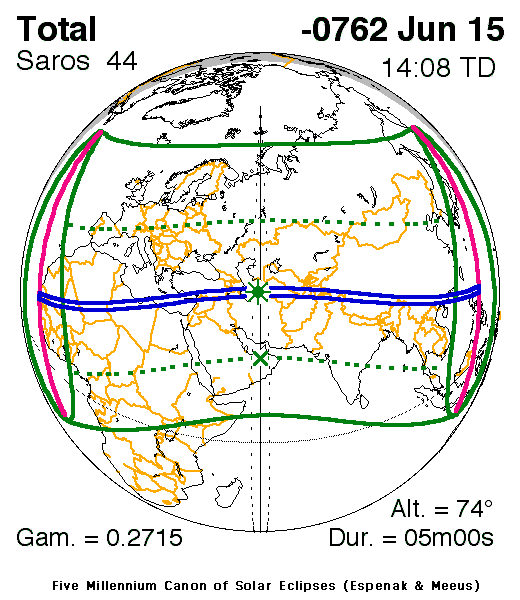
The NASA Five Millennium Canon of Solar Eclipses lists the event as catalogue number 02937, Julian date −762 June 15 (that is, 763 BC), type T for total, Saros 44, magnitude 1.0596 (NASA's magnitude for a central eclipse is the Moon/Sun diameter ratio; the local magnitudes in the table below are the fraction of the Sun's diameter covered, which is 1.030 on the centre line), greatest eclipse at 38.9°N 54.3°E with the Sun 74° high, path width 204 km, central duration five minutes, at 08:14 UT.38 The map shows the band of totality entering over the Atlantic, crossing the western Mediterranean, Anatolia and northern Mesopotamia at roughly 36 to 40°N, with greatest eclipse just east of the Caspian Sea in present-day Turkmenistan.38 Over Assyria the maximum fell at about 07:48 UT, roughly 10:40 in the morning local time, which matches Rawlinson's "commenced before noon".4
Two independent checks say the count from that pivot is right, and Ungnad stated both in 1938. First, Eduard Schrader had shown in 1872 that the rival eclipse of 13 June 809 BC "kommt nicht in Frage" (is out of the question). Second, "Es läßt sich indes noch ein zweiter Beweis liefern mit Hilfe des Ptolemäischen Kanons der babylonischen Herrscher, dessen Richtigkeit durch die im Almagest des Ptolemäus erwähnten Mondfinsternisse erwiesen wird" (a second proof can be given from Ptolemy's canon of the Babylonian rulers, whose correctness is established by the lunar eclipses mentioned in Ptolemy's Almagest), naming the three eclipses of 19 March 721 (his entry prints "19. April", a slip: Thoth 29/30 of Nabonassar 27 is 19/20 March), 8 March 720 and 1 September 720 in the first and second years of Mardokempados.3 His worked example is a tablet dated to Sargon's sixteenth year as king of Assyria and fourth as king of Babylon, which the king lists put in 706/5: "Der Eponym von 706 (berechnet nach der Sonnenfinsternis von 763) ist Mutakkil-Aššur. Beide Überlieferungen stimmen also überein!" (The eponym of 706, reckoned from the solar eclipse of 763, is Mutakkil-Aššur. So the two traditions agree!)3 That is the whole argument in miniature. Count the eponyms from the eclipse, count the Babylonian reigns from Ptolemy's eclipses, and the two counts meet on one tablet. Thiele's statement of the same point is the one apologists usually quote: "the date 763 for the eponymy of Bur-Sagale has been established not only by the astronomical evidence of Assyria but also by that of Ptolemy's canon, and we thus have complete assurance that 763 is the correct date for Bur-Sagale and that the other dates of the eponym lists, reckoned backwards or forwards from that date, are likewise correct."39 Kitchen says it in one sentence: "Full listings exist from 911 BC down to 648 BC, hence the one eclipse dates the whole series".40
What the tablet does not say
The tablet does not say the eclipse was total, and the Assyrian capitals probably did not see totality. The first computation ever made already showed this. Smith printed in 1875 the table that the Astronomer Royal, George Airy, had drawn up from John Russell Hind's elements, "ECLIPSE OF THE 15TH JUNE, B.C. 763.", with the northern limit, centre line and southern limit of totality at six instants.36 At the longitude of Nineveh Hind's southern limit lay near 38°N, about two degrees north of the city.36 Ungnad in 1938 wrote "fast totalen", almost total.3 The NASA elements give the same picture. An in-house solution of the local circumstances from NASA's Besselian elements, validated first against NASA's own greatest-eclipse point (it returns a 299.8 second total eclipse at Sun altitude 74.0° where NASA prints 05m00s and 74.0°), gives these magnitudes at NASA's value of ΔT, 21,211 seconds:4
| place | latitude N | longitude E | magnitude | total? |
|---|---|---|---|---|
| Harran | 36.87 | 39.03 | 1.028 | yes, 284 s |
| Guzana (Tell Halaf), Bur-Sagale's own province | 36.83 | 40.03 | 1.020 | yes, 270 s |
| Nineveh | 36.36 | 43.15 | 0.986 | no, about 50 km outside the southern limit |
| Kalhu (Nimrud) | 36.10 | 43.33 | 0.976 | no |
| Arbela | 36.19 | 44.01 | 0.975 | no |
| Assur | 35.46 | 43.26 | 0.956 | no |
| Babylon | 32.54 | 44.42 | 0.856 | no |
ΔT is the difference between uniform time and the Earth's irregular rotation, and for 763 BC it is known only to within some hundreds of seconds. Uncertainty in ΔT slides the shadow track east or west. Nineveh is inside the band of totality only for ΔT between about 21,800 and 23,500 seconds, Assur only between about 22,750 and 24,250; Harran and Guzana are total for ΔT from about 20,500 to 22,200 (Harran 20,200 to 22,150, Guzana 20,450 to 22,400). The 2016 long-term fit of Stephenson, Morrison and Hohenkerk, ΔT = −320.0 + (32.5 ± 0.6)((year − 1825)/100)² seconds, gives 21,431 seconds for the year, at which Nineveh comes out at 0.991, Kalhu 0.982, Assur 0.962, and Guzana and Harran total.41 So on any value within a thousand seconds of the modern one, the Sun was eclipsed over all Assyria late in the morning of 15 June 763 BC to a magnitude above 0.93, and the band of totality crossed the north-western provinces. Whether the capital cities saw the corona cannot be decided from the record. It does not matter for the chronology. ΔT moves the shadow; it cannot move the date.
Stephenson is explicit about how much the text will bear. "Although the event described in the Assyrian chronicle is specifically described as an eclipse, the text makes no mention of its magnitude. However, as no other eclipse is mentioned in the entire chronicle, Fotheringham supposed that the eclipse was total in Assyria and this inference was accepted by later authors." And: "the text mentions only the mere occurrence of an eclipse; a large partial obscuration of the Sun would thus probably suffice. Furthermore, as Fotheringham emphasized, the precise place of observation in Assyria is unknown."2 Rodger Young, writing for Associates for Biblical Research, concedes the same under his reproduction of the NASA map: "If this NASA reconstruction is correct, the eclipse would have been observed as only partial in the city, but total just a few miles further north."42 His "few miles" understates the 50 km computed above, and his main text still says the eclipse "was a total eclipse as it passed near Nineveh". Any apologetic page that says "total over Nineveh" overstates. Rawlinson's "which was total" overstated too. The date does not depend on it.
What the eclipse does not do
The eclipse dates the canon. It does not calibrate astronomy, and an article that says the Assyrian record "confirms" modern eclipse computation has the direction of inference backward. Stephenson's verdict on the record as a datum for the Earth's rotation: "Although there can be no doubt about the historical reliability of the record, and the date of 763 B.C. seems secure, the brevity of the description and the uncertainty in the location both render the observation useless for deducing the value of ΔT."2 He also wrote that of all the archaic texts in his survey, "Only one of the various texts — the Assyrian report of a solar eclipse discussed in Section 4.1 — proves to be of chronological importance."2 Consistently, the 2016 rotation study begins its data set at 720 BC and states that "The earliest direct record of a total solar eclipse in the history of any civilization is described in a Chinese state chronicle: the Chunqiu (Spring and Autumn Annals) ... The date corresponds to 709 BC July 17".41 The chain is one-directional. Astronomy dates the canon; the canon does not confirm the astronomy.
The rivals: 809 BC and the forty-seven-year gap
The nineteenth century tried the obvious escape, and abandoned it within a generation. Jules Oppert held that the canon had a break of forty-seven years. Smith reproduced Oppert's system of 1868, which includes "809 13th of June, eclipse of the sun." and "792 First capture of Nineveh. Interruption of the eponymes during forty-seven years."36 In Smith's words, Oppert "holds the opinion that there is a break of forty-seven years in the eponym canon, between the eponym Nergal-nazir, B.C. 746, and the accession of Tiglath-Pileser, which he lowers to B.C. 744. He thus lowers all the later Assyrian dates one year, and raises the earlier ones forty-six years, identifying the eclipse in the eponymy of Esdu-sarabe, B.C. 763, with one which happened B.C. 809."36 Smith's answer has three parts. "1. The regular order of the titles of the eponymes is not interrupted in the place of the supposed gap; the governor of Arbaha, B.C. 745, succeeded to the governor of Nisibin, B.C. 746, as usual. 2. The officer Vulbeluzur was eponym B.C. 748 and 738; and if forty-seven years were inserted, he would have held office fifty-seven years at least, which is extremely unlikely. 3. There is an utter absence in the inscriptions of any contemporary account, or later notice, of this supposed period of forty-seven years."36 Rawlinson had already noted in 1867 that Hincks and Oppert demanded a hiatus of "about forty years" to save the received Bible dates, and that "no trace exists on the tablets of any such hiatus, but that on the contrary the several independent copies of the Canon confirm and verify each other".35 By 1938 Ungnad could list Oppert 1868, Haigh 1871, Bosanquet, Lepsius 1869 and Brandes 1874 under the heading "Weitere veraltete Arbeiten", further outdated works.3 Then came the decisive check, the Ptolemaic one above: a gap of forty-seven years in Assyria would put the eponym of 706 forty-seven names away from the Babylonian tablet of Sargon's sixteenth year. It does not.
No source opened for this article proposes 791 BC, and Stephenson's computation leaves only 765 February 10 and 763 June 15 as large eclipses over Assyria between 777 and 745. Young names only unnamed "investigators" who move the eclipse, and says why: it "is usually done to support alternative biblical chronologies that do not agree with the conventional interpretation of the Assyrian Eponym Canon".42 Whether any current young-earth writer argues 791 is taken up in the objections.
What the canon covers, and where it is thinnest
The canon is continuous from 910 or 911 to 649 or 648 BC. Ungnad: "Der große Eponymenkanon beginnt wahrscheinlich mit d. J. 911, dem 1. Jahre des Königs Adad-nirari II. Der Anfang ist lückenhaft, von 890 an ist die Reihenfolge jetzt gesichert bis 648." (The great eponym canon probably begins with the year 911, the first year of King Adad-nirari II. The beginning is gappy; from 890 the sequence is now secured down to 648.)3 Stephenson: the chronicle "covers the period from 910 to 646 B.C."2 Rawlinson in 1867, with the material then known, could count "146 years before the eclipse and for 97 years after", that is 909 to 666.35 The small differences at the ends are conventions about accession years and about the last fragmentary entries, not disagreements about the count.
Two honest qualifications belong here, and both come from the canon's first editor. Smith on the very reigns that contain the eclipse: "The total absence of contemporary dated documents during the reigns of Shalmaneser III. and Assur-daan III. is remarkable; the Assyrian canon is here the only proof of the reigns of these kings."36 (His Shalmaneser III and Assur-daan III are today's Shalmaneser IV, 782 to 773, and Aššur-dan III, 772 to 755.) And Smith on the upper canon: "the annals of Tiglath Pileser prove the accuracy of the canon up to B.C. 745, and the eclipse of B.C. 763, equally confirms the next stage, so that up to that date there is no doubt of the truth of the list. Above the date B.C. 763 there is no positive proof of any Assyrian canon date, but there is some evidence in the agreement of the successive names".36 The modern 910/911 rests on overlapping copies and on dated tablets found after Smith wrote, and Ungnad's "secured from 890" is the careful way to put it. The eponyms of 911 to 891, the reign of Adad-nirari II, are the least redundantly attested part of the canon. Nothing biblical hangs on them. The first Hebrew synchronism is 853, inside the stretch that Smith already called beyond doubt.
The revisionists who want to cut centuries out of Egyptian history have conceded the Assyrian count. Peter James and his co-authors wrote that it "is as watertight as one could ask for any period of ancient history. Assyrian history is firmly datable, with a margin of error no greater than a year, as far back as 911 bc".43 Nicholas Postgate, reviewing them, called the Assyrian King List "a major stumbling-block" for any deep cut, worked out that dropping Tiglath-pileser I by 250 years would put him at 865 to 827 BC, "patently absurd", and concluded that "the Assyrian evidence remains an insurmountable obstacle composed of precise data".44 Kenneth Kitchen's summary is that Assyria has a continuous king list from about 1400 to 608 BC, dated reign by reign from 911 by intact eponym lists anchored to the 763 eclipse, with the partly preserved pre-911 eponym lists that "correspond closely with the King-list".45
Before 910 BC: the king list and its ten-year soft spot
Before the canon, the Assyrian King List carries the count back. John Brinkman's 1977 synthesis of the list and its variants, printed as the appendix to Oppenheim's Ancient Mesopotamia, is what the handbooks copy, and it states its own margins: "As a general rule, the dates given are approximate; but probable maximum limits of variation may be set down. For dates before 1500 B.C., it is unlikely that they will ever be raised or lowered much more than 64 years. For dates from 1500 to 900 B.C., an eventual deviation of more than two decades need not be expected. After 900, an error of more than one or two years (in most cases) cannot be foreseen".32 His table gives Adad-nirari II 911 to 891, Shalmaneser III 858 to 824, Adad-nirari III 810 to 783, Aššur-dan III 772 to 755, Tiglath-pileser III 744 to 727, Shalmaneser V 726 to 722, Sargon II 721 to 705, Sennacherib 704 to 681, Esarhaddon 680 to 669 and Assurbanipal 668 to 627.32 Bur-Sagale's 763 falls inside Aššur-dan III.
The known soft spot is a single king. Brinkman's note 32 on Ninurta-apil-Ekur, 1191 to 1179, reads: "Variant: (3). If this variant is accepted, all dates from 1430-1191 as listed here should be lowered ten years." Note 31 adds a one-year variant for Aššur-nadin-apli, and both notes "would also require comparable adjustments in the chronology of the Kassite dynasty, which is calculated on the basis of Assyro-Babylonian royal synchronisms."32 One copy of the king list gives this king thirteen years and another three, so every date before about 1190 BC moves as a block by ten years. That is the whole basis of Kitchen's "not more than 10 years at most" for 1400 to 1150 BC.45
A second kind of evidence fixes centuries but not decades. Kings stated intervals. Tiglath-pileser I wrote that the temple of Anu and Adad, "which in former days Shamshi-Adad, viceroy of Assur, the son of Ishme-Dagan, viceroy of Assur, had built, and, during the course of six hundred and forty-one years had fallen into decay, and Assur-dan, king of Assyria, the son of Urta-apil-Ekur, king of Assyria, had pulled down that temple and had not rebuilt it: — for sixty years the foundation thereof had not been laid."46 Read forward from the king list, such statements are what made Postgate's 250-year cut "patently absurd". But Hermann Gasche and his co-authors, who wanted the lowest possible second-millennium dates, were right about their limits: "Our analysis of the Distanzangaben makes it apparent that no firm chronological conclusions can be drawn from them. The statements of Shalmaneser I can be interpreted to support either the High Chronology or a chronology that is even lower than the one that we would suggest; Tiglath-pileser I's statements yield dates that are in the range of the Middle Chronology; while those of Esarhaddon yield dates that support our contention that the Middle Chronology is too high."47 So the interval statements corroborate the king list's order of magnitude and cannot choose between schemes a few decades apart.
The eponym system itself is older than the canon. A Middle Assyrian fragment, KAV 21+22, runs back before 910, probably to Tukulti-Ninurta I, and where it is preserved its entries "coincide with the data of the King List".44 Ungnad opened his article by noting that the Old Assyrian merchant tablets from Kültepe in Anatolia already date by eponyms.3 After 649 the canon ends; Brinkman gives no regnal years for the last Assyrian kings before Sin-šar-iškun's "-612", and the ordering of the "post-canonical" eponyms is a matter of reconstruction. Nothing in this article needs them, because by then the Babylonian dated tablets and Ptolemy's canon carry the count.
One line per tier, then. To the year: 910/911 to 649/648 BC by the eponym canon. To within a year or two after 649, where Babylon takes over. To within about ten years back to about 1400 BC. Before 1500 BC, Brinkman's 64 years, which is the second-millennium problem.
The second millennium: a 150-year argument settled by tree rings
Nothing in the first-millennium chain depends on this subsection. It is here because a young-earth reader who distrusts "secular chronology" will notice, rightly, that for most of the twentieth century the experts disagreed about Hammurabi's dates by 150 years, and the honest reply needs the facts.
The king lists and the interval statements fix the order and rough length of the earlier second millennium, but the First Dynasty of Babylon floats. The one astronomical text is the Venus Tablet of Ammisaduqa, which records first and last visibilities of Venus through that king's reign. Venus phenomena repeat almost exactly after 56 or 64 years, so the tablet admits several solutions that far apart, and the rival schemes differ by those amounts. Brinkman: "If one would wish to adjust to the corresponding 'high chronology,' all dates for the first five dynasties in these tables would have to be raised by fifty-six years (e.g., Hammurapi, 1848~1806); for the 'low chronology,' the shift would be downward by sixty-four years (e.g., Hammurapi, 1728-1686)."32 Peter Huber's 1982 study of the Venus data and month lengths concluded that "The Middle and Short Chronologies (i.e. -1645, -1637, -1581) agree so poorly that they must be ruled out", that "the odds are about 15 to 1 in favor of -1701", and that "Hammurapi reigned from 1848 B.C. to 1806 B.C."48 Huber himself wrote of "the low trustworthiness of the Venus data".48 In 1998 Gasche, Armstrong, Cole and Gurzadyan went the other way, arguing from pottery across the dark age that "the similarities in form between the shapes belonging to the end of our early second-millennium sequence and those we date to the beginning of the fourteenth century do not allow for the intervention of so great a span of time", and putting the "Fall of Babylon (1499 BC, see Chapter 5)", 96 years below the Middle Chronology's 1595.47 By 2006 Jörg Klinger could write that the Venus observations "are no longer viewed as reliable" and that the Middle/Low debate "must now be abandoned, having become pointless."49
In 2016 Sturt Manning and six co-authors settled it by a different route. Timbers from two Anatolian palaces, the Waršama Palace at Kültepe and the Sarıkaya Palace at Acemhöyük, carry a tree-ring sequence that they wiggle-matched to radiocarbon; the Kültepe eponym list ties the timbers to the Old Assyrian calendar, and sealings of Šamši-Adad I in the Sarıkaya Palace tie them to a king whose death falls in Hammurabi's eighteenth year. Their abstract: the period "has long floated in calendar time subject to rival chronological schemes up to 150+ years apart", and "The revised tree-ring-sequenced 14C time-series for Kültepe and Acemhöyük is compatible only with the so-called Middle Chronology and not with the rival High, Low or New Chronologies."33 "Under the High Chronology Šamši-Adad I would be dead four decades before the Sarıkaya Palace was even constructed, which is incompatible with his numerous documentary links with the building".33 "Thus we may rule out the Low and New Chronologies as implausible. This leaves as plausible either the Middle Chronology or the slightly later Low-Middle Chronology."33 The Low-Middle variant is "8 years later".33
| scheme | Hammurabi year 1 | fall of Babylon | Ammisaduqa year 1 | who, and on what evidence |
|---|---|---|---|---|
| High (Long) | 1848 | 1651 | 1702 | Huber 1982: Venus and month lengths, "odds about 15 to 1" |
| Middle | 1792 | 1595 | 1646 | Brinkman 1977; Gasche 1998's foil; Manning 2016 |
| Low-Middle | 1784 | 1587 | 1638 | Manning 2016's "8-year lower" alternative; Huber's "-1637" |
| Low (Short) | 1728 | 1531 | 1582 | Brinkman's note 4; Huber's "-1581" |
| Ultra-Low | 1696 | 1499 | 1550 | Gasche et al. 1998: ceramics plus a re-solved Venus |
Figures for the High, Low and Ultra-Low columns other than those quoted are arithmetic from the stated offsets of 56, 64 and 96 years.32 The point for this article is the contrast, and Brinkman's own 1977 table already drew it: 64 years before 1500 BC, against "one or two years" after 900. The second-millennium spread never touched the first-millennium canon, because the canon does not rest on Venus. It rests on a continuous count of names, one solar eclipse, and its overlap with the Babylonian count.
A historical note the reader should have
The canon was not built to harmonise with the Bible. It was first used against it. Rawlinson's 1867 letter lists among the consequences of the eclipse "That the numbers in the Hebrew text of the Bible will have to be altered, so as to curtail the interval between Hezekiah and Ahab by about forty years", and adds: "No Christian scholar now-a-days maintains the literal inspiration of the Holy Text. The general sequence of names and events is the same in the Bible as we find it in the Assyrian annals".35 Smith, for his part, thought the eclipse "appears also to have been noticed in Palestine", through the darkening at noon in Amos 8:9, a link "which Mr. J. W. Bosanquet has happily connected" with the prophet;36 that is a suggestion, not a datum, and the article does not lean on it. The reconciliation of the Hebrew regnal numbers with the canon came eighty years after Rawlinson, with Thiele. A critic is entitled to say that the harmonisation was built to fit the canon, and the article answers that charge on the merits when it reaches Thiele. But the order of events is the reverse of what a young-earth reader is sometimes told: the Assyrian count came first, and for two generations it was the Bible's numbers that were said to need altering.
The inscriptions that tie Israel and Judah into the canon
Between 853 and 667 BC, Assyrian royal inscriptions name nine kings of Israel and Judah: Ahab, Jehu, Joash, Menahem, Pekah, Hoshea, Ahaz, Hezekiah and Manasseh. Each naming carries an Assyrian date, by regnal year, campaign or eponym, and each can be laid against the reign lengths and synchronisms of Kings. This section takes them in order, gives the line itself in the current edition, says what Assyrian year it sits in, and grades how tightly it pins the Hebrew king. One fact should be stated at the outset, because a skeptic will notice it: Kings never mentions Qarqar, Jehu's tribute, Joash's tribute, Ahaz's place in a tribute list or Manasseh's labour gang, and Assyria never mentions the angel of 2 Kings 19, the 185,000, or Manasseh's arrest. The two records name each other's kings; they almost never narrate the same event. Sennacherib's campaign of 701 and the surrender of Jerusalem in 597 are the exceptions.
Ahab at Qarqar, 853 BC
The Kurkh Monolith is a stone stele of Shalmaneser III found at Kurkh on the upper Tigris in 1861, now in the British Museum. Kirk Grayson's edition dates the carving: "The last event narrated in the text is the battle of Qarqar (853 BC), and thus the monument was probably carved either late in 853 or in 852 BC. It was engraved in haste, as some other Assyrian steles (e.g. RIMA 2 pp. 237-54), with the result that there are numerous scribal errors".5 The campaign opens "On the fourteenth day of the month Iyyar, in the eponymy of Daiian-Assur", Shalmaneser's sixth regnal year, and the eponym canon puts that year at 853.5 The coalition list reads: "An alliance had been formed of (lit. "he/it had taken as his allies") these twelve kings: 1,200 chariots, 1,200 cavalry, (and) 20,000 troops of Hadad-ezer (Adad-idri), the Damascene; 700 chariots, 700 cavalry, (and) 10,000 troops of Irhulenu, the Hamatite; 2,000 chariots (and) 10,000 troops of Ahab (Ahabbu) the Israelite (Sir'alaia)".5 The Akkadian writes the name a-ha-ab-bu and the people sir-'a-la-a-a. Luckenbill's older rendering is "2,000 chariots, 10,000 soldiers of Ahab, the Israelite".46
What this fixes: Ahab was reigning in 853. Kings never mentions the battle. The synchronism is one-sided, and it has two oddities a critic will raise. Ahab's 2,000 chariots are the largest chariot force in the list, larger than Damascus's 1,200, on a monument Grayson says was "engraved in haste" with "numerous scribal errors"; the figure may be a scribal error, and the suggestion that it should be 200 has been made, though the article did not open that discussion.5 And Ahab fights beside Hadad-ezer of Damascus here while 1 Kings 20 and 22 show him at war with "Ben-hadad"; the usual reading makes Adad-idri the throne name of that Ben-hadad and the treaty of 1 Kings 20:34 the alliance Qarqar presupposes. That is an inference, not a statement of either text. The Assyrian claim of victory is also propaganda: Shalmaneser fought the same coalition again in 849, 848 and 845. None of this touches the date.
Jehu's tribute, 841 BC
Five texts of Shalmaneser III record tribute from Jehu. Four are annalistic and date it to the eighteenth regnal year; the fifth is the epigraph on the Black Obelisk, undated in itself. Grayson ties them together: "This epigraph on the Black Obelisk (see A.0.102.87) concerns the receipt of tribute from Jehu, king of Israel ("house of Omri"), in 841 BC (eighteenth regnal year), as recorded in the annals: A.0.102.8 lines 26''-27'', A.0.102.10 iv 10-12, and A.0.102.12 lines 29-30."5 The epigraph: "I received tribute from Jehu (Iaua) of the house of Omri (Humri): silver, gold, a gold bowl, a gold tureen, gold vessels, gold pails, tin, the staffs of the king's hand, (and) spears." The Akkadian is ma-da-tu šá m ia-ú-a DUMU m hu-um-ri-i, literally "tribute of Jehu son of Omri".5 The Calah bull inscription puts it in its year: "In my eighteenth regnal year I crossed the Euphrates for the sixteenth time. Hazael of Damascus, trusting in the might of his soldiers, (5'') carried out an extensive muster of his troops. ... I marched to Mount Ba'alira'asi, which is a cape (jutting out into) the sea, (and) erected my royal statue there. At that time I received (25'') tribute from the people of Tyre (and) Sidon (and) from Jehu (Iaua) of the house of Omri (Humri)."5 The Assur stone tablet and the Kurba'il statue repeat the year and the name, and a broken Calah statue preserves the end of it.5 The obelisk itself narrates every regnal year "down to and including his thirty-first year (828 BC)" and "was, then, composed late in 828 BC, or more probably in 827 BC";5 so the tribute's date rests on the annals, not on the obelisk, and an apologist who cites the obelisk alone has cited the one text of the five that carries no year. Luckenbill's renderings are "Tribute of Iaua (Jehu), son of Omri (mar Humri)" and, for the annals fragment, the eighteenth year.46
Kings says nothing of any tribute. 2 Kings 9 and 10 have Jehu, a commander under Joram, kill Joram and Ahaziah of Judah and reign twenty-eight years; Hazael of Damascus is named in both records. An Assyrian campaign against Hazael and a payment from a brand-new usurper seeking protection fit each other, but that too is a reading.
Two disputes belong here, and both should be stated rather than hidden. First, "son of Omri". Jehu destroyed Omri's dynasty, yet the scribe calls him DUMU Humri. Mordechai Cogan: "Jehu was certainly not a "son of Omri" (Iaua mar Humri) as recorded in Assyrian inscriptions. This ascription was not due to any lack of knowledge concerning events in Israel; Jehu's having seized the throne was certainly known beyond Israel's borders. It was Assyrian scribal practice to refer to certain kingdoms by the names of their founders. Thus Arpad is "the house of Agusi"; Damascus is "the house of Hazael"; and Israel is "the house of Omri." This turn of phrase first appears with reference to Jehu and remained in use into the eighth century, even after the last of Jehu's descendants was gone."9 Grayson's "of the house of Omri" renders the idiom, and Tadmor's note on the Calah slab says the same: mār Ḫumrî is "'King of Bit-Humri' (not 'Son of Omri' as in ARAB, ANET, DOTT)", like mār Agūsi and mār Adīni for the kings of Arpad and Bit-Adini.50 A page that prints "Jehu, son of Omri" without that explanation invites the charge that Assyria contradicts 2 Kings 9.
Second, whether the man is Jehu at all. In 1974 Kyle McCarter argued that ia-ú-a "is at best an ambiguous reference to Jehu and can refer to Jehoram equally well", since "The ninth-century forms of the names Jehu and Jehoram were Yaw-hu' and Yaw-ram", and he listed the difficulties: the cuneiform spelling "is less than straightforward" for Jehu, the title "son of 'Omri" is "quite surprising" for him, and if Ahab was at Qarqar in 853 and Jehu paid tribute in 841 "the Deuteronomistic chronology becomes very confined", since it requires "that Ahab died the same year that he sent troops to the battle of Qarqar, and that Jehu's purge took place the same year he paid tribute to Shalmaneser III."51 Thiele's reply is the one that matters for this article, because it makes the date independent of the identity: "whether the "Yaw" under consideration is Jehu or whether he is Jehoram, the date 841 B.C., so long held as "a cornerstone of Biblical chronology," has not been affected by the arguments presented. The tribute received by Shalmaneser III from "Yaw" of the land of Omri came to him in his 18th year, and according to Assyrian chronology that was 841 B.C. According to Biblical chronology, as will be shown, both Jehoram and Jehu were rulers in Israel in 841, so either of these kings could have been the Hebrew ruler mentioned by Shalmaneser."52 Manfred Weippert answered McCarter on the philology and called the 841 tribute "einer der Grundpfeiler der israelitischen Chronologie", one of the foundation pillars of Israelite chronology, noting that it "wird an drei Belegstellen in das 18. Regierungsjahr Salmanassars datiert" (is dated in three attestations to Shalmaneser's eighteenth regnal year).53 Baruch Halpern in 1987 accepted that the replies had been "convincingly defending the more traditional view" while allowing that "philological problems remain, both with the Assyrian transcriptions and with the Hebrew name, Jehu."54 The field kept Jehu; Halpern's verdict was that "No one other than Jehu could be meant." The honest summary is that the philology is thinner than a confident apologetic page suggests, and that the year does not depend on it.
The twelve years between, and what they show about counting
This is the point where the Bible's year-counting first meets Assyria's, and it deserves a paragraph before the later kings. Ahab alive in 853; Jehu (or Joram's last months) in 841; twelve years apart. Kings gives Ahab's successors Ahaziah two years and Joram twelve (1 Kings 22:51; 2 Kings 3:1). Fourteen does not fit in twelve. It fits only if the northern kingdom counted the year in which a king died as both his last year and his successor's first, so that each reign of N "years" covers N minus 1 actual years: Ahaziah's two are one, Joram's twelve are eleven, and the total is twelve. That counting convention, called the non-accession-year system, is not an apologetic invention; it is how the Assyrian and biblical figures are made to meet, and Thiele's whole reconstruction, treated below, begins from this pair of dates. McCarter's "very confined" is exactly right, and exactly what the data demand: Ahab died in 853 and Jehu took the throne in 841. The inscriptions do not say Qarqar was Ahab's last year; that is an inference from the fit.
Adad-nirari III and Joash, about 805 to 796
A stele found at Tell al-Rimah near the Jebel Sinjar reads, in Grayson's edition: "I mustered my chariotry, troops, (and) armed forces (and) ordered the march to the land Hatti. In one year I subdued the entire lands Amurru (and) Hatti. I imposed upon them tax (and) tribute forever. I (text "he") received 2,000 talents of silver, 1,000 talents of copper, 2,000 talents of iron, 3,000 linen garments with multi-coloured trim - the tribute of Mari', the Damascene. I (text "he") received the tribute of Joash (Iu'asu), the Samaritan, (and) of the people of Tyre (and) Sidon."5 It is the earliest Assyrian text to name the kingdom by its capital, Samerinaia, rather than as Bit-Humri; a Calah slab of the same king lists "Tyre, Sidon, Samaria (Humri), Edom, (and) Palastu" without naming Joash.5 Grayson's caution is the point: "the author describes military activity in the west, which he says took place "in one year." The phrase is a literary convention, not a chronological statement, for the description summarizes various western campaigns and highlights receipt of tribute from Damascus and Samaria." The stele "must date no earlier than 797 BC".5 Stephanie Page, who published it, reached Joash by the phonetics against the chronology that would have given Jehoahaz, and wrote that "a third expedition to Syria-Palestine must be added to those of 806 and 802, which took place either during or after 798 B.C."; Tadmor dated the composition "to some time after 797" from the grant of Hindanu to Nergal-eres in 797, and called the stele's "single year" "a literary, non-chronological convention".50 The eponym chronicle's western campaigns of Adad-nirari III fall between 805 and 796, and the Damascus submission is usually put in 796, but the text itself gives a window, not a year. Joash of Israel, whom Thiele puts at 798 to 782, was on the throne somewhere in 805 to 796. That is consistent with Thiele's dates and too loose to test them.
Tiglath-pileser III: Menahem, Pekah, Hoshea, Ahaz, and "Pul"
Here the record thickens and so do the problems. The edition is Hayim Tadmor and Shigeo Yamada's RINAP 1 (2011), whose chronological table puts the great western tribute in 738: "738: Year 7 (8th palû) | The city Kullani was conquered. | ... | Ungi and Hatarikka annexed; tribute received from all vassal kings of the West, including Rahianu (Rezin) of Damascus and Menahem of Samaria." For 733 and 732 the table has "Against the land Damascus", with "Siege of Damascus. Campaigns against the Arabs and to Gilead and Galilee" and then "Conquest and annexation of Damascus, Galilee, and Transjordan."6
Menahem. The Kalhu Annals for the eighth palû list "The payment of Kuštašpi of the city Kummuhu, Rahianu (Rezin) of the land Damascus, Menahem of the city Samaria, [Hiram of the city] Tyre, Sibitti-bi'il of the city Byblos, Urikki of the land Que, Pisiris of the city Carchemish, Eni-il of [the city Hama]th, ..."; the name is written me-ni-hi-im-me URU.sa-me-ri-na-a-a.6 The Iran Stele, composed in 737, carries a second list with "Menahem of the land Samaria" in it.6 Kings: "Pul king of Assyria invaded the land, and Menahem paid him 1,000 talents of silver to gain his support and to solidify his control of the kingdom" (2 Kings 15:19). The equation Pul = Tiglath-pileser is not a guess. Babylonian King List A, as RINAP 1 prints it, has "iv 8) 2 (years) Pūlu (Tiglath-pileser III) iv 9) 5 (years) Ulūlāyu (Shalmaneser V), Dynasty of Baltil (Aššur)", and the editors note that "The SDAS ... copy of the Assyrian King List, Babylonian King List A, and the Ptolemaic Canon record that Tiglath-pileser III (Pūlu) and Shalmaneser V (Ulūlāyu) were kings of Assyria and Babylonia."6 Pūlu was his name as king of Babylon for two years, 729 to 727, and Ptolemy's canon has the same two kings as Poros and Ilulaios.
Now the problem. Thiele dated Menahem 752 to 742/741. The Assyrian list that names him is dated 738, or 740 if Cogan's heading for the Iran Stele list is right; either way it is after Thiele's Menahem is dead. Thiele's escape was to read 2 Kings 15:19 as a one-off bribe paid in 743, during Tiglath-pileser's Arpad years, and to treat the 738 list as something else; Kitchen splits the difference: "Tiglath-pileser III (alias Pul) first appears in the reign of Menahem, who paid him a massive tribute, 1000 talents of silver ... This payment may have been made circa 740 or earlier; his tribute in 738 may have been the regular kind. As Tadmor has pointed out, 1000 talents of silver was the going rate of payment that "TP" commonly exacted from usurpers and local kings on wobbly thrones."25 The RINAP editors treat the 738 list as the occasion. This is a real collision between the standard Assyrian dating and the most-used evangelical reconstruction, and it is taken up again under Thiele's critics. What the Assyrian text establishes is only that Menahem was alive and king in 738 (or 740); it does not date his accession or his death. It should be added that the Annals tribute list is known only through nineteenth-century copies of a slab now lost or damaged, and that lines 10 to 12 are restored with the help of two other texts.6
Pekah and Hoshea. Summary Inscription 4, a pavement slab from Kalhu "discovered in the mid-nineteenth century at Kalhu, but left in situ", reads: "(As for) the land Bīt-Humria (Israel), I brought [to] Assyria [..., its "au]xiliary [army" ...] (and) all of its people, [...]. [I/they] killed Peqah, their king, and I placed Hoshea [as king o]ver them. I received from them ten talents of gold, ... talents of silver, [together with] their [proper]ty, and [I brou]ght them [to Assyria]."6 The editors' note on the verb is worth having: the traces allow "[They] killed" or "I killed", and Na'aman's proposal to read "he died" "the traces on Smith's draft do not support". Their note on the silver shows what a nineteenth-century copy is worth: "G. Smith's copy of frgm. d has 2 LIM ("2,000"), while his draft has 2 ME ("200") and his copy in 3 R has 1 LIM ("1,000")".6 Summary Inscription 13 has "(now) [they overthrew Peqa]h, their king,";6 Summary Inscription 9, a clay tablet from the Nabû temple, has "[... (and) I placed Hoshea as] king over them. [They brought ... to the city] Sarrabānu, before me", and since Sarrabānu is the Babylonian city Tiglath-pileser besieged in 731, the editors date Hoshea's installation and first payment to 731.6 The Galilee campaign of 2 Kings 15:29 survives in one damaged annals fragment, and the editors mark even its "Bīt-Humria" as doubtful.6
Kings: "Hoshea son of Elah conspired against Pekah son of Remaliah. He assassinated him and took his place as king" (2 Kings 15:30). "I placed Hoshea as king" and "Hoshea ... took his place as king" are compatible: a coup that Assyria accepted and taxed. The Assyrian side fixes Pekah's death and Hoshea's accession to 732/731. It does not date Pekah's accession, so the "twenty years" of 2 Kings 15:27 and the rival-reign hypothesis that Thiele built to hold them are his problem, not a datum here.
Ahaz. Summary Inscription 7, a clay tablet "Composed in or shortly after Tiglath-pileser's 17th palû (729)", ends with a list of western tributaries that includes "Mitinti of the land Ashkelon, Jehoahaz of the land Judah, Qaus-malaka of the land Edom".6 The editors' note: "This is a list of all of the newly subjugated western vassals and their tribute. It includes rulers who submitted in 738 (lines 7'-9' ...) and rulers who submitted in 734 (lines 10'-12')", and Jehoahaz stands among the 734 group. The Assyrian text gives the king's full name, Jehoahaz; Kings uses the short form Ahaz. 2 Kings 16:7-9 has Ahaz send to Tiglath-pileser, "I am your servant and your dependent", with the temple silver, and the Assyrian king "attacked Damascus and captured it. He deported the people to Kir and executed Rezin", which RINAP's table places in 732. So Ahaz was king of Judah and an Assyrian tributary by 734, and Damascus fell in 732. That fits Thiele's Ahaz without fixing his accession.
The fall of Samaria, 722 or 720
Three witnesses, and they do not tell one story. Babylonian Chronicle 1, in Grayson's edition, says of Shalmaneser V's accession: "He ravaged Samaria", with a note: "uruŠá-ma/ba-ra-'-in: The long debated problem of whether or not this is Samaria has been recently discussed by Tadmor, JCS 12 (1958), pp. 39f., who came to the conclusion that it is Samaria."55 The surrounding lines: "On the twenty-fifth of the month Tebêtu, Šalmaneser in Assyria and Akkad ascended the throne. He ravaged Samaria. The fifth year [722/721]: Šalmaneser went to his destiny in the month Tebêtu. For five years Šalmaneser ruled Akkad and Assyria. On the twelfth day of the month Tebêtu, Sargon ascended the throne in Assyria."56 Even that one line is a reading: Peter Dubovský's study opens by saying that "the handwriting of the scribe is unclear and therefore the third sign can be read either ma or ba; second, the spelling of Samaria in this tablet is different from the spelling commonly used for Samaria in the rest of cuneiform sources", and the identification rests on Tadmor's argument that Šamara'in "could be in fact considered as a good Neo-Babylonian rendering of the Aramaic form of Samaria", the Šmryn of Ezra 4:10 and the Elephantine papyri.57 The note stands in the accession paragraph, not under a year. RINAP 1's editors on Shalmaneser V: the chronicle "records that he conquered or devastated Samaria; the Bible (2 Kings 17:3-6 and 18:9-11) and Josephus (Jewish Antiquities IX 15) also credit Shalmaneser with the conquest of Samaria, which probably took place near the end of his reign. The Eponym Chronicle, which is very fragmentarily preserved for Shalmaneser's reign, appears to record campaigns conducted in his second, third, and fourth regnal years (725, 724, and 723), but the names of his military targets are unfortunately broken away".6
Sargon II claims the city for himself. His Display Inscription at Khorsabad: "I besieged and conquered Samaria (Sa-me-ri-na), led away as booty 27,290 inhabitants of it. I formed from among them a contingent of 50 chariots and made remaining (inhabitants) assume their (social) positions. I installed over them an officer of mine and imposed upon them the tribute of the former king." His Annals put it "At the beginning of my royal rule", with the figure "[27,290" restored.7 The Nimrud Prism gives a different count: "27,280 people, together with [their] char[iots] and the gods in whom they trust, I counted [as] spoil. 200 chariots I organized as a royal contingent from among them and the rest of them I settled in Assyria."9 So 27,290 against 27,280, 50 chariots against 200. Cogan's note on the Khorsabad figure adds that it "is too large for the population of the city Samaria alone and probably included persons from the entire district of Samaria", and that one should not read 2 Kings 17:5-6 "as if a total depopulation of Israel had been undertaken".9
Kings: "King Shalmaneser of Assyria marched up to attack him; so Hoshea became his subject and paid him tribute" (2 Kings 17:3); then "the king of Assyria" besieged Samaria three years, and "In the ninth year of Hoshea's reign, the king of Assyria captured Samaria and deported the people of Israel to Assyria" (17:6). 2 Kings 18:9-10 synchronises the siege with Hezekiah's fourth year and the capture with his sixth, "in the ninth year of King Hoshea's reign over Israel". Kings never names Sargon; Isaiah 20:1 does, for Ashdod.
Who took the city is unresolved. Tadmor in 1958 concluded that "Samaria fell sometime in the late summer or in the early autumn 722 after a siege which lasted approximately two years", to Shalmaneser V, with Hoshea already deported "before the siege had started, i.e. in 724/3", and that "Only sometime late in 720 Sargon returned to Samaria, to deport its people and to rebuild it as the center of a new province Samerina. All the references to the conquest of Samaria in Sargon's inscriptions thus refer to the events of 720"; M. Christine Tetley's 2002 survey lists the positions as Shalmaneser alone, Sargon alone in 720 (Nadav Na'aman), a siege begun by one and finished by the other, and the "widely held" two-conquest view.58 Na'aman's own framing: "Only one Assyrian king is called by name in this passage (v. 3). It is, however, clear that the reference is to two different kings, Shalmaneser V and Sargon II. ... In his inscriptions Sargon II several times repeats that he conquered Samaria at the beginning of his reign. For many years scholars interpreted 2 Kgs 17,6 in the light of Sargon's claim in his inscriptions."59 Tadmor's opening observation explains why Sargon's own years are slippery: "The difficulty in dating these campaigns lies mainly in the fact that their order in the Annals of Khorsabad is inconsistent with that in the fragmentary Prisms of Nineveh. The Prisms date the campaigns of Sargon by one palû earlier than the Annals."60 A skeptic will say that Kings telescopes two kings into one "king of Assyria". On every modern reading that is true. It does not affect the year count.
What is fixed, and what the fix rests on: Shalmaneser V reigned five years, 727/726 to 722, by Chronicle 1 and Babylonian King List A; Sargon's accession is Tebet 722; Sargon's western campaign is 720. Hoshea's accession in 732/731 plus his nine years (2 Kings 17:1) gives 723/722 for his ninth year; Hezekiah's sixth year, on Thiele's numbers, is the same year; Shalmaneser died in Tebet 722. That three-way fit, Tiglath-pileser's installation of Hoshea, 2 Kings 17 and 18, and Chronicle 1, is the real synchronism. It holds whichever king's soldiers walked through the gate.
Sennacherib and Hezekiah, 701 BC
This is the best-documented meeting of the two records and the only one in which both describe the same event at length. Sennacherib's annals count campaigns, not regnal years; the campaign against Judah is the third. Luckenbill describes the editions: "The final edition of Sennacherib's annals forms the text of the famous Taylor Prism of the British Museum ... In 1920 the Oriental Institute of the University of Chicago acquired an even more perfect copy of this text ... The Taylor Prism is dated in the eponymy of Bel-emuranni, 691 B.C.; the Oriental Institute prism, in the eponymy of Gahilu, 689 B.C." And: "The annals as they appeared after the third campaign are found on the Rassam Cylinder of the British Museum ... It is dated in the eponymy of Mutunu (700 B.C.). This text, with the exception of the closing paragraph, became the standard for campaigns 1-3 of all the later editions of the annals."1 So the third campaign precedes 700. Sennacherib's accession is 705, the first campaign against Merodach-baladan is 703 by the Babylonian Chronicle, the second is in the Zagros in 702, and the third is 701. Kitchen: "The death in battle of Sargon II (705) and the need for Sennacherib to get control of his inheritance led to disquiet and revolt in his wide empire. He had first to secure the position in Babylonia (whence in 703 Merodach-Baladan II raised intrigue, perhaps then also with Hezekiah; cf. 2 Kings 20:12-19 and Isa. 39:1-8; 2 Chron. 32:31). Only thereafter in 701 could Sennacherib move westward."25
The text, in Oppenheim's translation: "As to Hezekiah, the Jew, he did not submit to my yoke, I laid siege to 46 of his strong cities, walled forts and to the countless small villages in their vicinity, and conquered (them) by means of well-stamped (earth-)ramps, and battering-rams brought (thus) near (to the walls) (combined with) the attack by foot soldiers, (using) mines, breeches as well as sapper work. I drove out (of them) 200,150 people, young and old, male and female, horses, mules, donkeys, camels, big and small cattle beyond counting, and considered (them) booty. Himself I made a prisoner in Jerusalem, his royal residence, like a bird in a cage. ... Hezekiah himself, whom the terror-inspiring splendor of my lordship had overwhelmed and whose irregular and elite troops which he had brought into Jerusalem, his royal residence, in order to strengthen (it), had deserted him, did send me, later, to Nineveh, my lordly city, together with 30 talents of gold, 800 talents of silver, precious stones, antimony, large cuts of red stone, couches (inlaid) with ivory, nimedu-chairs (inlaid) with ivory, elephant-hides, ebony-wood, boxwood (and) all kinds of valuable treasures, his (own) daughters, concubines, male and female musicians."7 Luckenbill's older rendering has the same figures, "30 talents of gold and 800 talents of silver", and "like a caged bird".1
Kings: "In the fourteenth year of King Hezekiah's reign, King Sennacherib of Assyria marched up against all the fortified cities of Judah and captured them" (2 Kings 18:13), and Hezekiah, to the king at Lachish, "I have violated our treaty. If you leave, I will do whatever you demand. So the king of Assyria demanded that King Hezekiah of Judah pay 300 talents of silver and 30 talents of gold" (18:14). Both records name Hezekiah, Jerusalem and Lachish (the last on Sennacherib's reliefs rather than the prism), both give 30 talents of gold, and neither says Jerusalem was taken.
Three disputes, stated plainly. The silver does not agree: 800 talents in Assyria, 300 in Kings. Proposed reconciliations, a different talent, objects counted in one total and not the other, Assyrian inflation, Hebrew textual loss, are conjectures; the texts differ. The "fourteenth year" does not agree with the book's own synchronisms: 2 Kings 18:1 and 9-10 put Hezekiah's accession in Hoshea's third year and Samaria's fall in Hezekiah's sixth, which makes his fourteenth year about 714/713, not 701. Thiele admitted he could not make 18:13 fit and laid the figure to a late editor; others make Hezekiah co-regent from 729 with sole rule from 715 so that the "fourteenth year" counts from 715; others move the "fourteenth year" to Hezekiah's illness and Merodach-baladan's embassy, since the fifteen years added to his life (20:6) run from 701 to his death in 687/686. The Assyrian texts cannot arbitrate: they date the campaign, not Hezekiah's years. This is treated again under Thiele. And one campaign or two: because 2 Kings 19:9 names Tirhakah, who became king of Egypt only in 690, some have posited a second campaign about 688; Kitchen rejects this on the ground that Taharqa could lead an army as a prince in 701, and the Egyptian sources fit one campaign.25 The 200,150 deportees are widely thought inflated or mis-copied, and the prism's silence about any disaster to the army is what one expects of royal annals either way. None of these moves the year. The campaign itself, and why Jerusalem was not taken, is the subject of Why Did Sennacherib Fail to Take Jerusalem?.
Manasseh under Esarhaddon and Ashurbanipal
Two lists. Esarhaddon's Nineveh prism, on the building of his arsenal: "I called up the kings of the country Hatti and (of the region) on the other side of the river (Euphrates) (to wit): Ba'lu, king of Tyre, Manasseh (Me-na-si-i), king of Judah (Ia-ú-di), Qaushgabri, king of Edom, Musuri, king of Moab, Sil-Bel, king of Gaza, Metinti, king of Ashkelon, Ikausu, king of Ekron, Milkiashapa, king of Byblos, Matanba'al, king of Arvad, Abiba'al, king of Samsimuruna, Puduil, king of Beth-Ammon, Ahimilki, king of Ashdod - 12 kings from the seacoast;" then ten kings of Cyprus, "together 22 kings of Hatti, the seashore and the islands".7 Ashurbanipal's Cylinder C, for his first Egyptian campaign: "Ba'al, king of Tyre, Manasseh (Mi-in-si-e), king of Judah (Ia-ú-di), Qaushgabri, king of Edom, Musuri, king of Moab, Sil-Bel, king of Gaza, Mitinti, king of Ashkelon, Ikausu, king of Ekron, Milkiashapa, king of Byblos, Iakinlu, king of Arvad ..."7 Luckenbill's renderings are "Manasseh, king of Judah" and "Minsê (Manasseh), king of Iaudi (Judah)", and his footnote records that duplicates of the Ashurbanipal prism are "dated in the month of Abu, the sixth day, limmu of Nabu-shar-ahe-shu, governor of Samaria (Samirina)": a post-canonical eponym, and the governor of the Assyrian province that had been the kingdom of Israel.1 The dates of the two events, the 670s and 667, are the standard ones and were not re-checked in the current editions for this article. What they fix is that Manasseh was king of Judah both under Esarhaddon (681 to 669) and at the start of Ashurbanipal's reign. Thiele's Manasseh, co-regent from 697/696 and dead in 643/642, sits comfortably inside that, but the lists give neither his accession nor his death. 2 Chronicles 33:11-13's arrest of Manasseh and his removal "to Babylon" has no Assyrian record at all.
Merodach-baladan: a constraint, not a date
2 Kings 20:12 has "Merodach Baladan son of Baladan, king of Babylon" send letters and a gift to Hezekiah on hearing of his illness. Marduk-apla-iddina II of Bīt-Yakīn ruled Babylon twice. Babylonian King List A gives him "12 (years) ... Dynasty of the Sealand";6 Chronicle 1 has him take the throne in Nisan 721, lose it in his twelfth year, 710/709, when "Sargon went down to Akkad and did battle against Marduk-apla-iddina. Marduk-apla-iddina retreated before him and fled to Elam. For twelve years Marduk-apla-iddina ruled Babylon", and return for nine months in 703 until Sennacherib's first campaign, "Before Kiš, he joined battle with Marduk-apla-iddina. Before him, Marduk-apla-iddina retreated and fled to Guzummanu."56 Sennacherib's own words: "In my first campaign I accomplished the defeat of Merodach-baladan, king of Babylonia, together with the army of Elam, his ally, in the plain of Kish. In the midst of that battle he forsook his camp and made his escape alone; (so) he saved his life."1 Kitchen: "Merodach-Baladan II (721-710, 703) was an opportunist king in Babylon, well known from Assyrian records and in other documents, besides being mentioned with Hezekiah in 2 Kings 20:12ff."25 So the embassy fell in 721 to 710 or in 703. If Hezekiah died in 687/686, the illness was about 702/701 and the embassy 703, just before Sennacherib's western campaign, which makes the order of 2 Kings 18 to 20 non-chronological; if instead the "fourteenth year" belongs to the illness and sole rule began in 715, the embassy falls in 712/711, inside the first reign. Neither Assyria nor Babylon mentions the embassy. The synchronism narrows; it does not date.
The Babylonian side: chronicles, dated tablets, and the exile
Carchemish in 605 and the surrender of Jerusalem on 2 Adar 597
One tablet of the Babylonian Chronicle series, BM 21946, covers the twenty-first year of Nabopolassar through the eleventh of Nebuchadnezzar. Donald Wiseman published it in 1956. Its first lines: "In the twenty-first year the king of Akkad stayed in his own land, Nebuchadrezzar his eldest son, the crown-prince, mustered (the Babylonian army) and took command of his troops; he marched to Carchemish which is on the bank of the Euphrates, and crossed the river (to go) against the Egyptian army which lay in Carchemish ... He accomplished their defeat and to non-existence [beat?] them. ... At that time Nebuchadrezzar conquered the whole area of the Hatti-country. For twenty-one years Nabopolassar had been king of Babylon. On the 8th of the month of Ab he died (lit. 'the fates'); in the month of Elul Nebuchadrezzar returned to Babylon and on the first day of the month of Elul he sat on the royal throne in Babylon."13 Wiseman: "The year in which the battle of Carchemish took place is certain (605 B.C.) though no date is expressly given in the text. ... it is most likely that the operations at Carchemish took place about May-June of 605 B.C."13 That is the base for Jeremiah 46:2's Carchemish "in the fourth year of Jehoiakim", for Jeremiah 25:1's equation of that year with "the first year of Nebuchadnezzar", and for Daniel 1:1's "third year of the reign of King Jehoiakim", which When was Daniel written discusses.
The reverse of the same tablet carries the one cuneiform line that day-dates a biblical event: "In the seventh year, the month of Kislev, the king of Akkad mustered his troops, marched to the Hatti-land, and encamped against (i.e. besieged) the city of Judah and on the second day of the month of Adar he seized the city and captured the king. He appointed there a king of his own choice (lit. heart), received its heavy tribute and sent (them) to Babylon."13 Wiseman: "The date of this conquest of Jerusalem is now known precisely for the first time, namely, the second of Adar (15/16th March 597 B.C.). The siege cannot have lasted more than two months ... Since Jehoiakim's death took place three months and ten days before the city's fall, that is, on the twenty-second of Marcheswan (6/7th December 598 B.C.) he must have died and have been succeeded by Jehoiachin before the main forces had left Babylonia."13 The king "of his own choice" is Zedekiah (2 Kings 24:17); the chronicle names neither king. Kings dates the surrender to Nebuchadnezzar's "eighth year" (2 Kings 24:12); Jeremiah 52:28 and the chronicle say the seventh. That is a one-year difference in counting, whether Kings counts Nebuchadnezzar's years from 605 without an accession year or uses a Tishri year, and it should be stated, not hidden.
The chronicle then stops. Wiseman: "The catchline which ends the text of B.M. 21946 gives us but a brief glimpse of Nebuchadrezzar's activity at the beginning of his eleventh year (594/3 B.C.) ... We can but hope that some fortunate discovery will one day reveal the tablets listing the events of the whole of this year as well as of the remaining thirty-three years of Nebuchadrezzar. Other Chronicle tablets must certainly have filled the gap which now extends to the third year of Neriglissar (557/6 B.C.)."13 So the destruction of Jerusalem in Nebuchadnezzar's eighteenth or nineteenth year is in no surviving chronicle. Anyone who says "the Babylonian Chronicle records the fall of Jerusalem in 586" is wrong. It records 597. The date of the temple's burning comes from Kings' regnal number laid on the Babylonian king sequence, and that sequence is the subject of the next two subsections.
How Babylon counted, and the dated tablets
Richard Parker and Waldo Dubberstein's Babylonian Chronology (1942) is the handbook every date in this section runs through. The calendar: "In the period covered by this study the Babylonian calendar year was composed of lunar months, which began when the thin crescent of the new moon was first visible in the sky at sunset. Since the lunar year was about eleven days shorter than the solar year, it was necessary at intervals to intercalate a thirteenth month, either a second Ululu (the sixth month) or a second Addaru (the twelfth month) in order that New Year's Day, Nisanu 1, should not fall much before the spring of the year (late March and early April)."10 Before 367 BC intercalation was ordered year by year, so the calendar before that is reconstructed from attested intercalary months; the conversion tables rest on modern new-moon computations, and Parker and Dubberstein say that 70 per cent of their dates are "astronomically correct to the day, while the remaining 30 per cent may be off by one day".10 Regnal years were numbered from the first Nisanu 1 after a king's accession; the months before that were his accession year, and in the tables "The accession year of every king is shown as the last year of his predecessor".10 Because the year ran spring to spring, every Babylonian regnal year straddles two Julian years. That is why the literature writes 587/586: Nebuchadnezzar's year 18 ran from spring 587 to spring 586, his year 19 from spring 586 to spring 585.
What fixes the length of each reign is not a king list but tens of thousands of dated business documents, receipts, contracts, ration lists, each carrying day, month and regnal year. Parker and Dubberstein's list of the first and last known text of each king is the backbone of the whole Neo-Babylonian and Persian chronology, and the hand-overs are the point:10
| king | first dated evidence | last dated evidence | note |
|---|---|---|---|
| Nabopolassar | II/23/year 1 (15 May 625), Uruk | V/1/year 21 (8 August 605) | "the death of Nabopolassar occurred late in July, 605", if, as they suggest, the month V texts come from remoter towns where the news had not arrived |
| Nebuchadnezzar II | IV/accession (month ends 7 August 605), Sippar | VI/26/year 43 (7 October 562), Uruk | his last tablet and Amel-Marduk's first are dated on the same day |
| Amel-Marduk | VI/26/accession (7 October 562) | V/17/year 2 (7 August 560) | death "between August 7 and August 13, 560" |
| Neriglissar | V/23/accession (13 August 560) | I/2/year 4 (12 April 556) | |
| Labashi-Marduk | II/12/accession (22 May 556) | III/12/accession (20 June 556) | "recognized as king only in May and June, 556" |
| Nabonidus | II/15/accession (25 May 556) | VII/17/year 17 (14 October 539), Uruk | "the last tablet dated to Nabunaid from Uruk is dated the day after Babylon fell to Cyrus" |
| Cyrus | VII/accession (not later than 26 October 539) | V/23/year 9 (12 August 530) | |
| Cambyses | VI/12/accession (31 August 530) | I/23/year 8 (18 April 522) | |
| Bardiya | I/19 and II/accession (April 522) | VII/1/year 1 (20 September 522); killed 29 September | |
| Darius I | X/6/accession (22 December 522, from a text Parker and Dubberstein call inconclusive; XI/20, 4 February 521, is secure) | VII/27?/year 36 (7? November 486) | "Darius I died in November, 486" |
| Xerxes | VIII/22/accession (1 December 486) | X-XII/year 20 (ends 24 March 465), Persepolis | no cuneiform text of year 21 was known in 1942; one is now (below) |
| Artaxerxes I | III/year 1 (month begins 12 June 464), Persepolis | XI/17/year 41 (26 February 423) |
There is no interval into which an unrecorded reign or an extra twenty years could be put. At most successions the last text of one king and the first of the next lie within days; at Nebuchadnezzar's death they are the same day. Overlaps of a few weeks, where a remote town still dated by the dead king, occur at several hand-overs and shorten nothing. Parker and Dubberstein also say plainly what fixes the reigns after Darius II, where the dated tablets thin out: "The lengths of the kings' reigns from here on are established chiefly by use of the well known Ptolemaic Canon, of the Saros Tablet ..., and of the valuable Saros Canon".10 The same astronomical documents, read at the Neo-Babylonian end, are the locks of the next section.
Jehoiachin in Babylon, and his release in 562/561
Administrative tablets from Nebuchadnezzar's palace, published by Ernst Weidner in 1939, list oil rations. Oppenheim's rendering: "t[o?] Ia-'-ú-kīnu, king ... / to the qīpūtu-house of ... / ... for 126 men from Tyre"; "10 (sila of oil) to ... [Ia]-'-kīn, king of Ia[...] / 2½ sila (oil) to [... so]ns of the king of Judah (Ia-a-hu-du) / 4 sila to 8 men from Judah"; and "10 (sila) to Ia-ku-ú-ki-nu, the son of the king of Ia-ku-du (i.e. Judah) / 2½ sila for the 5 sons of the king of Judah (Ia-ku-du)".7 The group dates from Nebuchadnezzar's tenth to thirty-fifth years, 595 to 570; so a Babylonian palace record calls Jehoiachin "king of Ia[...]", king of Judah, and feeds "the sons of the king of Judah" while Zedekiah sits in Jerusalem, which is exactly the picture in Ezekiel 1:2, who dates by "the fifth year of King Jehoiachin's exile". Then 2 Kings 25:27: in the thirty-seventh year of the captivity, "in the first year of his reign", Evil-merodach released him. Evil-merodach is Amēl-Marduk, whose accession year the tablets put from October 562 to the following Nisan. Captivity year 1 is the Nisan year in which 2 Adar 597 fell, 598/597; year 37 is 562/561; its twelfth month is March 561, inside Amēl-Marduk's accession year. The Bible's "thirty-seventh year" and the tablets' 562 agree to the year by plain arithmetic.25 Nothing in the tablets dates the release itself; that date rests on Kings plus the Babylonian sequence.
587 or 586
The tablets and the astronomy, below, fix Nebuchadnezzar's year 18 to Nisan 587 to Adar 586 and his year 19 to Nisan 586 to Adar 585 beyond doubt. 2 Kings 25:8 puts the burning of the temple in the fifth month of "the nineteenth year"; Jeremiah 52:29 counts the deportation of that year as his "eighteenth year". Same event, two conventions: either Judah counted Nebuchadnezzar's years from 605 as year 1 with no accession year, or it used a Tishri new year, or Jeremiah's figure is Babylonian and Kings' is not. On the Babylonian side alone, "year 18, accession-year count" gives summer 587 and "year 19" gives summer 586. Which summer the temple burned in is a question about Judah's calendar, not Babylon's, and the section on Thiele takes it up. Any article that prints "586" or "587" flat, without that qualification, overstates.
Nabonidus and the fall of Babylon, 539
The Nabonidus Chronicle: "When Cyrus did battle at Opis on the [bank of] the Tigris against the army of Akkad, the people of Akkad retreated. He carried off the plunder (and) slaughtered the people. On the fourteenth day Sippar was captured without a battle. Nabonidus fled. On the sixteenth day, Ugbaru, governor of Gutium, and the army of Cyrus, without battle they entered Babylon. Afterwards, after Nabonidus retreated, he was captured in Babylon. ... On the third day of the month Arahsamna, Cyrus entered Babylon."61 The month is Tashritu of Nabonidus' seventeenth year. Parker and Dubberstein: "The Nabunaid Chronicle ... iii 14-18 states that Sippar fell to Persian forces VII/14/17 (Oct. 11, 539), that Babylon fell VII/16/17 (Oct. 13), and that Cyrus entered Babylon VIII/3/17 (Oct. 29). This fixes the end of Nabunaid's reign and the beginning of the reign of Cyrus. Interestingly enough, the last tablet dated to Nabunaid from Uruk is dated the day after Babylon fell to Cyrus. News of its capture had not yet reached the southern city some 125 miles distant."10 The commonly quoted 12 October comes from the recomputed tables of the 1956 edition; the one-day difference is within the tables' own stated margin and does not touch the year. The year 539 itself is the last year of the sequence the next section pins from both ends.
Cyrus to Artaxerxes I: the Persian years, and the one soft joint
Xerxes was murdered in the fifth month of his twenty-first year. A Babylonian eclipse compilation, LBAT *1419, notes it in passing between two eclipses of 465: "Month V, the 14th?, Xerxes - his son killed him."20 Julia Neuffer: "If the writer of this tablet, about 150 years (or more?) after the event, had correct information, Xerxes died approximately August 4-8, 465."62 The next eclipse in the compilation, 29 November 465, is still filed under Xerxes' year 21, exactly as an Aramaic deed from Elephantine in Egypt, Cowley's papyrus 6, still is: "On the 18th of Chisleu, that is the 7th day of Thoth, in year 21, the beginning of the reign when King Artaxerxes sat on his throne".21 The Egyptian day is restored as the 17th, and the double date fixes the deed to the night of 2/3 January 464. Parker and Dubberstein, before the eclipse tablet was known, already drew the conclusion: "This makes it certain that Xerxes had died and been succeeded by Artaxerxes before the end of 465."10 The first tablets of Artaxerxes follow in June to October 464, the last in December 424 to February 423.10
So Artaxerxes' Persian-Babylonian regnal years are fixed to the day. Year 1 began on Nisanu 1, 13 April 464; year 7 ran from 8 April 458 to 26 March 457; year 20 from 13 April 445 to 2 April 444.10 On that reckoning Ezra 7:9's "first day of the first month" of year 7 is 8 April 458, and Nehemiah 2:1's Nisan of year 20 is April 445. But Nehemiah 1:1 dates Kislev, the ninth month, "in the twentieth year", and Nehemiah 2:1 dates the following Nisan, the first month, to the same twentieth year. That is impossible on a Nisan year and natural on a year that begins in Tishri, the autumn. The Jews at Elephantine demonstrably used such a year and their own accession count; Siegfried Horn and Lynn Wood drew from the papyri the conclusions that "The Jews in Egypt were not bound to use the Persian calendar in reckoning the years of a Persian king's reign, but employed their own system of reckoning besides the legal Egyptian one", that "The months following a king's death until the next Jewish New Year's Day were considered as the new king's accession year", and that "The Jews employed a civil fall-to-fall calendar beginning with Tishri 1 as New Year's Day".22 Richard Parker disputed their reading of the Elephantine calendar in 1955; that exchange was not opened for this article.
Here is the soft joint. On a Tishri year, where year 1 begins depends on when the new king was counted as reigning. Horn and Wood, and Neuffer after the eclipse tablet was known, put Jewish year 1 at Tishri 464 to Elul 463, so that year 7 is Tishri 458 to Elul 457 and Ezra's Nisan is 457, and year 20 is Tishri 445 to Elul 444 and Nehemiah's Nisan is 444; Horn and Wood: "the king's 7th year ran from the fall of 458 to the fall of 457 BC".22 In their refereed statement of the Elephantine evidence they read AP 6 as equating "year 21" of Xerxes with "the beginning of the reign of Artaxerxes", a year that "began in the spring of 465 B.C. according to the Persian system of reckoning and in the fall of the same year according to the Jewish civil year", and they rested the civil fall-to-fall year on one papyrus, Kraeling 6, for which "the alternative assumption that a scribal error is involved must be rejected"; Richard Parker answered that a Jewish fall-to-fall calendar at Elephantine "is unlikely" for four reasons, the last being that "an easy emendation would keep this date with its fellows, all explicable by a Persian year".63 Neuffer's reason for keeping Tishri 464 although Xerxes died in August 465 is the papyrus itself: in January 464 the Jewish scribe still wrote "year 21 ... the beginning of the reign", so by that count year 1 had not yet begun.62 Count instead from the first Tishri after the murder, Tishri 465, and year 7 is Tishri 459 to Elul 458 (Ezra's Nisan 458) and year 20 is Tishri 446 to Elul 445 (Nehemiah's Nisan 445). The cuneiform and papyrus evidence fixes the Persian years to the day. It does not by itself choose between Tishri 465 and Tishri 464 for the Jewish year 1, and that choice is exactly what separates 458/445 from 457/444 in every reading of Daniel 9 that counts from Artaxerxes. Arguments that treat 457 or 445 as "fixed by the tablets" overstate. This is the only place in the whole chain where a biblical date hangs on a convention the documents do not settle.
All seventeen synchronisms in one table
"Cuneiform date" is what the tablet itself says; "BC" is the conventional equivalent through the eponym canon or the Babylonian tablet series. Firmness: A = named and year-dated on the cuneiform side with the Hebrew reign narrow enough to test; B = named and dated, Hebrew side only bracketed; C = named but undated or loosely dated on the cuneiform side.
| # | cuneiform date as written | BC | Hebrew king or event | text and edition | firmness |
|---|---|---|---|---|---|
| 1 | Shalmaneser III, "eponymy of Daiian-Assur, 14 Iyyar", regnal year 6 | 853 | Ahab at Qarqar (not in Kings) | Kurkh Monolith, RIMA 3 A.0.102.2 ii 78b-81a, 89b-102, p. 23 | A (year fixed; Ahab's last year inferred) |
| 2 | Shalmaneser III, "eighteenth regnal year" | 841 | Jehu's tribute (not in Kings) | RIMA 3 A.0.102.8, .10, .12, .16; Black Obelisk epigraph A.0.102.88 | A |
| 3 | Adad-nirari III, "in one year" (a literary convention); western campaigns 805-796 | about 805-796 | Joash of Israel (2 Kings 13) | Tell al-Rimah stele, RIMA 3 A.0.104.7, p. 211 | B |
| 4 | Tiglath-pileser III, 8th palû, the Kullani year | 738 (Cogan: 740 for the stele list) | Menahem (2 Kings 15:19-20, "Pul") | RINAP 1 no. 14 p. 46; no. 35 p. 87 | A (conflicts with Thiele's 752-742) |
| 5 | Tiglath-pileser III, the Damascus years; tribute delivered at Sarrabānu | 733-731 | Pekah killed, Hoshea installed (2 Kings 15:29-30; 17:1) | RINAP 1 no. 42 p. 106; no. 44 p. 111; no. 49 p. 131 | A |
| 6 | Tiglath-pileser III, tribute list composed 729 or after; submission assigned to 734 | 734 | Ahaz (2 Kings 16:7-10; Isaiah 7) | RINAP 1 no. 47 p. 122 | B |
| 7 | Shalmaneser V, accession paragraph ("he ravaged Samaria"), death in year 5; Sargon "at the beginning of my royal rule" | 723/722 and 720 | Hoshea's ninth year, Samaria falls (2 Kings 17:3-6; 18:9-10) | Chronicle 1 i 27-31, Grayson p. 73; ANET pp. 284-285; Nimrud Prism | B (window 723-720) |
| 8 | Sennacherib, "third campaign"; Rassam Cylinder dated eponymy of Mutunu (so Luckenbill; Millard reads Metunu) = 700 | 701 | Hezekiah (2 Kings 18:13-19:37; Isaiah 36-37) | ANET pp. 287-288; ARAB II §§232, 240, 283 | A (the "fourteenth year" and 300/800 talents are the disputes) |
| 9 | Babylonian King List A "12 (years)"; Chronicle 1; Sennacherib's "first campaign" | 721-710 and 703 | Merodach-baladan's embassy (2 Kings 20:12; Isaiah 39:1) | RINAP 1 p. 15; Chronicle 1 i 31-ii 23; ARAB II §234 | C (constraint only) |
| 10 | Esarhaddon, Nineveh prism (arsenal building) | 670s | Manasseh (2 Kings 21) | ANET p. 291; ARAB II §690 | B |
| 11 | Ashurbanipal, first Egyptian campaign | 667 | Manasseh | ANET p. 294; ARAB II §876 | B |
| 12 | Nabopolassar year 21; Nebuchadnezzar's accession 1 Elul | 605 | Carchemish; "fourth year of Jehoiakim" (Jeremiah 46:2; 25:1); Daniel 1:1 | BM 21946 obv. 1-13, Wiseman pp. 67, 69 | A |
| 13 | Nebuchadnezzar year 7, Kislev muster, city taken 2 Adar | 15/16 March 597 | Jehoiachin deported, Zedekiah installed (2 Kings 24:10-17; Jeremiah 52:28) | BM 21946 rev. 11-13, Wiseman p. 73 | A (day-dated) |
| 14 | Nebuchadnezzar years 10-35 (oil rations) | 595-570 | Jehoiachin "king of the land of Judah" and his sons in Babylon (2 Kings 24:15; Ezekiel 1:2) | Weidner's tablets, ANET p. 308 | B |
| 15 | Amēl-Marduk's accession year | 562/561 | Jehoiachin released in the 37th year of captivity (2 Kings 25:27; Jeremiah 52:31) | Kings plus the dated-tablet sequence | A (to the year, by arithmetic) |
| 16 | (no chronicle) | 587/586 | fall of Jerusalem, Nebuchadnezzar year 18/19 (2 Kings 25:8; Jeremiah 52:12, 29) | BM 21946 ends with the year-11 catchline, Wiseman p. 37 | rests on Kings' regnal numbers laid on the Babylonian sequence |
| 17 | Shalmaneser III year 18 (Ba'li-manzer of Tyre); Menander's list; Carthage 825 or 814 | 968 (Cross, Barnes) or 957 (Rowton, Albright) for the temple | Solomon's fourth year (1 Kings 6:1) | Josephus, Against Apion 1.106-127; RIMA 3 A.0.102.10 iv 10-11; Barnes 1991 | C (needs emendation and a Carthage date) |
The astronomical locks
The tablets give the order and length of every reign. What turns that sequence into Julian years is astronomy, and there are enough independent astronomical documents that no Neo-Babylonian or early Persian date can be moved by even one year. The Jehovah's Witness date of 607 BC for the fall of Jerusalem, twenty years off the conventional 587/586, is the standing test case, and this section uses it as one.
VAT 4956: Nebuchadnezzar's thirty-seventh year is 568/567
VAT 4956 is a clay tablet in Berlin. It is an astronomical diary: a month-by-month record of where the moon and the planets stood against named stars, with weather, river levels and prices. Its first line dates it to year 37 of Nebuchadnezzar, king of Babylon, and its top edge reaches into year 38. The surviving copy is a later transcript; the scribe twice writes "broken" where his original was damaged. Paul Neugebauer and Ernst Weidner published it in 1915: "Among the cuneiform texts to be found in the Berlin Museums' Near East Department the tablet VAT 4956 is of foremost importance. It is indeed the oldest known text of astronomical observations written in the detailed style of the late Babylonian Empire. ... Our new text dates back to the 37th year of Nebuchadnezzar II, therefore from the year -567/66".64 The standard edition is Sachs and Hunger's, and its translation can be read on ORACC. A few of its lines: "Year 37 of Nebuchadnezzar, king of Babylon. Month I, (the 1st of which was identical with) the 30th (of the preceding month), the moon became visible behind the Bull of Heaven ... Saturn was in front of the Swallow"; "Night of the 9th (error for: 8th), beginning of the night, the moon stood 1 cubit in front of the hind leg of the Lion (= β Virginis)"; month II, "The 3rd, Mars entered Praesepe. The 5th, it went out (of it)"; month II, 18th, "Venus was balanced 1 cubit 4 fingers above α Leonis"; month III, "Jupiter was above α Scorpii"; month III, 15th, "A lunar eclipse which passed by"; month XI, "Jupiter was 1 cubit behind the elbow of Sagittarius".11 Five months of one year; all five planets and the moon against named stars; a solstice; one predicted eclipse.
Why only one year fits. The moon returns to the same place among the stars on the same day of the lunar month whenever the sun is in the same place, so a lunar position on "Nisan 8" fixes only the season, and roughly the same configuration recurs every nineteen years. The planets do not. Saturn takes 29.5 years to go round the zodiac, Jupiter 11.9, Mars 1.9, and a given joint placement of all five recurs only after many centuries. Neugebauer and Weidner computed every recorded position for 568/567 and found the planetary ones match, Saturn in the south-west Fish, Jupiter in Scorpius-Sagittarius, Mars crossing Praesepe, Venus passing Regulus.64 Carl Olof Jonsson, the former Witness whose Gentile Times Reconsidered is the fullest published answer to 607, puts the Saturn point plainly: "As Saturn has a revolution of c. 29.5 years, it moves through the whole Zodiac in 29.5 years. This means that it can be observed in each of the twelve constellations of the Zodiac for about 2.5 years on the average. It means also that Saturn could be seen 'in front of the Swallow' 29.5 years previous to 568/67 B.C.E., that is, in 597/96 B.C.E, but certainly not 20 years earlier, in 588/87 B.C.E., the date the Watch Tower would like to assign for Nebuchadnezzar's thirty-seventh regnal year. That is simply an astronomical impossibility, even in the case of this one planet. But there are five planets that figure in the diary's astronomical observations."65 Twenty years before 568, Saturn stood about 244° further back along the ecliptic and Jupiter about 247°, in the wrong constellations for every month the tablet records.
The Watchtower's 607, as a test case
The Watchtower of 1 October and 1 November 2011 made the case in two articles, "When Was Ancient Jerusalem Destroyed?" Part One: "According to Bible chronology, then, the 70 years was a literal period of time that ended in 537 B.C.E. Counting back 70 years, the start date of the period would be 607 B.C.E." It attacks Berossus and Ptolemy's canon ("Notice that Ptolemy lists only four kings between the Babylonian rulers Kandalanu and Nabonidus. However, the Uruk King List ... reveals that seven kings ruled in between"), yet in the same article it relies on an astronomical tablet to fix 539: "A Babylonian astronomical clay tablet (BM 33066) confirms the date of Cyrus' death in 530 B.C.E. ... it contains the descriptions of two lunar eclipses that the tablet says occurred in the seventh year of Cambyses II ... These are identified with lunar eclipses visible at Babylon on July 16, 523 B.C.E., and on January 10, 522 B.C.E., thus pointing to the spring of 523 B.C.E. as the beginning of Cambyses' seventh year. ... So Cyrus' last year would have been 530 B.C.E., making 539 B.C.E. his first year of ruling Babylon."66 So the method is accepted when it yields 539.
Part Two, on VAT 4956: "Scholars say that all these positions occurred in 568/567 B.C.E., which would make the 18th year of Nebuchadnezzar II, when he destroyed Jerusalem, 587 B.C.E. But do these astronomical references irrefutably point only to the year 568/567 B.C.E.?" On the eclipse: "It is a fact that a lunar eclipse occurred on July 4 (Julian calendar) of this month during 568 B.C.E. However, there was also an eclipse 20 years earlier, on July 15, 588 B.C.E." On the moon: "Because of the superior reliability of the lunar positions, researchers have carefully analyzed these 13 sets of lunar positions on VAT 4956. ... While not all of these sets of lunar positions match the year 568/567 B.C.E., all 13 sets match calculated positions for 20 years earlier, for the year 588/587 B.C.E." And why the planets are set aside: "Though the cuneiform sign for the moon is clear and unambiguous, some of the signs for the names of the planets and their positions are unclear. ... Because of this, the planetary observations are open to speculation and to several different interpretations." Conclusion: "VAT 4956 points more convincingly to 607 B.C.E."16 Its box on the reading of the tablet: "The third line on this tablet reads that on the 'night of the 9th' during the first month (Nisanu/Nisan), the 'moon stood 1 cubit in front of ß Virginis.' However, Neugebauer and Weidner wrote in 1915 ... that 'the moon stood 1 cubit before this star on 8 Nisan, and not on 9 Nisan.' ... However, there was an exact match of the moon's position for 588 B.C.E. on Nisan 9, which points to the date 607 B.C.E."16 And on the business tablets, in its own footnote: "Business tablets exist for all the years traditionally attributed to the Neo-Babylonian kings. When the years that these kings ruled are totaled and a calculation is made back from the last Neo-Babylonian king, Nabonidus, the date reached for the destruction of Jerusalem is 587 B.C.E. However, this method of dating works only if each king followed the other in the same year, without any breaks in between."16
The Watchtower is right on three small points, and an honest answer says so. The tablet physically reads "9" where the editors print "8": Neugebauer and Weidner wrote, "Der Text bietet hier mûšu 9. Es ist sicher dafür mûšu 8(!) zu lesen" (the text gives here "night 9"; it is surely to be read "night 8"), because "Wie die Rechnung lehrt (s. S. 67), stand der Mond am 8. Nisan, und nicht am 9., 1 Elle vor diesem Sterne" (as the calculation shows, the moon stood 1 cubit in front of this star on 8 Nisan, not on the 9th), and they explained the error as a scribe's misreading of a sign in his original; Sachs and Hunger print "9th (error for: 8th)".64 The tablet is a later copy with scribal slips. And its month-III eclipse alone cannot choose between 568 and 588, because lunar eclipses recur in the same month at intervals like that; Huber and De Meis' list has both, 15 July 588 and 4 July 568.12
It is wrong on the large one, for three reasons. First, an emendation of one digit in a lunar entry is harmless, because no lunar position can pick a year; the whole weight of the dating rests on the planets, which the Watchtower discards by an appeal to sign ambiguity. The ORACC transliteration writes the planet names plainly, and Neugebauer and Weidner discuss the two Saturn names without any doubt about the identification.11 Second, and decisive, the Babylonian eclipse compilation LBAT *1420 records the very eclipse of 15 July 588 that the Watchtower wants in Nebuchadnezzar's year 37, and files it under his year 17. Huber and De Meis' edition: "[Year] 17, month IV [passed] / [Month X] 13, morning watch(?), 1 bēru 5 u[š before sunrise] / totally covered, [it set eclipsed]", that is, the unseen eclipse of month IV, 15 July 588, and the observed total eclipse of month X, 8 January 587, both under year 17; the preceding year's eclipses are filed under year 16.12 On the Watchtower's scheme 588/587 would be year 37 and the tablet's year 17 would be 608/607. On the conventional scheme year 17 is 588/587, year 18 is 587/586, and the temple burned in year 18 or 19. Jonsson, reading Hunger's edition of the same text, draws the same conclusion: "This entry, then, fully confirms that Nebuchadnezzar's 17th year began on 1 Nisan 588 BCE, which means that his 18th year, when he desolated Jerusalem, began on 1 Nisan 587 BCE."67 The Watchtower's only reply to texts of this kind is a general remark that a later compiler "may have used mathematical calculations"; a back-computed entry would not record that an eclipse "passed" unseen in one month and was "totally covered, it set eclipsed" in another, with wind and cloud. Third, the Watchtower's placement of Nisan 1 in 588 on "May 2/3", needed to push the July eclipse into the third month, lies outside the whole range of Babylonian Nisan dates (no Nisanu 1 in Parker and Dubberstein's tables, 626 BC to AD 45, falls later than 29 April); Parker and Dubberstein: "Thus the limits for Nisanu 1 in Period 11 are April 26 in year 6 and March 22 in year 12, ranging over thirty-six days. ... Eventually the first actual cycle, Period 21, had as the limits for Nisanu 1 March 26 and April 21, involving only twenty-seven days."10 The intercalary month exists to stop Nisan drifting too early; it never carries it into May.
The 588 re-dating comes from Rolf Furuli's Assyrian, Babylonian and Egyptian Chronology, which could not be obtained for this article. Hermann Hunger, the editor of the diaries, reviewed it. On Furuli's claim that pushing the reigns back one year would make VAT 4956 valueless: "I do not understand this: why is VAT 4956 valueless if we push back the chronology? We will have a hard time to push back the chronology because VAT 4956 simply provides a date for year 37 of Nebuchadnezzar." On Furuli's suggestion that the tablet once read "57" and a modern scholar changed it: "no person in the first part of the 19th century would have been able to understand the celestial positions; the first reliable identifications of stars were made by Epping in 1881. ... As for someone adding the numbers 37 and 38, there is no way of successfully adding cuneiform writing to a dried tablet."17 Jonsson adds that on Furuli's own 588 dates the moon is about 10.5° from η Tauri on Addaru 2 where the tablet says 4 cubits, about 8°, below it, and that Furuli, after the first criticism, issued a revised second edition within months and recalled the copies of the first he had sent out.67 And the Watchtower's "discrepancy" at Nebuchadnezzar's death, tablets of Amēl-Marduk's accession year dated to months IV and V while Nebuchadnezzar's year 43 runs to month VI, is, if the readings hold, an overlap of weeks at a succession of the same kind Parker and Dubberstein already record at Nabopolassar's death and at Uruk in 539. An overlap shortens nothing and lengthens nothing.
The eclipse tablets and Strm. Kambys. 400
Babylonian scribes compiled lunar eclipses in tables arranged by the eighteen-year Saros cycle. Peter Huber and Salvo De Meis, who edited them: "(A) A most interesting, tightly organized big compilation, originally covering 24 Saros cycles, that is 24 x 38 = 912 lunar eclipse possibilities or 24 x 18 = 432 years. Extending over several tablets, it must have started not earlier than -748 Sept. 21 and not later than -739 March 20, and it must have ended between -316 Dec. 13 and -307 July 9. (LBAT 1414, 1415+1416+1417, 1419). (B) Various shorter collections of consecutive lunar eclipses, often also in 18-year groups."12 "If one reads downward, one reaches the chronologically next eclipse possibility, 6 (sometimes 5) months later, if one reads across, one reaches the next eclipse in the Saros cycle, 18 years later."12 A single eclipse in a named month proves little. A sequence of eclipse possibilities every six months, each under a regnal year and month, with notes of what was seen, fits one and only one placement in the Julian calendar. Huber's list runs through Nabopolassar's years 14 to 19 (3 September 609 is year 17), Nebuchadnezzar's years 1 to 5, 10 to 17, 24 to 29, 31 and 32, 37 (the VAT 4956 eclipse of 4 July 568, in daylight at Babylon, magnitude 0.18) and 42, then Nabonidus, Cyrus, Cambyses, Darius and Xerxes.12
Strm. Kambys. 400, a tablet of Cambyses' seventh year, reads in Huber's rendering: "Year 7 (Kambyses), month IV, night 14, 1 2/3 bēru after sunset, the moon makes a total eclipse, (but) a little is left over; north(wind) blew. Month X, night 14, 2½ bēru to sunrise are left over, the moon makes a total eclipse." Huber's comment: "Despite the order sin an-mi, these must be predictions. The text describes the first eclipse as almost total, which is impossible."12 Franz Xaver Kugler, who first edited it in 1907, called it the oldest dated Babylonian tablet he knew "in denen eine wissenschaftliche Planetenkunde sich kundgibt", in which a scientific planetary astronomy shows itself.68 So an article should not call its two eclipses an observed pair; the year 523/522 is nonetheless secure from the whole tablet, planets included, and it pins the Persian end of the sequence, which is why the Watchtower itself uses it for 539.
Ptolemy's canon, the Almagest eclipses, and Newton's charge
Claudius Ptolemy dated his observations by the regnal year of a king plus the Egyptian month and day, and the list that makes those dates usable, the Canon of Kings, was issued with his Handy Tables and survives, extended by later hands, in Byzantine manuscripts of Theon's edition. Gerald Toomer: "Ptolemy's own chronological system is very simple. He uses the Egyptian year and the era Nabonassar. The Egyptian year is of unvarying length of 365 days ... Ptolemy's epoch, Nabonassar 1, Thoth 1 corresponds to -746 February 26 in our reckoning." "For the purposes of astronomical chronology, an integer number of years is assigned to each reign. As far as can be checked from independent sources, 'Year 1' of each reign was assumed to begin on the Thoth 1 preceding the historical date on which the king began to reign."18 Ptolemy's own reason for the era: "that is the era beginning from which the ancient observations are, on the whole, preserved down to our own time."18 Jona Lendering's summary of the rounding: "kings who died during a certain year were usually allowed to give their name to the entire year, and the next ruler is supposed to have ascended to the Babylonian throne on the first day of the new year. (Kings who reigned for less than one year are ignored.)"69 So the canon is an astronomer's rounding device, not a historical record: whole Egyptian years, sub-year reigns dropped, "kingless" stretches, year 1 backdated to the preceding Thoth 1. For the stretch that matters here it gives Nabopolassar 21, Nebuchadnezzar 43, Amel-Marduk 2, Neriglissar 4, Nabonidus 17, Cyrus 9, Cambyses 8, Darius 36, Xerxes 21, Artaxerxes 41; and at the top, Mardokempad 12 years from 721.69
What anchors the top is three eclipses in Almagest IV.6: "First, the three ancient eclipses which are selected from those observed in Babylon. The first is recorded as occurring in the first year of Mardokempad, Thoth [I] 29/30 in the Egyptian calendar [-720 Mar. 19/20]. The eclipse began, it says, well over an hour after moonrise, and was total. ... The second eclipse is recorded as occurring in the second year of the same Mardokempad, Thoth [I] 18/19 in the Egyptian calendar [-719 Mar. 8/9]. ... The third eclipse is recorded as occurring in the (same) second year of Mardokempad, Phamenoth [VII] 15/16 in the Egyptian calendar [-719 Sept. 1/2]."18 Those are 19/20 March 721, 8/9 March 720 and 1/2 September 720 BC, and Mardokempad is Marduk-apla-iddina, the Merodach-baladan of 2 Kings 20. These are the same three eclipses Ungnad used in 1938 to check the eponym count from the Babylonian side. Because they are real, datable events, the canon's Mardokempad year 1 is pinned to 721/720 independently of any later reign length, and the list from there down is a sum of reign lengths that the tablets confirm one by one. That is the sense in which Ptolemy's canon fixes anything: not by authority, but by agreeing reign by reign with the cuneiform record while anchored by eclipses at both ends.
Robert Newton charged in 1977 that Ptolemy was "the most successful fraud in the history of science",19 and he extended the charge to the king list: "Even if his king list is fabricated, he can still use it in order to assign a specific year of a specific king to his fabricated eclipse record. ... Any king list he used, regardless of its accuracy, would seem to be verified by eclipses. ... It follows that Ptolemy's king list is useless in the study of chronology, and that it must be ignored." He then conceded: "Luckily, the later part of his king list has independent verification" from the Cambyses tablet, though "the confirmation of the year is not as strong as we would like."19 Newton's logic is valid as far as it goes: a list verified only by the eclipses Ptolemy attached to it would be circular. It fails on the facts, because the Babylonian section of the list is verified by material Ptolemy never saw: the dated tablets, the Uruk King List, Berossus, VAT 4956 and the eclipse compilations. Owen Gingerich's reply conceded the smaller point and denied the larger: "Ptolemy's statements regarding observed quantities cannot always be taken at face value. R.R.Newton has systematically examined the observations reported in the Almagest and he finds (as I also do) quite appreciable errors compared to the actual positions of the celestial bodies at those times. These errors can be as much as a degree, and sometimes more." And: "When Newton and Einstein are generally considered frauds, I shall have to include Ptolemy also. Meanwhile, I prefer to think of him as the greatest astronomer of antiquity."70 Gingerich does not discuss the king list. So the honest statement is this: Newton's charge has some substance about Ptolemy's observations, and the 721/720 anchor should be described as "the dates of real eclipses", not "Ptolemy's precise observations"; the chronology does not rest on Ptolemy's honesty. Leo Depuydt's 1995 paper on the canon, which the Watchtower quotes for the caution that astronomical reliability "does not automatically mean that it is historically dependable", says more than the Watchtower lets it say. The sentences before read "It is assumed here that the Canon is true. No one has, to my knowledge, refuted any aspect of the Canon on good grounds", and the paragraph that asks for the canon "to be compared with the cuneiform record on a reign by reign basis" ends "Agreement seems to be the rule, but this would have to be confirmed." That reign-by-reign comparison is exactly what the next paragraph supplies.71
Berossus, the Uruk King List, and four witnesses that agree
Berossus, a Babylonian priest writing in Greek about 281 BC from temple records, is quoted by Josephus: "Nabuchodonosor, after he had begun to build the forementioned wall, fell sick, and departed this life, when he had reigned forty-three years; whereupon his son Evilmerodach obtained the kingdom. ... was slain by him when he had reigned but two years. After he was slain, Neriglissoor, the person who plotted against him, succeeded him in the kingdom, and reigned four years; his son Laborosoarchod obtained the kingdom, though he was but a child, and kept it nine months ... the conspirators got together, and by common consent put the crown upon the head of Nabonnedus ... when he was come to the seventeenth year of his reign, Cyrus came out of Persia with a great army".72 A Seleucid-era scribal list from Uruk gives Kandalanu 21, the two Assyrians Sin-shumu-lishir and Sin-shar-ishkun one year together, Nabopolassar 21, Nebuchadnezzar 43, Amel-Marduk 2, Neriglissar 3 years 8 months, Labashi-Marduk 3 months, Nabonidus 17.73
| king | dated tablets | Berossus | Uruk King List | Ptolemy's canon |
|---|---|---|---|---|
| Nabopolassar | accession 626/625; last year 21 (605) | (not in the fragment) | 21 | 21 |
| Nebuchadnezzar II | accession 605; last year 43 (562) | 43 | 43 | 43 |
| Amel-Marduk | accession 562; last year 2 (560) | 2 | 2 | 2 |
| Neriglissar | accession 560; last I/2/year 4 (April 556) | 4 | 3 years 8 months | 4 |
| Labashi-Marduk | May to June 556 only | 9 months | 3 months | omitted (under a year) |
| Nabonidus | accession 556; last year 17 (539) | "seventeenth year" | 17 | 17 |
Four witnesses of different origin, contemporary receipts, a Seleucid compilation, a Hellenistic priest, and a Greek astronomer's table, give the same regnal years for every king. The only disagreements are in how the months of the short reigns are expressed: Neriglissar's "4" in accession-year counting is "3 years 8 months" of actual rule, and Berossus' nine months for Labashi-Marduk against two or three in the tablets and the Uruk list is a real discrepancy that Parker and Dubberstein ascribe to a confusion of the Greek numerals θ (9) and β (2), which is a conjecture.10 Summed from Nabopolassar's year 1 to Nabonidus' year 17 they give 21 + 43 + 2 + 4 + 17 = 87 years, with no room for an extra twenty. The Watchtower's point that the Uruk list has "seven kings" where Ptolemy has four, and that "One of them, according to cuneiform economic tablets, ruled for seven years", is answered by the list itself: the three extra names are two Assyrians to whom the list gives one year between them, which Ptolemy folds into Kandalanu's count, and Labashi-Marduk, whose three months fall inside 556.66 The seven-year king is Sin-shar-ishkun, as the Watchtower's own note 8 says; he is one of those two Assyrians, the list gives the pair a single year, and Nabopolassar's own year 1 is dated at Uruk from 15 May 625, so a seven-year count for him runs alongside Nabopolassar's years, not before them. The year counts are identical; only the rounding differs.
Why no Neo-Babylonian date can move
Seven lines, resting on different documents and different kinds of evidence, fix Nebuchadnezzar's regnal years and so put his eighteenth and nineteenth years at 587/586 and 586/585: the continuous run of dated business tablets through every reign, with accession hand-overs bracketed to days; VAT 4956, year 37 = 568/567 by five-planet positions; the eclipse compilation LBAT *1420, which files the eclipses of 588 and 587 under years 16 and 17; Strm. Kambys. 400, Cambyses 7 = 523/522, pinning the Persian end; Berossus' reign lengths; the Uruk King List; and Ptolemy's canon anchored by the eclipses of 721/720 at the top. The Assyrian-Babylonian chronicle adds Carchemish 605 and 2 Adar 597 from the other side. A twenty-year gap cannot be inserted anywhere: the tablets leave no reign without dated texts, the successions fall within a month of each other, and the eclipse tablets number the years continuously. The residual uncertainties are real and small: which summer the temple burned in (Judah's counting, not Babylon's); whether Babylon fell on 12 or 13 October 539 (a one-day table convention); and, at the Persian end, which Tishri began Artaxerxes' first Jewish year.
Thiele's reconstruction of the Hebrew kings
The problem
The numbers in Kings look self-contradictory when added up by modern habits. Edwin Thiele's own tables state the problem best, because his critics use the same ones. From the split of the kingdom to Jehu's coup, two fixed points (Jeroboam and Rehoboam took their thrones in the same year; Joram and Ahaziah died in the same year), the stated reigns of Israel total "98 years, 7 days" and those of Judah "95 years". From Jehu's coup to the fall of Samaria, Israel's total "143 years, 7 months" against Judah's "166 years". Thiele: "Compared with Assyrian figures, both of these last figures seem too high. There are only 120 years from 841 B.C., the eighteenth year of Shalmaneser III, when the latter reported having received tribute from Jehu—usually conceded to be very early in Jehu's reign—to the accession of Sargon in 722/21, when the latter claimed to have captured Samaria. Compared with Assyrian figures, then, the total of the reigns of kings of Israel for this period seems to be about 23 years too high, while for Judah there seems to be an excess of about 46 years."14 The synchronisms contradict each other too: Ahaziah of Judah accedes in Joram's eleventh year (2 Kings 9:29) and in his twelfth (8:25); Omri accedes in Asa's thirty-first year and reigns twelve years yet dies in Asa's thirty-eighth; Zechariah should accede in Azariah's fourteenth year but the text says the thirty-eighth, "What should be done with the intervening twenty-four years?"; Pekah is slain in Jotham's twentieth year though Jotham reigned sixteen.14 And Hezekiah: "There is, for example, the discrepancy of some thirteen years between the fourteenth year of Hezekiah, when Sennacherib invaded Judea (2 Kings 18:13), and the Assyrian date for this event."14 The field's response before Thiele, in his words: "Almost everyone who has dealt with these and similar problems has eventually become baffled and and finally concluded that no harmony is possible." Some kept only the reign lengths and called the synchronisms late; others the reverse.14 The scholarly dates for the schism ran from 937 (Kamphausen, Kittel, Olmstead) through 931 (Coucke) to 922 (Albright).14
The rules
Thiele's system in his own one paragraph: "Israel began with the nonaccession-year system and later shifted to accession-year reckoning. Judah began with the accession-year system and at a time of collaboration with Israel adopted its nonaccession-year method. Later both nations simultaneously shifted to accession-year reckoning and followed it to the end. Each nation used its own system in its synchronisms with the other nation. In Israel the regnal year began with the month of Nisan and in Judah it began with the month of Tishri. When these points are understood, order will begin to replace chaos in dealing with the regnal data." To which he adds "dual dating", "the method used for the regnal data in five of the nine coregencies, or overlapping reigns, in Israel and Judah."14 The definitions: "In Assyria, Babylon, and Persia when a king first came to the throne, the year was usually called the king's accession year, but not till the first day of the first month of the next new year did the king begin reckoning events in his own first year. This system of reckoning is called the accession-year system, or postdating. In other places a king began to reckon his first year from the day he first came to the throne. This method of reckoning is known as the nonaccession-year system, or antedating."14
How much of this is evidence and how much is fit should be said plainly. The accession/nonaccession split has real evidence behind it: down to Jehoshaphat's eighteenth year the Judah reigns total 79 and the Israel reigns 86, and "Israel's totals increased by one year for every reign over the totals of Judah. This is positive evidence of the use of the accession-year system in Judah and the nonaccession-year system in Israel. When the lengths of reign of the Israelite rulers are expressed in actual rather than official years, the totals of the two kingdoms are the same".14 The rule that each scribe used his own system for the neighbour's years is a working hypothesis: "The rule was to use the system throughout the history of the two nations, in local use for the lengths of reign of local kings and also for the synchronisms with a neighbor, regardless of the system the neighbor used."14 The calendar assignment has some textual support for Judah (Josiah's eighteenth year, Nehemiah's reckoning), but by Thiele's own admission its strongest argument is fit: "Perhaps the strongest argument for the use of a Tishri-to-Tishri regnal year in Judah is that this method works, giving us a harmonious pattern of the regnal years and synchronisms, while with a Nisan-to-Nisan regnal year the old discrepancies remain. For Israel there seems to be no direct scriptural evidence as to the time of the beginning of the regnal year."14 And the overlapping reigns: "Some of these are specifically mentioned in Kings, but others are brought to light only by the regnal data. These data precisely reflect the true nature of the reigns to which they apply; and if they clearly point to an overlapping, the only proper course is to acknowledge it."14
The results, and the anchors
Thiele's statement of what fixes his pattern: "As I first completed my pattern of reigns, I faced problems of a single year with my date of 853 for the battle of Qarqar and 723 for Samaria's fall. The accepted date for Qarqar then was 854, a year earlier than my date; the accepted date for the fall of Samaria was 722, a year later than my date. However, in both these cases my pattern since proved to be accurate. The year 701, when Sennacherib came against Jerusalem in the fourteenth year of Hezekiah, is a major anchor point in my pattern. That date cannot be changed. But neither can my pattern be adjusted anywhere along the line. This pattern calls for precisely 152 years from the death of Ahab to the fourteenth year of Hezekiah. And Assyrian chronology likewise calls for precisely 152 years from the battle of Qarqar in 853 to Sennacherib's attack on Hezekiah in 701. With my pattern correct at these points, I know it is also correct at all points in between."14 The derivation of the schism: "With an interval of 78 years between the accession of Jeroboam I and the death of Ahab, and with the latter taking place in 853 B.C., we thus secure the date 931/930 B.C. as the year of Jeroboam's accession and of the schism between Judah and Israel."14 And of Jehu: "Since precisely twelve years elapsed from the death of Ahab to the accession of Jehu, we know 841 was the year when Jehu began to reign."14 Kitchen's restatement of the arithmetic: "on the nonaccession-year usage, Ahaziah would have only one full year and J(eh)oram eleven full years — total, twelve years, fitting neatly into the twelve years from 853 to 841. Then Ahab and his predecessors would also have used this mode. So six kings with eighty-four stated years had actually one full year each less, giving us eighty-four years - six years = seventy-eight years, back to 931/930, for the accession of Jeroboam I".25
Thiele's dates, from the third edition's Appendix B (coregencies or overlaps in brackets):14
| Judah | reign | Israel | reign |
|---|---|---|---|
| Rehoboam | 931/30-913 | Jeroboam I | 931/30-910/09 |
| Abijah | 913-911/10 | Nadab | 910/09-909/08 |
| Asa | 911/10-870/69 | Baasha | 909/08-886/85 |
| Jehoshaphat | [872/71-870/69] 870/69-848 | Elah | 886/85-885/84 |
| Jehoram | [853-848] 848-841 | Zimri; Tibni | 885/84; 885/84-880 |
| Ahaziah | 841 | Omri | [885/84-880, rival to Tibni] 880-874/73 |
| Athaliah | 841-835 | Ahab | 874/73-853 |
| Joash | 835-796 | Ahaziah | 853-852 |
| Amaziah | 796-767 | Joram | 852-841 |
| Azariah (Uzziah) | [792/91-767] 767-740/39 | Jehu | 841-814/13 |
| Jotham | [750-740/39] 740/39-732/31 | Jehoahaz | 814/13-798 |
| Ahaz | [735-732/31] 732/31-716/15 | Jehoash | 798-782/81 |
| Hezekiah | 716/15-687/86 | Jeroboam II | [793/92-782/81] 782/81-753 |
| Manasseh | [697/96-687/86] 687/86-643/42 | Zechariah; Shallum | 753-752; 752 |
| Amon | 643/42-641/40 | Menahem | 752-742/41 |
| Josiah | 641/40-609 | Pekahiah | 742/41-740/39 |
| Jehoahaz; Jehoiakim | 609; 609-598 | Pekah | [752-740/39, rival in Gilead] 740/39-732/31 |
| Jehoiachin; Zedekiah | 598-597; 597-586 | Hoshea | 732/31-723/22 |
His summary table on p. 10 prints 930 for the schism where Appendix B prints 931/30; he explains that "the year 931 might have been equally appropriate or even more accurate than 930, depending on the season of the year when Jeroboam's rebellion took place. Nevertheless, whether 931 or 930 is used, none of the succeeding dates will be affected."14 The three editions (1951, 1965, 1983) differ in small ways, and Leslie McFall lists nine minor alterations of his own; "Thiele's dates" is shorthand for a family of reconstructions that agree within a year.
The Hezekiah admission, and the repair
Thiele's system does not rescue every number, and he said so. 2 Kings 18:1 puts Hezekiah's accession in Hoshea's third year; 18:9-10 put the siege of Samaria in his fourth year and the fall in his sixth; 17:1 puts Hoshea's accession in Ahaz's twelfth. With Samaria falling in 723/722, those put Hezekiah's accession at 729/728 and his fourteenth year at 715/714, not 701. Thiele, in the third edition: "There was no overlap with Hezekiah, who began in 716. As shown in diagram 18 (page 130) the failure to understand these points brought into being the following synchronisms based on a reign of Hoshea that began twelve years too late", listing 2 Kings 17:1, 18:1, 18:9 and 18:10; "A careful survey of the account of Hezekiah's reign shows that when he began his reign Hoshea and the nation of Israel were gone." And: "Thus it is only when the synchronisms of 2 Kings 17 and 18 are seen as late and artificial that the true picture of Hebrew history of this important time can be reconstructed."14 His summary rule for the whole text: "With the exception of the late synchronisms of 2 Kings 17 and 18, the biblical data are in full harmony and there is no reason to reject them."14 So the man whose name is attached to "every number fits" rejected four verses as a late editor's work, and kept 701 as Hezekiah's fourteenth year by dating his accession to 716/715.
The repair came from inside his own method. Siegfried Horn, in 1964: "by assuming that Hezekiah in his younger years was a coregent together with his father Ahaz, just as several of his predecessors before him had been corregents with their respective fathers. The synchronisms of 2 Ki 18:1, 9, 10 speaking of Hezekiah as king at the time when Hoshea reigned over Israel, must be applied to this coregency, while 2 Ki 18:2, mentioning 29 years as the length of Hezekiah's reign, refers only to the length of reign after the coregency with his father had ended." "Hezekiah must therefore have been a coregent with his father for about 13 years, from 729/28 to 716/15 B.C."74 McFall's 1991 guide to the data lists "four coregencies that Thiele overlooked: (1) a coregency for Hezekiah from 729/728 to 715 B.C.; (2) a two-year coregency for Jehoash king of Israel from 799 to 798; (3) Ahaziah king of Judah ... probably became coregent in the 11th (nonaccession) year of Joram and in the 12th year became king ...; and (4) a coregency for Jehoiachin from September 608 —December 597 B.C. ... These modifications do not interfere with or alter Thiele's basic chronology; they are merely a fine tuning of his system."75 Rodger Young's verdict: "It is to be lamented that Thiele's original working hypothesis, that the text as received was without factual error when referring to these 'mysterious numbers,' was abandoned when he was unable to reconcile certain data related to the reign of Hezekiah. It was therefore left to later scholars to point out that the problems that led Thiele to reject the authenticity of the biblical synchronisms for the time of Hezekiah could be overcome by positing a coregency of Hezekiah and Ahaz, under which Hezekiah's sole reign began in 716 or 715 BC."26 Thiele's objection to that coregency was the age data: Ahaz was 20 at accession and Hezekiah 25 at his, so a coregency from 729 makes Ahaz about eleven at Hezekiah's birth. Young's answer is that Hezekiah's father, grandfather and great-grandfather all had coregencies with their fathers, and Hezekiah had one with his son.76 The honest statement is that the "every number fits" claim belongs to Horn, McFall and Young, not to Thiele, and that it needs ten inferred coregencies, of which the text states two.
The critics
Albright would not assume coregencies and emended the numbers instead. William Barnes: "W. F. Albright, for example, was forced to emend some 8 (out of 20) regnal totals for the rulers of Judah, and some 6 (out of 19) regnal totals for Israel (not to mention the number of synchronisms implicitly altered), yet his results were, on his own admission, only accurate to within five years or so".24 Albright's own words bear that out: his conclusions "are tentative", "the only date which is absolutely certain is that of the Fall of Samaria", and he did not believe "that any of these dates (except possibly in the first half of the eighth century) are more than five years wrong"; of his two stated objections to Thiele, one is Menahem: "Menahem was still alive in 738, when he paid tribute to the Assyrians. I cannot accept Thiele's effort to push this date back several years."77 His schism is 922.
Hayes and Hooker (1988) reject the whole apparatus: "Most modern chronologies assume a number of co-regencies when two kings ruled jointly over the same kingdom with the years of a co-regency being assigned to both kings. The weakness of this assumption is the fact that the hypothesis of co-regencies is without biblical warrant." And on the shifting systems: "Recourse to such a diversity in reckoning is based on the need to make synchronisms work rather than on any substantial evidence indicating such shifts." Their own axiom: "There were no co-regencies, periods when two monarchs ruled jointly, in either Israel or Judah." In place of coregencies they posit five abdications (for illness or under compulsion) and three years with no king on the throne, all regnal years beginning at the autumn festival. They land at 927 and 926 for Jeroboam and Rehoboam, 727 to 699 for Hezekiah, 596 to 586 for Zedekiah. On 2 Kings 18:13 they are blunt: "Although this date appears to be one of the most secure synchronisms for a Judean ruler, we cannot accept its accuracy. The correlation is the product either of pure editorial calculation or is a misplaced date that was originally associated with Hezekiah's illness".23 So a chronology with no coregencies at all lands within four or five years of Thiele at the schism and on the same Assyrian anchors, while rejecting the one synchronism Thiele called his "major anchor point". The Assyrian anchors, not Thiele's rules, are what fix the dates to within a few years; Thiele's rules are what make the biblical numbers agree with the anchors to the year.
Barnes (1991) is the fairest critic and the one to read. His summary of Thiele: "Assuming the uncanny accuracy of virtually all of the chronological data in the books of Kings (at least as preserved in the MT), he posited an elaborate series of coregencies to account for all of the high numbers in the regnal totals, and he presupposed a complicated series of variations in calendar ... and in mode of computing regnal years (antedating and postdating) to account for most of the variations in the synchronisms." His objection is to the "pragmatic argument": "his reconstruction should be accepted because 'it works,' ... Indeed, it seems an impressive tour de force!" "The pragmatic argument, however attractive it may be initially, is ultimately unconvincing. ... To state the obvious--we do not have all the pieces, and the pieces we do have can fit in more than one way." His test is Jehoshaphat: "the only datum which compels such a coregency is Jehoshaphat's extant regnal total of 25 years (1 Kgs 22:42). ... If Jehoshaphat had reigned, according to the MT, for some 29 years, then Thiele need only posit a 7 year coregency with his father Asa; had the regnal total been only 24 years, then only a 2 year coregency need be presupposed, and so on. In short, a considerable leeway (from 22 up to about 64 regnal years) is permissible in Jehoshaphat's regnal total without requiring any other element in Thiele's system (besides the length of his alleged coregency with Asa) being altered in any way." He is fair about what does work: "Some of Thiele's proposed coregencies do 'work' rather impressively ... Probably the most impressive 'fit' is the double coregency of Amaziah/Azariah and Joash/Jeroboam II ... Thiele is essentially right here: the arbitrary adjustment of a single year in any biblical synchronism or regnal total will indeed throw the entire reconstruction into chaos".24 That is a fair hit. Several coregency lengths are free parameters that could absorb a different regnal total without disturbing anything else, so fit is not proof for those cases; for the Amaziah/Azariah and Joash/Jeroboam pair it is rigid. Barnes's own schism is about 932, from the Tyrian list.
Galil (1996) keeps four of Thiele's five rules and reverses the calendars. McFall's summary of him: "He accepts four out of the five main factors that Thiele built his case on, namely, coregencies, two different New Year start dates (Nisan and Tishri), accession and non-accession methods of calculating the length of reigns, and the inclusion (sometimes) of coregency years in the total reigns. The one factor Galil rejects is Thiele's idea that data relating to the kings of Israel were reckoned by Judah's system and vice versa ... Galil was able to dispense with Thiele's fifth factor by postulating that Judah's year ran from Nisan to Nisan, contrary to Thiele's Tishri to Tishri."78 Galil's own verdict: "All that can be established with certainty in the study of the chronology of the period from the Schism to the Exile is that a number of Biblical data are clearly erroneous, and only a limited number of dates can be determined with any degree of confidence."78 His schism is 931/930, and he reaches the same dates as Thiele for the fall of Samaria and of Jerusalem. Kitchen's adjudication between the two: "Thiele assigned the Tishri calendar to Judah and the Nisan one to Israel, while Galil did the opposite. Thiele had respectable reasons in the Hebrew text for his choice ... but they are not needfully decisive. Galil produced no clearly independent evidence for his opposite view ... But careful examination of the total regnal data (at least for 931-841) shows that Thiele's treatment of coregencies is to be preferred to Galil's failure to account for a good number of regnal and synchronistic data."25 So two calendar hypotheses both "work" for the early synchronisms, and Kitchen's reason for preferring Thiele is the coregencies, not the calendar.
Tetley (2005) rejects the eponym canon before 763, reads the Black Obelisk's Iaua as Joram (so also Young's review), and puts the schism at 981: "commencement in 981 in the Julian calendar. This is 50 years earlier than the date 931/930 given by Thiele based on synchronisms with the AEC". Her verdict: "no reliance can be placed on Thiele's chronology and the dates afforded to the AEC earlier than 763".79 Young's review: "Tetley adds extra presuppositions like this throughout her work, so that her system ends up being more complicated than the system of Thiele that she rejected as too complicated", and "The Thiele/McFall chronology has no cases in which the reign lengths and synchronisms do not have textual backing, compared to the twenty cases in which Tetley's chronology has no textual support."80 No Assyriologist has followed her on the canon.
Cogan (1992), in the Anchor Bible Dictionary: Thiele's work "proceeds from the assumption of the basic soundness of the Hebrew text. This entails an elaborate system of calendrical and regnal patterns which were operative at different times in the two kingdoms. ... his harmonizing approach has not gone unchallenged, especially because of the many shifts in the basis of reckoning dates that it requires (e.g., Jepsen 1968: 34-35)—shifts which were unlikely in actual practice. The numerous extrabiblical synchronisms he invokes do not always reflect the latest refinements in Assyriological research ... In many cases, he posits an undocumented event in order to save a biblical datum". And the specific hit: "Menahem's reign could not have ended in 742, as Thiele supposes (1983: 139-62), if Menahem is listed among the kings who rendered tribute to Tiglath-pileser III four years later in 738".8 That is the Menahem collision of the inscriptions section, and it is a real problem for Thiele's Menahem dates; the Iran Stele was published after Thiele's death. Cogan's preferred reading of 2 Kings 18:13 moves the "14th year" to the illness narrative.
Kitchen accepts the framework and says why: "Thiele's 'pattern twelve-thirteen' kind of anomaly and Galil's dismissals of perfectly good data can now both be discarded. Only very minor miscopying need be assumed in (at most!) barely three instances out of scores of figures ... Thus we find in Kings a very remarkably preserved royal chronology, mainly very accurate in fine detail, that agrees very closely with the dates given by Mesopotamian and other sources."25 The spread of schism dates across the field, as tabulated by Paul Ash: "Thiele: 931; Hayes/Hooker: 926; Galil: 931/930; Albright: 922; Miller: 925/23; Barnes: 932; Hughes: 937."81 Everyone who accepts 853 and 841 for Ahab and Jehu lands between 937 and 922, and the 931/932 end of that range is what the Tyrian list, below, independently favours.
What is inferred rather than stated
Thiele posits nine overlapping reigns and says of them: "There is no good reason to doubt the accuracy of the chronological data in the Hebrew text that call for the overlappings here set forth, nor of the authenticity of the overlapping reigns thus called for in ancient Hebrew history."14 A reader should know which are in the text. Two are stated: Tibni and Omri, since 1 Kings 16:21-22 says half the people followed each until Tibni died; and Azariah and Jotham, since 2 Kings 15:5 says "his son Jotham was in charge of the palace and ruled over the people of the land" during his father's leprosy. A third, Jehoshaphat and Jehoram, hangs on a clause in the Hebrew of 2 Kings 8:16 ("Jehoshaphat being king of Judah") that some manuscripts and versions lack, plus the double synchronism of 2 Kings 1:17 and 3:1. The other six, Jehoash and Jeroboam II (twelve years), Menahem and Pekah (Pekah as rival in Gilead, twelve years), Asa and Jehoshaphat, Amaziah and Azariah (twenty-four years), Jotham and Ahaz, Hezekiah and Manasseh (ten years), are required by the numbers on the hypothesis that every number is right, and the "cause" Thiele gives each (an imminent war, a captivity, an illness, a coup) is his conjecture.14 To these the repair adds a tenth, Ahaz and Hezekiah. Judah's brief switch to nonaccession counting under Jehoram, Ahaziah and Joash, and Israel's later switch the other way, are inferred from the synchronism pattern. Kitchen's reply to the charge that this is ad hoc: "Coregencies usually have political significance, e.g., to affirm the succession under threats (real or potential) from within or without."25 That is true, and it does not make an inferred coregency a stated one.
587 or 586
The Babylonian side fixes Nebuchadnezzar's year 18 to spring 587 to spring 586 and his year 19 to spring 586 to spring 585. Which summer the temple burned in turns on how Judah counted. Thiele chose 586: "Zedekiah thus began his reign in Nisan of 597 B.C. In the Books of Jeremiah and Ezekiel the regnal years of the Hebrew as well as Babylonian kings are reckoned as beginning in Nisan. ... Famine prevailed, the city was broken, and the king fled, on the ninth day of the fourth month of Zedekiah's eleventh year (2 Kings 25:2-3; Jer. 39:2; 52:5-7), 18 July 586. On the seventh day of the fifth month the final destruction of the city began (2 Kings 25:8-10), 14 August 586. This was the nineteenth year of Nebuchadnezzar (2 Kings 25:8; Jer. 52:12), which was from Nisan 586 to Nisan 585, Babylonian reckoning, or Tishri 587 to Tishri 586, Judean years." He called Ezekiel 40:1 "definitive in regard to the year 586".14 Notice what he did: the man who insists on Tishri years for Judah everywhere else here assumes Jeremiah and Ezekiel use Nisan years for Judean kings and for the exile count. His own footnote concedes the cost: "according to the reckoning of Kings, the thirty-seventh year of Jehoiachin's captivity was from Tishri 562, to Tishri 561. But according to Ezekiel's and Jeremiah's method of reckoning, the thirty-seventh year of the captivity would not begin until Nisan 561."14
Young applied Thiele's own Tishri rule consistently and got 587: "Jerusalem fell in the fourth month (Tammuz) of 587 BC. All sources which bear on the question—Jeremiah, Ezekiel, and 2 Kings—are consistent in dating the event in that year. (2) Ezekiel consistently dated events from the time that Jehoiachin was taken captive in early 597 BC. He used Tishri years in all his reckoning. (3) Similarly, 2 Kings 24-25 consistently used Tishri years and non-accession reckoning for Judean kings. For Nebuchadnezzar, non-accession years, starting in Nisan, were used."15 His sharpest argument is Jehoiachin's release: 2 Kings 25:27 puts it in the thirty-seventh year of the exile, in Amel-Marduk's accession year, which fixes year 1 of the exile as Tishri 598 to Tishri 597, matching 2 Adar 597; Ezekiel 40:1's twenty-fifth year is then 574/573 and "year fourteen after the city fell puts the fall of the city in 574t + 14 = 588t, that is, the summer of 587 BC, not Thiele's summer of 586." "Thiele's logic falls apart when his assumptions (or special pleading) are applied to the time of Jehoiachin's release from captivity."82 Young also reports that "Jeremy Hughes listed eleven scholars who preferred the first date and eleven who preferred the second. Edwin Thiele was among those preferring 586, and this seems to be the date most widely used in the popular literature. However, to Hughes's list of those favoring 587 should be added the names of Donald Wiseman and Kenneth Kitchen."15 Cogan: "Whether Zedekiah's 1st regnal year is counted from Tishri 597 (Thiele, Malamat) or Nisan 596 (Tadmor), in both cases Jerusalem fell in 586", with 587 "(cf. Freedman)" if one follows the chronicle's March 597 appointment.8 Jack Finegan's 1964 handbook had "The second and final fall of Jerusalem to Nebuchadrezzar was probably on Jul 29, 587 B.C."83 Ussher had 588, and Larry Pierce keeps it; Floyd Nolen Jones takes 586.28
The one-year question is unresolved among people who agree on everything else. It does not touch the Babylonian anchors at 597, 562 or 539. 587 has the simpler reading of 2 Kings 25:27 and Ezekiel 40:1 on Tishri years; 586 has Thiele's reading of Jeremiah 32:1 and Ezekiel 40:1 on Nisan years. On the text's own terms the popular 586 is the weaker of the two.
From 931 to Solomon's fourth year, 967 or 966
Once the schism is fixed, Solomon's fourth year is his forty years (1 Kings 11:42) back from it, less three. Everything then hangs on three small choices: which half of 931 the schism fell in, whether Solomon's forty are accession or nonaccession years, and whether his years ran from Tishri. Thiele's tables imply Ziv of 966 for the temple's foundation, because he assumed Solomon died in the second half of 931; Young: "No one, to my knowledge, has written anything justifying Thiele's restriction of the death of Solomon to the last half of 931n".76 Young's own derivation: "Rule 2 positions Solomon's first year as 972t, or 971t if his forty-year reign is to be taken in a non-accession sense, as for other coregencies. His fourth year, in which the construction of the Temple began (1 Kgs 6:1) was 968t, whether accession years (start in 972t and subtract 4) or non-accession years (start in 971t and subtract 3) are used for Solomon. Construction began in the second month of the year (months are always counted from Nisan), that is, the spring of 967 BC for Rule 2. Under Rule 3, this would be one year later, the spring of 966 BC."26 Hence 967/966. What follows from 1 Kings 6:1 belongs to dating the Exodus.
The Tyrian king list as a check
One non-Assyrian line reaches the same decade. Josephus quotes Menander of Ephesus' list of Tyrian kings from Hiram, Solomon's contemporary, to Pygmalion, in whose seventh year Carthage was founded, with reign lengths, and concludes: "So the whole time from the reign of Hirom, till the building of Carthage, amounts to the sum of one hundred fifty five years, and eight months. Since then the temple was built at Jerusalem in the twelfth year of the reign of Hirom, there were from the building of the temple, until the building of Carthage, one hundred forty three years, and eight months."72 The arithmetic has two problems a critic will press. The reigns as transmitted (Hiram 34, Baleazarus 7, Abdastartus 9, a usurper 12, Astartus 12, Aserymus 9, Pheles 8 months, Ithobalus 32, Badezorus 6, Matgenus 9, Pygmalion's first 7) sum to 137 years 8 months, eighteen short of Josephus' total; Barnes, citing Tadmor: "none of the extant MSS of Josephus attests regnal totals for the Tyrian kings ... which add up to 155 years and eight months, Josephus' own total."24 And two classical dates for Carthage are in play, Timaeus' 814/813 and Pompeius Trogus' 825/824. What makes the list usable at all is Assyria: Shalmaneser III's annals for 841 name "Ba'ali-manzeri of Tyre" beside Jehu, and Menander's Badezorus son of Ithobalus is that king, which ties the list to 841 and pushes Pygmalion's seventh year toward 825. Barnes: "the Tyrian king list of Menander as preserved in Josephus' Contra Apionem, 1:117-26, coupled with the dated reference in Shalmaneser's annals to the Tyrian king Ba'li-manzer and the date of Pompeius Trogus for the founding of Carthage, provide a firm external synchronism for biblical chronology, and particularly for the dating of the founding of Solomon's temple in 968 (the twelfth year of Hiram of Tyre), as well as the dating of Solomon's accession to 971. A variation of a year or two is possible, of course ... but I seriously doubt that an error of more than two years either way is likely."24 Kitchen summarises the same list and its Assyrian link without discussing the Carthage arithmetic.25 With Timaeus' 814 the temple lands at 957/958, Albright's and Rowton's figure. So the list is independent of the Hebrew regnal data but not of Assyrian chronology, it works only after emendation and a choice of Carthage date, and its 968 against Thiele's 967/966 is agreement within two years. Corroboration with stated assumptions; not proof. Shoshenq's campaign (the Shishak of 1 Kings 14:25) is sometimes offered as a second check; Barnes treats the link as too weak to use, and the Egyptian side belongs to dating the Exodus.
Objections and responses
"The eponym canon was used against the Bible from the start, and Thiele bent the Bible to fit it."
The first half is true, and this article said so above: Rawlinson in 1867 announced that the Hebrew numbers "will have to be altered", and Thiele's reconciliation came eighty years later. The charge is made today by Floyd Nolen Jones: "the trend in modern scholarship for the past 150 years has been to accept these profane, secular materials — especially that of the Assyrian Eponym List — as correct. This data is then imposed upon the Biblical record and where there are discrepancies, the Biblical record is over-ruled and forced to fit the secular outline by the arbitrary invention of many non-Biblical co-regencies. ... some have reduced the actual length of the Kingdom of Judah's existence by 30 years, and as much as 44 (E.R. Thiele) and even as much as 53 years (W.F. Albright). These men, including Christian scholars, feel completely justified in this wicked practice because of the aforementioned eclipse calculation concerning the eponym of Bur-Sagale as being BC 763." And: "Thiele's chronology tortures and contorts the Hebrew record in order to make it fit the Assyrian framework."28 Larry Pierce, in the Journal of Creation: "Assyrian chronology is not as simple as Thiele would have us believe, and there is no reason to bend the Bible to fit the current reconstructions of Assyrian chronology."29 And in his appendix to Ussher's Annals: "Thiele very creatively manipulated the biblical data to eliminate about 40 years of history. He did this by constructing viceroy relationships to collapse the length of a king's reign by overlapping it with the king's predecessor."84
The answer has to be on the merits, and it is this. The question is not who came first but whether the Hebrew numbers, read by any consistent rule, meet the Assyrian dates. They do, to the year, at 853 and 841 (Ahab and Jehu, twelve years apart, against Ahaziah's two and Joram's twelve by nonaccession counting), at 732/731 (Hoshea's accession), at 723/722 (Hoshea's ninth year against Shalmaneser V's last), at 701 (Hezekiah), and at 597 (Jehoiachin). Ussher's dates cannot be made to meet any of them. Ussher put the temple in 1012 BC, the schism in 975, and the fall of Jerusalem in 588;27 on his dates Ahab died in 897 and Jehu took the throne in 884, and the Assyrian texts that name both kings are then 43 or 44 years wrong. To keep 975, the Ussher camp must do four things, and does. It moves the whole eponym canon: Jones writes of the canon "Covering the period from BC 911 according to Assyrian reckoning (actual date = 956 BC) to 659 BC", a 45-year shift, and proposes that a king "wishing to obliterate a predecessor(s)" would have removed the eponyms too, leaving "an absolutely indistinguishable gap".28 It denies the two synchronisms: Pierce on Qarqar, "This word may be translated Ahab but that does not prove that it was the King Ahab of the Bible ... No doubt some king from Israel sent an army to the battle of Qarqar. However, it was not likely King Ahab", and on the Black Obelisk, "So, except for the fact we are not certain of the actual date of the obelisk and who is in the picture, we are in fine shape!"29 It makes "Pul" a different Assyrian king (Jones identifies him with Aššur-dan III).31 And it reads Ezekiel's 390 years as the exact span of the divided kingdom: Jones, "beginning at 586 we number back 390 years arriving at BC 975 (inclusive numbering hence minus one) to arrive at the date of the death of Solomon whereupon the Kingdom divided. 586 + 390 = 976 — 1 = 975 BC (inclusive) ... 975 + 40 = 1015 BC - 3 = 1012 BC".28 Each of these has an answer in the body above: a 45-year gap in the canon would break the rotation of offices and the repeat eponym of 748/738, and would put the eponym of 706 forty-five names away from the Babylonian tablet of Sargon's sixteenth year, which it is not; the Kurkh Ahab is "Ahab the Israelite" in a coalition with Damascus and Hamath, and the 841 tribute is dated in four annalistic texts, not by the obelisk's picture; Babylonian King List A names Tiglath-pileser III "Pūlu"; and Menahem's tribute to Tiglath-pileser, in the Bible (2 Kings 15:19) and on the Iran Stele, is impossible on Ussher's Menahem of 772 to 761, as Young points out: "These dates are inconsistent with Menahem giving tribute to Tiglath-Pileser, although the tribute is mentioned both in the Bible (2 Kgs 15:19) and in Assyrian inscriptions."31 No Assyriologist has accepted any of the four moves.
The young-earth literature is not merely split on this; its most-read timeline is internally mixed. Answers in Genesis' Bible Timeline page prints "Monarchy Divides 975 BC / Assyrian Destruction of Israel 722 BC / Babylonian Captivity of Judah 586 BC", which is Ussher's 975 beside the Assyrian 722 and the Babylonian 586; neither of the chronologies the site recommends produces that set: Ussher's own dates for those two events are 721 and 588, and Jones's are 721 and 586.30 Creation Ministries International published both sides of the Pierce-McFall exchange, and Hardy and Carter's 2014 survey in its journal gives ranges rather than a date and says: "Thiele's 383 years from the start of Solomon's reign to the Babylonian Captivity is probably the shortest timespan proposed by a conservative scholar. ... Jones accounts for changing regnal year conventions and differing new year months using a more straightforward interpretation than Thiele to arrive at a longer timespan of 429 years. Pierce rejects Thiele completely. ... All of these authors have a high view of Scripture. Clearly, biblical chronology is a difficult subject." The same paper assigns the Nisan year to Judah and the Tishri year to Israel, which is the reverse of Thiele and matches Galil.85 Associates for Biblical Research holds the Thiele-Young line, and Young's reply to the Ussher camp is worth quoting for its tone: "It is almost incredible that such statements could be made in light of the background to Thiele's work that was documented above. ... Thiele was not infallible; his failure to recognize a coregency between Hezekiah and Ahaz led him into his greatest error, but many reviewers of Mysterious Numbers pointed out that such a coregency was entirely consistent with the basic principles that guided him. His error with respect to Hezekiah, however, can never justify the quotes just cited in misguided attempts to justify the Ussherian system."31 McFall's reply to Pierce makes the point that matters: Thiele "accepted 95% of the numbers as having been faithfully transmitted", and with the Hezekiah coregency "I did not have to change or ignore a single Hebrew numeral to arrive at the perfect harmony that I did."86 Pierce's rejoinder rests on Ezekiel's 390 and Ussher's jubilee cycles: "The Assyrian reconstruction of the divided kingdom fails miserably—Ussher's does not!"86 A reader can weigh that against the seventeen synchronisms tabulated above.
What the Thiele side must own in return is stated in the body: nine or ten inferred coregencies of which the text states two, a calendar assignment whose strongest argument is fit, the Hezekiah admission, the Menahem collision, and the fact that "Thiele's dates" are a family of reconstructions agreeing within a year. None of that reopens a 44-year gap.
"The eclipse could be 809, or 791, or some other year."
Oppert tried 809 in 1868 and needed a 47-year gap in the canon to do it; Smith's three reasons against, the unbroken rotation of offices, the repeat eponym of 748 and 738, and the absence of any trace of the missing years, stand, and Ungnad's Ptolemaic check (the eponym of 706 against the Babylonian tablet of Sargon's sixteenth year) closes it. Between 777 and 745 only two eclipses were large over Assyria, and the February one is in the wrong month. No source opened for this article argues 791, and Young says such re-datings are "usually done to support alternative biblical chronologies". An objector who wants a different year has to say where in the canon the names are missing, and explain why the Babylonian count from the other end lands on the same tablet.
"Ptolemy's canon is a forgery, so the Babylonian dates fall."
Newton's charge, and its answer, are in the astronomical section. The canon is an astronomer's rounding device that would be a year out here and there if used alone; its value is that it agrees reign by reign with the dated tablets, VAT 4956, the eclipse compilations, Berossus and the Uruk King List, none of which Ptolemy saw. Newton himself conceded that "the later part of his king list has independent verification". The chronology does not rest on Ptolemy's honesty.
"The Assyrian records are propaganda."
They are, about outcomes. Shalmaneser's "victory" at Qarqar had to be repeated three times; Sennacherib's prism does not mention why he went home; the tribute and casualty numbers vary between recensions (27,290 against 27,280; 16,000 against 16,020; 50 chariots against 200; 800 talents against the Bible's 300). None of that touches the dates, which are carried by eponym names and regnal years that the scribes had no motive to falsify and that check against Babylon. A king can lie about who won. He cannot easily lie about which year it was, when the year is named after an official whose name appears in thousands of dated contracts.
"Coregencies are ad hoc."
Partly conceded. Hayes and Hooker are right that the hypothesis "is without biblical warrant" for most of Thiele's nine, and Barnes is right that some of the lengths are free parameters. Two replies. First, coregencies are not an apologetic invention: David and Solomon's overlap is narrated, Jotham's is stated, Tibni's is stated, and the Assyrian and Egyptian records of the same centuries have them too; Kitchen's point that "Coregencies usually have political significance" is sober history, not special pleading. Second, the objection cuts less than it seems: Hayes and Hooker, with no coregencies at all and three kingless years instead, still land within four or five years of Thiele at the schism. The Assyrian anchors fix the frame; the coregencies are how the Hebrew numbers are read to fit inside it. Whether one reads them Thiele's way, Galil's way or Hayes and Hooker's way, the kings of Israel and Judah fall in the same decades, and the points where the Bible can be tested to the year (853/841 and 701, with 723/722 inside the chronicle's 723-720 window) come out the same; Menahem at 738 is the one that does not.
"The Bible's own numbers contradict the canon at Menahem and at Hezekiah's fourteenth year."
Both are conceded in the body, and both are about how the Hebrew regnal numbers are read, not about any Assyrian date. Menahem's tribute at 738 collides with Thiele's 752 to 742; the remedy is either Kitchen's earlier payment plus a "regular" 738 tribute or a later Menahem, and the Assyrian text itself does not date his accession or death. Hezekiah's "fourteenth year" does not equal 701 on the book's own synchronisms; the remedy is the Ahaz-Hezekiah coregency (Horn, McFall, Young), or moving the verse's date to the illness (Cogan, Hayes and Hooker), or, with Thiele, calling the synchronisms late. A skeptic who presses these has found real seams. He has not found a loose Assyrian date.
"Secular chronology is circular: the eclipse confirms the canon and the canon confirms the eclipse."
It is one-directional, and the article took care to say so. The astronomy dates the canon; the canon does not confirm the astronomy, and Stephenson calls the record "useless for deducing the value of ΔT". The independent lines are then these: the canon's internal structure, the eclipse, Ptolemy's canon with its three eclipses of 721/720, the dated Babylonian tablets, VAT 4956, the eclipse compilations, Berossus and the Uruk King List. Each can be checked against the others, and they meet.
"The Jehovah's Witnesses have shown that 607, not 587, is the date."
They have shown three small things and missed one large one; the test case is worked through above. The planets of VAT 4956 fix Nebuchadnezzar's thirty-seventh year to 568/567, the eclipse tablet LBAT *1420 files the eclipse of 15 July 588 under his seventeenth year, and the dated tablets leave no gap for twenty extra years. The Watchtower accepts exactly this method when it yields 539.
"You cannot even agree whether Jerusalem fell in 587 or 586."
True, and it is a question about Judah's calendar, not Babylon's. Nebuchadnezzar's eighteenth and nineteenth years are fixed to the season. The disagreement is between scholars who agree on every anchor, and on the text's own terms 587 has the simpler case.
Weaknesses, what would change these conclusions, and sources
Weaknesses, stated plainly
The eclipse tablet does not say "total", the capital cities probably saw a 0.99 partial, and any page that says "total over Nineveh" overstates. The canon's first two decades, 911 to 891, are its least redundantly attested stretch. The canon was deployed against the Hebrew text before anyone reconciled the two. Kings and Assyria almost never narrate the same event. The Kurkh Ahab's 2,000 chariots may be a scribal error, and his alliance with Damascus is not the surface of 1 Kings 20 to 22. The 841 tribute's "Jehu" rests on a philology that McCarter showed is thinner than it looks, though the date survives either reading. Menahem at 738 collides with Thiele's dates. "Son of Omri" is an idiom. Who took Samaria is unresolved. Hezekiah's "fourteenth year" does not fit the book's own synchronisms without a hypothesis, and the silver does not agree. Many of the tablets that name Hebrew kings are known only from nineteenth-century copies of slabs since lost. 587/586 is in no chronicle and is undecidable from Babylon alone. The Bible's "eighth year" and the chronicle's "seventh" for 597 differ. VAT 4956 physically reads "9" where editors print "8" and is a later copy with scribal slips. Strm. Kambys. 400's eclipses are predictions. Ptolemy's canon is a rounding device, and Newton was partly right about Ptolemy's observations. Berossus' nine months for Labashi-Marduk disagree with the tablets. Babylon fell on 12 or 13 October 539 depending on which edition of the tables one reads. Artaxerxes' Jewish year 1 is not fixed by any document, so 458/445 against 457/444 is open. The Tyrian list gives 968 only with Barnes's emendation and Trogus' Carthage date, and 957 with Timaeus'. Thiele rejected four verses; the repair needs a tenth coregency; only two of the overlaps are stated; the calendar assignment's strongest argument is fit; and the conservative camp is split by 44 years at the top. Before 1400 BC the Assyrian list carries a ten-year ambiguity, and before 1500 the old uncertainty was 64 years, settled only in 2016 by tree rings. Several sources were read only at their first page or through others, and the Sources paragraph lists them.
What would change these conclusions
A second copy of the eponym chronicle with an eclipse in a different Sivan year. A dated tablet that put an eponym between 746 and 745, or any Neo-Babylonian king's years beyond those the contracts attest. A Babylonian astronomical text whose planetary positions fit 588 and not 568 for Nebuchadnezzar's thirty-seventh year. An Assyrian text dating Menahem's tribute by an eponym of the 740s, which would relieve the one real collision with Thiele. A text naming the Assyrian king who entered Samaria with a year. A Hebrew manuscript of 2 Kings 18:13 with a different numeral. A double-dated Jewish document of Artaxerxes' early years, which would settle his Jewish year 1 and with it 457 against 458. Any of these would move something in this article. None has appeared. What would not change the conclusions is a new argument about how the Hebrew numbers should be read: the Assyrian and Babylonian dates are fixed without them, and the Hebrew numbers are what must be read to fit.
Sources
The primary documents and editions cited here were read as bytes, by the routes the footnotes give: Rawlinson's 1867 letter in The Athenaeum, George Smith's 1875 Assyrian Eponym Canon, Luckenbill's Ancient Records I and II, Ungnad's "Eponymen" (pp. 412-415 only), the NASA eclipse canon and Besselian elements, Stephenson's 2008 and 2016 papers, Brinkman's 1977 appendix, Huber 1982, Gasche 1998, Manning 2016, Grayson's RIMA 3, Tadmor and Yamada's RINAP 1, Pritchard's ANET (in an OCR re-typeset whose transliterations are unreliable), Cogan's Raging Torrent (by search), Grayson's Chronicles (one page, by search), Wiseman's Chronicles of Chaldaean Kings, Parker and Dubberstein 1942, Neugebauer and Weidner 1915, the ORACC editions of VAT 4956 and ADART V no. 4, Huber and De Meis 2004, Toomer's Almagest, Usener's preface in MGH, Newton 1977, Gingerich 1980, Cowley 1923, Kugler 1907, Horn and Wood 1953, Neuffer 1968, Jonsson 2004 and 2011, Hunger's review of Furuli, the two Watchtower articles, Josephus in Niese and Whiston, the Livius renderings of ABC 1, ABC 5, ABC 7, the Uruk King List and Ptolemy's canon, Thiele's third edition (the second reused from an earlier article), Horn 1964, and, through the JSTOR read-online route, Depuydt 1995, both parts of Tadmor 1958, McCarter 1974, Thiele 1976, Weippert 1978, Halpern 1987, Thiele 1944, Gelb 1954, Malamat 1968, Na'aman 1986, Albright 1945, Freedman 1956, Horn and Wood 1954 and Parker 1955 in JNES, Tadmor 1973 and Page 1968, McFall 1991 and 2002, Young 2003, 2004, 2005, 2007, 2018 and 2024, Barnes 1991, Hayes and Hooker 1988, Kitchen 2003, Cogan's ABD article, Finegan 1964, Ussher in Pierce's English, Jones 1999, Pierce 2001, 2002 and 2003, Hardy and Carter 2014, and AiG's timeline page. Read only at the first page or in snippets: Na'aman 1990, Tetley 2002, Dubovský, Galil 1996, Tetley 2005, Ash 1999. Not reached, and reported only through others: Millard's 1994 edition of the eponyms (the standard one; its Bur-Sagale line is quoted through Stephenson); the king-list studies of Boese and Wilhelm and of Yamada; Fotheringham 1920; Schrader 1872; Na'aman 1976 on the 2,000 chariots; Weidner 1939 on the Jehoiachin tablets; the Esarhaddon and Ashurbanipal prism dates in the current editions; Sachs and Hunger's printed ADART volumes; Furuli's book; Stephenson 1997; Steele 2000; Walker 1997; Briant 2002; Burstein on Berossus; Brown 2000; Clines 1972; Hughes 1990; Finegan 1998; the New Bible Dictionary article; and Jones's 2005 edition. Where a number in this article rests on one of these, the footnote says so.
- 1.
Luckenbill, Daniel David. Ancient Records of Assyria and Babylonia, vol. II: Historical Records of Assyria from Sargon to the End. Chicago: University of Chicago Press. 1927. A volume of translated historical records of Assyria from Sargon to the end, by a professor of Semitic languages at the University of Chicago. Its numbered sections include the Assyrian eponym lists, the lists of year-names. The article uses the list for the row that names Bur-Sagale in 763 BC, and its Sennacherib texts to set the Assyrian and Hebrew records side by side.
- 1a.
Section II. The Limmu or Eponym Lists, §1198, page 431. ↩
- 1b.
Section §1198, page 435: The row for 763 reads: “763 Bur (Ishdi)-Sagale (governor) of Guzana revolt in city of Assur. In the month of Simânu an eclipse of the sun took place.” The rows for 765 to 758 are on the same page. The bracketed Ishdi preserves an older reading of the first sign. ↩ ↩ ↩
- 1c.
Section §232, page 115. Section §283, page 136. ↩
- 1d.
Section §240, pages 120–121. ↩
- 1e.
Section §690, pages 265–266. Section §876, page 340: The footnote on the duplicates reads: “dated in the month of Abu, the sixth day, limmu of Nabu-shar-ahe-shu, governor of Samaria (Samirina)”. ↩
- 1f.
Section §234, page 116. ↩
- 1a.
- 2.
Stephenson, F. Richard. “How Reliable Are Archaic Records of Large Solar Eclipses?” Journal for the History of Astronomy 39:229–250. 2008. A paper by F. Richard Stephenson of Durham University, who has studied ancient eclipse records to measure changes in the Earth's rate of rotation. It asks whether reports of total eclipses from before 700 BC, from China and Western Asia, can be used for that purpose. The article uses it for Stephenson's check on the Assyrian eclipse of 763 BC: the record is reliable and the date is secure, but the entry is too brief to measure the Earth's rotation.
- 2a.
Section 4.1 Solar Eclipse Seen in Assyria in 763 B.C., page 244: The entry in Millard's translation, which the paper credits at note 83: “(Eponym of) Bur-Saggile of Guzana. Revolt in the citadel; in (the month) Siwan, the Sun had an eclipse (samas attalu).” ↩ ↩ ↩ ↩
- 2b.
Page 245: Equation (1) is his ΔT relation. The Fotheringham paper he refers to is J. K. Fotheringham, "A solution of ancient eclipses of the Sun", Monthly Notices of the Royal Astronomical Society 81 (1920) 104–126, at his note 86, p. 250. “the text makes no mention of its magnitude”. “the date of 763 B.C. seems secure”. ↩ ↩ ↩ ↩ ↩
- 2c.
Page 247. ↩
- 2a.
- 3.
Ungnad, Arthur. “Eponymen.” Reallexikon der Assyriologie 2:412–457. Berlin and Leipzig: de Gruyter. 1938. A German reference-work article on the Assyrian eponym lists, in volume 2 of the Reallexikon der Assyriologie. It says the great canon of eponyms probably begins in 911 BC, fixes its year of 763 BC by the eclipse of 15 June 763 BC, and rejects the rival eclipse of 809 BC. The article uses it for those three points and for Ungnad's check of the canon against the eclipses in Ptolemy's canon.
- 3a.
Page 412: “Eponymen. Während man in Babylonien ... wurden in Assyrien die Jahre nach einem staatlichen Würdenträger, einem Eponymen, benannt. Auch die sog. Kappadokischen Urkunden aus Kül-tepe zeigen diesen Brauch”. ↩ ↩
- 3b.
Page 414: The Schrader reference is: “Schrader (Keilinschr. u. Alt. Test. [1872], S. 300 ff.) gegen Oppert”. The three eclipses are: “Die vom 1. Jahre des Μαρδοκέμπαδος am 29./30. Thoth (Almagest IV 6; ed. Heiberg, S. 302) = 19. April 721 ... Die vom 2. Jahre des Μαρδοκέμπαδος am 18./19. Thoth (Alm. IV 6; Heiberg, S. 303) = 8. März 720 ... Die vom 2. Jahre des Μαρδοκέμπαδος am 15./16. Phamenoth (ebd.) = 1. IX. 720”. ↩
- 3c.
Page 415: The tablet is dated to Sargon's 16th year as king of Assyria and 4th as king of Babylon, which Ungnad gives as: “d. h. nach den Königslisten (s. o.) das Jahr 706/5.” ↩ ↩
- 3d.
Page 414: “Der große Eponymenkanon beginnt wahrscheinlich mit d. J. 911, dem 1. Jahre des Königs Adad-nirari II. Der Anfang ist lückenhaft, von 890 an ist die Reihenfolge jetzt gesichert bis 648. Durch die Erwähnung einer Sonnenfinsternis unter Bur-Sagale (763; Cb1 = Cb 8, Cb 2: ina ITI simani Šamaš attalâ ištakan) ist dieses Jahr mit der zuerst von Hind berechneten fast totalen Finsternis vom 15. Juni 763 gesichert.” Brinkman's table puts the first year of Adad-nirari II at 911, and Kitchen gives 911 as well. ↩ ↩
- 3e.
Page 413: Ungnad lists older works as outdated: “Weitere veraltete Arbeiten: Oppert La Chronologie biblique (Revue Archéologique 1868); Haigh Zeitschr. f. aeg. Sprache, August 1871; Bosanquet TSBA III 1; Lepsius Über den chron. Wert der ass. Eponymen (Berl. Akad. 1869); Brandes Abh. zur Gesch. d. Orients im Altertum (Halle 1874)”. ↩
- 3a.
- 4.
Computed for this article from NASA's polynomial Besselian elements (x, y, d, l1, l2, μ at t0 = 14.000 TDT; tan f1 = 0.0045982, tan f2 = 0.0045753) with the standard local-circumstance equations: observer coordinates ξ, η, ζ from geodetic latitude with flattening 0.99664719, time of maximum by iteration, magnitude (L1 − m)/(L1 + L2), totality if m < |L2|. ΔT enters as a westward longitude shift of 15.041° per hour. The script (
bessel.py, withbessel_dt.pyfor the ΔT sweep) was validated before use: at NASA's greatest-eclipse point, 38.9°N 54.3°E, it returns a total eclipse of 299.8 s at Sun altitude 74.0°, 3.7 km from the centre line, against NASA's 05m00s and 74.0°. The scripts are kept with the article's research files. ↩ ↩ ↩ - 5.
Grayson, A. Kirk. “Assyrian Rulers of the Early First Millennium BC II (858-745 BC).” The Royal Inscriptions of Mesopotamia, Assyrian Periods 3. University of Toronto Press (Toronto). 1996. A scholarly edition of the royal inscriptions of Assyrian kings from 858 to 745 BC, with transliterations of the texts and introductions that date them. The article uses it for the Assyrian inscriptions that name kings of Israel and Judah, such as Ahab at Qarqar and Jehu's tribute.
- 5a.
Section Text A.0.102.2 (the Kurkh Monolith, BM 118884), introduction, page 11: The proposal that. “2,000 chariots”. is a scribal error for 200 is usually attributed to Nadav Na'aman, "Two Notes on the Monolith Inscription of Shalmaneser III from Kurkh", Tel Aviv 3 (1976) 89-106. Grayson prints 2,000 without comment. ↩ ↩
- 5b.
Section A.0.102.2 ii 78b-81a, pages 22–23: The departure, with its date. “On the fourteenth day of the month Iyyar, in the eponymy of Daiian-Assur”. Section A.0.102.2 ii 89b-102: The coalition and the battle, on the same pages. Section A.0.102.2 ii 91-92: The Israel clause in transliteration: 2 LIM GIŠ.GIGIR.MEŠ 10 LIM ÉRIN.MEŠ šá m a-ha-ab-bu KUR sir-'a-la-a-a. Section A.0.102.76, page 144: An epigraph on a bronze band from Imgur-Enlil (Balawat). Grayson's introduction calls it. “the famous battle of Qarqar in the sixth year (853 BC)”. ↩ ↩ ↩
- 5c.
Section A.0.102.88, page 149: The epigraph on the Black Obelisk, with its transliteration ma-da-tu šá m ia-ú-a DUMU m hu-um-ri-i KÙ.BABBAR.MEŠ KÙ.GI.MEŠ sap-lu KÙ.GI zu-qu-ut KÙ.GI qa-bu-a-te.MEŠ KÙ.GI da-la-ni.MEŠ KÙ.GI AN.NA.MEŠ GIŠ hu-tar-tu šá ŠU MAN GIŠ pu-áš-ha-ti am-hur-šú, and Grayson's introduction to it on the same page. ↩ ↩ ↩
- 5d.
Section A.0.102.8 lines 1''-27'', page 48: The Calah bull inscriptions, known only from Layard's copies of squeezes since destroyed (pp. 41-42). Section A.0.102.10 iii 45b-iv 15a, page 54: The Assur stone tablet. Page 50: Its text. “concludes with the date, twentieth regnal year (839 BC)”. Page 54: The tablet, which gives 16,020 slain where A.0.102.8 gives 16,000, reads. “I received tribute from Ba'ali-manzeri of Tyre (and) from Jehu (Iau) of the house of Omri (Humri)”. Section A.0.102.12 lines 21-30a, page 60: The Kurba'il statue. Page 58: Grayson dates it. “in late 839 BC or 838 BC”. Section A.0.102.16 lines 134'-135', page 78: The broken Calah statue, restored from the parallels. ↩ ↩
- 5e.
Section A.0.102.14 (the Black Obelisk), introduction, pages 62–63: Found by Layard at Calah in 1846; it narrates every regnal year. “down to and including his thirty-first year (828 BC)”. . The text. “was, then, composed late in 828 BC, or more probably in 827 BC”. . Whether the prostrate figure in the relief above the epigraph is Jehu himself or an envoy is not stated by the text. ↩
- 5f.
Section A.0.104.7 (the Tell al-Rimah stele), lines 4-8, page 211: The transliteration of line 8 is ma-da-tu šá m iu-'a-su KUR sa-me-ri-na-a-a KUR sur-a-a KUR si-du-na-a-a im-hur. The word. “Samaritan”. is Grayson's rendering of the gentilic Samerinaia. Section introduction, pages 209–210: First published by Stephanie Page, Iraq 30 (1968) 139-153. The usual placement of the Damascus submission in 796 follows Hayim Tadmor, Iraq 35 (1973) 141-150, at. Page 148: , who speaks of. “the defeat of Damascus in 796”. . Page 1968 dates the two campaigns she can fix to 806 and 802 and puts a third. “either during or after 798 B.C.” (both now read; see the Page 1968 note). The eponym chronicle's campaigns of Adad-nirari III to the west fall between 805 and 796, according to Grayson's introduction to the Saba'a stele, A.0.104.6, pp. 207-208. ↩ ↩
- 5g.
Section A.0.104.8 lines 11-14, page 213: Transliteration of line 12: KUR sur-ru KUR si-du-nu KUR hu-um-ri-i KUR u-du-mu KUR pa-la-as-tu. ↩
- 5a.
- 6.
Tadmor, Hayim, and Shigeo Yamada. “The Royal Inscriptions of Tiglath-pileser III (744-727 BC) and Shalmaneser V (726-722 BC), Kings of Assyria.” The Royal Inscriptions of the Neo-Assyrian Period 1. Winona Lake: Eisenbrauns. 2011. A scholarly edition of the royal inscriptions of Tiglath-pileser III and Shalmaneser V, with an introduction to each king and the texts in transliteration. The article uses it for the Assyrian chronological table, the Kalhu Annals' list of tribute that names Menahem, and the Iran Stele's list of tribute bearers.
- 6a.
Section introduction, table chronological table, pages 13–14. ↩
- 6b.
Section introduction, page 45: Text no. 14, the Kalhu Annals (Tadmor's Ann. 13*), with the editors' notes to lines 10-12, restored with the help of text nos. 27 and 32; text no. 32 line 2 writes the name me-ni-hi-me. Lines 10b-12, page 46: Transliteration of lines 10-11: ma-da-at-tu šá m ku-uš-ta-áš-pi URU.ku-um-mu-ha-a-a m ra-hi-a-nu KUR.šá-ANŠE.NÍTA-šu-a-a m me-ni-hi-im-me URU.sa-me-ri-na-a-a [m hi-ru-um-mu URU].sur-a-a. ↩ ↩
- 6c.
Section text no. 35 (the Iran Stele), introduction, page 80: “the date of composition (737) is confirmed by the fact that the last campaign recorded in the text occurred in the king's 9th palû”. Section text no. 35 (the Iran Stele), lines iii 1-23, page 87: In Cogan's table of contents for Raging Torrent, this list is headed "No. 10 - List of Tribute Bearers in 740 BCE - The Iran Stela", set against "No. 9 - List of Tribute Bearers in 738 BCE - Annal Fragment". ↩
- 6d.
Section introduction, A. King Lists, page 15: Printing Babylonian King List A iv 7-10: “iv 7) 3 (years) (Nabû)-mukīn-zēri, Dynasty of Šapî (Šapiya) iv 8) 2 (years) Pūlu (Tiglath-pileser III) iv 9) 5 (years) Ulūlāyu (Shalmaneser V), Dynasty of Baltil (Aššur) iv 10) 12 (years) Marduk-apla-iddina (II), Dynasty of the Sealand”. ↩ ↩
- 6e.
Section text no. 42 (Summary Inscription 4), introduction, page 104, lines 15'b-19'a: With the editors' notes to lines 17' and 18' on p. 106. Transliteration of 17'-18': ... m pa-qa-ha LUGAL-šú-nu [x]-du-x-x-ma m a-ú-si-'i [a-na LUGAL-ti i]-na UGU-šú-nu áš-kun 10 GUN KÙ.GI x x GUN KÙ.BABBAR [a-di mar-ši]-ti-šú-nu am-hur-šú-nu-ma. Page 106: The editors' note refers Pekah's death to. “II Kings 15:25”. , a slip for 15:30. ↩ ↩ ↩
- 6f.
Section text no. 44 (Summary Inscription 13), introduction, page 110. Section text no. 44 (Summary Inscription 13), lines 17'-18', page 111. ↩
- 6g.
Section text no. 49 (Summary Inscription 9), introduction, page 128: “the replacement of its king, Peqah, with Hoshea (731)”. Section text no. 49 (Summary Inscription 9), lines rev. 9-11, page 131. ↩
- 6h.
Section text no. 22, lines 3' and 3'-7', page 62: The editors' notes say of this text: “this is the only surviving description of Tiglath-pileser III's campaign to Galilee. It is related to II Kings 15:29”. “the traces of the signs read here as hu-um- are virtually illegible in Layard's copies ... An alternative restoration is Bīt-Haza'-[ili]”. ↩
- 6i.
Section text no. 47 (Summary Inscription 7, K 3751), introduction, page 115. Section text no. 47 (Summary Inscription 7, K 3751), lines rev. 6'b-13', page 122: With the editors' note to rev. 7'-13', pp. 122-123. ↩
- 6j.
Section introduction to Shalmaneser V, pages 14–15. ↩
- 6a.
- 7.
Ancient Near Eastern Texts Relating to the Old Testament. Princeton: Princeton University Press. 3rd, with Supplement edition. Edited by James B. Pritchard. 1969. A collection of translated ancient Near Eastern texts, edited by James B. Pritchard, with translations by specialists such as A. Leo Oppenheim of Chicago and A. K. Grayson of Toronto. The article uses it for the English texts of the Assyrian royal inscriptions on Samaria, Hezekiah, Sennacherib's silver and Esarhaddon's lists of kings.
- 7a.
Pages 284–285: Oppenheim's translations of the Khorsabad Annals (Lie's edition), under "First Year", with "[27,290" in restoration brackets, and of the Display Inscription (Winckler), lines 23-26. ↩
- 7b.
Pages 287–288: Oppenheim's translation of "the final edition of the Annals of Sennacherib" (ii 37-iii 49), from D. D. Luckenbill, The Annals of Sennacherib, Oriental Institute Publications 2 (Chicago, 1924). ↩ ↩
- 7c.
Page 291: Oppenheim's translation of Esarhaddon, Prism B, v 54-vi 1. Page 294: Oppenheim's translation of Ashurbanipal, Cylinder C, i 24-46. The Esarhaddon prisms are conventionally dated 673/672 and the Ashurbanipal campaign 667. ↩ ↩
- 7d.
Page 308, section (c) Varia (1): Oppenheim's translation, from E. F. Weidner, "Jojachin, König von Juda, in babylonischen Keilschrifttexten", Mélanges syriens offerts à Monsieur René Dussaud II (Paris, 1939) 923-935; texts Babylon 28122, 28178 and 28186. The dated tablet of the group is usually cited as Nebuchadnezzar's year 13 (592 BC), while Ancient Near Eastern Texts gives only the range "10th to the 35th year". ↩
- 7a.
- 8.
Cogan, Mordechai. “Chronology, Hebrew Bible.” The Anchor Bible Dictionary 1:1002–1011. New York: Doubleday. 1992. Page 1006: The verdict on Thiele. Page 1007: On Menahem. Table 5 lists the absolute anchors: Qarqar 853, Jehu's tribute 841, Joash's tribute 796, Menahem's tribute 740 and 738, Ahaz's tribute 734, Hoshea's accession 732, Samaria's fall 722. Page 1008: On 2 Kings 18:13 and the fall of Jerusalem. Page 1009: On Jehoram's reign. A dictionary article on the chronology of the Hebrew Bible, in which Cogan gives his verdict on Thiele and a table of absolute anchors, which are fixed dates such as Qarqar in 853. The article uses it for that table and for the dated tributes it lists, including Menahem's tribute of 738. ↩ ↩ ↩
- 9.
Cogan, Mordechai. The Raging Torrent: Historical Inscriptions from Assyria and Babylonia Relating to Ancient Israel. Jerusalem: Carta. 2008. A collection of Assyrian and Babylonian inscriptions that concern ancient Israel, with Cogan's own notes on the texts. The article uses it for Cogan's explanation of why Jehu is called son of Omri, and for the two Assyrian counts of the people taken from Samaria.
- 9a.
Page 26: “The history of Jehu's reign in 2 Kgs 9-10 makes no mention of his submission to Shalmaneser III or of his tribute payments. Indeed, Assyria goes unmentioned in the biblical record until the days of Tiglath-pileser III, some hundred years later.” ↩ ↩
- 9b.
Page 89: The Nimrud Prism (Gadd 1954), column iv. Page 91: “27,280 people - The figure in the Khorsabad inscriptions is 27,290.” “200 chariots I organized as a royal contingent from among them - The figure in the Khorsabad inscriptions is 50.” Page 84: Cogan's note on his Khorsabad text reads: “I took as spoil 27,290 people who live there - A variant reads 27,280. This figure is too large for the population of the city Samaria alone and probably included persons from the entire district of Samaria (Younger 1998)”. ↩ ↩
- 9a.
- 10.
Parker, Richard A., and Waldo H. Dubberstein. “Babylonian Chronology 626 B.C.-A.D. 45.” Studies in Ancient Oriental Civilization 24. University of Chicago Press, Chicago. 1942. A handbook of the Babylonian calendar, with tables for turning Babylonian dates into Julian ones. It covers the Neo-Babylonian, Achaemenid Persian and Seleucid periods, and its authors say the tables are meant for historians, with biblical students also finding them useful. The article uses it as the handbook through which every date in its section on Babylonian dates runs. Mirror: Archive.org
- 10a.
Pages 1–2: The calendar and the nineteen-year cycle, which the authors standardised. “in 367 B.C. according to our scheme”. The 1956 Brown University Press edition (626 B.C.-A.D. 75) has the same calendar text. Page 23: “70 per cent of all the dates in our tables are astronomically correct to the day”. Page 24: “The accession year of every king is shown as the last year of his predecessor”. ↩ ↩ ↩
- 10b.
Section Kings' Reigns, pages 9–16: Every entry in the table is taken from these pages. Page 16: The summary of sources for the later reigns is here. Page 10: The θ/β suggestion for Berossus' nine months is here. “confusion between θ (9) and β (2) could easily have arisen; hence the original text may have said 2 months”. ↩ ↩ ↩ ↩ ↩
- 10c.
Page 11. Page 27: The 1942 tables give Tashritu 1 = 28 September and Arahsamnu 1 = 27 October 539. The 12 October commonly quoted for 16 Tashritu follows the recomputed tables of the 1956 edition. A modern new-moon computation puts conjunction on 25 September 539 at about 9 a.m. Babylon time, so a crescent on the evening of 26 September and Tashritu 1 = 27 September, which yields the 12 October commonly quoted. Page 23: The one-day difference is within the 30 per cent day-level margin that the authors state. ↩
- 10d.
Page 15: “There are no known cuneiform texts dated to year 21. However, Papyrus No. 6 ... is dated IX/18, 'year 21, the accession year of Artaxerxes' (Jan. 3, 464), Assuan, Egypt. This makes it certain that Xerxes had died and been succeeded by Artaxerxes before the end of 465.” ↩
- 10e.
Page 30: In the tables, the rows for years 1, 7, 8, 19, 20 and 21 of Artaxerxes I, with Nisanu 1 = 13 April 464; 8 April 458; 27 March 457; 26 March 446; 13 April 445; 3 April 444. ↩
- 10f.
Page 3: The paragraph on. “the smallest limits of variability in the start of the year”. with Plate I. Pages 25–45: Across all 410 year-rows of the conversion tables, the latest Nisanu 1 is 29 April (384 BC) and none falls in May. The Watchtower's "May 2/3" for Nisan 1 of 588 is in its note 17. ↩
- 10a.
- 11.
Sachs, A. J., and H. Hunger. Astronomical Diaries and Related Texts from Babylonia. Volume I. Vienna. 1988. Section obverse, lines 1–4, 8–17. Section reverse, lines 3'–20': The planet names in the transliteration are dSAG.UŠ / dGENNA (Saturn), dSAG.ME.GAR (Jupiter), dele-bat (Venus), GU₄.UD (Mercury) and AN (Mars). The scribe's "broken" notes are at r 15' and r 18'. Section top edge, line 1. An edition of Babylonian astronomical diaries, volume I, that reproduces diary no. −567, the record of VAT 4956. The article uses its transliteration to show that the planet names are written out plainly. ↩ ↩ ↩
- 12.
Huber, Peter J., and Salvo De Meis. Babylonian Eclipse Observations from 750 BC to 1 BC. Mimesis / IsIAO, Milan. 2004. A book that collects the complete texts, translations and analysis of Babylonian eclipse observations from 750 BC to 1 BC, with lists of solar and lunar eclipses. Its foreword says it makes the latest documents available, with accurately determined dates. The article uses its eclipse records, including the eclipse of 588 BC that a Babylonian scribe filed under Nebuchadnezzar's year 17. Mirror: Archive.org
- 12a.
Section 4.1 "List of Eclipses", page 67: The symbol key is here. Pages 68–74: The Neo-Babylonian and Persian entries are nos. 27–93 at pp. 68–69, including no. 57 "-587 July 15", no. 73 "-567 July 4", and the Cambyses eclipses, nos. 87–88. Huber prints astronomical years, so -587 is 588 BC. Pages 185–190: The regnal-year labels given in the text are Huber's own, read off his canon tables for each dated entry of the list, for example. “NBPLS 14 VIII -611NOV05”. “NBKDR 42A XII -561MAR02”. “XERXS 21U VIII -464NOV29”. Page 186: The canon gives the VAT 4956 eclipse as. “NBKDR 37 III -567JUL04”. at 11.05 h UT, magnitude 0.18. ↩ ↩
- 12b.
Page 89: The text edition is labelled "LBAT *1420 Obv. II 16ff. = H5,29". The year-16 entry is at lines 13–15 on the same page. The transliteration, with the translation quoted, reads. “16 [mu] 17 šu [dib] / 17 [ab] 13 zal 1 kas 5 u[š ...] / 18 gab?-bi?-šú šú [ád šú]”. The table lines. “NBKDR 16 X -587JAN19”. “NBKDR 17A IV -587JUL15”. “NBKDR 17A X -586JAN08”. are at p. 89 and again in the canon at p. 186. "H5,29" is Hunger's Astronomical Diaries V (2001), p. 29. Jonsson (2011, p. 12), reading that edition, gives the tablet as BM 38462, Hunger's no. 6 (pp. 26–30), describing it as. “annual lunar eclipse records dated to the first 29 years of Nebuchadnezzar (604-576 BCE)”. It is not BM 32238, which is Hunger's no. 2 (pp. 2–7), the Saros-interval compilation the Watchtower photographs. ↩ ↩ ↩
- 12c.
Pages 1–2: The five categories of text, and the layout of the great compilation. Page 7: Section 1.3, on telling predictions from observations: “an-mi sin (Šamaš) ordinarily denotes a predicted eclipse, whereas the opposite order sin (Šamaš) an-mi denotes an observed eclipse. However, there are many exceptions to this rule.” Parker and Dubberstein's "Saros Tablet" and "Saros Canon" (1942, p. 16) are the Saros Cycle texts edited by Aaboe, Britton, Henderson, Neugebauer and Sachs in Saros Cycle Dates and Related Babylonian Astronomical Texts (1991). ↩ ↩
- 12d.
Page 95: Strm. Kambys. 400, reverse lines 19–22, with Huber's comment. Page 7: Huber explains the first "observation" as. “a prediction for -522, made by quoting an actual observation of 54 years earlier”. Newton's The Crime of Claudius Ptolemy, p. 375, accepted the tablet as confirming Cambyses' seventh year while noting errors in its planetary data. The Watchtower cites the tablet as BM 33066. ↩
- 12a.
- 13.
Wiseman, D. J. Chronicles of Chaldaean Kings (626-556 B.C.) in the British Museum. Trustees of the British Museum, London. 1956. An edition of the surviving Babylonian Chronicles for the years 626 to 556 BC, held by the British Museum, written in an impersonal style by detached observers. The article uses it for the battle of Carchemish, the capture of Jerusalem in 597 BC, and a gap in the record. Mirror: Archive.org
- 13a.
Section BM 21946 obverse 1–13, pages 67, 69: Transliteration and translation. A. K. Grayson numbers the tablet Chronicle 5. The Livius rendering, adapted from A. K. Grayson, is at ABC 5. Page 25: The discussion of Carchemish. ↩ ↩
- 13b.
Section BM 21946 reverse 11–13, page 73: The transliteration is at p. 72. Page 33: The discussion of this date. The Julian equivalent, 15/16 March 597, is Wiseman's, from Parker and Dubberstein's tables. ↩ ↩ ↩
- 13c.
Page 37: On the catchline (reverse 25) and on BM 25124, which. “is filled for a single year only”. in the gap between Nebuchadnezzar's eleventh year and Nabonidus. ↩ ↩
- 13a.
- 14.
Thiele, Edwin R. The Mysterious Numbers of the Hebrew Kings. Zondervan, Grand Rapids. 3rd edition. 1983. Thiele's chronology of the kings of Israel and Judah, first published in 1951. It sets out the rules he used for dating each reign and each synchronism with the other kingdom, and the coregencies he assumed. The article uses it as the system that its claims are tested against, and for Thiele's own admission that some verses about Hezekiah did not fit his system.
- 14a.
Pages 36–37: The two pairs of totals and the 120-year comparison. Pages 36–38: The contradictory synchronisms. Page 38: The Hezekiah discrepancy, and the sentence with the word. “baffled”. . Page 40: The note on p. 40 lists the scholarly dates for the schism: “Kamphausen, Kittel, Krey, Olmstead, 937; Robinson, 936; Kleber, 932; Couche, Ruhl, Thilo, 931; Mowinckel, 930; Kugler, 929; Begrich, 926; Albright, Lewy, 922”. ↩ ↩ ↩ ↩ ↩
- 14b.
Section Preface to the Third Edition, page 23. ↩
- 14c.
Chapter 2, page 43: The six items that Thiele says. “must be definitely established”. , and the definitions of postdating and antedating. ↩
- 14d.
Pages 49–50: The 79/86 table and the rule for synchronisms. Page 53: The Tishri and Nisan argument. ↩ ↩ ↩
- 14e.
Chapter 3, page 61: The opening statement, and the table "Coregencies and Overlapping Reigns in Israel and Judah", with Thiele's stated cause for each. Chapter 3, page 62: Dual dating for Omri, Jeroboam II, Pekah, Jehoshaphat and Azariah. Chapter 3, page 64: Manasseh, “placed on the throne as coregent when he had reached the age of twelve”. Chapter 3, page 65: The closing claim. The judgement of which overlaps are stated in the text is this article's own, made from the verses Thiele himself cites. Section Appendix D, page 219. ↩ ↩ ↩
- 14f.
Section Preface to the Third Edition, pages 23–24. ↩
- 14g.
Page 78: The 931/930 derivation. Page 79: The note on 930 versus 931/30. ↩ ↩
- 14h.
Pages 103–104: “The date of 841 is established by Jehu's payment of tribute to Shalmaneser III of Assyria in that year and, together with 853, becomes one of the basic dates in Hebrew history ... Since precisely twelve years elapsed from the death of Ahab to the accession of Jehu, we know 841 was the year when Jehu began to reign.” ↩
- 14i.
Section Appendix B, "The Dates of the Kings of Israel and Judah", page 217: Cross-checked against the single-year table on p. 10 and Appendix D on p. 219. The three agree at every entry. ↩
- 14j.
Pages 134–136: The four synchronisms listed on p. 135 are: “2 Kings 17:1 —Hoshea accession = 12th year of Ahaz = —720 / 2 Kings 18:1 —Hoshea 3rd year = accession of Hezekiah —716 / 2 Kings 18:9 —Hoshea 7th year = 4th year of Hezekiah —712 / 2 Kings 18:10—Hoshea 9th year = 6th year of Hezekiah —710”. Page 85: This was Thiele's position from the first edition of 1951 to the third of 1983. ↩ ↩ ↩
- 14k.
- 14a.
- 15.
Young, Rodger C. “When Did Jerusalem Fall?” Journal of the Evangelical Theological Society 47:21–38. 2004. Page 21: Jeremy Hughes's count in Secrets of the Times: Myth and History in Biblical Chronology (Sheffield, 1990), p. 229 n.: eleven scholars for each date. Note 3 cites the New Bible Dictionary, p. 217, for Kitchen. Page 38: The conclusions. An article in which Rodger C. Young asks whether Jerusalem fell in 587 or 586 BC. He tests every combination of three choices a chronologist must make: whether the year starts in spring or autumn, whether a reign's first partial year counts as its first year, and whether the same method applies to both kingdoms. He argues that earlier scholars often picked one combination and blamed the data when it did not fit. The article uses it for Young's 587 date, reached by applying Thiele's own autumn (Tishri) rule for the start of the year consistently. ↩ ↩ ↩
- 16.
“When Was Ancient Jerusalem Destroyed? - Part Two.” The Watchtower. Nov 1, 2011. The second part of the 2011 magazine article. It argues that the astronomical diary VAT 4956 does not fix the year as 568/567 BC, and it points out that a lunar eclipse of 588 BC also occurred, twenty years before one of 568 BC. The article quotes its argument from that tablet and answers it.
- 16a.
Section the section on VAT 4956, with notes 17–19. Section the box "WHAT DOES VAT 4956 REALLY SAY?": Note 18 cites David Brown, Mesopotamian Planetary Astronomy-Astrology (2000), pp. 53–57, for the sign ambiguity. ↩ ↩ ↩
- 16b.
Section the paragraphs on R. H. Sack's business tablets and the footnote to paragraph 21. Section the box on BM 32238: “he may have used mathematical calculations to determine when the earlier ones took place”. ↩
- 16a.
- 17.
Hunger, Hermann. Review of Rolf Furuli, Assyrian, Babylonian and Egyptian Chronology, vol. II. n.d. A review by Hermann Hunger, the editor of the Babylonian astronomical diaries, of the second edition (Oslo: Awatu, 2008) of Furuli's book, which is the source of the 588 BC re-dating that the Watchtower used. The passages quoted in the review answer Furuli's pp. 67 and 123. The article uses it for Hunger's answer to two of Furuli's arguments about the tablet VAT 4956. ↩ ↩
- 18.
Toomer, G. J. Ptolemy's Almagest. Duckworth, London. 1984. A translation with notes of Ptolemy's Almagest, the astronomy treatise that Ptolemy wrote in the second century AD, with a long introduction and appendices. The article uses it for Ptolemy's dating system and for the eclipses that he records from Babylon.
- 18a.
Pages 9–11: The introduction, on the Egyptian year, the era Nabonassar, the Canon Basileon and its transmission in Theon's Handy Tables, and the rule quoted as. “Year 1 ... Thoth 1 preceding”. . The reconstructed king list is on p. 11, with the cuneiform names supplied by A. Sachs. Section III 7, page 166: Toomer's note that the earliest Babylonian observation in the Almagest is the eclipse of −720 March 19. Usener's edition of the canon is in Th. Mommsen (ed.), Chronica Minora saec. IV. V. VI. VII. III = Monumenta Germaniae Historica, Auctores Antiquissimi 13 (Berlin, 1898), pp. 447–453. Its preface, at p. 359, gives the epoch in these words: Section Preface to Usener's edition, p. 359: “deducuntur tempora ab anno primo Nabonasari Assyriorum regis i. e. a d. XXVI m. febr. a. 747 a. Chr.” ↩ ↩ ↩
- 18b.
Section IV 6, pages 191–192: With notes 30 and 32 (Oppolzer nos. 741–743). Modern computation gives the second eclipse. “a considerably smaller eclipse: Oppolzer (no. 743) 1.6 digits, P. V. Neugebauer 1.5 digits”. ↩
- 18a.
- 19.
Newton, Robert R. The Crime of Claudius Ptolemy. Johns Hopkins University Press, Baltimore. 1977. A 1977 book that charges Claudius Ptolemy with fabricating observations, with a chapter on what Newton calls the fabricated solstice of -431. The article uses it for the charge against Ptolemy and for Newton's concession about the later part of the king list.
- 20.
Sachs, and Hunger. Astronomical Diaries and Related Texts from Babylonia. Volume V. 2001. Section no. 4, reverse column iv lines 2–4: “(r iv 4) Month V, the 14th?, Xerxes - his son killed him.” Huber and De Meis (Babylonian Eclipse Observations from 750 BC to 1 BC, p. 97) render the same line "Month V 14[+x] Xerxes was murdered by his son" and place the eclipses either side of it at 5 June and 29 November 465 (p. 190). The tablet is usually cited as BM 32234. An edition of Babylonian astronomical diaries and related texts, in volume V. The article uses its no. 4, LBAT *1419, a record of eclipses that notes in passing that Xerxes was killed by his son, between two eclipses of 465 BC. ↩ ↩
- 21.
Cowley, A. Aramaic Papyri of the Fifth Century B.C. Clarendon Press, Oxford. 1923. Section No. 6, pages 15–18: “the 1st year of Artaxerxes”. Cowley's heading calls the papyrus this, but the papyrus says "the beginning of the reign", the accession year. Page 16: The translation. Page 17: The note on the broken Egyptian day. “most probably III, but it might be -> (making 14). Gutesmann and Hontheim calculate that it should be 17”. An edition, with translation and notes, of the Aramaic papyri of the fifth century BC, arranged as far as possible in date order. It re-edits texts the author had translated in 1919 and adds others with a commentary. The article uses its No. 6 for the date of Artaxerxes' accession year. Mirror: Archive.org ↩ ↩
- 22.
Horn, Siegfried H., and Lynn H. Wood. The Chronology of Ezra 7. Review and Herald, Washington. 1953. Section Conclusions (1)–(5): Drawn from the papyri and from the Artaxerxes discussion. Their refereed statement of 1954 is "The Fifth-Century Jewish Calendar at Elephantine", Journal of Near Eastern Studies 13 (1954) 1–20, answered by Richard A. Parker, "Some Considerations on the Nature of the Fifth-Century Jewish Calendar at Elephantine", Journal of Near Eastern Studies 14 (1955) 271-274. A book on the chronology of Ezra 7 that draws five numbered conclusions from the Elephantine papyri and from its discussion of Artaxerxes' regnal years. The article cites it for the view that Artaxerxes' seventh year ran from the fall of 458 to the fall of 457 BC. Mirror: Archive.org ↩ ↩ ↩
- 23.
Hayes, John H., and Paul K. Hooker. A New Chronology for the Kings of Israel and Judah and Its Implications for Biblical History and Literature. Atlanta: John Knox. 1988. Pages 11–13: The critique and their own axioms. Pages 16, 18: Rehoboam, 926–910. “the determination of the years 927 and 926 for the first regnal years of Jeroboam I and Rehoboam is based on calculating backward from later kings' reigns”. Page 68: “HEZEKIAH (727-699)”. Page 74: On 2 Kings 18:13. Page 94: “ZEDEKIAH (596-586)”. A 1988 book that rebuilds the chronology of the kings of Israel and Judah. Its pages 11–13 hold a critique of earlier work and the authors' own axioms, and the article uses the book for their rejection of coregencies, which are periods when two kings ruled together. ↩ ↩
- 24.
Barnes, William Hamilton. “Studies in the Chronology of the Divided Monarchy of Israel.” Harvard Semitic Monographs 48. Scholars Press, Atlanta. 1991. Pages 7, 16: On Albright. Page 12: The summary of Thiele. Pages 16–18: The pragmatic argument and the Jehoshaphat test. Page 19: 2 Kings 15:1 as the one synchronism behind two coregencies. Page 55: 932 for the schism. A 1991 monograph that tests Thiele's chronology of the divided kingdom of Israel and Judah. The article calls it the fairest critic of Thiele and the one to read, and uses it for Albright's emendations and for Barnes' objection to Thiele's pragmatic argument, that his system is right because it works. ↩ ↩ ↩
- 24a.
Chapter 2, pages 31–32: Tadmor on the totals; Albright, Rowton and Cross. Page 42: Balbazeros and Balezeros as. “variant Greek transliterations of originally the same Phoenician name, Ba'l-mazzer [I and II]”. Pages 48–49, 54–55: The conclusion, with the note that Elissa's departure. “can be closely dated to the year 825 B.C.E.” from Pompeius Trogus. Page 67: On Shishak. ↩ ↩ ↩
- 24a.
- 25.
Kitchen, K. A. On the Reliability of the Old Testament. Grand Rapids: Eerdmans. 2003. A defence of the Old Testament's historical reliability by the ancient historian K. A. Kitchen, who works back from the latest periods, where hard evidence is readily available, to the remotest times, using inscriptions and artifacts. The article uses it for Kitchen's preference for Thiele's treatment of the data over Galil's, and for his reading of Menahem's tribute to Tiglath-pileser III.
- 25a.
Chapter 2, section D. Tiglath-pileser III and the Hebrew Kingdoms. ↩
- 25b.
Chapter 2, section the section on Sennacherib and Hezekiah: Including the table entry. “Taharqa: prince vs. Sennacherib 701”. ↩ ↩
- 25c.
Chapter 2, section on Merodach-baladan. ↩
- 25d.
Chapter 2: “Evil-Merodach/Awel-Marduk of Babylon (562-560) is mentioned in 2 Kings 25:27-28, regarding Jehoiachin of Judah in exile; he is known from minor inscriptions of his own.” The captivity-year arithmetic in the text is this article's, from the tablet dates in Parker and Dubberstein. ↩
- 25e.
Page 27: The 853/841 arithmetic. Page 28: Thiele versus Galil on the calendars. Page 29: The verdict and the note on coregencies. ↩ ↩ ↩ ↩ ↩
- 25f.
Chapter 2, page 13: “This is the annotated Tyrian king list by Menander of Ephesus, cited and summarized by Josephus in his Against Apion 116-26. This gives a series of eight kings, from Abibaal (father of Hiram I, named as contemporary of Solomon) down to one Phelles, inclusive. Then comes an Ittobaal (I), or Ithobalos in Greek, and a Balezoros, originally succeeded by (and then confused with) a second Baal-ma(n)zer, named also in texts of Shalmaneser III, a contemporary of Ahab of Israel.” ↩
- 25a.
- 26.
Young, Rodger C. “When Did Solomon Die?” Journal of the Evangelical Theological Society 46:589–603. 2003. Page 589: On Thiele's abandoned hypothesis. Page 599: The derivation of 967/966. Young's Rule 2 is that Solomon died between Nisan and Tishri 931 and that Judean scribes used nonaccession years for Israel's kings. Rule 3 is Thiele's assumption of a death after Tishri 931. A 2003 article by the Old Testament scholar Rodger C. Young, arguing that Solomon died in the first half of the year that began in Nisan, 931 BC, rather than in the second half, as Thiele assumed. The article uses it to date Solomon's fourth year to 967 or 966 BC. ↩ ↩ ↩
- 27.
Ussher, James. Annals of the World. c. 1650. Paragraph 465: “2992c AM, 3702 JP, 1012 BC. The foundation of the temple was laid in the 480th year after Israel's exodus from Egypt. This was in king Solomon's 4th year of reign”. Paragraph 475–477: “3029c AM, 3739 JP, 975 BC. Solomon ... died when he had reigned 40 years ... From this sad division made in that kingdom, Rehoboam reigned over Judah and Benjamin 17 years”. Paragraph 846: “3416c AM, 4126 JP, 588 BC ... Near the end of the 11th year of Zedekiah ... The city was broken up and the Chaldeans entered it”. James Ussher's chronology of world history, which dates Solomon's temple, the split of the kingdom and the fall of Jerusalem. The text here is in Larry Pierce's modern English. The article uses it for Ussher's dates of 1012, 975 and 588 BC. ↩ ↩
- 28.
Jones, Floyd Nolen. The Chronology of the Old Testament. The Woodlands: KingsWord. 1999. Page 23: “The date of the Fall of Jerusalem has been taken as 586 BC. About 80 per cent of the previous works studied by this researcher concur. The years 588 and 587 also receive able support by careful men. For example Ussher, who held to the BC 588 date, has recently been joined in that decision by Eugene W. Faulstich, whereas Henry Fynes Clinton championed BC 587.” Page 24: The 390-year derivation. A 1999 book on the chronology of the Old Testament. Its author says that about 80 per cent of the earlier works he studied date the fall of Jerusalem to 586 BC, while Ussher's 588 and Clinton's 587 also have support. The article uses it for Jones's own account of the date of Jerusalem's fall. ↩ ↩
- 28a.
Page 117: The passage that calls Thiele's work a. “wicked practice”. Page 119: “Thiele did not do that which he stated. He did not honor the Hebrew Scriptures. He did not even come close. A careful study of his labors reveals that his faith and loyalty were totally to the Assyrian Eponym List”. Page 151: “Covering the period from BC 911 according to Assyrian reckoning (actual date = 956 BC) to 659 BC, Canon I is the foremost and standard copy”. Pages 153, 154. ↩ ↩ ↩
- 28a.
- 29.
Pierce, Larry. “Evidentialism—the Bible and Assyrian chronology.” TJ (now Journal of Creation) 15(1):62–68. 2001. Pages 62–64: The thesis; Qarqar and the Black Obelisk. Pages 65–66: On Uzziah's coregency: “it is rather difficult to be made king 8 years before you were born!” Also Pekah and the Hezekiah verses. Page 67. A 2001 article in TJ, the creationist journal now called Journal of Creation, by Larry Pierce. He argues that Thiele removed about 40 years of history from the Bible's chronology by building viceroy relationships, in which a king's reign overlaps his predecessor's. The article uses it for Pierce's remark on Qarqar. ↩ ↩ ↩
- 30.
Answers in Genesis. Bible Timeline. n.d. Retrieved Aug 22, 2026. “Creation 4004 BC / The Flood 2348 BC / Tower of Babel 2242 BC / Abraham 1996 BC / Joseph 1745 BC / Moses and the Exodus 1491 BC / David 1085 BC / Monarchy Divides 975 BC / Assyrian Destruction of Israel 722 BC / Babylonian Captivity of Judah 586 BC / Jesus 4 BC”. Its Timeline for the Flood page recommends Ussher's Annals and Jones's Chronology. “for an accurate chronology”. A web timeline from Answers in Genesis that lists biblical dates from Creation to Jesus. The article uses it to show that the site's own timeline mixes dates from chronologies that disagree. ↩ ↩
- 31.
Young, Rodger C. “Reply to Jones and Pierce.” Bible and Spade 31(2):47–62. 2018. Pages 51–52: On Menahem's dates and the Iran Stele, the reply says: “The text of the Iran Stela was published in 1994”. Also covers Ahab's dates against Shalmaneser's. Young there gives Jones's identification of Pul with Aššur-dan III, from Jones's 2005 edition, pp. 172–173. A reply by Rodger C. Young to Jones and Pierce, which discusses Menahem's dates and the Iran Stele, and Ahab's dates against Shalmaneser's. The article uses it for Menahem's tribute to Tiglath-pileser and for the Iran Stele. ↩ ↩ ↩ ↩
- 32.
Brinkman, J. A. “Appendix: Mesopotamian Chronology of the Historical Period.” Ancient Mesopotamia: Portrait of a Dead Civilization, by A. Leo Oppenheim, revised edition completed by Erica Reiner, 335–348. University of Chicago Press (Chicago). 1977. A chronology appendix to a survey of ancient Mesopotamia, giving the dates of Babylonian and Assyrian rulers in tables. The article uses it for Brinkman's stated margins of error, which differ by period, and for the Assyrian and Babylonian tables.
- 32a.
- 32b.
Pages 345–346: The Assyrian table, running from Tukulti-Ninurta I (1243-1207) to Aššur-uballit II (611-609). ↩
- 32c.
Page 348: Notes 31 and 32 to the Assyrian table. Note 30 refers the reader to Orientalia n.s. 42 (1973) 310-311 for the revision of dates between 1430 and 935 BC. Later discussions of the king list's editorial history are by Boese and Wilhelm, WZKM 71 (1979), and Yamada, ZA 84 (1994). ↩
- 32d.
Page 337: The First Dynasty of Babylon table. “6. Hammurapi 1792-1750 (43)”. “10. Ammisaduqa 1646-1626 (21)”. “11. Samsuditana 1625-1595 (31)”. Page 346: With note 4. ↩ ↩
- 33.
Manning, Sturt W. et al. “Integrated Tree-Ring-Radiocarbon High-Resolution Timeframe to Resolve Earlier Second Millennium BCE Mesopotamian Chronology.” PLoS ONE 11(7):e0157144. Jul 13, 2016. A 2016 paper that dates the earlier second millennium BC by matching tree rings to radiocarbon measurements of wood from Kültepe and Acemhöyük in Turkey, which are linked to named Assyrian officials and rulers. It concludes that the data fit only the so-called Middle Chronology and not the rival High, Low or New Chronologies. The article uses it for that conclusion and for the list of rival chronologies it compares.
- 33a.
Section Abstract, page 1. ↩
- 33b.
Page 16: The same page gives the death of Šamši-Adad I as. “REL197 = 1776 BCE on the Middle Chronology”. ↩
- 33c.
Page 19. Page 20: The conclusion, at this page, repeats that. “only the Middle Chronology or the Low-Middle Chronology (or a chronology very close to these) fits with the new dendro-14C dated constraints”. ↩ ↩
- 33d.
Pages 2, 4: “Middle Chronology (with a standard 'high' Middle Chronology and an 8-year lower alternative Low-Middle Chronology)”. “The standard Middle Chronology (MC) that dates the Fall of Babylon to 1595 BC”. “(L-MC) is 8 years later.” ↩
- 33a.
- 34.
NET Bible. Biblical Studies Press. n.d. A Bible translation. The article quotes its wording for every verse it cites unless a note says otherwise. ↩
- 35.
Rawlinson, H. C. “The Assyrian Canon verified by the record of a solar eclipse, B.C. 763.” The Athenaeum (2064):660–661. May 18, 1867. A letter, dated 13 May 1867, to a London periodical on literature, science and the fine arts. It argues that a record of a solar eclipse in 763 BC confirms the Assyrian canon, the chronological list of Assyrian years. The article uses it for Rawlinson's identification of that eclipse with the Assyrian record, made in 1867.
- 35a.
Page 661. ↩
- 35b.
Pages 660–661: “Distribution List of Offices under Tiglath-Pileser II”. The Distribution List was Rawlinson's own earlier publication of the tablet, in Cuneiform Inscriptions of Western Asia II, pl. 52 no. 1. Hincks had seen the tablet in 1853. Rawlinson's first announcement of the canon was in The Athenaeum no. 1805 of 31 May 1862, which this footnote gives as he recalls it in the 1867 letter. ↩
- 35c.
- 35d.
Page 661: Of the scheme for the Assyrian canon, Rawlinson wrote: “differs but by a single year from the dates which, relying on other and quite independent evidence, I had adopted in my previous examination of the Canon”. ↩
- 35e.
Page 660. ↩
- 35f.
Page 661. ↩
- 35a.
- 36.
Smith, George. The Assyrian Eponym Canon; containing translations of the documents, and an account of the evidence, on the comparative chronology of the Assyrian and Jewish kingdoms, from the death of Solomon to Nebuchadnezzar. Samuel Bagster and Sons, London. 1875. A book of translations of the documents that list the Assyrian eponyms, the officials whose names dated each year, with an account of the evidence for their dates. Its author was of the Department of Oriental Antiquities at the British Museum, and it sets the canon against Ptolemy's canon and the chronology of the Assyrian and Jewish kingdoms. The article uses it for Smith's 1875 reading of the eclipse entry, for Airy's eclipse table and for the Oppert system that it reproduces. ↩
- 36a.
Page 63: The events column of the chronicle copy against the year 763. Smith read the eponym's name as Esdu-sarabe. Pages 46–48: The other two copies are translated here: “in month Sivan sun was eclipsed”. ↩
- 36b.
Pages 82–83: “The eclipse of the sun in this reign which forms so important a proof of the correctness of the canon happened in the eponymy of Esdu-sarabe, (see pp. 46, 47, 63) in the month Sivan. Its elements have been calculated by Mr. Hind; and the following table is given from these calculations, by Mr. Airy, the Astronomer Royal.” ↩
- 36c.
Page 83: “ECLIPSE OF THE 15TH JUNE, B.C. 763.” Airy's table, with the paragraph beneath it. The table gives, at six instants from 18h54m to 19h22m G.M.T., the northern limit, centre line and southern limit of totality. The southern-limit points bracketing Nineveh's longitude are 42°39'E 38°3'N and 45°32'E 38°46'N, against Nineveh at 43.15°E 36.36°N. ↩ ↩
- 36d.
Pages 3–4: Smith reproduces the system of dates that Oppert gave at the end of his paper, published in the Revue Archéologique, Paris, 1868, under this heading: “The system of dates given by Professor Oppert at the conclusion of his paper, 'Chronologie Biblique'”. ↩
- 36e.
Page 153. ↩
- 36f.
Page 75. ↩
- 36g.
Page 152. ↩
- 36h.
Page 183: Smith credits J. W. Bosanquet with linking the eclipse to the passage in Amos. “In the year B.C. 763 an event happened in Assyria which appears also to have been noticed in Palestine; this was a great solar eclipse (see p. 63), which Mr. J. W. Bosanquet has happily connected with the passage in Amos 8. 9.” ↩
- 36a.
- 37.
Millard, Alan. “The Eponyms of the Assyrian Empire 910-612 B.C.” State Archives of Assyria Studies 2. Neo-Assyrian Text Corpus Project, Helsinki; reprinted Eisenbrauns, 2017. 1994. A book on the Assyrian eponyms, the officials whose names dated each year, covering the years 910 to 612 BC. The article cites it where it describes the eponym lists. ↩
- 38.
Espenak, Fred, and Jean Meeus. “Five Millennium Canon of Solar Eclipses.” NASA catalogue of eclipses, astronomical years −0799 to −0700. n.d. A NASA catalogue of solar eclipses, arranged by astronomical year, with one row per eclipse giving its date, type, place of greatest eclipse, path width and duration. The article uses the row for the eclipse of 15 June 763 BC, the total eclipse that dates the Assyrian eponym canon.
- 38a.
Table row 02937: The astronomical year −762 is 763 BC; the date is Julian. “−0762 Jun 15 14:07:32 21211 −34156 44 T −n 0.2715 1.0596 39N 54E 74 204 05m00s”. ↩
- 38b.
NASA's Besselian-elements page for the eclipse, at https://eclipse.gsfc.nasa.gov/SEsearch/SEdata.php?Ecl=-07620615, gives these values. The eclipse map is at https://eclipse.gsfc.nasa.gov/5MCSEmap/-0799--0700/-762-06-15.gif. “Instant of Greatest Eclipse: 14:07:32 TDT (=8:14:1 UT)”. “Gamma = 0.2715”. “Eclipse Magnitude = 1.0596”. “Saros Series = 44”. “ΔT = 21210.6 s”. “Ephemerides = VSOP87/ELP2000-82”. “Latitude: 38.9° N Longitude: 54.3° E Sun's Altitude: 74.0° Path Width = 203.8 km Central Duration = 05m00s”. ↩
- 38a.
- 39.
Thiele, Edwin R. The Mysterious Numbers of the Hebrew Kings. Eerdmans (Grand Rapids). 2nd edition. 1965. A study of the regnal numbers of the Hebrew kings, in its second edition. The article quotes it for the claim that the 763 BC date of Bur-Sagale's eponymy is secure, because the astronomical evidence from Assyria and Ptolemy's canon both support it.
- 39a.
Page 45. ↩
- 39a.
- 40.
Kitchen, K. A. “The chronology of ancient Egypt.” World Archaeology 23(2):201–208. 1991. A survey of how ancient Egyptian history is dated, from the king lists and regnal years to radiocarbon, which the author says has not yet improved on historical dating. The article quotes it for his claim that one eclipse dates the whole Assyrian eponym series, and it disputes his word "total" for that eclipse.
- 40a.
Page 204: “the total solar eclipse of 15 June 763 BC, which dates the eponymy of Bur-sagale: in Assyria eponyms refer to officials who held office, a different man for each year. Full listings exist from 911 BC down to 648 BC, hence the one eclipse dates the whole series (Unger 1938: 414).” Kitchen's bibliography (p. 208) credits RlA 2 p. 414 to "Unger, E. 1938"; the page is right and the author is wrong, since p. 414 falls inside Ungnad's "Eponymen" article. Kitchen's "total" is also the overstatement discussed in the text. ↩
- 40a.
- 41.
Stephenson, F. R. et al. “Measurement of the Earth's rotation: 720 BC to AD 2015.” Proceedings of the Royal Society A 472:20160404. 2016. A study of how the length of the day has changed since 720 BC, built from ancient and medieval eclipse records and from star occultations up to 2015. It finds that the mean solar day lengthens by an average of +1.8 ms per century, less than the +2.3 ms per century that tidal friction predicts. The article uses its fitted curve for ΔT, the gap between uniform time and the Earth's irregular rotation, to place the eclipse track over the Assyrian cities.
- 42.
Young, Rodger C. “The Eclipses of Josephus and Jonah.” Bible and Spade 26(2):37–39. 2013. An article in the periodical Bible and Spade on the eclipses of Josephus and Jonah, with a NASA eclipse map and its caption. The article uses it because Young names only unnamed "investigators" who move the 763 BC eclipse, and gives their reason: to support alternative biblical chronologies.
- 43.
James, Peter et al. Centuries of Darkness. Jonathan Cape (London). 1991. A book by Peter James and four co-authors. The article uses it for their concession that the Assyrian count is firm back to 911 BC.
- 43a.
Page 268: Postgate quotes only the second sentence of this passage (at CAJ 1:2 p. 245) and calls its implication "a crucial misapprehension", so the concession should not be read as agreement between the revisionists and their critics about what it implies. ↩
- 43a.
- 44.
Postgate, Nicholas. “The Chronology of Assyria — an insurmountable obstacle.” Cambridge Archaeological Journal 1(2):244–246. 1991. Pages 244–245. A review by Nicholas Postgate in the review feature on the book Centuries of Darkness, by Peter James and co-authors. The article uses it for Postgate's argument that the Assyrian king list is an insurmountable obstacle to any deep cut in Egyptian history. ↩ ↩
- 45.
Kitchen, K. A. The Third Intermediate Period in Egypt (1100-650 B.C.). Aris and Phillips (Warminster). 2nd, reprinted with new preface edition. 1996. A study of Egypt's Third Intermediate Period (1100 to 650 BC), with its lists of kings and high priests and the lengths of their reigns. The article uses its new preface for Kitchen's summary of the Assyrian king list and for his limit of ten years at most on the error for 1400 to 1150 BC.
- 46.
Luckenbill, Daniel David. Ancient Records of Assyria and Babylonia, vol. I: Historical Records of Assyria from the Earliest Times to Sargon. University of Chicago Press (Chicago). 1926. A collection of the historical records of Assyria, edited by Daniel David Luckenbill, professor of Semitic languages and literatures at the University of Chicago. The article uses its numbered texts, cited by § and page, for what the kings themselves wrote about intervals of years and about tribute.
- 46a.
Section §259, page 88: “Rebuilding of the temple of Anu and Adad (Col. VII, l. 60 — Col. VIII, l. 49)”. From the prism of Tiglath-pileser I. ↩
- 46b.
Section §611, under The Monolith Inscription, page 223. ↩
- 46c.
Section §590, page 211: The Black Obelisk epigraph, “Tribute of Iaua (Jehu), son of Omri (mar Humri)”. Section §672, page 243: The annals fragment dating the tribute to the eighteenth year. ↩
- 46a.
- 47.
Gasche, H. et al. “Dating the Fall of Babylon: A Reappraisal of Second-Millennium Chronology.” Mesopotamian History and Environment, Memoirs IV. University of Ghent and the Oriental Institute (Ghent and Chicago). 1998. A joint Ghent, Chicago and Harvard project that reviews the textual, archaeological and astronomical evidence for dating the second millennium BC. Its authors place the fall of Babylon at 1499 BC, 96 years below the Middle Chronology's 1595 BC, and call their scheme Ultra-low. The article uses it for the Assyrian distance statements, which the authors read as showing that the Middle Chronology is too high.
- 47a.
Section 3.3.1, The Assyrian Distanzangaben, page 57. ↩
- 47b.
Page 1: On the Middle Chronology, the page says it. “places the fall of Babylon in 1595 BC”. It also makes the ceramic argument for that scheme. Page 25: Notes to the stratigraphic table. “Fall of Babylon (1499 BC, see Chapter 5)”. “Suggested date for the resettlement of Babylon (1496 BC, see Chapter 5)”. The table pairs their dates with Middle Chronology dates in parentheses, 1499 beside. “(1595)”. , so the scheme sits 96 years below the Middle Chronology. Page 6: “Ultra-low”. The label is theirs. ↩
- 47a.
- 48.
Huber, Peter J. et al. “Astronomical Dating of Babylon I and Ur III.” Occasional Papers on the Near East 1(4):107–199. Undena (Malibu). 1982. A 1982 study that dates the First Dynasty of Babylon and the Ur III period by astronomy, using the Venus observations and month lengths. Its abstract says the evidence heavily favors the Long Chronology, with Ammisaduga year 1 beginning in 1702 BC. The article uses it for the Venus Tablet evidence and for Huber's verdict that the Middle and Short Chronologies must be ruled out.
- 48a.
Section Summary, page 110. ↩
- 48b.
Page 109: “In view of the low trustworthiness of the Venus data, one would prefer to”. work with month lengths alone, but the material does not suffice. Page 110: The strategy narrows the choices with the Venus data first and then checks them against month lengths. Page 107: The abstract is at this page. ↩
- 48a.
- 49.
Klinger, Jörg. “Chronological Links between the Cuneiform World of the Ancient Near East and Ancient Egypt.” Ancient Egyptian Chronology, Handbook of Oriental Studies I/83, 304–305. Brill (Leiden). Edited by Erik Hornung, Rolf Krauss and David A. Warburton. 2006. A chapter in a handbook of chapters by several specialists on how Egyptian chronology is built. Its pages 304-305 cover the Venus Tablet and the Middle/Low debate, which the article uses to show where that debate stood in 2006. ↩
- 50.
Page, Stephanie. “A Stela of Adad-nirari III and Nergal-ereš from Tell al Rimah.” Iraq 30:139–153. 1968. The first publication of a stela of Adad-nirari III found at Tell al Rimah in 1967. It names Ia'asu of Samaria, the earliest known cuneiform reference to Samaria by that name. Page's dates for Jehoahaz (814-798) and Joash (from 798) are Thiele's, cited to his 1944 p. 152. Hayim Tadmor's "The Historical Inscriptions of Adad-nirari III" (Iraq 35, 1973, 141-150) is cited alongside, at pp. 143 and 148-149. The article uses the stela for the tribute of Joash (Iu'asu) of Samaria. ↩ ↩
- 51.
McCarter, P. Kyle. “Yaw, Son of 'Omri': A Philological Note on Israelite Chronology.” Bulletin of the American Schools of Oriental Research 216:5–7. Dec 1974. Page 6: “Upon re-examination the evidence strongly supports the identification of Jehoram of Israel with 'Yaw, son of 'Omri' in the records of Shalmaneser III. The minimal conclusion to be drawn from this is that Jehoram was still on the throne in the year 841 B.C.” His own dates, in his note 17, are: Ahab to 851, Ahaziah 851-850, Jehoram 850-839, Jehu 839-. A short philological note, which argues from the spelling of the name that the Yaw, son of Omri, in Shalmaneser III's inscriptions could be Jehoram as well as Jehu. The article uses it as the first challenge to the usual identification with Jehu, raising the spelling, the title and the chronology of the 841 date. ↩
- 52.
Thiele, Edwin R. “An Additional Chronological Note on 'Yaw, Son of 'Omri'.” Bulletin of the American Schools of Oriental Research 222:19–23. 1976. Page 23: “This pattern provides 853 as the year of the death of Ahab and 841 as the last year of Jehoram and the first year of Jehu, the year in which Shalmaneser III received tribute from 'Yaw, Son of 'Omri.'” A short reply in the same journal by Edwin R. Thiele, whose reading of the Hebrew kings' dates this article follows. He uses the regnal years in Kings, taken with dual dating (an accession year counted twice, as the last year of the old king and the first year of the new one), to argue that 841 stands whichever of the two kings the name refers to. The article uses it as the answer to McCarter's challenge to the 841 date. ↩
- 53.
Weippert, Manfred. “Jau(a) mār Ḫumrî - Joram oder Jehu von Israel?” Vetus Testamentum 28:113–118. 1978. Page 116: His conclusion. “Es ist also nicht nötig, die gängige Gleichsetzung des von Salmanassar III. erwähnten Jau(a) mār Ḫumrî mit dem König Jehu von Israel zugunsten der Identifikation mit seinem von ihm entthronten Vorgänger Joram aufzugeben”. “das Jahr der Schlacht bei Qarqar (853) ist zugleich das Todesjahr Ahabs, das Jahr des Tributs Jehus (841) sein 1. Regierungsjahr.” Page 117: In his note 7, Weippert notes that 845/4 is the usual date for Jehu's revolt (Begrich, Kutsch). A German article that defends the usual identification of the Yaw, son of Omri, of Shalmaneser III's inscriptions with Jehu, against the proposal that it means Jehu's predecessor Joram. The article uses it for Weippert's conclusion that 853 was Ahab's death year and 841 was Jehu's first regnal year. ↩
- 54.
Halpern, Baruch. “Yaua, Son of Omri, Yet Again.” Bulletin of the American Schools of Oriental Research 265:81–85. 1987. Page 81: Halpern reports Na'aman's 1976 observation that hypocoristics (short pet forms of names) were rare in Assyrian inscriptions, and that ia-ú-a. “probably represented a full name, not a short form of Jehoram”. Page 83: Halpern concludes: “the name of Jehu, as Assyrian scribes would have construed it, appears as the name of Shalmaneser's Israelite triburary [sic]. No one other than Jehu could be meant.” A short article that answers McCarter's case for Jehoram. It argues that the Assyrian spellings are the scribes' attempts to decipher a written model (a Vorlage, the text they were copying), so the odd spelling does not rule out Jehu. The article uses it for Halpern's conclusion that no one other than Jehu could be meant. ↩
- 55.
Grayson, A. Kirk. “Assyrian and Babylonian Chronicles.” Texts from Cuneiform Sources 5. Winona Lake: Eisenbrauns. 2000. A 2000 reprint of Grayson's collection of the Assyrian and Babylonian chronicles, first published in 1975 at Locust Valley by J. J. Augustin. The article uses it for Babylonian Chronicle 1 and its account of Shalmaneser V's accession and the question of whether he took Samaria.
- 55a.
Page 73: Chronicle 1 (BM 92502), i 27-28, with Grayson's note. ↩
- 55a.
- 56.
Livius.org. Babylonian Chronicle 1 (ABC 1). n.d. Lines i 27-32. A web translation of the chronicle, adapted from A. K. Grayson's edition. The article uses it for the chronicle's account of Shalmaneser V's accession and of the years of Marduk-apla-iddina II. ↩
- 56a.
Lines i 31-ii 23: In the Livius translation adapted from Grayson. The first reign's end is at ii 1-5, and the battle before Kish is at ii 12-23. ↩
- 56a.
- 57.
Dubovský, Peter. “Did Shalmaneser V Conquer the City of Samaria? An Investigation into the ma/ba-sign in Chronicle 1.” Biblica 87:423. 2006. Dubovský reports Tadmor's argument in JCS 12, p. 40. Tadmor's own words, on that page, are: “could be in fact considered as a good Neo-Babylonian rendering of the Aramaic form of Samaria”. An article on whether the sign read ma/ba in Babylonian Chronicle 1 names Samaria, and so whether Shalmaneser V took the city. The article uses it to report Tadmor's argument that the Babylonian spelling could be a good rendering of the Aramaic name for Samaria. ↩
- 58.
Tetley, M. Christine. “The Date of Samaria's Fall as a Reason for Rejecting the Hypothesis of Two Conquests.” Catholic Biblical Quarterly 64:59–77. 2002. Page 59: With notes 2 and 3, Tetley attributes the two-conquest view to Hayim Tadmor, "The Campaigns of Sargon II of Assur", Journal of Cuneiform Studies 12 (1958) 22-40 and 77-100, and to Laato 1986 and Cogan and Tadmor's II Kings (1988). A 2002 article that argues against the two-conquest hypothesis and surveys the rival accounts of who took Samaria. The article uses it for that list of positions. ↩
- 59.
Na'aman, Nadav. “The Historical Background to the Conquest of Samaria (720 BC).” Biblica 71:206–225. 1990. Page 206. A historical study of the events of 720 BC, holding that Sargon alone took Samaria in that year. The article cites it for that position, which it reports from Tetley's survey. ↩
- 60.
Tadmor, Hayim. “The Campaigns of Sargon II of Assur: A Chronological-Historical Study.” Journal of Cuneiform Studies 12:22–40, 77–100. 1958. Page 22: The Annals and the Prisms. Page 33: The state of the question. Page 37: The 722 date and its reasons, with n. 132. Page 38: Covers 720. Pages 39–40: Covers Šamara'in. A chronological and historical study of the campaigns of Sargon II of Assur. It dates the fall of Samaria to 722 BC and gives the capture to Shalmaneser V, and it runs Hoshea's reign from 733/2 to 724/3, with his ninth year ending "in 724 or 723", a year earlier than the 732/731–723/722 used in this article. The article cites it for the date of the fall and for the view that Sargon returned in 720 to deport the people. ↩
- 61.
The Nabonidus Chronicle. n.d. Column iii, lines 12–18: The tablet is BM 35382, ABC 7. The same passage is cited in When was Daniel written. A Babylonian chronicle on a clay tablet, recording the campaign in which Cyrus took Sippar and then Babylon. The article quotes its passage for the dates of that conquest, the month being Tashritu of Nabonidus' seventeenth year. ↩
- 62.
Neuffer, Julia. “The Accession of Artaxerxes I.” Andrews University Seminary Studies 6:60–87. 1968. Pages 60–63, 82–86, 87: Pages 82–86 make the Tishri 464 argument. Neuffer cites the Xerxes tablet as LBART No. *1419, from A. J. Sachs as reported in Parker and Dubberstein's 1956 edition, p. 17. A 1968 article in Andrews University Seminary Studies, the journal of a Seventh-day Adventist seminary. It argues for a Tishri 464 start to Artaxerxes I's Jewish year 1, and it dates Xerxes' death from a Babylonian eclipse tablet. The article cites it for that argument and for the date of Xerxes' murder. ↩ ↩
- 63.
Horn, Siegfried H., and Lynn H. Wood. “The Fifth-Century Jewish Calendar at Elephantine.” Journal of Near Eastern Studies 13:1–20. 1954. Page 7: AP 6, Cowley's No. 6. Page 20: Kraeling 6, one of the fourteen new papyri. Page 274: Richard A. Parker's reply, "Some Considerations on the Nature of the Fifth-Century Jewish Calendar at Elephantine", Journal of Near Eastern Studies 14 (1955) 271-274, gives four reasons against the fall-to-fall reading. First, a Persian garrison would use the Persian-Babylonian calendar. Second, no double year date requires a Jewish year, while some require a Persian one. Third, the fall-to-fall year rests on a single date. “which if correct would be unique in its formula”. . Fourth, emending Kraeling 6's "year 3" to "year 4" removes it. A 1954 article on the calendar of the Jewish colony at Elephantine, in Egypt, in the fifth century BC. It works from fourteen dated Aramaic papyri that Emil G. Kraeling published in 1953, eleven of which carry double dates, an Egyptian date with a Persian or Jewish one. The article cites it for the fall-to-fall year, a year that starts in the autumn month of Tishri, which Parker challenged in the same journal. ↩
- 64.
Neugebauer, Paul V., and Ernst F. Weidner. “Ein astronomischer Beobachtungstext aus dem 37. Jahre Nebukadnezars II (-567/66).” Berichte über die Verhandlungen der Königl. Sächsischen Gesellschaft der Wissenschaften zu Leipzig, Phil.-hist. Klasse 67(2):27–89. 1915. The first edition, in German, of the Berlin clay tablet VAT 4956, an astronomical record from the 37th year of Nebuchadnezzar II, which the authors place in 568/567 BC. The article relies on their computation that the planetary positions fit that year. Mirrors: Archive.org | Archive.org
- 64a.
Page 29: The opening of the text. Pages 67–77: The computations: lunar observations numbered 1–17 (pp. 67–72), planetary 18–34 (pp. 72–77), and the solstice as no. 35. The "13 lunar and 15 planetary" count is the Watchtower's (Part Two, note 18), not the editors'. Page 72: Saturn on Nisan 1 is at λ 325.9°, β −1.9°. Page 81: The two Saturn names, SAG.UŠ and GIN, both read Kaimānu. ↩ ↩
- 64b.
Page 41: Note 3 to the transliteration of obverse line 3. Page 67: Lunar observation no. 2. “Surely Nisan 8(!)th is to be read here (see above p. 41). If one retains Nisan 9th, then the detail fits γ Virginis. However, this star is described differently, as No. 6 indicates.” The ORACC edition prints "Night of the 9th (error for: 8th)". ↩
- 64a.
- 65.
Jonsson, Carl Olof. The Gentile Times Reconsidered. Commentary Press, Atlanta. 4th edition. 2004. The fourth edition of a book published in Atlanta in 2004 by Commentary Press. The article cites it beside its own figures for how long the planets take to go round the zodiac. Mirror: Archive.org
- 65a.
Page 159: The sidereal-period figures, Saturn 29.46 years and Jupiter 11.86 years, are this article's arithmetic. ↩
- 65a.
- 66.
“When Was Ancient Jerusalem Destroyed? - Part One.” The Watchtower. Oct 1, 2011. The first part of a two-part magazine article from 2011, arguing that Jerusalem was destroyed in 607 BC. The article quotes it on two points: its attack on Berossus and Ptolemy's canon, and its use of an astronomical tablet to fix 539 BC, which the article says sits badly with that attack. ↩ ↩
- 67.
Jonsson, Carl Olof. When Was Ancient Jerusalem Destroyed? A critique of the two-part Watchtower article, Part Two. self-published, Göteborg. 2011. “'When Was Ancient Jerusalem Destroyed?' ... Part Two”. Pages 12–14: The tablet LBAT 1420, reading Hunger's ADART V edition. Pages 18–19: The lunar positions on Furuli's dates, and Furuli's withdrawal of his first edition. A 26-page critique of the second part of the Watchtower article on the destruction of Jerusalem, written by a Swedish critic of the Watchtower's chronology. It goes through the Babylonian chronicles, business tablets and astronomical tablets that the Watchtower cites, and it checks the experts it quotes against what they wrote. The article uses it for its reading of the tablet LBAT 1420 and for the lunar positions on Furuli's dates. ↩ ↩
- 68.
Kugler, Franz Xaver. Sternkunde und Sterndienst in Babel, I. Buch: Babylonische Planetenkunde. Aschendorff, Münster. 1907. Page 61: The introduction to Strm. Kambys. 400. Page 64: The transcription and translation, which run on from here. Page 70: The eclipses. The first book of a study of Babylonian planetary astronomy from its beginnings to the time of Christ, written in German by Franz Xaver Kugler, a Jesuit priest and Assyriologist, and based mostly on unpublished cuneiform tablets in the British Museum. The article cites Kugler's 1907 edition of the tablet Strm. Kambys. 400 and his judgement that it is the oldest dated Babylonian tablet he knew that shows scientific planetary astronomy. ↩
- 69.
Lendering, Jona. “Ptolemy's Canon.” Livius.org. n.d. Livius gives Thoth 1 of Nabonassar 1 as. “27 February 747”. . Toomer and Usener give 26 February. A web article by Jona Lendering with a table of the kings in Ptolemy's canon, giving each name in Ptolemy's list, its modern name, the years, and the Julian dates. The article cites it for the canon's kings and their dates. ↩ ↩
- 70.
Gingerich, Owen. “Was Ptolemy a Fraud?” Quarterly Journal of the Royal Astronomical Society 21:253–266. 1980. Pages 255, 264. A 1980 paper by the Harvard-Smithsonian astronomer Owen Gingerich that asks whether Ptolemy fabricated his equinox observation. Ptolemy's reported equinox agrees with an extrapolation from a Hipparchus observation 278 years earlier, though modern calculation puts the equinox about 30 hours earlier. Gingerich's answer to his own question is a tentative yes, and the article uses the paper to weigh the fraud charge. ↩
- 71.
Depuydt, Leo. “More Valuable than All Gold: Ptolemy's Royal Canon and Babylonian Chronology.” Journal of Cuneiform Studies 47:97–117. 1995. Section 3.A "Is the Canon True?", page 106: “It is assumed here that the Canon is true. No one has, to my knowledge, refuted any aspect of the Canon on good grounds. ... It has long been known that the Canon is astronomically reliable. Observations dated according to it can all be authenticated. But this does not automatically mean that it is historically dependable.” Section 3.A "Is the Canon True?", page 107: “It does much to guarantee that the portion of the Canon from the Persian period onward is reliable. As regards the earlier rulers, the Canon would need to be compared with the cuneiform record on a reign by reign basis, considering all the dates in the literary and non-literary sources, to establish if, and where, the Canon conflicts with cuneiform sources. Agreement seems to be the rule, but this would have to be confirmed.” The Watchtower (Part One) quotes the first and the "reign by reign" sentences and omits the rest. Page 99: Depuydt's note 6 adds a caution the other way. The Bur-Sagale eclipse. “is known only by year and month, not by day, date ... and cannot therefore be identified with certainty with that of 763 BCE without the Canon”. , so that Ginzel's appeal to limu dating. “seems circular because limu dating relies on the Canon. But it is true that limu dating and the Canon do not obviously contradict one another.” A historical guide to the Babylonian part of Ptolemy's Royal Canon, the list of kings and years that runs from Nabonassar to Cleopatra VII, written by an Egyptologist at Brown University. The article uses it for what a specialist says the canon can and cannot prove. ↩
- 72.
Josephus. Against Apion. Translated by William Whiston. Edited by Niese. c. 94. A work by the historian Josephus that quotes two older king lists: Berossus' list of the Babylonian kings and Menander of Ephesus' list of the kings of Tyre. The article uses it for both lists and for Josephus' own totals for the years after Hiram of Tyre.
- 72a.
Section 1.146–153: Josephus, quoting Berossus. Niese's numbering; in Whiston's translation this is book 1, section 20. “Ναβοκοδρόσορος μὲν οὖν ... βεβασιλευκὼς ἔτη μγ ... Εὐειλμαράδουχος ... βασιλεύσας ἔτη β ... Νηριγλίσαρος ἐβασίλευσεν ἔτη δ ... Λαβοροσοάρδοχος ... μῆνας θ ... Ναβοννήδῳ ... ἐν τῷ ἑπτακαιδεκάτῳ ἔτει”. ↩
- 72b.
Section 1.106–127: Niese's numbering; in Whiston's translation this is book 1, sections 17–18. Josephus' two totals differ by exactly twelve years, which is the temple's foundation at the end of Hiram's twelfth year. ↩
- 72a.
- 73.
“Uruk King List (IM 65066).” Livius.org. n.d. Lines 3'–14': Livius notes that Labashi-Marduk. “probably ruled just 3 months at the end of 556, but the tablet leaves space for something like MU 1”. . Nabonidus' figure is partly broken, given as. “17?” . The Watchtower's "seven kings" remark is in its Part One. A cuneiform king list on the tablet IM 65066, giving the reigns of the last Babylonian kings, including Labashi-Marduk and Nabonidus, in a transcription by Grayson as adapted on Livius.org. The article sets it beside Berossus' list of the same kings. ↩
- 74.
Horn, Siegfried H. “The Chronology of King Hezekiah's Reign.” Andrews University Seminary Studies 2:40–52. 1964. Pages 49–51: Horn notes, at p. 49 n. 15, that the Hezekiah-Ahaz coregency had been suggested by Whitehouse (1905) and Wade (1911). Pierce records that it was proposed in the New Bible Dictionary and that. “Thiele never accepted it.” A 1964 article by Siegfried H. Horn of Andrews University on the length of Hezekiah's reign. Horn argues that coregencies, where a king ruled alongside his father, are needed to make the Bible's dates match the Assyrian chronology, and he applies that to Hezekiah and Ahaz. The article uses it for the repair that Thiele's own method needed for Hezekiah. ↩
- 75.
McFall, Leslie. “A Translation Guide to the Chronological Data in Kings and Chronicles.” Bibliotheca Sacra 148:3–45. 1991. The guide lists the. “six absolute dates Thiele worked with”. as 853, 841, 723, 701, “2 Adar (15/16 March), 597 B.C.” and. “9 Tammuz (18 July), 586 B.C., the 19th year of Nebuchadnezzar, when Jerusalem fell (Thiele, p. 189)”. In a later statement, in TJ 16(2) (2002) 63, McFall says that he. “did not have to change or ignore a single Hebrew numeral to arrive at the perfect harmony that I did”. A guide to the chronological data in Kings and Chronicles, written for translators by Leslie McFall, a former Fellow of Tyndale House, Cambridge. It proposes four major and nine minor changes to Thiele's system and brings the data together in one view. The article sets it beside Horn's repair of Hezekiah's dates. ↩
- 76.
Young, Rodger C. “Tables of Reign Lengths from the Hebrew Court Recorders.” Journal of the Evangelical Theological Society 48:225–248. 2005. Page 228: The quoted sentence, and note 4, which reads: “The second month of the year 968t, when the foundation of the Temple was laid, was Ziv in the spring of 967 bc”. Page 246: The tables: Solomon 971t to 932t; Hezekiah coregency 729t/728n, sole reign 716t/715n. Page 229: The coregency argument: “Hezekiah's father, grandfather, and great-grandfather had coregencies with their fathers, and Hezekiah had a coregency with his son”. A 2005 article by Rodger C. Young that sets out the reign lengths and the starting and ending years of the kings of Judah and Israel in tables, for writers of study Bibles and commentaries. It summarises the results of the author's three earlier papers on the chronology of the two kingdoms. The article uses it for Young's dates for Solomon and Hezekiah. ↩ ↩
- 77.
Albright, W. F. “The Chronology of the Divided Monarchy of Israel.” Bulletin of the American Schools of Oriental Research 100:16–22. Dec 1945. Page 17: “tentative”. “the only date which is absolutely certain is that of the Fall of Samaria”. “more than five years wrong”. Page 21: Note 24 is on Menahem. Note 21 on the same page gives the ages of Amaziah and Uzziah at their sons' births, which is his other stated objection to Thiele. Pages 20–22: His table gives 922 for the schism, c. 869–850 for Ahab, c. 842–815 for Jehu, 722/1 for the fall of Samaria and 587 for Jerusalem. Note 32 says: “stormed by the Chaldaeans in August, 587”. A 1945 article in which W. F. Albright gives his own reconstruction of the chronology of Judah and Israel from the death of Solomon to the fall of Jerusalem. It was written after Edwin Thiele's 1944 study of the same kings, and Albright calls its conclusions tentative. The article uses it as an example of a scholar who changed the Hebrew numbers rather than assume coregencies, which are periods when two kings ruled together. ↩
- 78.
Galil, Gershon. “The Chronology of the Kings of Israel and Judah.” Studies in the History and Culture of the Ancient Near East 9. Leiden: Brill. 1996. Page 8: The conclusion, which is quoted for this article. Pages 4, 60: On Thiele. Page 15: On Jeroboam: “chose 1 Tishri as the beginning of the year in his realm (instead of 1 Nisan, which apparently marked the new year in Judah)”. Pages 101–102: Hezekiah's new count from 715. Not from Galil's text. Leslie McFall's review in Vetus Testamentum 49 (1999) 572–574 notes that Galil: “eventually arrives back at the same dates as Thiele as regards the fall of Samaria and Jerusalem”. A book that rebuilds the chronology of the kings of Israel and Judah. Galil says that Jeroboam chose 1 Tishri, in the autumn, as the start of the year in his realm, while Judah's year began on 1 Nisan, in the spring. The article uses it through Leslie McFall's summary of Galil's method, which the article quotes. ↩ ↩
- 79.
Tetley, M. Christine. The Reconstructed Chronology of the Divided Kingdom. Winona Lake: Eisenbrauns. 2005. Page 164: The date 981, with the reference: “MNHK3 79”. Page 180: The verdict on Thiele and the canon. Page 130: Identifies Iaua with Joram. Page 162: Samaria's fall, 719/718. Table 9.9, page 182. A 2005 book that rebuilds the chronology of the divided kingdom, the period when Israel and Judah were separate kingdoms. The article uses it for Tetley's date of 981 BC for the split and for her verdict on Thiele's chronology. ↩
- 80.
Young, Rodger C. “Review of Tetley, Reconstructed Chronology.” Andrews University Seminary Studies 45:278–283. 2007. A review by Rodger C. Young of Tetley's book, which summarises the working rules that Tetley's chronology rests on. The article uses it for the reviewer's judgment that Tetley's system is more complicated than Thiele's.
- 80a.
Young's summary of Tetley's axioms: one dating system for both kingdoms, years counted from the day of accession, regnal years rounded, and no coregencies or rival reigns, because they are. “witnessed neither by the regnal formulas nor any other textual evidence.” ↩
- 80a.
- 81.
Ash, Paul S. “David, Solomon and Egypt: A Reassessment.” JSOT Supplement 297. Sheffield: Sheffield Academic Press. 1999. Page 26. A 1999 book in the JSOT Supplement series that reassesses David, Solomon and Egypt. The article uses it for a table of the dates that scholars give for the split of the kingdom. ↩
- 82.
Young, Rodger C. “Ezekiel's Jubilee, Part 1.” Journal of the Evangelical Theological Society 67. 2024. Pages 477–479. Page 488: Note 23, on Thiele's Solomon dates: “put the start of temple construction in Ziv of 966 rather than Ziv of 967”. Young writes Tishri-based years beginning in the autumn of 574 and 588 BC as. “574t”. “588t”. The first part of a study of Ezekiel's jubilee by Rodger C. Young, who dates events by Tishri-based years, which begin in the autumn. The article uses it for Young's notation for those years. ↩
- 83.
Finegan, Jack. Handbook of Biblical Chronology. Princeton: Princeton University Press. 1964. Section §§301–302: Thiele's systems are described, with this remark: “W. F. Albright finds this system too elaborate”. Section §§323–332: The fall of Jerusalem: “The second and final fall of Jerusalem to Nebuchadrezzar was probably on Jul 29, 587 B.C.” A handbook of biblical chronology that describes Thiele's systems and dates the second and final fall of Jerusalem. Rodger C. Young cites the revised 1998 edition of this handbook, at p. 249, for accepting 931 in his article "Three Verifications of Thiele's Date for the Beginning of the Divided Kingdom", Andrews University Seminary Studies 45 (2007) 163–189, n. 13. The article cites it for the date of Jerusalem's fall. ↩
- 84.
Pierce, Larry. “Editorial appendix.” James Ussher, The Annals of the World, revised and updated by Larry and Marion Pierce. Green Forest: Master Books. 2003. Pages 913–914. Page 5: The editor's preface records: “In January of 1997, Answers in Genesis obtained photocopies of the 1650-1654 Latin copy and the 1658 English copy for us to examine”. An editorial appendix by Larry Pierce to a 2003 edition of Ussher's Annals of the World, which he revised and updated with Marion Pierce. The article quotes the appendix for its charge that Thiele manipulated the biblical data. ↩
- 85.
Hardy, Chris, and Robert Carter. “The biblical minimum and maximum age of the earth.” Journal of Creation 28(2):89–96. 2014. Page 94: “Judah appears to have advanced regnal years in the spring (Nisan), when their new year began, while Israel advanced theirs in the fall (Tishri)”. This reverses Thiele's assignment. A paper in the creationist Journal of Creation that sets limits on the date of creation by combining the Bible's timespans from creation to the Crucifixion. It finds that the Bible allows a creation between 5665 and 3822 BC, and that interpretations of the lists of kings add about 54 years of uncertainty. The article cites it as a young-earth source that gives a range of dates rather than one, and that reads the calendars the opposite way to Thiele. ↩
- 86.
McFall, Leslie, and Larry Pierce. “Chronologies forum.” TJ 16(2):63–68. 2002. Page 63: McFall wrote: “While Thiele did not go the whole way in trusting every Hebrew numeral ... the fact that he accepted 95% of the numbers as having been faithfully transmitted meant that he was right 95% of the time ... I did not have to change or ignore a single Hebrew numeral to arrive at the perfect harmony that I did.” Page 64: Pierce wrote: “This ties the terminus ad quem to the fall of Jerusalem in 588 BC according to the Biblical chronology and from this we deduce the 390-year period refers to the time of the divided kingdom and the terminus a quo was in 975 BC. ... The Assyrian reconstruction of the divided kingdom fails miserably—Ussher's does not!” Page 68. A forum in the TJ journal in which Leslie McFall and Larry Pierce set out their views on the chronology of the divided kingdom. The article uses it to show that the journal printed both sides of the McFall and Pierce exchange. ↩ ↩