Daniel 9
Summary
Daniel 9:24-26 uniquely predicts the year and month of Jesus’ crucifixion, with no credible alternative explanation:
- While living in Babylon (soon to be Persia) around 536 BC, the prophet Daniel wrote that the angel Gabriel told him the messiah would be killed 483 years after the decree to rebuild Jerusalem.
- Nehemiah 2 describes how Persian King Artaxerxes Longimanus issued this specific decree in March/April 444 BC.
- Ancient Babylonian and Persian calendars used a 360-day year. Counting 483 years of 360 days (173,880 days) from Artaxerxes' decree brings us to March/April of 33 AD, the widely accepted date of Christ's crucifixion.
Historical evidence from the Septuagint and Dead Sea Scrolls conclusively establishes that Daniel wrote the prophecy centuries before Christ came. This prophecy remains unmatched in specificity, accuracy, and historical verifiability, confirming divine inspiration and Jesus as the promised Messiah.
Verses and Interpretation
Quotes below are from Daniel 9:24-27 unless otherwise noted. The angel Gabriel gave Daniel a prophecy in 536 BC that:
Daniel 9:24
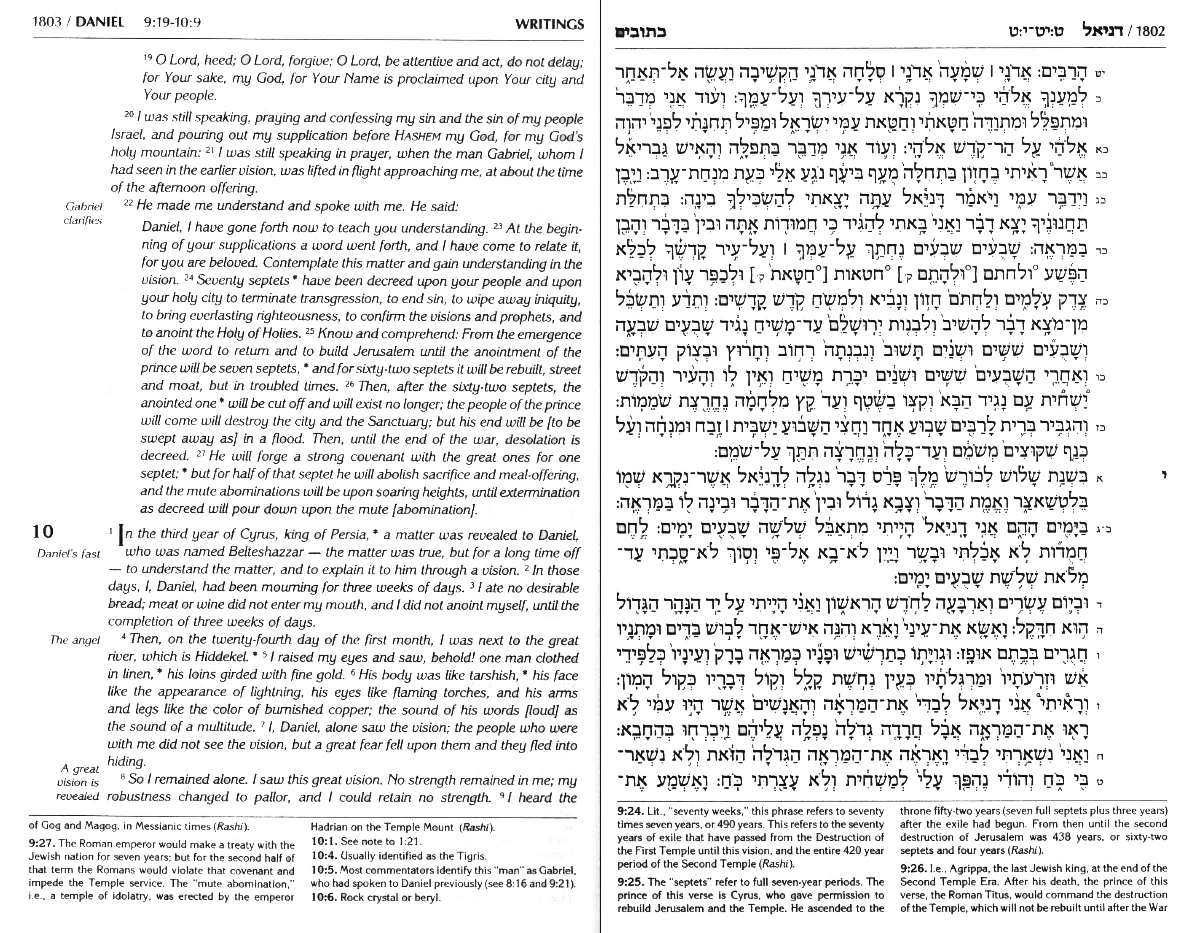
Seventy weeks have been determined concerning your people and your holy city to put an end to rebellion, to bring sin to completion, to atone for iniquity, to bring in perpetual righteousness, to seal up the prophetic vision, and to anoint a Most Holy Place."
The Jews, "you and your people and your holy city," have the 69 "sevens" (483 years, from verse 25) plus one more "seven" to get their act together--to stop sinning and to get the temple ready for the anointed one.
Daniel 9:25-26:a
From the issuing of the command to restore and rebuild Jerusalem until an anointed one, a prince arrives, there will be a period of seven weeks [sevens] and sixty-two weeks [sevens]. It will again be built, with plaza and moat, but in distressful times."
Now after the sixty-two weeks, an anointed one will be cut off and have nothing.
The time from the command to rebuild Jerusalem, until the messiah comes and is cut off, there will be (7 7 + 62 7) 483 years. The term for "cut off" here refers to the death of an animal in a covenant sacrifice, a judicial death sentence, or otherwise unnatural violent death.1
The messiah suffering and being killed fits well with the prophecies of Psalm 22 and Isaiah 53.
Daniel 9:26:b
As for the city and the sanctuary, the people of the coming prince will destroy them. But his end will come speedily like a flood. Until the end of the war that has been decreed there will be destruction."
Some time after the 70th week (40 AD), Jerusalem and the temple will be destroyed.
Titus destroyed the temple and Jerusalem in 70 AD. He became emperor in 79AD and died of a fever in 81 AD, at the age of only 41.
Daniel 9:27
He will confirm [or strengthen] a covenant with many for one week. But in the middle of that week he will bring sacrifices and offerings to a halt. On the wing [or temple, Septuagint and Theodotion] of abominations will come one who destroys, until the decreed end is poured out on the one who destroys.
Jesus had a 3.5 year ministry. Jesus brought a new covenant and the need for sacrifices stopped after his death on the cross at the end of those 3.5 years. The remaining 3.5 years appear to be in the future.
Daniel 12:9-13:a
He said, “Go, Daniel. For these matters are closed and sealed until the time of the end. 10 Many will be purified, made clean, and refined, but the wicked will go on being wicked. None of the wicked will understand, though the wise will understand. 11 From the time that the daily sacrifice is removed and the abomination that causes desolation is set in place, there are 1,290 days. 12 Blessed is the one who waits and attains to the 1,335 days. 13 But you should go your way until the end.
This suggests the second half of the week of the messiah confirming the covenant will happen at the end of time? This is also mentioend in revelation?
Or is this about Caligula? See section on Caligula below.
Nehemiah 1
In Nehemiah 1:3, Nehemiah :
The remnant that remains from the exile there in the province are experiencing considerable adversity and reproach. The wall of Jerusalem lies breached, and its gates have been burned down!
Nehemiah 2
This troubled Nehemiah greatly. In response, Persian king Artaxerxes issued a decree to rebuild the city. Nehemiah 2:1-5:
Then in the month of Nisan, in the twentieth year of King Artaxerxes, when wine was brought to me, I took the wine and gave it to the king. Previously I had not been depressed in the king’s presence. 2 So the king said to me, “Why do you appear to be depressed when you aren’t sick? What can this be other than sadness of heart?” This made me very fearful.
3 I replied to the king, “O king, live forever! Why would I not appear dejected when the city with the graves of my ancestors lies desolate and its gates destroyed by fire?” 4 The king responded, “What is it you are seeking?” Then I quickly prayed to the God of heaven 5 and said to the king, “If the king is so inclined and if your servant has found favor in your sight, dispatch me to Judah, to the city with the graves of my ancestors, so that I can rebuild it.”
8b ..."So the king granted me these requests"...
In the Jewish month of Nisan (March/April) in 444BC, the Persian King Artaxerxes gave Nehemiah the command to rebuild Jerusalem, as recorded in Nehemiah 2, and Nehemiah rebuilt it while facing much opposition. Nehemiah 4:21, "So we worked on, with half holding spears, from dawn till dusk."
When did the 483 years start?
Which Command?
There were multiple commands to rebuild various parts of Jerusalem, however, only the decree from Artaxerxes in 444 BC matches what Daniel 9 describes:
- "to restore and rebuild Jerusalem" per Daniel 9:24 (not just the temple)
- Built "with plaza and moat" per Daniel 9:25.
- Rebuilt "in distressful times" per Daniel 9:25.
| Decree | Target | plaza & moat? | Rebuilt amid distress? | Considered Rebuilt? |
|---|---|---|---|---|
| Cyrus, 539 BC | Temple only (Ezra 1) | ✗ | ✗ | ✗ |
| Artaxerxes I, 457 BC | Temple finances (Ezra 7) | ✗ | ✗ | ✗ |
| Artaxerxes I, 444 BC (Neh 2) | City, gates, wall | ? | ✓ (Neh 4–6) | ✓ |
| Artaxerxes II, 404 BC | No evidence | – | – |
Archaeology
In 2007, archaeologists uncovered a 30 meter section of wall and part of a tower that date to the 5th century (400s) BC via pottery dating.2 While this matches the timeline of Nehemiah, it only gives us the century and not a specific year.
In 2023, a large moat was found in Jerusalem, "at least nine meters deep and 30 meters wide... that extends across at least 70 meters, from west to east."3 4 It was dug in perhaps the 9th century BC or perhaps earlier.4 While this confirms a moat existed, we don't have evidence it was repaired by Nehemiah.
Dating Artaxerxes Longimanus' command to 444 BC
Papyri found at Elephantine and a cuneiform land deed found at Ur both independently corroborate that Artaxerxes became King of Persia after that, after his predecessor Xerxes died near the end of 465 BC.5 6
Assyria, Babylon, and Persia used the accession-year system, where the first year of a king's reign began on the first day of the new year after they became king,5 7 and biblical writers used the accession system when referring to Persian, as well as Babylonian kings, but they differed in what was considered the first month of the year:
- Tishri (Sep/Oct): Ezra, Nehemiah, and Daniel.
- Nisan (Mar/Apr: Jeremiah, Ezekiel, Haggai, and Zecharia.7 7
We know that Nehemiah used the Tishri-to-Tishri reckoning because Nehemiah 1:1 is in Kislev of the 20th year of Artaxerxes, while later in 2:1 it's Nisan and still the 20th year of Artaxerxes. 5th century BC Jewish papyri from Egypt also use the Tishri-to-Tishri method of counting the years of Persian kings.7
This tablet says when Xerxes became king?
https://commons.wikimedia.org/wiki/File:Astronomical_tablet_BM_32234.jpg

TODO: This was before Tishre, not afterward:
A Babylonian tablet contains reference to Xerxes death: “on the 14th day of Abu, Xerxes’ son killed him.” The terse reference is to the point and relatively precise on the time of death – by our calendar sometime in late July or early August in 465 BCE. https://www.cambridge.org/core/books/abs/ancient-persia/empire-at-large-from-the-death-of-xerxes-to-darius-ii/075CD13902D2A642CDF050176366E00A
ChatGPT 5.2 says:
That “Ur land deed” is UET IV 193. It does not prove Xerxes died in December.
- It was written in the 13th year of Artaxerxes I and only refers back to a “first arrangement” dated to “(Kislimu?), year 21 of Xerxes.” source
- The key part (“Kislimu”) is a reconstruction from broken signs; the same study says the month name could be something else and therefore eliminates the tablet as evidence for a late-December death. source
- Even if “Kislimu” were right, “year 21” is a regnal-year label (e.g., spring-to-spring), so a document in Nov/Dec 465 BCE can still fall in “year 21” even if Xerxes died earlier that same regnal year. source
What does anchor the death: a Babylonian eclipse text saying “Xerxes’ son killed him,” dated to 4–8 August 465 BCE, and an Egyptian papyrus by 4 January 464 BCE that still uses a transition formula (“21st year of Xerxes” + “accession year of Artaxerxes”). source
https://www.scribd.com/document/130253611/Some-Ghost-Facts-From-Achaemenid-Babylonian-Texts
Hence, both lunar and historical data support a start date for Nisan of 444 BC to be approximately March 4. https://digitalcommons.liberty.edu/cgi/viewcontent.cgi?article=1208&context=eleu
This guy says 445 BC was Artaxerxes' 20th year, based on Xerxes dying in August and not Dec: https://x.com/BereanArchive/status/2021358845487157461
Artaxerxes Longimanus, not Artaxerxes II
Cyrus (560-530 B.C.)
Cambyses (530-522)
Smerdis (522)
Darius I (522-486)
Ahasuerus (486-465)
Artaxerxes I (465-424)
Darius II (423-405)
Artaxerxes II (405-358)
A minority of scholars have suggested that the Artaxerxes of Ezra and/or Nehemiah was Artaxerxes II, who reigned from 405 to 358BC. This view doesn't fit well.
Ezra 4:5-6 lists public opposition to rebuilding the temple that happened under the kings Cyrus, Darius, Ahasuerus (Xerxes), and Artaxerxes. Likewise Ezra 5:14 mentions decrees to rebuild the temple from Cyrus, Darius, and Artaxerxes. Since these lists start from Cyrus who founded the Persian Empire, it's natural that the Darius, Xerxes, and Artaxerxes are the ones who followed soon afterward. Additionally, Ezra and Nehemiah never clarify which Artaxerxes and which Darius they're talking about, which makes since if additional kings with the same names didn't exist yet.
Ezra and Nehemiah were contemporaries:
- Nehemiah 8:1-6 and 8:13-18 describes Ezra the scribe reading the book of the Law to the people in Jerusalem. Nehemiah 8:7 and 12:25 describe Ezra as a "priestly scribe." Ezra is likewise described as a "priestly scribe" in Ezra 7:11-12 and 7:21, thus it's the same Ezra.
- Ezra 4:11-18 says during the reign of Artaxerxes, the Jews were, in the present tense, "completing its walls and repairing its foundations," matching the description of Nehemiah's restorations.
- Ezra 9 and Nehemiah 13:23-30 both record how Ezra and Nehemiah (respectively) respond to finding out that some Israelites returning from Persia had taken foreign wives. This is likely the same event.
Therefore it was Artaxerxes Longimanus who reigned from 465 to 424 BC who gave the command to rebuild Jerusalem.
The Jewish Encyclopedia puts Artaxerxes's rule as beginning in 465BC http://www.jewishencyclopedia.com/articles/1827-artaxerxes-i
But It also says Nehemiah was cupbearer to Artaxerxes II who began in 404 BC: "He was cupbearer to Artaxerxes (identified by De Saulcy with Artaxerxes II., whose reign began 404 B.C.)."
The artaxerxes II view has "been rejected by the overwhelming majority."
It doesn't match pottery dating showing the wall was rebuilt in the 5th century BC.
The elephantine papyri mention Sanballat, one of Nehemiah's antagonists.
This guy says "The Elephantine papyri (1) mention the high priest Johanan, also mentioned in Ezra 10:6, as a contemporary of Darius II " Which would make Artaxerxes II of 404 to 358 BC the Artaxerxes of Nehemiah.
To rebuild the city
Artaxerxes Longimanus gave Nehemiah approval in 444 BC to to "dispatch me to Judah, to the city with the graves of my ancestors, so that I can rebuild it."
This matches the description of the command given in Daniel 9:25. Daniel uses the Hebrew words banah (תשוב - Strong's ) and shuwb (ונבנתה - Strong's ) for "restore and rebuild," which suggest the city was raised to its former state, not a partial rebuilding but a complete restoration.8 Likewise Daniel's words rachob (רחוב - Strong's ) רחוב and charuwts (וחרוץ - Strong's ) for "plaza and moat" also suggests a rebuilding the whole city.8
Shortly after Artaxerxes' 444 BC command to rebuild the city, Nehemiah arrived in Jerusalem and found it in ruin. Nehemiah 2:13-14, 17:
I [Nehemiah] proceeded through the Valley Gate by night, in the direction of the Well of the Dragons and the Dung Gate, inspecting the walls of Jerusalem that had been breached and its gates that had been destroyed by fire. 14 I passed on to the Gate of the Well and the King’s Pool, where there was not enough room for my animal to pass with me.
17 Then I said to them, “You see the problem that we have—Jerusalem is desolate and its gates are burned. Come on! Let’s rebuild the wall of Jerusalem so that this reproach will not continue.”
Nehemiah 3 indicates that the Fish, Jeshanah, Valley, Dung, Fountain, Water, Horse, East, Inspection, and Sheep gates and walls were all rebuilt. Likewise Nehemiah 4:10:
Then those in Judah said, “The strength of the laborers has failed! The debris is so great that we are unable to rebuild the wall.”
Nehemiah 6:15 says the wall was finished after 52 days, and people were brought in to repopulate in 11:1.
This description also matches where Daniel predicted a command would be given to rebuild Jerusalem.
Other Commands
Some suggest the command predicted by Daniel should be counted as the earlier decrees by Cyrus in 539 BC (2 Chr 36:23, Ezra 1:2-4) or Artaxerxes Longimanus in 457/456 BC (Ezra 7:12-22).
Cyrus in 539 BC
In 539 BC, Cyrus decrees to go to Jerusalem and rebuild the temple. 2 Chronicles 36:23:
This is what King Cyrus of Persia says:
"The Lord God of heaven has given me all the kingdoms of the earth. He has appointed me to build a temple for him in Jerusalem, which is in Judah. Anyone of his people among you may go up there, and may the Lord his God be with him."
Ezra 1:2-4:
This is what King Cyrus of Persia says:
"The Lord God of heaven has given me all the kingdoms of the earth. He has appointed me to build a temple for him in Jerusalem, which is in Judah. 3 Anyone of his people among you (may his God be with him!) may go up to Jerusalem, which is in Judah, and may build the temple of the Lord God of Israel—he is the God who is in Jerusalem. 4 Anyone who survives in any of those places where he is a resident foreigner must be helped by his neighbors with silver, gold, equipment, and animals, along with voluntary offerings for the temple of God which is in Jerusalem."
Isaiah 44:28, 45:13:
44:28 [I am the Lord] who commissions Cyrus, the one I appointed as shepherd to carry out all my wishes and to decree concerning Jerusalem, "She will be rebuilt," and concerning the temple, "It will be reconstructed."
45:13 It is me—I stir him up and commission him [Cyrus, in 45:1]; I will make all his ways level. He will rebuild my city; he will send my exiled people home.
However at least 11 English translations,9 as well as the Septuagint10 and Theodotion.11 render 44:28 with not Cyrus, but God saying Jerusalem and the temple will rebuilt. The Christian Standard Bible:
who says to Cyrus, “My shepherd, he will fulfill all my pleasure” and says to Jerusalem, “She will be rebuilt,” and of the temple, “Its foundation will be laid.”
However, every English translation I checked (dozens) renders Isaiah 45:13 as saying Cyrus "will rebuild my city." Cyrus let the Jews return to Jerusalem and ordered the temple rebuilt, but did not rebuild the wall:
They talk about how it wasn't actually built until Nehemiah's time, and they say:It is me—I stir him up and commission him; I will make all his ways level. He will rebuild my city; he will send my exiled people home, but not for a price or a bribe,” says the Lord of Heaven’s Armies.
It is very possible that Isaiah 45:13 simply means that during the Persian rule the city of Jerusalem will be rebuilt.
Artaxerxes Longimanus in 457 BC
Artaxerxes Longimanus in his seventh year (Ezra 7:7) wrote a letter to Ezra the priest giving him authority to take up a collection to bring to the temple in Jerusalem, because he was afraid that God would bring "wrath against the empire of the king and his sons" (v23). Ezra 7:12-22:
Artaxerxes, king of kings, to Ezra the priest, a scribe of the law of the God of heaven: 13 I have now issued a decree that anyone in my kingdom from the people of Israel—even the priests and Levites—who wishes to do so may go up with you to Jerusalem. 14 You are authorized by the king and his seven advisers to inquire concerning Judah and Jerusalem, according to the law of your God which is in your possession, 15 and to bring silver and gold which the king and his advisers have freely contributed to the God of Israel, who resides in Jerusalem, 16 along with all the silver and gold that you may collect throughout all the province of Babylon and the contributions of the people and the priests for the temple of their God which is in Jerusalem. 17 With this money you should be sure to purchase bulls, rams, and lambs, along with the appropriate meal offerings and libations. You should bring them to the altar of the temple of your God which is in Jerusalem. 18 You may do whatever seems appropriate to you and your colleagues with the rest of the silver and the gold, in keeping with the will of your God. 19 Deliver to the God of Jerusalem the vessels that are given to you for the service of the temple of your God. 20 The rest of the needs for the temple of your God that you may have to supply, you may do so from the royal treasury.
Ezra 9:9b
He has extended kindness to us in the sight of the kings of Persia, in that he has revived us to restore the temple of our God and to raise up its ruins and to give us a protective wall in Judah and Jerusalem.
Problems
Four reasons the 539 BC Cyrus and 457 BC Artaxerxes Longimanus decrees don't match Daniel's prediction:
-
Even though the Lord commissioned Cyrus to rebuild the city, 2 Chronicles 36:23 and Ezra 1:2-4 only mention Cyrus rebuilding and restoring the temple in Jerusalem and not the rest of the city, as Daniel says "restore and rebuild Jerusalem" with a "plaza and moat." Likewise Artaxerxes Longimanus' 457 BC command to rebuild the temple never mentions the rest of the city.
-
Even many years after these commands were given, In Nehemiah 1-2, Nehemiah is still distressed that the city lies in ruin, and he requests materials to rebuild the gate and the wall. So those earlier commands didn't do much to get the city rebuilt. Why would Artaxerxes issue another decree in 444 BC if they had?
-
Daniel also says in 9:25 the city will be rebuilt "in distressful times," and Nehemiah's rebuilding project faced much greater opposition than the commands to rebuild the temple. Nehemiah 4:21, "So we worked on, with half holding spears, from dawn till dusk." Also see Nehemiah 2:19-20 and all of chapters 4 and 6.
-
Ezra 9:9 takes place after Ezra found out the Israelites returning from Persia had married foreign women, Nehemiah 13:23 mentions the same event and places it after Nehemiah had built the wall. So Ezra's thankfulness for the wall in Ezra 9:9 takes place after Artaxerxes Longimanus' 444 BC decree.
-
Adding 483 years to either of these other commands doesn't end at the death of Christ.
On the third point about "distressful times,"
On the fourth point, 483 years of 365.25 days from Nisan (March/April) of 457/456 BC ends in Nisan (March/April) of 26/27 AD. Nobody dates the crucifixion of Christ that early. Some who prefer a 30 AD crucifixion date suppose that Jesus was baptized around 26/27 AD. But the statement in Daniel 9:26 that "after the sixty-two weeks, an anointed one will be cut off and have nothing" doesn't describe baptism, so the timeline is still off by a few years.
Misc Chronology
This site argues that 444BC is the correct year, and makes corrections to Hoehner's calculations. https://www.neverthirsty.org/bible-qa/qa-archives/question/what-is-the-correct-calculation-of-daniels-69-weeks/
Anderson says
infidels.org says the 444BC year puts the date off by 1 month: http://infidels.org/library/modern/chris_sandoval/daniel.html https://archive.is/wip/cM0FX
will inclusive counting make it one year earlier?
When did the 483 Years End?
Heptads as 7 Years
The 360 Day Year
Math
var days = 7(62+7)360; var start = new Date(-444, 2, 14); // 2 for March because javascript months start at 0. -444 is actually 445BC because there was no year zero. start.setDate(start.getDate() + days) start.toString()
But is JS reliable for ancient dates? And I need to figure out differences in calendars.
Some Jews Also Expected the Messiah to come at the time of Jesus
From Sanhedrin 97:14,12 written around 200 to 500 AD, which is part of the Jewish Talmud:
The school of Eliyahu taught: Six thousand years is the duration of the world. Two thousand of the six thousand years are characterized by chaos; two thousand years are characterized by Torah, from the era of the Patriarchs until the end of the mishnaic period [273 BC to 190 AD]; and two thousand years are the period of the coming of the Messiah. That is the course that history was to take, but due to our sins that time frame increased. The Messiah did not come after four thousand years passed, and furthermore, the years that elapsed since then, which were to have been the messianic era, have elapsed.
Although surrounding passages give different calculations.
Rashi comments on Daniel 2:44.
https://www.chabad.org/library/bible_cdo/aid/16485/showrashi/true
"And in the days of these kings" in the days of these kings, when the kingdom of Rome is still in existence. "the God of heaven will set up a kingdom" The kingdom of the Holy One, blessed be He, which will never be destroyed, is the kingdom of the Messiah. "it will crumble and destroy" It will crumble and destroy all these kingdoms.
The Date of Jesus Crucifixion
What is the first seven sevens?
We don't know.
One possibility is that while the wall was completed "in just 52 days" (Nehemiah 6:15) other rebuilding projects in Jerusalem continued until around 396-395 BC, 49 years after Artaxerxes' decree. This could also fit the NRSV's atypical rendering of Daniel 9:25, "for 62 weeks it shall be built again with streets and moat." Articles on Daniel 9 commonly state the city was completed after 49 years, but no historical source exists that can confirm or reject this date.
Sir Robert Anderson proposed the 49 years ended when the book of Malachi was written, the last of the Old Testament prophets.13 Perhaps such would "seal up the prophetic vision" as described in Daniel 9:24. However, Malachi is generally considered to be written around 450 to 424 BC.14 15
Theologian Rick Lanser proposes the first seven sevens were distinct because 49 years is the length of the Jewish Jubilation cycle of 7 sabbatical year cycles, and this was a hint to show that the whole time period referred to sabbatical year cycles. https://biblearchaeology.org/abr-projects/the-daniel-9-24-27-project-2
In John 2, the pharisees say the temple has been built (or is being built) for 46 years. 3 years later is 49 years, the time of Christ's crucifixion. But it has to be the first seven weeks, not the last seven: "Now after the sixty-two weeks, an anointed one will be cut off and have nothing."
What is the 70th Week?
Caligula?
Summary:
- Caligula became emperor on March 16, 37AD, and the Jews claimed they began sacrificing to Caligula at this time. This is the 4th year of the 7 years after Christ was killed on April 3, 33 AD. "But in the middle of that week he will bring sacrifices and offerings to a halt"
- Around the year 40, Caligula converted the Jewish temple into "into a temple of his own, that he might call it the temple of the new Jupiter, the illustrious Gaius." This would mark the end of the 70 weeks the Jews were given to end sin "and to anoint a Most Holy Place."
But how does 33-40AD fit 9:27a: "He [who, the destroying prince?] will confirm [or strengthen] a covenant with many for one week" ? Caligula ruled only 4 years fro 37 to 41. In 33, Caligula married but his wife died after 1 year. In 33 Caligula began an quaestorship, but that's hardly a covenant with many.
The Septuagint and Theodotian say "And one week shall establish the covenant with many." It doesn't say "he."
Philo:
So great therefore was his inequality of temper towards every one, and most especially towards the nation of the Jews to which he was most bitterly hostile, and accordingly beginning in Alexandria he took from them all their synagogues there, and in the other cities, and filled them all with images and statues of his own form; for not caring about any other erection of any kind, he set up his own statue every where by main force; and the great temple in the holy city, which was left untouched to the last, having been thought worthy of all possible respect and preservation, he altered and transformed into a temple of his own, that he might call it the temple of the new Jupiter, the illustrious Gaius. https://www.earlychristianwritings.com/yonge/book40.html
this passage from Philo is also cited by Eusebius in Book 1 Chapter 6.
Wikipedia: "In 39... Caligula ordered the erection of a statue of himself in the Jewish Temple of Jerusalem... The Governor of Syria, Publius Petronius, fearing civil war if the order were carried out, delayed implementing it for nearly a year. Agrippa finally convinced Caligula to reverse the order. However, Caligula issued a second order to have his statue erected in the Temple of Jerusalem." https://en.wikipedia.org/wiki/Caligula#Early_reign
The Jews said they started sacrificing to Caligula [Gaius/Caius] after he become emperor. Philo:
O Lord Gaius, we are falsely accused; for we did sacrifice, and we offered up entire hecatombs, the blood of which we poured in a libation upon the altar, and the flesh we did not carry to our homes to make a feast and banquet upon it, as it is the custom of some people to do, but we committed the victims entire to the sacred flame as a burnt offering: and we have done this three times already, and not once only; on the first occasion when you succeeded to the empire, and the second time when you recovered from that terrible disease with which all the habitable world was afflicted at the same time, and the third time we sacrificed in hope of your victory over the Germans." (357) "Grant," said he, "that all this is true, and that you did sacrifice; nevertheless you sacrificed to another god and not for my sake; and then what good did you do me? Moreover you did not sacrifice to me." Immediately a profound shuddering came upon us the first moment that we heard this expression, similar to that which overwhelmed us when we first came into his presence.
A hecatomb is "A sacrifice to the ancient Greek or Roman gods consisting originally of 100 oxen or cattle."
He became emperor in March of 37 AD, so they perhaps sacrificed a couple months later after hearing the news. This would've been 4 years after Jesus was crucified, not 3.5. But it doesn't quite fit "in the middle of that week he will bring sacrifices and offerings to a halt," since there were still other sacrifices. And perhaps the sacrifices really were to God, as they said?
Caligula was the only Roman Emperor who tried to make the Jews participate in the Roman cult. "Caligula was the first emperor to try to force Jews to participate in the imperial cult. He was also, as it happens, the last."
Chaos in Israel after the year 40:
After the statues of Jupiter had arrived in the Holy Land, the situation there deteriorated rapidly. Bandits, false messiahs and miracle workers roamed the land. Famine, chaos and violence were the order of the day, setting the stage for the final confrontation between Rome and Jerusalem:
“Under the series of governors who followed, the situation sharply deteriorated. … Ferocious armed adventurers and self-styled prophets and holy men roamed round the land more or less unchecked, and insurrections with a religious or political coloring, or both, broke out in many regions. The procurator Tiberius Julius Alexander (46-48), a renegade Jew, had to deal with a major famine… The tenure of Ventidius Cumanus (48-52) witnessed riots, a massacre in the Temple, and clashes between Samaritans and Galileans. The next governor, Antonius Felix (52-60), enjoyed lofty connections both at the court of the emperor Nero (54-68) and among the Jews themselves. Nevertheless, his vigorous efforts to restore order only produced a higher level of violence, and Judaea was once again filled with armed bands of freedom-fighters and miracle workers, proclaiming a heady mixture of nationalistic and revolutionary and messianic slogans. In particular, a group of urban terrorists became an increasingly dangerous menace in Jerusalem itself.” (Michael Grant, The History of Ancient Israel, (Orion Publishing (2012), chapter 20: the Road to Rebellion) https://www.whitehorseblog.com/2015/09/13/the-seventieth-week-of-daniel-9/
Future Event
Jesus seems to say it's some future event in Matthew 25:14, "And this gospel of the kingdom will be preached in the whole world as a testimony to all nations, and then the end will come.15 “So when you see standing in the holy place ‘the abomination that causes desolation,’[a] spoken of through the prophet Daniel—let the reader understand— 16 then let those who are in Judea flee to the mountains.
And Mark 13:18-19:"Pray that this will not take place in winter, 19 because those will be days of distress unequaled from the beginning, when God created the world, until now—and never to be equaled again."
Jerome: "According to the history of Josephus, Vespasian and Titus concluded peace with the Jews for three years and six month."
Objections
"Seven refers to 7 days (a week) not 7 years."
Some question whether the "sevens" refer to years rather than weeks, since all other references to this word in the Old Testament never mean years.8 It refers to a week in Gen 29:27-28, Ex 34:22, Lev 12:5, Num 28:26, Deut 16:9-10, 16, 2Ch 8:13, Jer 5:24, Eze 45:21, and even Dan 10:2-3 which immediately follows the prophecy of weeks.
However:
- The bible sometimes uses days to represent years.
- The book of Jubilees often the same word as Daniel 9 (Hebrew shabuwa) for week to mean a period of seven years. E.g. Jubilees 10:1, "And in the third week of this jubilee." https://www.sefaria.org/Book_of_Jubilees.10.1?lang=bi&lookup=%D7%99%D7%90%20%D7%90%D7%AA&with=Lexicon&lang2=en
- The Hebrew word translated as "week" just means "seven" of anything, not necessarily seven days.
- The context of Daniel 9 is Israel's 70 year exile in Babylon, so we already have a context of years and not weeks when 70 is mentioned again in verses 24-27.
- Daniel later clarifies with a "weeks of days" when talking about a literal week a few verses later.
- Daniel 9:26, 12:7, and 12:11 refer to the middle of the 70th week happening after 1290 days, which is about three and a half years.
- Hebrew speaking Jews often translate it as "years" or "septets." Including The Stone Edition and Chabad.org, as well as the 11th century Jewish commentator Rashi.
These points explained in more detail:
In the bible, days sometimes represent years.
Numbers 14:34
According to the number of the days you have investigated this land, 40 days—one day for a year—you will suffer for your iniquities, 40 years, and you will know what it means to thwart me.
Ezekiel 4:6
When you have completed these days, then lie down a second time, but on your right side, and bear the iniquity of the house of Judah 40 days—I have assigned one day for each year.
The Hebrew word shabuwa just means a set of 7.
Hebrew shabuwa' (ושבעים / Strong's 7620) is equivalent to the word heptad in English--a group of seven. It means "a seven" just like the English word "dozen" refers to 12.
Daniel later clarifies "weeks of days" when talking about a literal week a few verses later.
Shortly after the prophecy of weeks, in Daniel 10:2-3 reads:
In those days I, Daniel, was mourning for three whole weeks. 3 I ate no choice food, no meat or wine came to my lips, nor did I anoint myself with oil until the end of those three weeks.
Daniel "was mourning for three whole weeks." Or literally “three weeks of days.” With Hebrew yome ( ימים - Strong's 03117) used for "days." It's as if Daniel wanted to clarify that now he was talking specifically about weeks of days, unlike a few verses earlier. Even though the context already makes it obvious he's not fasting for 21 years.
The word "day" doesn't occur in the prophecy of weeks.
Daniel's Context is the 70 Year Exile.
The reason Israel was in exile in Babylon was because they had failed to observe the Sabbath years (once every 7 years) of no growing crops that was commanded by God in Lev 25:1-7. From 2 Chronicles 36:20-21:
He deported to Babylon all who escaped the sword. They served him and his sons until the Persian kingdom rose to power. This took place to fulfill the Lord’s message spoken through Jeremiah and lasted until the land experienced its sabbatical years. All the time of its desolation the land rested in order to fulfill the seventy years.
The "message spoken through Jeremiah" refers to Jeremiah predicting 25:11 and 29:10 predicting that Israel would be in exile for 70 years. This implies the 70 years of Israel's deportation comes from their not obeying the sabbath year for 490 years, since one year out of 7 for 490 years is 70 years.
Daniel also understood the prophecy of Jeremiah referred to a 70 year exile several verses before the prophecy of weeks in 9:2:
the number of years for the fulfilling of the desolation of Jerusalem, which had come as the Lord’s message to the prophet Jeremiah, would be 70 years.
So given the context, Daniel is already thinking of 70 in the context of years, not weeks.
Daniel 12 says half of a "seven" is 1290 days.
Daniel 9:27 says "But in the middle of that week [seven] he will bring sacrifices and offerings to a halt. On the wing of abominations will come one who destroys..."
Daniel 12:11 confirms that this "week" is a period of 7 years, since half of 7 years ("in the middle of that week") is about 1290 days. Daniel 12:11:
From the time that the daily sacrifice is removed and the abomination that causes desolation is set in place, there are 1,290 days.
If the 70th week is referring to 7 years, then it's likely the other 69 weeks are too.
Hebrew speaking Jews often translate it as "years" or "septets."
- The popular Jewish translation The Stone Edition uses the English word "septets" in Daniel 9:24-27 and never mentions a week.16
- Likewise the English translation at the Jewish website Chabad.org renders it "Seventy weeks [of years]" with the bracketed "of years" being part of their translation.17
- The 11th century Jewish commentator Rashi, highly esteemed by Jews, likewise interprets the sevens as years,18 although he takes a very different interpretation of the timeline.
- However the Jewish websites Sefaria.org19 translates the "sevens" as "weeks."
Constable's Commentary on Daniel 9:24 says "Most scholars believe that this word here represents seven years."
"A 360 Day Calendar makes no sense."
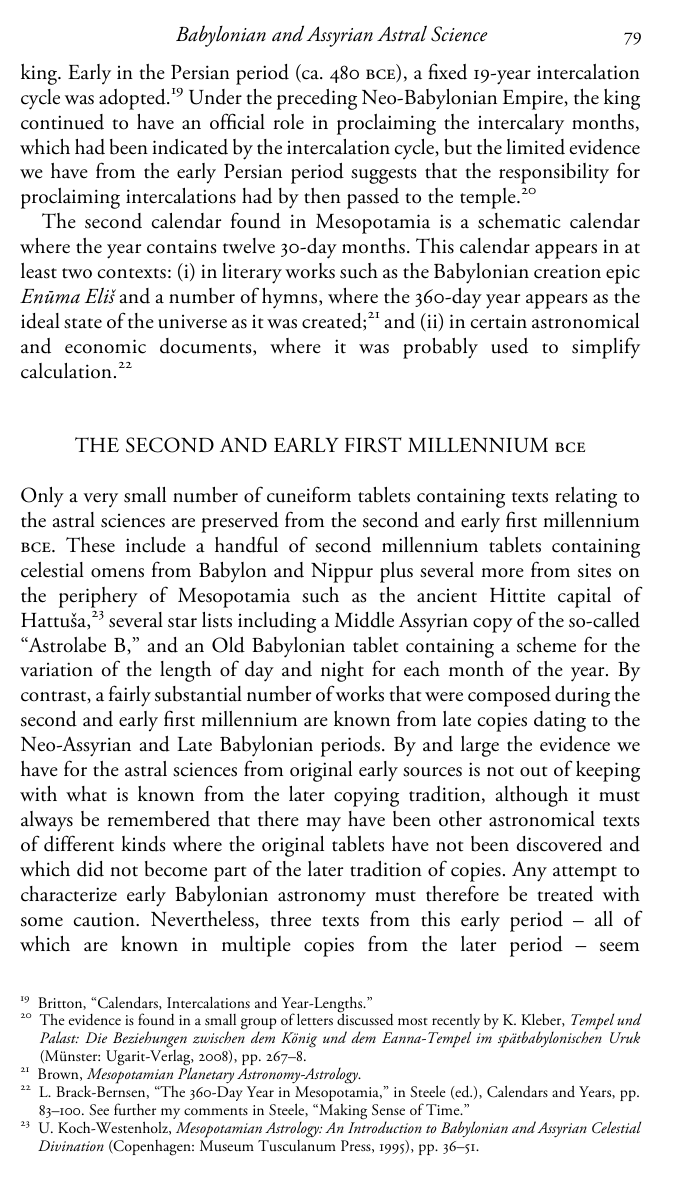
Ancient Mesopotamians used a variety of calendars for everyday life. But from 2600 to 300 BC, they used a 360 day year of 12 months of 30 days when doing administrative and bureaucratic calculations. The Babylonians saw the 360 day year as the "ideal" year, or "the ideal state of the universe as it was created."20 21
We even have preserved math "homework" assignments where scribes in Babylon were trained to do calculations using a 360 day year. Daniel was a scribe in Babylon.
In Daniel's time, the Babylonians had at least 5 different estimates for the number of days in a year. Leap months were used every 2-3 ears to align the 355 day civil calendar to the true solar year, and every 5-6 years to align the 360 day administrative/ideal years. But these were inserted arbitrarily at the whim of the king.22 20 Sometimes two years in a row had a leap month. Other times there were up to 5 years between leap months.
Given this confusion, to what system might Daniel look to when describing the timing of a distant event?
Additionally, a 7-year sabbatical cycle was a mainstay in the ancient near east, not just in Israel.
This instability in the length of a year is probably why Daniel was careful not to use the word "year", but instead used the 360 days which was likely the most precise long-term method of timekeeping available to him.
Notes:
Practically from the beginning of recorded time, men recognized that a year lasts about 360 days, a number still reflected in the use of a 360° circle among mathematicians and astronomers today. This may also have influenced the Babylonian adaptation of a sexagesimal, or base-60, number system (as opposed to the base-10 system used by Westerners today) in c. 2700 b.c. The figure of 360 represented a mean, or close to one, between the length of the lunar and solar calendars.
...
The Babylonian system that came to prevail throughout the Near East consisted of 12 basic months: Nisanu, Ayaru, Simanu, Du'uzu, Abu, Ululu, Tashritu, Arakhsamna, Kislimu, Tebetu, Shabatu, and Adaru. Every 19 solar years, or 235 lunar months, marked an entire luni-solar cycle, which required intercalation in years 3, 6, 8, 11, 14, 17, and 19.
The 360-Day Year in Mesopotamia. She's talking about pre-1000 BC though:
page 83
In the administrative calendar each month was put equal to 30 days. As we shall see, the administrative calendar was only used in the context of making calculations and never for dating.
For example, in MUL.APIN, a canonical astronomical/astrological text perhaps dating from around 1000 BC, we find astronomical schemes in which the ideal year of 360 days is used, together with indications of how to adjust schematic values according to observations.
Page 84
In bureaucratic calculations the duration of each month (independent of its actual length) was simply always taken to be 30 days.
But still, most scholars (including myself) tend to believe that daily life from the earliest beginning, i.e., from proto-literate time, was regulated by the sun and by lunar phases, while at the same time the artificial time measuring system was used in centralized bookkeeping.
Page 88
At the same time, scribal computations were carried out by an administrative system of time division in which the year consisted of 12 months of 30 days each. In contrast to the irregular lunisolar calendar, the 360-day year is very practical for bureaucratic calculations— it simplifies calculations and at the same time it increases the state’s demands on labour. Independent of its actual length, each synodic month was simply calculated as having 30 days. As an example of this practice we can consider an Ur III text [21st century BC] published by Englund (1988), p.126. The text calculates the number of workdays which a group of 36 female workers should deliver during a year of 12 (lunar) months.
- 36 female workers
- from the “harvest(-festival)” (month 1, Umma calendar)
- through “Tammuz(-festival)” (month12),
- performance involved: 12,960 days
...
From the earliest phase and throughout the history of cuneiform, tablets were produced for the education of scribes. Many such tables happen to survive from the Old Babylonian period [1894-1595 BC], the Old Babylonian mathematical texts being a rich source of early mathematics. Mathematics was an integral part of Mesopotamian scribal culture
Page 90
For dating and normal/cultic life, the lunisolar calendar alone was used. The 360-day year was only used in connection with accounting.
Page 93
Most scholars assume that the lunisolar calendar [not 360 day] was used by the Babylonians all way through until the end of the Seleucid Era.
In the astronomical/astrological compendia En‚ma Anu Enlil tablet XIV and MUL.APIN, a so-called “ideal” or “schematic” year of 12 × 30 days is used.
Page 94
the lunisolar calendar and the “ideal” calendar coexisted all way through from Old Babylonian times (1800 BC) to around 300 BC, and that the “ideal” calendar just is a continuation of the artificial year of accounting.
PAge 95
We do, however, have evidence of the 360-day year being used in the education of scribes. Some mathematical texts used in scribal schools state a problem and give a model solution. Such texts show how Babylonian mathematics functioned and what pupils were to learn.
Page 96
Analysis of Ur III work rates, Old Babylonian coefficient lists, and Old Babylonian mathematical texts have thus shown that accounting practices involving the artificial year of 12 × 30 days in either administrative or scribal training contexts are found throughout the time from Ur III [21st century BC] to the Old Babylonian period. And from this time onwards, we have evidence for the utilization of the artificial 360-day year in “astronomical” texts.
Page 98
the administrative and the cultic/civil calendars coexisted all way through from the earliest literate time (ca. 2600 BC) until ca. 300 BC. The astronomical lunisolar calendar regulated life, while the artificial accounting or ideal calendar (which I see as a practical and regular approximation to nature) could be used for calculation.23
Different estimates of the number of days in a year in Daniel's time:
Page 126
The measure, 364½ days, is the earliest explicit year-length from cuneiform sources, and might plausibly have been the source of the 364 unit division of the sky in the early ziqpu text. In any event, it clearly predates the 6th century. How seriously it was regarded is hard to know, since it is also a regular number, a fact utilized by the author of BM 36712 in subsequent computations. Its 30-year error of 23 days would suggest either an absence of reliable early records or of close attention.
With the parameter 365;10 [365 ⅙] days we arrive at the first solid estimate of the year’s length to appear in cuneiform sources. From its context it seems almost certain to have been derived from an estimate that 30 years, marked by Sirius risings, comprised 10,955 days, 20 days longer than implied by the 364½ day year.... this parameter seems to date from around the beginning of the 6th century. What is slightly surprising is how relatively late this is, not to mention the fact that the year-length itself is pretty poor.
The next year-length, 365;16 [365.2667] days, appears in BM 36731 another text from Babylon probably written around –560. The text is the earliest ephemeris we know of and consists of computed dates and instants of the solstices and equinoxes together with the dates of the appearances and disappearances of Sirius, probably from the accession year of Nabopolassar (–625) to the end of Nebuchadnezzar’s reign in –561. One of several remarkable features of this text is that the solstice and equinox dates are actual dates in the civil calendar, not schematic dates assuming months of 30 tithis, as we typically find in later texts dealing with such phenomena, and indeed even in this text for the risings and settings of Sirius. The basis for this year-length seems likely to have been recognition that Sirius risings recur after 30 years at intervals of 10,958 days, a number 3 days greater than the apparent earlier estimate and correct to the nearest day for sidereal phenomena.
Page 130
Conspicuously absent are either 365 days or 365¼ days, neither of which appear in cuneiform texts to my knowledge.
Priests didn't use a 13th leap month:
Another shortcoming of the normative calendar of 360 days is that it does not take intercalary months into account. On average, one year in three counted 13 months instead of 12, but we never hear of priests holding prebends [priestly stipends] for intercalated days. A text like YBC 3991, which gives a list of all the prebend days owned by Urukean bakers and brewers in the temple of Larsa, clearly shows that no formal arrangements existed for the temple service of the 13th month. How were priests called to duty in the extra month of leap years? It seems that arrangements for the temple service of intercalary months were made ad hoc... there were no pre-existing arrangements for cultic service in an intercalary month and that special arrangements had to be made with members of the various priesthoods shortly ahead of time, probably as soon as the temple administrators had been notified by the royal bureaucracy about the upcoming intercalation.21
Babylonians believe the world was created with a 360 day year:
Perhaps the Babylonian Epic of Creation (Enūma Eliš) provides the fabric of such stories: the creation of time by Marduk, his installment of the 360-day calendar, his assignment by lot of duties to the Anunnaki, and the work’s exegesis of some of Marduk’s fifty names all fit in the prebendary sphere.21
Sabbatical Cycle
The sabbatical year was the seventh year, and the jubilee year followed seven sabbatical cycles. This was a pervasive system in the ancient Middle East. https://www.britannica.com/topic/Middle-Eastern-religion/Religious-practices-and-institutions
Seven sevens would be the jubilee cycle.
Babylon
the Babylonian calendar remained chaotic throughout most of the first millennium BC due to the irregular insertion of random months. The Babylonian year apparently consisted originally of 12 months of 30 days, but sometimes made use of sightings of the crescent moon to name the beginning of a month. Under Nabonassar (747-734 BC), a fixed-length month of 30 days was used. The Babylonians finally systematized a strictly lunar calendar which began with the first visible crescent moon around 500 BC.
https://scienceworld.wolfram.com/astronomy/BabylonianCalendar.html
In the MUL.APIN tablets, an 'ideal' year composed of 12 'ideal' months, each of which was composed of an 'ideal' 30 days, even though the Babylonians used a lunisolar calendar, indicating both the Moon phase and the time of the solar year.
Persia
http://www.iranchamber.com/calendar/articles/calendar_systems_origins.php http://archive.is/6KpaV
The first calendars based on Zoroastrian cosmology appeared during the later Achaemenian [first Persian] period 559–330 BC and though they have evolved and changed over the centuries the names of the months have remained more or less the same till now. Before this period old Persian inscriptions and tablets indicate that early Iranians used a 360-day calendar based on Babylonian system modified according to their own beliefs with their own name days.
Herodotus:
the Egyptians, basing the calendar on twelve thirth-day months, intercalate five additional days every year, whereby the cycle of the seasons returns with uniformity.
Check the sources on this site: http://360dayyear.com/
http://www.academia.edu/2360595/The_Length_of_the_Month_in_Babylonian_Calendars_of_the_First_Millennium_BC notes, in Babylonian dates “There [is] a value [that denotes] the time interval between sunset and moonset. This time interval is given in units of US where there are 360 US in a day from sunset to sunset”.)
Mike Winger at 39:25, "India, Persia, Babylonnia, Assyria, Egypt, Central and South America, and China" ancient calendars had 360 days. Most had a 12 month year of 30 days.
Hebrews did too. Genesis 7:11b:
In the second month, on the seventeenth day of the month—on that day all the fountains of the great deep burst open and the floodgates of the heavens were opened.
Genesis 8:3-4:
The waters kept receding steadily from the earth, so that they had gone down by the end of the 150 days. 4 On the seventeenth day of the seventh month, the ark came to rest on one of the mountains of Ararat.
This is 5 months spanning 150 days, which gives 30 day months.
Revelation 11:2-3:
But do not measure the outer courtyard of the temple; leave it out because it has been given to the Gentiles, and they will trample on the holy city for forty-two months. 3 And I will grant my two witnesses authority to prophesy for 1,260 days, dressed in sackcloth.”
42 * 30 = 1260. In a modern calendar, 42 months would round closest to 1280 days, not 1260.
Also 13:5 where the beast speaks blasphemies for "42 months."
Also Revelation 12:6 where the woman flees to the wilderness with her son for 1260 days. This matches gentiles trampling the holy city for forty-two months.
Was the 360 degree circle based on 360 days in the circle of a year?
Jews adopted a Babylonian calendar while in Babylon / Persia:
The Hebrews had both names and numbers for their months. Before the Babylonian exile these names seem to have been identical with the Canaanite month names. Three of the four month names mentioned in preexilic books of the Bible—Zif the second month, Ethanim the seventh month, and Bul the eighth month—are also attested in ancient Canaanite texts. But during the Exile, the Jews adopted the month names of the Babylonian calendar as is clearly seen from the fact that in all postexilic books of the Bible—Ezra, Nehemiah, Haggai, Zechariah, and Esther—the month names are Hebrew variants of the Babylonian ones: Nisan for Nisanu, Sivan for Simanu, Elul for Ululu, Chislev for Kislimu, Tebeth for Tebetu, Shebat for Shabatu and Adar for Addaru. Thus it is certain that the Jews adopted the month names of the Babylonian calendar during their stay in Babylon... https://www.ministrymagazine.org/archive/1981/08/elephantine-papyri-and-daniel-814
"The 70 Sevens were Symbolic."
But Daniel's prayer in 9:4-19 was based on his expectation of a literal seventy-year exile.
"Daniel was written after the time of Jesus."
No historians date Daniel after the time of Christ.
The fragmentary Dead Sea Scrolls contain most of Daniel, including parts of Daniel 9 and Daniel 10, but the text of 9:24-27 has not survived. http://dssenglishbible.com/Scrollsdaniel.htm
Septuagint has Daniel 9:24-27.
Jesus planned to be crucified at the end of this prophecy
When people tried to make Jesus king, he'd say "My time has not yet come" or "My hour has not yet come."
Also Jesus said a lot about it being the specific time in Luke 19:29-44. See Mike Winger at 51:50.
Jesus planned to be crucified at a lunar eclipse?
Could the crucifixion have been planned to happen on this date to fulfill prophecy? But none of the NT writers mention it. Josephus gets the date of Artaxerxes wrong What do other christian writers say? Jerome: "the interval from the twentieth year of Artaxerxes to the time of Christ completes the figure of seventy weeks, if we reckon according to the lunar computation of the Hebrews, who did not number their months according to the movement of the sun, but rather according to the moon." He also quotes Tertullian putting an estimate together. http://www.tertullian.org/fathers/jerome_daniel_02_text.htm
Early church father views:
At NeverThirsty.org "Julius Africanus, another ancient author, reported that Phlegon had stated, “And the calculation makes out that the period of seventy weeks, as noted in Daniel, is completed at this time.”"
https://www.bible.ca/H-70-weeks-daniel.htm
TODO more early church father views here: https://paultanner.org/English%20HTML/Publ%20Articles/Daniel's%2070th%20Wk%20-%20BibSac%20Article%201%20-%20Dr%20Tanner.pdf
Tertullian:
Tertullian says Jesus died in the 15th year of Tiberius, which would be on March 25, 29 AD,? and the 70 weeks ends at this time. Although Passover of 29 AD was actually on April 18th or possibly April 17th.
And the suffering of this extermination was perfected within the times of the lxx hebdomads [70 weeks in Danial 9], under Tiberius Cæsar, in the consulate of Rubellius Geminus and Fufius Geminus, in the month of March, at the times of the passover, on the eighth day before the calends of April, on the first day of unleavened bread, on which they slew the lamb at even, just as had been enjoined by Moses.?
Jerome: https://www.tertullian.org/fathers/jerome_daniel_02_text.htm shares the interpretations of others:
-
Africanus
-
Eusebius
-
Eusebius, alt explanation:
-
Hippolytus
-
Apollinarius of Laodicea
-
Clement
-
Origen
-
Tertullian
-
The Hebrews (Jews):
- The 70 weeks begins with "the first year of the Darius who slew Belshazzar" and ends "four hundred and ninety years" later.
- And "within these seventy weeks that the city shall be rebuilt and the Temple restored, but also the Christ, who is the eternal righteousness, shall be born."
- Also "the street shall be rebuilt by Nehemiah and Ezra"
- "after the sixty-two weeks the Christ shall be slain, and the nation who shall reject Him shall go out of existence"
- "it is simply the idiomatic usage of the Hebrew language, as well as of antique Latin, that in quoting a figure, the small number [7 weeks] is given first and then the larger [62 weeks]."
- "According to the history of Josephus, Vespasian and Titus concluded peace with the Jews for three years and six month. And the [other] three years and six months are accounted for in Hadrian's reign, when Jerusalem was completely destroyed and the Jewish nation was massacred in large groups at a time, with the result that they were even expelled from the borders of Judaea." This is what the Hebrews have to say on the subject.
"On the other hand, the interval from the twentieth year of Artaxerxes to the time of Christ completes the figure of seventy weeks, if we reckon according to the lunar computation of the Hebrews, who did not number their months according to the movement of the sun, but rather according to the moon... For according to their (p. 544) computation, these years can be made up of months of twenty-nine (variant: twenty-eight) and a half days each... Africanus has expressed his views in these very words which we have copied out."
that the number of years from the sixth year of Darius, who |102 reigned after Cyrus and his son, Cambyses, ---- and this was the date when the work on the temple was completed ---- until the time of Herod and Caesar Augustus is reckoned to be seven weeks plus sixty-two weeks, which make a total of four hundred eighty-three years. (688) That was the date when the christ, that is to say, Hyrcanus, being the last high priest of the Maccabaean line, was murdered by Herod, and the succession of high priests came to an end, so far as the law of God was concerned
He preached the Gospel for three years and six months, according to John the Evangelist. And he established the worship of the true God with many people, undoubtedly meaning the Apostles and believers generally. And then, after our Lord's passion, the sacrifice and offering ceased in the middle of the week. For whatever took place in the Temple after that date was not a valid sacrifice to God but a mere worship of the devil, while they all cried out together, "His blood be upon us and upon our children" (Matt. 27:25); and again, "We have no king but Caesar."
According to the Evangelist John (John 2 and 11), Christ completed two years over a period of three passovers.
"The prophecy isn't messianic"
There's no definite article before Messiah.
The Septuagint for Daniel 9:2610 puts a definite Greek article (τοῦ - like "the") before anointed one in Daniel 9:26, reading literally "the Christ": τοῦ χριστοῦ.
The Jewish translations at Chabad.org17 and Sefaria.org19 both have "the anointed king" in verse 25 and "the anointed one" in verse 26. The Jewish Stone Edition use "the annointed one" for verse 26 but in 25 reads "the anointment of the prince."
The Hebrew language can sometimes specify a particular person or event without a definite article.
Michael Brown says:
I agree it is reading too much into the text to justify the translation "the Messiah (still reflected in the NASB). But that does not mean the interpretation is wrong. Quite the contrary.
Not Agrippa
If the second anointed one is Agrippa, his death had almost no consequence. But the death of Jesus affected the entire world, as there are now 2 billion Christians.
Ananus
"Beckwith presents the case that Josephus interpreted the “anointed one” (who was cut off, Dan. 9:26) as the high priest Ananus, who was murdered by the Idumaeans in the temple in A.D. 66" https://paultanner.org/English%20HTML/Publ%20Articles/Daniel's%2070th%20Wk%20-%20BibSac%20Article%202%20-%20Dr%20Tanner.pdf
Why "Seven sevens and sixty two sevens?"
In Denmark they say the number ninety two as "Two and five minus a half twenties" (TODO: Verify this) https://www.facebook.com/informationisbeautiful/posts/pfbid026qfktmdXFdxwEP6kmCLMi7AhLDZ1RRBnGzDNKZt6iL7Pt21BHhRX6geYdkQpWt35l
"The seven weeks is distinct from the sixty two weeks, and there are two different anointed ones."
The New Revised Standard Version, a liberal Christian translation, has the anointed one coming after only the first seven weeks. 9:25-26:
Know therefore and understand: from the time that the word went out to restore and rebuild Jerusalem until the time of an anointed prince, there shall be seven weeks, and for sixty-two weeks it shall be built again with streets and moat, but in a troubled time. 26 And after the sixty-two weeks, an anointed one shall be cut off, and shall have nothing; and the people of the prince who is to come shall destroy the city and the sanctuary. Its [or his] end shall come with a flood, and to the end there shall be war; desolations are decreed.
The ESV, a conservative translation, reads similarly.
In other words, if we interpret the Hebrew this way, we have an anointed prince coming after 49 years in 395 BC, and a different anointed one cut off 434 years later. Hebrew scholar and messianic (Christian) Jew Michael Brown even endorses such an interpretation:
I do believe the traditional Jewish rendering is more natural and there is no problem with seeing two anointed ones in the prophecy.
Even if we assume the first "anointed prince" is to come at the end of the first 49 years, the second anointed one who is cut off still matches the timeline of Jesus.
However, there are no known figures around the time of 395 BC (49 years after the decree was given in 444 BC) who fit the profile of an "anointed prince."
Theologian Harold W. Hoehner stated in 1978:
[M]ost commentators think that the seven weeks and the sixty nine weeks are successive or continuous making a total of sixty-ninen weeks between the decree to restore Jerusalem and the Messiah the Prince.8
Jewish Translations
Early Jewish translations also prefer grouping the seven and 69 weeks:
- The Septuagint, a Jewish translation of the Hebrew Old Testament to Greek around 280 to 100 BC,24 translates the timeline in 9:25 as "for the building of Jerusalem until Christ the prince [there shall be] seven weeks, and sixty-two weeks."
- Likewise with Theodotion11 a Jew who translated the Hebrew Old Testament to Greek in around 150 to 180 AD, who may or may not have used the Septuagint as a source. He translates the timeline in 9:25 as "from the going forth of the word to respond to and to rebuild Jerusalem until an anointed leader, there will be seven weeks and sixty-two weeks, and it [or he, antecedent unclear] will return"
However, the modern Jewish translation The Stone Edition,16 as well as those at at Chabad.org? and Sefaria.org19 translate the seven and 62 weeks as separate, similar to the NRSV.
Alternate dating
David Pitts redates Nehemiah 2 drastically earlier, at around 529 BC?: http://www.biblicaltheology.com/Research/PittsD02.pdf
But Sanballat is in the Elephantine papyri.
Letters sent from the Jewish settlement at Elephantine to Sanballat have been dated to c. 407. If that is the same Sanballat who withstood Nehemiah, the new dates must be wrong. But Lumen argues that the Darius mentioned was Darius Hystaspes and so the ‘17th year of his reign’ when the letters were written was 504/3.96 http://www.biblicaltheology.com/Research/PittsD02.pdf
Archaeological evidence of wall being rebuilt in 5th century.
Traditional Jewish Chronology
According to Seder Olam, as cited by Alexander Hool:
- Darius the Mede - 1 year
- Cyrus - 3 years
- Achashveros (Xerxes) - 14 years
- Darius - 36 years
Although widely rejected by historians,25 some Orthodox Jews use what's known as the Traditional Jewish Chronology that omits most of the Persian Kings and brings forward the Persian period and everything before it by about 166 yeas. For example Rabbi Bentzion Kravitz argues:
- The seven weeks begins at the destruction of the temple in 420 BC (not the conventional 586 BC).
- The 70 weeks end 490 years in the year 70 AD where the king and priest (anointed ones) of Jerusalem are killed, and Jerusalem itself is destroyed.26
This is supported by the Talmud in Nazir 32b:
The Second Temple would be destroyed seventy Sabbatical cycles of seven years after the destruction of the First Temple, which is 490 years.
And likewise by the respected Jewish commentator Rashi:
The number of seven weeks is four hundred and ninety years. The Babylonian exile was seventy [years] and the second Temple stood four hundred and twenty [years].
If this chronology is true, the prophecy in Daniel 9 cannot refer to Jesus.
Ptolemy
However, this fringe view25 is disproven by many historical records of eclipses and other astronomical phenomenon recorded history by Ptolemy, the Babylonians, and the Assyrians. Archaeologist Edwin Richard Thiele shares how incredibly well Ptolemy's chronology gives us the exact timeline back to 747 BC. Emphasis not original:
His [Ptolemy's] famous canon begins in 747 B.C. with the start of the reign of Nabonassar in Babylon. First appears a list of the rulers of Babylon and their lengths of reign, from Nabonassar to Nabonidus, the ruler when the Neo-Babylonian empire came to its end. Then follow the rulers of Persia, from Cyrus, the conqueror of Babylon, to Darius III, the last ruler of Persia when it was overthrown by Alexander the Great. Following Alexander and Philip, Ptolemy lists the Ptolemaic rulers of Egypt to Cleopatra and then goes on with the rulers of Rome, from Augustus to Antoninus Pius (138—161 AD). In addition to the number of years for each king, the sum of the years for the period of each ruler from the beginning of the canon is also given, this figure being secured by merely adding the sums of the previous reigns. We thus have what is called the Nabonassar era that began on 27 February 747 B C. (astronomically noon, 26 February). Following the years of the Babylonian and Persian rulers up to the time of Alexander the Great, the years are again numbered beginning with Philip, and the totals are thus expressed to Antoninus Pius and the end of the canon.
What makes the canon of such great importance to modern historians is the large amount of astronomical material recorded by Ptolemy in his Almagest, making possible checks as to its accuracy at almost every step from beginning to end. Over eighty solar, lunar, and planetary positions, with their dates, are recorded in the Almagest and these have been verified by modern astronomers. The details concerning eclipses are given with such minuteness as to leave no question concerning the exact identification of the particular phenomenon referred to and make positive verification possible. Early in the on, for instance, its correctness can be checked by an eclipse of the moon that took place in the first year of Mardokempados on the night of 29/30 Thoth; it began in Babylon one hour after the rise of the moon and was a total eclipse. This was the twenty-seventh year of the Nabonassar era. The eclipse has been fully verified as having taken place on 19 March 721. Ptolemy also mentions an eclipse in the seventh year of Cambyses, which would be the year 225 of the Nabonassar era (523 B.C.). This eclipse has been computed to have taken place on 16 July 523. And once more, Ptolemy states in the Almagest that an eclipse of the moon took place in the thirty-first year of Darius on 3/4 Tybi. Since the death of Cambyses occurred in 522 B c. (year 226 of the Nabonassar era), the thirty-first year of Darius would bring us to 491 B.C. (year 257 of Nabonassar era). The eclipse took place 25 April 491 B.C. The dates of the Nabonassar era have thus been fully established, and once the method of procedure involved in the reckoning of the years of the kings is understood the canon of Ptolemy may be used as a historical guide with the fullest confidence.
Since Ptolemy's canon gives precise and absolutely dependable data concerning the chronology of a period beginning with 747 and since the Assyrian eponym canon carries us down to 648 B.C. it will be seen that there is a century where these two important chronological guides overlap and where they may be used as a check on each other. The canon of Ptolemy provides the date B.C. (year 39 of the Nabonassar era) when Sargon, king of Assyria, became king of Babylon. From Assyria come two tablets, K 5280 and K 2688, that provide the information that the eponymy of Mannu-ki-Ashur-li', the thirteenth year of Sargon as king of Assyria, was his first year as king of Babylon. We thus secure 709 B C. as the year of the eponymy of Mannu-ki-Ashur-li' and the thirteenth year of Sargon as king of Assyria. Now on the basis of Ptolemy's canon we are able to provide dates to all the other eponymies on the Assyrian lists, and we thus secure 763 for the eponymy of Bur-Sagale—the same date as was secured for that eponymy by the evidence of the solar eclipse that took place that year in the month Simanu. So the date 763 for the eponymy of Bur-Sagale has been established not only by the astronomical evidence of Assyria but also by that of Ptolemy's canon. We thus have complete assurance that 763 is the correct date for Bur-Sagale and that the other dates of the eponym lists, whether reckoned backward or forward from that date, are likewise correct.
Many other cross references between the Assyrian eponym list and the canon of Ptolemy are possible, such as the fourteenth year of Sargon as king of Assyria and second year as king of Babylon, in the eponymy of Shamash-upahhir, the fifteenth year of Sargon as king of Assyria and third year as king of Babylon, in the eponymy of Sha-Ashur-dubbi, the sixteenth year of Sargon as king of Assyria and fourth year as king of Babylon, in the eponymy of Mutakkil-Ashur, and others.7
A paper published in the Journal of Near East Studies in 1954 likewise comments on the extraordinary chronological verification given by Ptolemy.5
The Canon of Ptolemy has preserved a continuous list of Babylonian. Persian, Macedonian, and Roman rulers for nine centuries. Ptolemy begins his list with Thoth 1 in the first regnal year of Nabonassar (February 26, 747 B.C.), which he uses as the starting point of his so-called "Nabonassar Era." Since all these dates can be checked astronomically by nineteen lunar eclipses ranging over nine centuries, and have been proved to be correct, Ptolemy's Canon allows us to establish the Julian date of Thoth 1 for any year from 747 B.C. onward. When Thoth 1 has been ascertained, it is easy to convert any Egyptian date into terms of the Julian calendar.
Ptolemy often gives not just the year, but precision including the month, day, and fraction of an hour when an eclipse occurred. He also gives the position of an eclipse with degrees including two decimal points. From Ptolemy's Almagest, written around 150 AD:
We then took, first, the eclipse observed in Babylon in the year 31 of Darius, Egyptianwise Tybi 3-4 [25 April 491 B.C. per the quote from Thiele above] at the middle of the sixth hour; and the moon was eclipsed to a breadth of 2 digits from the southern side.
[...]
But at the first eclipse [of Darius] the moon was 100°19′ from the epicycle's apogee, for the middle of this eclipse occurred in Babylon ½ hour before midnight, and in Alexandria 1⅓ hours before midnight. And the time from its epoch in the reign of Nabonassar totals 256 years, 122 days, and 10⅔ equatorial hours simply considered, but 10¼ hours with respect to mean solar days. Therefore, the true course was less than the periodic course by 5°.27
As noted, this and other eclipses mentioned by Ptolemy establish the conventional chronology, but there's no way to make them match the traditional Jewish chronology.
Assyria
The chronology has been similarly established through Assyrian documents:
One item of unusual importance is a notice of an eclipse of the sun that took place in the month Simanu in the eponymy of Bur-Sagale. Astronomical computation has fixed this as 15 June 763. With the year of the eponymy of Bur-Sagale fixed at 763 B.C., the year of every other name of the complete canon can likewise be fixed. The Assyrian lists extant today provide a reliable record of the annual limmu officials from 891 to 648 B.C.; and for this period they provide reliable dates in Assyrian history.7
Library of Ashurbanipal
Found in the Library of Ashurbanipal, believed to be destroyed in 612BC: https://en.wikipedia.org/wiki/Library_of_Ashurbanipal
- A tablet saying that Jupiter and Venus were visible during an eclipse during the reign of Ashurbanipal. An eclipse matching this happened on 21 April 667 BC.
- Tablet K51 which mentions an eclipse, matching June 15, 763 BC. https://en.wikipedia.org/wiki/George_Smith_(Assyriologist) https://www.britishmuseum.org/collection/object/W_K-51 Described here: https://youtu.be/3DJtVlLRMGw?si=_P6mNOC82tMuiVIB&t=625
Babylon Astronomical Diaries
The Babylonians also kept precise astronomical records, noting the year, month and day of eclipses, which also confirm the widely accepted conventional chronology.28 The first day of month 1 in Nebuchadnezzar's year corresponds to April 22/23 567 BC.28 As one example of this precision, on the 13th day of that month, the Babylonians tell us the positions of Mercury, Venus, Mars, and Jupiter in the sky:
13: Mercury passed below Mars to the East? Jupiter was above α Scorpii; Venus was in the west opposite ϑ Leonis.28
Additionally, Babylonian eclipse records "agree very well" with ancient Chinese eclipse records.29
The Late Babylonian period provides the most abundant and diverse collec- tion of cuneiform texts dealing with the astral sciences.44 More than 4,000 tablets containing texts of astronomy and astrology have been recovered from sites in Babylonia.20
page 85. More on pages 86 and 87.
Traditional Jewish Chronology
The traditional Jewish chronology seems to originate from a document known as Seder Olam, written around or after 160 AD.25
Nazir 32b.6 in the Talmud likewise says the first temple was destroyed 490 years before the second temple was destroyed, by assuming there were 490 years between the two destructions, per Daniel's 70 weeks. Counting backward 490 years from the 70 AD destruction of the second temple achieves the traditional Jewish chronology's 420 BC date for Nebuchadnezzar's destruction of the first temple. Nazir 32b.6 says that all though the Jews didn't known that the temple would be destroyed in 70 AD, the should have known. But if it was knowable, why did they start a rebellion against the Romans right before the temple was supposed to be destroyed?
Scattered notes
https://en.wikipedia.org/wiki/Traditional_Jewish_chronology https://en.wikipedia.org/wiki/Missing_years_(Jewish_calendar)
Problems listed by Wikipedia that I haven't checked:
- The traditional Jewish chronology has Herodotus writing about Persian kings before they were even king.
- "Josephus painstakingly listed the complete panoply of Jewish high priests who served during the Second Temple period and which, by comparison of dates when each man officiated as high priest, can be used as a time indicator to determine the span of time in which the Second Temple had its existence. It is of primary importance to note that Josephus, who claims that the Second Temple stood 639 years (approximately from 571 BCE), is consistent with his figures and demarcations in time all throughout his histories." But they go on to list various chronology errors Josephus makes elsewhere.
- "The figure of 420 years is likely derived from the prophecy of seventy weeks in Daniel 9:24–27."
Also the Babylonian astronomy records have the siege at 586 BC.: https://www.tapatalk.com/groups/messiahtruth/re-confusion-about-dates-thread-ask-the-rabbi-foru-t2535.html?sid=cdd2a37cf17660b4b2eb981e352740d7#p37723 https://archive.is/wip/cM0FX https://westcoaststays.caeno.org/pdf/F019_Translation.pdf https://web.archive.org/save/https://westcoaststays.caeno.org/pdf/F019_Translation.pdf https://archive.is/wip/fRsLQ
According to Jerome, Clement of Alexandria believed the 490 years was from Cyrus to the temple being destroyed:
The learned scholar Clement, presbyter of the church at Alexandria, regards the number of years as a matter of slight consequence, (691) asserting that the seventy weeks of years were completed by the span of time from the reign of Cyrus, King of the Persians, to the reign of the Roman emperors, Vespasian and Titus; that is to say, the interval of four hundred and ninety years, with the addition in that same figure of the two thousand three hundred days of which we made earlier mention. He attempts to reckon in these seventy weeks the ages of the Persians, Macedonians, and Caesars, even though according to the most careful computation, the number of years from the first year of Cyrus, King of the Persians and Medes, when Darius also bore rule, up to the reign of Vespasian and the destruction of the Temple amounts to six hundred and thirty.
More Astronomy
From Humphreys:
(i)The lunar eclipse of 20 September, 331 B.C. occurred two days after Alexander crossed the Tigris and the moon was described by Curtius (IV, 10 (39), 1) as 'suffused with the colour of blood.'
(ii) The lunar eclipse of 31 August A.D. 304 (probably) which occurred at the martyrdom of Bishop Felix, was described in Acta Sanctorem. 'when he was about to be martyred the moon was turned to blood.'
(iii) The lunar eclipse of 2 March A. D. 462 was described in the Hydatius Lemicus Chronicon thus I on March 2 with the crowing of cocks after the setting of the sun the full moon was turned to blood.'
"We have determined the eclipses relevant to our work using the most comprehensive data available as corrected by Stephenson (private communication, see also refs. 32 and 33), who used ancient Babylonian eclipse records to refine the calculations to take into account more accurately long term changes in the earth's rate of rotation. These calculations agree very well with records of Babylonian and Chinese eclipse observations (the probable error in a calculated eclipse time 2000 years ago is typically 5 minutes)."
From J.R. Hind in 1872 in Nature: https://www.nature.com/articles/006251a0.pdf
ChatGPT5
We have primary king lists from the Persian period itself, not later reconstructions. These come from contemporaneous sources:
1. Babylonian King Lists and Chronicles
- Clay tablets written during the reigns of the kings themselves.
- Examples: the Babylonian King List of the Achaemenid Dynasty, Babylonian Chronicles, and Nabonidus Chronicle.
- These record the accession year and regnal years of Persian kings from Cyrus onward, tied to actual months and days.
2. Cuneiform Astronomical Diaries
- Daily sky observations with exact dates, linked to regnal years of the current king.
- These provide fixed points by matching recorded eclipses and planetary positions with modern astronomical calculations.
- Example: BM 33066, an astronomical tablet dated to year 7 of Cambyses II (523 BCE).
3. Persepolis Fortification and Treasury Tablets
- Elamite, Aramaic, and Old Persian administrative tablets recording food rations, payments, and events, dated to regnal years of Darius I, Xerxes, Artaxerxes I, etc.
- Found in situ at Persepolis and sealed during those reigns.
4. Egyptian Demotic and Aramaic Papyri (Elephantine Papyri)
- Legal contracts, letters, and petitions from the Jewish military colony in Elephantine.
- Dated explicitly to “year X of King [Name]” (e.g., Year 14 of Darius II = 410 BCE).
5. Inscriptions by the Kings Themselves
- Behistun Inscription (Darius I) — names Cyrus, Cambyses, Bardiya, himself.
- Naqsh-e Rustam and Susa inscriptions listing legitimate succession.
These contemporary records all agree with each other on the sequence and lengths of reigns. They make Seder Olam’s 34-year Persian era impossible because they prove those kings existed and ruled over decades.
Nadav's View
Based on traditional chronology.
-
Jeremiah 25:12: beginning of Jeremiah's first 70 year period 18 years later
-
Jeremiah 29:10: beginning of Jeremiah's 2nd 70 year period (destruction of Jerusalem and start point of Daniel's prophecy)
-
Ezra 1:1: 52 years later: Cyrus, the anointed one of Daniel 9:25 comes and issues a decree to rebuild Jerusalem and the temple - Isaiah 44:28: Who says of Cyrus, "He is My shepherd, and all My desire he shall fulfill," and to say of Jerusalem, "It shall be built, and the Temple shall be founded."
-
2 more "weeks" later after Ezra 1:1 (18 years, completing the construction of Jerusalem, the first seven weeks are completed as well as 2 weeks of the 62, leaving us with 60 weeks) (edited)
Weaknesses:
- Jeremiah 29:14 just says Israel will be rebuilt. It doesn't say anything about being a specific command to rebuild the city.
- We don't know when Jeremiah 29:14 takes place.
- Wasn't Jeremiah taken to Babylon with the other exiles in the final deportation in 420 BC in the Traditional Jewish Chronology?
- It depends on the problematic Traditional Jewish Chronology.
Unsorted
Josephus' Jewis Wars 6.2.1 records when the sacrifices ended:
And now Titus gave orders to his soldiers that were with him to dig up the foundations of the tower of Antonia, and make him a ready passage for his army to come up. While he himself had Josephus brought to him: (for he had been informed that on that very day, which was the seventeenth day (4) of Panemus [Tamuz], the sacrifice, called the daily sacrifice had failed, and had not been offered to God, for want of men to offer it: and that the people were grievously troubled at it.
The modern footnote says this is 3.5 years before the city was destroyed.
What is Daniel 11:28-31? This takes place 200 years before Jesus:
Then the king of the north will return to his own land with much property. His mind will be set against the holy covenant. He will take action, and then return to his own land. 29 At an appointed time he will again invade the south, but this latter visit will not turn out the way the former one did. 30 The ships of Kittim [Cyprus or broader Mediterranean] will come against him, leaving him disheartened. He will turn back and direct his indignation against the holy covenant. He will return and honor those who forsake the holy covenant. 31 His forces will rise up and profane the fortified sanctuary, stopping the daily sacrifice. In its place they will set up the abomination that causes desolation.
What is Daniel 12:11-12:
From the time that the daily sacrifice is removed and the abomination that causes desolation is set in place, there are 1,290 days. 12 Blessed is the one who waits and attains to the 1,335 days.
NET note 65 on Daniel 9:25 says the Masoretic text added accentuation that separated the 7 weeks from the 62 weeks, to read that the messiah comes only after the 7 weeks.
Other interpretations of Events
The abomination that causes desolation? Jerome writes in 400ish AD?: "However the aforementioned man writes that in the same year Pilate the governor secretly in the night set up images of Caesar in the temple, and from this arose the first cause of the rebellion and turmoil of the Jews." http://www.tertullian.org/fathers/jerome_chronicle_03_part2.htm
Josephus goes into even more detail here (seemingly lots of other good source material): http://www.bethlehemstar.net/the-day-of-the-cross/pilate-and-sejanus/
Unsupported Claims
Problems with Mike Winger's talk
- NKJV translation has "but not for Himself" in 9:26. The NET says "The KJV rendering 'but not for himself,' apparently suggesting a vicarious death, cannot be defended."
- Can't find a source for Josephus saying rebuilding was complete in 396 BC, even though I checked that section of Antiquities of the Jews.
- At 47:00, Winger says Nehemiah tells us the date when he arrives in Jerusalem, and counting back from that a few days gives us Nisan 1 as the start date.
Translation Notes
The KJV says "But not for himself," but the NET translator's notes say:
The expression have nothing is difficult. Presumably it refers to an absence of support or assistance for the anointed one at the time of his “cutting off.” The KJV rendering 'but not for himself,' apparently suggesting a vicarious death, cannot be defended.
Footnotes
- 1.
Tanner, J. Paul. "Is Daniel's Seventy-Weeks Prophecy Messianic? Part 2." Bibliotheca Sacra. 2009.
- 1a.
"the Hebrew term for 'cut off' (tr'K;) in verse 26 is an appropriate reference to Christ’s sacrificial death on the cross. “The ‘cutting off’ of Messiah indicates a violent death. The Hebrew word is used of making a covenant, involving the death of a sacrificial animal (Gen 15:10, 18). The word is used of the death penalty (Lev 7:20) and always of an unnatural violent death (cf. Isa 53:8)." ↩
- 1a.
- 2.
Lefkovits, Etgar. "Nehemiah's Wall Uncovered" The Jerusalem Post. 2007. ↩
- 3.
Toi Staff. "Solving mystery, archaeologists find vast moat that protected Jerusalem’s biblical kings." The Times of Israel. 2023. ↩
- 4.
Gadot et al. "An Early Iron Age Moat in Jerusalem between the Ophel and the Southeastern Ridge/City of David." Journal of the Institute of Archaeology of Tel Aviv University. 2023.
- 4a.
"Our calculated reconstruction is that the [east–west] ditch was ca. 30 m wide and 6–9 m deep... According to our calculations, the ditch had to be ca. 75 m long to span the entire width of the ridge. A ditch of this nature would have functioned first and foremost as a physical obstacle... The ditch was probably not the only physical obstacle in this part of the ridge. As noted above, the finds include a 5 m high scarp along the upper part of the western slope. It is possible that this scarp also served as a contemporaneous fortification, intended to defend the city from the west. However, its date is uncertain—it may have been cut earlier than the ditch—and the fact that only a small part of the scarp was exposed makes it impossible to determine its function with any certainty." ↩
- 4b.
"The ditch was cut either during or before the Late Iron IIA [9th century BC]" ↩
- 4a.
- 5.
Horn, Siegfried and Lynn Wood. "The Fifth Century Jewish Calendar at Elephantine." Journal of Near Eastern Studies. 1954.
- 5a.
Page 8, middle right: "The 21st year of Xerxes, which was also the accession year of Artaxerxes I, began in the spring of 465 B.C. according to the Persian system of reckoning and in the fall of the same year according to the Jewish civil year. The month Kislev, the 9th month of the Babylonian calendar, always fell toward the end of the Julian calendar year--thus from December, 465, to January, 464 B.C., during the year under discussion... These two documents [a cuneiform found at Ur and an Aramaic papyri from Elephantine], agreeing completely with one another, make it thus certain that Artaxerxes came to the throne shortly before the end of 465 B.C." ↩
- 5b.
"The reader is reminded that al¬ though the Persians used the accession year system, calling the interval between the accession of a king and the next New Year’s Day “accession year,” the Egyptians called the interval between the king’s accession and the next Egyptian New Year’s Day 'year 1'" ↩
- 5c.
- 5a.
- 6.
Briant, Pierre. "From Cyrus to Alexander: A History of the Persian Empire." Eisenbrauns. 2002. Pierre Briant is a French Iranologist, Professor of History and Civilisation of the Achaemenid World and the Empire of Alexander the Great at the Collège de France.
- 6a.
Page 566, middle: "In the Babylonian tablets, Artaxerxes succeeds his father, with no break in continuity. Xerxes dies at the beginning of August 465; his son Arses (who took the throne name Artaxerxes) succeeded him, without a single tablet's recording any Artabanus. The same is true for the Egyptian documents. The absence of a usurper from the tablets does not imply that there was no trouble after Xerxes' death (at Artaxerxes I's death, neither Xerxes II nor Sogdianus appeared on a single tablet, either); it does seem to imply, however, that the possible usurper was never officially recognized. On the other hand, Justin, Diodorus, and Ctesias do not report such an event. Ctesias states to the contrary that, after the assassinations of Xerxes and Darius, 'Artaxerxes became king (kai basileuei Artoxerxēs)'" simply saying that he owned the throne to the 'ardent zeal (spoudē)' of Artabanus." ↩
- 6a.
- 7.
Thiele, Edwin Richard. "The Mysterious numbers of the Hebrew Kings, 3rd Edition." Zondervan. 1983.Thiele was a Seventh Day Adventist archaeologist and Old Testament scholar. Assyriologist D. J. Wiseman wrote in 1993, "The chronology most widely accepted today is one based on the meticulous study by Thiele." Old Testament professor Leslie McFall said, "Thiele's chronology is fast becoming the consensus view among Old Testament scholars, if it has not already reached that point... It will be noticed that any particular year of a king's reign according to the nonaccession-year system is always one year higher than according to the accession-year method."
- 7a.
Page 43: "In Assyria, Babylon, an Persia when a king came to the throne, the year was usually called the king's accession year, but not till the first day of the first month of the next new year did the king begin reckoning events in his own first year. This system of reckoning is called the accession-year system, or postdating." ↩
- 7b.
Page 180: "A careful examination indicates that all biblical writers of this period used the accession-year system for Hebrew, Babylonian, and Persian kings. But there were wide diversities concerning the months with which regnal years began. The recorders in Kings continued to use Tishri years for Hebrew kings and apparently also for Babylonian rulers. Ezra-Nehemiah used Hebrew Tishri years for Persia, although Persia itself had Nisan years. The evidence for Tishri reckoning is found in Nehemiah and 2:1, for Nehemiah was in the palace with Artaxerxes in Kislev of the twentieth year, and the following Nisan was still in the twentieth year. "That would have been the twenty-first year if the regnal year had been reckoned from Nisan. Such writers as Jeremiah, Ezekiel, Haggai, and Zechariah used Nisan years for Hebrew kings and also for the rulers of Babylon and Persia. Daniel used Tishri years for Hebrew kings." ↩
- 7c.
Page 53: "Furthermore, it is clear from Nehemiah and that Nehemiah reckoned the years of the Persian king Artaxerxes from Tishri-to-Tishri, for the month Kislev (Nov./ Dec.) fell within the twentieth year of the king and the following Nisan was still in the same twentieth year. But why would Nehemiah do this, when the custom in Persia was to reckon the year from Nisan-to-Nisan? Is it not reasonable to suppose that Nehemiah was acquainted with the custom formerly followed by the kings of Judah to begin their regnal years with Tishri and, in a spirit of intense nationalism, applied the customary Jewish practice even to a Persian king? In the double-dated Aramaic papyri from Elephantine of the fifth century B.C., the reigns of Persian kings were also dated according to Judean Tishri years rather than Persian Nisan years. Perhaps the strongest argument for the use of a Tishri-to-Tishri regnal year in Judah is that this method works, giving us a harmonious pattern of the regnal years and synchronisms, while with a Nisan-to-Nisan regnal year the old discrepancies remain." ↩ ↩
- 7d.
- 7e.
Page 69. ↩
- 7a.
- 8.
Hoehner, Harold W. "Chronological Aspects of the Life of Christ." 1978.Hoehner was a theologian who earned his Th.D at Cambridge and was Chairman of the Department of New Testament Literature and Exegesis at Dallas Theological Seminary.
- 8a.
Page 101. "although the term ושבעי does not refer to years elsewhere in the Bible it has this meaning in the Mishna." ↩
- 8b.
Page 102. "the words תשוב ונבנתה ('to restore and to rebuild') suggest that the city was raised to its former state. It is not a partial rebuilding but a complete restoration." ↩
- 8c.
"Second, the words רחוב וחרוץ (“plaza and moat”) give weight to the position for a complete restoration of the city. The first of these words means a plaza, street, or square, “the broad spaces, generally just inside the city gates, the centre of city life.” It is a wide and free unoccupied place in the city (cf. Ezra 10: 9; Esther 4: 6; 2 Chron. 32: 6; Neh. 8: 1, 3). The second word, וחרוץ, is more difficult to define. It is a passive participle of חוץ meaning “to cut, to sharpen, to decide.” In the Old Testament it is used fourteen times: four times it refers to a sharpened threshing instrument, a threshing sledge (Isa. 28: 27; 41: 15; Amos 1: 3); one time it suggests the idea of being maimed, cut, or mutilated (Lev. 22: 22); six times it is used poetically of gold from the idea of the sharp bright color or from the idea that it is eagerly desired by men (חוץ can have the idea “to be eager, to covet”) (Ps. 68: 14 [13]; Prov. 3: 14; 8: 10, 19; 16: 16; Zech. 9: 3); two times it refers to “something decided,” a strict decision as in the phrase “valley of decision” (Joel 3: 14 bis); and once it is used in Daniel 9: 25. Outside the Bible this term is used in Aramaic of a “trench;” in Akkadian it has the idea of a “city moat;” in the Qumran writings it is used of a “moat of the rampart or bulwark;” and in mishnaic and targumic literature it has the idea of an incision, furrow, or trench. Thus its basic idea is to make an incision, or cut or dig a trench. Commentators are divided on how to apply the two words, רחוב וחרוץ, to Daniel 9: 25, but it is best to take the first word plaza as referring to the interior of the city and the second word trench as referring to a moat going around the outside of the city. Part of Jerusalem’s natural defenses consisted of a great cutting in the rock along the northern wall, which is still visible, for the purpose of building a defense wall. Montgomery states that these “two items present a graphic picture of the complete restoration.” ↩
- 8d.
Page 111. ↩
- 8e.
Page 118, "Anderson's calculations include some problems. First, in the light of new evidence since Anderson's day, the 445 B.C. date is not acceptable for Artaxerxes' twentieth year; instead the decree was given in Nisan, 444 B.C. Second, the A.D. 32 date for the crucifixion is untenable. It would mean that Christ was crucified on either a Sunday or Monday. In fact, Anderson realizes the dilemma and he has to do mathematical gymnastics to arrive at a Friday Crucifixion. This makes one immediately suspect. Actually there is no good evidence for an A.D. 32 crucifixion date."
- 8a.
- 9.
Berean Study Bible, Bishops' Bible of 1568, Catholic Public Domain Version, CEV, CSB/HCSB, Coverdale Bible of 1535, Douay-Rheims, God's Word, Majority Standard Bible, NRSV, Smith's Literal Translation. ↩
- 10.
The Septuagint.
- 10a.
Daniel 9:24-27, "24 Seventy weeks have been determined upon thy people, and upon the holy city, for sin to be ended, and to seal up transgressions, and to blot out the iniquities, and to make atonement for iniquities, and to bring in everlasting righteousness, and to seal the vision and the prophet, and to anoint the Most Holy. 25 And thou shalt know and understand, that from the going forth of the command for the answer and for the building of Jerusalem until Christ the prince [there shall be] seven weeks, and sixty-two weeks; and then [the time] shall return, and the street shall be built, and the wall, and the times shall be exhausted. 26 And after the sixty-two weeks, the anointed one shall be destroyed, and there is no judgment in him: and he shall destroy the city and the sanctuary with the prince that is coming: they shall be cut off with a flood, and to the end of the war which is rapidly completed he shall appoint [the city] to desolations. 27 And one week shall establish the covenant with many: and in the midst of the week my sacrifice and drink-offering shall be taken away: and on the temple [shall be] the abomination of desolations; and at the end of time an end shall be put to the desolation."
"24 ἑβδομήκοντα ἑβδομάδες συνετμήθησαν ἐπὶ τὸν λαόν σου καὶ ἐπὶ τὴν πόλιν τὴν ἁγίαν σου τοῦ συντελεσθῆναι ἁμαρτίαν καὶ τοῦ σφραγίσαι ἁμαρτίας καὶ ἀπαλεῖψαι τὰς ἀνομίας καὶ τοῦ ἐξιλάσασθαι ἀδικίας καὶ τοῦ ἀγαγεῖν δικαιοσύνην αἰώνιον καὶ τοῦ σφραγίσαι ὅρασιν καὶ προφήτην καὶ τοῦ χρῖσαι ἅγιον ἁγίων. 25 καὶ γνώσῃ καὶ συνήσεις· ἀπὸ ἐξόδου λόγου τοῦ ἀποκριθῆναι καὶ τοῦ οἰκοδομῆσαι ῾Ιερουσαλὴμ ἕως χριστοῦ ἡγουμένου ἑβδομάδες ἑπτὰ καὶ ἑβδομάδες ἑξηκονταδύο· καὶ ἐπιστρέψει καὶ οἰκοδομηθήσεται πλατεῖα καὶ τεῖχος, καὶ ἐκκενωθήσονται οἱ καιροί. 26 καὶ μετὰ τὰς ἑβδομάδας τὰς ἑξηκονταδύο ἐξολοθρευθήσεται χρῖσμα, καὶ κρίμα οὐκ ἔστιν ἐν αὐτῷ· καὶ τὴν πόλιν καὶ τὸ ἅγιον διαφθερεῖ σὺν τῷ ἡγουμένῳ τῷ ἐρχομένῳ καὶ ἐκκοπήσονται ἐν κατακλυσμῷ, καὶ ἕως τέλους πολέμου συντετμημένου τάξει ἀφανισμοῖς. 27 καὶ δυναμώσει διαθήκην πολλοῖς, ἑβδομὰς μία· καὶ ἐν τῷ ἡμίσει τῆς ἑβδομάδος ἀρθήσεταί μου θυσία καὶ σπονδή, καὶ ἐπὶ τὸ ἱερὸν βδέλυγμα τῶν ἐρημώσεων, καὶ ἕως τῆς συντελείας καιροῦ συντέλεια δοθήσεται ἐπὶ τὴν ἐρήμωσιν." ↩ - 10b.
Isaiah 44:28 translated to Engllilsh: "Who bids Cyrus be wise, and he shall perform all my will: who says to Jerusalem, Thou shalt be built, and I will lay the foundation of my holy house." ↩
- 10a.
- 11.
Theodotion
- 11a.
Daniel 9:24-27, in English: "24 Seventy weeks have been cut short for your people and for the holy city: for sin to be consummated and to seal sins and to atone for iniquities and to bring everlasting righteousness and to seal vision and prophet and to anoint a holy of holies. 25 And you shall know and shall understand: from the going forth of the word to respond to and to rebuild Jerusalem until an anointed leader, there will be seven weeks and sixty-two weeks, and it [or he, antecedent unclear] will return, and streets and a wall will be built, and the seasons will be emptied out. 26 And after the sixty-two weeks, an anointing will be destroyed, and there is no judgment in it. And it [or he, antecedent unclear] will destroy the city and the sanctuary along with the leader who is to come. And they will be cut off by a flood, and there will be annihilations to the finish of a shortened war. 27 And it [antecedent unclear] will strengthen a covenant with many, one week, and by half of the week sacrifice and libation will cease, and in the temple there will be an abomination of desolations even until a consummation, and a consummation will be given for the desolation."
In Greek: "24 ἑβδομήκοντα ἑβδομάδες συνετμήθησαν ἐπὶ τὸν λαόν σου καὶ ἐπὶ τὴν πόλιν τὴν ἁγίαν σου τοῦ συντελεσθῆναι ἁμαρτίαν καὶ τοῦ σφραγίσαι ἁμαρτίας καὶ ἀπαλεῖψαι τὰς ἀνομίας καὶ τοῦ ἐξιλάσασθαι ἀδικίας καὶ τοῦ ἀγαγεῖν δικαιοσύνην αἰώνιον καὶ τοῦ σφραγίσαι ὅρασιν καὶ προφήτην καὶ τοῦ χρῖσαι ἅγιον ἁγίων 25 καὶ γνώσῃ καὶ συνήσεις ἀπὸ ἐξόδου λόγου τοῦ ἀποκριθῆναι καὶ τοῦ οἰκοδομῆσαι Ιερουσαλημ ἕως χριστοῦ ἡγουμένου ἑβδομάδες ἑπτὰ καὶ ἑβδομάδες ἑξήκοντα δύο καὶ ἐπιστρέψει καὶ οἰκοδομηθήσεται πλατεῖα καὶ τεῖχος καὶ ἐκκενωθήσονται οἱ καιροί 26 καὶ μετὰ τὰς ἑβδομάδας τὰς ἑξήκοντα δύο ἐξολεθρευθήσεται χρῖσμα καὶ κρίμα οὐκ ἔστιν ἐν αὐτῷ καὶ τὴν πόλιν καὶ τὸ ἅγιον διαφθερεῖ σὺν τῷ ἡγουμένῳ τῷ ἐρχομένῳ καὶ ἐκκοπήσονται ἐν κατακλυσμῷ καὶ ἕως τέλους πολέμου συντετμημένου τάξει ἀφανισμοῖς 27 καὶ δυναμώσει διαθήκην πολλοῖς ἑβδομὰς μία καὶ ἐν τῷ ἡμίσει τῆς ἑβδομάδος ἀρθήσεταί μου θυσία καὶ σπονδή καὶ ἐπὶ τὸ ἱερὸν βδέλυγμα τῶν ἐρημώσεων καὶ ἕως συντελείας καιροῦ συντέλεια δοθήσεται ἐπὶ τὴν ἐρήμωσιν" ↩ - 11b.
Isaiah 44:28, translated to English: "Who bids Cyrus be wise, and he shall perform all my will: who says to Jerusalem, Thou shalt be built, and I will lay the foundation of my holy house." ↩
- 11a.
- 12.
TODO: Cite this as Babylonian Talmud like the Chronology of Christ article.
- 12a.
- 13.
Anderson, Sir Robert. "The Coming Prince, 10th Edition." 1915.Anderson was a preacher and a detective who was Chief of the Criminal Investigation Department for Scotland Yard when Jack te Ripper was terrorizing London. (Page 316). Mirrors: Google Books. Archive.org
- 13a.
Page 72: "The division of the 69 weeks into 7+62 is accounted for by the fact that the first 49 years, during which the restoration of Jerusalem was completed, ended with a great crisis in Jewish history, the close of the prophetic testimony. Forty-nine years from B.C. 445 brings us to the date of Malachi's prophecy." ↩
- 13a.
- 14.
Singer, Isadore, and Adolf Guttmacher. "Malachi, Book Of." The Jewish Encyclopedia. 2021. The authors write: "The consensus of opinion seems to point to 432-424 B.C. as the time of the composition of the book." ↩
- 15.
Utley, Bob. "Introduction to Malachi." 2012. Utley writes, "The best guess for a date is between 450-430 b.c., after Nehemiah's return to the court of Artaxerxes I, Neh. 13:6." ↩
- 16.
"The Stone Edition." 1998.
- 16a.
- 17.
Chabad
- 17a.
Daniel 9:24-27, "24 Seventy weeks [of years] have been decreed upon your people and upon the city of your Sanctuary to terminate the transgression and to end sin, and to expiate iniquity, and to bring eternal righteousness, and to seal up vision and prophet, and to anoint the Holy of Holies. 25 And you shall know and understand that from the emergence of the word to restore and to rebuild Jerusalem until the anointed king [shall be] seven weeks, and [for] sixty-two weeks it will return and be built street and moat, but in troubled times. 26 And after the sixty-two weeks, the anointed one will be cut off, and he will be no more, and the people of the coming monarch will destroy the city and the Sanctuary, and his end will come about by inundation, and until the end of the war, it will be cut off into desolation. 27 And he will strengthen a covenant for the princes for one week, and half the week he will abolish sacrifice and meal- offering, and on high, among abominations, will be the dumb one, and until destruction and extermination befall the dumb one." ↩ ↩
- 17a.
- 18.
Rashi.Rashi (1040-1105) was a medieval French Fabbi who authored comprehensive commentaries on the Hebrew bible and the Talmud.
- 18a.
: "seven weeks Seven complete shemittah cycles they will be in exile before Cyrus comes, and there were yet three more years, but since they did not constitute a complete shemittah cycle, they were not counted. In the one year of Darius, in which Daniel was standing when this vision was said to him, seventy years from the conquest of Jehoiakim terminated. Deduct eighteen years from them, in which the conquest of Jehoiakim preceded the destruction of Jerusalem, leaving fifty-two years. This is what our Rabbis learned (Yoma 54a): “For fifty-two years no one passed through Judea.” They are the fifty-two years from the day of the destruction until they returned in the days of Cyrus. Hence, we have seven shemittah cycles and three years." ↩
- 18a.
- 19.
Sefaria
- 19a.
Daniel 9:24-27, "24 Seventy weeks have been decreed for your people and your holy city until the measure of transgression is filled and that of sin complete, until iniquity is expiated, and eternal righteousness ushered in; and prophetic vision ratified, and the Holy of Holies anointed. 25 You must know and understand: From the issuance of the word to restore and rebuild Jerusalem until the [time of the] anointed leader is seven weeks; and for sixty-two weeks it will be rebuilt, square and moat, but in a time of distress. 26 And after those sixty-two weeks, the anointed one will disappear and vanish. The army of a leader who is to come will destroy the city and the sanctuary, but its end will come through a flood. Desolation is decreed until the end of war. 27 During one week he will make a firm covenant with many. For half a week he will put a stop to the sacrifice and the meal offering. At the corner [of the altar]-c will be an appalling abomination until the decreed destruction will be poured down upon the appalling thing." ↩ ↩ ↩
- 19a.
- 20.
Steele, John M. "Babylonian and Assyrian Astral Science" in The Cambridge History of Science Volume I. Cambridge University Press. 2018. ↩
- 20a.
Page 79: "The question of whether or not to intercalate is frequently discussed in the correspondence of scholars with the Neo-Assyrian kings in the seventh century bce. Some of these scholars were clearly basing their recommendations upon astronomical criteria; nevertheless, the final decision over whether or not to intercalate rested with the king. Early in the Persian period (ca. 480 bce), a fixed 19-year intercalation cycle was adopted. Under the preceding Neo-Babylonian Empire, the king continued to have an official role in proclaiming the intercalary months, which had been indicated by the intercalation cycle, but the limited evidence we have from the early Persian period suggests that the responsibility for proclaiming intercalations had by then passed to the temple."
Mirrors: Local screenshot ↩ - 20b.
Page 79: "The second calendar found in Mesopotamia is a schematic calendar where the year contains twelve 30-day months. This calendar appears in at least two contexts: (i) in literary works such as the Babylonian creation epic Enūma Eliš and a number of hymns, where the 360-day year appears as the ideal state of the universe as it was created; and (ii) in certain astronomical and economic documents, where it was probably used to simplify calculation."
Mirrors: Local screenshot ↩
- 20a.
- 21.
Waerzeggers, Caroline. "Priestly Courses and the Administration of Time in Neo-Babylonian Temples." Brill. 2021. Mirrors: Archive.org, Archive.is ↩ ↩
- 21a.
"All known rotas [work schedules] are based on the normative calendar of 360 days, or twelve 30-day months. This idealized calendar, which disregards the alternation between 29- and 30-day lunar months, was already used by the earliest Mesopotamian bureaucracies as a means to normalize the irregularities of lunar time for the purpose of book-keeping and calculation, and it remained in use until the Seleucid period [312 BC]. Neo-Babylonian [612 to 539 BC] priests used this 360-day calendar to calculate and divide their prebends [stipends]." ↩
- 21a.
- 22.
Britton, John P. "Calendars, Intercalations and Year-Lengths in Mesopotamian Astronomy" in Calendars and Years: Astronomy and Time in the Ancient Near East. Oxbow Books. 2007.
- 22a.
Page 121: "Rather surprisingly, we find much greater irregularity than previously during the half century from year 4 of Nebuchadnezzar (–600) to year 10 of Nabonidus (–545). From –599 to –593 there were 3 successive 2-year intervals between intercalations, while –587 was followed by 4 years between intercalations. –568 was followed by a 5-years interval, which however, was promptly countered by successive intercalations in –563 and –562. Finally after –549 there was again a 4-year interval between intercalations. Clearly something different is happening in this period than either before or (as it turns out) after. Beginning in –545, year 10 of Nabonidus, regular patterns of intercalation resume, except for the omission of an expected intercalation in –537, the first year of Cyrus’s reign at Babylon, which was promptly made up the following year." ↩
- 22a.
- 23.
Brack-Bernsen, Lis. "Calendars, Intercalations and Year-Lengths in Mesopotamian Astronomy" in Calendars and Years: Astronomy and Time in the Ancient Near East. Oxbow Books. 2007. ↩
- 23a.
- 24.
Dunham, Kyle. "When and Where was the Septuagint Written?" 2019.
- 24a.
"Most scholars place the initial translation of the Pentateuch (ca. 280–250 B.C.)... The translation of the historical books is thus usually placed in the second to early-first century B.C., the prophetic books in the mid-second century B.C., and the wisdom books in the latter half of the second century B.C." ↩
- 24a.
- 25.
Tanner, J. Paul. "Is Daniel's Seventy-Weeks Prophecy Messianic? Part 1." Bibliotheca Sacra. 2009.
- 25a.
"This tendency in Jewish circles to see the seventy weeks fulfilled in Jerusalem’s destruction in A.D. 70 is even more strongly affirmed in the Jewish chronological work, Seder Olam Rabbah, which, according to tradition, was composed about A.D. 160 (though it may have been supplemented and edited at a later period). This work provides a chronological record that extends from Adam to the Bar Kokhba revolt of A.D. 132–135. The significance of Seder Olam Rabbah is that the chronology espoused therein became commonly accepted in subsequent Jewish writings, including the Talmud and the consensus of Jewish rabbinical scholars (e.g., Rashi, A.D. 1040–1105). Seder Olam Rabbah says that the seventy weeks were seventy years of exile in Babylon followed by another 420 years until the destruction of the second temple in A.D. 70. The latter figure of 420 is achieved by assigning 34 years for the domination of the Persians, 180 years to the Greeks, 103 years for the Maccabees, and 103 years for the Herods. The problem, of course, is that these figures are simply unacceptable to modern historians, especially the significantly low figure of 34 years for the Persians. Nevertheless this became the basis for Jewish calculations of the prophecy, though Jewish commentators differed on the details." ↩ ↩ ↩
- 25a.
- 26.
Kravitz, Bentzonion. "Daniel 9 - A True Biblical Interpretation." Jews for Judiasm. Retrieved 2023.Mirrors: Archive.org, Archive.is. ↩
- 27.
Ptolemy. "The Almagest." 150 AD.
- 28.
"Feats of Clay." Caeno Foundation.
- 28a.
"The Diary begins in Year 37 of Nebukadnezar, Month 1, the 1st day which authors Sachs & Hunger identify as -567, Apr 22/23. The tablet has 19 lines on one side (Obv), 21 on the other (Rev), and a few more along the edges. Much of the text is lost. Only a section of the tablet survives and some of the inscriptions have deteriorated. Still, the tablet logs more than 40 readable astronomical observations... Of more than 40 observations tallied in the Diary, all but 3 entries closely match computed values." ↩
- 28b.
"The inquiry focuses on two Diaries checked in depth, No. -567 and No. -197, and on observations randomly chosen from several other Diaries. The results show that the ancient sky pictured by modern astronomers conforms to the observations recorded in the Diaries. The match is so clear-cut that there can be little doubt the dates attributed to the Diaries are astronomically correct. The astronomy of Diary No. -567 was looked at carefully because it is dated early and it records many observations. Moreover, it bears the name Nebuchadnezzar, a name famously cited in the Old Hebrew Testament. Scholars regard the tablet as a chronological link between the Bible and archeology. The endorsement of biblical history, however, rests on identifying the cuneiform name on the tablet - a philological issue outside the scope of astronomy." ↩
- 28c.
- 28a.
- 29.
Hind, J.R. "Historical Eclipses." Nature. 1872.
- 29a.
"We have determined the eclipses relevant to our work using the most comprehensive data available as corrected by Stephenson (private communication, see also refs. 32 and 33), who used ancient Babylonian eclipse records to refine the calculations to take into account more accurately long term changes in the earth's rate of rotation. These calculations agree very well with records of Babylonian and Chinese eclipse observations (the probable error in a calculated eclipse time 2000 years ago is typically 5 minutes)." ↩
- 29a.