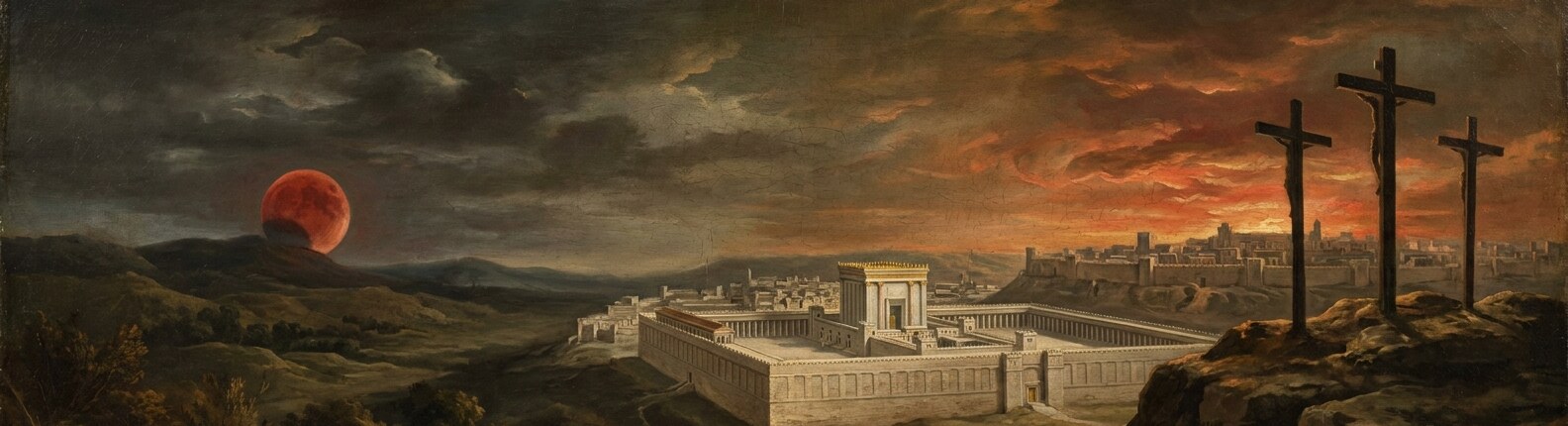
Summary
Jesus likely began his ministry in the second half of 29 AD and was crucified on April 3, 33 AD. The date of Jesus birth will be discussed in a future version of this article.
29 AD Ministry Start
John 1:6-41 describes Jesus beginning his ministry very close to when John the Baptist began preaching. And Luke 3:1-2 says John the Baptist began his ministry when:
| Event | Date |
|---|---|
| Pilate was governor of Judea (26–36 AD) | 26–36 AD |
| Herod Antipas was Tetrarch of Galilee | 4 BC – 39 AD |
| Philip, brother of Herod Antipas, was Tetrarch of Iturea and Trachonitis | 4 BC – 34 AD |
| Annas and Caiaphas were high priests | 18–36 |
| It was the 15th year of Tiberius, who became Emperor in 14 AD (not 11–13 AD as some suppose1). | Aug 19, 28 AD – Spring of 30 AD |
Additional clues about when Jesus started his ministry:
| Event | Date |
|---|---|
| Jesus was About 30 Years Old | ~27–30 |
| The Temple had "been under construction for forty-six years" when Jesus attended the Passover (in springtime) in John 2:20. | 27–30 AD, but possibly 24–36 AD |
3 Year Ministry Length
Jesus' ministry likely lasted a little over 3 years, because the Gospel of John names three Passovers (John 2:13, 6:4, 11:55) and implies a fourth: John 4:35 places Jesus in Samaria in mid-winter, four months before the harvest, so another Passover must have passed unrecorded before the next Passover John names in 6:4.
Crucifixion
All four gospels say Jesus was crucified on Passover, which was also the day of preparation (Friday) that occurred before the Sabbath.2 1 The Jews had no concept of a Sabbath on any day other than Saturday.1 The table below shows why 33 AD is the most likely crucifixion date:
| Event | Dates |
|---|---|
| Pilate was still governor of Judea when Jesus was crucified, per Luke 3:1, Josephus,2 and Tacitus.3 | 26–36 |
| Herod Antipas was involved in the trial leading to the crucifixion (Luke 23:7), but was deposed in 39 AD. | Before 39 |
| Sejanus was executed on October 18, 31 AD. Afterward, Tiberius reversed the anti-Jewish policies of Sejanus and began going after those close to him. This gives weight to the Jews' threat, "If you release this man, you are no friend of Caesar!" in John 19:12. | After Oct 18, 31 |
| Passover was on a Friday only in 30 and 33 AD, but not the surrounding years.4 | Friday, April 7, 30 or Friday, April 3, 33 |
| The duration of Jesus' ministry of just over 3 years ends on Passover (early spring) of 32 or 33 AD, based on the 29 AD start date above. | 32 or 33 |
| A Partial Lunar Eclipse occurred at moonrise of Passover on April 3, 33 AD,5 matching Peter's quote of Joel 2:31 "the sunlight will be turned to darkness and the moon to the color of blood" in Acts 2. | April 3, 33 |
| An Earthquake happened at the crucifixion per Matthew 27:50-54 and the Greek historian Phlegon,6 and at the resurrection per Matthew 28:2. Dead Sea varves indicate an earthquake in 31 AD ± 5 years.7 | 26–36 |
| The Talmud says the Jewish Sanhedrin lost their ability to give capital punishment "40 years before the temple was destroyed"8 in 70 AD, explaining why they had Pilate to sentence Jesus to death in John 18:31. | In or after 30 |
| The Talmud says the Jews saw multiple bad omens in the temple beginning "40 years before the temple was destroyed,"8 8 in 70 AD, which perhaps started either when Jesus' ministry began or at the crucifixion. | 30 or 33 |
| Phlegon says Jesus was crucified in fourth year of the 202nd Olympiad.6 | 33 |
April 3, 33 AD is the most compatible date for the crucifixion given all the data above, and is only contradicted by some of the dates estimated by early writers around or after 200 AD.
Birth
It's generally believed that Jesus was born between 7 BC and 1 BC. This section will be expanded later.
29 AD Start of Ministry
15th Year of Tiberius
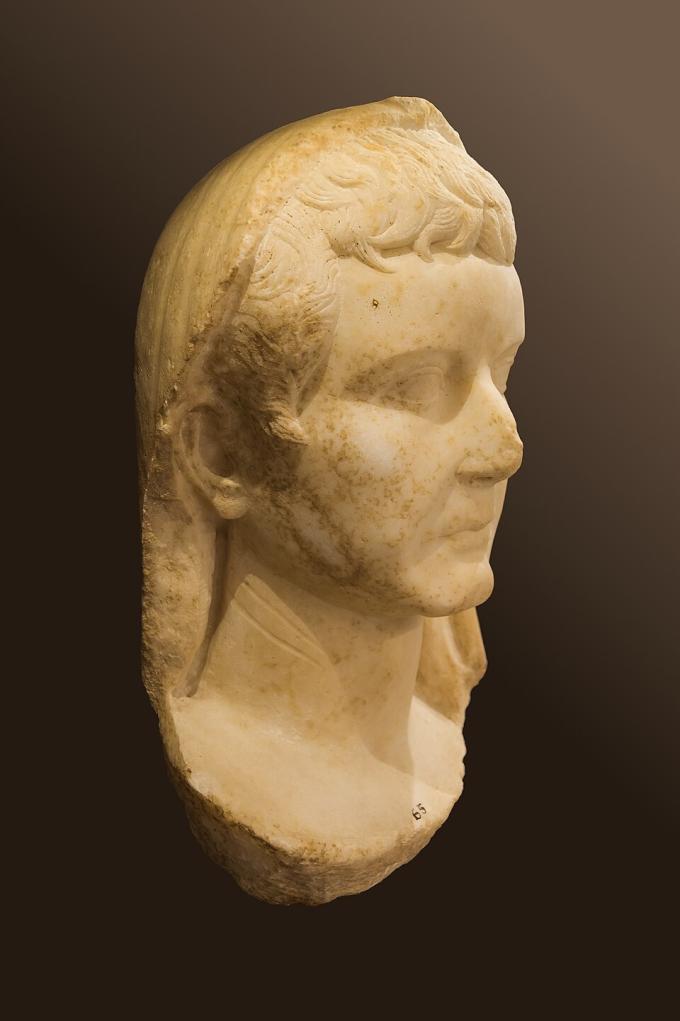
Tiberius Caesar. Roman marble portrait head, Archaeological Museum of Heraklion, Crete. Photo by Jebulon, CC0.

Luke 3:1-2 dates the start of John the Baptist's ministry to "the fifteenth year of the reign of Tiberius Caesar." Tiberius succeeded Augustus as emperor when Augustus died on August 19, 14 AD. The Roman Senate confirmed him on September 17.2 9 But ancient writers counted the years of a reign in several different ways. Depending on the system, his 15th year lands in different places:4 1 10
| System | 15th Year of Tiberius |
|---|---|
| Counting from accession on Aug 19, 14 AD | Aug 19, 28 – Aug 18, 29 AD |
| Jewish civil calendar (years begin in the fall) | Fall 28 AD – fall 29 AD |
| Roman Julian calendar (years begin Jan 1) | Jan 1 – Dec 31, 29 AD |
| Jewish religious calendar (years begin in spring) | Spring 29 AD – spring 30 AD |
Every system places the 15th year between August of 28 AD and the spring of 30 AD. All four include the spring and summer of 29 AD. The Roman reckonings are also the most likely. Luke addressed his gospel to "most excellent Theophilus" (Luke 1:3), a form of address he uses elsewhere only for Roman officials (Acts 23:26, 24:2). And Roman historians of the period — Tacitus, Suetonius, and Cassius Dio — dated an emperor's first year from the January 1 after his accession.4 1 10 By that reckoning, the 15th year of Tiberius is 29 AD.
John Meier and N. T. Wright instead have Luke counting inclusively, so that Tiberius's partial accession year of 14 AD counts as year one and the 15th year becomes 28 AD.11 But Andrew Steinmann's 2022 survey found no ancient evidence for inclusive counting of Tiberius's years. Egypt's dated coins and inscriptions stop at his year 23, exactly the count from 14 AD; an inclusive count would have reached year 24.11
A few scholars, such as Rainer Riesner, instead count Tiberius's reign from 11 to 13 AD, when Augustus granted him joint authority over the provinces.12 10 11 This co-regency reckoning is usually proposed to make room for a crucifixion in 30 AD. Counting from 14 AD leaves too little time for the 15th year plus a three-year ministry to finish by then.13 But no ancient source counts this way. Josephus, Tacitus, Suetonius, and Cassius Dio all count from Augustus's death in 14 AD. No surviving coin or inscription reckons his years from the co-regency.2 4 1 10 11 Steinmann's survey makes the coin evidence concrete. A coin of Antioch in Syria is double-dated to both "year one" of Tiberius and year 45 of Antioch's Actian era, September of 14 AD to September of 15 AD, and a coin of Seleucia likewise pairs his year 3 with Actian year 47. The years 24 to 26 that a co-regency count would require appear on no dated coin or inscription anywhere in the empire. And none calls Tiberius "son of the divine Augustus" until after Augustus died and was deified in 14 AD.11
Advocates of the earlier reckoning give six supporting arguments. Steinmann states and answers each:
- "About thirty years old." Luke 3:23 says Jesus was about thirty when he began his ministry. If Jesus was born in 4 BC, a baptism around 27 AD fits that number more comfortably. But the 4 BC birth year rests on Emil Schürer's 19th-century dating of Herod's death, which is disputed: W. E. Filmer, and later Steinmann himself, date Herod's death to 1 BC and the birth to about 2 BC. A contested birth year cannot fix the baptism year.11
- A Jubilee year. Jesus opened his ministry by reading Isaiah 61's "year of the Lord's favor" in the Nazareth synagogue (Luke 4:16-19). August Strobel argued that fall 26 to fall 27 AD was a Jubilee year, which would fit that reading, and Riesner follows him. But no ancient source records Jubilee years being observed at all in this period, and the reconstructed cycles contradict each other: Zuckermann's puts a Jubilee in 33/34 AD and Wacholder's in 34/35. Riesner also moves the underlying Sabbatical year forward a year "without offering any documentation." And Wacholder, whose work the argument leans on, wrote of Luke 3:1 that "this passage makes no mention of a sabbatical date."11
- The temple's 46 years. If John 2:20 means the temple had been under construction for 46 years, the exchange falls around 27 to 28 AD, and the baptism must come earlier still. But the count and its starting point are uncertain, as the next section shows, and the verb more likely means the sanctuary "was built forty-six years ago." Steinmann defends that reading at length and dates John 2:20 to the Passover of 30 AD, which requires a 29 AD baptism.11 14
- Annas and Caiaphas. Luke 3:2 names two high priests at once, so, the argument runs, Luke thought in terms of joint rule and applied it to Tiberius as well. But Luke never names the supposed co-ruler Augustus, so the parallel is an argument from silence. And by the same logic Pilate, Herod Antipas, Philip, and Lysanias, all listed in Luke 3:1, should each have had co-rulers. None did.11
- Luke's word for "reign." Luke wrote ἡγεμονία (hegemonia) rather than βασιλεία (basileia), which Riesner and Strobel read as pointing to Tiberius's hands-on authority over the provinces, granted while Augustus still lived. But ἡγεμονία is a general word for rule of any kind. Josephus, himself a provincial, uses the very same word for "the reign of the Romans transferred to Tiberius... after the death of Augustus." Luke also had reason of his own to avoid βασιλεία: everywhere else in Luke-Acts, "the kingdom of" a person means God's kingdom, with Satan's as the lone opposite.11
- The coins. Riesner writes, "Numismatic evidence also attests the rise of Tiberius as coregent after A.D. 13," but names no coins. The coins he cites elsewhere show the opposite. Until Augustus died, only Augustus carries the emperor's titles of pontifex maximus and pater patriae, while Tiberius appears as honored heir, never as ruler.11
After surveying the first- and second-century authors and every dated coin and inscription, Steinmann concludes it is "extremely unlikely that either Luke or his audience would have understood Luke 3:1 to place Jesus's baptism in any other year than AD 29."11
Luke 3:1 dates John the Baptist's ministry, not Jesus'. But John's Gospel shows Jesus beginning his ministry not long after John. In John 1:19, "the Jewish leaders sent priests and Levites from Jerusalem" to find out who John the Baptist was. This was likely soon after John began attracting attention. "On the next day" (John 1:29) John points out Jesus as "the Lamb of God." He also testifies that he saw the Spirit descend on Jesus at his baptism (John 1:32-34). So Jesus had already been baptized by then. Jesus gathers his first disciples over the following days (John 1:35-51) and soon begins his public ministry (John 2).
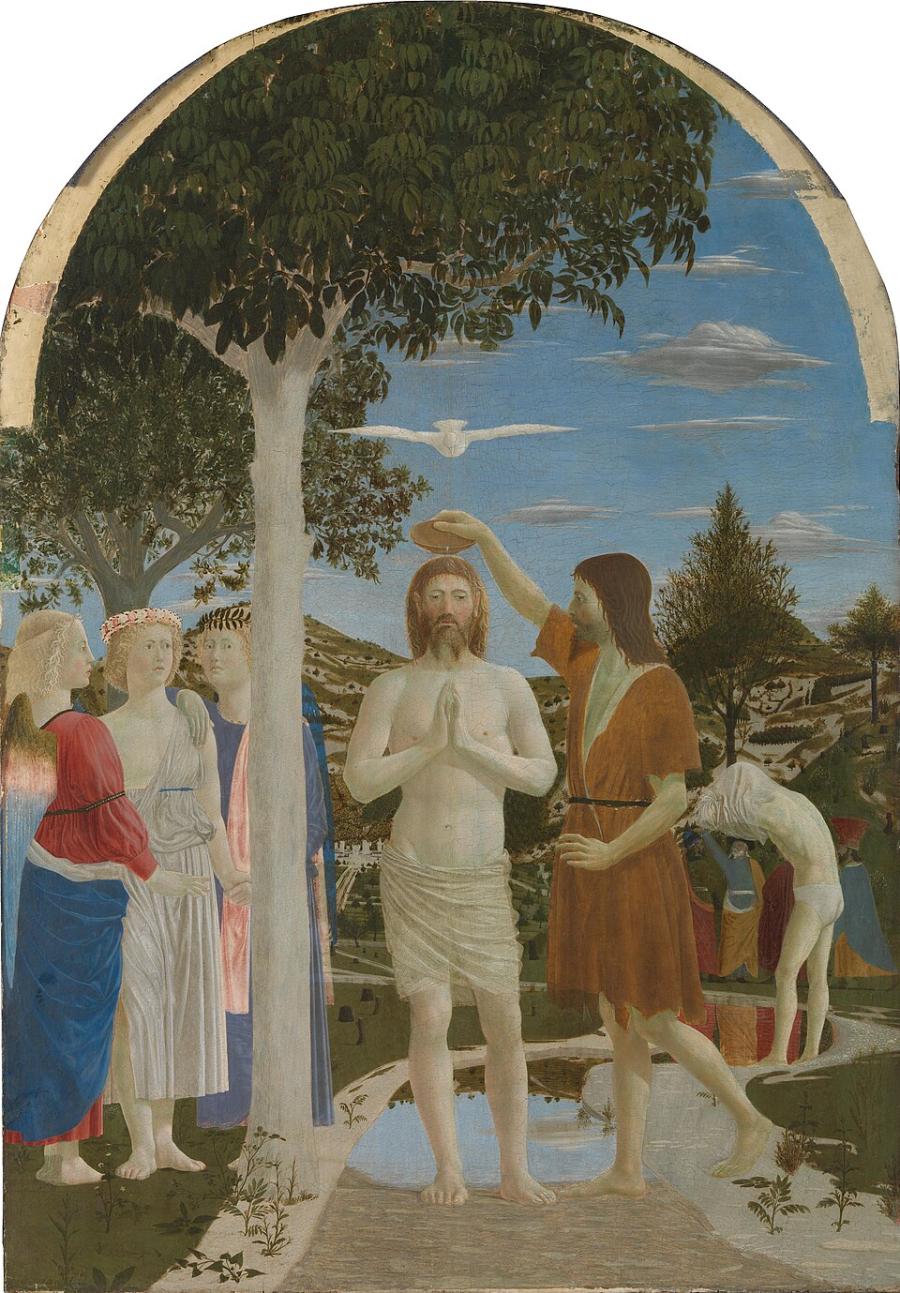
The Baptism of Christ, Piero della Francesca, about 1437–1445. National Gallery, London. Public domain.

46 Years to Build the Temple
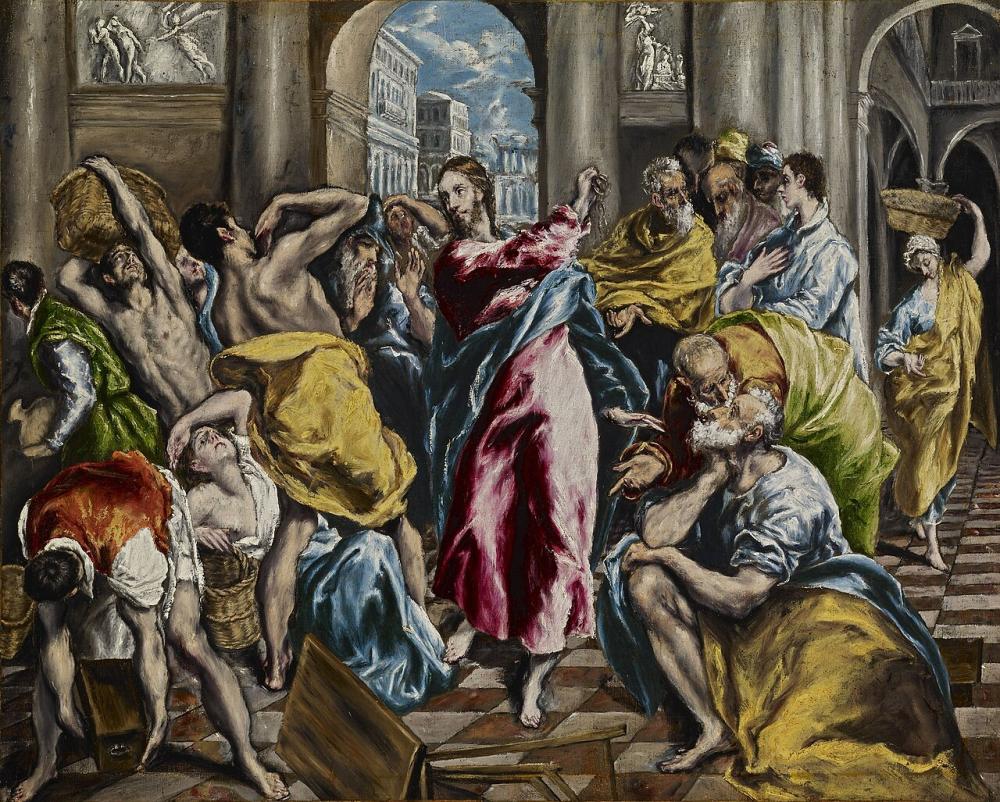
The Purification of the Temple, El Greco, about 1600. The Frick Collection, New York. Public domain.

In John 2:20, the Jewish leaders challenge Jesus:
Then the Jewish leaders said to him, “This temple has been under construction for forty-six years, and are you going to raise it up in three days?”
This was the temple Herod the Great rebuilt, so dating the leaders' forty-six years requires answering two questions: when Herod's project began, and what event the count runs from.
On the first question, the first-century Jewish historian Josephus gives two different start dates. In The Jewish War he says Herod rebuilt the temple in the 15th year of his reign,15 but in his later Antiquities of the Jews he says the 18th year.2 Josephus counts Herod's reign from his capture of Jerusalem in 37 BC and begins each regnal year at Nisan (March/April), so the 15th year runs from spring 23 to spring 22 BC, and the 18th from spring 20 to spring 19 BC.1 The 18th year is usually preferred because Josephus links the project to Caesar Augustus's visit to Syria, which the Roman historian Cassius Dio dates to 20 BC.1 Josephus adds that Herod first gathered a thousand wagons for hauling stone, ten thousand workmen, and a thousand priests' garments, and had priests trained as stonecutters and carpenters, all before building began — so actual construction may have started somewhat after the 18th year.2
On the second question, the forty-six years can be taken two ways. Most English translations read "has been under construction for forty-six years,"16 which is historically plausible: work on the temple complex continued off and on until about 63 AD, only seven years before the Romans destroyed it.2 But the Greek verb can also mean "this temple was built forty-six years ago" — that is, finished and standing for forty-six years.17 On that reading the count runs from the completion of some part of the complex: Josephus says "the temple it self was built by the priests in a year and six months,"2 while the outer courts took eight years.2 Combining the options gives a wide range of dates for the exchange in John 2:20:
| # | Reckoning | 46 years reached |
|---|---|---|
| 1 | 15th year (Mar 23 – Mar 22 BC) + 46 years under construction | Mar 24 – Mar 25 AD |
| 2 | 15th year + 1.5-year sanctuary build + standing 46 years | Sep 25 – Sep 26 AD |
| 3 | 15th year + 8-year courts build + standing 46 years | Mar 32 – Mar 33 AD |
| 4 | 18th year (Mar 20 – Mar 19 BC) + 46 years under construction | Mar 27 – Mar 28 AD |
| 5 | 18th year + 1.5-year sanctuary build + standing 46 years | Sep 28 – Sep 29 AD |
| 6 | 18th year + 8-year courts build + standing 46 years | Mar 35 – Mar 36 AD |
Two considerations narrow this range. First, the word John uses for temple is ναός (naos), which refers to the sanctuary building itself, rather than ἱερόν (hieron), the whole complex with its courts.17 The sanctuary is the part the priests built in 18 months,1 so the forty-six years should not be counted from the eight-year courts, ruling out reckonings #3 and #6. Second, the Antiquities 18th-year start date is the better attested, favoring #4 and #5 over #1 and #2. Those two reckonings place John 2:20 at a Passover around 27–29 AD, or a year or two later if construction began only after the preparations Josephus describes. Either way this is consistent with the chronology above: a ministry beginning in 29 AD, with its first Passover in the spring of 30 AD.
Andrew Steinmann defends the "built forty-six years ago" reading at length in a separate study. Dating the sanctuary's completion to late 18 BC, he places the John 2:20 exchange at the Passover of 30 AD exactly — the first Passover of a ministry that began in 29 AD.14
About 30 years Old
Luke 3:23 says "Jesus, when he began his ministry, was about thirty years old." But to make use of this number we need to know when Jesus was born, and that will be added in a future version of this article.
Early Writers on the Start
Every early witness who names a starting year, orthodox and heretic alike, anchors the start of Jesus' public life to Luke's 15th year of Tiberius. The hostile witnesses are the earliest: the Basilideans claimed to know the very day of the baptism, and Marcion, who denied the birth narratives entirely, still had Christ appear in the 15th year of Tiberius. Their statements are collected in the Early Writers section at the end of this article.
Three Year Ministry
Four Passovers in the Gospels
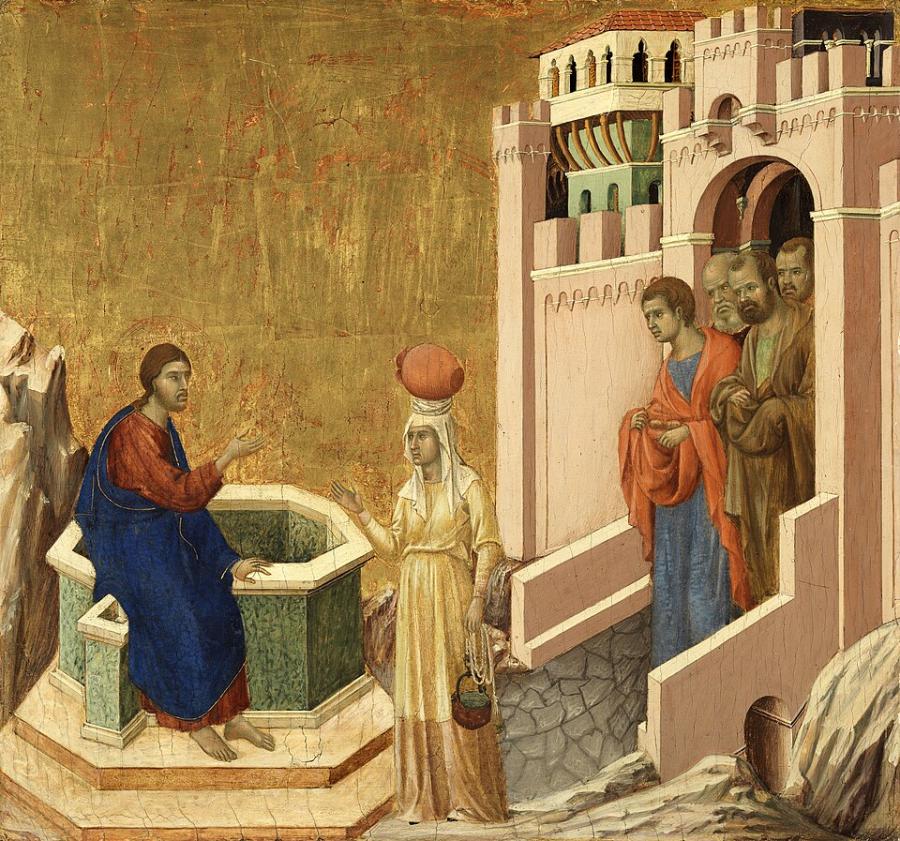
Christ and the Samaritan Woman, Duccio di Buoninsegna, 1310–1311. Museo Thyssen-Bornemisza, Madrid. At this well Jesus says the harvest is four months away, which dates the visit to midwinter. Public domain.

The Gospel of John names three Passovers during Jesus' ministry and implies a fourth. This gives a ministry of a little more than three years with some months before the first Passover.4 The gospels give these clues about the time of year:
-
Before the first Passover came:
- Jesus' baptism (Mark 1:9-11, Matthew 3:13-17, Luke 3:21-22, John 1:29-31)
- the 40-day temptation in the desert (Matthew 4:1-11, Mark 1:12-13, Luke 4:1-13)
- the calling of the first disciples (Matthew 4:18-22, John 1:43-51)
- the Wedding at Cana (John 2:1-11)
- and the journey to Capernaum (John 2:12).
-
In John 2:13 we see the first Passover of Jesus' ministry: "Now the Jewish feast of Passover was near, so Jesus went up to Jerusalem." Passover falls in late March or April.
-
In John 4:35, at the well in Samaria, Jesus tells his disciples: "Don't you say, 'There are four more months and then comes the harvest'?" Grain was harvested in April/May, so four months earlier puts this visit around December or January. Some suggest Jesus was only quoting a proverb. But no such proverb is attested,1 and a proverb about the growing season should say six months, the actual span from sowing in October/November to harvest.18 1 19 Jesus goes on to say "the fields are already white for harvest." Since the real harvest was still four months away, this is a metaphor for the Samaritans then streaming out to him (John 4:30), not a second time marker.
-
In Matthew 12:1, Mark 2:23, and Luke 6:1 the disciples pick and eat heads of grain as they walk through the fields. This fits the April/May harvest season.1 In the Synoptic order this happens long before the feeding of the 5000 (see #6). So it marks another springtime, and therefore another Passover season, between the first and third Passovers that John names.
-
John 5:1 mentions a feast without naming it: "After this there was a Jewish feast, and Jesus went up to Jerusalem." Which feast? Manuscripts split between "a feast" and "the feast," and the better-attested shorter reading points away from Passover. The NET translators also note that the sick lying outdoors in the porticoes (John 5:3) fits a warmer season, and they lean toward Pentecost.17 John names the Passover everywhere else he clearly means it (2:13, 2:23, 6:4, 11:55, 12:1, 13:1, 18:39, 19:14). So this feast was likely Pentecost in May, or the Feast of Tabernacles in September/October, which John elsewhere calls simply "the feast" (7:2, 7:10, 7:14, 7:37). If so, the second Passover passed unrecorded between the winter of John 4:35 and this feast. Irenaeus, the earliest writer to count John's Passovers, instead took this feast to be a Passover itself.20 Either way, a second Passover has now occurred.
-
John 6:4, at the feeding of the 5000: "Now the Jewish Feast of the Passover was near." This was the third Passover. Mark 6:39 independently notes the "green grass" of spring at the same event.
-
John 7:2, "Now the Jewish Feast of Shelters [Tabernacles] was near," in September/October.
-
John 10:22, "Then came the feast of the Dedication [Hanukkah, in December] in Jerusalem. It was winter, and Jesus was walking in the temple area in Solomon’s Portico." This might correspond to when "Jesus set out resolutely to go to Jerusalem" in Luke 9:51.
-
In John 11:7-17, Jesus returned to Bethany, near Jerusalem, after the death of Lazarus. This could possibly correspond with the same trip in Luke 13:31-33: "some Pharisees came up and said to Jesus, 'Get away from here, because Herod wants to kill you.' But he said to them, '... I must go on my way today and tomorrow and the next day, because it is impossible that a prophet should be killed outside Jerusalem.'"
-
In John 11:55, "Now the Jewish Feast of Passover was near." This was the Passover of the crucifixion — Jesus' fourth and final Passover. It could possibly correspond with Jesus' trip toward Jerusalem in Luke 17:11, and with his going to "the region of Judea" in Matthew 19:1 and Mark 10:1.
The weakest links in this count are the unnamed feast of John 5:1 and the reading of John 4:35, and a skeptic could reject both. But even then, John still names three Passovers outright (2:13, 6:4, 11:55), which by themselves force a ministry of at least two years. Irenaeus pressed this same point against the one-year-ministry Gnostics around 180 AD: "that these three occasions of the passover are not included within one year, every person whatever must acknowledge."20 The Synoptics name only the final Passover, but they agree with John's longer span: the ripe grain of #4 and the green grass of #6 both fall well before the final Passover in their order of events. A one-year ministry, favored by several early writers below, is only possible if John's named Passovers are set aside.
Early Writers on the Length
Early writers disagreed widely about how long Jesus' ministry lasted, from one year to more than ten. Many were not reasoning from the Gospel record, so their testimony carries less weight than the Passover count above. Still, the three-year figure appears as early as Melito, around 170 AD. Each writer's statements are collected in the Early Writers section at the end of this article.
Friday Passover Crucifixion
A Friday crucifixion is the common consensus of the Church fathers, scholars throughout history, and scholars today.1 But rather than lean on consensus, let's examine the evidence.
The week before Passover
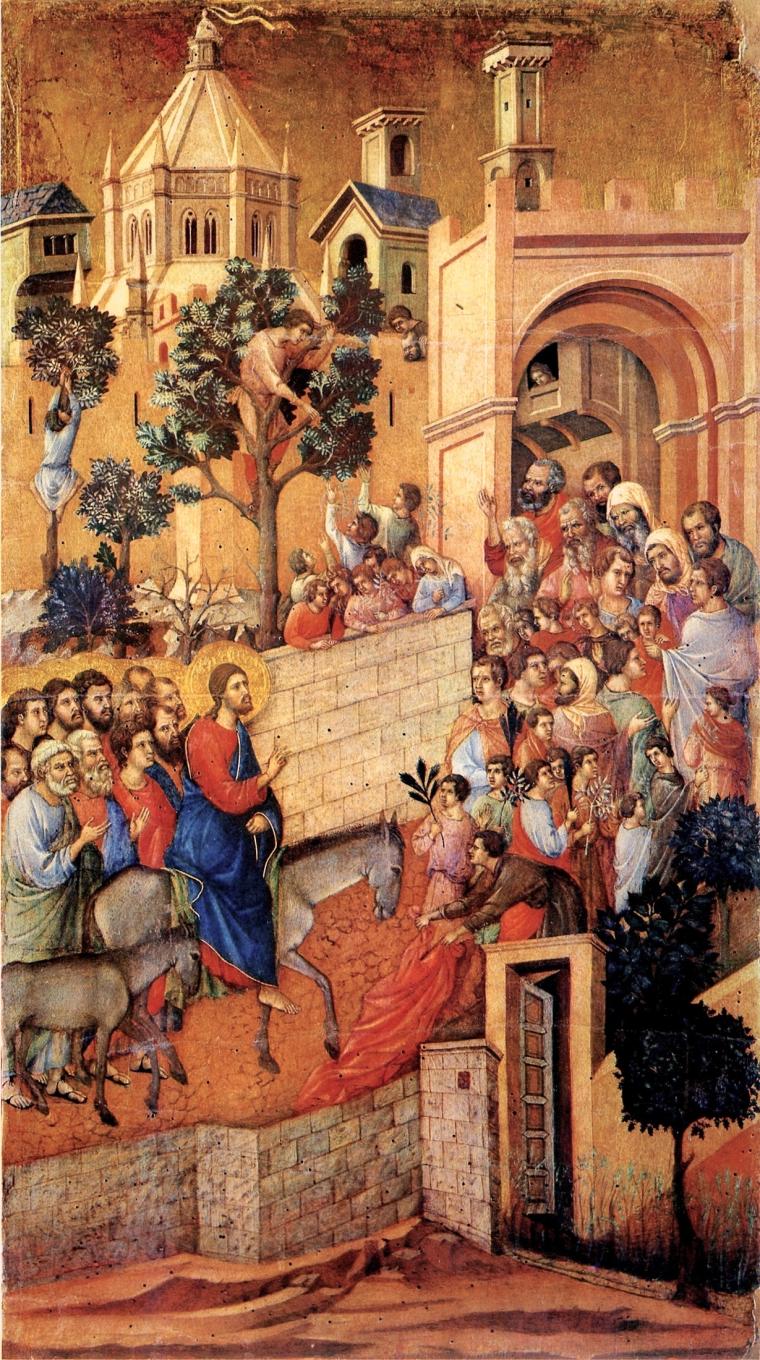
Entry into Jerusalem, from the back of Duccio di Buoninsegna's Maestà, 1308–1311. Museo dell'Opera del Duomo, Siena. Public domain.

John 12:1 says "six days before the Passover, Jesus came to Bethany." Counting six days back from a Friday Passover lands on the previous Saturday. From there the gospels can be pieced together to trace each day of the week:
- Saturday
- John 12:1-9 says "six days before the Passover, Jesus came to Bethany." He has dinner with Lazarus, Mary, and Martha, with Martha serving. Mary anoints Jesus' feet with oil, and Judas complains that the oil should've been sold. A large crowd comes to see Jesus and Lazarus. The chief priests plan to kill Lazarus.
- Sunday
- John 12:12-13 says the Triumphal Entry (Palm Sunday) was the next day. A "large crowd that had come to the feast" brought palm branches to meet Jesus, shouting "Hosanna!" Jesus rides a donkey into Jerusalem.
- Mark 11:1-11 Mark 11:1-11 describes the same event and adds that Jesus went back to Bethany late that night with the disciples. This allows us to merge John's and Mark's time-lines.
- Monday
- Mark 11:12-14 says "the next day, as they went out from Bethany" Jesus cursed a fig tree.
- Mark 11:15-19 describes Jesus coming to the temple area and turning over the tables of the money changers. "When evening came, Jesus and his disciples went out of the city."
- Tuesday
- Mark 11:20-21 says "In the morning" Peter pointed out "the fig tree you cursed has withered" and 11:27 says "they came again to Jerusalem." In Mark 11:27 to 13:37, the Pharisees question Jesus' authority and Jesus gives many teachings.
- Wednesday
- Mark 14:1 says it was now "two days before the Passover and the Feast of Unleavened Bread." Mark 14:3-11 describes Jesus visiting Simon the leper where a woman pours expensive oil on Jesus, and some present complain about the cost. Judas meets with the chief priests to betray Jesus.
- Thursday
- Mark 14:12-16 says the disciples went into Jerusalem and prepared a large upstairs room for the Passover meal.
- That evening Jesus ate the Last Supper with the twelve, predicted his betrayal, and instituted the bread and the cup (Mark 14:17-25, Matthew 26:20-29, Luke 22:14-23, John 13).
- Late that night Jesus prayed in Gethsemane and was arrested (Mark 14:32-52). The Sanhedrin tried him during the night while Peter denied him outside (Mark 14:53-72).
- Friday
- Early in the morning the Sanhedrin handed Jesus over to Pilate (Mark 15:1, John 18:28).
- Jesus was crucified at "the third hour," about 9 am (Mark 15:25).
- Darkness covered the land from noon until 3 pm, when Jesus died (Mark 15:33-37).
- Jesus was buried before evening (Mark 15:42-47).
Jesus dies on the Eve of Passover
Jewish days ran from sunset to sunset. The Passover lambs were slain on the afternoon of Nisan 14, and the Passover meal was eaten that evening, after the start of Nisan 15 (Exodus 12:6-8, Leviticus 23:5-6). Josephus says the lambs were slain "from the ninth hour till the eleventh," about 3–5 pm.15 So "Passover Eve" means Nisan 14, the day of the sacrifice. These statements indicate Jesus died on that day:
- John 13:1-2: "Just before the Passover Feast, Jesus knew that his time had come to depart from this world to the Father... The evening meal was in progress." John 13-18 indicates Jesus' betrayal, arrest, trial, and crucifixion occurred immediately after this and into the next day.
- In John 18:28, on the morning of the trial, the Jewish leaders would not enter Pilate's residence. They wanted to avoid ritual defilement so that they could still "eat the Passover." The Passover meal was still ahead of them.
- In 1 Corinthians 5:7, Paul wrote, "...Christ, our Passover lamb, has been sacrificed." Jesus died at about 3 pm (Mark 15:34-37), the hour the lambs began to be slain.
- In 1 Corinthians 15:20, Paul wrote, "...Christ has been raised from the dead, the firstfruits of those who have fallen asleep." The firstfruits offering was made on Nisan 16, the day after the Passover feast day (Leviticus 23:11).2 Jesus rose on "the first day of the week" (Mark 16:2, Luke 24:1, John 20:1). If that Sunday was Nisan 16, then the Sabbath was Nisan 15, and Jesus died on Friday, Nisan 14, the eve of Passover.
The Babylonian Talmud agrees. Sanhedrin 43a says:
On Passover Eve they hung the corpse of Jesus the Nazarene after they killed him by way of stoning.8
But Didn't Jesus Eat a Passover Meal the Night Before?
Here the gospels seem to contradict each other, and skeptics press the point. Mark 14:12 says the disciples prepared the upper room "on the first day of the feast of Unleavened Bread, when the Passover lamb is sacrificed." At the table Jesus says, "I have earnestly desired to eat this Passover with you before I suffer" (Luke 22:15). Matthew 26:17 and Luke 22:7 say the same. Read alone, the Synoptics make the Last Supper a Passover meal, which would put the crucifixion on Nisan 15. But the evidence above — John 18:28, John 19:14, Paul, and the Talmud — puts the death on Nisan 14, before the priests had eaten. If there was only one lawful evening for the meal, both cannot be right.
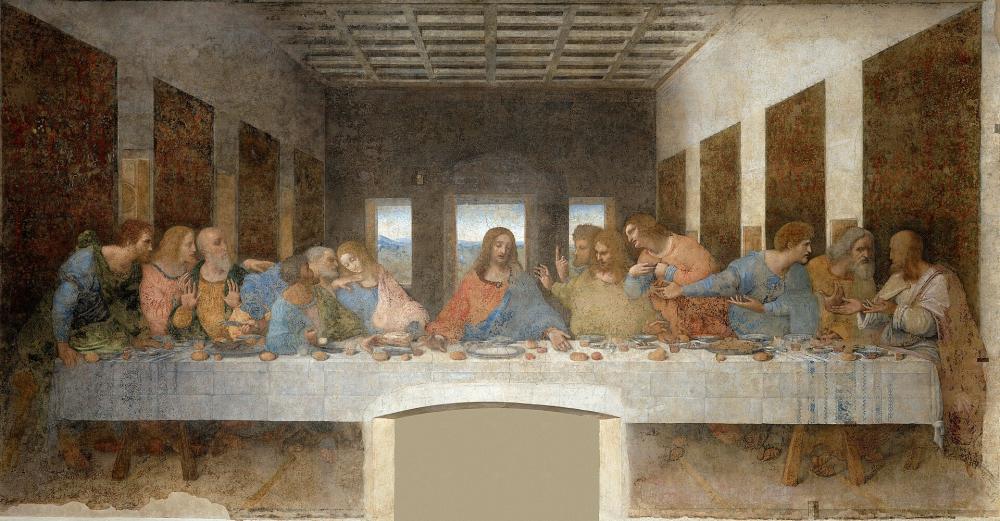
The Last Supper, Leonardo da Vinci, 1495–1498. Santa Maria delle Grazie, Milan. Public domain.

The Last Supper has the marks of a real Passover meal, not an ordinary supper. Joachim Jeremias collected the evidence: it was eaten at night, inside Jerusalem's crowded walls as the Law required, reclining, with red wine and a closing hymn. Some disciples assumed Judas left to buy feast supplies or to give to the poor, both Passover-night customs.1 Attempts to make it a kiddush blessing ceremony or an ordinary fellowship meal have failed to fit these details.1
Several harmonizations have been proposed:
- John is speaking loosely. Some scholars, such as Andreas Köstenberger, take the Synoptics literally and read John's "eat the Passover" (John 18:28) as the feast sacrifices later in the week.13 On this view Jesus died on Nisan 15. Leon Morris objected that "the Passover" can include the whole week's feast, but it cannot mean the feast without the Passover meal itself, which is what the view requires.1 It also fits the astronomy poorly: the computed calendars below put Nisan 14, not 15, on Friday, April 3 of 33 AD.
- Jesus held his Passover a day early, knowing he would die. But the lamb had to be slain in the temple, and the priests would not have sacrificed one a day ahead of the law.1
- Jesus followed the Essene solar calendar and ate the Passover on Tuesday (Annie Jaubert). Nothing in the gospels connects Jesus to the Qumran calendar.1
- Jesus followed the older sunrise-based calendar and ate a real Passover on Wednesday (Colin Humphreys).10 This shares the same weakness, and it would move the Last Supper a day earlier than the day-by-day walkthrough above.
The most economical solution needs no second calendar, only two ways of marking when a day begins, and both are attested. Harold Hoehner, drawing on calendar studies by Julian Morgenstern and G. R. Driver, argues that Galileans and Pharisees counted the day from sunrise, while Judeans and Sadducees counted from sunset.1 By Galilean reckoning, Nisan 14 ran from Thursday sunrise to Friday sunrise: their lambs were slain Thursday afternoon and eaten that evening. By Judean reckoning, Nisan 14 ran from Thursday sunset to Friday sunset: the official temple lambs were slain Friday afternoon and eaten Friday night. So Jesus, a Galilean, ate a true Passover on Thursday evening, while the priests who arrested him still had theirs ahead of them, exactly as John 18:28 says. The Mishnah preserves a trace of the regional difference: Galileans did no work at all on the day of Passover, while Judeans worked until midday.1 Two days of slaughter would also ease the enormous task of killing every household's lamb in a single two-hour window. And Jesus died about 3 pm on Friday, the very hour the official lambs began to be slain: "Christ, our Passover lamb, has been sacrificed" (1 Corinthians 5:7).
We state the weakness plainly. No ancient text says outright that the two groups reckoned the day differently, or that lambs were slain on two afternoons. Hoehner concedes: "there is no explicit statement to support the view. Although one cannot be overly dogmatic, it does fit well with the data at hand."1
Whichever harmonization is right, the date barely moves. Every option keeps a Friday death in Passover week, and John's Nisan-14 dating — supported by Paul, the Talmud, and the computed calendars below — stands on its own. The dispute is only over how the Thursday meal was also a Passover.
The Passover when Jesus died was Friday, the day before the Sabbath
All four gospels say Jesus was crucified on "the day of preparation" (Matthew 27:62, Mark 15:42, Luke 23:54, John 19:14, 19:31, 19:42). In the gospels and in other sources from the period, this term means Friday, the day when Jews prepared for the Saturday Sabbath.2 1 Mark 15:42 defines it when Joseph of Arimathea asks for the body of Jesus:
it was the day of preparation (that is, the day before the Sabbath)
And Luke 23:54:
It was the day of preparation, and the Sabbath was beginning.
John 19:31, directly after Jesus dies, likewise says the next day was the Sabbath:
Then because it was the day of preparation, so that the bodies should not stay on the crosses on the Sabbath (for that Sabbath was an especially important one), the Jewish leaders asked Pilate to have the victims’ legs broken and the bodies taken down.
That Sabbath was "especially important" because it was doubly holy. It was both the weekly Saturday Sabbath and Nisan 15, the opening feast day of Passover and Unleavened Bread, itself a day of rest (Leviticus 23:5-7, Numbers 28:17-18).
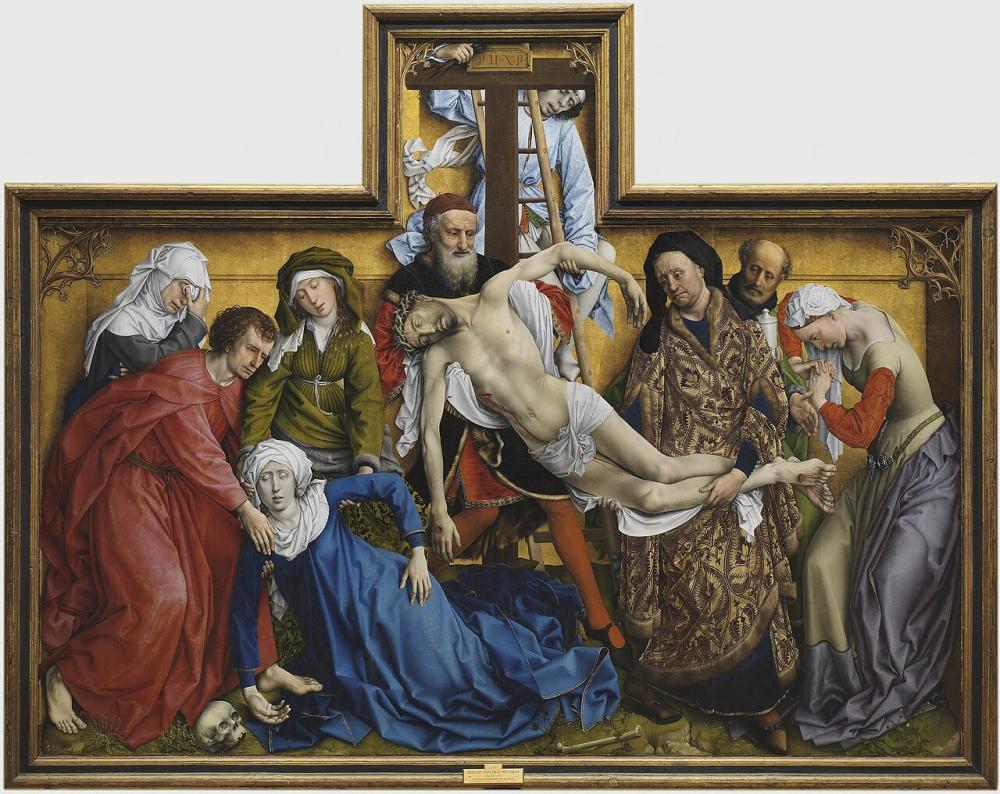
The Descent from the Cross, Rogier van der Weyden, about 1435. Museo del Prado, Madrid. Joseph of Arimathea asked Pilate for the body because the Sabbath was about to begin. Public domain.

Not Crucified on Wednesday or Thursday
Some propose that Jesus was crucified on Wednesday or Thursday rather than Friday. The case rests mainly on Matthew 12:40:
For just as Jonah was in the belly of the huge fish for three days and three nights, so the Son of Man will be in the heart of the earth for three days and three nights.
Jesus rose on or just before dawn on the first day of the week (Matthew 28:1, Mark 16:2, 9, Luke 24:1, John 20:1). A Friday burial to a Sunday resurrection spans only two nights. So proponents read "three days and three nights" as three full days, or exactly 72 hours, and count backward from Sunday to reach Thursday or Wednesday. They must then take the Sabbath after the crucifixion (John 19:31) to be an annual feast day rather than a Saturday. The sections below examine each step.
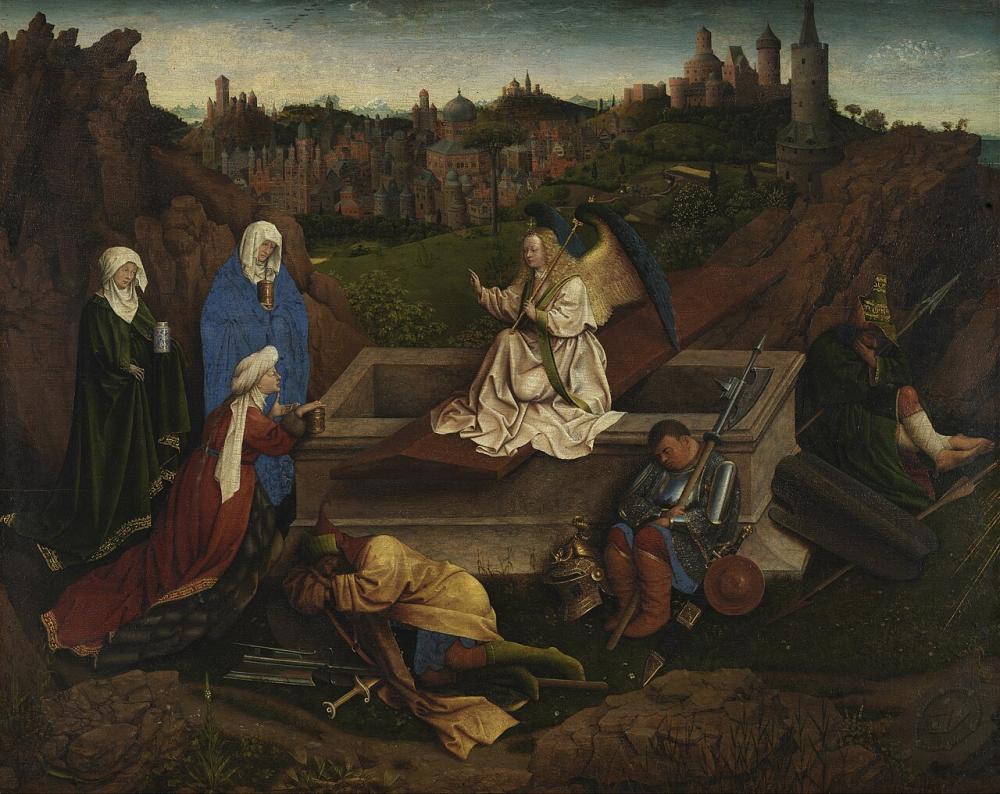
The Three Marys at the Tomb, Hubert and/or Jan van Eyck, about 1425–1435. Museum Boijmans Van Beuningen, Rotterdam. Public domain.

Before/On/After the Third Day
Various passages seem to disagree about whether Jesus would rise from the dead before, on, or after the third day:
- Before the third day: In Matthew 27:63-64 the chief priests asked Pilate to guard the tomb "until the third day." The key word being "until." Likewise in Luke 24:21, "it is the third day" since Jesus was crucified, spoken while it was still the first day of the week (Luke 24:1, 24:13).
- On the third day: Jesus says he will rise "on the third day" in Matthew 16:21, 17:23, 20:19, Luke 9:22, 18:33, and 24:7. Acts 10:40 and 1 Corinthians 15:4 also say Christ was raised on the third day.
- After three days: Mark 8:31, 9:31, and 10:34 say Jesus will rise "after three days," and Matthew 12:40 says "three days and three nights."
If each phrase is pressed as an exact duration, these statements contradict each other no matter which day Jesus died. They only agree if all were loose idioms for the same short span. The next two sections show that Jewish counting worked exactly this way.
No such thing as a mid-week "Sabbath"
John 19:31 says the day after the crucifixion was a Sabbath. After a Wednesday or Thursday crucifixion, that next day would be a Thursday or Friday. So these theories must claim that the feast day of Nisan 15 was itself called a Sabbath, whatever day of the week it fell on, since no regular work was done on it (Leviticus 23:5-7). But there is no evidence that Jews ever called this feast day a Sabbath. Hoehner writes:
The argument that since Nisan 15 is a holy convocation on which no one works and thus conclude that it was a Sabbath is a non sequitur. There is no evidence for this anywhere. This is a creation of those who hold this theory only to fit their [Wednesday or Thursday crucifixion] theory.1
Furthermore, John's phrase "an especially important" Sabbath fits the weekly Sabbath and the Feast of Unleavened Bread falling on the same day, as shown above.
Some also cite Matthew 28:1, literally "at the end of the Sabbaths," as evidence that this week had two Sabbaths. But the plural form was normal for a single day. A third of the New Testament's mentions of "Sabbath" are plural while only one day is in view, as in Matthew 12:1-12.1
Sunday was "the third day"
One version of the Wednesday theory proposes that Jesus rose at sunset on Saturday, exactly 72 hours after a Wednesday evening burial. This aims to satisfy "on the third day" and "after three days" at once.
But on Sunday the disciples on the Emmaus road said "it is now the third day" since Jesus was crucified (Luke 24:1, 24:13, 24:21). Counting from a Wednesday crucifixion, Sunday would be at least the fourth day, not the third.
Jews Often Used Inclusive Counting
Early Jewish sources show that part of a day was counted as a whole day. By this inclusive counting, the parts of Friday, Saturday, and Sunday that Jesus spent in the tomb count as three days.
The Jerusalem Talmud records Rabbi Eleazar ben Azariah, who taught around 110–135 AD:
Rebbi Ismael treats part of a term like the whole, but Rebbi Aqiba does not treat part of a term like the whole. It was stated so about Rebbi Aqiba: “Therefore if part of the first term had elapsed, one completes it by the sixth term.” It was stated: Rebbi Eleazar ben Azariah says, day and night each are a term, and part of a term is like the whole.21
The Babylonian Talmud, drawing rules from the actions of Rabbi Hiyya around 200–220 AD, says:
with regard to the halakhot [law] of mourning, the legal status of part of the day is like that of an entire day.8
Though the principle was sometimes disputed:
At the outset what did he hold, and ultimately what did he hold? Initially, Rabbi Yehuda HaNasi held that the legal status of part of the day is like that of an entire day, and since the thirtieth day already begun, Rabbi Hiyya’s time of admonition had ended. But ultimately he held that with regard to this issue we do not say that the legal status of part of the day is like that of an entire day.8
Likewise the Jewish Encyclopedia says:
In Jewish communal life part of a day is at times reckoned as one day; e.g., the day of the funeral, even when the latter takes place late in the afternoon, is counted as the first of the seven days of mourning; a short time in the morning of the seventh day is counted as the seventh day;22
Examples of Inclusive Counting
Other passages in both the Old and New Testaments use before, on, and after three days interchangeably:
- Genesis 42:17-19 tells of Joseph dealing with his brothers: "he put them all together in custody for three days... On the third day Joseph said to them... let the rest go and carry grain for the famine of your households"
- Esther 4:16, Esther asks Mordecai to have the Jews fast: “do not eat or drink for three days, night or day. I and my young women will also fast as you do. Then I will go to the king...” And then in 5:1, "On the third day Esther put on her royal robes and stood in the inner court of the king's palace."
- 2 Chronicles 10:5, 12, "Come again unto me after three days. ... So ... all the people came to Rehoboam on the third day.”
- Luke 13:32-33, "He [Jesus] replied, 'Go tell that fox [Herod], "I will keep on driving out demons and healing people today and tomorrow, and on the third day I will reach my goal." In any case, I must press on today and tomorrow and the next day—for surely no prophet can die outside Jerusalem!'"
And in the writings of Josephus:
- David commanded Amasa to gather an army and "come to him within three days." Amasa "made some delay... and so was not yet returned." Then "on the third day" David said, "It is not fit we should make any delay."2
No signs of Decay on the Shroud of Turin
There's good evidence the Shroud of Turin is the burial cloth of Jesus. This evidence will be presented in a future article.
The shroud limits how long Jesus was in the grave. A decaying body leaves chemical traces on cloth about 40 hours after death, and the shroud shows none:23
On the Shroud there are no signs of putrefactions, which occur at the orifices about 40 h after death. This means that the image does not depend on putrefaction gases and the corpse was wrapped in the Shroud not longer than two days.
A Friday evening burial to an early Sunday resurrection is about 36 hours, within that limit. A Wednesday or Thursday burial would mean roughly 60–84 hours in the grave, well past it.
April 3, 33 AD Crucifixion
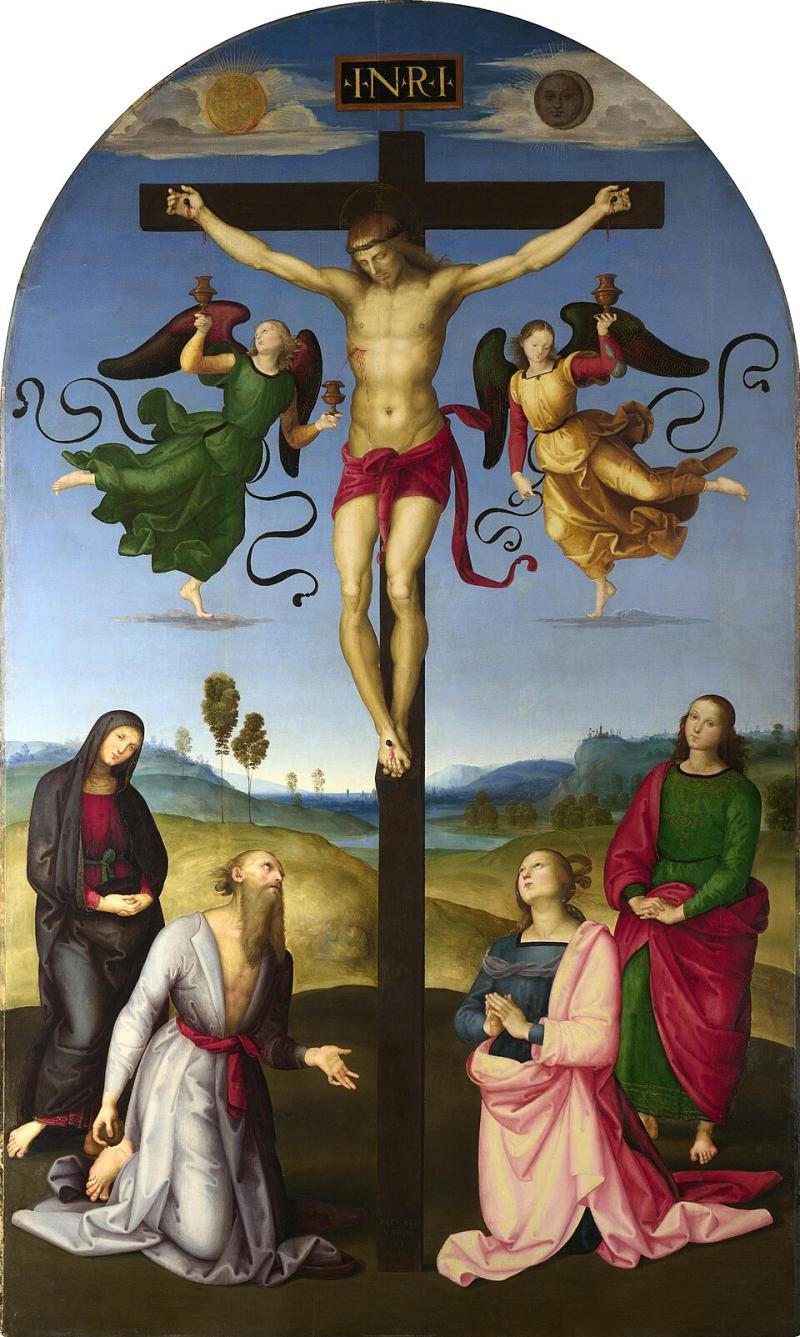
The Mond Crucifixion, Raphael, about 1502–3. National Gallery, London. The sun and the moon flank the cross, a standard feature of medieval and Renaissance crucifixions. Public domain.

A Friday Passover Eve only occurs in 30 and 33 AD.
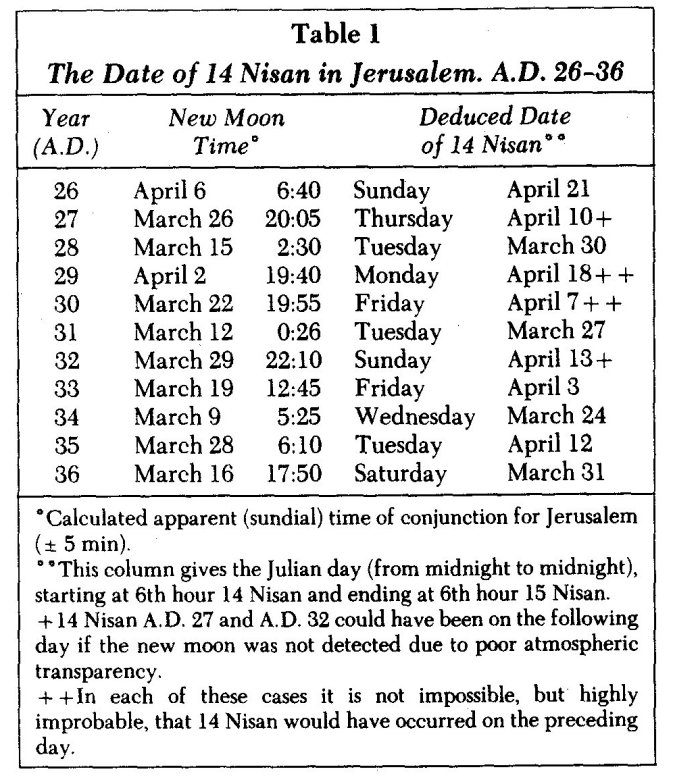
Astronomers can compute ancient Jewish calendar dates. Nisan 1 began at sunset when the new crescent moon first became visible from Jerusalem. Astronomy fixes the moment of each new moon, and visibility rules fix the evening the crescent was first seen. Nisan 14, Passover Eve, follows 13 days later. Two uncertainties remain. First, bad weather could hide the crescent, starting the month a day late. Second, the priests sometimes added a 30-day leap month (a second Adar) to keep Passover after the spring equinox. These give some years an alternate possible date.24 25
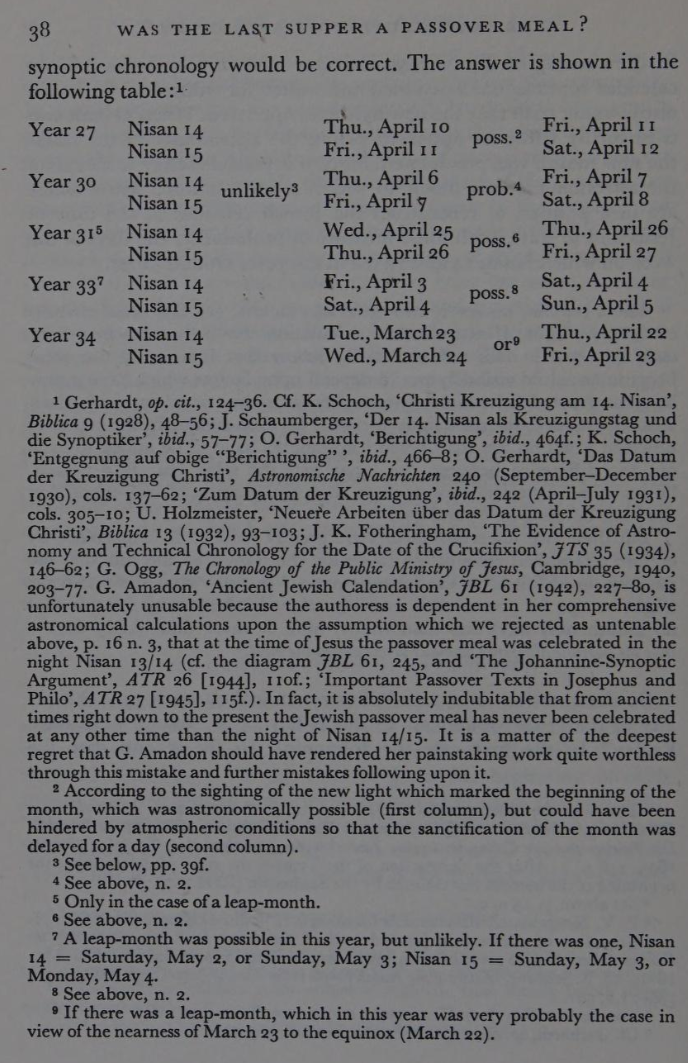
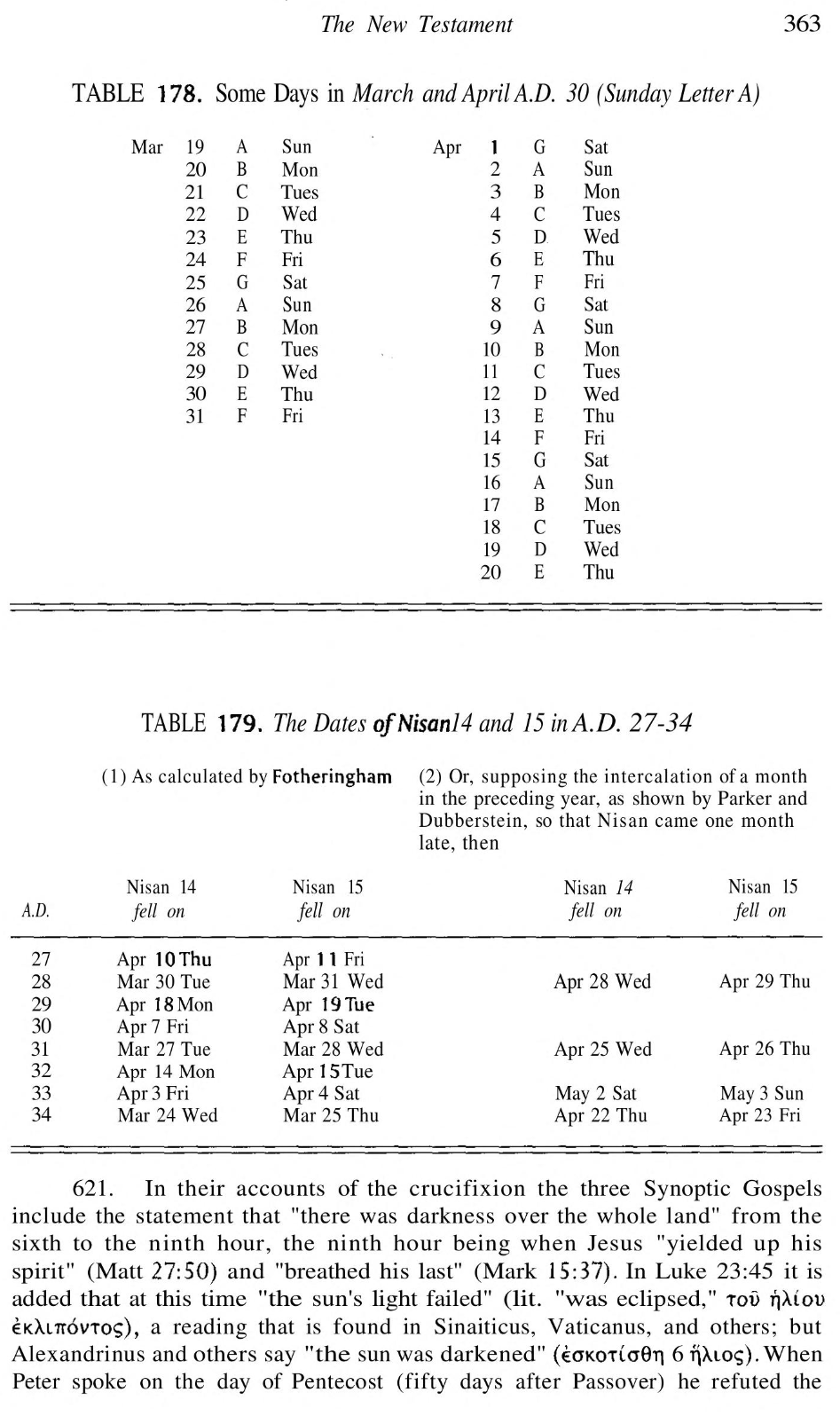
Three independent computations cover the candidate years: Oxford astronomer J. K. Fotheringham (1934),26 New Testament professor Joachim Jeremias (1977),24 and physicist Colin Humphreys with astrophysicist Graeme Waddington (1985).25 Each author's dates for Nisan 14:
| Year | Fotheringham 1934 | Jeremias 1977 | Humphreys & Waddington 1985 |
|---|---|---|---|
| 26 | Sun, Apr 21 | ||
| 27 | Thu, Apr 10 | Thu, Apr 10; possibly Fri, Apr 11 | Thu, Apr 10 † |
| 28 | Tue, Mar 30; leap: Wed, Apr 28 | Tue, Mar 30 | |
| 29 | Mon, Apr 18 | Mon, Apr 18 †† | |
| 30 | Fri, Apr 7 | probably Fri, Apr 7; unlikely Thu, Apr 6 | Fri, Apr 7 †† |
| 31 | Tue, Mar 27; leap: Wed, Apr 25 | leap only: Wed, Apr 25; possibly Thu, Apr 26 | Tue, Mar 27 |
| 32 | Mon, Apr 14 | Sun, Apr 13 † | |
| 33 | Fri, Apr 3; leap: Sat, May 2 | Fri, Apr 3; possibly Sat, Apr 4; unlikely leap: Sat, May 2 | Fri, Apr 3 |
| 34 | Wed, Mar 24; leap: Thu, Apr 22 | Tue, Mar 23; probable leap: Thu, Apr 22 | Wed, Mar 24 |
| 35 | Tue, Apr 12 | ||
| 36 | Sat, Mar 31 |
† Could be one day later if bad weather hid the new crescent.25
†† The preceding day is "not impossible, but highly improbable."25
"leap:" marks the date if a leap month was added that year. Fotheringham's leap alternates come from Parker and Dubberstein's tables of Babylonian intercalations, added by Finegan.27
All three computations agree: between 26 and 36 AD, Nisan 14 falls on a Friday only in 30 AD (April 7) and 33 AD (April 3).4 Hoehner reports older studies that also allowed Fridays in 27 and 36 AD.1 The later computations rule both out: 27 AD gives a Friday only if the crescent was missed, and 36 AD comes out a Saturday. Both years are impossible anyway. A 27 AD crucifixion comes before Luke's 15th year of Tiberius, and a 36 AD crucifixion requires a ministry of about seven years.
A popular 32 AD crucifixion date also fails this test. It comes from The Coming Prince, an 1881 book by Sir Robert Anderson, who later led Scotland Yard's Criminal Investigation Department. Anderson counted the 69 weeks of Daniel 9:25-26 as 173,880 days: 483 "prophetic years" of 360 days each. He ran them from a decree of Artaxerxes on March 14, 445 BC to a triumphal entry on Sunday, April 6, 32 AD, and declared the fit exact "to the very day."28 Both endpoints are now outdated. Newer evidence puts the decree in Nisan of 444 BC. And the table above gives 32 AD no Friday Passover eve; Hoehner notes a 32 AD date "would mean that Christ was crucified on either a Sunday or Monday," forcing Anderson into "mathematical gymnastics to arrive at a Friday crucifixion."1 Hoehner reran the same 360-day count from the corrected 444 BC start. It ends on March 30, 33 AD, which was Nisan 10, four days before the crucifixion on Friday, April 3.1
All dates above are in the Julian calendar, the standard for ancient history. Some websites instead convert to our modern Gregorian calendar, which relabels Friday, April 3, 33 AD as April 1 — the same physical day, two days earlier on paper.
Three years after ministry start is 32–33 AD.
Based above on Jesus starting his ministry about 29 AD and having about four Passovers, the crucifixion at the fourth Passover would be on April 3, 33 AD. Even if we only use the three Passovers explicitly mentioned in John, this is still too much time for a 30 AD crucifixion.
Lunar Eclipse on April 3, 33 AD
A partial lunar eclipse happened on the proposed crucifixion date of April 3, 33 AD.29 5 A full moon always rises in the east at sunset, opposite the sun. So as the sun set in Jerusalem that evening, a partly darkened moon was rising.
In Acts 2 / Joel 2:31
Seven weeks later, Jesus' disciple Peter says the moon had changed "to blood" at the crucifixion. Acts 2:16, 20, 22-23:
16 ...this is what was spoken about through the prophet Joel: ...
20 "The sun will be changed to darkness and the moon to blood before the great and glorious day of the Lord comes." ...
22 Men of Israel, listen to these words: Jesus the Nazarene, a man clearly attested to you by God with powerful deeds, wonders, and miraculous signs that God performed among you through him, just as you yourselves know— 23 this man, who was handed over by the predetermined plan and foreknowledge of God, you executed by nailing him to a cross at the hands of Gentiles.
A "blood moon" was a common way to describe a lunar eclipse in the ancient world.25 In Acts 2:20 Peter quotes the prophet Joel (Joel 2:31), who wrote hundreds of years earlier. Peter presents the darkness and the blood moon as recently fulfilled, before a crowd he says knew these things themselves (Acts 2:22).30
This is not a detail anyone could invent or stage. The eclipse was a public event, visible to the whole city, and modern astronomy confirms it happened on the same date the rest of the evidence already points to. To be clear, lunar eclipses were predictable long before 33 AD. Babylonian astronomers had forecast them for centuries,31 32 and lunar eclipses are far easier to predict than solar ones because each is visible from the entire night side of the earth.33 So this does not claim the timing was miraculous or secretly foreseen. The claim is that it's unlikely someone could arrange to be arrested, tried, and crucified on the exact day a blood moon would rise over Jerusalem.
Table of Lunar Eclipses
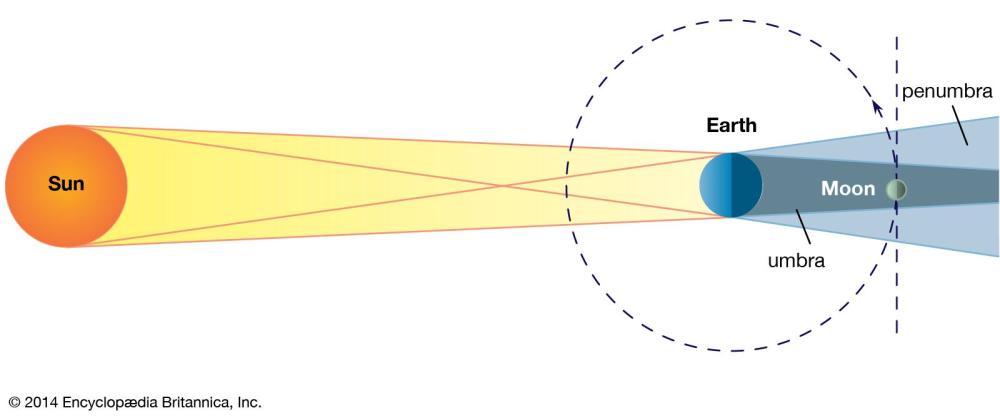
The diagram above34 is not to scale.
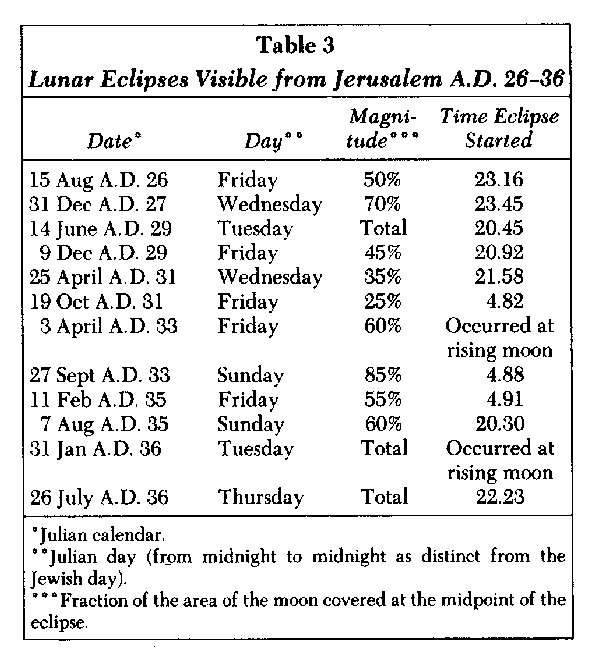
We built the table below with the Astronomical Calculations tool in Stellarium, a free astronomy program. It lists every eclipse between 26 and 36 AD where part of the moon was inside the earth's umbra, the dark central shadow, while above Jerusalem's horizon. Even after the moon leaves the umbra, the penumbra still shades it for a while.
| Year | Date | Time (UTC+3) | Moon within Umbra | At Passover | Red |
|---|---|---|---|---|---|
| 26 | Aug 17 | 00:26:22 | 50% | ||
| 28 | Jan 1 | 00:52:10 | 70% | ||
| 29 | Jun 14 | 22:05:13 | 100% | yes | |
| 29 | Dec 9 | 22:03:31 | 40% | ||
| 31 | Apr 25 | 22:31:12 | 30% | unlikely but possible | |
| 31 | Oct 19 | 05:32:12 | 20% | ||
| 33 | Apr 3 | 18:21:00 | 10% (after moon-rise) | yes | yes |
| 33 | Sep 27 | 05:49:00 | 80% (before moon-set) | yes | |
| 35 | Feb 11 | 06:26:44 | 50% | ||
| 35 | Aug 7 | 21:40:37 | 60% | ||
| 36 | Jan 31 | 18:36:19 | 100% | yes | |
| 36 | Jul 27 | 00:08:54 | 100% | yes |
Only the April 3, 33 AD eclipse lands on a likely Passover Eve.35 The years missing from the table, including 30 AD, had no such eclipse visible from Jerusalem. This unique fit adds weight to the April 3, 33 AD crucifixion date.
Humphreys and Waddington published a similar table in 1985.25 A few of their dates differ slightly from Stellarium's, perhaps because they lacked modern computers.
One eclipse outside the table deserves mention. A total lunar eclipse fell on Monday, April 14, 32 AD, one of the two possible Passover Eve dates for that year.5 But Jerusalem saw none of it. The moon there set three hours before the eclipse even began at 8:31 am local time.
Could Anyone See It? Schaefer's Objection
In 1990, NASA scientist Bradley Schaefer argued the April 3, 33 AD lunar eclipse would've been hard to see. The moon rose mostly or fully clear of the umbra,35 and low on the horizon, twilight can wash out a shallow partial eclipse.36 Even the moon's altitude during the eclipse is uncertain: six calculations Schaefer gathered disagreed.36 It's a fair objection. But photos of similar eclipses answer most of it.
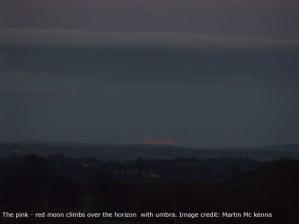
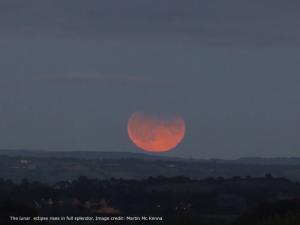
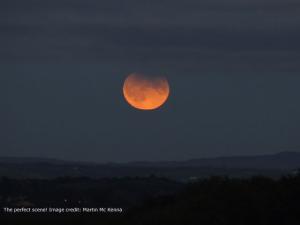
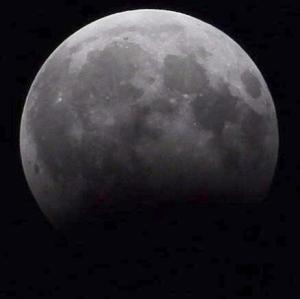
In 2006, Martin McKenna photographed a partial eclipse rising over Northern Ireland, its bite shrinking from 17% through the 33 AD depth of 10% as the moon climbed.37 The bite "was very obvious with the naked eye" in a sky still too bright for stars.37 His photos below are even deliberately under-exposed:
 |
 |
 |
|---|
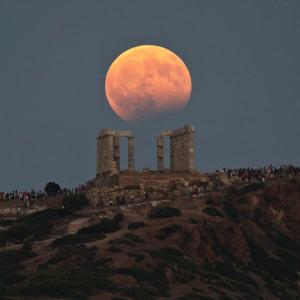
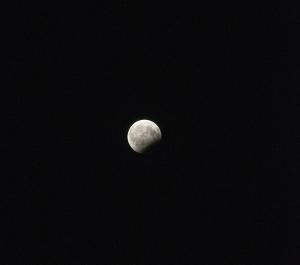
What about color? A rising moon looks red every month, because its light crosses more air. So redness alone proves nothing. The bite is the sign: a bite means an eclipse, and the ancient world called eclipses the moon turning "to blood."25 Still, the color fit the words. Near the horizon even the bite's shadow glows red instead of gray,25 38 and McKenna's rising moon was "a brilliant pink - red colour" that faded as it climbed.37 In the 2017 eclipse below (25% deep, versus 10% in 33 AD), the moon is red at the horizon in Athens, and pale farther east where it sat higher:
| Athens, Greece39 | Lysychansk, Ukraine40 | Pune, India40 |
|---|---|---|
 |
 |
 |
Most lunar eclipses pass unnoticed while we sleep. Not this one. On Passover evening, people across Israel watched for sunset and moonrise, the signal to begin the Passover meal.25 Instead of the expected full moon, they perhaps saw one rise with a dark or reddened bite. The argument doesn't need a dramatic blood-red moon. A bite people noticed and remembered is enough. Seven weeks later at Pentecost, the crowd knew exactly which blood moon Peter meant.
Reproducing in Stellarium
The image below shows a simulation of the April 3, 33 AD lunar eclipse in Stellarium. The green band at the bottom is the horizon:
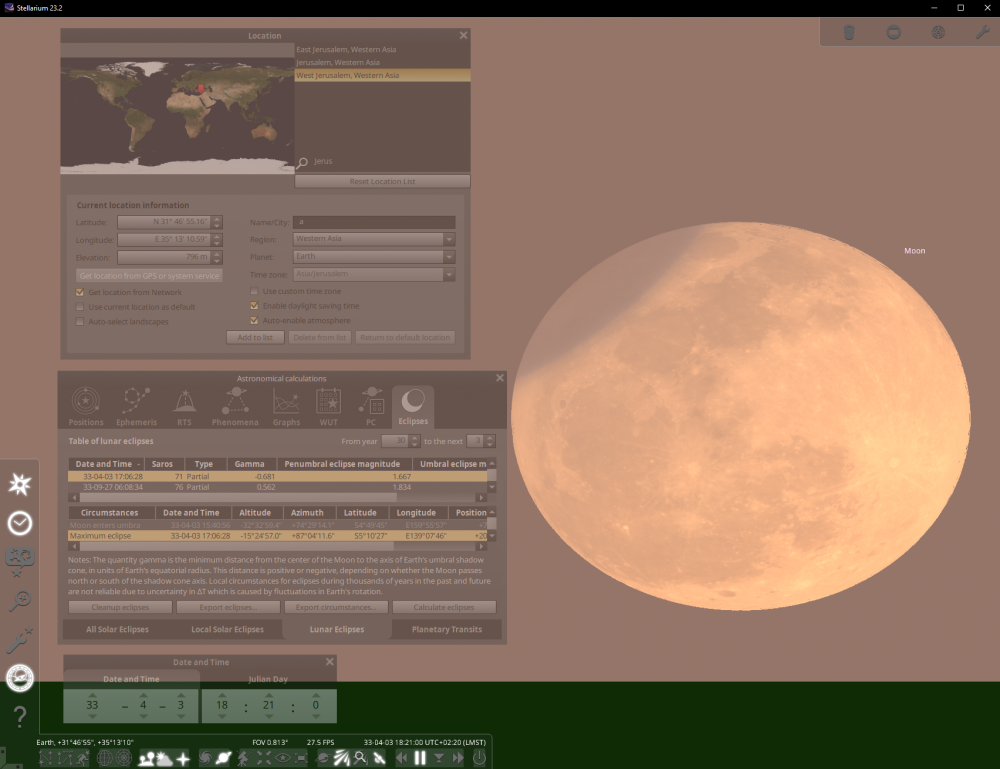
Step-by-step instructions to reproduce this eclipse in Stellarium are on a separate page.
Pilate became easy on Jews after the death of Sejanus in 31 AD
Two ancient Jewish writers describe Pilate's character. Philo of Alexandria was a Jewish philosopher and a contemporary of Pilate. Josephus was a Jewish historian writing a generation later. Both picture Pilate as greedy, inflexible, and cruel.1 The Gospels show a different man: a governor who caved to Jewish pressure at Jesus' trial. Both pictures can be true — if the trial came after October of 31 AD. Paul Maier and Harold Hoehner both make this argument.4 1
In 26 or 27 AD, the emperor Tiberius retired to the island of Capri. He left Sejanus, prefect of the Praetorian Guard, in effective control of the government.1 Philo says Sejanus wanted "to destroy our nation," Israel.41 Sejanus probably appointed Pilate governor of Judea in 26 AD.4 1 Pilate followed his lead and governed the Jews harshly:
- Right after arriving, Pilate "sent by night those images of Cæsar that are called ensigns into Jerusalem." Jewish law forbade images in the city. Pilate backed down after five days of protest at Caesarea, when the Jews bared their necks and "cried out that they were sooner ready to be slain, than that their law should be transgressed."15
- Pilate spent the temple treasury, "that sacred treasure which is called Corban," on an aqueduct. When crowds protested, he planted disguised soldiers among the protesters, who clubbed and killed many of them.15
- Luke 13:1 mentions "the Galileans whose blood Pilate had mixed with their sacrifices."
- Starting in 29/30 AD, Pilate minted coins bearing the lituus, a curved staff used in pagan Roman divination.1
Why did no complaint reach the emperor? As long as Sejanus controlled access to Tiberius on Capri, Hoehner argues, complaints about Sejanus's own appointee went nowhere.1
Then everything reversed. Tiberius had Sejanus executed on October 18, 31 AD, and began prosecuting his allies as traitors.1 Philo says Tiberius then recognized the charges against the Jews as "false calumnies, inventions of Sejanus," and "sent commands to all the governors of provinces" to protect Jewish customs.41 Pilate's offensive coins stopped early in 32 AD.1 When Pilate then hung golden shields honoring Tiberius in Herod's Jerusalem palace,41 probably in 32 AD, the Jews appealed straight to the emperor and won. Tiberius wrote Pilate a letter "reproaching and reviling him in the most bitter manner" and ordered the shields moved to Caesarea.41 1
This is the Pilate of the Gospels. At the trial the Jews shout, "If you release this man, you are no friend of Caesar!" (John 19:12). "Friend of Caesar" (amicus Caesaris) was a technical term for the emperor's trusted circle. Losing the title meant political ruin.1
If Jesus' trial was instead in 30 AD, with Sejanus screening every complaint, the threat would have been empty. But in 33 AD, with Sejanus's allies being executed and Pilate already once denounced to Tiberius, the Jews' threat against Pilate had teeth. The alternate 30 AD date can't explain how the ruthless Pilate of the 20s became the pliable Pilate of Jesus' trial.
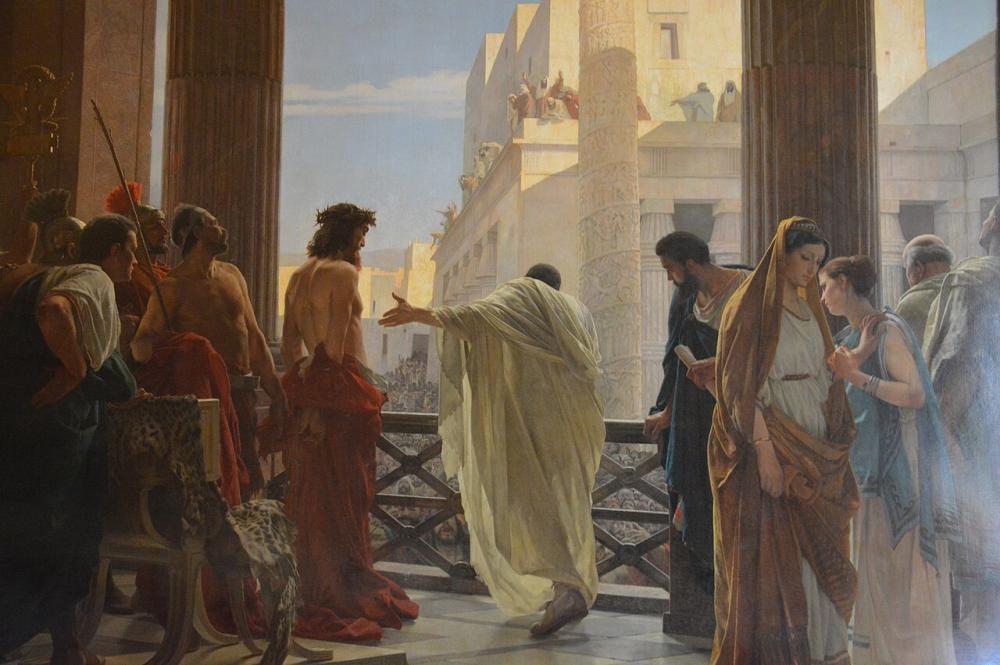
Ecce Homo, Antonio Ciseri, 1871–1888. Uffizi Galleries, Florence. Pilate presents Jesus to the crowd. Public domain.

Earthquake in 31 AD, plus or minus 5 years
Matthew reports an earthquake at the crucifixion: "the earth shook and the rocks were split" (Matthew 27:51), and another at the resurrection (Matthew 28:2).
Sediments at the bottom of the nearby Dead Sea give physical evidence of this. They form annual layers, called varves, and earthquakes visibly deform them. In 2001, Revital Ken-Tor's team dated a thin quake layer in the Ze'elim shore section to 5-50 AD, from sediment build-up anchored on the well-documented quake of 31 BC.42 In 2004, Claudia Migowski's team counted the varves in a sediment core from nearby Ein Gedi and matched 27 documented earthquakes to its deformed layers.43 Both teams labeled the early-first-century layer "33 AD" after Matthew's crucifixion earthquake, which the standard earthquake catalogs file under the traditional crucifixion year.7 In 2011, geologist Jefferson Williams's team re-dated the Ein Gedi layer with no date assumed, "based on varve counting alone," counting up from 31 BC. Their result, published in the secular International Geology Review: 31 AD, plus or minus 5 years, the uncertainty coming from hard-to-distinguish layers.7 7 The sediments record a real quake within a few years of the crucifixion. But the ranges cover roughly 26 to 50 AD, so they cannot decide between a 30 AD and a 33 AD crucifixion.
Phlegon's Earthquake
Phlegon also pairs an earthquake with a great midday darkness (quoted in the Early Writers section below).6 It is tempting to count him as independent confirmation of Matthew. Five caveats stand in the way.
- Wrong place. Phlegon puts the shaking in Bithynia, Nicaea, and Pontus: northern Anatolia, about 1,200 km from Judea. Jefferson Williams's earthquake catalog is blunt: "an earthquake experienced in Judea would not have created seismic effects in this part of Anatolia or vice-versa."44
- Earthquake damage is local. Large crustal quakes topple buildings within one or two hundred kilometers, not a thousand. The 1927 Jericho quake (magnitude 6.3, on the same Dead Sea fault as the seismite above) heavily damaged Jerusalem 30 km away, and nothing beyond the Levant.45 Bithynia also sits on a different fault system, the North Anatolian.
- His eclipse is real, datable, and probably from 29 AD. A midday sky dark enough to show stars is an eclipse. NASA lists exactly one total solar eclipse near the Near East in that generation: November 24, 29 AD, midday, its path crossing northern Anatolia.46 44 If that is Phlegon's eclipse, his report belongs to 29 AD. Perhaps a copyist corrupted the "1st year" (Α΄) of the 202nd Olympiad into the "4th" (Δ΄).44
- The crucifixion darkness cannot be a solar eclipse anyway. Passover falls at full moon, when solar eclipses are impossible, Africanus's own argument against Thallus.47 Skeptic N. P. L. Allen adds that no total solar eclipse was visible at Jerusalem between 23 and 43 AD at all.48
- His report may already be a conflation of separate events. Phlegon wrote an Olympiad chronicle: a year-by-year list of notable events, compiled a century after the fact. In that format, an eclipse and an earthquake filed under the same year need not have happened the same day. The report then grew in Christian hands. Eusebius's quote of Phlegon gives no duration and no moon phase. Africanus's version adds "at full moon" and "from the sixth hour to the ninth," Gospel details that are impossible for a real eclipse, which cannot occur at full moon and gave at most two minutes of darkness that day.46 Africanus even announces the identification himself: "manifestly that one of which we speak."47 Origen adds that Phlegon confused Jesus with Peter in the same book, so Phlegon garbled secondhand material even before Christians quoted him.49
What survives is narrower. A pagan chronicler tied a memorable darkness and earthquake to the years around Olympiad 202, and early Christians dated the crucifixion by his account. But Matthew's earthquake must stand on the Dead Sea evidence above, not on Phlegon.
The Talmud on Bad Omens
The Talmud says the temple's rituals began failing "forty years" before the temple was destroyed in August of 70 AD. That places the change at about 30 AD, the very window of Jesus' ministry and crucifixion.
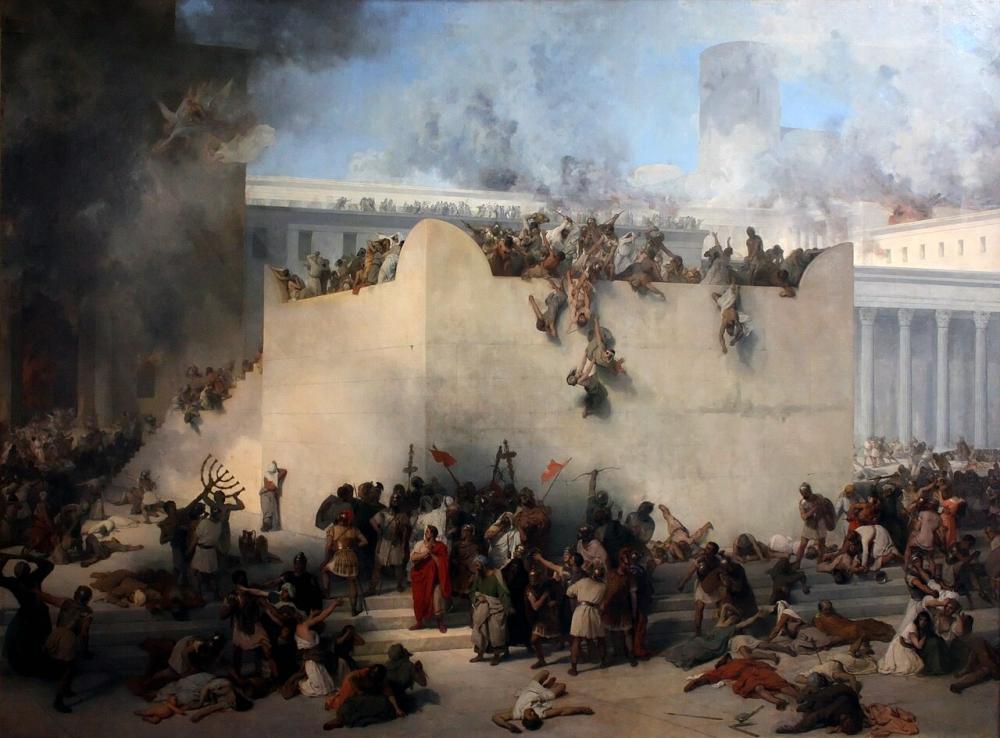
The Destruction of the Temple of Jerusalem, Francesco Hayez, 1867. Gallerie dell'Accademia, Venice. The Romans burned the temple in August of 70 AD, the event the rabbis counted back forty years from. Public domain.

Two of the failing rituals belonged to the Day of Atonement. Each year the high priest drew lots over two goats, one "for the LORD" and one "for Azazel," the scapegoat sent into the wilderness bearing Israel's sins (Leviticus 16:7-10). A lot drawn in the right hand was considered a good sign. A strip of crimson wool was also tied to the scapegoat, and tradition held that it turned white when God accepted the atonement, recalling Isaiah 1:18: "Though your sins have stained you like the color red, you can become white like snow." The other signs involved the menorah's continually burning lamp and the sanctuary doors. Yoma 39b:5-6:
The Sages taught: During the tenure of Shimon HaTzaddik, the lot for God always arose in the High Priest’s right hand; after his death, it occurred only occasionally; but during the forty years prior to the destruction of the Second Temple, the lot for God did not arise in the High Priest’s right hand at all. So too, the strip of crimson wool that was tied to the head of the goat that was sent to Azazel did not turn white, and the westernmost lamp of the candelabrum did not burn continually.
And the doors of the Sanctuary opened by themselves as a sign that they would soon be opened by enemies, until Rabban Yoḥanan ben Zakkai scolded them. He said to the Sanctuary: Sanctuary, Sanctuary, why do you frighten yourself with these signs? I know about you that you will ultimately be destroyed, and Zechariah, son of Ido, has already prophesied concerning you: “Open your doors, O Lebanon, that the fire may devour your cedars” (Zechariah 11:1), Lebanon being an appellation for the Temple.8
Rosh Hashanah 31b:17:
And it is taught in a baraita: During the forty years before the Second Temple was destroyed the strip of crimson wool would not turn white; rather, it would turn a deeper shade of red.8
The Jerusalem Talmud, compiled independently of the Babylonian, preserves the same tradition. Yoma 6:3:
Forty years before the Temple was destroyed was the Eastern light extinguished, and the shiny strip became red, and the lot of the Name came up in the left hand. They were locking the doors of the Temple hall in the evening and in the morning they found them open.21
These accounts were written down centuries after the events, so they are tradition rather than contemporary records. But they are hostile tradition. The rabbis had no motive to invent signs of God's displeasure at them beginning at the same year they began to oppose Jesus in his ministry.
Rome Barred Jewish Executions After 30 AD
The Talmud also says the Sanhedrin lost the authority to impose the death penalty "forty years before" the temple was destroyed, again about 30 AD. Shabbat 15a:9:
Forty years before the Temple was destroyed, the Sanhedrin was exiled from the Chamber of Hewn Stones... Rather, emend and say: That they no longer judged capital cases. The authority to impose the death penalty was stripped from the Sanhedrin, and therefore they willingly left the Chamber of Hewn Stone.8
Avodah Zarah 8b:11:
Forty years before the Temple was destroyed, the Sanhedrin was exiled from the Chamber of Hewn Stone and sat in the store near the Temple Mount.8
This explains John 18:31. When Pilate told the Jewish leaders to judge Jesus by their own law, they replied, "We cannot legally put anyone to death." So they needed Pilate to order the crucifixion.
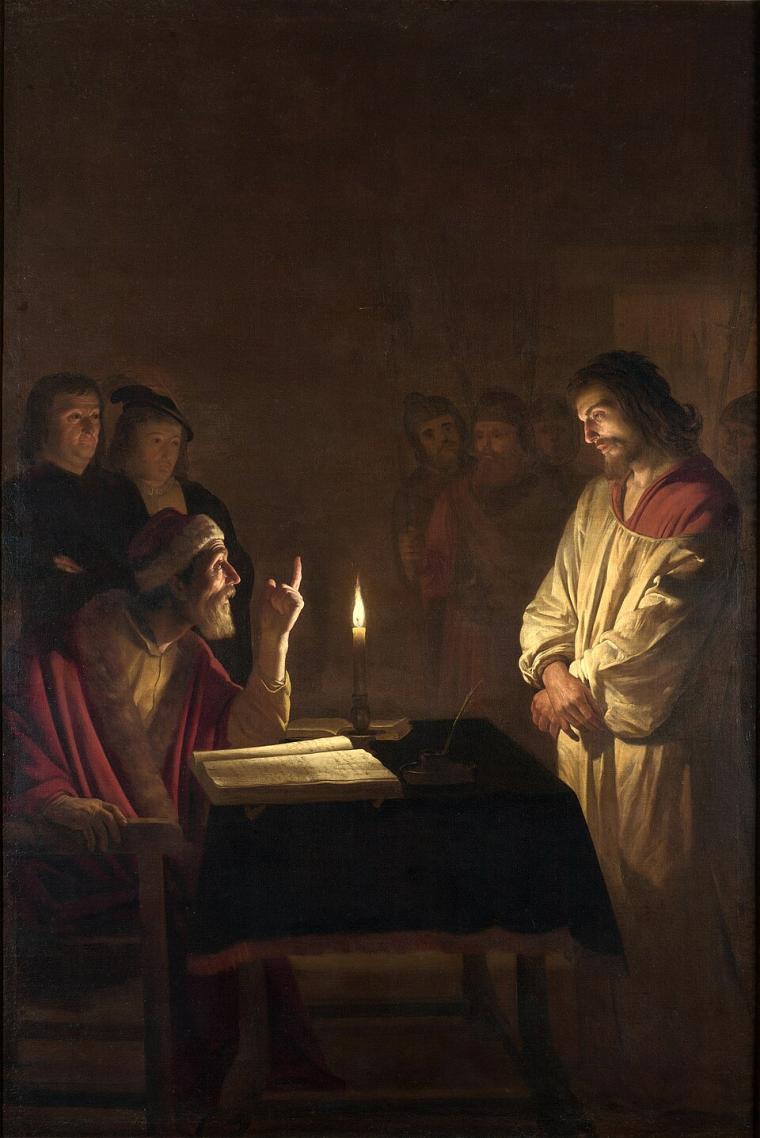
Christ before the High Priest, Gerrit van Honthorst, about 1617. National Gallery, London. Public domain.

Josephus corroborates the rule. Around 62 AD, in the gap between two Roman governors, the high priest Ananus convened the Sanhedrin and had "the brother of Jesus who was called Christ, whose name was James" stoned. Citizens complained to the incoming governor that "it was not lawful for Ananus to assemble a sanhedrim without his consent," and King Agrippa deposed Ananus over it.2
Possibly related is the woman caught in adultery in John 7:53-8:11. The Pharisees ask Jesus whether she should be stoned "in an attempt to trap him, so that they could bring charges against him" (John 8:6). The trap works best if Jewish executions were already forbidden: approving the stoning could be reported to the Romans, while forbidding it would deny the Law of Moses. However, this passage is missing from the earliest manuscripts of John,17 so don't place too much weight on it.
Early Writers on the Date
Early writers give crucifixion dates ranging from 28 to 33 AD. None supports Friday, April 7 of 30 AD, the only possible crucifixion date in that year. The full table of their dates, and each writer's statements, are collected in the Early Writers section at the end of this article.
The Best Case for April 7, 30 AD

Saint Jerome in his Study, Antonello da Messina, about 1475. National Gallery, London. Public domain.

Fairness requires stating the other side at its strongest. April 7, 30 AD is probably the most widely held crucifixion date in modern scholarship. Josef Blinzler, himself a proponent, counted A. T. Olmstead, Joachim Jeremias, and a dozen more scholars for the year 30.50 51 John Meier and N. T. Wright hold it today.52 53 Rainer Riesner reaches it through the co-regency reckoning,12 and Rick Lanser of Associates for Biblical Research defends it from Paul's chronology.54 Hoehner, arguing for 33, concedes that "there are a great number of scholars who hold to A.D. 30 as the date of Christ's crucifixion."1 Here is their case at its strongest:
- The astronomy fits. Nisan 14 fell on a Friday in both 30 and 33, as the tables above show. Blinzler: "the fourteenth of Nisan fell twice on a Friday in the years 28 to 34; namely, in the year 30 on the seventh of April, and in the year 33 on the third of April."51
- An earlier 15th year of Tiberius. Blinzler and Jeremias, following Conrad Cichorius, count Tiberius's years by the Syrian calendar, in which the first year of a reign ends at the New Year festival on October 1. Tiberius's 15th year then runs from October of 27 AD to September of 28 AD, and Jesus is baptized in 28.51 24
- A two-year ministry. Meier: "In my opinion, A.D. 30 is the more likely date. To begin Jesus' ministry in A.D. 28 (which seems to me the most probable year) but to put off his death until A.D. 33 would result in a ministry of some four to five years."52 He concludes that the ministry "perdured for two years and a few months" and ended on the cross on April 7, 30.52 Wright likewise puts the crucifixion in 30.53
- The temple's forty-six years. On the common translation of John 2:20, the temple had been under construction forty-six years, counted from Herod's start in 20/19 BC. That puts the first Passover of the ministry in 28 AD and the fourth in 31. Blinzler: "everything points to the year 30 as the year of the death of Jesus... To accept the year 32 involves rejecting the chronology based on John 2:20, and this could hardly be justified."51
- "About thirty years old." Born about 5/4 BC, Jesus turns thirty in 26/27 AD. A baptism in 27/28 matches Luke 3:23 naturally; a 29 baptism makes him thirty-two or thirty-three.1
- Paul's chronology. This is the classic objection to 33.1 Jeremias states it in one breath: the Gallio inscription and the Sabbatical-year cycle date the Jerusalem council to 48 AD; Galatians 1:18 and 2:1 put Paul's conversion seventeen years earlier, "i.e. in 31 or 32 (hardly 33). The year of Paul's conversion is the latest possible year for the death of Jesus."24 Lanser's version is tighter still. He reads Galatians 2:1 as the famine-relief visit of Acts 11, anchored by Herod Agrippa I's death in 44 AD, with its fourteen years running from Paul's conversion: "Counting back fourteen years from 44 AD using inclusive reckoning, we conclude Paul was saved in 31 AD, possibly even late 30 AD." Since "the time from the Crucifixion to Paul's conversion was less than a year, likely about nine months," the crucifixion lands in 30.54
- The Talmud's forty years. The Sanhedrin lost capital jurisdiction, and the temple omens began, "forty years before the temple was destroyed" — about 30 AD. If those memories anchor to the crucifixion year, they name 30, not 33.
- The earliest fathers. The one-year-ministry writers place the passion in 28 to 30 AD; Tertullian and Lactantius name the consuls of 29. Their dates sit closer to 30 than to 33.
These arguments deserve answers, not dismissal. In turn:
- The Syrian reckoning (#2) requires counting Tiberius's first six weeks as a whole year — inclusive counting, for which Steinmann's survey found no ancient evidence (see the 15th Year of Tiberius section above). It also requires Luke, writing to a Roman official, to use a provincial reckoning no Roman historian used. Hoehner asks: "But is one sure that Luke reckoned in this manner, especially since he was writing to Theophilus, a Roman official?"1
- The two-year ministry (#3) must ignore the winter time-stamp of John 4:35, the springtime grain-plucking of the Synoptics, and the unnamed feast of John 5:1 — and some versions must swap the order of John 5 and 6 with no manuscript support. See the Four Passovers section above.1
- On John 2:20 (#4), the Jews spoke of the ναός, the sanctuary building finished in 18/17 BC, not the still-unfinished courts. Standing forty-six years, it dates that Passover to 30 AD — the first Passover of a ministry that began in 29.1 14
- On "about thirty" (#5), the birth year is itself disputed, and Luke's "about" is elastic. Hoehner: born in winter 5/4 BC, Jesus "would have been thirty-two years of age with his thirty-third birthday approaching" at a 29 AD baptism.1
- On Paul (#6), every link in the chain has slack, and one datum pulls the other way.
- Hoehner reconstructed Paul's chronology while assuming a 30 AD crucifixion and still arrived at a conversion in 35 AD. The apostolic dates simply do not pin down the gospel dates: "In the end one does not determine the chronology of the Gospels on the basis of the chronology of the apostolic age or vice versa."1
- Lanser's chain needs two contested identifications at once: that Galatians 2:1 describes the famine visit rather than the Jerusalem council, and that its fourteen years run from the conversion rather than from the first Jerusalem visit. Jeremias read the same verses the other way and got a conversion of 31-32. The argument's own advocates cannot agree on the arithmetic.
- The Aretas datum pulls against a tight 30 AD chain. Paul escaped Damascus while an ethnarch of King Aretas guarded the city (2 Corinthians 11:32-33), about three years after his conversion (Galatians 1:17-18, Acts 9:23-25). But Nabataean control of Damascus is nowhere attested while Tiberius lived. Douglas Campbell argues it was impossible before the tetrarch Philip died in 34 AD and unlikely after 37, dating the escape to 34-36;55 Bryan Windle and others date it to Caligula's territorial grants after 37.56 On either dating, a conversion in late 30 with an escape three years later, in 33, comes too early. A conversion in 33 or 34 with an escape in 36 or 37 fits. Lanser answers with F. F. Bruce: "Paul's escape from the city is probably to be dated before A.D. 37," and the ethnarch may only have led the Nabataean colony inside the city.54 The datum is contested — but it is the 30 AD chain that needs it explained away.
- Even Jeremias concedes ground on the astronomy his date needs: his own summary calls April 7, 30 as Nisan 15 — required by his Synoptic chronology — "a considerably weaker possibility."24
- The Talmud's "forty years" (#7) is a round number, and it fits 33 as well: the omens could anchor to the start of the ministry, and the argument above needs only the Sanhedrin's capital jurisdiction gone by the trial, which both dates satisfy.
- The earliest fathers (#8) derived their dates from Luke's 15th year plus an assumed one-year ministry, so they are evidence for the start of the ministry, not independent evidence of the death year — see the Early Writers section below. None of them lands on April 7, 30 either, and the two external data among them, Phlegon's Olympiad and the eclipse tradition, point to 33.
- Pilate's softness is unexplained by the 30 AD date. In April of 30, Sejanus still ruled Rome and Pilate feared no one — the threat "you are no friend of Caesar" (John 19:12) has force only after Sejanus's fall in October of 31.
- A lunar eclipse happened on April 3, 33 AD, while the moon rose ordinary and full on April 7, 30. Only the first gives Peter's "moon to blood" quotation at Pentecost its referent.
In the end the two dates stand or fall with two questions settled earlier in this article: when Tiberius's 15th year fell, and how long the ministry ran. With the baptism anchored in 29 AD and four Passovers counted, the crucifixion lands on Friday, April 3, 33 AD.
Early Writers
Below is every surviving writer from within 300 years of the crucifixion that could be found, checked against George Ogg's 1940 survey.57 Two patterns stand out. Every witness who names a starting year anchors it to Luke's 15th year of Tiberius. And their crucifixion dates diverge mainly with the ministry length each assumed, usually taken from prophecy or numerology rather than the Gospel record. None supports Friday, April 7 of 30 AD, the only possible crucifixion date in that year.
| Writer | Year Written | Year of Birth | Year of Baptism | Ministry Length | Year of Crucifixion |
|---|---|---|---|---|---|
| Phlegon of Tralles (quoted by Origen) | 137 AD | 33 AD | |||
| Marcion (quoted by Tertullian) | ~144 AD | 29 AD (descent) | |||
| The Valentinians (per Irenaeus) | mid-100s AD | 1 year | |||
| Melito of Sardis | ~170 AD | 3 years | |||
| Tatian | ~172 AD | 2–3 years | |||
| Irenaeus | ~180 AD | 2–3 BC | 28–29 AD | 10+ years | ? |
| The Basilideans (quoted by Clement) | 198 AD | Jan 28 or 29 AD | 29 or 30 AD | ||
| Clement of Alexandria | 198 AD | 1 year | 28 AD | ||
| Tertullian | ~200 AD | ~1 year | 29 AD | ||
| Hippolytus | 202 AD | ~3 years implied | 32–33 AD | ||
| Julius Africanus | ~221 AD | ~1 year implied | ~31 AD | ||
| Origen | ~225 and ~248 AD | 1 year, later 3 | |||
| De Pascha Computus | 243 AD | ~28 AD | 1 year | 28–29 AD | |
| Lactantius | ~311 AD | 29 AD | |||
| Eusebius | 313 AD | 29 AD | 3–4 years | 32–33 AD |
 |
 |
 |
 |
|---|---|---|---|
| Marcion | Basilides | Hippolytus | Julius Africanus |
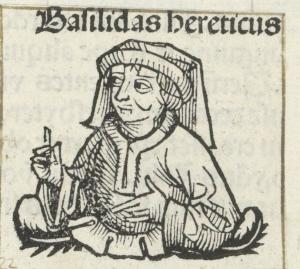
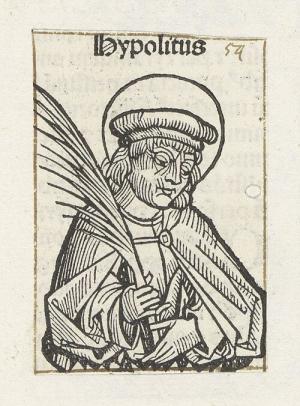
Four of the writers below, as woodcuts in the Nuremberg Chronicle of 1493. Rijksmuseum, CC0.

Phlegon: 137 AD
Eusebius's Chronicon, in the entry quoted in the Eusebius section below, quotes the Greek historian Phlegon, who wrote around 137 AD:
Phlegon, who is an excellent calculator of olympiads, also writes about this, in his 13th book writing thus:
However in the fourth year of the 202nd olympiad, an eclipse of the sun happened, greater and more excellent than any that had happened before it; at the sixth hour, day turned into dark night, so that the stars were seen in the sky, and an earthquake in Bithynia toppled many buildings of the city of Nicaea.6
- The Olympiads started in 776 BC and began each August.58
- The 202nd Olympiad therefore began on -776 + 201*4 + 1 = 29 AD.
- The fourth year of the 202nd Olympiad therefore lasted from August of 32 AD to August of 33 AD.
- The only Passover during this time would have been April 3, 33 AD.
But Phlegon's report has problems, including evidence his eclipse belongs to 29 AD. See the "Phlegon's Earthquake" caveats in the Earthquake section above.
Marcion: ~144 AD
Marcion is a hostile witness, and the earliest to use the text of Luke itself. Around 144 AD, he denied that Christ was born at all and instead that Christ simply descended from heaven in the 15th year of Tiberius. Marcion's gospel was an edited version of Luke that began at Luke 3:1. Tertullian, writing against him around 208 AD, summarizes his teaching:
In the fifteenth year of Tiberius, Christ Jesus vouchsafed to come down from heaven, as the spirit of saving health.59
In the fifteenth year of the reign of Tiberius (for such is Marcion's proposition) he came down to the Galilean city of Capernaum, of course meaning from the heaven of the Creator, to which he had previously descended from his own.59
Even a teacher who cut away Luke's nativity accounts kept the 15th year of Tiberius as the fixed starting point of Jesus' public appearance.
The Valentinians: Mid-100s AD
The earliest one-year claim comes from the Valentinian Gnostics, in the mid-100s AD. Their reason was numerology. Jesus' career had to mirror their system of thirty divine "Aeons," the twelfth of which suffered a fall. Irenaeus reports their view:
They further maintain that the passion which took place in the case of the twelfth Æon is pointed at by the apostasy of Judas, who was the twelfth apostle, and also by the fact that Christ suffered in the twelfth month. For their opinion is, that He continued to preach for one year only after His baptism.20
Melito of Sardis: ~170 AD
The earliest surviving three-year statement comes from Melito, bishop of Sardis, around 170 AD:
For, being at once both God and perfect man likewise, He gave us sure indications of His two natures: of His Deity, by His miracles during the three years that elapsed after His baptism; of His humanity, during the thirty similar periods which preceded His baptism.60
The same sentence supports Luke's age of about thirty at the baptism. But two cautions apply. The fragment survives only in a quotation by Anastasius of Sinai, writing about five centuries later. And its "two natures" wording resembles the theological vocabulary of those later centuries, so some scholars doubt Melito wrote it.
George Ogg nonetheless counted Melito as "the first in post-canonical times to assign to the public ministry of Jesus a duration of three years." He judged the objections to the fragment "not unanswerable." And he noted that Melito's bare use of the term τριετία, "the three-year span," suggests the view was already "generally known and accepted" in his region.57
Tatian: ~172 AD
Around 172 AD, Tatian wove the four Gospels into a single running story, the Diatessaron. It became the standard Gospel text of the early Syrian church. Tatian kept John's framework, with its multiple Passovers. Theodor Zahn, who reconstructed the Diatessaron's text, concluded that its ministry spans "two years and some months." Ogg files it under the three-year tradition.57 Either way, it presents a multi-year ministry.
Irenaeus: ~180 AD
Around 180 AD, Irenaeus wrote against the Valentinian Gnostics, whose "opinion is, that He continued to preach for one year only after His baptism."20 In response he affirmed Luke 3:23, that Jesus was baptized at about age 30:
For when He came to be baptized, He had not yet completed His thirtieth year, but was beginning to be about thirty years of age (for thus Luke, who has mentioned His years, has expressed it: "Now Jesus was, as it were, beginning to be thirty years old," when He came to receive baptism); and, [according to these men,] He preached only one year reckoning from His baptism.20
He also wrote that Jesus was born "about the forty-first year of the reign of Augustus," that is about 2–3 BC.20 But he doesn't tie the baptism to a year of Tiberius.
Irenaeus refuted the Valentinian one-year ministry by counting John's Passovers, as quoted in the Four Passovers section above.20 But he then overcorrected, claiming Jesus taught into at least his 40s:
[F]rom the fortieth and fiftieth year a man begins to decline towards old age, which our Lord possessed while He still fulfilled the office of a Teacher, even as the Gospel and all the elders testify; those who were conversant in Asia with John, the disciple of the Lord, [affirming] that John conveyed to them that information.20
His basis was the Jews' remark in John 8:57, "You are not yet fifty years old," plus this secondhand appeal to the elders.20 Almost no other early writer followed his view. He never states a crucifixion year, so the table lists him with a question mark. His reasoning would push it many years later than every other early writer allows.
The Basilideans: 198 AD
The followers of the Gnostic teacher Basilides celebrated the date of Jesus' baptism as a festival. Basilides taught at Alexandria in the early-to-mid 100s AD. Clement of Alexandria reports their date:
And the followers of Basilides hold the day of his baptism as a festival, spending the night before in readings. And they say that it was the fifteenth year of Tiberius Cæsar, the fifteenth day of the month Tubi; and some that it was the eleventh of the same month.61
Tubi 15 and Tubi 11 are January 10 and January 6 on the Egyptian calendar. In the 15th year of Tiberius, that is January of 29 AD, or of 28 AD if they counted Tiberius's years by Egyptian reckoning. They not only knew Luke's year; they claimed to know the day.
In the same passage, Clement records calculators, probably the Basilideans again,62 who dated the passion to the 16th year of Tiberius:
And treating of His passion, with very great accuracy, some say that it took place in the sixteenth year of Tiberius, on the twenty-fifth of Phamenoth; and others the twenty-fifth of Pharmuthi; and others say that on the nineteenth of Pharmuthi the Saviour suffered.61
Those Egyptian dates are March 21, April 20, and April 14. The year works out to 29 or 30 AD, depending on how they counted Tiberius's years. Finegan notes that on the Egyptian non-accession reckoning, the 16th year ran from August of 28 AD to August of 29 AD, putting all three dates in 29 AD.62 None of the three falls on a Passover eve: the actual Nisan 14 was April 17-18 in 29 AD and April 7 in 30 AD.
Clement of Alexandria: 198 AD
In 198 AD Clement of Alexandria placed the crucifixion 42 years and 3 months before the destruction of Jerusalem in 70 AD, which works out to 28 AD. He calls that year the 15th of Tiberius, though the 15th year was actually 29 AD. He also takes "the acceptable year of the Lord" literally, assuming a ministry of about one year and contradicting the multiple Passovers in the Gospel of John:
Some set down the dates of the Roman emperors thus:...
And our Lord was born in the twenty-eighth year, when first the census was ordered to be taken in the reign of Augustus...
And there are those who have determined, with still greater attention to detail, not only the year of our Lord’s birth, but also the day; and they say that it took place in the twenty-eighth year of Augustus, and in the twenty-fifth day of Pachon...
“And that it was necessary for Him to preach only a year, this also is written: ‘He hath sent Me to proclaim the acceptable year of the Lord.’...
Accordingly, in fifteen years of Tiberius and fifteen years of Augustus; so were completed the thirty years till the time He suffered. And from the time that He suffered till the destruction of Jerusalem are forty-two years and three months.61
Tertullian: ~200 AD
Around 200 AD, Tertullian placed Jesus' death in the 15th year of Tiberius, the same year Luke gives for the start of John the Baptist's ministry. That leaves room for a ministry of only about a year. Even Mosshammer, the modern historian summarizing him, calls this chronology "perhaps too short."63
Roman tradition fixed the day as March 25, 29 AD.63 But the Passover table above shows Passover in 29 AD fell on April 18th, or possibly April 17th. In the same work Tertullian also dates the death by the consuls of 29 AD, the two Gemini. Ogg notes this consular dating is "a distinctly Roman way of dating," appears first in Tertullian, and may have come from an official document.57
For, after Augustus who survived after the birth of Christ, are made up 15 years. He was succeeded by Tiberius Caesar, who held the empire 20 years, 7 months, and 28 days. (In the 15th year of his reign Christ suffered, being about 30 years of age when he suffered.)64
Hippolytus: 202 AD
Hippolytus of Rome, in his commentary on Daniel written around 202 AD, says Jesus was killed in the 18th year of Tiberius, which is 32–33 AD:
For the first advent of our Lord in the flesh, when he was born in Bethlehem, was December 25th, Wednesday, while Augustus was in his forty-second year, but from Adam, five thousand and five hundred years. He suffered in the thirty-third year, March 25th, Friday, the eighteenth year of Tiberius Caesar, while Rufus and Roubellion were Consuls.65
His two markers conflict. "Rufus and Roubellion" are the two Gemini, Fufius Geminus and Rubellius Geminus, the consuls of 29 AD. Tertullian and Lactantius use that same consular pair to date the crucifixion to 29 AD. But the 18th year of Tiberius is 32–33 AD.
Ogg also notes that Hippolytus has statements on both sides of the ministry's length: his Easter cycle separates Jesus' birth and death by exactly 30 years, which with Luke 3:23 would instead imply a one-year ministry.57
Julius Africanus: ~221 AD
Julius Africanus, writing around 221 AD, was the first Christian to attempt a complete world chronology. He ended Daniel's 70 weeks, and with them "the time of Christ," in the 2nd year of the 202nd Olympiad. He equates that year with the 16th year of Tiberius:
It is by calculating from Artaxerxes, therefore, up to the time of Christ that the seventy weeks are made up, according to the numeration of the Jews. For from Nehemiah, who was dispatched by Artaxerxes to build Jerusalem in the 115th year of the Persian empire, and the 4th year of the 83d Olympiad, and the 20th year of the reign of Artaxerxes himself, up to this date, which was the second year of the 202d Olympiad, and the 16th year of the reign of Tiberius Caesar, there are reckoned 475 years.47
His two markers don't quite agree. The 2nd year of the 202nd Olympiad ran from summer 30 AD to summer 31 AD. But the 16th year of Tiberius, counted from 14 AD, was 29–30 AD. The only Passover inside his stated Olympiad year fell in the spring of 31 AD. Either way, a passion in Tiberius's 16th year implies a ministry of only about a year. Africanus also independently quotes Thallus and Phlegon on the darkness at the crucifixion. He argues it could not have been a natural solar eclipse, because Passover falls at full moon.47
Origen: ~225 and ~248 AD
Origen took both sides at different times. In his early works, De Principiis (before 231 AD) and his comment on Matthew 26:15, he followed his teacher Clement of Alexandria in assuming a one-year ministry:57
after a short period had elapsed — for He taught only during a year and some months — the whole world, nevertheless, became filled with His doctrine, and with faith in His religion.66
But in his late works, Contra Celsum and his comment on Matthew 24:15, written around 246–248 AD, Origen instead reckoned "about three years" as "the time of the preaching of the Lord."57
De Pascha Computus: 243 AD
An anonymous North African writer composed this Easter-calculation tract in 243 AD. It dates the baptism, the crucifixion, and its own distance from both:
the Lord Jesus was baptized by John in the fifteenth year of the reign of Tiberius Caesar; in whose sixteenth year he suffered and rose again... from the passion to the fifth year of Gordian, in the consulship of Arrianus and Papus [243 AD], 215 years are completed.67
Counting 215 years back from 243 AD gives 28 AD, or 29 AD counting inclusively. The tract also sets the Last Supper on Thursday, April 8, and the crucifixion on Friday, April 9.67 Those dates come from its own schematic Easter cycle rather than from astronomy: no Passover eve fell on Friday, April 9 in any nearby year.
Lactantius: ~311 AD
Lactantius was a Latin teacher of rhetoric and tutor to Emperor Constantine's eldest son. Writing around 304–315 AD, he dated the crucifixion twice by the Roman consuls of 29 AD:63
Afterwards they had tetrarchs until the time of Herod, who was in the reign of Tiberius Cæsar; in whose fifteenth year, in the consulship of the two Gemini, on the 23d of March, the Jews crucified Christ.68
In the latter days of the Emperor Tiberius, in the consulship of Ruberius Geminus and Fufius Geminus, and on the tenth of the kalends of April, as I find it written, Jesus Christ was crucified by the Jews.68
The "tenth of the kalends of April" is March 23. That matches no Passover: Nisan 14 fell around April 17-18 in 29 AD. Like Tertullian's March 25, it reflects a Roman tradition that fixed the date on the solar calendar rather than the moon.
Eusebius: 313 AD
Around the year 313 AD, Christian historian Eusebius, citing Luke 3:1, says Jesus was baptized in the 15th year of Tiberius and the fourth year of Pontius Pilate:
It was in the fifteenth year of the reign of Tiberius, according to the evangelist [Luke], and in the fourth year of the governorship of Pontius Pilate, while Herod and Lysanias and Philip were ruling the rest of Judea, that our Saviour and Lord, Jesus the Christ of God, being about thirty years of age, came to John for baptism and began the promulgation of the Gospel.69
And elsewhere Eusebius says:
Pilate was made procurator of Judea by Tiberius in the twelfth year of his reign.69
These two statements agree with each other. Counting inclusively, a governor appointed in Tiberius's 12th year is in his fourth year during Tiberius's 15th. They also fit the chronology above. Pilate likely became governor in 26 AD,4 1 so his fourth year was about 29–30 AD. That matches the most likely 15th year of Tiberius, 29 AD.
Eusebius's Chronicon likewise places this entry under the 15th year of Tiberius:
John the son of Zechariah, preaching in the desert by the Jordan River, bears witness that Christ, the son of God, is present in their midst. Also the Lord Jesus Christ himself announces the way of salvation to all people, proving by signs and wonders that the things that he said were true.6
The same work counts 42 years "from the 15th year of Tiberius Caesar and from the beginning of the preaching of the Gospel" to the destruction of Jerusalem in 70 AD.6 That again places the start of the ministry in 28–29 AD.
For the ministry's length, Eusebius reasoned from the high priests named in the Gospels:
Since he began his work during the high priesthood of Annas and taught until Caiaphas held the office, the entire time does not comprise quite four years.69
His Chronicon states the three-year figure directly:
The proof however of this matter, that in this year the Saviour suffered, the gospel of John presents, in which it is written that after the 15th year of Tiberius Caesar, the Lord preached for three years.6
One caution on his method. Eusebius got "not quite four years" by assuming the four high priests from Annas to Caiaphas each served one year during the ministry.69 Josephus actually places those successions around 15 to 18 AD. Caiaphas then held the office about eighteen years, spanning the entire ministry. So Eusebius's math is confused, even though his conclusion matches John's Passover count.
For the crucifixion, the Chronicon places the Passion in the 18th year of Tiberius, which is 32–33 AD:
Jesus Christ, according to the prophecies, which had been spoken about him beforehand, came to the Passion in the 18th year of Tiberius, at which time also we find these things written verbatim in other commentaries of the gentiles: an eclipse of the sun happened, Bithynia shaken by earthquake, and in the city of Nicaea many buildings collapsed: all of which agree with what occurred in the Passion of the Saviour.6
These statements fit together: baptism in the 15th year (29 AD) plus a ministry of 3–4 years gives a Passion in 32–33 AD. The "commentaries of the gentiles" are Phlegon's, whose eclipse and earthquake belong to the Olympiad year running from August 32 to August 33 AD, as shown in the Phlegon section above.
Fringe Groups
Ogg's survey also catalogues the fringes, mostly known through later hostile reports. On the one-year side he lists the Gnostic Docetae (whose chronology matched the Valentinians), the Alogi, the Abgar legend, the pseudo-Clementine Homilies, and the Manichaeans. On the three-year side he adds the apocryphal Acts of John, where Jesus tells John: "who for two years didst blind me... who in the third year didst open the eyes of my mind."57
Sources
- 1.
Hoehner, Harold W. "Chronological Aspects of the Life of Christ." 1978.Hoehner was a theologian who earned his Th.D at Cambridge and was Chairman of the Department of New Testament Literature and Exegesis at Dallas Theological Seminary.
- 1a.
Page 82: "There have been several studies in this, and their conclusions are that the only possible times Nisan 14 fell on a Friday were in the years of A.D. 27, 30, 33, and 36. Of these, A.D. 27 is the least likely astronomically. In that year it is possible that Nisan 14 fell on a Thursday rather than a Friday. The year of A.D. 30 has also been debated, but it is reasonably certain that Nisan 14 was a Friday that year." ↩
- 1b.
Page 29: "the rebuilding of the temple, which according to Josephus' *Antiquitates Judaicae (XV. 11. 1 380) began in the eighteenth year of Herod's reign, coincides with the arrival of Augustus in Syria, which according to Dio Cassius occurred in the spring or summer of 20 B.C. This is corroborated in Josephus' other account, where he states that this Augustan visit to Syria was ten years after his first visit in 30 B.C. Therefore, since the eighteenth year of Herod's reign was from Nisan 1, 20 B.C. to Nisan 1, 19 B.C.,4Z Josephus must have reckoned from 37 B.C. and not 40 B.C." ↩ ↩
- 1c.
Page 29: "Returning to Josephus it seems clear that the first part of Herod's rebuilding the temple was the temple edifice which was done by the priests in one year and six months." ↩
- 1d.
Page 24: "The fifth opinion is that Luke used the normal Roman method of reckoning, according to which Tiberius' fifteenth year would have run from August 19, 28 to August 18, 29. Lewin states: "The reign of Tiberius, as beginning from 19th Aug. A.D. 14, was as well-known a date in the time of Luke as the reign of Queen Victoria in our own day, and that no single case has ever been or can be produced in which the years of Tiberius were reckoned in any other way." The biggest objection to this view is that it would be too complicated and confusing to reckon according to dynastic years. However, on the other hand, since Luke was addressing a Roman official it is plausible to think that he would have been familiar with dynastic years." ↩ ↩
- 1e.
Some say the beginning of Tiberius's reign should count as starting in not 14 AD when he became emperor, but in 11 AD when he became coregent with Augustus. But nobody counts it this way. Hoehner notes on page 22: "this method is to be rejected because there is no evidence, either from historical documents or coins, for its employment whereas there is abundant evidence that Tiberius reckoned his first year after the death of Augustus." And on page 85: "There is no evidence, either from historical documents or coins, that Tiberius' reign was ever reckoned from his coregency." ↩ ↩
- 1f.
Page 45: "Wheat sowing begins in October/November and is harvested in April/May." ↩ ↩
- 1g.
"there is no attestation to the existence of such a proverb." ↩
- 1h.
Page 88: "It is probable that when Pilate succeeded Valerius Gratus as prefect in Judea in A.D. 26 he was appointed by the equestrian Lucius Aelius Sejanus." ↩ ↩
- 1i.
Page 56: "the argument that since Nisan 15 is a holy convocation on which no one works and thus conclude that it was a Sabbath is a non sequitur. There is no evidence for this anywhere. This is a creation of those who hold this theory only to fit their [Wednesday or Thursday crucifixion] theory." ↩ ↩
- 1j.
Page 57: "The term Sabbath is frequently (one third of all of its New Testament occurrences) in the plural form in the New Testament when only one day is in view. For example, in Matthew 12:1-12 both the singular and the plural forms are used (cf. esp. v. 5)." ↩
- 1k.
Page 57: "It necessitates the unnatural meaning of παρασκευὴ. Both the Scriptures (Matt 27:62; Mark 15:42; Luke 23:54; John 19:14, 31, 42) and Josephus indicate the day of preparation is the day before the weekly Sabbaths, namely, Friday. Even Westcott, who holds to a Thursday crucifixion, concedes that the normal use of the phrase refers to Friday." ↩ ↩
- 1l.
Page 58: "Jesus was crucified on Friday and was resurrected on Sunday. This is also the common consensus of the Church Fathers and scholars throughout church history, and it is the view generally accepted today." ↩
- 1m.
In the section "The Contribution of History," in the chapter "The Year of Christ's Crucifixion": "In the trial of Jesus, Pilate is pictured as one who was submissive to the pressures of the Jews... whereas he is described by his contemporary Philo and later by Josephus as being one who was greedy, inflexible, and cruel, and who resorted to robbery and oppression." And: "This was not a problem as long as Sejanus was in full control. Any complaint sent to Tiberius would be destroyed by Sejanus before it reached the island of Capri." ↩ ↩ ↩
- 1n.
Same section: "by A.D. 26 or 27 when Tiberius retired to the island of Capri, Sejanus was virtually in full control of the government." Hoehner's sources: Tacitus, Annals 4.41, 57, 67; Dio 58.1; Suetonius, Tiberius 39-41. ↩
- 1o.
Same section: "Pilate issued offensive coins, a crosier symbolizing the Roman emperor worship, in A.D. 29/30," and "Early in A.D. 32 Pilate stopped issuing coins that were offensive to the Jews." Hoehner's sources: Stauffer, "Zur Münzprägung und Judenpolitik des Pontius Pilatus," La Nouvelle Clio 1/2 (1950), pages 495-514; Bammel, "Syrian Coinage and Pilate," Journal of Jewish Studies 2 (1951), pages 108-110. ↩ ↩
- 1p.
Same section: "On that day, October 18, A.D. 31, Sejanus was executed." Hoehner's sources: Dio 58.9-12; Suetonius, Tiberius 65; Josephus, Antiquities 18.6.6. ↩
- 1q.
Same section: the shields episode "occurred later in Pilate's administration... possibly the Feast of Tabernacles of A.D. 32." See also Maier, "The Episode of the Golden Roman Shields at Jerusalem," Harvard Theological Review 62 (1969), pages 109-121. ↩
- 1r.
Same section: "The phrase 'friend of Caesar' is a technical phrase which meant that such a one was among the elite in the Roman government who were loyal to the emperor... To lose the status of amici Caesaris meant political doom." ↩
- 1s.
In the section "Calculation with the 360-day year," in the chapter "Daniel's Seventy Weeks and New Testament Chronology": "Anderson's calculations include some problems. First, in the light of new evidence since Anderson's day, the 445 B.C. date is not acceptable for Artaxerxes' twentieth year; instead the decree was given in Nisan, 444 B.C. Second, the A.D. 32 date for the crucifixion is untenable. It would mean that Christ was crucified on either a Sunday or Monday. In fact, Anderson realizes the dilemma and he has to do mathematical gymnastics to arrive at a Friday crucifixion. This makes one immediately suspect. Actually there is no good evidence for an A.D. 32 crucifixion date." For the Sunday-or-Monday point Hoehner's endnote cites Fotheringham 1934, page 162. ↩
- 1t.
Same chapter: "Nisan 1 in 444 B.C. was March 4, or more likely March 5 since the crescent of the new moon would have been first visible so late at night (ca. 10p.m.) on March 4 and could easily have been missed." And: "Multiplying the sixty-nine weeks by seven years for each week by 360 days gives a total of 173,880 days. The difference between 444 B.C. and A.D. 33, then, is 476 solar years. By multiplying 476 by 365.24219879 or by 365 days, 5 hours, 48 minutes, 45.975 seconds, one comes to 173,855.28662404 days or 173,855 days, 6 hours, 52 minutes, 44 seconds. This leaves only 25 days to be accounted for between 444 B.C. and A.D. 33. By adding the 25 days to March 5 (of 444 B.C.), one comes to March 30 (of A.D. 33) which was Nisan 10 in A.D. 33. This is the triumphal entry of Jesus into Jerusalem." Hoehner puts that entry on Monday: "This occurred on Monday, Nisan 10 (March 30) and only four days later on Friday, Nisan 14. April 3, A.D. 33, Jesus was cut off or crucified." ↩
- 1u.
In the section "The Problem of the Last Supper," in the chapter "The Day of Christ's Crucifixion." For the list Hoehner's endnote credits Joachim Jeremias, "The Eucharistic Words of Jesus" (1966), pages 41-56, among others. Selections: "(1) the Synoptics explicitly state that the Last Supper was a Passover (Matt. 26:2, 17, 18, 19; Mark 14:1, 12, 14, 16; Luke 22:1, 7, 8, 13, 15). (2) It took place, as required by the Law (Deut. 16:7), within the gates of Jerusalem even though it was so crowded at the time... (4) The Last Supper was eaten at night (Matt. 26:20; Mark 14:17; John 13:30; 1 Cor. 11:23) which was an unusual time for a meal... (6) A reclining posture at the table was for special occasions only... (9) Red wine was drunk which was only for special occasions. (10) Some of the disciples thought that Judas left (John 13:29) to purchase items for the feast... (11) Some of the disciples thought that Judas left to give to the poor (John 13:29) which was customary on Passover night. (12) The Last Supper ends with the singing of a hymn which would have been the second half of the Passover hallel." On the kiddush and fellowship-meal alternatives: "In conclusion, one sees that any theory which makes the Last Supper not the Passover meal, does not give a satisfactory identification of the meal." ↩ ↩
- 1v.
In the section "The Problem of Harmonization," in the chapter "The Day of Christ's Crucifixion." On reading John by the Synoptics, as Zahn and Geldenhuys proposed: "But Morris has given a death blow to this theory when he states that one may concede that 'the Passover' can refer to the Passover plus the Feast of Unleavened Bread, but certainly it cannot refer to the Feast of Unleavened Bread without the Passover, which is what is required if one accepts this theory." On a private Passover held a day early: "But this is impossible since the Passover lamb had to be slaughtered within the temple precincts. None of the officials would have done this for that would be against the regulations." On Jaubert's Qumran-calendar theory: "there is no indication that Jesus was really associated with or ministered to the Qumran community and certainly no indication in the Gospels to support the conclusion that Jesus ever followed a Qumran calendar." ↩ ↩ ↩
- 1w.
Same section: "The Galileans and Pharisees used the sunrise-to-sunrise reckoning whereas the Judeans and Sadducees used the sunset-to-sunset reckoning... Thus, Jesus had eaten the Passover meal when His enemies, who had not as yet had the Passover, arrested Him." For the two reckonings Hoehner's endnote cites Julian Morgenstern, Vetus Testamentum 5 (1955), pages 64-65, and G. R. Driver, The Journal of Theological Studies 16 (1965), page 327. On the work custom, citing Mishnah Pesahim 4:5: "It was the custom of the Galileans to do no work on the day of the Passover while the Judeans worked until midday." His admission: "The second problem with the theory is that there is no explicit statement to support the view. Although one cannot be overly dogmatic, it does fit well with the data at hand. It is simple and makes good sense." ↩ ↩ ↩
- 1x.
In the chapter "The Year of Christ's Crucifixion": "Between A.D. 21 and 36 there are advocates for nearly every year." And: "There are a great number of scholars who hold to A.D. 30 as the date of Christ's crucifixion." On the astronomy: "The year of A.D. 30 has also been debated, but it is reasonably certain that Nisan 14 was a Friday that year." ↩
- 1y.
Same chapter. On Blinzler's reckoning, Hoehner responds: "But is one sure that Luke reckoned in this manner, especially since he was writing to Theophilus, a Roman official?" On the two-year ministry: "However, this view ignores the time note in John 4:35 and does not adequately explain the chronological setting for the unnamed feast of John 5:1. In addition this view requires a transposition of chapters 5 and 6 of John's Gospel." His summary verdict: "In conclusion, the A.D. 30 crucifixion is not the best possibility because: (1) it has some (not great) difficulty astronomically; (2) it has difficulty in fitting Luke 3:1-2 into Christ's life unless one reckons according to the Syrian chronology which one is not at all sure Luke was using; (3) it attempts to explain John 2:20 as referring to Herod's rebuilding the temple precincts when actually the passage is talking about the temple edifice; and (4) it limits Christ's ministry to a little over two years which requires a transposition of John 5 and 6 and does not explain the time note of John 4:35 or the unnamed feast of John 5:1." ↩ ↩ ↩
- 1z.
Same chapter. On the Paul objection: "First, the most prevalent one, is that one cannot have the crucifixion so late because it would interfere with the date of Paul's conversion and the apostolic age." His endnote credits Jeremias, "Eucharistic Words," page 39 note 1; G. B. Caird, "The Chronology of the NT," The Interpreter's Dictionary of the Bible, volume 1 (1962), page 603; and W. G. Kümmel, "Introduction to the New Testament" (17th ed., 1975), pages 252-55. His response: "However, one could reverse this question and ask if Paul's conversion is placed too early in the objector's scheme." And: "In the end one does not determine the chronology of the Gospels on the basis of the chronology of the apostolic age or vice versa." From the endnote: "In fact the present author worked on Paul's chronology assuming the A.D. 30 crucifixion date with the result of having Paul's conversion date in A.D. 35," citing his own Th.D. dissertation, "Chronology of the Apostolic Age" (Dallas Theological Seminary, 1965). On Luke 3:23: "Luke's statement that Christ was 'about thirty years of age,' however, is elastic. Assuming His birth to have been in the winter of 5/4 B.C. and the commencement of His ministry in the summer or autumn of A.D. 29, He would have been thirty-two years of age with his thirty-third birthday approaching in the winter of A.D. 29/30." ↩ ↩ ↩ ↩
- 1a.
- 2.
Josephus. "Antiquities of the Jews." 93 AD.
- 2a.
Book 18, chapter 6, verse 10: "So when Tiberius had at this time appointed Caius to be his successor, he outlived but a few days, and then died: after he had held the government twenty two years, five months, and three days." Tiberius died on March 16, 37 AD, so his reign would've began on October 13th, 14 AD by Josephus's reasoning. Note also that Josephus doesn't consider Tiberius' reign as beginning in 11 AD when he was co-regent with Augustus, as some calculate. ↩ ↩
- 2b.
Book 15, chapter 11, verse 1: "And now Herod, in the eighteenth year of his reign, and after the acts already mentioned, undertook a very great work; that is to build of himself the temple of God, and make it larger in compass, and to raise it to a most magnificent altitude: as esteeming it to be the most glorious of all his actions, as it really was, to bring it to perfection; and that this would be sufficient for an everlasting memorial of him." ↩
- 2c.
Book 15, chapter 11, verse 2: "for they were afraid that he would pull down the whole edifice, and not be able to bring his intentions to perfection for its rebuilding... But while they were in this disposition, the King encouraged them; and told them, 'He would not pull down their temple till all things were gotten ready for building it up intirely again.' And as he promised them this beforehand, so he did not break his word with them: but got ready a thousand waggons, that were to bring stones for the building; and chose out ten thousand of the most skilful workmen, and bought a thousand sacerdotal garments, for as many of the priests; and had some of them taught the arts of stone cutters, and others of carpenters; and then began to build: but this not till every thing was well prepared for the work." ↩
- 2d.
Book 15, chapter 11, verse 6: "But the temple it self was built by the priests in a year and six months." ↩
- 2e.
Book 16, chapter 6, verse 2. Josephus records the words of Roman Emperor Augustus describing the day of preparation as meaning the day before the Sabbath: "It seemed good to me and my counsellours, according to the sentence and oath of the people of Rome, that the Jews have liberty to make use of their own customs, according to the law of their fathers, as they made use of them under Hyrcanus the High Priest of Almighty God; and that their sacred money be not touched, but be sent to Jerusalem; and that it be committed to the care of the receivers at Jerusalem; and that they be not obliged to go before any judge on the Sabbath-day, nor on the day of the preparation to it, after the ninth hour" ↩ ↩
- 2f.
Book 7, Chapter 11, verse 6: "and commanded him to gather together, out of the tribe of Judah, as great an army as he could; and come to him within three days... But as Amasa was gone out, and made some delay in gathering the army together, and so was not yet returned, on the third day the King said to Joab, 'It is not fit we should make any delay in this affair of Sheba.'" ↩
- 2g.
Book 15, chapter 11, verse 5: "The temple it self was within this: and before that temple was the altar; upon which we offer our sacrifices and burnt offerings to God. Into none of these three did King Herod enter. For he was forbidden; because he was not a priest. However, he took care of the cloisters, and the outer inclosures; and these he built in eight years." ↩
- 2h.
Book 18, Chapter 3, verse 3: "Now there was about this time Jesus, a wise man; if it be lawful to call him a man. For he was a doer of wonderful works; a teacher of such men as receive the truth with pleasure. He drew over to him both many of the Jews, and many of the Gentiles. He was [the] Christ. And when Pilate, at the suggestion of the principal men among us, had condemned him to the cross;7 those that loved him at the first did not forsake him. For he appeared to them alive again, the third day:8 as the divine prophets had foretold these and ten thousand other wonderful things concerning him. And the tribe of Christians, so named from him, are not extinct at this day."
Many think this passage may have been edited by Christians, but that Jesus death under Pilate is original to the text. ↩ - 2i.
Book 20, chapter 9, verse 7: "[A.D. 63.] And now it was that the temple was finished. So when the people saw that the workmen were unemployed, who were above eighteen thousand; and that they receiving no wages were in want, because they had earned their bread by their labours about the temple... they persuaded him to rebuild the eastern cloisters." ↩
- 2j.
Book 3, chapter 10, verse 5: "But on the second day of unleavened bread, which is the sixteenth day of the month, they first partake of the fruits of the earth: for before that day they do not touch them... they offer the first-fruits of their barley" ↩
- 2k.
Book 20, chapter 9, verse 1: "Festus was now dead; and Albinus was but upon the road. So he assembled the sanhedrim of judges, and brought before them the brother of Jesus who was called Christ, whose name was James: and some others... And when he had formed an accusation against them as breakers of the law, he delivered them to be stoned... Nay some of them went also to meet Albinus, as he was upon his journey from Alexandria; and informed him, that it was not lawful for Ananus to assemble a sanhedrim without his consent. Whereupon Albinus complyed with what they said; and wrote in anger to Ananus; and threatened that he would bring him to punishment for what he had done. On which account King Agrippa took the High Priesthood from him, when he had ruled but three months." ↩
- 2a.
- 3.
Tacitus. "Annals." 116 AD.
- 3a.
Book 15 ↩
- 3a.
- 4.
Maier, Paul. "Sejanus, Pilate, and the Date of the Crucifixion" Church History. 1968.Maier is a historian. Mirrors: JSTOR. ↩
- 4a.
Page 5 "Most investigators of Roman history would readily identify the 'fifteenth year' in terms of the Julian calendar as the fifteenth regnal year since Tiberius succeeded Augustus as princeps on the latter's death in August, 767 A.U.C. (14 A.D.), hence 781-82 A.U.C (29-29 A.D.), a dating system regularly used by Tacitus, Suetonius, and Dio Cassius. The actual fifteenth regnal year of Tiberius would run from August 19, 28 A.D., to August 18, 29 A.D., so the beginning of John's ministry should have fallen within these dates. Since Roman historians of the time usually dated the first regnal year of a princepts from January 1 of the year following the date of accession, the year 29 would seem intended here."
Page 6: "The normal Roman understanding of the fifteenth year as dating from the accession of Tiberius, then, would seem the most natural also in this instance. Not only is this the method of our chief Roman sources for the early principate--Tacitus, Suetonius, and Dio--but a system confirmed by the epigraphy, coinage, and papyri from the Mediterranean world during this era. It seems improbable, more over, that an event anchored to the regnal years of a Roman emperor would use a system of reckoning those years different from that employed by the princeps and S.P.Q.R. themselves, as well as the Empire in general. It seems further unlikely that the author of Luke-Acts would have dared 'ignore' the last two years of the great Augustus and added them to the reign of his successor in this careful calculation of the date of John's opening ministry. And since Luke-Acts is addressed to a 'most excellent' Theophilus, a form of address used elsewhere by the same author only for a Roman official (Acts 23:26, 24:2), the Gospel was likely written for a gentile and Roman consumption and thus involved normal Roman chronology. In interpreting `the fifteenth year of the reign of Tiberius Caesar,' then, reckoning should proceed not from a co-regency in 12 A.D., but from the death of Augustus and accession of Tiberius in 14--hence 28-29 AD." ↩ ↩ ↩ - 4b.
Page 8: "It happens that Nisan 14 fell on a Friday in both 30 and 33 A.D. but on other days in all other years between 27 and 34 A.D., the absolute outer limits of possibility for the date of the crucifixion by any method of reckoning. Accordingly, Finegan quite properly concludes, with Fotheringham et al., "... the two dates which are possible, astronomically and calendrically, for the crucifixion are: Friday Apr 7, A.D. 30 and Friday Apr 3, A.D. 33." ↩
- 4c.
Page 8-9: "It seems more than probable that in 26 A.D., Pontius Pilate was nominated to succeed Valerius Gratus as praefectus Iudaeae by L. Aelius Sejanus, Tiberius' notorioius prefect of the Praetorian Guard, whose conspiracy would be exposed five years later." ↩ ↩
- 4d.
Page 8: "It happens that Nisan 14 fell on a Friday in both 30 and 33 A.D., but on other days in all other years between 27 and 34 A.D." ↩
- 4e.
Page 7: "three Passovers are specifically cited in the Fourth Gospel [John 2:13, 6:4, 11:55] while a fourth is implied. This would allow a range of dates 31 to 33 A.D. for the crucifixion." ↩
- 4a.
- 5.
"Five Millennium Catalog of Lunar Eclipses: Lunar Eclipses: 0001 to 0100." NASA. 2006.The page lists all eclipses from 1 AD to 100AD and includes a row for "0033 Apr 03 17:37:53." See also NASA's linked diagram of the April 3, 33 AD lunar eclipse. ↩ ↩ ↩
- 6.
Eusebius, Chronicon. Translated to Latin by Jerome. ↩ ↩ ↩ ↩ ↩
- 6a.
Listed under the 15th year of Tiberius. ↩
- 6b.
Under the 2nd year of Vespasian: "The entire length of time to the 2nd year of Vespasian and the most recent destruction of Jerusalem, is reckoned to be... from the 15th year of Tiberius Caesar and from the beginning of the preaching of the Gospel, 42 years." ↩
- 6c.
Immediately after the Phlegon eclipse quote, under the 18th-19th year of Tiberius. ↩
- 6a.
- 7.
Williams, Jefferson B. et al. "An early first-century earthquake in the Dead Sea." International Geology Review." 2011. ↩
- 7a.
We have tabulated a varved chronology from a core from Ein Gedi on the western shore of the Dead Sea between deformed sediments due to a widespread earthquake in 31 BC and deformed sediments due to an early first-century earthquake. The early first-century seismic event has been tentatively assigned a date of 31 AD with an accuracy of ±5 years.
...
While a previous study (Migowski et al. 2004)attempted to reconcile a varve-counted seismite date observed in the section to an earthquake date (33 AD) listed in the earthquake catalogues (e.g. Willis 1928; Amiran et al. 1994), this study makes no assumptions about the likely date of this early first-century seismite. A date was assigned to the seismite based on varve counting alone.
...
Similar layers are found elsewhere in the world .As noted by Ken-Tor et al. (2001a), similar soft sediment deformation structures have been documented in several other localities worldwide and interpreted as seismites.
...
Correlation to documented earthquakes. In the 1522-year varve-counting interval in the Ein Gedi core, brecciated layers were correlated to 28 historically documented earthquakes (Migowski et al. 2004). Seismites from other outcrops on the shores of the western Dead Sea have also been correlated to historically documented earthquakes.
...
Because of the ubiquity of sediment deformation due to the 31 BC earthquake throughout the Dead Sea (Reches and Hoexter 1981; Enzel et al. 2000; Ken-Tor et al. 2001a; Migowski et al. 2004; Kagan et al. 2011), once this event is identified in a given section, it can be treated as a chrono-logical anchor (see Event B in Figure 2). Varve counting,for example, can proceed from the 31 BC event upward in the section towards more recent earthquake events. The primary historical source for the earthquake of the early spring of 31 BC is Josephus Flavius, who wrote in The Jewish War (Book 1, Chapter XIX, 370):
...
'But as he [King Herod] was avenging himself on his enemies, there fell upon him another providential calamity; for in the seventh year of his reign, when the war about Actium was at the height, at the beginning of the spring the earth was shaken, and destroyed an immense number of cattle, with thirty thousand men; but the army received no harm, because it lay in the open air.'
...
In the 62 years counted from 31 BC to 31 AD, 36 (58%) had a varve quality rating of 1 and 26 (42%) had a varve quality rating of 2 or higher. In addition to the varve quality tracks, two more track types are present. They are the facies tracks and years tracks
...
One way to determine the accuracy of this estimate is to compare the varve-counting accuracy of this study with that of Migowski (2001), who counted varves in the same core. Since both investigations independently came up with similar dates for the early first-century earth-quake (31 AD vs. ∼33 AD in Migowski (2001)), this is considered to be a valid comparison. Between two well-defined ‘anchor’ earthquakes of 31 BC and 1293 AD, Migowski (2001) counted 1324 varves. Of these, 94 years were masked by earthquake deformation. Inasmuch as Migowski (2001) used varve counts in the masked intervals to match her varve-counted year to historically documented earthquakes, the number of masked years in the 1324-year interval represents a combination of deformed layers and adjustments in the varve count to account for errors in varve counting; 94 years out of 1324 years amounts to 7.1%. Assuming a worst case scenario that the entire masked varve count is due to varve-counting errors, 7.1% of the 62-year interval between 31 BC and 31 AD amounts to 4.4 years. Rounding up, this means that for any given earthquake between 31 BC and 31 AD, the dating possesses an accuracy of at least ±5 years." ↩ ↩ - 7b.
"Migowski et al. (2004) assigned the brecciated layer in Figure 5 to an earthquake listed as occurring in 33 AD in the earthquake catalogues. Ken-Tor et al. (2001a), using the outcrops at Nahal Ze'elim, assigned a correlative seismite (labelled Event C) to the 33 AD earthquake. Kagan et al. (2011) also assigned 33 AD to an earthquake event identified in outcrops at En Feshka. All of these assignments could refer to an earthquake reported to have occurred immediately after the crucifixion of Jesus of Nazareth. The primary source document for the earthquake of the crucifixion is the 27th chapter of the Gospel of Matthew in the New Testament." Williams names the catalogs elsewhere in the paper: "an earthquake date (33 AD) listed in the earthquake catalogues (e.g. Willis 1928; Amiran et al. 1994)." Willis 1928 is "Earthquakes in the Holy Land," Bulletin of the Seismological Society of America, Volume 18. Amiran 1994 is Amiran, Arieh, and Turcotte, "Earthquakes in Israel and Adjacent Areas," Israel Exploration Journal, Volume 44. Note that the same thin layer appears at three separate sites: the Ein Gedi core, the Nahal Ze'elim outcrops, and En Feshkha. ↩
- 7a.
- 8.
The Babylonian Talmud.
- 8a.
Sanhedrin 43a at Sefaria.org ↩
- 8b.
Pesachim 4a:2 at Sefaria.org ↩
- 8c.
Moed Katan 16b:4 at Sefaria.org ↩
- 8d.
Rosh Hashanah 31b:17 at Sefaria.org ↩ ↩
- 8e.
Yoma 39b:5-6 at Sefaria.org ↩ ↩
- 8f.
Avodah Zarah 8b:11 at Sefaria.org ↩
- 8g.
Shabbat 15a at Sefaria.org ↩ ↩
- 8a.
- 9.
"Tiberius." Encyclopedia Britannica.
Tiberius became emperor in 14 AD: "in 14 CE, on August 19, Augustus died. Tiberius, now supreme, played politics with the Senate and did not allow it to name him emperor for almost a month, but on September 17 he succeeded to the principate." And was killed in the spring of 37 AD: "In the spring of 37 CE, Macro, kept his head, and on the next day he hurried to Tiberius’s bed, caught up a heap of blankets, and smothered Tiberius with them." ↩ - 10.
Humphreys, Colin. "The Mystery of the Last Supper." Cambridge University Press. 2011. ↩
- 10a.
Page 64: "Luke tells us that he wrote his gospel for a person called Theophilus (Luke 1), and from the way that Luke addresses him he was probably a Roman official.3 The style in which Luke writes, 'In the fifteenth year of the reign of', is typical Of the style Of Roman and Greek historians of the time. So how did Roman historians of the time count the years of Tiberius? As we saw in Chapter 2, John Meier states: 'All the major Roman historians who calculate the years of Tiberius' rule — namely, Tacitus, Suetonius and Cassius Dio — count from AD 14, the year of Augustus' death.'
Nearly all modern scholars agree that the 'fifteen years' of Luke 3:1—2 should be counted from AD 14. However, a few scholars, for example Rainer Riesner, argue that the fifteen years should be counted from Tiberius' joint rule with Augustus. There is no evidence to support this and Meier somewhat scathingly states: 'Presumably, Luke, who is intent on trying to follow the conventions of Greco-Roman historiography, would not have chosen an unheard-of means of reckoning Tiberius' years over a generally accepted one.' In addition, it is clear from the coin evidence that Tiberius started to reign in AD 14 (see Chapter 1, fig. 2.1).
It is therefore clear that the fifteenth year of the reign Of Tiberius should be counted from his appointment as the new emperor by the Roman Senate on September 17, AD 14. If we were counting the years of his reign today we would say that the first year was September 17, AD 14 to September 17, AD 15, so that the fifteenth year of his reign was from September 17, AD 28 to September 17, AD 29. However, once again we must remind ourselves that the way we count today is not necessarily the same as the way people counted in the first century AD.
Since Luke was writing to the Roman Theophilus, and since Luke is written about the Roman emperor Tiberius, using a Roman style of writing, Luke is probably using the standard Roman method of counting regnal years when he refers to the fifteenth year of Tiberius. It is known that Roman historians of the time, such as Tacitus, dated the first year of a ruler's reign from January of the year following the ruler's appointment: So Roman historians counted the first year of the reign of Tiberius as January I to December 31, AD (and the last year of the reign of the previous emperor, Augustus, as January I to l)ecember 31, AD 14), since the Roman year, using the Julian calendar, started on January 1. Thus Luke probably meant by the 'fifteenth year of the reign of Tiberius' the period January I to December 31, AD 29.
However, we cannot be certain that Luke used the standard Roman method of counting the years of rulers, and he may have used a Jewish calendar. If he was using the Jewish religious calendar that began in the spring, then, as Finegan shows, the fifteenth year of Tiberius was spring AD 29 to spring An 30. If he was using the Jewish civil calendar that began in the previous autumn then the fifteenth year was autumn AD 28 to autumn AD 29." ↩ ↩ ↩ ↩
- 10a.
- 11.
Steinmann, Andrew E. "Reckoning Tiberius's Reign and Jesus's Baptism." Tyndale House, Cambridge. 2022. Mirrors: Archive.org, Archive.is
- 11a.
"some have wished to date the fifteenth year of Tiberius earlier by claiming that Luke would have understood Tiberius’s reign as commencing sometime between AD 11 and 13, when Tiberius was granted joint authority with Augustus over the provinces. A survey of the extant literary–historical sources from the first and second centuries combined with surveys of the surviving numismatic and inscriptional evidence reveals that there is no support for an earlier dating of Tiberius’s reign. Thus, it is highly unlikely that Luke or his readers would have understood the fifteenth year of Tiberius as occurring before AD 29." ↩ ↩
- 11b.
Sections 5 ("Numismatic Evidence") and 6 ("Inscriptional Evidence"). On a coin of Syrian Antioch: "The reverse has an inscription within a laurel wreath that reads Α ΕΠΙ ΣΙΛΑΝΟΥ ΑΝΤΙΟΧΕΩΝ ƐΜ, ‘[year] one, under the authority of Silanus of Antioch, [year] forty-five’. The dual dating of this coin enables a synchronisation of Tiberius’s reign with a known year. This coin was issued in Tiberius’s first year, which was also the forty-fifth Actian year, 2 September AD 14 to 1 September AD 15." The Seleucia coin "confirms the non-inclusive reckoning of Tiberius’s reign as beginning in AD 14–15." On Egypt: "there are no coins marked years twenty-four, twenty-five, or twenty-six, which one might expect if Tiberius’s reign was reckoned from his joint rule of the provinces with Augustus." On inscriptions: "The almost three hundred inscriptions that can be dated to a particular year of either the reign of Augustus or that of Tiberius always depict him as emperor after Augustus’s death in AD 14 and never before that time." On the title: "Augustus was deified after his death. Thus, during his reign, Tiberius is often characterised as son of the divine Augustus on coins and inscriptions, but never during Augustus’s reign." ↩
- 11c.
Section 2: "One argues that Tiberius’s reign began in AD 14 and Luke was reckoning the years of Tiberius’s reign inclusively, making the date for Jesus’s baptism AD 28." His footnote names John Meier and, apparently, N. T. Wright. Section 7: "Two important negative deductions can be confidently asserted. First, there is no support for the supposition that the beginning of Tiberius’s reign was reckoned from his joint rule of the provinces with Augustus. Second, there is no evidence for inclusive reckoning of Tiberius’s reign." On Egypt's coins: "No Alexandrian coins are dated year twenty-four, as might be expected if the inclusive system were used." ↩ ↩
- 11d.
Section 2: "Some have argued that John 2:20 has often been mistranslated and misinterpreted, proposing instead that Jesus’s opponents were stating, ‘This temple was built forty-six years ago’. According to this alternate view, John 2:20 took place in the spring of AD 30, favouring AD 29 as the year of Jesus’s baptism." Against Riesner's claim that the Jews' forty-six years must answer Jesus' three days of building: "Jesus said that he would raise the temple ἐν τρισὶν ἡμέραις, which could be understood as ‘three days from now’ (point in time) not ‘over the period of three days’ (extent of time)... Thus, it is more probable that the phrase in John 2:20, ἐν τρισὶν ἡμέραις, means ‘three days later’." ↩
- 11e.
Section 2: "This argument assumes that the date for the birth of Jesus defended by Emil Schürer in the late nineteenth century and accepted by most since that time is correct. However, Schürer’s dating of Jesus’s birth has not gone unchallenged, with others arguing for a 2 BC birth. Thus, it is questionable whether one can calculate the date of Jesus’s baptism by counting forward from Jesus’s birth." His footnote cites W. E. Filmer, "The Chronology of the Reign of Herod the Great," The Journal of Theological Studies 17 (1966), pages 283-298, and his own Herod studies with Rodger Young. ↩
- 11f.
Section 2, quoting Robin DeWitt Knauth: "There is no evidence that the Jubilee as legislated here was ever practised, aside from fallow provisions (which were also part of the Sabbatical Year laws) during the Second Temple period (1 Macc 6:48-54)." Steinmann: "Coupled with a lack of evidence for the celebration of Jubilees during the Second Temple era, these hypothetical proposals demonstrate that any claim to using Jubilee years as an indication of what Luke meant by Tiberius’s fifteenth year is speculative." On Riesner's added year: "However, he believes – without offering any documentation – that this should be increased by one year to Tishri AD 27 to Elul AD 28." And: "However, Wacholder himself stated: ‘It should be noted that this passage [Luke 3:1] makes no mention of a sabbatical date.’" ↩
- 11g.
Section 2: "There are at least two problems with this logic. One is that Luke specifically omits the supposed other Roman coregent (Augustus), making this an argument from silence. Second, this logic would also imply that the other magistrates mentioned in Luke 3:1 – Pilate, Herod Antipas, Philip, and Lysanias – were also likely to have had co-magistrates, a proposition that is false." ↩
- 11h.
Section 2: "The term ἡγεμονία is a general term for ruling, although here it is being treated as if it were a specific term for non-titular rule. Yet ἡγεμονία encompasses all kinds of ruling, including βασιλεία." Quoting Josephus, Jewish War 2.168, in his own translation: "‘when the reign of the Romans transferred to Tiberius, son of Julia, after the death of Augustus’. Josephus was from the provinces, having lived in Palestine for over forty years. However, he uses the term ἡγεμονία to refer to the reign of Tiberius commencing after the death of Augustus, not from the time of Tiberius’s joint rule over the provinces." ↩
- 11i.
Sections 2 and 5: "Sixthly, it is stated by Riesner that ‘Numismatic evidence also attests the rise of Tiberius as coregent after A.D. 13.’ He makes this statement without describing the coins or their features." On the coins Riesner points to: "It is ironic that these are the coins that Riesner cites in his attempt to provide numismatic evidence that Tiberius’s reign could have been reckoned from his joint rule of the provinces with Augustus. They demonstrate the opposite: Tiberius is not depicted as ruler with Augustus. Instead, only after Augustus’s death is he depicted holding the emperor’s office." And: "on coins until his death in AD 14, only Augustus was accorded honours and titles reserved for the emperor, such as pontifex maximus (chief priest) or pater patriae (father of his country)." ↩
- 11j.
Section 7: "Given the pervasiveness of the early evidence for Tiberius’s reign, it is extremely unlikely that either Luke or his audience would have understood Luke 3:1 to place Jesus’s baptism in any other year than AD 29. An earlier acknowledged starting point for Tiberius’s reign among his contemporaries or near-contemporaries in Luke’s day, as far as I can determine, has no support from any numismatic or inscriptional evidence from the first century and no unassailable evidence from the surviving literary–historical sources from the first two centuries AD." ↩
- 11a.
- 12.
Riesner, Rainer. "Paul's Early Period: Chronology, Mission Strategy, Theology." Translated by Doug Stott. Eerdmans. 1998. Pages 39-48.Riesner dates Jesus' baptism to 26 or 27 AD, which requires reckoning Tiberius's 15th year from his joint rule of the provinces rather than from Augustus's death. His main positive argument (pages 43-45) is that Tishri 26 to Elul 27 AD was a Sabbatical year and, he argues, a Jubilee year, fitting Jesus' reading of Isaiah 61's "year of the Lord's favor" in the Nazareth synagogue (Luke 4:16-19). August Strobel argued similarly in "Plädoyer für Lukas: Zur Stimmigkeit des Chronistischen Rahmens von Lk 3,1," New Testament Studies 41 (1995), pages 466-469. Steinmann 2022, pages 93-96, surveys and responds to these arguments. ↩ ↩
- 13.
Köstenberger, Andreas. "April 3, AD 33: Why We Believe We Can Know the Exact Date Jesus Died." Center for Biblical Studies at Midwestern Seminary. 2020.Köstenberger has a PhD from Trinity Evangelical Divinity School and works as a theologian. ↩
- 13a.
"it should be acknowledged that many believe Jesus was crucified in the year AD 30, not 33. However, if the beginning of Tiberius’s reign is placed in the year AD 14, it is virtually impossible to accommodate fifteen years of Tiberius’s reign and three years of Jesus’ ministry between AD 14 and 30. For this reason, some have postulated a co-regency (joint rule) of Tiberius and Augustus during the last few years of Augustus’s reign. However, there is no reliable ancient historical evidence for such co-regency." ↩
- 13a.
- 14.
Steinmann, Andrew E. "Did It Take Forty-Six Years or More to Build the Temple in Jerusalem? Reconsidering John 2:20." Journal of the Evangelical Theological Society, Volume 65, Number 2. 2022. Pages 319-331.
- 14a.
From the conclusion, pages 330-331: "The alternate translation of John 2:20, though endorsed by only a small minority of scholars, is preferable due to its alignment with both Greek syntax and semantics as well as the known historical events of the construction of the Jerusalem temple in the first century BC and first century AD... The temple building was completed in mid-to-late 18 BC... On Passover forty-six years after the completion of the temple building, Jesus was in the temple in Jerusalem near the beginning of his ministry but after his baptism. Therefore, the date of the events of John 2 would be the following spring of AD 30." ↩ ↩ ↩
- 14a.
- 15.
Josephus. "The Jewish War." 75 AD.
- 15a.
Book 1, Chapter 21, verse 1: "Accordingly, on the fifteenth year of his reign, Herod rebuilt the temple, and encompassed a piece of land about it with a wall, which land was twice as large as that before inclosed" ↩
- 15b.
Book 6, Chapter 9, verse 3: "So these High-priests, upon the coming of that feast which is called the passover, when they slay their sacrifices, from the ninth hour till the eleventh" ↩
- 15c.
Book 2, Chapter 9, verses 2-3: "Now Pilate, who was sent as procurator into Judea by Tiberius, sent by night those images of Cæsar that are called ensigns, into Jerusalem... those laws do not permit any sort of image to be brought into the city... Hereupon the Jews, as it were at one signal, fell down in vast numbers together, and exposed their necks bare, and cried out that they were sooner ready to be slain, than that their law should be transgressed." The same event is told in Antiquities, Book 18, chapter 3, verse 1. ↩
- 15d.
Book 2, Chapter 9, verse 4: "After this he raised another disturbance, by expending that sacred treasure which is called Corban upon aqueducts... he mixed his own soldiers in their armour with the multitude, and ordered them to conceal themselves under the habits of private men... with their staves to beat those that made the clamour... Now the Jews were so sadly beaten, that many of them perished by the stripes they received." The same event is told in Antiquities, Book 18, chapter 3, verse 2. ↩
- 15a.
- 16.
BibleHub.
- 17.
Bible Gateway.
- 17a.
See the NET translator's note "b" on John 2:20: "A close parallel to the aorist οἰκοδομήθη (oikodomēthē) can be found in Ezra 5:16 (LXX), where it is clear from the following verb that the construction had not yet been completed. Thus the phrase has been translated “This temple has been under construction for forty-six years.” Some, however, see the term ναός (naos) here as referring only to the sanctuary and the aorist verb as consummative, so that the meaning would be “this temple was built forty-six years ago” (so ExSyn 560-61). Ultimately in context the logic of the authorities’ reply appears to fit more naturally if it compares length of time for original construction with length of time to reconstruct it." ↩ ↩
- 17b.
See the NET translator's note "a" and study note on John 5:1: "to read ἑορτή with the article would almost certainly demand a reference to the Jewish Passover... Overall, the shorter reading has somewhat better support... Thus, the verse refers to a feast other than the Passover. The incidental note in 5:3, that the sick were lying outside in the porticoes of the pool, makes Passover an unlikely time because it fell toward the end of winter and the weather would not have been warm... Jews were obligated to go up to Jerusalem for 3 major annual feasts: Passover, Pentecost, and Tabernacles. If the first is probably ruled out because of the time of year, the last is not as likely because it forms the central setting for chap. 7... This leaves the feast of Pentecost... This is uncertain, however." ↩
- 17c.
See the NET translator's note on John 7:53: "This entire section, 7:53-8:11, traditionally known as the pericope adulterae, is not contained in the earliest and best mss and was almost certainly not an original part of the Gospel of John. Among modern commentators and textual critics, it is a foregone conclusion that the section is not original but represents a later addition to the text of the Gospel. B. M. Metzger summarizes: 'the evidence for the non-Johannine origin of the pericope of the adulteress is overwhelming' (TCGNT 187)." ↩
- 17a.
- 18.
Mishna
- 18a.
Ta'anit 1:4-7, "If the seventeenth of Marḥeshvan arrived and rain has not fallen, individuals, but not the entire community, begin to fast three fasts for rain.... If these fasts have passed and they have not been answered the court does not decree additional fasts, but the entire community observes the customs of mourning. They decrease their engagement in business transactions, in building and planting... if Nisan has ended and rains subsequently fall, they are a sign of a curse, as it is stated: “Is not the wheat harvest today?" ↩
- 18a.
- 19.
"Jewish Calendar." JewFAQ.org. ↩
- 20.
Irenaeus. "Against Heresies." ~180 AD.
- 20a.
Book 1, chapter 3, section 3, describing the Valentinians' teaching. ↩ ↩
- 20b.
Book 2, chapter 22, section 5. The bracketed "[according to these men]" is the translator's note that Irenaeus is here reporting his opponents' one-year view, which he goes on to reject. ↩
- 20c.
Book 2, chapter 22, section 3: "they have not examined the Gospels to ascertain how often after His baptism the Lord went up, at the time of the passover, to Jerusalem... First of all, after He had made the water wine at Cana of Galilee, He went up to the festival day of the passover... Afterwards He went up, the second time, to observe the festival day of the passover in Jerusalem; on which occasion He cured the paralytic man... He came to Bethany six days before the passover, and going up from Bethany to Jerusalem, He there ate the passover, and suffered on the day following. Now, that these three occasions of the passover are not included within one year, every person whatever must acknowledge."
Note that Irenaeus counts the unnamed feast of John 5:1 (the healing of the paralytic) as a Passover, and skips the Passover of John 6:4 entirely. ↩ ↩ ↩ - 20d.
Book 2, chapter 22, section 5. ↩
- 20e.
Book 2, chapter 22, section 6: "For when the Lord said to them, 'Your father Abraham rejoiced to see My day; and he saw it, and was glad,' they answered Him, 'You are not yet fifty years old, and have You seen Abraham?' Now, such language is fittingly applied to one who has already passed the age of forty, without having as yet reached his fiftieth year, yet is not far from this latter period." ↩
- 20f.
Book 3, chapter 21, section 3: "our Lord was born about the forty-first year of the reign of Augustus" ↩
- 20a.
- 21.
The Jerusalem Talmud.
- 21a.
- 21b.
- 22.
"Day" The Jewish Encyclopedia.Mirrors: Archive.org, Archive.is. ↩
- 23.
Lazzaro, Paolo Di et al. "Superficial and Shroud-like coloration of linen by short laser pulses in the vacuum ultraviolet." Applied Optics. 2012. ↩
- 24.
Jeremias, Joachim. The eucharistic words of Jesus. 1977.
- 24a.
Page 38. Mirrors: Local screenshot. Jeremias's table summarizes the astronomical studies of Schoch, Gerhardt, Schaumberger, and Fotheringham (1928-1934), listed in his footnote 1 on the same page. ↩ ↩
- 24b.
Page 41, footnote 1 (borrowable at Archive.org): "According to Luke 3.1 John the Baptist first appeared in the fifteenth year of Tiberius, which according to the Syrian calendar is the period from October 1, 27, to September 30, 28; this rules out Passover of the year 27 as a date for the death of Jesus. The inscription of Gallio and the chronology of the Sabbath years... date the Apostolic Council in the year 48; according to Gal. 1.18; 2.1 the conversion of Paul took place seventeen years earlier (or, if the first and last years are counted as full years: fifteen years plus the months of the first and last years), i.e. in 31 or 32 (hardly 33). The year of Paul's conversion is the latest possible year for the death of Jesus; 34 is therefore impossible as the year of the crucifixion." ↩ ↩
- 24c.
Page 43: "We may summarize this discussion as follows: astronomical chronology leads unfortunately to no certain result. It establishes the probability that Friday, April 7, 30, and Friday, April 3, 33, fell on Nisan 14, which would correspond to the Johannine chronology. But it does not completely exclude the possibility that Friday, April 27, 31 (or, as a considerably weaker possibility, Friday, April 7, 30), fell on Nisan 15, which would agree with the synoptic chronology." ↩
- 24a.
- 25.
Humphreys, Sir Colin J. and Graeme Waddington. "The Date of the Crucifixion" Journal of the American Scientific Affiliation. 1985.Humphreys is Professor of Experimental Physics at the Royal Institution in London. Waddington is an astrophysicist and professor at Oxford.
- 25a.
See table 1. Local screenshot ↩ ↩ ↩ ↩
- 25b.
(i)The lunar eclipse of 20 September, 331 B.C. occurred two days after Alexander crossed the Tigris and the moon was described by Curtius (IV, 10 (39), 1) as 'suffused with the colour of blood.'
(ii) The lunar eclipse of 31 August A.D. 304 (probably) which occurred at the martyrdom of Bishop Felix, was described in Acta Sanctorem. 'when he was about to be martyred the moon was turned to blood.'
(iii) The lunar eclipse of 2 March A. D. 462 was described in the Hydatius Lemicus Chronicon thus I on March 2 with the crowing of cocks after the setting of the sun the full moon was turned to blood.'
In the mediaeval European annals compiled by Pertz 28 there are so many lunar eclipses described by I the moon turned to blood' that the phrase appears to be used as a standard description. ↩ ↩ - 25c.
See table 3. Local screenshot. ↩
- 25d.
"There is great variability in exact colouration from eclipse to eclipse owing to atmospheric conditions. As explained previously, the umbral shadow is normally blood red. However, this colour is most noticeable during total lunar eclipses. For partial eclipses, particularly with the moon at high altitude, there is a large contrast difference between the obscured and unobscured part of the moon, so that the moon often appears almost white with a very dark 'bite' removed. However for some partial eclipses the red colour of the umbral. shadow is clearly visible. For example, Davis has recently depicted in colour an eclipse sequence as seen by the human eye with the moon low in the sky, and the colouration of the umbra in the partial eclipse phase is almost as vivid as when the eclipse is total. For the case of the eclipse of 3 April A.D. 33 the moon was just above the horizon. The most probable colour of the rising moon would be red in the umbra] shadow (shaded in Fig. 1) and yellow-orange elsewhere. At moonrise the initially small yellow-orange region would indicate that the moon had risen, but with most of its visible area 'turned to blood." ↩
- 25e.
"The majority of lunar eclipses pass unnoticed, occurring when we are asleep or indoors. This eclipse however would probably have been seen by most of the population of Israel, since the Jews on Passover Day would be looking for both sunset and moonrise in order to commence their Passover meal. Instead of seeing the expected full Paschal moon rising they would have initially seen a moon with a red 'bite' removed (Fig. 1). The effect would be dramatic. The moon would grow to full in the next half-hour. The crowd on the day of Pentecost would undoubtably understand Peter's words, the moon turning to blood, as referring to this eclipse which they had seen." ↩
- 25a.
- 26.
Fotheringham, J. K. "The Evidence of Astronomy and Technical Chronology for the Date of the Crucifixion." The Journal of Theological Studies, Volume 35. 1934. Pages 146-162.Fotheringham was an Oxford astronomer specializing in ancient calendars. His table of Nisan 14 dates is reprinted as column 1 of Finegan's Table 179, page 363 (screenshot). ↩
- 27.
Finegan, Jack. "Handbook of Biblical Chronology. Revised Edition." Hendrickson. 1998.The 1964 first edition can be borrowed at Archive.org with a free account. The revised edition has no authorized free copy online.
- 27a.
Table 179 on page 363. Screenshot. Column 1 is "as calculated by Fotheringham"; column 2 gives the dates "supposing the intercalation of a month in the preceding year, as shown by Parker and Dubberstein." ↩
- 27a.
- 28.
Anderson, Robert. "The Coming Prince." Hodder and Stoughton, London. 1881. Chapter 10, "Fulfilment of the Prophecy."
- 28a.
"The Persian edict which restored the autonomy of Judah was issued in the Jewish month of Nisan. ... The seventy weeks are therefore to be computed from the 1st of Nisan B.C. 445." And: "The Julian date of that 10th Nisan was Sunday the 6th April, A.D. 32." And: "The interval contained exactly and to the very day 173,880 days, or seven times sixty-nine prophetic years of 360 days, the first sixty-nine weeks of Gabriel's prophecy." His arithmetic: 476 years times 365 days is 173,740 days, plus 116 leap days, plus the 24 days from March 14 to April 6 inclusive, totals 173,880. Anderson dated 1 Nisan of 445 BC to March 14 from a Royal Observatory computation of the new moon at Jerusalem (March 13, 445 BC, 7h 9m a.m.). ↩
- 28a.
- 29.
Hind, J.R. "Historical Eclipses." Nature. 1872.
- 29a.
Page 252, top right: "The moon was eclipsed on the generally received date of the Crucifixion, A.D. 33, April 3. I find she had emerged from the earth's dark shadow a quarter of an hour before she rose at Jerusalem (6:36 P.M.): but the penumbra continued upon her disc for an hour afterwards." ↩
- 29a.
- 30.
Two later sources also report a blood moon at the crucifixion, though both may simply depend on Acts 2. Cyril of Alexandria, in his fifth-century commentary on Joel, wrote that "perhaps something unusual also happened to the orb of the moon, causing it to appear to be changed into blood," while granting "there was silence on the part of the holy evangelists about such an event." The Report of Pilate, a forgery that Anne Catherine Baudoin dates to the fifth century, likewise says, "At the time he was crucified there was darkness over all the world... and the moon, as if turned into blood, failed in her light." ↩
- 31.
Steele, John M. "Eclipse Prediction in Mesopotamia." Archive for History of Exact Sciences 54 (2000), pages 421-454."In Babylon, by at least the middle of the seventh century BC... astronomical observations were being systematically conducted and recorded in a group of texts which we have come to call Astronomical Diaries. These Diaries contain many observations and predictions of eclipses. The predictions generally include the expected time of the eclipse, apparently calculated quite precisely." "Indeed, between -746 [BC] and -340 [BC] the scheme correctly predicts every eclipse that was visible in Babylon." "When the Babylonian astronomers were predicting the time of the beginning of the eclipse, they generally obtained times that were accurate to between 1 and 2 hours..." ↩
- 32.
Steele, John M. "Babylonian and Assyrian Astral Science," chapter 4 in The Cambridge History of Science, Volume 1: Ancient Science, edited by Alexander Jones and Liba Taub. Cambridge University Press, 2018."The Babylonian astronomers combined knowledge of the Saros period with the fact that eclipse possibilities generally occur after six months but occasionally take place after a five-month interval to develop a method for predicting all lunar and solar eclipse possibilities for many centuries. [...] The eclipse observations and predictions recorded in the various eclipse compilations, as well as in the Astronomical Diaries and other texts, all agree with a scheme of this kind that stretched from 747 bce down to the first century bce, with three small realignments of the beginning of the scheme during the third and second centuries bce." ↩
- 33.
Frost, Natasha. "How to Predict an Eclipse Without a Computer." Atlas Obscura. 2017.
- 33a.
"By the first few centuries A.D., ancient Roman astronomers were able to predict eclipses with some accuracy using pattern recognition, though not because anyone understood the nature of the celestial event.
...
“You really need to know that the Earth is round, and you need to know where you are on that spherical Earth, because the shadow of the Moon is such a small area,” adds [Alexander] Jones [pProfessor of the History of the Exact Sciences in Antiquity at New York University]. “If you don’t know your location on the Earth, you’re not going to make forecasts of solar eclipses that are very meaningful.” By the last few centuries B.C., the ancient Mesopotamians had more or less figured out the mathematical approach, but they didn’t know that the world was round, or where they were on it.
...
You don’t need to have a modern computer or even a calculator to predict an eclipse, though some kind of a machine may be helpful. One of the most exciting historical examples is the Antikythera Mechanism, an ancient machine that kept track of the date, and the positions of the Sun, Moon, and planets. “It also predicted eclipses and kept track of upcoming Olympic games,” Jones writes in his book A Portable Cosmos: Revealing the Antikythera Mechanism.
...
Found in 1901 on a wreck off the Greek island of Antikythera, it is believed to date to some time between 205 and 87 B.C., though the wreck itself probably happened around 65 B.C." ↩
- 33a.
- 34.
"Lunar Eclipse." Encyclopedia Britannica. ↩
- 35.
Sources disagree on how much of the moon was still in the earth's umbra when it rose over Jerusalem. The Stellarium table above shows about 10% still in the umbra just after moonrise. Hind's 1872 calculation instead put the moon just clear of the umbra: he found she "had emerged from the earth's dark shadow a quarter of an hour before she rose at Jerusalem (6:36 P.M.): but the penumbra continued upon her disc for an hour afterwards." Humphreys and Waddington assume a small umbral "bite" was still visible at moonrise. The disagreement is only about the exact minutes around moonrise, not about whether the eclipse happened. ↩ ↩
- 36.
Schaefer, Bradley E. "Lunar visibility and the crucifixion." Quarterly Journal of the Royal Astronomical Society. 1990.
- 36a.
"Page 62: middle "The sun is always close to the horizon whenever an eclipsed moon is rising, so daylight or twilight may strongly interfere with the visibility of the moon." ↩
- 36b.
Page 59, bottom: "For calculations concerning the visibility of the eclipse from Jerusalem, the vital parameter is the apparent altitude of the moon when the end of the (umbral) eclipse happened. The calculation of ancient eclipse circumstances is a complicated problem, one which I am not qualified to answer. To overcome this problem, I have consulted Fred Espenak (NASA/Goddard Space Flight Center), John Bangert (U.S. Naval OBservatory(, Jean Meeus and Hermann Mucke (Meeus & Muck 1979) and Graem Waddington (Humphreys & Waddington 1983) and Waddington 1988, private communication)... In this tabulation, the results of Humphreys and Waddington stand out from the other five calculations concerning the eclipse magnitude and duration. The reason for this difference is not clear, since these two parameters have only slight dependences on the assumed delta-T and lunar acceleration. The primary result of these calculations is that the altitude of the moon at the time of the umbral contact is between 2.0 and 5.65 degrees. I believe that these differences are indicative of fundamental uncertainties which are not likely to be overcome in the near future. While it may be that the actual altitude is outside this range, I will follow the best modern calculations which indicate that at umbral contact the moon had an altitude of 3.8 degrees altitude (with a possible error of 1.9 degrees)." ↩
- 36a.
- 37.
McKenna, Martin. "September 7th Partial Lunar Eclipse - 2006" Nightskyhunter.com. 2006.Mirrors: Archive.org, Archive.is.
McKenna used 10x optical zoom for the photos, but also under-exposed the photos to make them less bright: "I took many images deliberately under exposed at 10X optical zoom and 5X digital zoom using manual focus at ISO 100. Through the 10X50 binoculars the eclipsed moon was beautiful beyond words! Conor and I could not believe our eyes."
Timeline: NASA lists greatest eclipse at 18:51 UT with umbral magnitude 0.190, and the umbral phase ending at 19:37 UT (Eclipses During 2006). McKenna, observing near Maghera, Northern Ireland, first saw the rising moon at 20:05 BST (19:05 UT), 14 minutes after maximum, and watched the umbral shadow shrink until it "vanished before 21.00 BST." So his photos span roughly 17% umbral coverage down to zero. ↩- 37a.
"The moon sported a brilliant pink - red colour when it rose however as the earths rotation caused the moon to climb higher into the sky this colour changed to peach then later into a eerie clear colour." And: "clearly visible covering a generous amount of the northern limb was the 'umbra' - the dark central region of the earths shadow which gave the impression that something unseen had taken a large bite from our satellite." And: "The shrinking of the umbral shadow was very obvious with the naked eye and we new the event was nearing it's end so I took as many images as I could then just sat back and enjoyed the experience" And: "It felt very strange watching an astronomical event in near day time without the cover of darkness." [sic throughout] ↩ ↩
- 37a.
- 38.
The earthquake at the crucifixion (Matthew 27:50-54) may also have raised dust, and dust makes a low moon look redder still. Humphreys and Waddington also cite Sibylline Oracles Book 3, which describes a cloud of dust darkening the sun, as a possible reference to the crucifixion darkness. But the passage never mentions the crucifixion, and its date is uncertain. In Book 3: "When in the starry heaven swords shall by night point straight toward west and east, straightway shall there be also from the heaven a cloud of dust borne forth to all the earth, and the sun's brightness in the midst of heaven shall be eclipsed, and the moon's beams appear and come again on earth; by drops of blood distilling from the rocks a sign shall be; and in the cloud shall ye behold a war of foot and horse, like the chase of wild beasts in the dense fog. This end of all things God shalt consummate, whose dwelling is in heaven. But all must sacrifice to the great King."
Humphreys et al 1985, from the footnote above, says "this section of which was probably written before A.D. 160," but they give no justification for this date. ↩ - 39.
Fleur, Nicholas St. "Partial Lunar Eclipse Will Shadow the Moon on Monday."Mirrors: Archive.org, Archive.is ↩
- 40.
"August 17 Lunar Eclipse." Wikipedia. ↩ ↩
- 41.
Philo. "On the Embassy to Gaius." ~40 AD.
- 41a.
"Pilate was one of the emperor's lieutenants, having been appointed governor of Judaea. He, not more with the object of doing honour to Tiberius than with that of vexing the multitude, dedicated some gilt shields in the palace of Herod, in the holy city; which had no form nor any other forbidden thing represented on them except some necessary inscription, which mentioned these two facts, the name of the person who had placed them there, and the person in whose honour they were so placed there. (300) But when the multitude heard what had been done, and when the circumstance became notorious, then the people, putting forward the four sons of the king, who were in no respect inferior to the kings themselves, in fortune or in rank, and his other descendants, and those magistrates who were among them at the time, entreated him to alter and to rectify the innovation which he had committed in respect of the shields; and not to make any alteration in their national customs, which had hitherto been preserved without any interruption, without being in the least degree changed by any king of emperor." ↩
- 41b.
"And those who were in power in our nation, seeing this, and perceiving that he was inclined to change his mind as to what he had done, but that he was not willing to be thought to do so, wrote a most supplicatory letter to Tiberius. (304) And he, when he had read it, what did he say of Pilate, and what threats did he utter against him! But it is beside our purpose at present to relate to you how very angry he was, although he was not very liable to sudden anger; since the facts speak for themselves; for immediately, without putting any thing off till the next day, he wrote a letter, reproaching and reviling him in the most bitter manner for his act of unprecedented audacity and wickedness, and commanding him immediately to take down the shields and to convey them away from the metropolis of Judaea to Caesarea, on the sea which had been named Caesarea Augusta, after his grandfather, in order that they might be set up in the temple of Augustus. And accordingly, they were set up in that edifice." ↩
- 41c.
Sections 159-161: "when Sejanus was preparing to make his attempt against our nation; (160) for he knew immediately after his death that the accusations which had been brought against the Jews who were dwelling in Rome were false calumnies, inventions of Sejanus, who was desirous to destroy our nation... (161) And he sent commands to all the governors of provinces in every country to comfort those of our nation in their respective cities... And he ordered them to change none of the existing customs, but to look upon them as pledges" ↩ ↩
- 41a.
- 42.
Ken-Tor, R., A. Agnon, Y. Enzel, S. Marco, J. F. W. Negendank, and M. Stein. "High-resolution geological record of historic earthquakes in the Dead Sea basin." Journal of Geophysical Research, Volume 106. 2001. Pages 2221-2234. Free copy at Tel Aviv University.
- 42a.
Page 2230, on their layer "Event C": "Since no organic debris was found in unit C, the event was dated according to the sedimentation rate at this part of the section (4-9 mmy-1, Figure 3b) to a calendar range of 64 B.C. to 311 A.D.. This range can be further reduced to 5-50 A.D. by using the 31 B.C. earthquake (event B) as a chronological anchor point in the section. Mixed layer C is correlated with the earthquake of 33 A.D. that damaged the Second Temple in Jerusalem [Amiran et al., 1994; Willis, 1928]. The earthquake was not reported elsewhere in the Dead Sea area. The lack of documentation and the limited evidence for geological disturbance suggest a small magnitude earthquake in the Dead Sea area."
Their Table 3 (page 2228) shows everything the historical catalogs hold for that year: "33 A.D.: Reports were from Judea region. The Temple in Jerusalem was damaged," citing only Willis 1928 and Amiran et al. 1994. ↩
- 42a.
- 43.
Migowski, C., A. Agnon, R. Bookman, J. F. W. Negendank, and M. Stein. "Recurrence pattern of Holocene earthquakes along the Dead Sea transform revealed by varve-counting and radiocarbon dating of lacustrine sediments." Earth and Planetary Science Letters, Volume 222. 2004. Pages 301-314.Page 307: "Within the counting interval of 1500 years, 27 historical earthquakes from the Dead Sea region can be matched with the age-depth counting model. Twenty-one of these events are correlated to the top of deformed layers and six are masked by subsequent deformation (Table 2). This finding is significant since the chance for a random fit of a series of 20 intervals between the identified events with a combined error of 20 years and a mean recurrence of 100 years is of the order 10-10 (additional matching the six masked events by accident is even less likely)." (Williams 2011 counts "Twenty-eight historically documented earthquakes... in a 1598-year interval between 140 BC and 1458 AD"; Migowski's own text says 27 within the 1500-year counting interval. The tallies differ with the interval chosen.)
Table 2, page 306, row 28 lists the layer: 0.2 cm thick at 2.74 m depth, dated "A.D. 33," magnitude 5.5. Page 310 adds that the same thin layer also appears in the separate Ze'elim shoreline section: "very thin sequences exist at both sites, reflecting the earthquakes of A.D. 419 and 33, and 64 B.C." Migowski's 2001 dissertation count of the same core also dated the seismite to about 33 AD. ↩ - 44.
Williams, Jefferson. "29 CE Solar Eclipse Quake." Earthquake Catalog of the Dead Sea.Williams is the lead author of the 2011 Dead Sea varve study cited above.
- 44a.
"Phlegon is reported by the later authors to have reported seismic shaking in Bithynia, many collapsed structures Nicea, and serious earthquake damage in Pontus." And: "~1200 km. separates Judea from Bithynia, Nicea, and Pontus, which means that an earthquake experienced in Judea would not have created seismic effects in this part of Anatolia or vice-versa." Williams shows NASA's path of the total solar eclipse of November 24, 29 CE crossing northern Anatolia, and notes the suggestion that "at some point, before or after Phlegon, Α΄ was corrupted to Δ΄" — turning the 1st year of the 202nd Olympiad into the 4th. ↩ ↩ ↩
- 44a.
- 45.
"1927 Jericho earthquake." Wikipedia.Magnitude 6.3 on the Dead Sea fault, July 11, 1927. Jerusalem, about 30 km from the epicenter, was heavily damaged; 285 to 400 people died in Mandatory Palestine and Transjordan. ↩
- 46.
"Five Millennium Catalog of Solar Eclipses: 0001 to 0100." NASA.Lists the total solar eclipse of 0029 Nov 24, greatest eclipse 12:15, maximum duration 1 minute 59 seconds. See also NASA's path map. ↩ ↩
- 47.
Julius Africanus. "Extant Fragments" of the Chronographiae and other works. ~221 AD.
- 47a.
Fragment 16, On the Seventy Weeks of Daniel, section 3. A parallel passage in Fragment 18, section 2 repeats the same reckoning but misprints "the 2d year of the 102d Olympiad" for the 202d — the arithmetic (the 4th year of the 83d Olympiad plus 475 years) only works with 202. ↩
- 47b.
Fragment 18, section 1: "This darkness Thallus, in the third book of his History, calls, as appears to me without reason, an eclipse of the sun. For the Hebrews celebrate the passover on the 14th day according to the moon, and the passion of our Saviour falls on the day before the passover; but an eclipse of the sun takes place only when the moon comes under the sun." And: "Phlegon records that, in the time of Tiberius Caesar, at full moon, there was a full eclipse of the sun from the sixth hour to the ninth — manifestly that one of which we speak." ↩ ↩ ↩
- 47a.
- 48.
Allen, N. P. L. "Thallus and Phlegon: Solar Eclipse in Jerusalem c. 33 CE?" Akroterion, Volume 63. 2018. Pages 73-93.Allen writes as a skeptic of any historical value in Thallus and Phlegon.
- 48a.
From the abstract: "only one conclusion is possible, namely any account of a total solar eclipse at any time during any activity in or around Jerusalem between 23 CE and 43 CE would have to be entirely and undeniably fictitious." His Table 2 (page 86) lists every annular, hybrid, and total eclipse from 23 to 42 CE with the closest point of greatest eclipse to Jerusalem; for the total eclipse of November 24, 29 CE that point is Qatar. ↩
- 48a.
- 49.
Origen. "Contra Celsum." ~248 AD.
- 49a.
Book 2, chapter 14: "Now Phlegon, in the thirteenth or fourteenth book, I think, of his Chronicles, not only ascribed to Jesus a knowledge of future events (although falling into confusion about some things which refer to Peter, as if they referred to Jesus), but also testified that the result corresponded to His predictions." And chapter 33: "And with regard to the eclipse in the time of Tiberius Cæsar, in whose reign Jesus appears to have been crucified, and the great earthquakes which then took place, Phlegon too, I think, has written in the thirteenth or fourteenth book of his Chronicles." ↩
- 49a.
- 50.
Olmstead, A. T. "Jesus in the Light of History." Charles Scribner's Sons. 1942.Olmstead was professor of Oriental history at the University of Chicago. Page 263: "There is an epilogue. It was April 7, in the year 30 of our era." ↩
- 51.
Blinzler, Josef. "The Trial of Jesus." Translated by Isabel and Florence McHugh. The Newman Press. 1959.Blinzler was a Catholic New Testament scholar. Page numbers follow the linked printing; Hoehner cites the same discussion at pages 72-80 of the 2nd German edition.
- 51a.
Page 89, naming (with earlier scholars) "P. Feine, O. Gerhardt, C. Schneider, M. Dibelius, J. Jeremias, R. von Mayr, Fr. Doerr, C. H. Kraeling, A. T. Olmstead" as having "declared themselves for the year 30 A.D." He adds: "But next to the year 30, the year 33 is, in particular, frequently suggested," listing among others A. C. Headlam, P. Gaechter, and G. Ogg. Blinzler's own verdict, page 22: the final scene took place "one Friday more than nineteen-hundred years ago — it was actually the seventh of April of the year 30 A.D. — on a hill outside the walls of Jerusalem." ↩
- 51b.
Page 93, citing the New Moon Tables of the Berlin Astronomical Calculation Institute: "the fourteenth of Nisan fell twice on a Friday in the years 28 to 34; namely, in the year 30 on the seventh of April, and in the year 33 on the third of April." ↩
- 51c.
Page 89: "Conrad Cichorius (ZNW, 22 [1923], 17-20) has pointed out that according to the Syrian chronology, which was also adopted by the Jews of Palestine, and may be assumed to have been used — particularly by Syrian-born Luke — the first year of a ruler's reign was reckoned from the date of his accession to the next New Year festival. As the Syrian New Year was celebrated on October first, according to this chronology, the first year of the reign of Tiberius would fall between August nineteenth and September thirtieth of the year 14 A.D., and the fifteenth year between October first of the year 27 and September thirtieth of the year 28." ↩
- 51d.
Pages 90-91. Blinzler counts John 2:20's forty-six years of construction from Herod's 18th year, 20/19 BC, placing the first Passover of the ministry in 28 AD. Then: "Hence, everything points to the year 30 as the year of the death of Jesus. The year 31 must be left open, it is true, but it is definitely less probable. To accept the year 32 involves rejecting the chronology based on John 2:20, and this could hardly be justified." ↩
- 51a.
- 52.
Meier, John P. "A Marginal Jew: Rethinking the Historical Jesus, Volume 1." Doubleday. 1991.Meier was a Catholic priest and professor of New Testament at Notre Dame; his four-volume series is a standard critical treatment of the historical Jesus.
- 52a.
Pages 402-403: "In my opinion, A.D. 30 is the more likely date. To begin Jesus' ministry in A.D. 28 (which seems to me the most probable year) but to put off his death until A.D. 33 would result in a ministry of some four to five years. While this is not impossible, it goes beyond what either the Synoptics or John indicate. As a tentative conclusion, then, I suggest that Jesus began his ministry soon after that of John the Baptist in A.D. 28 and that he was executed on the cross on April 7, 30." ↩ ↩
- 52b.
Page 407: "This ministry perdured for two years and a few months." And: "He was dead by the evening of Friday, April 7, 30. He was about thirty-six years old." ↩
- 52a.
- 53.
Wright, N. T. "The New Testament and the People of God." Fortress Press. 1992.
- 54.
Lanser, Rick. "How Acts and Galatians Indicate the Date of the Crucifixion." Associates for Biblical Research. 2019. ↩
- 54a.
"The time from the Crucifixion to Paul's conversion was less than a year, likely about nine months." On the anchor: "the death of Agrippa I, known without doubt from classical histories to have taken place in AD 44, solidly anchors in time Paul's second visit to Jerusalem." And the conclusion: "Counting back fourteen years from 44 AD using inclusive reckoning, we conclude Paul was saved in 31 AD, possibly even late 30 AD depending on how much time was spanned by the events of Acts 1-9. Accordingly, the most likely date for the Crucifixion, so far as the scriptural and astronomical clues we have examined are concerned, is Friday, April 7, 30 AD." ↩
- 54b.
Lanser quotes F. F. Bruce, "Chronological Questions in the Acts of the Apostles," Bulletin of the John Rylands Library 68 (1986): "His ethnarch who, according to 2 Corinthians 11:32, watched the gates of Damascus in an attempt to arrest Paul, was probably the head of the Nabataean colony in that city... Even if Aretas did control Damascus from A.D. 37 until his death, Paul's escape from the city is probably to be dated before A.D. 37. It is only in a very general way that the reference to Aretas helps us in our chronological quest." ↩
- 54a.
- 55.
Campbell, Douglas A. "An Anchor for Pauline Chronology: Paul's Flight from 'the Ethnarch of King Aretas' (2 Corinthians 11:32-33)." Journal of Biblical Literature, Volume 121, Number 2. 2002. Pages 279-302.Campbell, of Duke Divinity School, argues Nabataean control of Damascus was impossible before the tetrarch Philip's death in 34 AD and unlikely after Agrippa's accession in 37, leaving 34 to about 36 for Paul's escape. ↩
- 56.
Windle, Bryan. "Aretas IV: An Archaeological Biography." Bible Archaeology Report. 2023.On Caligula's territorial grants of 37-38 AD: "In this historical context, it is entirely probable that Aretas... would have been given control of Damascus for a short time before his death." ↩
- 57.
Ogg, George. "The Chronology of the Public Ministry of Jesus." Cambridge University Press. 1940. Borrowable at Archive.org with a free account. ↩
- 57a.
Page 155: "From his master Clement Origen learned that the ministry of Jesus had lasted for a single year, and he himself appears as a supporter of that view in his Commentary on Matthew in treating of xxvi, 15 and in his De Principiis. But in the same Commentary in treating of xxiv, 15 and in his Contra Celsum he appears to support the three-year theory." Ogg dates De Principiis before 231 AD, and the Commentary on Matthew and Contra Celsum to about 246-248 AD. Page 100 gives the late phrase: "about three years (fere annos tres)—the time of the preaching of the Lord (praedicationis Domini)." ↩ ↩
- 57b.
Page 92: "the first in post-canonical times to assign to the public ministry of Jesus a duration of three years was Melito of Sardis in Lydia, who flourished in the time of Marcus Aurelius (A.D. 161-180)." On the fragment's authenticity, page 93: "These arguments, however, are not unanswerable." And page 148: "The term τριετία which he employs suggests that the view of a three-year ministry was already in his day, at least in his district, generally known and accepted." ↩
- 57c.
Pages 94-98. Page 94: "According to the Diatessaron compiled by Tatian on his return from Rome to his native Mesopotamia c. A.D. 172/3 the public ministry of Jesus occupied two years and some months. This is the conclusion of Zahn." Ogg's own table of contents files Tatian under "The Three-Year Theory." ↩
- 57d.
Pages 81-90. On Africanus, page 81: "Gelzer reckons Africanus a supporter of the one-year theory of the ministry of Jesus." On Hippolytus's Easter cycle, page 90: the birth and death of Christ "were separated by a period of (14 + 1 x 16) years, i.e. 30 years. That, taken in combination with Lk. iii, 23, points to a ministry of a year's duration." ↩
- 57e.
Pages 77-79 list the one-year fringe (Basilidians, Valentinians, Docetae, Marcionites, Alogi, pseudo-Clementine Homilies, and the Manichaeans). Page 106 quotes the Acts of John, chapter 113: "John, if thou hadst not been mine, I would have suffered thee to marry: who for two years didst blind me... who in the third year didst open the eyes of my mind." ↩
- 57f.
Page 263: "This is a distinctly Roman way of dating; and since in the writings that have come down to us it is found first in the Adv. Judaeos of Tertullian, himself a man of Roman culture, it has been thought by some that he obtained it from an official document." ↩
- 57a.
- 58.
"Ancient Olympic Games." Encyclopedia Britannica. Accessed 2025.
- 58a.
"ancient Olympic Games, quadrennial athletic event that was held in Olympia, Greece, from 776 bce to about 393 ce... Of all the games held throughout Greece, the Olympic Games were the most famous. Held every four years between August 6 and September 19, they occupied such an important place in Greek history that in late antiquity historians measured time by the interval between them—an Olympiad." ↩
- 58a.
- 59.
Tertullian. "Against Marcion." ~208 AD.
- 60.
Melito of Sardis. "Remains of Melito (Roberts-Donaldson translation)." ~170 AD.
- 60a.
Fragment VII, "On the nature of Christ," preserved by Anastasius of Sinai in his Viae Dux. ↩
- 60a.
- 61.
Clement of Alexandria. "The Stromata (Book 1)." 198 AD. ↩
- 62.
Finegan, Jack. "Handbook of Biblical Chronology." Princeton University Press. 1964. Borrowable at Archive.org with a free account.
- 62a.
Sections 460-461, pages 326-327: "According to Clement of Alexandria the followers of Basilides put the passion in the sixteenth year of Tiberius on the twenty-fifth of Phamenoth (= Mar 21) or on the nineteenth or twenty-fifth of Pharmuthi (= Apr 14 or 20)." And: "if the sixteenth year of Tiberius were reckoned in the Egyptian calendar according to the nonaccession-year system, it would correspond to Aug 29, A.D. 28, to Aug 28, A.D. 29, and the dates Mar 21, Mar 25, Apr 14, and Apr 20 would fall in the year 29 of the Christian era." ↩ ↩
- 62a.
- 63.
Mosshammer, Alden A. "The Easter Computus and the Origins of the Christian Era." Oxford University Press. 2008
- 63a.
Page 336: "Tertullian said (Adversus Iudaeos 8. 16) that Jesus was crucified at the age of 30 on 25 March in the 15th year of Tiberius, the consulship of Rubellius Geminus and Fufius Geminus, AD 29. That date became the traditional date of the Passion in the Roman church. In Tertullian's formulation, the date entails a very short chronology for the ministry of Jesus, perhaps too short." ↩ ↩ ↩
- 63a.
- 64.
Tertullian. "Against the Jews". ~200 AD.
- 64a.
Chapter 8. ↩
- 64a.
- 65.
Schmidt, T. C. "Hippolytus of Rome: Commentary on Daniel." 2010.The first complete English translation, published at chronicon.net.
- 65a.
Book 4, section 23.3, page 141. Schmidt's note on the passage: "The authenticity of this passage is supported in the Appendix to this book. This is the earliest reference for Jesus’ birth on December 25th." ↩
- 65a.
- 66.
Origen. "De Principiis." Written in the 220s AD.
- 67.
"De Pascha Computus." 243 AD. An anonymous Latin Easter computus transmitted among Cyprian's works, so its author is called pseudo-Cyprian. Latin text at the Scaife Viewer; translations here are ours.
- 67a.
Chapter 22: "Dominus Iesus a natiuitate sua baptizatus est a Ioanne anno quintodecimo imperii Tiberii Caesaris: cuius anno sextodecimo passus est et resurrexit... a passione usque ad annum quintum Gordiani Arriano et Papo consulibus suppleti sunt anni CCXV." Similarly chapter 20: "Dominum nostrum anno sextodecimo imperii Tiberii Caesaris passum, cum esset ipse annorum XXXI" — "our Lord suffered in the sixteenth year of the reign of Tiberius Caesar, when he was 31 years old." ↩
- 67b.
Chapter 9: "sed et ipse Iesus dominus et saluator noster... cum discentibus suis manducauit Pascha VI id. April. V feria: et passus est altera die V id. April. VI. feria" — "Jesus our Lord and Saviour ate the Passover with his disciples on April 8, a Thursday, and suffered the next day, April 9, a Friday." ↩
- 67a.
- 68.
Lactantius. "The Divine Institutes" (~304-311 AD) and "Of the Manner in Which the Persecutors Died" (~313-315 AD).Lactantius was a Latin rhetorician, and tutor to Crispus, eldest son of Emperor Constantine.
- 68a.
The Divine Institutes, Book 4, chapter 10. ↩
- 68b.
Of the Manner in Which the Persecutors Died, chapter 2. ↩
- 68a.
- 69.
Eusebius. "Church History." ~313 AD.