"It is not often in science that experimental data so clearly validate a pre-published numerical model." — D. Russell Humphreys, Radioisotopes and the Age of the Earth Vol. II, 20051
"Thus my previously published predictions of diffusion coefficients still happen to be numerically valid—no thanks to me! But the numbers should be re-interpreted to apply to zircon, not biotite." — D. Russell Humphreys, same chapter, four pages earlier1
"The heat would have melted the crustal rocks many times over unless there was some mechanism for simultaneously removing it quickly." — the RATE group, on their own hypothesis2
Summary
Uranium decays to lead. Every step of that decay spits out a helium nucleus. Zircon crystals swallow uranium when they form, so an old zircon should be full of helium — except that helium is the smallest and slipperiest atom there is, and it leaks out of hot rock.
In 1982 a team at Oak Ridge measured how much helium was still inside zircons pulled from a deep borehole in New Mexico. The rock is dated at about 1.5 billion years. The shallow, cool samples still held a lot of helium. That is the observation the whole argument rests on, and it is a real observation that deserves an explanation.
Beginning in 2000, a group of young-earth researchers called RATE — Radioisotopes and the Age of the Earth — argued that the explanation is that the helium has only been leaking for about 6,000 years, and that the 1.5 billion years' worth of decay happened in a burst. They hired a Caltech laboratory to measure how fast helium actually escapes those zircons. The laboratory did not know who the client was or what answer was wanted. In 2005 RATE published a helium diffusion age of 6,000 ± 2,000 years, and it has been Answers in Genesis' and the Institute for Creation Research's headline physical evidence for a young earth ever since.
The argument does not work. Not because the measurements were faked, and not because the experiment was badly run. It fails on the inputs.
Here is the short version of why, in order of how much each one costs the argument:
- Nobody can reproduce the retention fractions. Every percentage in the argument is a ratio: helium found, divided by helium that should be there. The denominator was estimated once, in 1982, and the working is gone — Humphreys says so himself. Three people have independently tried to rebuild it, and all three land two to five times higher than the number RATE used. This article rebuilds it a fourth time from the published uranium and thorium, and gets 73.7 against RATE's 15. Humphreys has conceded that one of the critics' figures is "in the right ball park."3
- The borehole contains its own cross-check, and it points the other way. Zircon holds helium below about 170 °C. Apatite holds fission tracks below about 125 °C. A cooling rock passes 170 °C first. Using nothing but the numbers already published for this borehole, the zircon helium clock reads about 100 million years and the apatite clock reads about 62 million — the right two numbers in the right order.4 That is what an old thermal history predicts, and it did not have to come out that way.
- The young-earth model only fits because of an assumption RATE's own data contradict. Their model has the surrounding black mica acting as a bottle cap that slows the helium's escape. RATE also measured helium diffusion in that mica. Below 300 °C it turns out to be two to three orders of magnitude faster than the zircon.5 The bottle has no cap.
- The rock was not sitting at today's temperature for 1.5 billion years. RATE assumed it was, and called that assumption "generous to the uniformitarian model."1 The borehole is on the flank of the Valles Caldera, one of the youngest big volcanoes on earth. The published Los Alamos thermal models show the rock heating up recently, not cooling down — which means it was colder than today for almost all of its history, which is the opposite of generous.
- Run the argument's own numbers anywhere else and it breaks. RATE's diffusion rates say a zircon sitting near the surface should still be nearly full of helium after 6,000 years. Zircons washed out of the Himalayas and sitting in the Ganges have lost more than 99 % of theirs.6
- The low-temperature line that carries the whole result is three-quarters assumption. It is fitted to four points on the plot. One is a measurement. The other three are back-calculated from the retention data by assuming the 6,000-year age the line is then used to support.1
- RATE never solved the heat problem, and says so. Compressing 1.5 billion years of decay into one year releases enough energy to melt the crust many times over. Their own summary volume calls this unresolved and says the proposed fix "may not, in fact, be the correct mechanism."2
What survives, and it is not nothing
The observation is real. A 1.5-billion-year-old zircon at 105 °C holding a measurable fraction of its helium is a fact that needs a thermal history to explain it. Mainstream thermochronology has one, and it is not hand-waving: the rock spent most of its life colder and shallower than it is now, and the heat it sits in today arrived within the last fifty thousand years from a nearby volcano. But the explanation is a history, not a constant, and RATE was right that the constant-temperature version fails.
The experiment was honestly run. Kenneth Farley at Caltech made the diffusion measurements through a shell company, without being told the client, the goal, or even where the rocks came from.7 That is better blinding than most published science gets. Only the diffusion runs were blind — the mineral separations were done by labs that knew the depths — but the core measurement stands, and no one has challenged it.
Humphreys corrected himself in print, repeatedly, including on points that cost him. He wrote that his first model "wrongly assumed that the zircons were a negligible impediment."1 He conceded a units error that a critic caught.3 He conceded that Gentry's original working no longer exists. That is more than several of his critics did.
Several of the critics are wrong, and this article says which ones. The most-repeated objection — that measuring diffusion in a vacuum makes the answer wrong by a factor of a thousand — was asserted without a source, cannot be recovered from the physics, and was quietly dropped by the man who made it. Another critic's key citation about pressure is a paper that never varied pressure. A third critic's one published criticism was simply a misreading.
The thing that is actually surprising
The claim you will hear everywhere is that RATE predicted the helium diffusion rates in advance, then measured them, and the measurement landed on the prediction. Answers in Genesis, the Institute for Creation Research and creation.com all tell it that way.
The 2000 prediction was about black mica, not zircon.8 Humphreys' first model treated the zircons as empty bubbles offering no resistance at all, with the surrounding mica as the barrier. The mica was measured in 2001. It came in about an order of magnitude off, in the direction that hurts the model. RATE then moved the barrier from the mica to the zircon, and two separate corrections happened to cancel to within half a percent, so the old curve survived on the new plot.
Humphreys published all of this himself. The popular retellings do not.
What this article does
It works the arithmetic in the open with the published numbers, and shows the steps so a hostile reader can redo them. Where a figure is computed rather than quoted, the computation is given.
It takes the strongest version of the young-earth case, which is Humphreys' own technical chapters, not the magazine summaries.
It grades both sides by the same standard, which means it also documents where the rebuttals are wrong.
Every source is catalogued, with what it measured and which way it cuts, in a companion page: the literature. The quotations are gathered in the quotes file.
The physics, in plain terms
Uranium makes helium. A uranium-238 atom decaying to lead-206 emits eight alpha particles along the way. An alpha particle is a helium nucleus. Grab two electrons and it is a helium atom. Uranium-235 gives seven, thorium-232 gives six.
Zircon takes in uranium and keeps it. Zircon is zirconium silicate, ZrSiO4. Uranium substitutes for zirconium in the crystal easily, because the ions are a similar size and charge. Lead does not — it is too big and carries the wrong charge. So a fresh zircon starts with uranium and essentially no lead, which is why zircon is the workhorse mineral of radiometric dating.
Helium leaks. Helium is a small, neutral, unreactive atom. It wanders through a crystal lattice by hopping between gaps. The hopping rate follows the Arrhenius law:
D = D0 * exp( -Ea / (R*T) )D is the diffusion coefficient in cm²/s, Ea is the activation energy, R is the gas constant and T is absolute temperature. Plot the logarithm of D against 1/T and you get a straight line whose slope is -Ea/R. That plot is called an Arrhenius plot, and every figure in this dispute is one.
Hot means empty. Because D sits in an exponential, a modest temperature rise empties a crystal fast. Below some temperature the crystal keeps essentially all its helium; above it, essentially none. Geologists call the crossover the closure temperature. For helium in zircon it is roughly 170–190 °C, which is why zircon helium dating measures when a rock cooled through that window rather than when it formed.9
Two more wrinkles matter here.
Alpha ejection. An alpha particle recoils 15 to 20 microns when it is emitted. In a crystal only 40 to 60 microns across, a decay near the edge fires its helium straight out into the surrounding rock. A grain therefore never keeps all the helium its uranium made. The standard correction factor is called FT, and for a grain this size it removes something like 45 to 55 % of the total. Any calculation that ignores alpha ejection overestimates how much helium should be inside.
Radiation damage. Every alpha decay also wrecks a little of the lattice. Over a billion years a uranium-rich zircon accumulates enough damage to change its character. A moderate dose makes the crystal more retentive; past a threshold the damage zones join up and the crystal becomes leaky. This means a zircon's helium diffusivity today is not the diffusivity it had for most of its life, and it is one of the few points on which the young-earth and old-earth accounts genuinely need the same physics.
Where the argument comes from
The paper trail is short and worth following, because the argument's most important number was measured once, forty years ago, by one person.
1974 — the hole gets drilled. Los Alamos National Laboratory bored GT-2 at Fenton Hill, New Mexico, on the west flank of the Valles Caldera in the Jemez Mountains. It was a hot-dry-rock geothermal experiment: find rock that is hot near the surface, crack it, and pump water through. The site was chosen precisely because it is unusually hot for its depth. That fact will matter a great deal later.
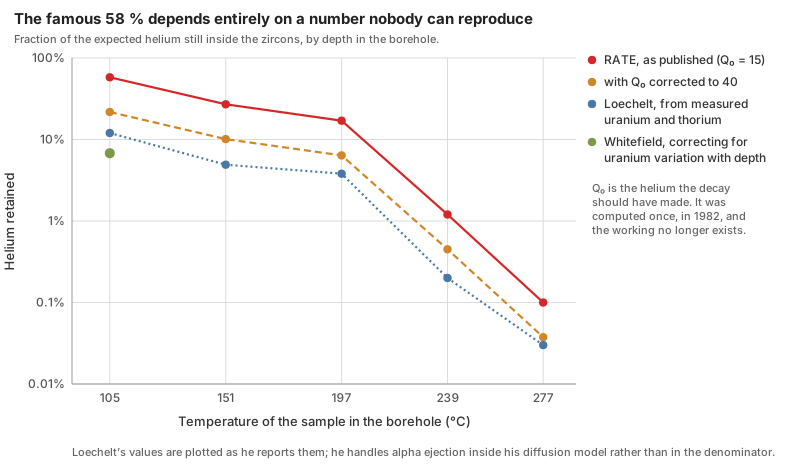
1982 — Gentry measures the helium. Robert V. Gentry and colleagues at Oak Ridge published two short papers on zircons from the core.10 11 They heated individual crystals to 1000 °C in a mass spectrometer and measured the helium that came out. The published retentions ran from 58 % at 105 °C down to about 0.1 % at 277 °C.
2000 — Humphreys turns it into a test. D. Russell Humphreys, a physicist who had spent twenty years at Sandia National Laboratories, wrote Chapter 7 of the first RATE volume.8 He noticed that Gentry's retentions imply a diffusion rate, and that the rate you infer depends entirely on how long you think the leaking has been going on. Assume 1.5 billion years and you need one number; assume 6,000 years and you need a number about 100,000 times larger. Measure the real rate and you can tell which. This is a genuinely good idea, and it should be said plainly: it is a real, falsifiable, quantitative test, and proposing it was the right instinct.
2000–2003 — the measurements. RATE contracted Kenneth Farley's laboratory at Caltech through a shell company called Zodiac Minerals and Manufacturing. Farley measured black mica in October 2000 and March 2001, and zircon in May 2002 and again in July 2003.
2003 — first publication. Humphreys, Austin, Baumgardner and Snelling presented "Helium Diffusion Rates Support Accelerated Nuclear Decay" at the Fifth International Conference on Creationism.7 The published age was 4,000 to 14,000 years.
2004–2005 — the number becomes 6,000. The familiar 6,000 ± 2,000 first appears in the Creation Research Society Quarterly in June 2004,12 and again in the definitive technical version, Chapter 2 of RATE Volume II.1
2005 onward — the critics. Kevin Henke, a geochemist, posted a long rebuttal in March 2005 and has revised it four times.13 Randy Isaac replied to RATE again in 2008, and had the last word in that exchange.14 Randy Isaac, then head of the American Scientific Affiliation, reviewed the RATE volumes in 2007.15 Rodney Whitefield, a retired IBM physicist, published a short paper in 2008.4 Gary Loechelt, a semiconductor engineer with published diffusion-modelling work of his own, produced the most detailed technical reanalysis in September 2008.5 Timothy Christman published a generalisation test in 2005.6
2010 — Humphreys declares victory. In Journal of Creation16 he wrote that "the 'dogs of war' attacking a recent item of scientific evidence for a young world seem to have stopped barking," supporting it with a Google Scholar search that turned up nothing newer than a year old.16 Loechelt's 37-page technical paper had been published thirteen months earlier and is item 12 in Humphreys' own table on the facing page.
How the argument works
Three numbers do all the work.
Q is the helium actually found in the crystal, in billionths of a cubic centimetre per microgram of zircon. This was measured.
Q0 is the helium that should be there — everything the uranium and thorium made, less what alpha ejection threw away. This was never measured. It was calculated, once, in 1982.
D is the diffusion coefficient, measured by Farley in 2003.
From Q/Q0 and D you can solve for how long the leaking has been going on.
Gentry's table
RATE's transcription of Gentry's 1982 results, with RATE's own corrections to the units:1
| Sample | Depth (m) | Temperature (°C) | He (10⁻⁹ cm³/µg) | Q/Q0 |
|---|---|---|---|---|
| 1 | 960 | 105 | 8.6 | 0.58 ± 0.17 |
| 2 | 2,170 | 151 | 3.6 | 0.27 ± 0.08 |
| 3 | 2,900 | 197 | 2.8 | 0.17 ± 0.05 |
| 4 | 3,502 | 239 | 0.16 | 0.012 ± 0.004 |
| 5 | 3,930 | 277 | ~0.02 | ~0.001 |
| 6 | 4,310 | 313 | ~0.02 | ~0.001 |
Sample 6 is discarded by RATE as a special case. Samples 1 to 5 carry the argument.
The two model curves
Here is the step most readers miss, and it is the reason the famous figure looks so decisive.
Neither curve on RATE's plot is a prediction from physics. Both are back-calculations from the table above. Take the measured retention, pick an elapsed time, and solve for the diffusion coefficient that would produce that retention in that time. Feed in 6,000 years and you get the "creation model" line. Feed in 1.5 billion years and you get the "uniformitarian model" line.
Humphreys says so explicitly: the table shows "the zircon diffusion coefficients that would be necessary for the Jemez zircons to retain the observed fractions of He for 6000 years at the temperatures listed."1 And of the other line: "The points of that model are the values of diffusivity required to retain the observed amounts of He for 1.5 billion years at today's temperatures in the rock unit."1
So the celebrated hundred-thousand-fold gap between the two curves is, at bottom, the ratio of two assumed times, filtered through two different diffusion solutions. It is not two theories making independent predictions. It is one dataset divided by two numbers.
That does not make the comparison worthless. If the measured diffusivity lands on one line and nowhere near the other, that is still informative. But it does mean the whole thing inherits every error in Q/Q0, because Q/Q0 is the only physical input to both curves.
The measurement
The 2003 run used about 1,200 zircons from 1,490 m depth, sieved to 50–75 microns, 216 micrograms in total.1 The first nine heating steps were discarded on the experimenter's advice, because the initial helium profile in a crystal is distorted near the surface. Nineteen steps were retained.
The lowest temperature actually measured was 175 °C. Gentry's samples 1 and 2 sit at 105 °C and 151 °C — below every data point. RATE reaches them by extending the fitted line downward, and says so: "Because our lowest measured value for D is at 175 °C, we extrapolated 24 °C down to the temperature of sample 2 but not further down."1
The measured points fall on two straight segments with a bend, or "knee," near 255–275 °C. Above the knee is the steep line you expect from a clean crystal lattice. Below it the line is much shallower, which means the helium is escaping faster at low temperature than the lattice alone would allow. This shallow lower segment is called the defect line, and it is the whole argument. It is the only segment that overlaps the borehole's actual temperatures, and it is the segment RATE's 6,000-year model matches.
Every serious critic attacks that one line.
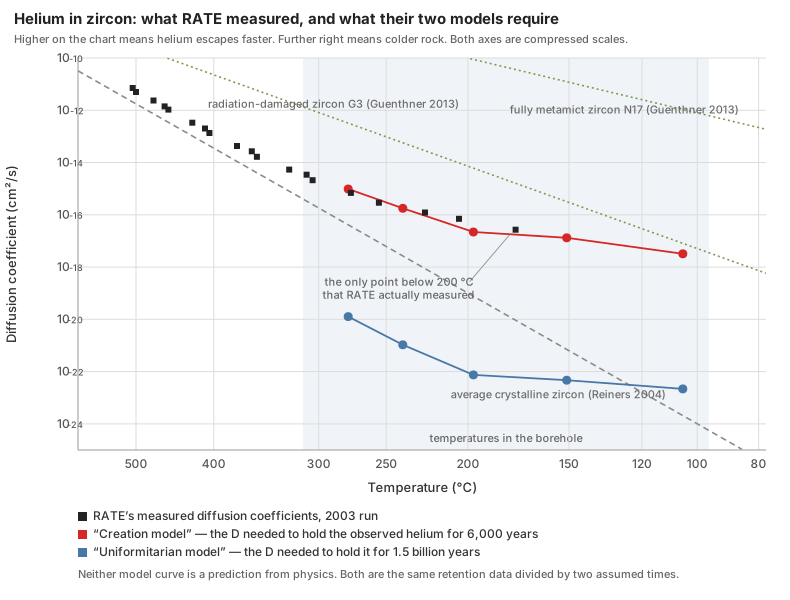
This is the figure the whole argument turns on, redrawn here from RATE's own tables together with the mainstream measurements they should be judged against. Three things are worth seeing before reading anyone's commentary. The two model curves are not independent predictions — they are the same retention data divided by two assumed times, which is why the gap between them is a constant hundred thousand. The measured points stop at 175 °C, well above the temperatures of the samples that carry the young age. And the measurements sit comfortably between two real, radiation-damaged natural zircons that mainstream laboratories measured for entirely unrelated reasons.
The published age
RATE Volume II derives a separate age from each of four samples:1
| Sample | Temperature (°C) | Retention | Age (years) |
|---|---|---|---|
| 2 | 151 | 27 % | 7,270 |
| 3 | 197 | 17 % | 2,400 |
| 4 | 239 | 1.2 % | 5,730 |
| 5 | 277 | ~0.1 % | ~7,330 |
| Average | 5,681 |
"We round off those numbers to 6000±2000 years."1
Two things about this table should be said out loud, because the magazine versions never do. The age is the mean of four numbers, and those four numbers span a factor of three. If the method worked, four samples of the same rock leaking for the same length of time should give four similar answers. They do not. And the quoted ±2,000 is one standard deviation computed with n rather than n−1 in the denominator, which is the smaller of the two conventional choices. Redone the usual way at two standard deviations, the same four numbers give 6,000 ± 4,600 years.13
The prediction that was not quite the prediction
The most persuasive thing about this argument, to a non-specialist, is the claim that the answer was written down before the experiment. It is the reason the argument gets called RATE's best. Here is Answers in Genesis' version, and creation.com's, and ICR's, compressed: in 2000 RATE published numerical predictions for two models; in 2003 an unwitting expert measured the real rates; the measurements landed on the creationist line.
The chronology in RATE's own volumes is different.
The 2000 prediction was about biotite. Biotite is black mica, the flaky dark mineral the zircons are embedded in. Humphreys' first model treated the zircon itself as offering no resistance whatever — he modelled it as a helium-filled hollow cavity — and put all the resistance in the surrounding mica. His own words:
"For simplicity, I assume the zircons to be He-filled spherical cavities in the biotite. The cavity diameters are 44 microns, to match the surface areas of the zircons. Then for each temperature, I calculate what diffusion coefficient in the biotite is necessary to get the observed percent He retention in the zircons during the time allotted by each of the two models."8
The figure containing the prediction is titled, inside the plot area, "Diffusion in Biotite." Its caption begins: "Predictions of yet-future experiments on He diffusion through biotite."8 And the formal prediction in the chapter's conclusion reads:
"In particular, experimental He diffusion rates in Jemez biotite should turn out to be within an order of magnitude of the 'Creation model' line in Figure 7."8
The biotite was measured, and it missed. Farley ran Jemez biotite in March 2001. RATE's own appendix records what happened next, and this sentence is the hinge of the entire story:
"Because these data below 300 ºC were also about an order of magnitude higher than our creation model, we supposed that zircon might be a more significant hindrance to helium loss than biotite, so we turned our attention to zircon."7
An order of magnitude is the outer edge of the tolerance Humphreys himself had set, and the miss is in the bad direction: faster mica means the helium should have escaped sooner.
The barrier then moved from the mica to the zircon. Humphreys is candid about this in print:
"As we mentioned at the end of section 4, in our first Creation model we wrongly assumed that the zircons were a negligible impediment to the He diffusion. In this section we construct a new Creation model."1
And about why the old curve survived the change:
"The effect of two changes (going from cavity in biotite to solid in biotite, and increasing the effective radius from 22 µm to 30 µm) almost completely canceled each other out. Thus my previously published predictions of diffusion coefficients still happen to be numerically valid—no thanks to me! But the numbers should be re-interpreted to apply to zircon, not biotite."1
That is an honest thing to write, and it deserves credit. It is also the sentence that none of the popular retellings carry.
What does survive
Be fair about the part that holds. When the conference paper's text was frozen in February 2003, the only zircon data ran down to 300 °C — above the bend. Humphreys wrote that he expected the low-temperature points, when they arrived, to fall onto a shallow defect line near his model values.7 The July 2003 run arrived and they did.
That is a genuine, narrow, successful prediction: not of the diffusivity, which was back-calculated from the retention, but of the shape of the curve below the bend. It is worth something. It is not the thing the magazines describe.
Loechelt makes the sharper version of the objection: the low-temperature extrapolation was published in the same 2003 paper as the model, so "this good agreement by the RATE model cannot be called a true prediction because the experimental data was available at the same time the model was published."17 He also builds an alternative young-earth model17 — solid zircon, mica ignored — that fits the data worse, to show that the published model is not the only way to embody the young-earth hypothesis. "For a highly tunable model to exactly match a preliminary dataset is suspicious, not impressive."17
Problem one: the denominator nobody can reproduce
Every retention percentage in this argument is a fraction, and the fraction's denominator was calculated once, in 1982, by a method that no longer exists on paper.
Gentry did not measure how much helium should be in the zircons. He inferred it from lead. Uranium and thorium decay chains produce, on average, 7.7 helium atoms for every lead atom, so measuring the lead gives you the helium that was made. From about 80 parts per million of lead he arrived at roughly 15 billionths of a cubic centimetre of helium per microgram, with a stated uncertainty of ±30 %. That single number is the denominator of every Q/Q0 in the table.
Humphreys, answering Henke in 2005,3 wrote: "Gentry's original calculations are no longer available."3
Three people have rebuilt it independently. None of them gets 15.
Henke redid Gentry's own stated assumptions and got 41. Humphreys' response conceded the ballpark: "He is in the right ball park, but he is probably using too small a value for the percentage of alpha particles."3
Loechelt discarded the lead route entirely. Zartman, in a 1979 Los Alamos report, published direct uranium and thorium measurements on a Fenton Hill zircon: 328.78 ppm uranium, 169.42 ppm thorium.18 Run those through the decay equations for 1,440 million years and you get 73.68 ncc/µg of helium produced.5
Whitefield noticed something neither of the others used. Gentry's second 1982 paper reports uranium and thorium on individual zircons at several depths, and they are not the same at every depth. The zircons at 960 m — the sample carrying the headline 58 % retention — contain about 8.5 times more uranium and thorium than the 2,900 m zircons Gentry took his lead measurement from. Correct for that and the retention at 960 m falls from 0.58 to about 0.068.4
Recomputed for this article
Loechelt's number is the one that can be checked from first principles, so it was recomputed here from scratch. Take Zartman's published uranium and thorium. Split the uranium into its two isotopes at present-day abundances. Apply the standard decay constants. Count eight helium atoms per uranium-238 decay chain, seven per uranium-235, six per thorium-232. Integrate over 1,440 million years:
He produced   = 3.287e-6  mol per gram of zircon
              = 7.367e-2  cm3 STP per gram
              = 73.67     ncc per microgram
That reproduces Loechelt's 73.68 to four significant figures.19
Now apply alpha ejection. Loechelt's own calibration gives FT = 0.4538 for a 20-micron sphere, and Gentry's stated retention factor was 0.60. Multiplying 73.7 by something in the range 0.45 to 0.60 gives 33 to 44 ncc/µg left inside the grain — which lands on Henke's independently derived 41.
Three routes, one answer, and it is not RATE's. RATE used 15. The defensible range is roughly 33 to 44 for the 2,900 m zircons, and higher still for the shallow ones, whose uranium content is several times greater.
There is a fourth route, and it is Gentry's own recipe applied to Gentry's own inputs. Take his 80 ppm of lead, his 7.7 helium atoms per lead atom, and his stated alpha-ejection loss of 30 to 40 %. The answer is 43.8 ncc/µg.20 To force his published 15 out of those same inputs you would need an alpha-ejection loss of about 78 % — roughly double what he wrote, and far above what a crystal this size can actually suffer.
Humphreys' defence is that Gentry did not mean what he wrote:
"He is in the right ball park, but he is probably using too small a value for the percentage of alpha particles. The percentage came from Gentry's paper, but Gentry may have misstated what he meant by the number. ... Gentry's original calculations are no longer available. But after discussing the matter with him, I'm inclined to think that even if he had an error in Q0, the error canceled out when he calculated the ratio Q/Q0."3
The last sentence cannot work. Q0 is the denominator of Q/Q0. An error in it does not cancel; it propagates in full. And this is the third conjectured misstatement in a two-page paper, after the units and the value for sample 4.
One more measurement makes a single Q0 untenable. Gentry's companion paper reports ion-microprobe uranium on individual grains, and at 960 m — the depth of the famous 58 % — the values run up to about 5,300 ppm, a spread of more than twenty-fold within one sample.11 Gentry noted the problem himself: "frequently, there were significant differences in the U and Th concentrations from two different locations on the same zircon." A retention fraction computed by dividing one crystal's helium by another crystal's average lead is not a measurement of anything.
Nobody has ever measured uranium and helium on the same Fenton Hill zircon. That single experiment would settle the retention question, and in forty years it has not been done.
How much does this cost the argument?
Less than a critic might hope, and more than RATE allows.
Correcting Q0 from 15 to 40 multiplies every retention fraction by 0.375. Sample 1 drops from 58 % to about 22 %. Sample 3 drops from 17 % to 6.4 %. Using Whitefield's depth correction as well, sample 1 drops to about 6 %.
A factor of two or three does not close a gap of a hundred thousand. Henke and Loechelt both know this, which is why neither of them stops here. But it does two things that matter. It removes the rhetorical punch of "58 % of the helium is still there after 1.5 billion years" — the number people remember. And it makes RATE's age estimate wobble badly, as the next section shows.
Rerunning RATE's own dating equation
The four per-sample ages in RATE's table already scatter by a factor of three. To see how much of that is the input, the calculation was redone here with the textbook solution for helium leaking out of a sphere, holding RATE's own diffusion coefficients fixed and varying only Q0.21
| Sample | Temp (°C) | RATE published | Q0 = 15 | Q0 = 40 | Q0 = 73.7 |
|---|---|---|---|---|---|
| 2 | 151 | 7,270 | 2,500 | 5,070 | 6,690 |
| 3 | 197 | 2,400 | 625 | 1,140 | 1,460 |
| 4 | 239 | 5,730 | 625 | 780 | 870 |
| 5 | 277 | ~7,330 | 222 | 258 | 280 |
| spread 3.0× | spread 11× | spread 20× | spread 24× |
Read that table carefully, because it says two different things.
The absolute ages in the last three columns are lower than RATE's, and the reason is stated below in the section on the bottle cap: this calculation uses the standard zero-concentration boundary at the crystal's edge, while RATE's model wraps the zircon in a mica shell that holds helium in. That single modelling choice is worth roughly a factor of three to four in age, which is a large share of RATE's answer.
The pattern, though, does not depend on the boundary choice at all. The per-sample ages fall steadily with temperature, and they spread further apart, not closer, as Q0 is corrected upward. Four samples of one rock, leaking for one span of time, should converge. These diverge. A method whose answers depend this strongly on which sample you pick is not measuring a date.
There is a simple reason why. A crystal leaking helium approaches a steady state, and the time it takes is roughly a²/15D. Using RATE's own diffusivities and their own 30-micron radius:
| Sample | Temperature (°C) | Time to reach steady state |
|---|---|---|
| 2 | 151 | 1,740 years |
| 3 | 197 | 350 years |
| 4 | 239 | 100 years |
| 5 | 277 | 24 years |
Humphreys computed the same quantity himself22 and reported "values between a few dozen years and a few thousand years."22 He treated it as a supporting point. It is not. If a crystal reaches equilibrium in 24 years, then after 6,000 years its helium content tells you about the balance between production and leakage right now, and almost nothing about how long ago anything started. The hottest samples — the ones RATE reads ages of 5,730 and 7,330 years from — are exactly the ones that lost their memory first.
Problem two: the bottle with no cap
RATE's young-earth model does not treat the zircon as a bare crystal sitting in a vacuum. It puts the zircon inside a sphere of biotite mica 1,000 microns across, and gives the mica the same diffusion coefficient as the zircon. Helium leaving the crystal therefore has to cross a further millimetre of slow rock before it is gone. This is what makes the helium last 6,000 years instead of a few hundred.
RATE measured the biotite. Twice.
Loechelt put RATE's own zircon and biotite measurements on a single Arrhenius plot and found:
"below 300 °C, which is the temperature region of interest, the diffusivity of helium in biotite is 2-3 orders of magnitude higher than that of zircon."5
Mica is a sheet mineral. It cleaves into flakes because the bonds between its layers are weak, and helium travels along those layers with very little to stop it. Treating it as an equal partner to zircon — one of the hardest and densest silicates there is — is not a conservative simplification. It is the assumption that produces the answer.
Loechelt's sharpest charge is about consistency rather than physics:
"Yet, in a classic bait and switch maneuver, this approximation is applied only to their young-earth creation model, and not to their old-earth uniformitarian model. In the old-earth model, the effect of the surrounding biotite is neglected altogether."5
That is checkable and it is correct: the creation model uses the shell, the uniformitarian model does not. The helium-retaining bonus goes to one side only.
He adds an argument from RATE's own book that is hard to answer. Chapter 8 of the same volume argues that polonium radiohalos formed because radon gas — a much larger atom than helium, with a half-life of 3.8 days — escaped zircons and travelled "scores of microns between biotite plates" fast enough to build halos. Chapter 2 needs the same biotite to bottle up helium for thousands of years. "Ironically, the helium diffusion study and the polonium radiohalo study are published as consecutive chapters in the same book."5
Problem three: the temperature history the site actually had
RATE assumed the rock has been at today's temperature for its entire existence, and presented this as a concession:
"Our assumption of constant temperatures is generous to the uniformitarian model."1
The reasoning is that if the rock had ever been hotter, it would have lost its helium faster, and the old-earth model would be in worse trouble. That is sound as far as it goes. The problem is the premise.
Fenton Hill is hot because of a young volcano. The borehole sits on the flank of the Valles Caldera. The site was selected for a geothermal experiment precisely because the rock is anomalously hot near the surface. The heat is not a billion-year-old background condition; it arrived recently, and the question is exactly how recently.
Humphreys cites two Los Alamos thermal models23 and reads both as showing the rock was hotter in the past — 50 to 120 °C hotter about 600,000 years ago, and 110 to 190 °C hotter as recently as 24,000 years ago.1 If true, that helps his argument, because it means the old-earth model needs the helium to survive even more heat.
Loechelt says both figures were read backwards. His charge is specific and checkable:
"on the left hand side of the figure, the temperature of the blue curve is only 75 ºC, identical to the stated initial condition for a depth of 3000 m in a background geothermal gradient of 25 ºC/km. If zero time corresponds to the initial condition of the theoretical model, then the maximum time must correspond to the final condition (i.e. the modern temperature at the site). Therefore, the figure depicts a heating (not cooling) event in which the temperature rises to maximum at a square root time of 600. Humphreys apparently read this figure backwards, supposing that time advanced from right to left instead."5
He makes the same charge against the second figure, and notes that the horizontal axis is the square root of time, which is easy to misread as time.
This article has not independently checked those two figures, and says so plainly. But there is a quotation from the original authors that does not depend on reading any figure, and Loechelt reproduces it:
"No reasonable fits to the measured geotherm were obtained for source ages significantly in excess of 40 ka. Thus, if the deep gradient increase in EE-2 is due to conductive heating from a source below Fenton Hill, the source is constrained to be young, much younger than the Valles caldera."23
That is Harrison, Morgan and Blackwell in 1986, saying the heat now in the deep borehole arrived within the last forty thousand years. Nearby eruptions fit: the El Cajete pumice at 50–60 ka, the Battleship Rock tuff at 55 ± 6 ka, the Banco Bonito rhyolite at 40 ± 4 ka.24
If the heat is that young, then for essentially all of the rock's history it was cooler than it is now — and RATE's "generous" assumption is not generous, it is backwards. A cooler past means the old-earth model has to explain much less helium loss than RATE credited it with.
There are independent thermal constraints in the same borehole pointing the same way. Potassium-feldspar argon dating puts the rock below about 200 °C by 1,030 million years ago and below 130 °C by 870 million.13 Fission tracks in sphene say the rock at 743 m has not exceeded about 250 °C in the last 1.3 billion years. Fluid inclusions in calcite veins at 2,624 m record a cooling episode to about 152 °C — 26 °C below today's temperature at that depth — followed by reheating to the present value.25
Problem four: what is the defect line?
Everything now reduces to one question. RATE's Arrhenius plot has a shallow low-temperature segment, and that segment is the only part of the plot that overlaps the borehole's temperatures. If it is real and applies underground, RATE has a genuine anomaly. If it is a laboratory artefact, or belongs to a tiny fraction of the helium, the argument evaporates.
Before the critics: how the defect line was drawn
There is a prior problem, and it comes from Humphreys' own text.
The defect line is a straight line fitted to four points on the Arrhenius plot. Here is how he describes the fit:
"In Figure 15, the right-hand four points, the 175 °C experimental point (solid dot) and the three points deduced from retentions and a 6000 year age (hollow squares and star) appear to make a fairly straight line."1
Three of the four points are back-calculated from the retention data by assuming a 6,000-year age. One is a measurement.
That means the defect line cannot serve as independent evidence for a 6,000-year age. It already contains one. The line is not a measured property of zircon that happens to agree with the creation model; it is three-quarters made of the creation model.
And the one real point is very small. Step 17, at 175 °C, released 7.78 × 10⁻⁴ ncc of helium out of a sample total of 1,356 ncc. That is about 0.035 femtomoles, and it moved the cumulative gas released from 0.183717 to 0.183718 of the total.1 Typical procedural blanks on a modern helium extraction line are quoted in the range of 0.05 to 1 femtomole. RATE reports a procedural blank for the uranium-lead work in the same chapter. For the helium measurements they report none.
This is not an accusation that the number is wrong. It is an observation that the single measured point carrying the low-temperature end of the argument sits at a gas quantity where the blank matters, and that the information needed to judge it was not published.
Four critics, four incompatible explanations
Four critics give four different answers, and the four exclude each other.
Loechelt: it is real, but it is a rounding error. Modern thermochronology routinely finds that a small fraction of the gas in a crystal sits in damaged, fast-diffusing domains. Loechelt fits RATE's data with two domains: 99.7 % of the helium at 38.1 kcal/mol, and 0.3 % at 13.9 kcal/mol.5 The fast 0.3 % dominates the low-temperature steps of a laboratory run, because that is all that can move at 175 °C, but it has almost no effect on how much helium a crystal keeps over geological time. He grounds this in the mainstream literature rather than inventing it, quoting Reiners et al.'s zircon work: "the best agreement was consistently found for those cases in which a small fraction of gas in the system (less than 2%) diffused at a much higher rate than the majority of gas."9
Whitefield: it is not zircon at all. His argument is a fingerprint match. The activation energy of RATE's low-temperature zircon segment, computed from RATE's own table, is 13.9 kcal/mol. The activation energy of RATE's own GT-2 biotite over the same temperature range is 11.4 kcal/mol. Typical zircon is about 35.4 More than 40 % of GT-2 zircons carry non-zircon overgrowths, and the experimenter had used hydrofluoric acid on an earlier batch specifically to strip clinging biotite. Whitefield's mechanism: the step-heating run went up to 500 °C first, where helium moves about 100,000 times faster than at 200 °C; helium leaving the zircon loaded the mica inclusions; and it dribbled back out during the later low-temperature steps. He calculates that a single biotite inclusion smaller than 0.2 % of the crystal's volume would be enough.
Henke: it may be real in a vacuum and absent in the ground. His mechanism is not the textbook pressure term but crack closure — the metamict patches, microcracks and pits visible in RATE's own electron-microscope images are open in a vacuum chamber and partly squeezed shut under the 200 to 1,200 bar the rock actually sits under.13
Henke again, alternatively: some of the helium is not from the zircons. He documents extraneous helium in nearby Valles Caldera geothermal wells at 0.018 to 0.117 ncc/µg — concentrations comparable to what RATE reports for the deep samples 4, 5 and 6 (0.16, 0.02, 0.02).13 If true this breaks Loechelt's model too, and Henke says so.
These four cannot all be right, and RATE says so. Humphreys makes rhetorical use of the disunity, and it is a fair point as far as it goes. Loechelt's reply is the fair one from the other side: "The very thing that Humphreys criticizes, multiple people who are unrelated and unknown to each other bringing their different and sometimes conflicting ideas to the table, debating and even disagreeing with one another, is how true science works!"17
But there is a real cost here and this article will not paper over it. The critics have not converged on a single positive account of what the defect line is. Until they do, RATE can truthfully say that each critic's explanation is rejected by the others.
One coincidence in the middle of that disagreement is worth chasing, and nobody in the literature has. Loechelt's fitted activation energy for his fast-diffusing domain is 13.9 kcal/mol. Whitefield's measured activation energy for the low-temperature segment, which he assigns to biotite, is also 13.9 kcal/mol. Two workers extracted the same number from the same data and gave it to two different minerals. That is either a strong hint that the low-temperature signal is one physical thing, or a coincidence, and it is testable: measure zircons that have been verified free of mica inclusions.
Problem five: the argument does not generalise
This is the cleanest objection in the whole dispute, because it needs none of RATE's disputed inputs — not Q0, not the grain radius, not Fenton Hill's thermal history. It takes RATE's diffusion coefficients at face value and asks what they predict for zircons somewhere else.
Extrapolate RATE's four lowest-temperature points down to 100 °C and you get a diffusion coefficient around 10⁻¹⁸ cm²/s. For a 30-micron crystal, that means roughly 50,000 years to fall to 10 % of the starting helium and about 100,000 years to reach 2 %.6 In 6,000 years, a zircon at 100 °C or below should have lost almost nothing.
Now the field data. Zircons eroded out of the Himalayas and carried down the Ganges and Indus have helium ages "often less than one percent of the uranium/lead age." Zircons in Missouri River sediment with uranium-lead ages over 1.2 billion years have helium ages under 50 million. At Gold Butte in Nevada, where a fault block tilted on its side has exposed rock from as deep as 15 km, the deepest zircons hold about 1 % of the helium their uranium made and the shallowest about 10 %.6
Christman's point:
"The results of helium measurements from these detrital samples are significant because there is no conceivable scenario for those zircons to have been exposed to elevated temperature (>100 °C) during the last 6000 years. These sediments must have been eroded from near the surface in the mountains of northern India."6
On a 6,000-year earth with RATE's own diffusivities, those grains should be nearly full. They are nearly empty.
The honest counter, which Christman does not address: a committed accelerated-decay model can say those zircons were also emptied during the Flood year, by the same burst of heat and decay. That is not absurd. But it costs something. RATE would then need a mechanism that stripped surface zircons worldwide down to under 1 % retention while leaving Fenton Hill zircons at 58 % — or 22 %, or 6 % — at 105 °C, in the same year. Nobody has proposed one.
The cross-check that decides it
The strongest argument against RATE is not a critique of RATE at all. It is a positive reconstruction, it uses only numbers published about this borehole before the controversy began, and it produces a result that did not have to come out right.
Two different minerals in the same rock record two different temperatures.
- Zircon stops losing helium below roughly 170–190 °C.
- Apatite stops losing fission tracks below roughly 125 °C.
A rock cooling from depth passes 170 °C before it passes 125 °C. So if both clocks are working, the zircon helium age must be older than the apatite fission-track age. That is a prediction with a direction, and it is not a prediction anyone tuned.
Whitefield ran it. Using Gentry's own uranium and thorium measurements to fix the retention at 960 m — the correction described above, giving about 6.8 % rather than 58 % — the zircon helium clock at that depth reads about 100 million years.4
Apatite fission-track ages measured in the same borehole in 1977, long before any of this: 66.8 million years at 790 m, 55.1 million at 1,130 m. Interpolating to 960 m gives about 62 million years.26
"As a consequence, the 102 million year cooling age date for the zircon is consistent with the 62 million year apatite fission track cooling age. Sphene fission track data indicate that the rock had not been hotter than about 250 °C for the last 1,300 million years."4
Three independent thermochronometers — sphene, zircon, apatite — in the correct order, from three different closure temperatures, in one core. No multi-domain model, no reconstructed thermal history, no new measurements.
That is what a working dating system looks like. It is also, incidentally, an answer to the question RATE originally asked. The zircons still hold helium not because the decay was fast, but because the rock has only been hot for a geologically short time and was cool before that.
The borehole says so itself
The last section relied on other people's reconstructions. This one does not. It uses one table, published by Gentry in 1982, and division.
Take Gentry's own depths and temperatures and work out the temperature gradient between consecutive samples:
| Interval (m) | Temperature change | Gradient (°C/km) |
|---|---|---|
| 0 – 960 | 20 → 105 °C | 88.5 |
| 960 – 2,170 | 105 → 151 °C | 38.0 |
| 2,170 – 2,900 | 151 → 197 °C | 63.0 |
| 2,900 – 3,502 | 197 → 239 °C | 69.8 |
| 3,502 – 3,930 | 239 → 277 °C | 88.8 |
| 3,930 – 4,310 | 277 → 313 °C | 94.7 |
Below two kilometres the gradient rises steadily with depth, from 63 to 95 °C per kilometre.
That pattern is diagnostic. Rock sitting in thermal equilibrium, with heat flowing steadily up from below, has a constant gradient. Rock that also generates its own heat from radioactivity has a gradient that gets shallower with depth, because heat accumulates on the way up. A gradient that gets steeper with depth means only one thing: the rock is being heated from below right now, and has not had time to settle.
This is the curvature that Harrison, Morgan and Blackwell analysed in 1986 and used to date the heat source at under 40,000 years old. It is visible in Gentry's own table, printed in 1982, in the paper RATE's argument is built on.
Two cautions, stated because they are real. The three deepest points come from a different borehole, so the profile is a composite. And there is a separate shallow disturbance near the top of the Precambrian basement, so the first row is not a clean conductive gradient either. Neither caution touches the trend below two kilometres.
There is more in the same cores. Los Alamos published two other temperature-sensitive measurements on this rock before any of this began.
Zartman, 1979: apatite fission-track ages "have effectively been reset to 0 m.y." below 1,800 m.18 Apatite anneals completely at 110 to 150 °C. A reset to zero means the deep rock is hot now.
Laney and Laughlin, 1981, on radiohalos in the biotite from the same core: "Annealing of the haloes is first observed in samples from a depth of 1850 m (134 °C present temperature) and is complete in samples from a depth of 2120 m (151 °C)."27
That second one is worth pausing on. Radiohalos — the coloured rings that alpha particles leave in mica — are the subject of Chapter 8 of the same RATE volume, and RATE's own summary states that they survive only "below the annealing temperature of 150 °C."2 Los Alamos measured the halos in these very cores being wiped out between 134 and 151 °C, exactly as expected. The rock below two kilometres has been hot enough, for long enough, to erase them.
A correction that RATE never made
One more thing about the samples, because it affects what the argument is entitled to say.
GT-2 bottoms out at about 2,930 metres.28 Gentry's samples 4, 5 and 6 come from 3,502, 3,930 and 4,310 metres. They cannot be from GT-2, and Gentry says so: his Science paper describes samples "from Los Alamos National Laboratory drill holes GT-2 and EE-2."11
RATE describes all of them as coming from "borehole GT-2." Two of the four samples that produce the 6,000-year average — samples 4 and 5 — are from the other hole.
The rock type is wrong too. RATE calls the samples "Jemez granodiorite," and explains in their own conference paper why this matters: "it is important to get helium diffusion data on zircon and biotite from the same rock unit."7 Los Alamos logs biotite granodiorite only below 2,591 m; about 75 % of the GT-2 and EE-1 cores are gneiss.13 Matching depths against the core log, one of Gentry's samples is granodiorite, and neither of RATE's two samples is. Henke reports an eyewitness account of a 2007 RATE presentation at which Baumgardner conceded the point and Humphreys apologised;13 no correction appears in the published record.
And the two halves of the argument share no ground at all. The retention data come from 960 to 4,310 metres. The diffusion data come from 750 and 1,490 metres. Not one depth appears in both. The grain radius that sets the diffusion coefficient was assumed at half the crystal length rather than measured, and for the 750 m sample the crystals were never sized at all.
None of this is fatal by itself. It is the accumulation that matters. The retention data come from one set of crystals; the diffusion rate comes from a different set, at different depths, collected twenty years later. The denominator comes from lead measured in a third rock type at a fifth depth. Each substitution is individually arguable. Stacked, they are the reason no two people who have redone this calculation get the same answer.
The lead the argument does not mention
Here is a problem RATE printed in their own appendix and never discussed.
Q0 is computed from lead. That only works if the zircons kept all their lead. Uranium-lead dating has a standard test for whether they did: compare the age from uranium-238 decaying to lead-206 against the age from the lead-207 to lead-206 ratio. If the crystal is closed, the two agree. If lead has leaked out, the first age comes out too young.
Zartman's zircon, 1979: lead-206/uranium-238 age of 1,159 ± 10 million years against a lead-207/lead-206 age of 1,465 ± 30 million.18
RATE's own three zircons, printed in Appendix A of the helium chapter: lead-206/uranium-238 ages of 631.0, 1,368.1 and 1,023.4 million years, against lead-207/lead-206 ages of 1,423.2, 1,438.2 and 1,434.9 million.1
One of RATE's own grains has lost about 56 % of its radiogenic lead.
The consequence runs one way. Lost lead means the surviving lead understates the decay that happened, so a Q0 computed from lead is a lower bound. Every retention fraction built on it is therefore an upper bound — the true retentions are lower than published, on RATE's own data, printed in RATE's own book.
What mainstream thermochronology actually says
It would be easy to leave the impression that Humphreys measured something bizarre. He did not, and this needs saying plainly, because it is the single most surprising result of checking his work.
Humphreys' fitted high-temperature Arrhenius parameters for Fenton Hill zircon are an activation energy of 143.9 ± 3.8 kJ/mol and a frequency factor of 0.032 cm²/s.7
Guenthner and colleagues, in the standard modern reference on helium diffusion in natural zircon, measured a sample called TH62Z at 145.96 ± 0.44 kJ/mol and 0.0170 cm²/s.29
The activation energies are indistinguishable, and the frequency factors differ by less than a factor of two. Evaluated at Fenton Hill temperatures the two lines lie within a factor of about three of each other. The published range across natural zircons runs from 70.7 to 172 kJ/mol in activation energy and across six orders of magnitude in frequency factor, all as a function of how much radiation damage the crystal has soaked up. Humphreys' values sit comfortably inside it.
The single low-temperature point he actually measured — 2.68 × 10⁻¹⁷ cm²/s at 175 °C — is 2,900 times above the generic line for undamaged zircon. But it is also 60 times below a real zircon Guenthner measured at a slightly higher damage dose, and about a million times below another.30 Nothing he measured is off the mainstream chart.
Which means the argument is about the thermal history, not the physics
That reframes the entire dispute. If the kinetics are ordinary, then the disagreement is entirely about the temperature-versus-time path, and the helium content is a thermometer reading rather than a clock reading.
Two further pieces of mainstream physics matter here, and both were established after RATE finished.
The Fenton Hill zircons sit exactly on a knife edge. Radiation damage first makes zircon more retentive, by blocking the fast channels along the crystal's axis, and then — once the damaged patches join up into a connected network — makes it catastrophically leaky. Guenthner and colleagues29 found the turnover at about 2 × 10¹⁸ alpha decays per gram, above which "diffusivity increases by about nine orders of magnitude."29
The Fenton Hill dose, computed for this article from Zartman's published uranium and thorium over 1,440 million years, is 1.98 × 10¹⁸ alpha decays per gram.19 Individual grains are worse: RATE's own analysis found one at 612 ppm uranium, which alone gives 3.3 × 10¹⁸.
These are precisely the crystals that mainstream thermochronology says you must not date with generic kinetics. They are old, uranium-rich, and sitting on the percolation threshold where diffusivity swings by nine orders of magnitude. That cuts against RATE's "uniformitarian model," which applies generic kinetics — but it cuts much harder against the idea that anything anomalous is going on, because the mainstream literature predicts enhanced leakiness in exactly this population and measured it in other crystals before anyone looked at these.
And the constant-temperature version fails for everybody. This is the point on which RATE was right and their critics have mostly been quiet.
Take the published mainstream kinetics for zircon and ask them to keep 27 % of the helium at a constant 151 °C for 1.44 billion years. They cannot. They give about 1.9 %.31 At the most retentive damage dose in the whole ZRDAAM model, they give 3.8 %.
There is a second, sharper version of the same problem. The diffusion coefficient the old-earth model requires changes by only a factor of 3.4 between the 105 °C sample and the 197 °C sample. A real Arrhenius law with the published zircon activation energy changes by a factor of 37,000 over that same interval.31 No single-domain kinetics of any kind, creationist or mainstream, can produce a retention profile that flat at constant temperature.
Humphreys' response was to invoke a very shallow defect line. The mainstream response is that the temperature was not constant, and that the crystals have more than one kind of diffusion domain. Both responses are attempts to fix the same real failure. RATE identified a genuine problem with the naive old-earth calculation. What they did not establish is that their fix is the right one.
The reframe that makes everything fit
Put the pieces together and a different reading of RATE's own result appears.
The rock spent most of its existence cool. The background geothermal gradient at the site, before the volcano, was about 30 °C per kilometre — which puts the sample depths between roughly 22 and 129 °C. At those temperatures zircon holds helium well. Then the Valles magmatic system arrived and drove the temperatures to today's 96 to 313 °C, and the helium started pouring out.
On that reading, the helium loss is dominated entirely by the recent hot interval. And then RATE's "helium diffusion age" is not the age of the rock at all. It is the duration of the heat pulse.
Harrison, Morgan and Blackwell dated that pulse independently, using argon in feldspar from the same borehole, at roughly 10,000 to 40,000 years — with a shallow disturbance nearer 10,000 and a deep one under 40,000.23
RATE's number is 6,000 years, from helium. Los Alamos' number is 10,000 to 40,000 years, from argon, published nineteen years earlier. They are not identical, and this article will not pretend they are — RATE's figure depends on their mica-shell boundary condition and their low Q0, both of which push it downward. But they are the same kind of number for the same physical event, and that is the point. RATE measured something real. They measured the age of the heat, and called it the age of the earth.
The honest limits of this reconstruction
A simple two-stage history — cold for 1.44 billion years, then a brief pulse — was tested for this article against the observed retentions. It does not work either. It over-retains badly: it predicts 94 to 99 % retention where 12 to 58 % is observed.32 The constant-temperature history under-retains just as badly at depth.
Neither simple story fits. What fits requires a real burial and exhumation history in between — the Paleozoic uplift, the Mesozoic burial under the Mancos and Lewis shales, the Laramide exhumation — plus damage-dependent, multi-domain kinetics. That is what Loechelt built, and his model does fit.
But it should be said clearly that Loechelt has more adjustable parameters than RATE does: a multi-domain kinetic spectrum plus a hand-assembled 1.44-billion-year temperature path, fitted to five retention numbers. A model with more knobs is not automatically better evidence. What his paper establishes is narrower and sufficient: an old-earth model that reproduces the data exists. Therefore the data cannot be used to prove an old earth impossible. He also reports, to his credit, that a young-earth model with his kinetics fails in the opposite direction: "there is now insufficient thermal budget in a young earth to cause enough helium loss."5
Where the critics are wrong
Grading both sides by one standard means saying this part out loud.
Randy Isaac's factor of a thousand was made up. His 2007 review says the vacuum measurements are off because "actual diffusion rates in field conditions are known to be considerably lower, by as much as a factor of one thousand or more."15 The essay contains no footnotes and no references of any kind. The number is asserted flat. It is the most-repeated objection to the RATE helium work and it has never had a source.
It also cannot be recovered from the physics. The pressure dependence of diffusion is governed by the activation volume in D = D0·exp(−(Ea + P·ΔV)/RT). Activation volume has been measured for argon in mica, by piston-cylinder experiments at 10 and 20 kilobars, at about 14 cm³/mol.33 Apply that to Fenton Hill's actual pressures:
| Depth (m) | Pressure (kbar) | D(P)/D(0) |
|---|---|---|
| 960 | 0.25 | 0.89 |
| 2,170 | 0.58 | 0.80 |
| 2,900 | 0.77 | 0.76 |
| 4,310 | 1.14 | 0.72 |
Confining pressure at these depths slows helium diffusion by 9 to 28 %. Not a factor of a thousand. To get a factor of a thousand you would need about 17 kilobars — roughly 66 kilometres of overburden, near the base of the continental crust. The deepest sample here is at 4.3 km.
Helium is a smaller atom than argon, so its activation volume should be smaller still, which makes the real effect weaker than the table shows. This objection cuts in Humphreys' favour, and the article says so. Isaac himself dropped it in 2008, substituting a different and much narrower claim about phase breakdown in vacuum-heated minerals — a real phenomenon in hydrous minerals like mica, but not one that applies to zircon, which is anhydrous and does not break down at these temperatures.
Henke's key pressure citation is a paper that never varied pressure. He cites Dunai and Roselieb's work on garnet as showing that "under 250 bars of pressure and at temperatures as high as 700 °C, helium would take tens to hundreds of millions of years to just partially diffuse out."13 What that paper actually did was load garnet with helium at 250 bar to measure absorption, and the 250 bar was the limit of their platinum capsules, not an experimental variable. Their conclusion is that garnet is intrinsically retentive because of its low ion porosity. Pressure was never shown to slow anything. This is the clearest technical mistake by any critic in the literature.
Henke's "nine orders of magnitude" framing is empty. He contrasts the vacuum, at about 10⁻⁶ bar, with 1,000 bar underground, and calls it a nine-order-of-magnitude difference. But only the absolute pressure enters the equation, not the ratio. Going from nothing to 1,000 bar is going from nothing to 10⁸ pascals, and 10⁸ pascals times any physically possible activation volume is a small number.
Henke's headline "90,000 ± 500,000 years" is a rhetorical device. A two-sigma band that extends into negative time is not an age. He says as much, but he also repeats it in his abstract as though it were a result.
Joe Meert's one published criticism was simply an error. In 2002 he accused ICR of a transcription mistake, claiming Humphreys' "−196 °C" should have been "+190 °C" from Reiners' paper.34 Humphreys' reply is correct: −196 °C was not a closure temperature at all, it was the temperature at which the Jemez zircons' diffusion rates would be slow enough to retain the observed helium for 1.5 billion years. Meert also misquoted the figure as 190 rather than 196.
Isaac's charge that RATE's equations are "physically meaningless" is wrong, and the strongest critic says so. Isaac argued in 2008 that inserting 1.5 billion years into a steady-state equation is meaningless.14 Loechelt independently re-derived Humphreys' steady-state relation from the standard formalism and found it correct — it "corresponds to Humphreys' uniformitarian model once the difference in notation is taken into account."5 He found the same for Humphreys' creation-model equations. The algebra is right. The inputs are wrong. Isaac attacked the algebra and missed; Loechelt attacked the inputs and landed.
Loechelt applies one uranium value across every depth — the practice he condemns. He uses Zartman's single zircon at 2,900 m and applies its 73.68 ncc/µg to all eight samples, after writing "This assumption is not very good" about doing exactly that.5 Gentry's own data show uranium varying several-fold with depth, and Gentry's companion paper notes that "frequently, there were significant differences in the U and Th concentrations from two different locations on the same zircon."11
Loechelt's fast-diffusing domain is loosely pinned. He says so: "reasonable fits could be obtained for fractions ranging from 0.1% to 10%."5 Two orders of magnitude of latitude on the parameter that carries his whole reinterpretation. That is the same charge he levels at RATE.
Christman's generalisation test assumes what a committed young-earther denies. He takes detrital zircon helium ages at face value. A thoroughgoing accelerated-decay model can answer that those grains were reset too. His argument is strong within a conventional framework and question-begging against a fully committed one — though, as noted above, the answer costs RATE a mechanism nobody has proposed.
And Henke's tone is a liability. "YEC tabloids," "anti-science agenda," "fraudulent." His technical work contains real findings, several of them decisive. Quote his data, not his adjectives.
The heat problem
Everything above concerns whether the helium data show what RATE says. This section concerns what would follow if they did. The full budget across every Flood mechanism, and every proposed solution, is in The Heat Problem.
If 1.5 billion years of radioactive decay happened in one year, the energy has to go somewhere. Radioactive decay releases heat. That is why the earth has a molten core and why geothermal power exists. Compress the whole history into twelve months and you get the whole history's heat in twelve months.
RATE knows this. It is the first thing Vardiman raises in the introduction to Volume 1, and it is the section of the final summary2 that has done the project the most damage:
"The heat would have melted the crustal rocks many times over unless there was some mechanism for simultaneously removing it quickly. How did the earth survive such a massive dose of heat without vaporizing the oceans and melting the rocks? How did Noah and his family survive such an environment on the Ark?"2
How big is it?
RATE never publishes the number, and the secondary literature repeats it without derivation. So it was computed for this article from published crustal abundances, with every input shown.35
Take the standard composition of bulk continental crust — 1.3 ppm uranium, 5.6 ppm thorium, 1.81 % potassium oxide36 — and the standard heat-production constants for each.37 Present-day heat production works out to 3.25 × 10⁻¹⁰ watts per kilogram.
Two checks that this is right. Multiplied by the mass of the continental crust it gives 6.7 terawatts, against the published estimate of 6.8. And Baumgardner's own chapter in RATE Volume 1 quotes 3.32 × 10⁻¹⁰ W/kg for average crust — within 2 %. RATE and this calculation are using the same crust.
Now integrate. You cannot simply multiply by 4.5 billion years, because there was more uranium in the past; the correct factor is (e^λT − 1)/λ for each nuclide. The results:
| Scenario | Energy per kg of crust | Temperature rise |
|---|---|---|
| RATE's own budget: 500 Myr of decay in the Flood year | 5.12 × 10⁶ J/kg | 5,700 K |
| The full 4.5-billion-year inventory | 9.45 × 10⁷ J/kg | 105,000 K |
Melting crustal rock takes roughly 1.5 × 10⁶ J/kg. Vaporising it takes roughly 1.45 × 10⁷. RATE's own, smaller number is 3.4 times more than enough to melt the crust. The full inventory is 6.5 times more than enough to vaporise it. In an ordinary granite, which is several times more radioactive than average crust, RATE's own budget gives about 18,000 K.
Their sentence — "would have melted the crustal rocks many times over" — is precisely accurate.
Can it be radiated away?
Grant the most generous possible assumption: every joule reaches the surface instantly, and the earth radiates as a perfect blackbody for the whole year.
The earth would have to glow at about 6,800 K — hotter than the surface of the sun, which is 5,772 K. On RATE's smaller half-billion-year budget it is still about 3,300 K, above the melting point of every common rock-forming mineral, for twelve continuous months.
Conduction is far worse. Heat diffuses through granite about 13 metres in a year.
The proposed solution, and why it fails
Humphreys' answer is cosmological. In an expanding universe a freely travelling photon loses energy — that is the ordinary redshift, and the energy really does vanish rather than going somewhere we can point to. Humphreys proposes that God stretched out the heavens during the Flood, that this changed nuclear decay rates, and that the same stretching drained the heat. A two-fold expansion in a year would remove three-quarters of the thermal energy.
State it at its strongest and the objections are still decisive.
It contradicts itself. Humphreys explains, correctly, two paragraphs earlier that bound systems do not expand with the universe because their binding forces overwhelm the expansion — "the fabric of space between particles bound to each other ... continues to expand, sliding past the particles essentially without friction."8 If it slides past without friction it cannot also be extracting energy. This is why atoms, planets and rocks do not cool as the universe expands.
A factor of four is not a factor of 100,000. His worked example removes 75 % of the heat. The requirement is to remove 99.999 %.
It cannot be selective, and RATE says so. From their own summary:
"Had the granite plutons with their high concentrations of radioactive elements cooled at sufficiently high rates to form and persist as crystalline rock, then the oceans would have frozen solid had they cooled by the same amount. Likewise, Noah and his family on the Ark would have been in danger of freezing."2
Their proposed patch is that the cooling might scale steeply with temperature. But cosmological energy loss scales with the expansion rate of spacetime, which has no way of knowing that a pluton is hot and the sea is cold.
And RATE hedges it themselves. "Humphreys' postulated explanation ... may not, in fact, be the correct mechanism."2 Humphreys, on his own model: "Though this is sheer guesswork now, I am confident that a good explanation exists."1
A note on the popular version. You will sometimes hear that time dilation solves this — that "outside" time was long, so the heat radiated away over billions of years. It does not work, for a simple reason. The heat is deposited in the rock's own frame, and it is the rock's own clock over which the rock has to get rid of it. A rock cannot simultaneously live fast enough to decay a billion times quicker and slow enough to radiate over billions of years.
The radiation problem, which is worse and gets less attention
Accelerate decay by a factor of 500 million and you also multiply the radiation by 500 million. Flood water shields the Ark from the rocks below. It does not shield Noah from Noah.
Every human body contains about 140 grams of potassium, of which one part in eight thousand is radioactive potassium-40. That gives an internal dose of about 0.17 millisieverts per year.38 Multiply by RATE's own acceleration factor:35
5e8 x 0.17 mSv = 85,000 SvThe acute lethal dose for a human is about 4 sieverts. This is 21,000 times lethal. It also deposits enough energy to raise body temperature by 24 K. For scale, medical devices are sterilised at 25 kGy; this is 85 kGy.
Invert it and the threshold is stark: an acceleration of only 24,000-fold, for one year, is already fatal from internal potassium alone. RATE needs a factor between 10⁸ and 10⁹.
Humphreys saw this in 2000 and wrote that potassium-40 "would be enough to kill Noah."8 His escape is that Noah's potassium came from pre-Flood soil that God made without radioactive isotopes. Three problems. Accelerated decay destroys potassium-40, it does not create it, so a separate production mechanism is needed and none is offered. Terrestrial potassium is isotopically uniform to a few parts in ten thousand across seawater, soil, plants, granite and meteorites, which is not what a 4,500-year-old mixing event produces. And RATE's own isochron work says beta decay — which is how potassium-40 decays — was accelerated within a factor of about 1.6 of alpha decay, so potassium cannot be exempted.
The argument eats itself
This is the sharpest objection available, and it needs no source outside RATE.
Every one of RATE's four main evidences is a thermometer.
| RATE evidence | Destroyed above |
|---|---|
| Helium retained in zircon | ~180–200 °C |
| Polonium radiohalos in biotite | 150 °C — RATE's own figure2 |
| Fission tracks in zircon | ~200–350 °C |
| Carbon-14 in coal | well below 1,000 °C |
So the same granite must, in the same year, absorb five hundred million years' worth of decay heat — and never exceed 150 °C, or the radiohalos anneal — and never exceed about 200 °C, or the zircons lose the helium that is the centrepiece of the entire project.
Put at its sharpest: if those zircons really contain 1.5 billion years' worth of radiogenic helium, and that decay happened in a year, then those same zircons absorbed 1.5 billion years' worth of alpha-particle kinetic energy in a year, inside a crystal twenty microns across. There is no arrangement in which the helium survives and the crystal does not.
Independent evidence that decay rates have not changed
Two lines, stated with their limits.
The Oklo natural reactor. In Gabon there is a uranium deposit where natural nuclear reactors ran, moderated by ordinary groundwater, in roughly thirty-minute pulses separated by two-and-a-half-hour cooldowns. The samarium isotopes left behind pin the fine-structure constant to within about one part in ten million of today's value during operation.39
The obvious young-earth reply is that Oklo is not two billion years old. The argument survives it twice over. Whatever date you assign, the reactor's entire fission-product inventory is reproduced by present-day cross sections — so the constants were unchanged while it ran. And RATE places the Proterozoic inside the Flood year, which means a water-moderated reactor whose duty cycle is governed by groundwater boiling was operating inside a rock that was simultaneously absorbing enough heat to vaporise it.
RATE knew about Oklo. Chaffin presented work on it at the second RATE meeting, and $25,000 was budgeted for an Oklo plutonium study.8 Neither appears as a chapter in Volume 2.
Supernova light curves. A type Ia supernova is powered by nickel-56 decaying to cobalt-56 to iron-56, and its late light curve is a direct readout of the cobalt-56 half-life. Spectra of thirteen distant supernovae show them ageing at exactly the rate expected once cosmological time dilation is removed.40 The gamma-ray decay lines themselves have been detected directly from SN 1987A and SN 2014J.41
Be honest about what this does and does not show. A young-earth reader will point out that this light left its source long before the Flood, so it constrains a period RATE does not claim was accelerated. That objection is fair. What the supernova data do establish is narrower: decay constants are not free parameters that drift with epoch or environment in any observed way, and Humphreys' proposed mechanism is cosmological, which means it should have applied everywhere at once. Nothing in the observed universe records such an event.
And Chaffin's own numbers fall short. RATE's nuclear theorist wrote in Volume 1 that changing the nuclear potential well depth by 5 MeV changes the decay constant by only a factor of ten, and that allowing the alpha energy to move by 10 % gets a factor of 10⁵ — against the 10⁹ needed. His conclusion: "a one year episode of accelerated decay at the time of the Flood may not be enough."8 That is RATE's own theoretician conceding a four-order-of-magnitude shortfall, in RATE's own first volume.
Worse, the fix collides with another RATE chapter. Alpha particle range in a solid scales roughly as energy to the 1.5 power, so moving alpha energies by the 20–25 % Chaffin would need widens a radiohalo ring by 30–40 %. Radiohalo radii are exactly how Gentry and Snelling identify which nuclide made each ring. RATE cannot have both the accelerated decay and the radiohalos.
The rest of RATE, briefly
The helium argument does not stand alone, and a reader deserves to know what else is in the project.
Carbon-14 in coal and diamonds (Baumgardner). The claim is that samples supposedly millions of years old still contain measurable radiocarbon. This site has a separate treatment; in short, the measured levels sit at or near the contamination and instrument-background floor of accelerator mass spectrometry, and the diamond results in particular are consistent with known machine backgrounds.
Radiohalos (Snelling). Rings left in mica by alpha particles. The polonium-halo argument is Gentry's, and most creationists have abandoned it; Snelling's version argues instead that the halos require rapid hydrothermal transport. As noted above, Los Alamos measured the halos in these very cores annealing away between 134 and 151 °C.
Fission tracks (Snelling). Damage trails from spontaneous uranium fission, used to argue for large amounts of decay in a short time.
Isochron discordance (Austin, Snelling). The most interesting of the four. Different decay systems in the same rock give different apparent ages, and RATE argues alpha-decay systems read systematically older than beta-decay ones, implying acceleration varied with decay mode.
That last one deserves a note, because it undercuts the rest. The discordances Austin reports on the Bass Rapids diabase span roughly 0.84 to 1.38 billion years — a factor of about 1.6. RATE's own data therefore measure alpha and beta acceleration differing by 60 %, and are then used to argue for an overall acceleration of a billion-fold. A mechanism that changes nuclear rates by nine orders of magnitude while keeping alpha and beta within 60 % of each other, and while keeping five different decay systems concordant in meteorites, is very finely tuned indeed. RATE measured a small effect and interpreted it as evidence for an enormous one.
RATE concedes the meteorite concordance. Their Volume 2 recommendations admit that "the abundance of daughter products from long-lived radioisotopes in meteorites from space needs much more attention," and that "the studies conducted by RATE on rocks from the earth do not yet adequately address the issue of the age of meteorites."2
Objections and responses
"The measurement was blind. A Caltech expert who didn't know who was paying him produced these numbers."
True, and it is the best feature of the project. It also does not help. Nobody disputes Farley's diffusion measurements — not Henke, not Loechelt, not Whitefield, not this article. What is disputed is the retention fractions, which Farley did not measure, and the thermal history, which no laboratory can measure. A perfectly blinded measurement of the wrong quantity is still the wrong quantity. It should also be noted that only the diffusion runs were blind; ICR's own laboratory and a commercial lab did the mineral separations and knew the depths.
"RATE predicted the diffusion rates in advance and the measurement confirmed them."
The 2000 prediction was about biotite, and Humphreys says so in print. The biotite was measured and missed by about an order of magnitude in the unhelpful direction. The barrier then moved to the zircon and the old curve happened to survive. What genuinely was predicted in advance was the shape of the low-temperature segment, and that is worth acknowledging. It is not what the popular versions describe.
"The critics contradict each other, so none of them can be right."
They do contradict each other, and this article says so. But the four rival explanations of the defect line are not the load-bearing objection. The load-bearing objections are that nobody can reproduce Q0, that the borehole's own temperature profile shows it is still heating, and that the same borehole's apatite and sphene clocks agree with a conventional zircon helium age. Those three are consistent with each other and do not depend on which account of the defect line is correct.
"Helium diffusion measured in a vacuum doesn't apply underground."
This objection is wrong, and this article says so at length above. The measured activation volume for a noble gas in a silicate implies a 9 to 28 % effect at Fenton Hill pressures, not a factor of a thousand. Isaac asserted the thousandfold figure without a source and withdrew it a year later. A narrower version survives — that the low-temperature defect segment specifically might be a vacuum artefact — but nobody has tested it, and RATE's counter-claim of "far less than one percent" is equally uncomputed.
"The old-earth model doesn't work either. Mainstream kinetics can't keep 27 % of the helium for 1.44 billion years at 151 °C."
Correct, and this is the strongest thing RATE has. Mainstream kinetics at constant temperature give about 1.9 %. The observation genuinely does refute the naive old-earth calculation. The answer is that the temperature was not constant, and the evidence for that is in the borehole itself: a gradient that steepens with depth, apatite fission tracks reset to zero, radiohalos annealed away, and an argon age of 10,000 to 40,000 years for the heat. RATE identified a real problem. Their fix is not the only one, and it is not the one the site's own data support.
"Loechelt's model has more free parameters than RATE's, so it proves less."
Fair, and stated above. His model does not prove the earth is old. It establishes something weaker and sufficient: an old-earth model reproducing these data exists, so the data cannot show an old earth is impossible.
"Even if this argument fails, doesn't the residual helium still need explaining?"
Yes, and it has an explanation. The rock spent most of its history cool, at a background gradient of about 30 °C per kilometre, where zircon holds helium well. The heat arrived recently from the volcano next door. How recently is measurable, and Los Alamos measured it three different ways before RATE existed.
"The heat problem is a problem for everyone. Conventional geology has heat problems too."
Conventional geology has 4.5 billion years to shed the same energy. That is the entire difference, and it is a factor of 4.5 billion.
The verdict
The RATE helium-in-zircon argument does not show that nuclear decay was accelerated, and it does not date the earth.
The measurement at its centre is sound. The chain of inputs around it is not. The denominator cannot be reproduced by anyone, including from its author's own stated recipe. The retention data and the diffusion data come from different crystals at different depths in different rock types, with no depth in common. The model's fit depends on a mica bottle cap that RATE's own mica measurements rule out. The constant-temperature assumption is not conservative, because the site's heat is demonstrably young. And the argument's own diffusion rates, applied anywhere else on earth, predict full zircons where empty ones are found.
Behind all of that stands a problem RATE never solved and never hid: the heat. Their own budget melts the crust three times over, their own summary says the proposed fix may be wrong, and the same rocks that are supposed to have absorbed the heat are the ones whose survival of low temperatures is the evidence.
What the Fenton Hill zircons actually record is a young heating event, not a young earth. RATE measured something real. They measured how long the volcano has been cooking the rock, and Los Alamos had already measured the same thing with argon, apatite and annealed radiohalos, and got an answer in the same range.
Credit where it is due
Humphreys proposed a genuine, falsifiable, quantitative test, at a time when almost nobody in his movement was proposing tests at all. He paid for real measurements at a real laboratory, and he blinded them. He published his data, his equations and his failures, including several corrections that cost him. Nothing in this article was discovered by anyone who did not first read what he wrote.
That is a better record than the argument's popular retellings deserve, and considerably better than that of some of his critics.
What would change this verdict
Stated in advance, as it should be.
- Measure uranium and helium on the same Fenton Hill zircon. This has never been done in forty years, and it would settle the retention question outright. If Q0 really is near 15 ncc/µg, the central objection collapses.
- Measure helium diffusion in zircon under confining pressure. Nobody has. If the low-temperature defect segment survives at a kilobar, one whole family of objections dies; if it vanishes, so does RATE's argument.
- Publish the Fenton Hill diffusion data in the open literature. Farley never did, and Humphreys says he encouraged him to. A conventional thermochronology treatment of these samples would be the single most useful document in the dispute.
- Read Harrison, Morgan and Blackwell's Figure 9 and Kolstad and McGetchin's Figure 11 directly. Loechelt says Humphreys read both backwards. This article could not obtain either paper — both are paywalled with no open copy — and has relied on Loechelt's transcription plus a quotation from the original authors that points the same way. It is a factual question with a definite answer, and it is the one open item that could still move this article's conclusion.
- Show a mechanism that empties surface zircons worldwide while leaving Fenton Hill's at even 6 % retention in the same year. Until then Christman's generalisation test stands.
Sources
- 1.
Humphreys, D. Russell. “Young Helium Diffusion Age of Zircons Supports Accelerated Nuclear Decay.” Radioisotopes and the Age of the Earth II:25–100. Institute for Creation Research and Creation Research Society. Edited by Larry Vardiman, Andrew A. Snelling and Eugene F. Chaffin. 2005. Chapter 2 of the second volume of the RATE book, and the definitive technical statement of the Jemez helium work. Its author works in the Astrogeophysics Department of the Institute for Creation Research. It combines and updates three earlier publications, including the 2003 conference paper and the 2004 journal article. It reports an average of 5681 years, which it rounds to 6000 ± 2000 years. The article quotes two passages about the earlier prediction, and it tests the chapter's low-temperature line and its temperature assumptions against the chapter's own numbers. ↩
- 1a.
Page 54: “Even in the defect region, the data agree quite well with the model. It is not often in science that experimental data so clearly validate a pre-published numerical model.” ↩
- 1b.
Page 51: “This new model turns out to be very close to my previous Creation model—within 0.5% for sample 1 and 0.05% for the others—despite the different assumptions and equations. The effect of two changes (going from cavity in biotite to solid in biotite, and increasing the effective radius from 22 µm to 30 µm) almost completely canceled each other out. Thus my previously published predictions [Humphreys, 2000, p. 348, Figure 7] of diffusion coefficients still happen to be numerically valid—no thanks to me! But the numbers should be re-interpreted to apply to zircon, not biotite.” ↩ ↩
- 1c.
Page 46: “As we mentioned at the end of section 4, in our first Creation model we wrongly assumed that the zircons were a negligible impediment to the He diffusion. In this section we construct a new Creation model.” ↩ ↩
- 1d.
Table 1: RATE's transcription of Gentry et al. 1982, with two stated corrections to the units and to sample 4. Its footnote reads: “After consulting with Dr. Gentry, we have corrected, in the fourth column, two apparent typographical errors in the corresponding column of his table.” ↩
- 1e.
Page 51: “In summary, the fifth column shows the zircon diffusion coefficients that would be necessary for the Jemez zircons to retain the observed fractions of He (third column) for 6000 years at the temperatures listed in the second column.” ↩
- 1f.
Page 54: “The points of that model are the values of diffusivity required to retain the observed amounts of He for 1.5 billion years at today's temperatures in the rock unit.” ↩
- 1g.
Pages 42–45: New core from GT-2 at 1490 m, size-sorted to 50–75 µm by Activation Laboratories, ~1200 crystals, 216 µg, not HF-etched, received July 2003. Effective radius assumed a = 30 µm. Steps 1–9 discarded on the experimenter's advice; D reported for steps 10–28. ↩
- 1h.
Page 56: “Because our lowest measured value for D is at 175 °C, we extrapolated 24 °C down to the temperature of sample 2 but not further down to those of samples 2003, 1, or 2002.” ↩
- 1i.
Table 5, page 56. ↩
- 1j.
Page 56: “The average was 5681 years with a sigma (square root of variance) of 1999 years. We round off those numbers to 6000±2000 years.” ↩
- 1k.
Page 52: “Our assumption of constant temperatures is generous to the uniformitarian model.” ↩ ↩
- 1l.
Page 52: Ma means millions of years. The chapter summarizes Kolstad & McGetchin (1978) and Harrison, Morgan & Blackwell (1986) as giving a peak. “about 0.6 Ma ago at temperatures roughly 50 to 120 ºC above today's values”. and says of the past: “past temperatures being higher, 110 to 190 ºC more than today's levels just 24,000 years ago.” ↩
- 1m.
Section Appendix A, table A1: U-Pb analysis of three zircons from GT-2 at 750 m by Yakov Kapusta, Activation Laboratories Ltd. The ²⁰⁶Pb/²³⁸U ages are 631.0, 1368.1 and 1023.4 Ma, against ²⁰⁷Pb/²⁰⁶Pb ages of 1423.2, 1438.2 and 1434.9 Ma. The concordia upper intercept is 1439.3 ± 1.8 Ma. ↩
- 1n.
Pages 60–61: “In Figure 15, the right-hand four points, the 175°C experimental point (solid dot) and the three points deduced from retentions and a 6000 year age (hollow squares and star) appear to make a fairly straight line. That suggests that below 175°C, the 'defect' slope has established itself.” The resulting fit is eq. (18): E₁ = 10.19 kcal/mol (42.63 kJ/mol), D₁ = (2.49 ± 1.69) × 10⁻¹² cm²/s. That is about a quarter of the mainstream crystalline activation energy, and below even Guenthner's fully metamict N17 at 70.74 kJ/mol. ↩ ↩
- 1o.
Table 2: Step 17: 175 °C, 7.78 × 10⁻⁴ ncc of helium released over 7,260 s, D/a² = 2.97 × 10⁻¹² s⁻¹, D = 2.68 × 10⁻¹⁷ cm²/s. Sample total 1,356 ncc from 216 µg. One ncc is 44.6 femtomoles, so step 17 released about 0.035 fmol. Cumulative release moved from 0.183717 to 0.183718. Appendix A reports a procedural blank for the U-Pb work (< 0.6 pg Pb, < 0.1 pg U); no blank is reported for the helium extractions. ↩
- 1p.
Page 74: “If Tmin were about 300 K during the Genesis Flood, then creatures aboard the Ark could stay warm. Though this is sheer guesswork now, I am confident that a good explanation exists (whether or not we can find it).” ↩
- 1a.
- 2.
Vardiman, Larry et al. “Summary of Evidence for a Young Earth from the RATE Project.” Radioisotopes and the Age of the Earth II:735–772. 2005. It is chapter 10 of the second RATE volume, written by eight RATE team members, five of them at the Institute for Creation Research. It states the project's main result, that nuclear decay appears to have been sped up during brief periods of earth history, and it lists the unresolved problems that critics are likely to raise. The article uses it as the project's own statement of its results and of the problems it has not solved, chiefly the heat. ↩
- 2a.
Page 761: “If God caused a period of accelerated decay during the Genesis Flood, it would have generated a massive pulse of heat in the earth. The RATE group estimates that the heating would have been equal to that produced by about a half billion years of decay at today's rates. But, it would have been generated over the period of only one year of the Genesis Flood. The heat would have melted the crustal rocks many times over unless there was some mechanism for simultaneously removing it quickly. How did the earth survive such a massive dose of heat without vaporizing the oceans and melting the rocks? How did Noah and his family survive such an environment on the Ark?” ↩ ↩
- 2b.
Page 763: “Humphreys' postulated explanation represents only a beginning attempt to understanding the complicated events of the Genesis Flood and may not, in fact, be the correct mechanism.” ↩ ↩
- 2c.
Pages 763–764: “Had the granite plutons with their high concentrations of radioactive elements cooled at sufficiently high rates to form and persist as crystalline rock, then the oceans would have frozen solid had they cooled by the same amount. Likewise, Noah and his family on the Ark would have been in danger of freezing.” ↩
- 2d.
Page 745: The chapter says of radiohalos: “can be formed in solid crystalline rock (such as granite) at temperatures below the annealing temperature of 150°C.” ↩ ↩
- 2e.
Page 769: “the abundance of daughter products from long-lived radioisotopes in meteorites from space needs much more attention ... The studies conducted by RATE on rocks from the earth do not yet adequately address the issue of the age of meteorites.” ↩
- 2a.
- 3.
Humphreys, D. Russell. “Helium Evidence for a Young World Remains Crystal-Clear.” TrueOrigin Archive. Apr 27, 2005. It is a web reply by the Institute for Creation Research physicist D. Russell Humphreys to Kevin Henke, an anti-creationist geochemist who had posted a 25,000-word critique of the RATE helium work. Humphreys answers Henke's fifteen charges one at a time and reports a 2001 blind measurement of helium loss from zircons in the same borehole, which he says fell on the 6,000-year prediction. The article uses it for Humphreys' own concessions that Gentry's original calculations are no longer available and that Henke is in the right ball park. ↩
- 3a.
Section Item 6: “In his Appendix A Henke derives his value for Q0, 41 ncc/g ... He is in the right ball park, but he is probably using too small a value for the percentage of alpha particles ... The percentage came from Gentry's paper, but Gentry may have misstated what he meant by the number. From our own measurements of lead in zircons and my own very rough estimate of alpha particle losses, I got a Q0 considerably less than 25 ncc/µg. Gentry's original calculations are no longer available. But after discussing the matter with him, I'm inclined to think that even if he had an error in Q0, the error canceled out when he calculated the ratio Q/Q0.” ↩ ↩ ↩ ↩
- 3b.
Section Item 8: “It turns out that the problem is not with the data itself, but rather with my summary of it ... He did not report the units for that column, so I assumed they were also 'nmol/g' and added those units to the label of the column ... However, it turns out that the units of the helium column should be 'ncc'.” ↩
- 3a.
- 4.
Whitefield, Rodney. 22,000 °K? Really? The RATE Project Claims. Feb 13, 2008. A five-page commentary by Rodney Whitefield, a physicist retired from IBM. It re-checks RATE's retention figure using Gentry's own uranium and thorium measurements, and it argues that the low-temperature helium comes from attached biotite rather than from zircon. The article uses it for the recalculated retention of 0.068 and for its cross-check of the zircon age against the borehole's apatite fission-track data. ↩
- 4a.
Page 1: “An improved estimate can be similarly computed using the measured U and Th content of the zircons at the 2,900 meter depth, the same values used by Gentry. This estimate indicates 8.5 times more helium at the 960 meters depth than at the 2,900 meter depth, and an estimated fraction of 0.068 for the retained helium (i.e. 0.58/ 8.5= 0.068).” The factor of 8.5 decomposes into 5.3 from the uranium-thorium difference between depths and 1.6 from correcting Gentry's Q₀ arithmetic. ↩ ↩
- 4b.
Page 2: “As a consequence, the 102 million year cooling age date for the zircon is consistent with the 62 million year apatite fission track cooling age. Sphene fission track data indicate that the rock had not been hotter than about 250 °C for the last 1,300 million years.” ↩ ↩
- 4c.
Whitefield's activation energies, computed from RATE's own tables: the 2003 zircon sample over 175-255 °C gives 13.9 kcal/mol (his footnote 11, from steps 17/19, 16/17 and 17/18 of RATE Table 2, p. 45); GT-2 biotite over 150-250 °C gives 11.4 kcal/mol (his footnote 12, from RATE Table B2, p. 80). Typical zircon is about 35 kcal/mol. Page 3: “The closeness of these two values, and the known presence of biotite as an attached contaminate on the zircons, reveals that the major portion of the helium measured below 255 °C derives from biotite.” ↩
- 4a.
- 5.
Loechelt, Gary H. “Fenton Hill Revisited: The Retention of Helium in Zircons and the Case for Accelerated Nuclear Decay.” Reasons to Believe. Sep 11, 2008. A 37-page technical paper that re-models RATE's Fenton Hill helium data with a multidomain diffusion model and concludes that the data support an old earth. Its author is a semiconductor device engineer who co-wrote a 1993 Journal of Applied Physics paper on boron diffusion in silicon. The Creation Research Society Quarterly rejected the paper, and Reasons to Believe, an old-earth creationist website, published it. The article uses it for the biotite argument, the recalculated Q₀ and the most detailed reanalysis of RATE's helium work. ↩
- 5a.
Section 3.1: “Using his measured concentrations of 328.78 ppm for uranium and 169.42 ppm for thorium and a decay time of 1440 Ma, a Qo value of 73.68 ncc/µg is obtained.” ↩
- 5b.
Section 3.3: “below 300 °C, which is the temperature region of interest, the diffusivity of helium in biotite is 2-3 orders of magnitude higher than that of zircon.” ↩ ↩
- 5c.
Section 3.3: “Yet, in a classic bait and switch maneuver, this approximation is applied only to their young-earth creation model, and not to their old-earth uniformitarian model. In the old-earth model, the effect of the surrounding biotite is neglected altogether.” ↩
- 5d.
Section 3.3: On the internal tension with RATE's radiohalo chapter, which requires radon (half-life 3.8235 days) to travel "scores of microns between biotite plates": “Ironically, the helium diffusion study and the polonium radiohalo study are published as consecutive chapters in the same book.” ↩
- 5e.
Section 3.4: On Kolstad & McGetchin (1978) Figure 11: “on the left hand side of the figure, the temperature of the blue curve is only 75 ºC, identical to the stated initial condition for a depth of 3000 m in a background geothermal gradient of 25 ºC/km. If zero time corresponds to the initial condition of the theoretical model, then the maximum time must correspond to the final condition (i.e. the modern temperature at the site). Therefore, the figure depicts a heating (not cooling) event in which the temperature rises to maximum at a square root time of 600. Humphreys apparently read this figure backwards, supposing that time advanced from right to left instead.” He makes the same charge against Harrison et al. (1986) Figure 9. ↩
- 5f.
Page 14: Eqs. 6-7 give the diffusivity of the high-retentivity domain (D_HRD) and the low-retentivity domain (D_LRD): D_HRD = 4.08 × 10⁻¹ exp(−38.1 kcal/mol / RT), gas fraction 99.7 %; D_LRD = 2.25 × 10⁻⁷ exp(−13.9 kcal/mol / RT), gas fraction 0.3 %. ↩
- 5g.
Page 14: “This value is not well constrained by the experimental data, and reasonable fits could be obtained for fractions ranging from 0.1% to 10%, with the quality of fit deteriorating rapidly for values less than 0.1%.” ↩
- 5h.
Section 3.1: On applying a single Q₀ across all depths: “This assumption is not very good.” ↩
- 5i.
“In the limit of a large diffusion-time product Dt, the concentration in Eq. (75) approaches a steady-state value of C_steady-state = a²U/15D = D_steady-state/D, which corresponds to Humphreys' uniformitarian model once the difference in notation is taken into account.” He finds the same for Humphreys' creation-model equations. ↩
- 5j.
Section 5: “The young-earth model goes from excessive depletion to excessive retention. With the more retentive multi-domain diffusion model, there is now insufficient thermal budget in a young earth to cause enough helium loss. The combination that best fits the measured data is a multi-domain diffusion model in the context of an old earth with multiple thermal events occurring over the last 1.44 billion years.” ↩
- 5a.
- 6.
Christman, Timothy K. Critique of the RATE Group's Zircon-Helium Diffusion Project. Nov 7, 2005. A web critique of RATE's zircon-helium work by Timothy K. Christman, Ph.D., of Columbus, Ohio. He uses RATE's own diffusion rate to predict how much helium zircons should still hold, then compares that prediction with zircons from rivers and rock formations outside the Fenton Hill well. The article uses it to show that RATE's numbers fail when they are applied to other sites. ↩
- 6a.
Christman extrapolated RATE's four lowest-temperature points down to 100 °C, which gives a diffusion coefficient D ≈ 10⁻¹⁸ cm²/s. “The figure shows that the helium concentration needs nearly 50,000 years to drop to approximately 0.1 times the original level, while nearly 100,000 years are needed for the residual level to reach 0.02 times the original.” ↩
- 6b.
“The results of helium measurements from these detrital samples are significant because there is no conceivable scenario for those zircons to have been exposed to elevated temperature (>100 °C) during the last 6000 years. These sediments must have been eroded from near the surface in the mountains of northern India.” His field data: Ganges and Indus zircons with helium ages "often less than one percent of the uranium/lead age"; Missouri River zircons over 1.2 Ga by uranium-lead with helium ages under 50 Ma; Gold Butte, Nevada, where the deepest structural levels hold about 1 % of the theoretical helium and the shallowest about 10 %. ↩ ↩ ↩
- 6a.
- 7.
Humphreys, D. Russell et al. “Helium Diffusion Rates Support Accelerated Nuclear Decay.” Proceedings of the Fifth International Conference on Creationism, 175–195. Creation Science Fellowship, Pittsburgh. 2003. A conference paper by four authors. Humphreys, Austin and Snelling were at the Institute for Creation Research, and Baumgardner was at Los Alamos National Laboratory. It reports new measurements of how fast helium leaks out of zircon and biotite from the Jemez granodiorite, the rock Robert Gentry sampled, and combines them with Gentry's retention figures. It concludes that the rocks are between 4,000 and 14,000 years old. Its text was frozen in February 2003. The article uses it for that first published age and for the passage where the team turned to zircon. ↩
- 7a.
Section 5: “Through a small mining company, Zodiac Minerals and Manufacturing, we contracted with Kenneth A. Farley of the California Institute of Technology (Division of Geological and Planetary Sciences) to measure the diffusion coefficients of the zircon and biotite from the Jemez site. He is a recognized expert on helium diffusion measurements in minerals, having many publications related to that field. As we wished, Zodiac did not tell Farley they were under contract to us, the goals of the project, or the sites of the samples.” ↩
- 7b.
Section Appendix B: RATE's own bracketed comment: “[The similarity Farley remarks upon made us decide that the biotite data were approximately correct. Because these data below 300 ºC were also about an order of magnitude higher than our creation model, we supposed that zircon might be a more significant hindrance to helium loss than biotite, so we turned our attention to zircon. It turned out that our supposition was correct, which makes it less important to have exact biotite data.]” ↩
- 7c.
Section 8: “It looks as if the retention data require points 1 and 2 of the creation model to be on a 'defect' line, similar to the Russian data for radiation-damaged zircons. The similarity gives us good reason to hope that the low-temperature zircon data, when they come in, will come close to those model points as well.” ↩
- 7d.
Page 6: “Measurements of noble gas diffusion in a given type of naturally occurring mineral often show significant differences from site to site, caused by variations in composition. For that reason it is important to get helium diffusion data on zircon and biotite from the same rock unit (the Jemez Granodiorite [sic]) which was the source of Gentry's samples.” ↩
- 7e.
ICC 2003 eq. (5a) is the least-squares fit to the full range of Farley's 2002 zircon run. E₀ is the activation energy, the energy a helium atom needs before it can leave the crystal: E₀ = 34.4 ± 0.9 kcal/mole (143.9 ± 3.8 kJ/mol). The fit also gives D₀/a² = 3548 s⁻¹, which gives D₀ = 0.032 cm²/s at a = 30 µm. ↩
- 7a.
- 8.
Humphreys, D. Russell. “Accelerated Nuclear Decay: A Viable Hypothesis?” Radioisotopes and the Age of the Earth: A Young-Earth Creationist Research Initiative, 333–379. Institute for Creation Research and Creation Research Society. Edited by Larry Vardiman, Andrew A. Snelling and Eugene F. Chaffin. 2000. Chapter 7 of the first volume of the RATE project, a creationist research program on radioisotope dating. The chapter proposes that nuclear decay ran much faster in the past, and it predicts how fast helium should diffuse through biotite if that is true. Its author, D. Russell Humphreys, is a physicist at Sandia National Laboratories. The article uses it as the source of the helium test. ↩
- 8a.
Figure 7, page 348: “Predictions of yet-future experiments on He diffusion through biotite, using the observed He retention in Jemez zircons in two very different theoretical models.” The panel title inside the plot area reads "Diffusion in Biotite." ↩ ↩
- 8b.
Page 347: “For simplicity, I assume the zircons to be He-filled spherical cavities in the biotite. The cavity diameters are 44 microns, to match the surface areas of the zircons. Then for each temperature, I calculate what diffusion coefficient in the biotite is necessary to get the observed percent He retention in the zircons during the time allotted by each of the two models.” ↩
- 8c.
Pages 374–375: “The theory needs to be worked out in detail, but we can already make some predictions. In particular, experimental He diffusion rates in Jemez biotite should turn out to be within an order of magnitude of the 'Creation model' line in Figure 7.” ↩
- 8d.
Pages 371–372: “the fabric of space between particles bound to each other ... continues to expand, sliding past the particles essentially without friction.” ↩
- 8e.
Page 373: “However, ⁴⁰K is a problem. Even though ⁴⁰K represents only about 0.01% of all the K we have in our tissues today (the other 99.99% is ³⁹K), that would be enough to kill Noah if he underwent more than a few million radioisotopic years worth of nuclear decay.” ↩
- 8f.
Page 307: The speaker is Eugene F. Chaffin, one of the volume's three editors. The passage is in the same volume. “For a 5 MeV change in the potential well depth, with the α-energy held exactly constant, the computer program shows that the decay constant will change by only one power of ten. If the α-particle is allowed to change by 10% or so, then the decay constant changes by about 10⁵. In Chapter 2 by DeYoung, it was shown that a change in the decay constant of the order of 10⁹ may be required, if the accelerated decay is restricted to the one year period of the Genesis Flood. Thus, these considerations seem to indicate that a one year episode of accelerated decay at the time of the Flood may not be enough.” ↩
- 8g.
Page 12: Vardiman's account of the second RATE meeting, in the same volume, records Chaffin's presentation of a paper with this title: “A Study of the Variation in the Neutron Resonance and Effective Capture Cross Section of Samarium for the Oklo Natural Reactor”. Page 1144: The funded proposal is listed here: “Pu in Oklo Reactor — $25,000 — 1 year”. ↩
- 8a.
- 9.
Reiners, Peter W. et al. “Zircon (U-Th)/He thermochronometry: He diffusion and comparisons with ⁴⁰Ar/³⁹Ar dating.” Geochimica et Cosmochimica Acta 68:1857–1887. 2004. Section Abstract: “Diffusion experiments on zircons with varying ages and U-Th contents yield Arrhenius relationships which, after about 5% He release, indicate Ea = 163–173 kJ/mol (39 – 41 kcal/mol), and D0 = 0.09 –1.5 cm2/s, with an average Ea of 169 ± 3.8 kJ/mol (40.4 ± 0.9 kcal/mol) and average D0 of 0.46+0.87−0.30 cm2/s.” “the zircon (U-Th)/He thermochronometer has a closure temperature of 170 –190°C for typical plutonic cooling histories.” A laboratory study of how fast helium leaves zircon crystals when they are heated. The authors ran diffusion experiments on zircons of different ages and uranium and thorium contents, and the energy helium needs to escape averages 169 kJ/mol. The article uses it for the closure temperature, the temperature below which a crystal keeps its helium, which the paper gives as 170–190 °C. ↩
- 9a.
Loechelt (2008) quotes this passage from Reiners et al.: “the best agreement was consistently found for those cases in which a small fraction of gas in the system (less than 2%) diffused at a much higher rate than the majority of gas (greater by a factor of 40 000 or more). These small gas domains would have little impact on the bulk diffusivity of a zircon crystal.” ↩
- 9a.
- 10.
Gentry, Robert V. et al. “Differential helium retention in zircons: implications for nuclear waste containment.” Geophysical Research Letters 9(10):1129–1130. Oct 1982. “we made the assumption that the radiogenic Pb concentration in zircons from all depths was, on the average, the same as that measured (Zartman, 1979) at 2900 m, i.e., ~80 ppm ... this means there should be ~7.7 atoms of He generated for every Pb atom in these zircons.” This is Gentry's own stated method for Q₀. “as many as 30—40%”. His stated alpha-ejection compensation for the small zircons, meaning the share of helium from alpha particles (helium nuclei) that could have escaped at the start. “±30%”. The uncertainty in the final retention values, which the paper says are good only to this level. A short letter in which the authors heated zircon crystals from six deep granite cores to 400, 600 and 1000 °C and measured the helium each group gave off. It found that the zircons kept most of their helium down to 2900 m, which it attributes to helium diffusing faster at higher temperature rather than to the crystals corroding. The paper is about nuclear waste containment and draws no young-earth conclusion, but the article uses it for the retention figures, which run from 58 % at 105 °C down to about 0.1 % at 277 °C. Mirror: Halos.com ↩
- 11.
Gentry, Robert V. et al. “Differential lead retention in zircons: implications for nuclear waste containment.” Science 216:296–298. Apr 16, 1982. “Because it has been suggested that temperatures in the granite formation are rising, we do not know precisely how long the zircons have been exposed to the present temperatures.” Gentry's own caveat. A short report in which the authors used a new ultrasensitive method to measure lead isotopes in single zircon crystals from granite cores at 960, 2170, 2900, 3930 and 4310 m. They found that lead stayed in the zircons at the elevated temperatures of those depths, and they also report ion-microprobe measurements of uranium and thorium on individual grains. The article uses it to show that uranium varies within a single crystal and that the samples came from the drill holes GT-2 and EE-2. Mirror: Halos.com ↩
- 11a.
Page 296: “Samples of granite from Los Alamos National Laboratory drill holes GT-2 and EE-2 from all five depths were individually crushed...” ↩
- 11b.
Page 296: “Frequently, there were significant differences in the U and Th concentrations from two different locations on the same zircon.” Individual-grain uranium at 960 m ranges to roughly 5,300 ppm, a spread of more than twenty-fold within the sample that carries the 58 % retention. ↩ ↩
- 11a.
- 12.
Humphreys, D. Russell et al. “Helium Diffusion Age of 6,000 Years Supports Accelerated Nuclear Decay.” Creation Research Society Quarterly 41(1):1–16. Jun 2004. A journal article by the same four authors as the 2003 conference paper. It reports new measurements of how fast helium leaks out of Jemez zircons at lower temperatures, from 100 to 277 °C, made by a contracted high-precision laboratory. Combined with Gentry's retention figures, the rates give a helium diffusion age of 6,000 ± 2,000 years. It is the first appearance of that figure. The paper includes an appendix, pages 12–15, answering a critic from December 2003 who is not named. The article cites it for that first appearance. ↩
- 13.
Henke, Kevin R. “Dr. Humphreys' Young-Earth Helium Diffusion 'Dates': Numerous Fallacies Based on Bad Assumptions.” TalkOrigins Archive. 2010. A long technical critique of Humphreys' helium diffusion dating. The original version is dated 17 March 2005, and it was revised on 24 November 2005, 25 July 2006 and in June 2010. It is self-published and not peer reviewed in the journal sense, and it is technically substantial but rhetorically intemperate, so the article quotes it on technical points only. The article uses it for the recalculated uncertainty on the age, the borehole's heat history and the suggestion that pressure may have closed the zircons' cracks. ↩
- 13a.
“Instead of utilizing the traditional approach, Humphreys et al. (2004, Table III, p. 8) minimized their standard deviation at 2,000 years by using the 'biased' equation (n instead of n-1 in the denominator) and only reporting one standard deviation.” Recomputed unbiased at 2σ, the same four ages give 6,000 ± 4,600 years. ↩
- 13b.
Citing Harrison et al. (1986, pp. 1899, 1901): potassium-feldspar ⁴⁰Ar/³⁹Ar at 1,130, 2,620 and 2,900 m indicates temperatures fell below about 200 °C around 1,030 Ma and below about 130 °C around 870 Ma. Sphene fission-track data indicate the rock at 743.4 m has not exceeded about 250 °C in the last 1.3 Ga. ↩
- 13c.
“A review of the scientific literature on the subsurface geology of the Fenton Hill borehole site indicates that about 75% of the GT-2 and EE-1 cores consist of gneisses (Laughlin, 1981, p. 308; Laney et al., 1981, p. 2) and that granodiorite is not encountered in the cores until depths of 2591 meters.” ↩
- 13d.
Henke reproduces a 2007 eyewitness account by Todd Feeley of a RATE presentation: “Baumgardner conceded that the core sample was indeed a gneiss and not a granodiorite. To his credit, Humphreys did begrudgingly apologize.” No published correction has appeared. ↩
- 13e.
“Dr. Humphreys is assuming that natural pressures of 200-1,200 bars would not have closed or narrowed a significant number of fractures or other defects in his zircons, thereby decreasing the permeability of the zircons and lowering the zircon defect curve in his graph away from his 'creation model' and towards his 'uniformitarian model'.” ↩
- 13f.
Citing Smith & Kennedy (1985, p. 897) on the Valles Caldera Baca geothermal wells: extraneous ⁴He ranging from 0.0183 to 0.1173 ncc STP/µg, against RATE's reported zircon helium of 0.16, ~0.02 and ~0.02 ncc/µg for samples 4, 5 and 6. ↩
- 13g.
Henke's characterisation: “laboratory studies in Dunai and Roselieb (1996) show that under 250 bars of pressure and at temperatures as high as 700 °C, helium would take tens to hundreds of millions of years to just partially diffuse out of garnet.” Dunai & Roselieb, Earth and Planetary Science Letters 139:411-421 (1996), in fact loaded garnet with helium at 250 ± 10 bar to measure sorption; the 250 bar was the pressure limit of their platinum capsules, not an experimental variable, and their conclusion concerns garnet's intrinsic retentivity and low ion porosity. Pressure was never shown to retard diffusion. ↩
- 13a.
- 14.
Isaac, Randy. “Isaac Replies.” Perspectives on Science and Christian Faith 60(1):36–38. Mar 2008. “RATE Responds to the Isaac Essay Review”. Page 36: “This does not mean that we have solved all the problems, far from it. The primary concern openly admitted by the RATE group is the disposal of the large amount of heat if the decay processes were multiplied by a factor of one million or so during the Flood.” Isaac's reply, following the RATE group's response on pages 34–36, signed collectively by Vardiman, Snelling, Chaffin, Austin, Humphreys, DeYoung and Boyd. He disputes RATE's answers on isochrons, carbon-14 and the steady-state equations, and he had the last word in the exchange. The article uses it for Isaac's charge that RATE's steady-state equation is physically meaningless, and for the RATE group's reply, which concedes that disposing of the heat is still an open problem. ↩
- 14a.
“The RATE team inserts 1.5 billion years into their steady-state condition Eq. 16 and the results are physically meaningless.” ↩
- 14a.
- 15.
Isaac, Randy. “Assessing the RATE Project.” Perspectives on Science and Christian Faith 59(2):143–146. Jun 2007. An essay review of the second RATE volume, Radioisotopes and the Age of the Earth (2005), by Randy Isaac, executive director of the American Scientific Affiliation, who holds a PhD in solid-state physics and spent 28 years at IBM. He summarizes the book's four lines of evidence, from helium diffusion in zircons to carbon-14 in old rock, and reports the RATE team's concession of "more than 500 million years worth" of decay at today's rates. The article uses it as the origin of the factor-of-a-thousand objection to RATE's helium work. ↩
- 15a.
Page 145: The essay has no footnotes and no references of any kind, so the figure is asserted without a source. In his 2008 reply Isaac substitutes a different claim, a two-order-of-magnitude vacuum effect attributed to phase breakdown during heating, citing McDougall & Harrison (1999) pp. 143-154, which concerns hydrous minerals and does not transfer to anhydrous, refractory zircon. “However, the data presented were taken in conditions of laboratory vacuum and actual diffusion rates in field conditions are known to be considerably lower, by as much as a factor of one thousand or more.” ↩
- 15a.
- 16.
Humphreys, D. Russell. “Critics of Helium Evidence for a Young World Now Seem Silent.” Journal of Creation 24(1):14–16. 2010. A 2010 article in which Humphreys surveys the criticism of the RATE helium evidence and concludes that the critics have gone quiet. He bases that on a Google Scholar search that found no criticism newer than a year old. The article uses it to show Humphreys declaring the dispute over, although a 37-page technical paper by Loechelt had appeared thirteen months earlier. ↩
- 16a.
“After seven years, the 'dogs of war' attacking a recent item of scientific evidence for a young world seem to have stopped barking.” Footnote 1 of the article reads: “A search I did for 'helium diffusion zircon' on 11 November 2009 using Google Scholar uncovered no scientific criticisms of the RATE helium research more recent than a year ago.” Loechelt's 37-page technical paper had appeared thirteen months earlier and is item 12 of the article's own Table 1. ↩
- 16a.
- 17.
Loechelt, Gary H. A Response to the RATE Team Regarding Helium Diffusion in Zircon. Mar 18, 2009. A reply to Humphreys' criticisms of Loechelt's 2008 reanalysis of RATE's helium data. It argues that RATE's young-earth model fits the data only because its parameters were adjusted to fit preliminary data, and that the initial heating ramp of the experiment better supports the old-earth model. The article uses it for the objection that a model tuned to a dataset cannot count as a prediction of that dataset, and for the point that critics of RATE disagree among themselves. ↩
- 17a.
“this good agreement by the RATE model cannot be called a true prediction because the experimental data was available at the same time the model was published.” ↩
- 17b.
“For a highly tunable model to exactly match a preliminary dataset is suspicious, not impressive.” ↩
- 17c.
“The very thing that Humphreys criticizes, multiple people who are unrelated and unknown to each other bringing their different and sometimes conflicting ideas to the table, debating and even disagreeing with one another, is how true science works!” ↩
- 17a.
- 18.
Zartman, Robert E. “Uranium, Thorium, and Lead Concentrations and Lead Isotopic Composition of Biotite Granodiorite (Sample 9527-2b) from LASL Drill Hole GT-2.” Los Alamos Scientific Laboratory report LA-7923-MS. Jul 1979. An informal Los Alamos report, written by a U.S. Geological Survey scientist, that measured uranium, thorium and lead in minerals from a biotite granodiorite core taken from the GT-2 geothermal test hole. It measured 328.78 ppm uranium and 169.42 ppm thorium on zircons from 2,903.8 m. The article uses it for those uranium and thorium figures, for the fission-track ages that show the deep rock was reset, and for a uranium-lead age that disagrees with its lead-lead age. ↩
- 18a.
Page 4: “A much more drastic reduction of apatite fission-track ages occurs whereby all samples below a depth of 6000 feet (1800 m) have effectively been reset to 0 m.y.” ↩
- 18b.
Table 5: ²⁰⁶Pb/²³⁸U age 1159 ± 10 Ma against a ²⁰⁷Pb/²⁰⁶Pb age of 1465 ± 30 Ma, a discordance indicating substantial radiogenic lead loss. ↩
- 18a.
- 19.
Computed for this article. Inputs: Zartman's 328.78 ppm U and 169.42 ppm Th; present-day isotopic abundances ²³⁸U 0.992742 and ²³⁵U 0.007204; decay constants λ₂₃₈ = 1.55125 × 10⁻¹⁰, λ₂₃₅ = 9.8485 × 10⁻¹⁰, λ₂₃₂ = 4.9475 × 10⁻¹¹ yr⁻¹; alpha yields 8, 7 and 6 per chain; molar volume 22,414 cm³ STP. Over 1,440 Ma: 3.2869 × 10⁻⁶ mol He per gram = 7.3673 × 10⁻² cm³ STP/g = 73.67 ncc/µg, reproducing Loechelt's 73.68 to four significant figures. The same integral expressed as alpha-decay events gives 1.98 × 10¹⁸ α/g at 1,440 Ma and 2.08 × 10¹⁸ at 1,500 Ma — which is necessarily the same quantity as Q₀, since each alpha is one helium atom. ↩ ↩
- 20.
Computed for this article from Gentry's own stated inputs. 80 ppm Pb ÷ 206.25 g/mol = 3.879 × 10⁻⁷ mol/g; × 7.75 He per Pb = 3.006 × 10⁻⁶ mol/g; × 22,414 cm³/mol = 6.74 × 10⁻² cm³/g = 67.4 ncc/µg generated; × 0.65 for 35 % alpha-ejection loss (the midpoint of Gentry's stated 30-40 %) = 43.8 ncc/µg. Forcing his published 15 out of the same inputs requires an alpha-ejection loss of about 78 %. ↩
- 21.
Computed for this article. Retention in a sphere of radius a with uniform initial concentration and zero surface concentration is Q/Q₀ = (6/π²) Σ n⁻² exp(−n²π²Dt/a²), solved for t by bisection using RATE's own a = 30 µm and RATE's own diffusivities from Volume II Table 5. This is not RATE's model: RATE embeds the zircon in a biotite shell of the same diffusivity, which retains helium longer and lengthens the derived ages by roughly a factor of three to four. The absolute ages are therefore not comparable to RATE's; the pattern — divergence rather than convergence as Q₀ is corrected — does not depend on the boundary condition. The steady-state times are τ = a²/15D, model-independent given a and D. ↩
- 22.
Humphreys, D. Russell. “Reply to Joe Meert.” Institute for Creation Research. 2002. It is the reply by the Institute for Creation Research physicist D. Russell Humphreys to Joseph Meert, who had posted on his website that the RATE helium claim was a transcription error. Humphreys says Meert wrongly took the +190 °C closure temperature from another study to be the 196 °C below zero figure in the RATE article. The article uses it for Humphreys' own figure for how long after closure a zircon reopens to helium loss, a few dozen to a few thousand years, which it argues makes the helium a record of recent conditions. ↩
- 22a.
“Using the effective radius of the zircons, 30 µm, and the measured values of D (Figure 7) in eq. (22) gives us tci values between a few dozen years and a few thousand years, depending on the temperature of the sample in the borehole.” The relation is tci ≈ a²/(15D). ↩
- 22a.
- 23.
Harrison, T. M. et al. “Constraints on the age of heating at the Fenton Hill site, Valles Caldera, New Mexico.” Journal of Geophysical Research 91(B2):1899–1908. 1986. A study that dated the heating of the Fenton Hill rock by argon-argon dating (⁴⁰Ar/³⁹Ar) on separates of microcline, a potassium feldspar, from five samples between 1.13 and 4.56 km deep. The article uses it for the independent dating of the heat pulse, at roughly 10,000 to 40,000 years, and for the conclusion that the heat source must be young. ↩
- 23a.
“No reasonable fits to the measured geotherm were obtained for source ages significantly in excess of 40 ka. Thus, if the deep gradient increase in EE-2 is due to conductive heating from a source below Fenton Hill, the source is constrained to be young, much younger than the Valles caldera.” The abstract additionally puts the shallow thermal disturbance at about 10 ka and records earlier thermal events at about 1030 and 870 Ma. ↩ ↩
- 23a.
- 24.
Kelley, S. A. et al. The youngest southwest ring-fracture eruptions of the Valles Caldera. 2007. A study that dates the youngest eruptions on the southwest ring fracture of the Valles Caldera. It gives the El Cajete Pumice at 50–60 ka, the Battleship Rock Tuff at 55 ± 6 ka and the Banco Bonito Rhyolite at 40 ± 4 ka. The article uses these ages to show that eruptions near the site fit the young heat source that Harrison, Morgan and Blackwell describe. ↩
- 25.
Sasada, M. Fluid-inclusion study of GT-2 core at 2,624 m. 1989. A fluid-inclusion study, which examines tiny pockets of fluid trapped inside crystals as they form. It records calcite veins in the GT-2 core at 2,624 m that formed at about 152 °C, some 26 °C below the present temperature at that depth, between a thermal maximum and reheating to today's value. The article uses it as one of several thermal constraints from the same borehole, recording a cooler episode followed by reheating. ↩
- 26.
Brookins, D. G. et al. “Rb-Sr, K-Ar, and fission-track geochronological studies of samples from LASL drill holes GT-1, GT-2 and EE-1.” Los Alamos Scientific Laboratory report LA-6829-MS. 1977. A Los Alamos report that dated rock samples from three deep drill holes by three methods, Rb-Sr, K-Ar and fission-track dating. It gives apatite fission-track ages of 66.8 Ma at 790 m and 55.1 Ma at 1,130 m. The article uses those two ages to estimate about 62 million years at 960 m. ↩
- 27.
Laney, R., and A. W. Laughlin. “Natural annealing of pleochroic haloes in biotite samples from deep drill holes, Fenton Hill, New Mexico.” Geophysical Research Letters 8(5):501–504. 1981. Section Abstract: “Annealing of the haloes is first observed in samples from a depth of 1850 m (134°C present temperature) and is complete in samples from a depth of 2120 m (151°C). The observed temperature of annealing of the haloes is in good agreement with earlier observations of fission track annealing in apatite from the same core samples.” A short letter on pleochroic haloes, the rings of discoloration that radiation from tiny radioactive grains leaves in biotite mica. It reports how those rings in samples from deep Fenton Hill drill holes begin to fade and are fully erased by heat (annealed). The article uses it for the depth and temperature at which the rings are erased. ↩
- 28.
Laughlin, A. William, and Andrea Eddy. “Petrography and Geochemistry of Precambrian Rocks from GT-2 and EE-1.” Los Alamos Scientific Laboratory report LA-6930-MS. Aug 1977. An informal Los Alamos report that describes the rock types and whole-rock chemistry of the Precambrian rock cored in the GT-2 and EE-1 holes at Fenton Hill. GT-2 was completed in December 1974 to a total depth of 2,928–2,932 m with an equilibrium bottom-hole temperature of 197 °C, and the Precambrian basement contact is at 730 m, below 106.7 m of Bandelier Tuff, 15.2 m Paliza Canyon, 15.2 m Abiquiu Tuff, 237.7 m Abo Formation, 275.9 m Madera Limestone and 79.3 m Sandia Formation. The article uses it for the depth of GT-2, which the report gives as 2.93 km deep, so Gentry's deeper samples cannot come from it. ↩
- 29.
Guenthner, William R. et al. “Helium diffusion in natural zircon: radiation damage, anisotropy, and the interpretation of zircon (U-Th)/He thermochronology.” American Journal of Science 313:145–198. Mar 2013. A laboratory study of how radiation damage inside natural zircon changes the speed at which helium leaves the crystal. The authors dated zircon grains from single hand samples and ran diffusion experiments on pairs of crystal slabs with different amounts of damage. They found that damage first slows helium loss and then, once the damaged patches connect, speeds it up sharply. The article uses it as the standard modern reference on helium diffusion in natural zircon. ↩
- 29a.
Section Abstract: “Between 1.2 × 10¹⁶ α/g and 1.4 × 10¹⁸ α/g, the frequency factor, D0, measured in the c-axis parallel direction decreases by roughly four orders of magnitude, causing He diffusivity to decrease dramatically (for example by three orders of magnitude at temperatures between 140 and 220 °C). Above ~2 × 10¹⁸ α/g, however, activation energy decreases by a factor of roughly two, and diffusivity increases by about nine orders of magnitude by 8.2 × 10¹⁸ α/g.” ↩
- 29b.
Table 4: The table gives, for each sample, the frequency factor D₀ and the activation energy Ea. Sample TH62Z: D₀ = 0.0170 cm²/s, Ea = 145.96 ± 0.44 kJ/mol. Sample M127 (1.48 × 10¹⁸ α/g): D₀ = 0.0265, Ea = 161.58 ± 0.81. Sample G3 (4.04 × 10¹⁸ α/g): D₀ = 4.193 × 10⁻³, Ea = 106.53 ± 0.31. Sample N17 (8.21 × 10¹⁸ α/g): D₀ = 6.367 × 10⁻³, Ea = 70.74 ± 0.40. ↩
- 29a.
- 30.
Computed for this article from published Ea/D₀ pairs using D = D₀ exp(−Ea/RT), R = 8.314 J/mol/K. At 175 °C: Humphreys' fitted intrinsic line 5.4 × 10⁻¹⁹ cm²/s; Guenthner TH62Z 1.7 × 10⁻¹⁹; Reiners et al. 2004 average 9.2 × 10⁻²¹; Guenthner G3 (4.0 × 10¹⁸ α/g) 1.6 × 10⁻¹⁵; Guenthner N17 (8.2 × 10¹⁸ α/g) 3.6 × 10⁻¹¹. Humphreys' single measured value at 175 °C is 2.68 × 10⁻¹⁷ — 2,900 times above the generic Reiners line, 60 times below Guenthner's G3, and about 1.4 million times below N17. ↩
- 31.
Computed for this article. With Reiners et al. 2004 kinetics (Ea = 169 kJ/mol, D₀ = 0.46 cm²/s), a = 30 µm and t = 1.44 Gyr, the steady-state retention Q/Q₀ = a²/(15Dt) is 1.87 % at 151 °C and 0.02 % at 197 °C, against observed 27 % and 17 %. The diffusivity required by the observed retentions rises only from 2.28 × 10⁻²³ at 105 °C to 7.77 × 10⁻²³ at 197 °C, a factor of 3.4, while a genuine Arrhenius law at Ea = 169 kJ/mol rises by a factor of 37,000 across the same interval. ↩ ↩
- 32.
Spherical diffusion model with uniform production and zero surface concentration, a = 30 µm, run for this article against two end-member thermal histories over 1.5 Gyr. Constant present-day temperature with mainstream kinetics under-retains badly at depth (predicting 1.6 × 10⁻⁴ against an observed 0.17 at 197 °C). A cold background at 30 °C/km followed by a brief recent pulse over-retains badly everywhere (predicting 0.94-0.99 against observed 0.12-0.58). Neither end member fits; a real burial and exhumation history plus multi-domain kinetics is required, which is what Loechelt built. ↩
- 33.
Harrison, T. Mark et al. “Diffusion of ⁴⁰Ar in muscovite.” Geochimica et Cosmochimica Acta 73:1039–1051. 2009. Section Abstract: “Experiments at 20 kbar yield diffusivities lower by about an order of magnitude and correspond to an activation volume of 14 cm3/mol.” A laboratory study of argon escaping from muscovite, a common mica, under high pressure. At 20 kbar the authors found diffusion about ten times slower, which gives an activation volume (a number for how much pressure slows diffusion) of 14 cm³/mol. The same value was obtained by Harrison, Duncan and McDougall (1985) for argon in biotite, another mica. The article uses it as a conservative upper bound for helium, because helium's smaller kinetic diameter (how much space the atom takes up when it moves) implies a smaller pressure effect still. ↩
- 34.
Meert, Joe. Criticism of ICR Impact article No. 352. Oct 10, 2002. “The cited paper by Reiners (2002 Tectonophysics) actually cites diffusion temperatures [sic] for zircons on the order of +190 C!! Seems a little transcription error has resulted in ICR's triumphant claims.” A criticism of an ICR Impact article, reproduced verbatim in Humphreys' reply. The article judges Humphreys' answer correct: −196 °C was a retention temperature, not a closure temperature, and Meert also misquoted 196 as 190. ↩
- 35.
Computed for this article. Heat production per kilogram of bulk continental crust from Rudnick & Gao abundances and Huang et al. constants: ²³⁸U 1.221 × 10⁻¹⁰ + ²³⁵U 5.33 × 10⁻¹² + ²³²Th 1.473 × 10⁻¹⁰ + ⁴⁰K 5.00 × 10⁻¹¹ = 3.247 × 10⁻¹⁰ W/kg, which gives 6.7 TW for the whole continental crust against a published 6.8 TW. Total energy over a span T is the present power times (e^λT − 1)/λ summed over nuclides, giving 9.445 × 10⁷ J/kg for 4.5 Ga and 5.124 × 10⁶ J/kg for RATE's 500 Myr. At a specific heat of 900 J/(kg·K) those are 105,000 K and 5,700 K. Blackbody flux over 5.10 × 10¹⁴ m² for one year gives equilibrium temperatures of 6,796 K and 3,279 K. Radiation dose: 5 × 10⁸ × 0.17 mSv/yr = 8.5 × 10⁴ Sv, against an acute LD50 of about 4 Sv; the acceleration at which internal ⁴⁰K alone becomes lethal in one year is 4 ÷ 1.7 × 10⁻⁴ = 2.35 × 10⁴. ↩ ↩
- 36.
Rudnick, Roberta L., and Shan Gao. “Composition of the Continental Crust.” Treatise on Geochemistry 3. 2003. Chapter 3.01 in volume 3 of the Treatise on Geochemistry, which gives the average composition of the whole continental crust: 1.3 ppm uranium (parts per million), 5.6 ppm thorium and 1.81 % potassium oxide (K₂O) by weight. The article uses these figures as the standard composition for its heat calculation. ↩
- 37.
Huang, Yu et al. “A reference Earth model for the heat-producing elements and associated geoneutrino flux.” Geochemistry, Geophysics, Geosystems 14:2003–2029. 2013. A model of where uranium, thorium and potassium sit inside the Earth, built from seismic crust models and rock samples and used to predict the geoneutrino flux (faint particles given off by radioactive decay inside the Earth). It gives the heat each element produces as 9.85 × 10⁻⁵ W/kg for uranium, 2.63 × 10⁻⁵ W/kg for thorium and 3.33 × 10⁻⁹ W/kg for potassium, with a continental crust mass of 2.06 ± 0.25 × 10²² kg and a modelled continental heat production of 6.8 (+1.4/−1.1) TW (terawatts). The article uses its heat-production constant for each element. ↩
- 38.
United Nations Scientific Committee on the Effects of Atomic Radiation. Sources and Effects of Ionizing Radiation, 2008 Report, Volume I, Annex B: Exposures of the public and workers from various sources of radiation. United Nations. 2010. The committee's 2008 report, Annex B, which surveys radiation doses to the public and to workers. It puts the internal dose from potassium-40 (the radioactive form of potassium in the body) at 0.17 mSv (millisieverts, a unit of radiation dose) per year. A 70 kg adult carries about 140 g of potassium, giving roughly 4,400 becquerels of ⁴⁰K. The article uses the 0.17 mSv per year figure as the starting dose for its heat calculation. ↩
- 39.
Damour, Thibault, and Freeman Dyson. “The Oklo bound on the time variation of the fine-structure constant revisited.” Nuclear Physics B 480:37–54. 1996. Section Abstract: “Our final (95% C.L.) results are: −0.9 × 10⁻⁷ < (α_Oklo − α_now)/α < 1.2 × 10⁻⁷.” A reanalysis of rare-earth isotope data from the Oklo natural reactor in Gabon, which ran about two billion years ago, with the reactor's operating temperature treated as very uncertain. It sets a tight limit on how much the fine-structure constant (α, the number that sets how strongly charged particles feel electromagnetism) can have changed since then. The reactor's duty cycle, roughly 30 minutes of chain reaction followed by about 2.5 hours dormant, was reconstructed by Meshik et al. from fission xenon in Physical Review Letters 93:182302 (2004). The article uses it for the limit and for the reactor's on-off pattern. ↩
- 40.
Blondin, Stéphane et al. “Time dilation in type Ia supernova spectra at high redshift.” Astrophysical Journal 682:724. 2008. Section Abstract: “Comparison with the observed elapsed time yields an apparent aging rate consistent with the 1/(1 + z) factor (where z is the redshift) expected in a homogeneous, isotropic, expanding universe.” A study of 13 distant type Ia supernovae, whose spectra were matched against a large database to work out how fast each one seemed to age. Redshift (z) measures how far the universe has stretched a distant object's light, and the paper compares the measured aging rate with the 1/(1 + z) factor that expansion predicts. The article cites it for evidence about how fast distant supernovae age. ↩
- 41.
Grebenev, S. A. et al. “Hard-X-ray emission lines from the decay of ⁴⁴Ti in the remnant of supernova 1987A.” Nature 490:373–375. 2012. An observation with INTEGRAL, the International Gamma-Ray Astrophysics Laboratory satellite, which saw two X-ray lines given off by titanium-44 as it decays in the remnant of supernova 1987A. The lines, at 67.9 and 78.4 keV, give an initial titanium-44 mass of (3.1 ± 0.8) × 10⁻⁴ solar masses, which the authors describe as near the upper bound of theory. Churazov et al., Nature 512 (2014), detected the ⁵⁶Co gamma lines from SN 2014J in M82. The article uses it for the direct detections from SN 1987A and SN 2014J. ↩