"This is equivalent to a temperature rise of more than 22,000°C, which is sufficient, of course, to vaporize a granitic pluton many times over!" — Andrew Snelling, Radioisotopes and the Age of the Earth Vol. II, 20051
"The only solution I can envision is a rapid volumetric removal of heat, at least in the top 50-100 km of the earth, during the Flood. This, as far as I can see, represents a supernatural solution." — John Baumgardner, author of catastrophic plate tectonics, 20122
"The main conclusion of this article is that the total amount of geological heat deposited in the formation of the ocean floors and of LIPs is overwhelming: it cannot be removed from the biosphere within a biblically-compatible timescale by known natural processes." — William Worraker, Answers Research Journal, 20233
Summary
Every mechanism that a young-earth Flood model uses to do geological work in a year makes heat. Radioactive decay makes heat. Sinking ocean floor into the mantle makes heat. Forming a new ocean floor out of molten rock leaves heat behind. Erupting lava, and rocks falling from space, make heat. Ordinary geology spreads these over four and a half billion years. A Flood model spreads them over one year. The heat problem is the question of where that year's heat went.
This article adds the terms up, prices every sink, and audits every published solution. It is the parent of a separate article on Walt Brown's hydroplate answer, which is already audited in full and is not repeated here.
The findings, stated first.
- The Flood-year budget is about 3 × 10²⁹ joules, and every term in it is a creationist's own published number. Accelerated nuclear decay in the crust, about 1.1 × 10²⁹ J, from the RATE project's "half billion years" of decay and Worraker's heat-production table. Forming today's ocean floors, 1.4 × 10²⁹ J, from Worraker.3 The gravitational energy of runaway subduction, 3.4 × 10²⁸ J, from Baumgardner.4 Impacts, at least 10²⁸ J. Flood basalts, about 4 × 10²⁶ J. No hostile estimate is needed anywhere. One creationist number is too high, and it is corrected here in the young-earth side's favour: the depth of today's ocean floor measures the heat it has lost at 5.8 × 10²⁸ J, 2.4 times less than Worraker's figure, which brings the total to about 2 × 10²⁹ J. Nothing below turns on the difference.
- Boiling the entire ocean away absorbs about one per cent of it. Warming all 1.4 × 10²¹ kg of seawater from 2 °C to 100 °C and then evaporating it takes 3.7 × 10²⁷ J. The budget is 81 times that.5
- The ocean did not, in fact, get hot, and a creationist proved it. Marine shells record deep-ocean temperatures. Worraker reviewed that record for Answers Research Journal and concluded the deep ocean "never exceeded 13 °C through the Cenozoic."6 That caps what the ocean absorbed at about 6 × 10²⁵ J, which he computes as "only 0.04% of the total heat deposition: the remaining 99.96% must have been removed or absorbed elsewhere."3
- Radiating it to space in a year would require the earth's surface to sit at about 4,300 K for twelve months. That is above the boiling point of silica and three-quarters of the temperature of the sun's surface. Even an earth held at the boiling point of water for a whole year radiates only 1.8 × 10²⁵ J, 194 times less than it takes to boil the ocean.5
- The people who built the models say the answer is a miracle, and have said so in print for forty years. The RATE group's final report says the heat removal "likely involved a process other than conduction, convection, or radiation" and that God may have "employed some supernatural process which does not occur today or cannot be detected."7 Baumgardner says the cooling of the ocean floor "represents a supernatural solution."2 Creation Ministries International says "there is no simple scientific answer to this issue. Indeed, there may not be one."8 The Biblical Creation Trust's research plan proposes "a supernatural, transiently-operating form of temperature-dependent radiation (not electromagnetic)."9 Since 2023 Baumgardner has given the miracle a timetable: pulses of "supernatural cooling," each removing about 2 × 10²⁸ J in a day, to cut the erosion surfaces between the megasequences. It is the one form of the miracle that says what the rocks should show. On its own numbers every continent drained completely four times in the Flood's first eighty days, while Tim Clarey of ICR reads the same rocks as a sea that may never have drained.
- Every natural mechanism proposed since fails on its own author's numbers. Humphreys' cosmic-expansion cooling removes at most three-quarters of the heat by his own worked example, which leaves three times enough to melt granite, and a physicist showed in 2009 that the effect does not exist for bound matter at all. Baumgardner's supersonic steam jets to space were withdrawn by Baumgardner in 2012 after he found a factor-of-1,000 arithmetic error.2 Helmkamp's nuclear latent heat removes at most 78 % of the load and cannot touch potassium-40 at all. Humphreys' 2018 four-dimensional radiation is the best-aimed proposal in the literature, and it was refuted in Answers in Genesis's own journal by Worraker, with Humphreys' help on the mathematics. Brown's hydroplate mechanism needs more energy than it disposes of. Turning the heat into another form of energy, the "battery" of coal and oil that popular young-earth videos propose, is dismissed by Winsberg and, by report, by Worraker, and pricing it bears them out: the chemical, latent and mechanical stores whose products exist today hold, all together, about a tenth of one per cent of the budget.
- The one miracle-free model handles about one per cent of the ocean-floor heat, by its author's own account, and the ocean floor shows the rest has already left the rock. David Winsberg, an engineer, argues correctly that heat cannot cross the ocean floor fast enough to boil the ocean in a year, and proposes that it stayed in the rock and leaked out over centuries. He puts the most the post-Flood climate could absorb at about 10²⁷ J. In 2024 he accepted Worraker's 1.4 × 10²⁹ J and said "the CPT model needs to be revised"; by 2026 he was calling Worraker's numbers wrong.10 The depth of the ocean floor settles the size: it has lost 5.8 × 10²⁸ J, 2.4 times less than Worraker's figure and about 60 times more than Winsberg's budget. It is not still in the rock: measured heat flow, seismology and a 2 km borehole all find the rock cold. And a planet with a liquid ocean cannot radiate that much in less than about 86,000 years. Michael Oard's ice-age model, meanwhile, needs a 30 °C ocean; Worraker's shells cap it at 13 °C.
- The candour is in the technical literature and absent from the flagship popular literature. ICR's flagship article promoting catastrophic plate tectonics and Answers in Genesis's chapter on it contain the phrases "heat problem," "miracle," and "supernatural" zero times between them.11 Smaller outlets have begun to say it plainly. The New Creation blog's 2026 explainer, reviewed before publication by Worraker, calls the study of the heat problem "an active research question" and says the problem "is as-of-yet unsolved."12
The verdict. The heat problem is real, it is conceded by every young-earth research organisation that has examined it, and no published natural mechanism closes the budget or comes within a factor of ten of closing it. The honest young-earth position, held by Baumgardner, the RATE group, CMI, and the Biblical Creation Trust, is that God removed the heat. That is coherent theology. It is not a scientific model, because a mechanism that "cannot be detected" makes no prediction. The best statements of the problem were written by young-earth researchers, who did the arithmetic honestly and published what it showed.
Part 1: The budget
The heat problem is usually stated as a problem with accelerated nuclear decay. It is broader than that. Snelling put it this way in the RATE final report: "All creationist models of young earth history have serious problems with heat disposal, because there is simply too much geological work that has to be done in too short a time."1 Humphreys said the same thing five years earlier, in the first RATE volume: "all creationist Creation or Flood models I know of have serious problems with heat disposal."13 Four separate mechanisms contribute.
Accelerated nuclear decay
The rocks contain the products of about four and a half billion years of radioactive decay at today's rates: lead where uranium was, argon where potassium was, helium trapped in zircon crystals, and the microscopic damage trails that decay leaves in minerals. The RATE project, an eight-year study by the Institute for Creation Research and the Creation Research Society, concluded that this decay really happened but was compressed into two short episodes, one in Creation Week and one during the Flood. Its final report puts the Flood-year share at "about a half billion years of decay at today's rates."7 Baumgardner gives the split in numbers: "roughly 3.7 billion years' worth" in Creation Week and "up to about 600 million years' worth" during the Flood.2
Snelling did the arithmetic in the RATE report itself, for a granite pluton. Granite produces about 10⁻⁹ watts of decay heat per kilogram. Five hundred million years is 1.6 × 10¹⁶ seconds. Granite's specific heat is about 700 joules per kilogram per kelvin. His result: "This is equivalent to a temperature rise of more than 22,000°C, which is sufficient, of course, to vaporize a granitic pluton many times over!"1 He then noted that the biotite crystal around a zircon is an order of magnitude worse: "Of course, the biotite crystal and the zircon grain included in it would be vaporized! So whichever way the calculation is made, there is no denying that there is a genuine heat problem associated with accelerated nuclear decay."1
Worraker, writing for Answers Research Journal in 2018, did it in joules. Six hundred million years of decay in granite is 1.99 × 10⁷ J/kg. Melting granite from room temperature takes 1.46 × 10⁶ J/kg.14 The decay heat is thirteen times the melting budget. Every step reproduces from his stated inputs, and an independent calculation from standard crustal abundances, done for the RATE helium article, lands within 15 %. Multiplied over the continental crust, the Flood-year decay term is about 1.1 × 10²⁹ J.15
Two things about this term are worth fixing in mind. First, it is already the post-split residue. RATE moved most of the decay to Creation Week before stating the half-billion-year figure, so that move cannot be used a second time to shrink it. Second, RATE's own numbers do not agree with each other. Baumgardner's chapter in the first RATE volume argues from continental heat flow that the Flood decay pulse raised granite temperatures by a benign 5 to 22 K, but that argument requires only 190,000 years' worth of decay, not 500 million.13 Worraker noticed: "The challenge is to identify a cooling mechanism strong enough to limit the temperature rise in granite plutons to the ~20 K level deduced by Baumgardner."14 The two halves of the RATE case are about 3,000-fold apart unless an unknown cooling mechanism is assumed.
Catastrophic plate tectonics
Catastrophic plate tectonics is the standard young-earth model of the Flood, and it has two heat loads of its own. Baumgardner stated the first in the founding paper in 1990. The pre-Flood ocean floor sinks 2,800 km into the mantle in months, and its gravitational potential energy becomes heat: "we obtain a value of 3.4 x 10^28 J for the amount of associated gravitational potential energy."4 He compares it, in the same sentence, with the energy to melt silicate rock and to boil cold water; his own figure is enough to boil away a layer of water 25 km deep over the whole planet. The world ocean averages under 4 km.
The second load is larger. The model replaces the entire ocean floor during the Flood year with new lithosphere made from mantle near its melting point, which then has to cool to today's state. Worraker computed the heat released in that cooling at 3.9 × 10¹⁴ J per square metre of new ocean floor, a figure he takes from Furlong and Chapman's mainstream review, over 3.6 × 10¹⁴ square metres: 1.4 × 10²⁹ J.3
That figure is too high, and the error should be stated plainly because it runs in the young-earth side's favour. The ocean floor measures its own heat loss. New ocean floor is hot and stands high at the ridges; as it cools, it contracts and sinks. How far it has sunk, converted through isostasy and the measured thermal expansion of rock, gives the heat it has lost, with no assumption about how thick the plate is or how fast it cooled. Worraker himself reads the depth this way: "the bathymetry or surface subsidence represents the integrated heat loss."3 Summed over today's ocean floor, the depth says 5.8 × 10²⁸ J has already left the rock.16 Worraker's figure is 2.4 times that, for two reasons: it treats every square metre as fully cooled, when much of the floor is young and still warm, and it counts the continental shelves as ocean floor. With the measured term the Flood-year budget is about 2 × 10²⁹ J rather than 3 × 10²⁹. Every conclusion below holds at either figure. The table keeps Worraker's published number, as it keeps every other creationist number, and Part 4 uses the measured one where it matters. The catastrophic plate tectonics article covers the model's other problems; here it is one row in the budget.
Magma
Flood basalts, granite plutons, and the rest of the Flood year's igneous rock add heat too, but the terms are small next to the ocean floor. Worraker puts the large igneous provinces at about 4 × 10²⁶ J.3 The flood basalts article works out that the Columbia River basalts carry six millionths of the ocean-floor heat. Granite cooling has its own article, because the creationist argument there is about time rather than joules; its heat is four to five orders of magnitude below the ocean-floor term.
Impacts
The Biblical Creation Trust lists "bombardment from space" as one of three heat sources each "overwhelmingly sufficient to melt the entire Earth's crust or to boil away the oceans," at a published minimum of 10²⁸ J.9 Part 5 takes up the impact record.
The total
| Mechanism | Energy in the Flood year | Whose number |
|---|---|---|
| Accelerated decay, crust, 500 to 600 million years' worth | about 1.1 × 10²⁹ J | RATE's budget, Worraker's heat-production table |
| Forming today's ocean floors | 1.4 × 10²⁹ J (5.8 × 10²⁸ J measured from the ocean floor's depth) | Worraker 2023; the measurement is this article's |
| Runaway subduction, gravitational energy | 3.4 × 10²⁸ J | Baumgardner 1990 |
| Impacts | at least 10²⁸ J | Kring and Cohen, via Worraker |
| Large igneous provinces | about 4 × 10²⁶ J | Worraker 2023 |
| Total | about 3 × 10²⁹ J (about 2 × 10²⁹ J with the measured ocean-floor term) |
For scale, the total energy the earth receives from the sun in a year is 5.5 × 10²⁴ J.3 The Flood-year budget is 55,000 years of sunshine.
The decay numbers are not in dispute. Snelling's 22,400 K, Worraker's 1.99 × 10⁷ J/kg, and an independent calculation from Rudnick and Gao's crustal composition land within 20 % of each other. The one disputed term is the ocean floor. David Winsberg, the engineer whose model is audited in Part 4, holds that Worraker's figure is about a hundred times too high. The ocean floor's own depth says it is 2.4 times too high. The mainstream figure for the full 4.5-billion-year inventory, 7.6 × 10³⁰ J, is a textbook number Worraker reprints without complaint. The conversion factors are agreed too: Baumgardner's 1990 figure for the energy to melt silicate rock, 5.6 × 10⁹ J/m³, is within 3 % of the mainstream value for gabbro.17 Beyond that factor, the disagreement in this subject is about where the heat went, not about how much there was.
Part 2: The sinks
Where could 3 × 10²⁹ J go in a year? There are only a few places heat can go: into the ocean, into the air, into the rock, into space, or off the planet with ejected mass. It could also be turned into some other form of energy, chemical, latent or mechanical; Part 4 prices that option, and it holds under 2 per cent. Each can be priced. The prices below are computed for this article from standard constants, and the working is in the research file.5
| Sink | Capacity in one Flood year | Share of the budget |
|---|---|---|
| Warming the whole ocean by 1 K | 5.5 × 10²⁴ J | 0.002 % |
| Warming the ocean from 2 °C to boiling | 5.4 × 10²⁶ J | 0.18 % |
| Warming and then evaporating the whole ocean | 3.7 × 10²⁷ J | 1.2 % |
| What the ocean actually absorbed, from the shell record (Worraker) | 6 × 10²⁵ J | 0.02 % |
| Warming the whole atmosphere by 1,000 K | 5.2 × 10²⁴ J | 0.002 % |
| Conduction into rock | about 13 m depth | none |
| Radiation to space, earth at 300 K | 7.4 × 10²⁴ J | 0.002 % |
| Radiation to space, earth at 373 K, the boiling point of water | 1.8 × 10²⁵ J | 0.006 % |
| Radiation to space, earth at 1,500 K, glowing orange | 4.6 × 10²⁷ J | 1.5 % |
| Radiation to space, earth at 4,260 K | 3.0 × 10²⁹ J | the whole budget |
The ocean. Its total heat capacity is 5.5 × 10²⁴ J per kelvin.3 Boiling all of it away, from 2 °C, absorbs 3.7 × 10²⁷ J. That is the largest sink on the planet, and it is about one per cent of the budget. The budget is enough to boil the ocean away 81 times. And the ocean was not, in fact, boiled. The shells of marine organisms record the temperature of the water they grew in, through oxygen isotopes and magnesium content. Worraker reviewed that record in Part 2 of his series. His conclusion: "deep ocean temperatures never exceeded 13 °C through the Cenozoic, an important constraint on Flood and post-Flood models."6 Eleven kelvin of warming is 6 × 10²⁵ J. Worraker did the division himself: "This is only 0.04% of the total heat deposition: the remaining 99.96% must have been removed or absorbed elsewhere. It seems that this must have been accomplished by some special, hitherto unrecognized mechanism."3 The mainstream record agrees. Grossman and Joachimski's 2022 reassessment of Phanerozoic ocean temperatures puts the hottest low-latitude sea surface anywhere in the record at 47 °C, in the Late Cambrian.18 A Flood that even part-boiled the ocean would have to leave that signal in the shells being deposited at the time. It is not there.
The air. The atmosphere weighs 5 × 10¹⁸ kg, a thousandth of the ocean. Heating all of it by 1,000 K absorbs 5 × 10²⁴ J. Worse, once the ocean is in the air as steam, the steam is opaque to infrared, and the planet's ability to radiate collapses to the runaway-greenhouse limit of about 282 W/m², "unrelated to surface temperature."19 Every route that boils the ocean to absorb heat closes the only route that exports any.
The rock. Heat diffuses through granite about 13 metres in a year. Conduction into the deep crust is not a sink on this timescale. Snelling says the same from the other direction: getting the heat out of a pluton in six to ten days "requires heat dissipation at least six orders of magnitude greater than currently postulated by conventional wisdom."1
Space. This is the only true exit, and it has a ceiling set by the Stefan-Boltzmann law: a body at temperature T radiates σT⁴ per square metre. Assume the most generous case possible. Every joule reaches the surface instantly, the atmosphere is perfectly transparent, and the earth radiates as a perfect black body over its whole area for the whole year. At today's 288 K the earth sheds 6 × 10²⁴ J a year. At the boiling point of water, 1.8 × 10²⁵ J. To shed 3 × 10²⁹ J the surface must be held at about 4,260 K for twelve months. That is above the melting point of every rock-forming mineral, above the boiling point of silica at 3,177 K, and about three-quarters of the temperature of the surface of the sun. The requirement is not that the earth gets warm. It is that the earth becomes a small star for a year.
That generous case is not available to a planet that keeps its ocean. A wet planet cannot emit more than about 282 W/m² however hot its surface gets, and the earth already absorbs 240 W/m² of sunlight, so the most it can shed on top of that is about 42 W/m²: 2 × 10¹⁶ W, or 7 × 10²³ J a year.20 At that rate the published Flood-year budget takes about 440,000 years to leave, and even the measured 5.8 × 10²⁸ J of ocean-floor heat alone takes 86,000. With the sun switched off entirely, the ocean-floor heat would still take 12,900 years.
Ejected mass and the deep earth. Throwing hot material off the planet exports its heat; Baumgardner proposed supersonic steam jets to space in 2003, and Part 4 records what happened to that. The mantle and core could in principle absorb the whole budget with about 22 K of warming, and the newest young-earth proposal is built on that; Part 4 shows that transport, not capacity, is the obstacle.
Part 3: What the rocks record
The energy argument says the heat could not have been disposed of. There is a second, independent argument: the rocks say it was never there.
RATE's own evidences are thermometers. The four lines of evidence the RATE project offered for accelerated decay are helium retained in zircon crystals, polonium and uranium radiohalos in biotite, fission tracks in zircon, and carbon-14 in coal and diamonds. Every one of them is a low-temperature record that heat destroys. Helium leaves zircon above about 200 °C; that is the whole basis of the helium dating method. RATE's own report says radiohalos form and survive only "below the annealing temperature of 150°C."7 Fission tracks in zircon anneal at a few hundred degrees. So the same granite must, in the same year, absorb five hundred million years of decay heat and never exceed 150 °C. Snelling states both requirements in the same appendix. His radiohalos require plutons to cool from 400 °C "within six to ten days,"1 and his decay budget deposits 22,400 K into the same rock. His resolution: "Incredible amounts of heat must have somehow been removed rapidly by a process or processes that we have not yet discovered or understood, for otherwise these rocks and the radiohalos in them would have been vaporized!"1 The helium argument and the heat argument are the same measurement read two ways. If the zircons really hold 1.5 billion years' worth of helium made in a year, the same zircons absorbed 1.5 billion years' worth of alpha-particle energy in a year, in place. There is no configuration in which the helium survives and the crystal does not. The RATE helium article develops this.
Low-temperature thermochronometers survive in Flood rocks everywhere. Apatite crystals in ordinary sedimentary rock lose helium and heal their fission tracks at modest temperatures. Reiners and Brandon's review gives closure temperatures of 67 °C for apatite helium and 116 °C for apatite fission tracks, and notes that apatite "will lose measurable amounts of He when held at average surface temperatures (~10 °C) for longer than ~250 Myr".21 Unreset apatite ages are routine in Phanerozoic sediments on every continent. Those sediments are, on the young-earth reading, Flood deposits. Any Flood model that warms the upper crust past about 110 °C, even briefly, resets them. No creationist has published a kinetic calculation showing those ages survive a Flood-year thermal pulse.
Humphreys closes the local escape himself. The commonest reply in popular young-earth discussion is that hot water circulating through the granite carried the heat away. Humphreys considered exactly that in the RATE report, and answered it: "the heat carried by the water has to go somewhere else on earth, and that heat would be more than enough to melt the earth's crust globally."22 Moving heat around inside the earth does not dispose of it. The granite cooling article works the hydrothermal case in detail.
Part 4: The proposed solutions, audited
Each proposal below is taken from its primary source, stated at full strength, and tested against its own author's numbers. The first section sorts them by where each one sends the heat. The rest are in rough order of how seriously the young-earth technical literature has taken them.
Where the heat could go
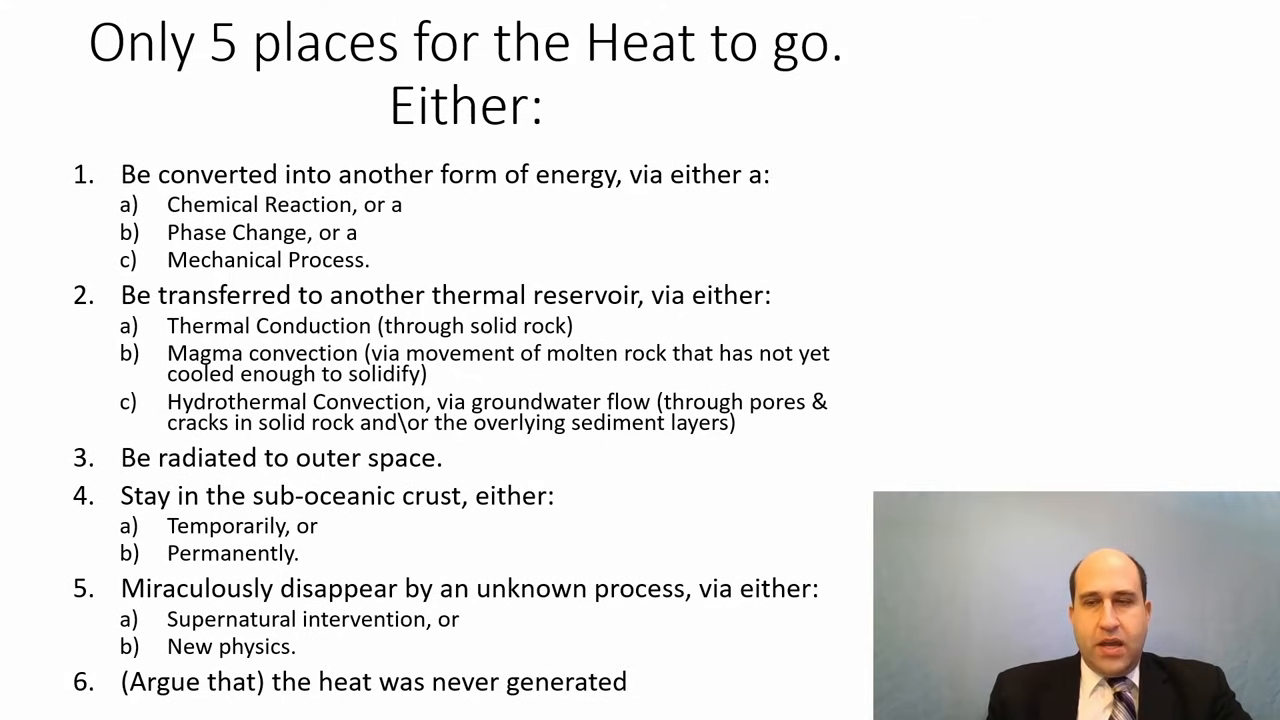
The clearest map of this ground was drawn on the young-earth side. David Winsberg, an engineer presenting on the Standing For Truth channel in January 2024, argued that "we've got only five different ways we can deal with" the heat.10 His 2026 slide sets them out. The heat must "Be converted into another form of energy," by a chemical reaction, a phase change or a mechanical process; "Be transferred to another thermal reservoir," by conduction, moving magma or groundwater flow; "Be radiated to outer space"; "Stay in the sub-oceanic crust," either "Temporarily" or "Permanently"; or "Miraculously disappear by an unknown process," by "Supernatural intervention" or "New physics." A sixth line reads "(Argue that) the heat was never generated."23 He does not claim the list is closed ("Maybe somebody can think of a sixth or a seventh one"), only that every creationist proposal so far "can be reclassified as one of these five."23 The New Creation blog's 2026 explainer, reviewed by Worraker, uses the same list, though it gives the third place as Humphreys' radiation into a fourth dimension, where Winsberg's slide has ordinary radiation to space.12
The list is sound, because it is only the first law of thermodynamics written out, and every proposal in this Part falls under one of its lines.
| Where the heat goes | Proposals audited here | Best case | Section |
|---|---|---|---|
| 1. Converted into another form of energy: chemical, phase change, mechanical | the "biomass battery" of coal and oil; evaporation; Brown's hydroplate (mechanical) | under 2 % of the budget for any store that could have run; 0.12 % for the stores whose products exist today | converting the heat; the hydroplate article |
| 2. Moved to another reservoir: ocean, air, rock, mantle, core | Oard's warm ocean; Budinsky's core model | the whole ocean boiled dry holds 1.2 %, and the shell record allows 0.02 %; the deep interior has the capacity and no route in | Part 2; the warm ocean; the core model |
| 3. Radiated to space | Baumgardner's steam jets, withdrawn; Humphreys' radiation into a fourth dimension, which needs new physics | about 0.2 % of the budget a year, at the ceiling for a planet with an ocean | Part 2; the steam jets; 4D radiation |
| 4. Left in the rock, for a time or for good | Winsberg | his model lets 7 × 10²⁶ J out over centuries; the ocean floor's depth shows 5.8 × 10²⁸ J has already left the rock | Winsberg's trapped heat |
| 5. Removed by a miracle or by new physics | RATE, Baumgardner, CMI, the Biblical Creation Trust; Baumgardner's cooling pulses; Humphreys 2000; Helmkamp | unlimited, and undetectable, except in the pulse version, which says what the rocks should show | the miracle; cooling pulses; volume cooling; nuclear latent heat |
| 6. Never generated | decay moved to Creation Week; daughters created in place; "dating is unreliable"; Winsberg on decay | removes the heat, and with it the evidence the heat was invoked to explain | moving the decay out of the Flood |
Humphreys' volume cooling by cosmic expansion, 2000
Humphreys' proposal in the first RATE volume is a genuine piece of general relativity. In an expanding universe a free photon loses energy; that is the ordinary redshift, and the energy really does vanish rather than going anywhere. "The solution takes advantage of a little-known but well-established consequence of the expansion of the cosmos: it makes energy disappear! That includes heat energy."13 He proposes that God stretched space during the Flood year, and extends the result from free particles to atoms bound in a crystal by a thought experiment about a molecule in a mirrored box. His worked example: "if there were a two-fold expansion during the year of the Genesis Flood ... the system would undergo a four-fold loss of temperature during that year."13
It fails three ways, in increasing order of severity.
The arithmetic. A four-fold drop in temperature removes three-quarters of the heat. Three-quarters of 1.99 × 10⁷ J/kg leaves 5 × 10⁶ J/kg, which is 3.4 times enough to melt the granite. Humphreys never claims more than a factor of four, and never claims it closes the budget; his words are "alleviate our problem, perhaps solving it."13 Morton and Murphy made this point in 2004: "the 25% of the thermal energy that would remain would still wreak havoc during a global flood."24
The selectivity. Cosmic expansion does not know a pluton from an ocean. RATE saw this and stated it against its own mechanism: "Had the granite plutons with their high concentrations of radioactive elements cooled at sufficiently high rates to form and persist as crystalline rock, then the oceans would have frozen solid had they cooled by the same amount. Likewise, Noah and his family on the Ark would have been in danger of freezing."7
The physics. Bound matter does not cool as the universe expands; atoms, planets and rocks track their potential wells. Isaac put it in one line in 2007: "cosmological expansion does not cool material on earth nor does it cool some materials and not others."25 Brian Pitts, a physicist with a second doctorate in philosophy of science, derived the result formally in 2009: the spacetime around the earth is static, a static metric conserves the energy of the matter in it, and so "there is no volume cooling."26 He left the fair loophole open: a "novel super-fast expansion" might do something, but "Humphreys then owes us an argument that the effect would be mere cooling of the earth, as opposed, for example, to its disruption."26 No reply to Pitts has been published in seventeen years. RATE's own 2008 response to Isaac says of heat only that "We discussed this frankly and suggested at least one possible solution—cosmological cooling."27 Humphreys abandoned the mechanism in 2018 for the one below.
Humphreys' four-dimensional radiation, 2018
This is the best-aimed proposal in the literature and deserves to be presented as such. Humphreys proposes that space is a thin fabric in a fourth spatial direction, that the "windows of heaven" of Genesis 7 are the opening of that direction, and that while they are open the interior of a hot body radiates black-body energy into hyperspace. Cooling becomes volumetric rather than surface-limited, and it goes as the fourth power of temperature, so hot things cool fast and cool things barely at all. That is exactly the selectivity RATE said in 2005 it needed. His worked case: "Granite with accelerated decay generating 1500 W/m³ in it would rise to a temperature of only about 600 Kelvin (about 300°C)."28 Check that against the requirement: 1,500 W/m³ is 0.57 W/kg, and Worraker's budget implies 0.63 W/kg. Humphreys is within 10 % of the real power density. No other proposal in this article is aimed at the right number.
It is not a mechanism, though. It is a description of how a miracle might have been implemented, and Humphreys is explicit about that. The size of the opening is a free parameter fixed by the requirement that Noah survive: "If we want his heat loss P to be only 10 watts, then these data in eq. (8) require θc = 0.295 milliradian (61 arc-seconds)."28 It then varies from place to place by divine choice: over the core and mantle "He may have left the windows entirely closed (with θc = 0), in order to keep the temperatures of the core and mantle as high as they are today."28 Two knobs, both set by hand to produce the wanted answer.
Worraker refuted it in Answers Research Journal in 2023, thanking Humphreys in the acknowledgements for help with the mathematics. Four objections: the cooling completes in under a second at full emissivity, no heat sink of this shape reproduces the observed ocean-floor depth and heat-flow profile, the windows are open for only 150 days of a 371-day Flood, and in four spatial dimensions electron orbits are unstable, so atoms cannot exist. Worraker's own comment on the last: "this problem alone looks like a show-stopper!"3 He adds a textual objection: reading the "windows of heaven" as a fourth spatial dimension, "although formally legitimate, is far from obvious in the water-saturated context of the biblical description of the Flood."3 There is also an unresolved discrepancy between the two men. Humphreys' paper uses a fourth-power law; Worraker's appendix derives a fifth-power law for four spatial dimensions. Nobody has reconciled them.
Helmkamp's nuclear latent heat, 2022
Barbara Helmkamp, a physicist, proposed in two Creation Research Society Quarterly papers that during accelerated decay God weakened the nuclear force, that unstable nuclei then sat in a low-entropy phase, and that when a decay chain reaches stable lead the nucleus reverts to its normal phase and absorbs a latent heat from the surrounding rock. Each radioactive centre becomes its own refrigerator. She puts the sink at "an MeV per alpha cluster for arguably 41 alpha clusters in lead's nucleus", against "the 43.7 MeV of heat produced in stopping the eight alpha particles emitted in the uranium decay series".29
Take every number she gives at face value. The uranium chain releases 51.7 MeV in total and she absorbs 41 of it. The thorium chain releases 42.6 and she absorbs 41. Potassium-40, which is 11 % of granite's decay heat, decays by beta emission with no alpha chain and no lead daughter, so her mechanism cannot touch it, and she never claims it can. The residue is 22 % of the load, 4.4 × 10⁶ J/kg, three times enough to melt the granite. Grant her 100 % of both alpha chains and the potassium alone still leaves 1.5 times the melting budget.30 Her papers are about why radiohalos survive, not about the global budget, and she says so; the beta heat "is largely deposited outside the sphere of the halo."29 The journal printed its own reservation on the title page: "Neither the reviewers, the physics editor, nor the author of this article were fully satisfied with the explanation of how heat could be transferred from the surroundings into the nucleus, but it was decided to leave that for future research."31 In four years the papers have drawn no published response, on either side.
Baumgardner's steam jets to space, 2003, withdrawn 2012
In 2003 Baumgardner proposed that seawater flashing to steam at the spreading ridges could form supersonic jets reaching escape velocity, carrying heat off the planet. He claimed 10⁸ J per kilogram of steam. In 2012 he corrected it: "The error was that I incorrectly included a factor of density when I calculated the amount of thermal specific energy available. The density of water is about 1000 kg/m³, so I overestimated the available thermal specific energy by a factor of 1000. It was an embarrassing error, but at least I caught it not long after the conference."2 The consequence: "none of the steam and entrained water can leave the earth's atmosphere."2 Escape velocity needs 6.3 × 10⁷ J/kg; the corrected 2 × 10⁶ J/kg buys about 2 km/s. The mechanism is gone, not reduced. Worraker confirms it in ARJ: Baumgardner "did not pursue the idea further because its cooling potential was too limited."3 The retraction is in a self-published question-and-answer document, and it is not mentioned in ICR's or Answers in Genesis's popular presentations of the model. Earlier Berean Archive research files called this "the best natural cooling proposal in the creationist literature." That assessment is withdrawn here.
What Baumgardner offers instead is stated plainly in the same document, in answer to a question about whether the model relies on untestable supernatural causes: "The measured thermal diffusivity of rock is much too low to cool the newly forming lithosphere at the rate implied by CPT. Moreover, there is no adequate sink for so much heat even if the thermal diffusivity were somehow much higher. The only solution I can envision is a rapid volumetric removal of heat, at least in the top 50-100 km of the earth, during the Flood. This, as far as I can see, represents a supernatural solution."2 Asked whether anything had changed since his 1986 paper said the same: "In my assessment nothing has changed since 1986".2
Winsberg's trapped heat, 2023 to 2026
David Winsberg, a licensed engineer whose graduate work was in groundwater flow, is the one young-earth author who builds a model of the ocean-floor heat without a miracle. He set it out in two abstracts at the 2023 International Conference on Creationism, a four-hour Standing For Truth livestream in January 2024, and a series of videos in January 2026. He rejects the miracle explicitly: "the use of miracles in this situation is unnecessary and also theologically problematic."32 It is the one route in the literature that does not need fast disposal, because it does not try to dispose of the heat during the Flood.
His argument, at full strength. Heat has to cross the ocean floor to reach the ocean, and it cannot do so quickly. Conduction through rock reaches about 112 m in a century and 750 m in 4,500 years. Hot groundwater circulating through cracks in the new crust is faster, and he computes it from Darcy's law: for rock as permeable as he assumes, it delivers 800 to 1,000 W/m² from rock above about 700 °C, and drains each kilometre of hot rock in about 50 years.10 To bring the whole ocean to 100 °C in one year would need 51,500 W/m² averaged over the entire ocean floor, and "a heat flux of 51,500 watts per square meter across the seafloor for an entire year is simply not possible."23 So the heat "remained trapped under the seafloor for hundreds of years after the flood ended," leaked into the deep ocean through hydrothermal circulation, and was radiated to space from the upper atmosphere.32 In his model the deep ocean peaks about 15 °C warmer two centuries after the Flood and is back to today's temperature by 1,000 years, where Oard's ice-age model needs 30 °C at once.
On the first point he is right, and it should be granted plainly. Nothing natural moves heat through the ocean floor fast enough to boil the ocean in a year. Worraker reached the same conclusion from the other direction.
What his number is. An earlier version of this article said Winsberg priced the ocean-floor heat at 7 × 10²⁶ J, two hundred times below Worraker, and that neither cited the other. That misread him. The "~700 ˣ 10²⁴ Joules" in his abstract33 is the heat his climate model delivers to the ocean over several centuries, and the abstract proposes "a 'maximum geothermal heat budget' that the climate can safely handle, which any proposed CPT model must comply with."33 In the 2024 livestream he put that budget at "roughly 10 to the 27 [joules] that's what the climate can handle," the heat of cooling "a thousand million cubic kilometers of ... rock by 500 degrees." He accepted Worraker's 1.4 × 10²⁹ J for the ocean floors ("that sounds right") and drew the conclusion himself: "the CPT model needs to be revised because that's not going to work." Put to him that he had therefore "solved about 1% of the heat problem," he answered, "I suppose you could look at it that way."10 In the same stream he objected that Worraker's figure rests on "uniformitarian assumptions" about cooling to "50 60 kilometer depth," and that heat that deep, if it was there when the Flood ended, is there still: "if those Rock layers ... were that hot at the end of the flood they're still that hot."10 By 2026 he was saying Worraker's numbers are wrong, and deferring the reason to a later video, which has not appeared.23
On the size of Worraker's number, the measurement sides with neither man. Worraker's per-area figure is for "the upper 100 km," not 50 to 60,14 and the depth of the ocean floor measures the heat lost without assuming any thickness at all (Part 1). It says 5.8 × 10²⁸ J. Worraker's figure is 2.4 times too high, and the heat that has actually left the rock is 58 to 83 times what Winsberg's model lets out.
Where is the heat? Winsberg separates two problems, "boil the oceans" and "where is the heat," and says his videos answer only the first. He concedes the second is "a valid concern" that "should be discussed."34 He also states the test for it. The heat "either it escaped and it was radiated into outer space or it's still on the ground somewhere," and "if the ground is cold it had to get out somewhere."10 His own slide offers heat staying in the crust "Temporarily" or "Permanently." Each can be checked, and the checks are measurements, not models.16
It is not still in the rock. If it were, every square metre of ocean floor would still stand at the height of a ridge crest, on average 2.3 km higher than it does. The basins would hold 660 million cubic kilometres less water, half the ocean, and sea level would stand about 1,470 m above today's, with about 95 per cent of the globe under water. That is Baumgardner's own Flood-time high-stand, "a temporary rise in the world sea level by as much as 1,500 m,"4 still in place. Winsberg saw the problem and said so: "I don't have an answer for the ocean [bathymetry] but it would require that kind of heat removal to have the amount of contraction [of] the plate that they're talking about."10 Other measurements agree with the depth. Seismic waves find a cold, stiff lid in the ocean mantle whose "isotachs deepen with lithospheric age, following the [half-space cooling] model until about 70 Ma."35 Earthquakes break the ocean mantle down to about 47 km, and "almost all the earthquakes occur in regions of the oceanic plate that are cooler than 600 °C."36 And rock made 4,500 years ago and left to conduct would push 7.6 W/m² through the ocean floor today, where old ocean floor measures 48 to 54 mW/m², 140 to 160 times less.37 Summed over every ocean, that would be 72 times the 31 TW the ocean floor actually loses.38 At the bottom of Hole 504B, the deepest hole ever drilled into ocean crust, 2,111 m below the sea floor, the rock is at 189 °C, where heat left to conduction would hold it near 1,450 °C.39
Water did not take most of it out. Hot water did once run through the ocean crust: drill cores from Hole 1256D show "dikes partially altered to chlorite and other greenschist facies minerals (at temperatures greater than ~250°C)."40 But water reaches only the crust. Winsberg's aquifer has a permeability at the very top of the range measured in ocean crust, found only in the upper 200 metres of basement; below 250 m, Hole 504B measures "bulk permeabilities near 10⁻¹⁷ m²," ten thousand times less.41 Even granting the impossible best case, the whole 7 km crust cooled from 1,450 °C to 0 °C on the day the Flood ended, the crust holds at most 21 per cent of the heat the depth says has gone. At least 79 per cent came out of the mantle below it, where conduction moves heat only about 0.7 km in 4,500 years, which is Winsberg's own point. Where seawater does reach the mantle today, at the bend of a plate into a trench, it leaves slow, serpentinised rock: "the uppermost 3–4 km of the mantle might be highly serpentinized, by up to 24 per cent."42 The ordinary ocean mantle carries the cold, fast lid instead.
It could not have been radiated away in time. Whatever path the heat took out of the rock, it then had to leave the planet. A planet with a liquid ocean can shed at most about 42 W/m² on top of the sunlight it absorbs (Part 2). At that rate the 5.8 × 10²⁸ J takes 86,000 years; with the sun switched off, 12,900. Losing it within 4,350 years needs 833 W/m² averaged over the whole globe, three and a half times all the sunlight the earth absorbs.20 Winsberg's own smaller figure sits at the edge too: exporting 7 × 10²⁶ J within the 1,000 years his model allows needs 43.5 W/m² for the whole millennium, at the runaway limit. His climate arithmetic uses the bare radiative response, "about four watts per square meter" per degree.10 The IPCC's assessed net response, once water vapour and clouds are counted, is 1.16 W/m² per degree, 3.4 times weaker,43 and a straight-line response has no ceiling, where a wet atmosphere has one.
So Winsberg's route answers "boil the oceans" and loses "where is the heat." The ocean floor records how much heat left it, about 5.8 × 10²⁸ J, and no natural route gets that much off the planet in 4,500 years. His hydrothermal circulation is real; it is also the mainstream account of how the crust cooled at the ridges. It cannot carry this much heat, from this deep, this fast. Worraker and Ward reached the same verdict from the modelling side in 2018: none of the heat sinks they could devise on a Flood timescale reproduced the measured depth and heat flow of the ocean floor near the ridges.44
The warm ocean
Michael Oard's ice-age model, the standard young-earth account, needs the post-Flood ocean warm. He sets it at 30 °C: "if the average temperature was much warmer than 30ºC, marine life as we know it now would have been seriously threatened. This suggests using 30ºC as a probable maximum temperature for the oceans immediately following the flood."45 ICR's Clarey uses the same heat as a feature: "A hot, newly formed ocean crust would have provided tremendous amounts of heat to the ocean waters above."11
The warm ocean is a consequence of the heat, not a disposal route, and no creationist claims otherwise. Warming the whole ocean from today's 4 °C to 30 °C absorbs 1.4 × 10²⁶ J, one part in a thousand of the ocean-floor heat and one part in two thousand of the full budget.5 It also costs the young-earth side something. Worraker's shell record caps the ocean at 13 °C. If Oard's 30 °C is right, the palaeothermometry that Worraker used is wrong; if the palaeothermometry is right, Oard's ocean is excluded. The two best quantitative workers on the young-earth side are in direct conflict on this number and neither has addressed the other. The ice age article covers the rest of Oard's model.
The core model, 2025
The newest proposal, from Donny Budinsky of the Standing For Truth channel, sends the heat downward: "Move most heat down into the mantle and core with the huge heat reservoir. Vent a fraction up as radiation to space."46 His capacity figure is right. He gives 6.4 × 10²⁷ J/K for the deep earth, and an independent check from the masses and specific heats of the mantle and core gives 6.5 × 10²⁷. The ocean-floor heat divided by that is 22 K of warming, exactly his "only 20 something degrees."46 He names the real issue himself: "The heat problem is not a capacity problem. It is a throughput problem."46
He then does not compute the throughput. David Winsberg, whose trapped-heat model is described above and is built on heat-transfer rates, did it for him in 2026. Carrying 1.4 × 10²⁹ J into the interior in one year, through the entire surface of the earth, needs "at least 8.7 million watts per square meter. ... I think that's just unrealistic."23 Conduction moves heat about 13 m in a year. The only alternative is advection, and in catastrophic plate tectonics the downgoing material is the pre-Flood ocean lithosphere, about 1.2 × 10²³ kg. For that mass to carry 1.4 × 10²⁹ J into the mantle, each kilogram would have to arrive about 1,180 K hotter than the mantle it enters.47 Subducting slabs are colder than the mantle; that is why they sink, and it is the engine of Baumgardner's runaway. Clarey's ICR article makes the cold slabs an argument for a recent Flood: "Colder, subducted slabs are best explained by runaway subduction just thousands of years ago during the great Flood."11 The core model needs the same conveyor to run hot. And the accelerated-decay half of the budget is in continental granite, which does not subduct in any model. Budinsky offers the model as falsifiable: "I'll see if this model needs to be discarded."46
Converting the heat into another form of energy
The first line of Winsberg's list is the one most often proposed in popular young-earth discussion and never priced. Joseph Hubbard, on Standing For Truth in 2021, suggested that making coal and oil in the Flood "created an enormous battery if you like which sucks up the vast majority of the heat."48 Donny Budinsky has repeated the "perfect battery" idea since, though by 2025 he ranked such sinks "only a very small percentage" of the answer.46 ICR's John Morris proposed the phase-change version for the wind of Genesis 8:1: "Evaporating water removes significant heat from the system, and abundant heat was everywhere."49 Winsberg dismisses all three routes in a sentence each. Of endothermic reactions, "there really aren't many of them that absorb large amounts of heat"; "Phase changes are reversible"; and of mechanical schemes such as "projectiles going into space," "that doesn't really work either."10 Worraker, by the New Creation blog's report, calls the option "a non-starter."12 They are right, and the reason can be priced. Every store of energy leaves a product, and the product has to be there still, or the heat has come back out.50
Chemistry. The reactions that absorb heat are few, and their products are missing. Precipitating all the world's limestone from seawater does absorb heat, which is Winsberg's point about limestone, but at most 2 × 10²⁶ J, 0.07 per cent of the budget. The largest geological sink runs the other way: baking limestone into lime, which takes 179 kJ per mole.51 Baking every limestone on earth absorbs about 10²⁷ J, a third of one per cent, and would release 43 to 50 times the mass of today's atmosphere as carbon dioxide. The limestone is still here, and the air is 0.04 per cent CO₂. Driving the water out of rock during metamorphism absorbs 3.35 to 4.2 kJ per gram of water.52 Treating the whole crust as water-rich shale and cooking it dry takes 1 to 2 per cent of the budget, and would leave a crust of dry, high-grade metamorphic rock. Nearly two-thirds of the land surface is sedimentary rock instead, the Flood sediments are unmetamorphosed shale, and RATE's own radiohalos sit in biotite, a mineral that still holds its water. The geologists who worked out these enthalpies call the effect, in a model built to maximise it, "only marginally significant."52 Splitting water into hydrogen and oxygen absorbs more per kilogram than any of these, but absorbing the whole budget would mean splitting 13.8 oceans, heat cannot do it below about 2,100 K, and the gases recombine. The coal-and-oil battery is the smallest of all. Cracking every kilogram of the world's kerogen at the highest measured heat of pyrolysis absorbs 1.2 × 10²⁵ J, four thousandths of one per cent. And turning plant matter quickly into coal in hot water, the laboratory route that creationists cite for rapid coal, gives heat off rather than taking it in, 0.76 to 1.07 MJ per kilogram.53 Seawater soaking into new ocean mantle, which catastrophic plate tectonics would make on a grand scale, adds heat too.
Phase change. A phase change stores heat only while the new phase lasts. Evaporating the whole ocean would hold 1.2 per cent of the budget; the water vapour in the air today holds 3 × 10²² J, a hundred-thousandth of one per cent, and the rest came back as rain, as Winsberg says. Melting all of Antarctica's ice holds 0.003 per cent, and the young-earth ice age runs the other way, freezing water and releasing heat. Only molten rock could hold the whole budget, and it would take an eighth of the mantle still molten today. Baumgardner cites the seismic evidence that it is not: "shear waves propagate throughout the entire mantle."2
Mechanical work. Raised rock is the one mechanical store the Flood could leave behind. All the world's topography, counting its buried roots, holds 1.3 × 10²⁶ J, 0.04 per cent; lifting the entire continental crust through the full height of the continents above the ocean floor would hold 0.3 per cent. In catastrophic plate tectonics the energy runs the other way in any case: the continents rise by buoyancy once subduction stops, and the sinking of the old ocean floor is itself one of the heat sources in Part 1. Heat does lift the new ocean floor as the rock expands, but only about 1 per cent of the heat becomes lift, and it comes back out as the floor cools and sinks. Throwing mass off the planet would mean launching three and a half oceans' worth. And no engine, however perfect, turns heat into work without rejecting some of it: for rock cooling from magma temperature, a third to a half of the budget stays heat whatever is done with the rest.
All told, the stores whose products exist today hold 3.5 × 10²⁶ J, about a tenth of one per cent of the budget. Stacking every generous ceiling at once, as if the same crust could be both melted and dried out and the same ocean both boiled and split, reaches 15 per cent. The only stores that come near the budget, a molten mantle and oceans split into hydrogen and oxygen, leave products that are not there.
Moving the decay out of the Flood
RATE's own move, made in 2005, was to put most of the decay in the first three days of Creation Week, when "there was as yet no life on the earth."7 That answers the radiation problem for Noah. It does not reduce the Flood-year number, because the half-billion-year figure everyone quotes is already the residue left after that move. And it buys the problem back at the other end: 3.7 billion years' worth of decay is seven times the Flood episode, about 1.3 × 10⁸ J/kg of granite, ninety times the melting budget, to be disposed of in three days instead of a year. Nobody has published what state the crust would be in on Day 4. Baumgardner closed the further escape of spreading that decay over the 1,656 years before the Flood, with arithmetic and a biblical datum: background radiation would have been "2.4 x 10⁶ times higher than it is today," and "The fact that human longevity, according to the genealogy of Genesis 5, did not decrease during that interval between the Fall and the Flood, seems to argue against such extreme levels of radiation in the environment."2
A second option RATE lists is that the daughter isotopes were created in place: the lead was always lead.7 That removes the heat entirely, and also removes every RATE evidence, because helium in zircon, radiohalos, and fission tracks are records of decays that happened. RATE does not adopt it.
A third option, common in popular apologetics, is that young-earth creationists "don't need to worry about trying to accelerate the rates or anything" because radiometric dating is unreliable.54 This misunderstands the problem. The heat budget is computed from the daughter products, helium, tracks and halos physically present in the rock, not from the validity of any clock. If the earth is 6,000 years old, those decays happened inside 6,000 years whatever one thinks of dating. Discrediting the clock leaves the inventory, and the inventory is the heat. RATE understood this, which is why it argued for accelerated decay rather than against dating.
Winsberg, the one author who refuses a miracle for the ocean-floor heat, takes this third route for the decay term, and says what it costs. "I don't believe in accelerated nuclear decay," he told a 2024 livestream, and he conceded what it would need if it happened: "the only way to make accelerated nuclear decay work is you'd have to have some miraculous heat removal." Asked what then explains the radiometric evidence, he answered candidly: "I don't know what the solution for that is but it's not accelerated nuclear decay."10 That is an honest position, and it leaves the helium, the halos and the fission tracks unexplained.
The hydroplate theory
Walt Brown refused the miracle: "miracles should not be imagined to solve scientific problems." His replacement, a piezoelectric mechanism that manufactured the earth's radioactive elements during the Flood, is audited at length in its own article. In one paragraph: his headline energy figure of 7.72 × 10³⁰ J is honest and lands within 2 % of the mainstream radiogenic total, his proposed sink turns out to be an energy demand several orders of magnitude larger than any source he has, his own book requires more energy to launch the comets than the whole event released, and the neutron flux his model needs would have left an isotopic scar in every rock on earth that is found only at the Oklo natural reactor in Gabon. The hydroplate theory does not solve the heat problem. It has a larger one.
The miracle
This is the majority position among the people who built the models, and it is held openly. The RATE final report lists among the admissible inferences from Noah's survival that "God supernaturally protected Noah and his entourage by rapidly removing the large amount of heat that was produced by some unknown mechanism," and concludes that the removal "likely involved a process other than conduction, convection, or radiation. ... Of course, God was directly involved in all of these events, so it is possible that He employed some supernatural process which does not occur today or cannot be detected."7 It then hands the problem on: "The RATE project did not have time to pursue this issue to any significant depth. We encourage others with the requisite physics background to investigate this problem and explore these largely uncharted waters."7 Baumgardner says the cooling of the ocean floor is supernatural. CMI's Shaun Doyle: "there is most likely a severe heat budget issue for any purely natural explanation of what happened during the Flood. As such, there is no simple scientific answer to this issue. Indeed, there may not be one. However, this need not be problematic."8 And: "Science can't be the final determinant of what we consider a plausible account of the cause-effect narrative of the Flood. The Bible has to be."8 The Biblical Creation Trust's research plan: "One possibility may be a supernatural, transiently-operating form of temperature-dependent radiation (not electromagnetic) from crustal materials, to which terrestrial substances are transparent."9
This position should be engaged as what it is, not mocked. Someone who already believes God made the world from nothing has no principled reason to refuse a second intervention. Pitts, who is no young-earth creationist, ends his refutation of Humphreys by noting that "Unwillingness to posit miracles somewhere or other in Noah's Flood was largely a later seventeenth-century rationalist Protestant innovation. This move made the Flood story empirically vulnerable and contributed to its ultimate rejection."26 The cost is not incoherence. The cost is that a mechanism which "cannot be detected" forbids nothing, and so is supported by nothing. It also inverts the selling point of Flood geology, which is that it explains the rocks by ordinary physics run fast. A miracle that removes 99.96 % of the energy is doing more work than the geology is. The Faulkner's miracle article reaches the same verdict about the same move on distant starlight, where the proposer says so himself.
Baumgardner's cooling pulses, 2023 to 2025
Baumgardner has not left the miracle vague. In a 2023 paper with Evan Navarro he gave it a schedule and made it the engine of the rock record. Their heading is "The imperative of supernatural cooling of the ocean lithosphere during the Flood." New ocean floor forms so fast that it replaces the entire ocean bottom every 41 days, and "Were hot lithosphere to cover the entire ocean bottom, subduction would cease and the CPT process would come to an abrupt halt."55 What is new is the timing. If "God's cooling of the oceanic lithosphere" came "in distinct pulses" rather than steadily, each pulse would drop the ocean floor, drain the continents, and cut an erosion surface.55 North America's six megasequences are separated by such surfaces, and the paper puts a pulse at each of them: seven episodes, each "a 700 m drop in the average sea bottom height," the first six "at 25-day intervals beginning at time zero, with each unfolding during a 24-hour period," and a final 1,200 m drop from day 150 that drains the continents.55 A 2025 abstract revises this to five pulses of 600 m, one at the base of each of the first five megasequences, and "a final, less abrupt era of cooling" worth 1,500 m.56 The New Creation blog's "drop in sea level of almost 2,000 feet (600 meters)" is this 600 m, but it is the drop in the ocean floor, not in the sea. While the continents are under water the sea falls by about 0.7 of it; once they have drained, it falls by nearly the whole amount.
The cause is a miracle, by the authors' own description, so this article does not test the cooling. It tests the arithmetic and the fingerprint, which are both the authors' own.57
The heat. Each pulse removes about 1.9 × 10²⁸ J (600 m) to 2.2 × 10²⁸ J (700 m), five or six times the heat of boiling the whole ocean, within a day. That is about 2 × 10²³ W, two million times the sunlight the earth absorbs. In rock, it is a 50 km slab of the ocean lithosphere cooled by about 300 °C overnight, the paper's "many hundreds of degrees Celsius." Added up, the 2025 schedule removes 1.4 × 10²⁹ J, the same as Worraker's figure, and the 2023 schedule 1.7 × 10²⁹ J. The pulses do not shrink the heat problem. They are the miracle position, costed.
The one check against a measurement passes. The paper says the final pulse "brought the temperature profile of oceanic lithosphere quickly to what we observe it to be presently."55 Today's ocean floor records the heat it has lost (Part 1): 5.8 × 10²⁸ J. The 2025 final era's 1,500 m corresponds to 4.7 × 10²⁸ J, within about 20 per cent. Baumgardner's bookkeeping and the depth of the ocean floor agree, because both rest on the same isostasy.
The ocean floor cannot test the pulses themselves. On Baumgardner's own chronology, "all the continental sediment record containing fossils considered Paleozoic in age had already been deposited before any of today's basaltic ocean crust had cooled and crystallized."56 The pulses acted on ocean floor that has since been subducted. Their fingerprint has to be read on the continents.
On the continents, the fingerprint is sharper than the paper says. The paper does not plot its sea level, but its numbers fix it. New ocean floor raises the average sea bottom 36 m a day, and each pulse lowers it 700 m, starting on day 0. So just after the pulses on days 0, 25, 50 and 75 the average sea bottom lies about 700, 500, 300 and 80 m below its pre-Flood level. Whenever it is below that level the sea stands below the pre-Flood shoreline, and every continent is drained completely. That happens for about 43 of the first 80 days, and for 33 of the first 40, the forty days in which Genesis 7:17 says "the waters increased, and bare up the ark." This is a definite prediction, and it collides with the other young-earth reading of the same rocks. Tim Clarey, whose megasequence work the paper cites for their global extent, reads the eastern United States the opposite way. There the lowest Tippecanoe rock is limestone lying on Sauk limestone, which "suggests that the floodwaters may never have drained off these areas between the Sauk and Tippecanoe Megasequence cycles."58 At the median North American column, Macrostrat resolves no break at that contact or at the next two.59 Both readings cannot hold.
The schedule does not fit the paper's own calendar. The paper maps its model days onto the conventional timescale: "20 days corresponds to 470 million years ago ... 50 days to 320 million years ago ... 80 days 220 million years ago ... 120 days to 150 million years ago ... 160 days to 60 million years ago."55 On that map the megasequence boundaries fall at about days 0, 21, 30, 50, 105 and 157. The pulses on days 75 and 125 land in the Middle Triassic and the Early Cretaceous, where no megasequence boundary exists, and no pulse falls on the Tippecanoe/Kaskaskia boundary. The paper spaced the pulses equally "for simplicity," and the 2025 abstract ties them to the boundaries instead, so this is a slip the authors can fix.
The sediment prediction has not been made yet. The authors say plainly that their model "does not have diagnostics to characterize the sedimentary signature of these episodes of dramatic sea level drop."55 They expect that a "laterally extensive sandstone sheet" above each boundary would not be surprising. That fits the Sauk, whose lowest unit is sandstone in 69 per cent of North American columns, and the Tejas at 69 per cent. It does not fit the Tippecanoe or the Kaskaskia, at 37 and 32 per cent.59 Clarey says of the Kaskaskia that it is "mostly limestone at its base with virtually no sandstone across its entire expanse."58
So the pulse model is the most specific form of the miracle in the literature. It says what was cooled, by how much, when, and what the rocks should show. It pays the whole heat bill supernaturally, and it matches the depth of today's ocean floor. Its own numbers predict that every continent drained completely four times in the first eighty days, and the young-earth geologist whose maps it relies on reads the same rocks as a sea that never drained at all.
Part 5: Impacts
The impact term is the one part of the budget where the young-earth side's problem is self-inflicted, and where the escape is cheap.
Michael Oard scaled the moon's crater count to the earth in 2009 and concluded that "the earth should have 36,000 impact craters, with about 100 over 1,000 km and a few with diameters of 4,000 to 5,000 km," nearly all of them in the Flood year.60 Wayne Spencer revised the count upward to 58,000 in 2013.61 Both then faced the energy. Oard, 2012: "The amount of energy from all these impacts, based on the size frequency distribution of impacts on the moon, is so huge that the surface of the earth would be destroyed many times over."62 His resolution: "God must have modulated the effects of the impacts, unless there is some other explanation of which I am unaware. Invoking God is not an unreasonable idea since God was involved in the Genesis Flood."62 Spencer: "It may be necessary to propose God somehow intervened to protect the Ark."61 Baumgardner ran Oard's inputs through in 2013 and got 4.4 × 10¹² J per square metre of the earth's surface, which he found "sufficient to melt a layer of rock ... 1.1 km thick over the entire earth. This would obviously turn the earth's surface into a transient magma ocean."63 Converting Oard's own inventory through the standard crater-scaling laws gives about 10²⁹ J, nearly all of it in the hundred largest craters.64 Faulkner, Answers in Genesis's astronomer, rejected Flood cratering on these grounds and moved the impacts to Creation Week, writing that "the appeal to a miraculous cooling mechanism at the time of the Flood ought to be less palatable than miraculous cooling during the Creation Week."65 Spencer changed his mind the same year. Oard's count then fell: "58,000 impacts would have devastated Earth. Since it does not appear to have suffered that extent of damage, the number of impacts must have been fewer on Earth."66 No new data drove any step of that descent; the consequence did.
Here is the concession the other way, and it matters. The confirmed terrestrial record is 200 impact structures and 46 ejecta horizons.67 Summing the kinetic energy of every one of them, Vredefort at 250 km down to the small tail, gives about 7 × 10²⁴ J, which would warm the ocean by about 1 K.64 Chicxulub alone is a quarter of a degree. A Flood with a handful of impacts has no impact heat problem. That is Clarey's position at ICR, who calls Oard's circular-basin impacts "speculative and unverifiable,"68 and it is thermally coherent. The impact heat problem exists only if the earth was hit as often as the moon. The price of dropping that is the rest of Oard's model, which uses the bombardment to start the Flood, and any explanation of why the moon and Mars are saturated with craters and the earth is not. There is also a stratigraphic test. The 46 ejecta horizons are discrete, chemically distinct and separately dated; tens of thousands of impacts in forty days would leave one chaotic layer, not 46 spaced ones. The crater record itself is the subject of Impact Craters and the Flood.
Objections and responses
"The heat problem is a problem for conventional geology too." Not in the same sense. Mainstream geology releases the same 7.6 × 10³⁰ J over 4.5 billion years, which is 47 terawatts today, about a five-thousandth of sunlight, and the earth radiates it without noticing.38 The problem is the year, not the joules.
"The critics are using their own inflated numbers." Every figure in Part 1 is a creationist's. RATE's half billion years, Snelling's 22,400 K, Worraker's 1.99 × 10⁷ J/kg and 1.4 × 10²⁹ J, Baumgardner's 3.4 × 10²⁸ J, Oard's 36,000 craters. The critics have, if anything, understated: Morton and Murphy wrote 10²⁸ J where Baumgardner published 3.4 × 10²⁸. The one inflated number is a creationist's: Worraker's ocean-floor figure is 2.4 times the heat the ocean floor's depth says it has lost, and this article says so and uses the measured figure where it matters.
"The heat could not have boiled the ocean, because it cannot cross the ocean floor fast enough." This is Winsberg's argument, and it is correct. It moves the problem rather than solving it. Heat that did not reach the ocean is either still in the rock or it left later. Measured heat flow, seismology and boreholes show it is not in the rock, the depth of the ocean floor shows about 5.8 × 10²⁸ J has left, and a planet with a liquid ocean cannot radiate that much in 4,500 years. Winsberg himself calls the question of where the heat went "a valid concern," and says he has no answer for the ocean floor's depth.
"Some of the heat went into making coal, oil and limestone." It did not go far. Making limestone absorbs at most 0.07 per cent of the budget, maturing the world's kerogen 0.004 per cent, and making coal quickly in hot water releases heat rather than absorbing it. Winsberg, who counts limestone as a heat sink, adds "Not very much, by the way."23
"RATE never claimed to have solved it." True, and the article says so. The criticism, which is Isaac's, is what happened next: "the expectation of a future solution to a major scientific impasse is being translated into conferences, books, and videos proclaiming the good news that the RATE project has demonstrated the scientific validity of a young earth".25 Nineteen years on, the popular presentations still do not mention it.
"God could have removed the heat." Yes. This article does not argue otherwise, and it quotes the researchers who say so. What it argues is that this is not a scientific model, that it forbids nothing, and that it should be presented to lay readers as what it is.
"The RATE evidences show decay happened without melting, so a mechanism must exist." This is Snelling's argument, and it holds only if the evidences are secure. The helium, halo and fission-track evidence each have their own articles, and each has a mainstream explanation that needs no acceleration.
"Your ocean-temperature argument depends on mainstream palaeothermometry." It depends on Worraker's use of it, in a creationist journal. A young-earth reader who discards it must also discard his own side's Ice Age modelling and much of its case for a warm Flood ocean.
Issues and unanswered questions
- Nobody on either side has published a kinetic calculation of whether apatite helium and fission-track ages survive a one-year thermal pulse at a few hundred degrees. It would be decisive and uses only published annealing parameters.
- The fourth-power versus fifth-power discrepancy between Humphreys 2018 and Worraker 2023 is unresolved.
- Helmkamp's sink stores about 41 MeV per decay chain somewhere. If it is booked to the lead daughter, radiogenic lead should be measurably heavier than primordial lead, and it is not. Nobody has run that check.
- Worraker's announced Parts 5 to 7, on accelerated decay, impacts, and the synthesis, were unpublished as of September 2026. When they appear, this article should be updated.
- Winsberg announced in January 2026 that he would explain why Worraker's ocean-floor numbers are wrong; his Part 3, recorded then, had not been posted by 21 September 2026. Any such explanation now has to reckon with the depth of the ocean floor, which measures the heat lost without a plate model. His full paper, "not complete" in January 2024, has not appeared either.10
- Baumgardner's cooling pulses have no computed sedimentary signature; the authors say their model lacks the diagnostics. The 2025 revision gives neither a schedule nor an uplift rate, and its 4,500 m of drops no longer balance the 2023 paper's 5,400 m of uplift, so its sea-level history cannot yet be rebuilt. The sea-level history in this article is derived from the 2023 numbers, not plotted by the authors.
- The per-area figure behind Worraker's ocean-floor term, Furlong and Chapman's 3.9 × 10¹⁴ J/m², is unsourced by Worraker's own account, and their review was not read for this article. The article no longer depends on it.
- The bathymetric calculation uses Stein and Stein's sediment-corrected depth-age curve over the age grid, not a sediment correction square kilometre by square kilometre; the raw depths give a floor 40 per cent lower. Either is 35 to 83 times Winsberg's figure.
- No creationist source states whether accelerated decay reached the mantle. If it did, the budget roughly triples.
- The silica vaporisation enthalpy used for the "vaporise the crust" comparisons is the weakest-sourced constant in this article. The melting figures are secure.
Verdict
The Flood-year heat budget is about 3 × 10²⁹ J on the young-earth side's own published figures, and about 2 × 10²⁹ J with the ocean-floor term measured. The largest natural sink on the planet, the whole ocean boiled dry, takes one or two per cent of it, and the ocean was not boiled. Radiating it away in a year needs a surface hotter than 4,000 K. No natural mechanism proposed since 1986 closes the gap, and the two that had real arithmetic behind them were withdrawn or refuted by their own side: Baumgardner's steam jets by Baumgardner, Humphreys' two mechanisms by Pitts and by Worraker. The one miracle-free model, Winsberg's, explains why the ocean did not boil in the Flood year and cannot say where the heat went: the ocean floor's depth shows the heat has left the rock, and nothing natural could have taken it off the planet in 4,500 years. Turning it into some other form of energy holds a tenth of one per cent. The remaining answer, held by RATE, Baumgardner, CMI and the Biblical Creation Trust, is that God removed the heat by a process that cannot be detected.
Two things should be said for the young-earth researchers. They did the arithmetic first, in their own journals, and every number of theirs rechecked for this article reproduced from its stated inputs. The one input found to be too high, Worraker's ocean-floor figure, made their own problem look bigger, which is the opposite of special pleading. The problem is not their honesty. It is that their honest result, that the model does not work without a miracle at its centre, has not reached the readers of the flagship popular literature that markets the model, although smaller young-earth outlets have begun to carry it.
What would change this verdict. A published mechanism with a stated throughput of 10²⁹ J in one year, a spatial pattern that clears continental granite and mid-ocean ridges alike, and a prediction that could fail. A reply to Pitts. A young-earth ocean-temperature record hotter than 13 °C that survives Worraker's review. A trapped-heat model that reproduces today's ocean-floor depth, heat flow and seismic structure. None exists today.
Further reading
- The Hydroplate Theory and the Heat Problem, the child article: Walt Brown's natural mechanism, audited in full.
- RATE and Helium in Zircons, where the accelerated-decay budget is computed from crustal abundances and the radiation dose to Noah is worked out.
- Catastrophic Plate Tectonics, Granite Cooling, Flood Basalts, and The Ice Age for the individual heat terms in their own settings.
- Faulkner's Miracle for the same move, a candidly supernatural solution, on distant starlight.
Sources
- 1.
Snelling, Andrew A. “Radiohalos in Granites: Evidence for Accelerated Nuclear Decay.” Radioisotopes and the Age of the Earth, Volume II, 101–207. Institute for Creation Research / Creation Research Society. 2005. Chapter 3 of the second RATE volume, by a geologist at the Institute for Creation Research, on the dark rings called radiohalos that radioactive decay leaves in the mica biotite in granite. From the polonium rings it argues that granite plutons cooled within six to ten days, so the decay in them ran far faster than it does today. Its Appendix C, "The Heat Problem," pp. 182–185, is the one place in the RATE corpus where the decay budget is turned into a temperature with the inputs shown, and the article relies on it.
- 1a.
Page 183: “This is equivalent to a temperature rise of more than 22,000°C, which is sufficient, of course, to vaporize a granitic pluton many times over!” Snelling's inputs, from Stacey 1992, were 10⁻⁹ W/kg, 700 J/kg/K and 1.6 × 10¹⁶ s; the arithmetic gives 22,857 K. ↩ ↩
- 1b.
Page 183: “Thus the adiabatic temperature rise in the biotite as a result of 500 million years worth of accelerated radioactive decay is an order of magnitude higher than the value obtained for the granitic rock as a whole. Of course, the biotite crystal and the zircon grain included in it would be vaporized! So whichever way the calculation is made, there is no denying that there is a genuine heat problem associated with accelerated nuclear decay.” ↩
- 1c.
Page 182: “The survival of the Po isotopes and formation of these Po radiohalos places a severe timescale limit of six to ten days on the cooling of granitic plutons from 400°C or more down to the ambient temperatures at the near-surface crustal levels at which these plutons have been emplaced. This results in the problem of removing the enormous quantity of heat involved from the huge volume (specifically of the order of 200–500 km3) of each granitic pluton within six to ten days. Such removal requires heat dissipation at least six orders of magnitude greater than currently postulated by conventional wisdom [Petford et al., 2000].” ↩ ↩
- 1d.
Page 184: “Incredible amounts of heat must have somehow been removed rapidly by a process or processes that we have not yet discovered or understood, for otherwise these rocks and the radiohalos in them would have been vaporized!” ↩
- 1e.
Page 184: “All creationist models of young earth history have serious problems with heat disposal, because there is simply too much geological work that has to be done in too short a time.” ↩
- 1a.
- 2.
Baumgardner, John R. 101 Questions and Answers Concerning Catastrophic Plate Tectonics. Self-published. Apr 2012. Baumgardner's answers to the questions that peer-review panelists put to his catastrophic plate tectonics model, in a review of Flood models hosted by In Jesus' Name Productions. The editor shortened the questions, and the document is derived from the set of answers on that model. The article uses it for his statements that cooling the ocean floor needs a supernatural solution, for his admitted arithmetic error on the steam jets, and for his split of the nuclear decay into two episodes.
- 2a.
Section Q23, page 43: “The rock material of the mantle is in the solid, not liquid, state, except for some extremely tiny pockets near the surface where some partial melting is taking place. ... How do we know that the mantle is solid and that the rock is strong? The primary evidence comes from seismology. Waves of the type known as shear waves propagate throughout the entire mantle.” ↩
- 2b.
Section Q32: “In my assessment nothing has changed since 1986 when I emphasized the problem of cooling the ocean lithosphere from near a molten state to its present state within the time constraints of Bible history.” ↩
- 2c.
Section Q33: “The error was that I incorrectly included a factor of density when I calculated the amount of thermal specific energy available. The density of water is about 1000 kg/m³, so I overestimated the available thermal specific energy by a factor of 1000. It was an embarrassing error, but at least I caught it not long after the conference.” ↩ ↩
- 2d.
Section Q39: “The place in CPT where the supernatural must be invoked, as far as I can presently discern, is in regard to the removal of heat from the rapidly forming oceanic lithosphere. The measured thermal diffusivity of rock is much too low to cool the newly forming lithosphere at the rate implied by CPT. Moreover, there is no adequate sink for so much heat even if the thermal diffusivity were somehow much higher. The only solution I can envision is a rapid volumetric removal of heat, at least in the top 50-100 km of the earth, during the Flood. This, as far as I can see, represents a supernatural solution.” ↩ ↩ ↩
- 2e.
Section Q73: “That scenario would imply that the level of background radiation from the granitic rocks beneath everyone's feet, on average, would have been 4 x 10⁹/1656 = 2.4 x 10⁶ times higher than it is today. In my assessment, that would have been devastating to life on earth during that time. The fact that human longevity, according to the genealogy of Genesis 5, did not decrease during that interval between the Fall and the Flood, seems to argue against such extreme levels of radiation in the environment.” ↩
- 2f.
Section Q76: “This first episode accounts for up to as much as roughly 3.7 billion years' worth (at presently observed rates) of nuclear decay products in the earth's pre-Flood rocks.” “Among the lines of evidence for up to about 600 million years' worth of nuclear decay (at presently observed rates) during the Flood cataclysm, are the presence of abundant radiohalos, both from uranium and polonium, as well as high concentrations of fission tracks in crystals in volcanic tuffs and in granitic rocks”. ↩
- 2g.
Section Q100: “Because the thermal energy available is insufficient for steam in the jets to reach the earth's escape velocity, none of the steam and entrained water can leave the earth's atmosphere.” ↩
- 2a.
- 3.
Worraker, William J. “Heat Problems Associated with Genesis Flood Models—Part 4: Heat Deposited by Magmatic Activity.” Answers Research Journal 16:201–251. 2023. The fourth part of Worraker's series on the heat of the Flood, on the heat that magmatic activity (the rise of molten rock) deposited. The article uses it for Worraker's conclusion that the heat from new ocean floor and from large igneous provinces (LIPs) cannot be removed by known natural processes within a biblically-compatible timescale.
- 3a.
Page 221: “However the total amount of heat involved (not exceeding 4.0 x 10^26 J) is insignificant in comparison with the heat deposition involved in forming the ocean floors (1.4 x 10^29 J).” The 1.4 × 10²⁹ J is 3.9 × 10¹⁴ J/m² (Furlong and Chapman 2013) times 3.6 × 10¹⁴ m² of ocean floor; Table 1, p. 204, lists it as 0.14 × 10³⁰ J. ↩ ↩
- 3b.
Page 221: “not exceeding 4.0 x 10^26 J”. ↩
- 3c.
Page 221: “The total volume of ocean water today is 1.335 x 10^9 km3 (Eakins and Sharman 2010) and approximate average values for its density and constant-pressure specific heat capacity are 1,025 kgm-3 and 4,000 Jkg–1K–1 respectively (Nayar et al. 2016; Sharqawy, Lienhard, and Zubair 2010), implying a total thermal capacity of 5.5 x 10^24 J/K.” ↩
- 3d.
Page 204, table 1: “Solar energy incident in 1 year 5.5 x 10^-6”. The figure is in units of 10³⁰ J, i.e. 5.5 × 10²⁴ J. Page 221: “If all of this heat due to LIP emplacement were to be dissipated by purely natural mechanisms within the one year of the Flood, the necessary rate of heat loss would be 72 times the gross solar input to the earth (see table 1).” ↩
- 3e.
Page 228: “Given that the highest bulk ocean temperature in the early Cenozoic did not exceed 13°C in contrast with the present-day value of ~2°C (Worraker 2018; the lower figure of 2°C may be taken as a representative pre-Flood minimum temperature), the total heat absorbed by the oceans, earth's main environmental heat sink, would have been of order 6 x 10^25 J at most, assuming a thermal capacity of 5.5 x 10^24 J/K (as estimated above). This is only 0.04% of the total heat deposition: the remaining 99.96% must have been removed or absorbed elsewhere. It seems that this must have been accomplished by some special, hitherto unrecognized mechanism.” ↩ ↩
- 3f.
Page 227: “The main conclusion of this article is that the total amount of geological heat deposited in the formation of the ocean floors and of LIPs is overwhelming: it cannot be removed from the biosphere within a biblically-compatible timescale by known natural processes.” ↩
- 3g.
Pages 211–212: “Although this phenomenon was contemplated by Baumgardner (2003) as a possible mechanism for rapid heat removal, he did not pursue the idea further because its cooling potential was too limited.” ↩
- 3h.
Section Cooling by 4D thermal radiation, pages 212–214: “an even more fundamental problem arises at the atomic scale, since in 4D space electron orbits within atoms would be unstable, implying that stable atoms could not exist (Barrow and Tipler 1986, 265; Rees 1999, 149–151); this problem alone looks like a show-stopper!” Appendix 3 derives the generalised Stefan-Boltzmann law as T⁵ for four spatial dimensions; the acknowledgements thank Russell Humphreys for help with the coefficient. ↩
- 3i.
Page 213: “An alternative view is to recognize that the bathymetry or surface subsidence represents the integrated heat loss through a section of the lithosphere at a particular distance from the spreading center, corresponding to a particular elapsed time since eruption, while surface heat flux indicates the present-day vertical temperature gradient immediately adjacent to the surface”. ↩
- 3j.
Page 213: Closes the section on cooling by 4D thermal radiation. “Furthermore Humphreys' interpretation of the opening of the 'windows of heaven' as referring to the temporary opening of a fourth spatial dimension, although formally legitimate, is far from obvious in the water-saturated context of the biblical description of the Flood.” ↩
- 3a.
- 4.
Baumgardner, John R. “3-D Finite Element Simulation of the Global Tectonic Changes Accompanying Noah's Flood.” Proceedings of the Second International Conference on Creationism, 35–44. Creation Science Fellowship, Pittsburgh. Edited by R. E. Walsh and C. L. Brooks. 1990. A 1990 conference paper by John R. Baumgardner of the Institute for Creation Research. It proposes that the cold, dense pre-Flood ocean floor sank into the mantle, releasing gravitational energy, and it simulates that sinking in three dimensions on a computer. The article uses it for the energy figure and for the temporary rise in world sea level of as much as 1,500 m that the paper predicts.
- 4a.
Page 3: “we obtain a value of 1.4 x 10^9 J/m3 for the gravitational potential energy density. This may be compared with the energy per unit volume required to melt silicate rock, 5.6 x 10^9 J/m3, and with the energy per unit volume needed to boil cold water at atmospheric pressure, 2.7 x 10^9 J/m3. Considering the volume of oceanic lithosphere to be layered 80 km thick covering 60% of the earth's surface, we obtain a value of 3.4 x 10^28 J for the amount of associated gravitational potential energy.” The derivation is 0.6 × 5.1 × 10¹⁴ m² × 8 × 10⁴ m × 1.4 × 10⁹ J/m³ = 3.4 × 10²⁸ J. Morton and Murphy's "10²⁸ J" understates it. ↩ ↩
- 4b.
Section Abstract, page 35: “Rapid replacement of the cold, dense pre-Flood oceanic lithosphere with hot, less dense mantle material from below resulted in significant elevation of the ocean floors relative to the continental surfaces causing a temporary rise in the world sea level by as much as 1,500 m.” ↩
- 4a.
- 5.
Computed for this article in
research/budget.md, §5, andresearch/critics-and-baseline.md, Part B, from the following: ocean mass 1.37 × 10²¹ kg (Charette and Smith 2010), seawater specific heat 4,000 J/kg/K and latent heat of vaporisation 2.18 to 2.26 × 10⁶ J/kg (MIT seawater tables, revision 2b, 2023), earth surface 5.101 × 10¹⁴ m², Stefan-Boltzmann constant 5.67 × 10⁻⁸ W/m²/K⁴, one year 3.156 × 10⁷ s, granite thermal diffusivity 1.35 × 10⁻⁶ m²/s. Warming the ocean from 2 °C to 100 °C: 5.5 × 10²⁴ × 98 = 5.4 × 10²⁶ J. Evaporating it: 1.4 × 10²¹ × 2.26 × 10⁶ = 3.16 × 10²⁷ J. Radiation in one year at temperature T: σT⁴ × 5.101 × 10¹⁴ × 3.156 × 10⁷ = 1.61 × 10²² × σT⁴; solving for 3.0 × 10²⁹ J gives 4,258 K. Conduction length √(4κt) = 13 m. Warming the ocean from 3.9 °C to 30 °C: 5.5 × 10²⁴ × 26.1 = 1.4 × 10²⁶ J. Seawater values give 3.44 × 10²⁷ J to vaporise the ocean; fresh-water values give 3.7 × 10²⁷; either is one per cent of the budget. ↩ ↩ ↩ ↩ - 6.
Worraker, William J. “Heat Problems Associated with Genesis Flood Models—Part 2: Secondary Temperature Indicators.” Answers Research Journal 12:211–254. 2019. A review of the methods that read past ocean temperatures from fossil material, by William Worraker of the Biblical Creation Trust. It covers the magnesium-to-calcium ratio in the shells of tiny shell-building sea organisms called foraminifera, the strontium-to-calcium ratio in corals, biological molecules used as temperature markers, and the clumped-isotope method, and it combines shell data with sea-level records to conclude that deep ocean water has cooled by 12 °C since the early Eocene. The article uses it for the claim that the deep ocean never exceeded 13 °C through the Cenozoic.
- 6a.
Section Abstract: “The most important conclusion from this review, based on analysis of combined δ¹⁸O-Mg/Ca data and sea level records, is that deep ocean water has cooled by 12 °C since the early Eocene. This supports the conclusion in the first paper that deep ocean temperatures never exceeded 13 °C through the Cenozoic, an important constraint on Flood and post-Flood models.” ↩ ↩
- 6a.
- 7.
Vardiman, Larry et al. “Summary of Evidence for a Young Earth from the RATE Project.” Radioisotopes and the Age of the Earth, Volume II: Results of a Young-Earth Creationist Research Initiative, 735–772. Institute for Creation Research (El Cajon, CA); Creation Research Society (Chino Valley, AZ). 2005. Chapter 10 of the second RATE volume, a closing summary by eight authors. Its main result, it says, is that nuclear decay appears to have been accelerated during brief periods of earth history. Its section 3.2, "The Heat Problem," runs pages 761–764, and the article quotes it on the heat problem, the supernatural explanation it offers, and the freezing-oceans problem.
- 7a.
Page 761: “If God caused a period of accelerated decay during the Genesis Flood, it would have generated a massive pulse of heat in the earth. The RATE group estimates that the heating would have been equal to that produced by about a half billion years of decay at today's rates. But, it would have been generated over the period of only one year of the Genesis Flood. The heat would have melted the crustal rocks many times over unless there was some mechanism for simultaneously removing it quickly.” ↩
- 7b.
Page 762: “God supernaturally protected Noah and his entourage by rapidly removing the large amount of heat that was produced by some unknown mechanism”. Page 763: “The removal of heat was so rapid that it likely involved a process other than conduction, convection, or radiation. For example, the cooling of granite plutons would have taken thousands of years by conventional thermal diffusion. Of course, God was directly involved in all of these events, so it is possible that He employed some supernatural process which does not occur today or cannot be detected. However, He commonly uses natural law to do His work on earth, and so we believe it may be possible to discover how He did it.” ↩ ↩
- 7c.
Pages 763–764: “Had the granite plutons with their high concentrations of radioactive elements cooled at sufficiently high rates to form and persist as crystalline rock, then the oceans would have frozen solid had they cooled by the same amount. Likewise, Noah and his family on the Ark would have been in danger of freezing.” ↩
- 7d.
Page 764: “The RATE project did not have time to pursue this issue to any significant depth. We encourage others with the requisite physics background to investigate this problem and explore these largely uncharted waters.” ↩
- 7e.
Page 760: “The only other likely period seems to be early in the Creation week, particularly during the first three days. During the first two days and part of the third day of Creation there was as yet no life on the earth. Any radiation, heat, or other by-products of these nuclear disintegration or transformation processes would not have been a problem for plants and animals.” ↩
- 7f.
Page 761: “Some who still have a problem with the term 'nuclear decay' being 'bad' could alternatively interpret the considerable quantity of the daughter products we observe today simply to be the result of God's supernatural creative work with no reference to any specific process.” ↩
- 7g.
Page 743: Speaking of radiohalos: “can only be formed in solid crystalline rock (such as granite) at temperatures below the annealing temperature of 150°C”. ↩
- 7a.
- 8.
Doyle, Shaun. “Too much heat in Noah's Flood?” Creation Ministries International. Jul 25, 2020. A feedback reply from Creation Ministries International to a reader who had been given a critic's heat figure from the National Center for Science Education. Doyle argues that science cannot decide whether the Flood was a purely natural event, because the Bible has to decide that, and he cites Worraker's two-part heat study for the size of the problem and Humphreys's 2018 paper for a possible mechanism. The article uses it for Creation Ministries International's own statement that there is no simple scientific answer to the heat problem.
- 8a.
Paragraph 2: “Whether that particular figure is right or not, there is most likely a severe heat budget issue for any purely natural explanation of what happened during the Flood. As such, there is no simple scientific answer to this issue. Indeed, there may not be one. However, this need not be problematic.” ↩ ↩
- 8b.
“Science can't be the final determinant of what we consider a plausible account of the cause-effect narrative of the Flood. The Bible has to be.” ↩
- 8a.
- 9.
Worraker, William J., and Paul Garner. “Research projects: Heat problems.” Biblical Creation Trust. n.d. Retrieved Sep 2026. A project summary page from the Biblical Creation Trust, by its principal investigator William Worraker with Paul Garner. Its bottom line is that no general explanation has yet been found for how a heat catastrophe during the Flood was avoided, and its closing note refers to the Origins 2016 conference, where summaries of the work up to July 2016 were given in two talks. The article uses it for the three heat sources it lists, each enough to melt the crust or boil the oceans, and for its proposal of a supernatural heat removal.
- 9a.
Section The bottom line: “The main sources of heat during the Flood are: (1) Accelerated Nuclear Decay, (2) Catastrophic Plate Tectonics (CPT) and (3) bombardment from space. Each is overwhelmingly sufficient to melt the entire Earth's crust or to boil away the oceans. They follow different spatial patterns. Although no general explanation has yet been found of how a heat catastrophe during the Flood was avoided, worthwhile further investigations have become apparent.” The impact figure on the page is from Kring and Cohen 2002, "a minimum of 10²⁸ J with a possible maximum an order of magnitude larger." ↩
- 9b.
Section Technical summary: “Given that these enormous heat loads arise by different mechanisms and in different locations, a generic heat removal mechanism is difficult to formulate. One possibility may be a supernatural, transiently-operating form of temperature-dependent radiation (not electromagnetic) from crustal materials, to which terrestrial substances are transparent. The feasibility of this idea could be investigated by simple quantitative modelling of crustal heat flows in Flood conditions.” ↩ ↩
- 9a.
- 10.
Winsberg, David. “A Solution to the Genesis Flood Heat Problem | With David Winsberg - Presentation & OPEN MIC!” Standing For Truth (YouTube). Jan 11, 2024. A livestream of 4 h 04 min, hosted by Donny Budinsky, in which David Winsberg, an engineer with a master's degree in civil engineering focused on hydrology and groundwater flow, presents his model of the ocean-floor heat and then takes questions. He argues that conduction through rock is far too slow to carry the heat away, and that hot groundwater moving through the new crust is faster. The article uses it for his own admissions, including that he has no answer for the ocean bathymetry and that "the CPT model needs to be revised".
- 10a.
At 01:02:35: “I don't believe in accelerated nuclear Decay”. At 01:03:04: “the only way to make accelerated nuclear Decay work is you'd have to have some miraculous heat removal”. At 01:03:27: “I realize there's an issue with radiometric dating and it doesn't agree with the Bible and I get that I don't know what the solution for that is but it's not accelerated nuclear Decay that's my opinion anyways”. ↩
- 10b.
At 00:09:20: “we've got only five different ways we can deal with this um you can either it can either be converted into another form of energy um it can be transferred to another thermal Reservoir it can be radiated to outer space it can stay in the suboceanic crust or it can mysteriously Disappear by an unknown process”. The next sentence puts "Supernatural Intervention which would be Miracles or new physics in the same category." ↩
- 10c.
At 00:20:34: “the thermal diffusivity of using the numbers I've given you is about 1 millimeter squar per second uh 100 years is roughly three billion seconds you plug all that in there you get a conduct distance of only 112 M”. At 00:34:08: “once you start hitting 7800 degrees Centigrade you kind of plate off around um 800 to 1,000 watts per square meter for an aquafer with this permeability”. "7800 degrees" is the caption's rendering, most likely of "700, 800 degrees." At 00:35:09: “it minimizes about 50 years per kilometer of aquafer thickness for this permeability”. At 00:56:13: “the thermal diffusivity over 4500 years is only 750 meters”. His reference aquifer has a hydraulic conductivity of 10⁻⁶ m/s (00:31:01), a permeability of about 1.0 × 10⁻¹³ m² in 20 °C water. ↩
- 10d.
At 02:26:05: “the climate can handle post flood and we're not talking about pre- flood post flood can handle roughly 10 to the 27 jewels that's what the climate can handle so if a catastrophic plate tectonics model requires that more than that heat was generated and dumped into the oceans then that needs to be revised in order to match what can be dissipated by climate post flood”. At 02:35:37: “you could cool a thousand million cubic kilometers of of rock by 500 degrees centigrade and dump that heat into the ocean before you have a problem”. At 02:31:50: “I believe warer said 1.4 time of the 29th so that sounds right”. At 02:34:00–02:34:32: Mr. Anderson: “according to AIG the estimate of the amount of heat that you need to dissipate just for the CPT stuff is about a 100 times that right”. Winsberg: “that's what warer says and the CPT model needs to be revised because that's not going to work”. Mr. Anderson: “so what you're saying is that you solved about 1% of the heat problem if we take aig's numbers”. Winsberg: “yeah or another way of saying it is yeah I mean I suppose you could look at it that way”. ↩ ↩
- 10e.
At 00:58:45: “he's using un I hate to say it but he's using uniformitarian assumptions that says 50 60 kilometer depth um and he's trying to remove heat from 50 to from 50 to 60 kilm of depth”. At 00:59:19: “if th if those Rock layers those geological layers were that hot at the end of the flood they're still that hot the temperature hasn't gone anywhere”. ↩
- 10f.
At 00:47:18: “it's important to realize that the model is going to need to explain all the heat um either it escaped and it was radiated into outer space or it's still on the ground somewhere”. At 00:56:13: “if if the ground is cold it had to get out somewhere”. ↩
- 10g.
At 01:01:25: “I don't have an answer for the ocean Beth themetry but it would require that kind of heat removal to have the amount of contraction the plate that they're talking about”. "Beth themetry" is the caption's rendering of "bathymetry." ↩
- 10h.
At 00:13:44: “if the temperature was to increase and you take the uh Stefan boltzman radiation equation um you get roughly at around the Earth's radiative temperature each uh degree Centigrade that you have increased you get about four watts per square meter multiply that by the Earth's area and that's where this uh 2.04 patts per CGR increase is”. 4 W/m² per kelvin over 5.1 × 10¹⁴ m² is 2.04 × 10¹⁵ W per kelvin, the Planck response alone. ↩
- 10i.
At 00:10:12: “there really aren't many of them that absorb large amounts of heat even if you were to able to do that um it's going to create uh significant constraints on the geology of the suboceanic crust”. At 00:10:34: “Phase changes are reversible so if large amounts of water was evaporated as a way to absorb heat um as soon as that water Rec condenses you're going to get all that heat back”. At 00:11:03: “I've even heard people talk about projectiles going into space or something like that um that doesn't really work either”. ↩
- 10j.
At 00:09:02: “I've been working on this for a while um I'm currently working on a paper regarding this it is not complete”. ↩
- 10a.
- 11.
Clarey, Timothy. Embracing Catastrophic Plate Tectonics. Institute for Creation Research. Apr 29, 2016. An Institute for Creation Research article that is ICR's flagship popular presentation of catastrophic plate tectonics, the model in which the continents moved rapidly during the Flood. The article uses it, with Answers in Genesis's chapter on the same model, as popular writing that never uses the words "heat problem," "miracle," or "supernatural."
- 11a.
The words "heat problem," "miracle," and "supernatural" occur zero times in this article and zero times in Snelling's "Can Catastrophic Plate Tectonics Explain Flood Geology?" (The New Answers Book 1, chapter 14, Answers in Genesis), about 17,500 words of page between them. ↩
- 11b.
“A hot, newly formed ocean crust would have provided tremendous amounts of heat to the ocean waters above. This would have raised the overall temperature of the ocean and caused a greater amount of evaporation, resulting in staggering amounts of precipitation.” ↩
- 11c.
“Colder, subducted slabs are best explained by runaway subduction just thousands of years ago during the great Flood.” ↩
- 11a.
- 12.
Ryan, Christian. “The Heat Problem: The Achilles' Heel of Creationism?” New Creation Blog. Sep 2, 2026. A blog post with a 13-minute reading time, by Christian Ryan on the New Creation blog that surveys the options for the heat. The post says its views are the author's, not necessarily New Creation's, and it thanks William Worraker "for reviewing this article prior to publication." The article uses it as a creationist writer's admission that the heat problem is unsolved.
- 12a.
Section Who's Going to Pay the Heat Bill?: “A recent discussion by Dr. David Winsberg summarized the options in the five following points.” The five subheadings that follow are "Conversion into Another Form of Energy," "Transfer to Another Thermal Reservoir," "Radiation into Another Dimension," "Storage in Sub-Oceanic Crust," and "Disappearance by a Supernatural (or Otherwise Unknown) Process." ↩
- 12b.
Section Conversion into Another Form of Energy: “However, as per the 2nd Law of Thermodynamics, physical and chemical processes ultimately tend to convert usable energy into heat rather than heat into usable energy. This is why some researchers, like Worraker, view this as a non-starter.” The post's footnote 6 gives the source as "William Worraker, personal communication with author, August 2026." Worraker's published series neither proposes nor discusses the option. ↩
- 12c.
Section What is the Heat Problem?: “The study of the heat problem is an active research question with the goal of developing a coherent scientific description of how that happened.” Section Conclusion: The Path Forward: “While the heat problem is as-of-yet unsolved, there remains a clear path forward for future research”. ↩
- 12a.
- 13.
Radioisotopes and the Age of the Earth: A Young-Earth Creationist Research Initiative. Institute for Creation Research (El Cajon, CA); Creation Research Society (St. Joseph, MO). Edited by Larry Vardiman, Andrew A. Snelling and Eugene F. Chaffin. 2000. Chapter 7: “Accelerated Nuclear Decay: A Viable Hypothesis?” An edited book of technical chapters by creationist scientists, the first volume of the RATE project, a creationist study of radioactive decay and the age of the earth. Its prologue is by John D. Morris, president of the Institute for Creation Research. The article uses two chapters: Humphreys on accelerated decay as a viable hypothesis (chapter 7, pp. 333–379, with its heat section at section 15, pp. 369–374), and Baumgardner on how far granite would heat up (chapter 3).
- 13a.
Pages 369–370: Said by Humphreys, the author of chapter 7. “The most obvious problem with the hypothesis of accelerated nuclear decay is: what to do with all the heat? A simple calculation shows that crustal rocks with their present amount of radioactivity would melt many times over if decay rates were accelerated. However, I would like to emphasize here that all creationist Creation or Flood models I know of have serious problems with heat disposal [Baumgardner, 1986, p. 21]. There is simply too much geological work to be done in too short a time.” ↩
- 13b.
Page 370: “The solution takes advantage of a little-known but well-established consequence of the expansion of the cosmos: it makes energy disappear! That includes heat energy. A rapid expansion, such as outlined in the previous section, makes heat disappear fast enough to alleviate our problem, perhaps solving it.” ↩ ↩
- 13c.
Pages 372–373: “For example, if there were a two-fold expansion during the year of the Genesis Flood [Humphreys, 1994, p. 68] assuming the possibility of time dilation during that period, the system would undergo a four-fold loss of temperature during that year.” ↩
- 13d.
Page 85: Said by Baumgardner, the author of chapter 3. His τ is 190,000 years' worth of decay, derived from the continental heat-flow relation Q = Q₀ + DH with D = 10 km. “Using values typical of granite for ρ of 2670 kg/m³ and for Cp of 830 J kg K⁻¹ [Stacey, 1992], we obtain a temperature rise, given by Hτ/ρCp, of 5.5 K for H = 2 × 10⁻⁶ W/m³ and 22 K for H = 8 × 10⁻⁶ W/m³. These values for H span those measured for most granites. The amplitude of temperature rise associated with the hypothesized decay episode is therefore modest and reasonable.” ↩
- 13a.
- 14.
Worraker, William J. “Heat Problems Associated with Genesis Flood Models—Part 1: Introduction and Thermal Boundary Conditions.” Answers Research Journal 11:171–191. 2018. The first part of a series on the heat that Genesis Flood models produce. Its Table 3, page 185, gives 1,050 × 10⁻¹² W/kg for granite, after Stacey and Davis 2008. The article uses its granite figures to set the decay heat against the heat needed to melt granite.
- 14a.
Page 184: “Taking the average present-day radiogenic heat production in granite as 1.05 x 10⁻⁹ Wkg-1 (Table 3), the total heat generated by 6x10^8 years' worth of radioactive decay is 1.99 x 10^7 Jkg-1. Taking the granite melting point as its typical liquidus temperature of 1550 K, its latent heat of melting as 4.2 x 10^5 Jkg-1 and its specific heat capacity as 830 Jkg-1K-1 (Stacey and Davis 2008, Table A.6), and assuming a starting temperature of 300 K (= 27ºC), the heat needed to melt it is 1.46 x 10^6 Jkg-1.” ↩
- 14b.
Pages 182–183: “Furlong and Chapman estimate that a total of ~3.9 × 10¹⁴ Joules (per square meter of surface area of fresh oceanic lithosphere) is deposited in the upper 100 km of the region”. In Part 4 (2023, p. 218) Worraker adds: "Furlong and Chapman (2013) do not cite sources for this figure." ↩
- 14c.
Page 184: “Given that the Genesis Flood lasted about a year, Snelling's comment implies an overall acceleration factor of about 6 x 10^8, or 600 million, considerably larger than the value of 1.9 x 10^5 implied by Baumgardner's results. To reconcile this difference note that Baumgardner's analysis deals only with the net additional heating of the rocks during the Flood as a result of AND; given a sufficiently strong additional cooling mechanism operating simultaneously during the Flood, there is no conflict. The challenge is to identify a cooling mechanism strong enough to limit the temperature rise in granite plutons to the ~20 K level deduced by Baumgardner.” ↩
- 14a.
- 15.
Computed for this article in
research/budget.md, §1. RATE's 500 to 600 million years of decay at Worraker's heat-production rates, over Huang et al.'s continental crust mass of 2.06 × 10²² kg, gives 1.1 × 10²⁹ J; over the whole crust, 1.5 × 10²⁹ J. An independent calculation from Rudnick and Gao's crustal abundances in the RATE helium article's research files gives 5.1 × 10⁶ J/kg of average crust for the same budget. ↩ - 16.
Computed for this article in
research/trapped-heat-tests.md, T1, and the scriptresearch/trapped-heat-tests.ts, which reproduces fifteen published values before it is trusted. Isostasy makes the heat an ocean-floor column has lost Q = c (ρm − ρw) Δd / α, where Δd is its depth below the ridge crest. With Stein and Stein's GDH1 constants (c = 1,171 J/kg/K, α = 3.1 × 10⁻⁵ K⁻¹, ρm = 3,330 and ρw = 1,000 kg/m³, pp. 124–126) that is 8.8 × 10¹⁰ J/m² per metre of subsidence. It needs no plate thickness, mantle temperature or cooling model. For fully cooled floor it gives 2.68 × 10¹⁴ J/m², the figure Worraker and Ward print for "The net heat loss, which gives rise to the vertical shrinkage" (p. 678). Integrated over the Seton et al. 2020 crustal-age grid (2.93 × 10¹⁴ m² of dated ocean floor) with GDH1's sediment-corrected depth-age curve: mean subsidence 2,264 m, 5.84 × 10²⁸ J. Five other routes give 5.2 to 6.1 × 10²⁸ J; raw ETOPO1 depths with no sediment correction give a floor of 3.5 × 10²⁸ J. GDH1's own uncertainty on α moves the result by −21 % to +35 %. Worraker's 1.4 × 10²⁹ J is 2.4 times the central figure: 3.9 × 10¹⁴ J/m² is a fully cooled 100 km plate, where the actual floor has lost on average 1.99 × 10¹⁴ (a factor of 1.96), and 3.6 × 10¹⁴ m² is the whole ocean surface including the continental shelves (a factor of 1.23). If the heat were still in the rock, the basins would hold 6.6 × 10⁸ km³ less water, which through today's hypsometry (worked up for the water budget article) raises sea level about 1,470 m, ignoring the small isostatic response to the water load. Winsberg's reach for water: cooling the whole 7 km crust from 1,450 °C to 0 °C at once, plus the most conduction the mantle could supply in 4,500 years, removes 4.2 × 10¹³ J/m², 21 % of the average loss. ↩ ↩ - 17.
Lesher, Charles E., and Frank J. Spera. “Thermodynamic and Transport Properties of Silicate Melts and Magma.” The Encyclopedia of Volcanoes, 113–141. Academic Press. 2nd edition. Edited by H. Sigurdsson. 2015. Table 5.1, page 116: Gives specific heats of fusion of 220 kJ/kg for dry granite and 396 kJ/kg for gabbro. Melting gabbro from 300 K with their liquid heat capacity comes to 2.14 × 10⁶ J/kg; Baumgardner's 5.6 × 10⁹ J/m³ at 2,700 kg/m³ is 2.07 × 10⁶ J/kg. Page 120: Discusses fusion enthalpies in general. Chapter 5 of a reference work on volcanoes, written by two geoscientists, that collects measured heat and flow properties of molten rock. The article uses its heats of fusion to check Baumgardner's figure for the energy needed to melt rock. ↩
- 18.
Grossman, Ethan L., and Michael M. Joachimski. “Ocean temperatures through the Phanerozoic reassessed.” Scientific Reports 12:8938. 2022. A 2022 journal paper that reassesses ocean temperatures through the Phanerozoic, the geological eon the title names. The article uses it for the temperature record of the ancient oceans, including the hottest surface waters the paper reports.
- 18a.
Page 6, section Results: “Late Cambrian (Furongian) and Early to Middle Ordovician low-latitudes experienced the highest SSTs, 47 °C and between 35 and 47 °C, respectively.” SST means sea-surface temperature. Section Abstract: The abstract says low-latitude shallow-water temperatures: “fluctuate around 25.1 ± 3.5 °C from the Mississippian to today.” ↩
- 18a.
- 19.
Goldblatt, C. et al. “Low simulated radiation limit for runaway greenhouse climates.” Nature Geoscience 6:661–667. 2013. A computer model of the radiation that a planet with a steamy, moist atmosphere can send to space, run on detailed spectral data for water vapour with clear skies only. It found a limit of 282 W/m², lower than the 310 W/m² of earlier calculations; a 2014 corrigendum (Nature Geoscience 7:931) changes the absorbed sunlight in the abstract from 294 to 286 W/m² and leaves the 282 limit unchanged. The article uses the 282 W/m² limit as the most heat a planet can radiate once its ocean has turned to steam.
- 19a.
Section Abstract, page 661: “Warming a wet planet such as Earth would make the atmosphere moist and optically thick such that only thermal radiation emitted from the upper troposphere can escape to space. Hence, for a hot moist atmosphere, there is an upper limit on the thermal emission that is unrelated to surface temperature. ... We find a thermal radiation limit of 282 W m−2 (lower than previously reported)”. ↩
- 19a.
- 20.
Computed for this article in
research/trapped-heat-tests.md, T4. The ceiling on outgoing radiation for a planet with a liquid ocean is 282 W/m² (Goldblatt et al. 2013, p. 661); the earth absorbs 240 W/m² of sunlight (AR6 Figure 7.2, p. 934); the difference, 42 W/m² over 5.1 × 10¹⁴ m², is 2.14 × 10¹⁶ W, or 6.75 × 10²³ J a year. At that rate 3 × 10²⁹ J takes 440,000 years and 5.84 × 10²⁸ J takes 86,000; with no sunlight at all (282 W/m²), 5.84 × 10²⁸ J takes 12,900 years. Losing 5.84 × 10²⁸ J in 4,350 years needs 4.25 × 10¹⁷ W, 833 W/m² over the globe. Winsberg's 7 × 10²⁶ J gone within 1,000 years needs 43.5 W/m². Two generous variants do not change the verdict. A cloudier planet absorbing only 170 W/m² could shed 112 W/m² and would still need 32,000 years; and Leconte et al.'s 3-D climate model (Nature 504, 2013) makes a warming planet darker, not brighter, which lowers the ceiling to about 28 W/m². Vardiman's hypercanes (ICC 2003, p. 17) are offered as a consequence of a warm ocean, not a way to export heat, and deep moist convection drives the atmosphere toward the 282 W/m² limit rather than past it. ↩ ↩ - 21.
Reiners, Peter W., and Mark T. Brandon. “Using thermochronology to understand orogenic erosion.” Annual Review of Earth and Planetary Sciences 34:419–466. 2006. A review article that explains how thermochronology measures the timing and rate at which rocks cool as they rise toward the surface, and so how fast mountain ranges erode. It covers the helium and fission-track clocks in minerals such as apatite, and their closure temperatures, the point below which each clock keeps the record it has built up. The article uses the closure temperatures for apatite to show that a Flood model warming the upper crust past about 110 °C would reset those clocks.
- 21a.
Table 2, page 429: Gives closure temperatures at 10 °C/Myr of 67 °C for apatite (U-Th)/He and 116 °C for apatite fission track. Page 427: “Among all thermochronometers that are currently thought to be well calibrated and understood, the He apatite system has the lowest PRZ temperatures. In fact, our PRZ calculations predict that apatite will lose measurable amounts of He when held at average surface temperatures (~10 °C) for longer than ~250 Myr”. Closure temperature is defined for slow monotonic cooling; a one-year pulse needs the full kinetic integral, which nobody has published. ↩
- 21a.
- 22.
Humphreys, D. Russell. “Young Helium Diffusion Age of Zircons Supports Accelerated Nuclear Decay.” Radioisotopes and the Age of the Earth, Volume II, 25–100. Institute for Creation Research / Creation Research Society. 2005. Chapter 2 of the second RATE volume, by D. Russell Humphreys. It argues that helium still trapped in zircon crystals gives them a young age, and that the decay which made the helium was accelerated. The article uses its section 13, "Disposing of Excess Heat," pp. 67–74, to show that the author considered hot water carrying the heat away and rejected it.
- 22a.
Page 69: “It is very likely water was flowing through the cleavage planes of the biotite while it was hot [Snelling, 2005a, p. 133]. That would keep these zircons cooler than zircons in a material like tuff [Snelling, 2005b, p. 276ff] without clear channels for water flow. But probably that mechanism alone would not be enough to keep the temperature increase as low as 90°C. Also, the heat carried by the water has to go somewhere else on earth, and that heat would be more than enough to melt the earth's crust globally. Thus we require significant volume cooling to compensate for the otherwise large amount of heat from accelerated nuclear decay.” ↩
- 22a.
- 23.
Winsberg, David. “How to Boil the Oceans Part 1 of 3: It's Impossible - With David Winsberg.” Standing For Truth (YouTube). Jan 4, 2026. A video of 1 hour 29 minutes in which a young-earth creationist answers critics of the heat problem, as a follow-up to a four-hour live stream given earlier on the same channel. Part 1.5 followed on 8 January and Part 2 on 11 January; Part 3, which Winsberg says was recorded and sent to the channel on 1 January 2026, had not been posted by 21 September 2026. The article uses it for the five-option slide and for the heat flux that Winsberg's own inputs require. Mirror: screenshot
- 23a.
At 01:26:28: “he needs at least 8.7 million watts per square meter. Um, and if he if he can if he can do that, his mechanism works. If it doesn't, if he can't, it doesn't work. And it's that simple. ... Um I think it's very difficult if not impossible for him to get 8.7 million watts per square meter. I think that's just unrealistic.” The inputs on screen from 01:25:25 are 1.4 × 10²⁹ J, the earth's whole surface of 510 million km², and one year. Arithmetic: 1.4 × 10²⁹ J ÷ (5.1 × 10¹⁴ m² × 3.156 × 10⁷ s) = 8.7 × 10⁶ W/m². ↩
- 23b.
At 00:48:17: “Only 5 places for the Heat to go. Either: 1. Be converted into another form of energy, via either a: a) Chemical Reaction, or a b) Phase Change, or a c) Mechanical Process. 2. Be transferred to another thermal reservoir, via either: a) Thermal Conduction (through solid rock) b) Magma convection (via movement of molten rock that has not yet cooled enough to solidify) c) Hydrothermal Convection, via groundwater flow (through pores & cracks in solid rock and\or the overlying sediment layers) 3. Be radiated to outer space. 4. Stay in the sub-oceanic crust, either: a) Temporarily, or b) Permanently. 5. Miraculously disappear by an unknown process, via either: a) Supernatural intervention, or b) New physics. 6. (Argue that) the heat was never generated”. The sixth line was added after a comment by the critic Gutsick Gibbon (00:52:00). A frame of the slide at 00:48:40 is kept beside the article. ↩
- 23c.
At 00:48:50: “I'm not saying that there's only five ways for for uh only five ways to get rid of this heat. Maybe somebody can think of a sixth or a seventh one. I'm not saying that. I'm saying that every single creationist attempt to get rid of the heat from catastrophic plotonic, accelerious list of heat problems, whatever you want to call them, whatever heat source exists, all of them can be reclassified as one of these five.” ↩
- 23d.
At 01:19:38–01:20:08: 51,500 W/m² over the whole 360 million km² of ocean floor for a year delivers 5.85 × 10²⁶ J, enough to raise the ocean 105 °C. At 01:28:01: “The bottom line is that a heat flux of 51,500 watts per square meter across the seafloor for an entire year is simply not possible.” At 01:28:32: “At least not in the post flood conditions proposed by catastrophic plague tectonics.” ↩
- 23e.
At 01:13:18: “the lithification of limestone is an endothermic reaction, meaning it actually absorbs heat. Not very much, by the way, because there's not much limestone, but it actually is an an endothermic reaction. So limestone could be a heat sink, but it won't.” ↩
- 23f.
At 00:28:59: “Now I'm not going to discuss why workers numbers are wrong today. Of course I'm going to discuss that. But another video some other time, not today.” "workers" is the caption's rendering of "Worraker's." ↩
- 23a.
- 24.
Morton, Glenn, and George L. Murphy. “Flaws in a Young-Earth Cooling Mechanism.” Reports of the National Center for Science Education 24(1):31–32. 2004. A critique of Humphreys' cooling mechanism, in which the expanding universe is supposed to draw heat out of bound particles, written by Glenn Morton, a former young-earth geophysicist, and George L. Murphy. The authors reject it because it is wrong, ineffective, falsified by observational data, and theologically flawed. The article uses their second objection, that a quarter of the energy would still wreak havoc in a global flood.
- 24a.
Second criticism: “But even if this were true for a bound particle (and it is not), the 25% of the thermal energy that would remain would still wreak havoc during a global flood.” ↩
- 24a.
- 25.
Isaac, Randy. “Assessing the RATE Project.” Perspectives on Science and Christian Faith 59(2):143–146. Jun 2007. An essay review, by the executive director of the American Scientific Affiliation, of the 2005 final report of the RATE project, a book of technical chapters on radioactive decay and the age of the earth. Isaac lists the heat problem and the radiation problem among the book's unresolved points. The article uses it for his complaint that talks, books and videos presented a hoped-for solution as a proven result.
- 25a.
Page 146: “Unfortunately for young-earth advocates, cosmological expansion does not cool material on earth nor does it cool some materials and not others.” ↩
- 25b.
Page 146: “the expectation of a future solution to a major scientific impasse is being translated into conferences, books, and videos proclaiming the good news that the RATE project has demonstrated the scientific validity of a young earth”. ↩
- 25a.
- 26.
Pitts, J. Brian. “Nonexistence of Humphreys' 'Volume Cooling' for Terrestrial Heat Disposal by Cosmic Expansion.” Perspectives on Science and Christian Faith 61(1):23–28. Mar 2009. A paper in the journal of the American Scientific Affiliation. Its author holds doctorates in physics and in history and philosophy of science, and he argues that cosmic expansion cannot cool bound matter such as the earth: the static gravitational field on earth conserves the energy of the matter in it, so there is no mechanism for disposing of heat. The article uses it as the formal refutation of Humphreys' volume-cooling proposal.
- 26a.
Page 27: “There being no dependence on time in the problem, the two integrals are equal. Thus the energy of matter is conserved; it follows that there is no volume cooling.” ↩
- 26b.
Page 25: “In calling the effect of cosmic expansion nonexistent or, at most, negligible, I am assuming the expansion rates implied by standard Big Bang cosmology. If Humphreys wishes to appeal to some novel super-fast expansion during terrestrial history, the effects might not be negligible. However, Humphreys then owes us an argument that the effect would be mere cooling of the earth, as opposed, for example, to its disruption.” ↩
- 26c.
Page 27: “Unwillingness to posit miracles somewhere or other in Noah's Flood was largely a later seventeenth-century rationalist Protestant innovation. This move made the Flood story empirically vulnerable and contributed to its ultimate rejection.” ↩
- 26a.
- 27.
The RATE Group, and Randy Isaac. “RATE Responds to the Isaac Essay Review, with Isaac Replies.” Perspectives on Science and Christian Faith 60(1):35–39. Mar 2008. The RATE researchers' reply to Isaac's essay review, with Isaac's rejoinder appended. The reply defends the claim of accelerated nuclear decay and answers Isaac's technical objections. The article uses it for the group's admission that the heat problem is open, and for its one suggested fix, cosmological cooling.
- 27a.
Page 36: “This does not mean that we have solved all the problems, far from it. The primary concern openly admitted by the RATE group is the disposal of the large amount of heat if the decay processes were multiplied by a factor of one million or so during the Flood. We discussed this frankly and suggested at least one possible solution—cosmological cooling.” Isaac's rejoinder, p. 37, adds that at a Denver conference on 15 September 2007 "Don DeYoung noted the need to invoke divine intervention in order to circumvent these problems." ↩
- 27a.
- 28.
Humphreys, D. Russell. “New Mechanism for Accelerated Removal of Excess Radiogenic Heat.” Proceedings of the Eighth International Conference on Creationism, 731–739. Creation Science Fellowship (Pittsburgh). Edited by J. H. Whitmore. 2018. A paper in the proceedings of the Eighth International Conference on Creationism. The article calls it the best-aimed proposal in the literature for removing the Flood heat, and argues that it describes how a miracle might have been carried out rather than a natural mechanism.
- 28a.
Page 736, figure 9 caption: “Granite with accelerated decay generating 1500 W/m³ in it would rise to a temperature of only about 600 Kelvin (about 300°C).” ↩
- 28b.
Page 736: “If we want his heat loss P to be only 10 watts, then these data in eq. (8) require θc = 0.295 milliradian (61 arc-seconds).” ↩
- 28c.
Page 736: “For example, over ('over' in the w-direction) places like the Earth's core and mantle, which may not have many radioactive nuclei, He may have left the windows entirely closed (with θc = 0), in order to keep the temperatures of the core and mantle as high as they are today.” ↩
- 28a.
- 29.
Helmkamp, Barbara S. “Latent Heat Could Solve Accelerated Nuclear Decay's Heat Problem—Part II.” Creation Research Society Quarterly 59(2):92–102. 2022. The second of her two papers, which sets out the mechanism in full: during accelerated decay the nuclear force weakens, the unstable nuclei sit in a low-entropy phase, and when the chain reaches stable lead the nucleus returns to its normal phase and absorbs latent heat from the surrounding rock. It was published in the Fall 2022 issue. The article uses it for her own estimate of how much heat that absorption could take up, set against the heat released by the decay chains.
- 29a.
Page 92: “latent heat of an MeV per alpha cluster for arguably 41 alpha clusters in lead's nucleus is roughly commensurate with the 43.7 MeV of heat produced in stopping the eight alpha particles emitted in the uranium decay series”. Part 1, p. 32, footnote 16, gives the chain totals: 51.7 MeV for the uranium series and 42.6 MeV for thorium. ↩
- 29b.
Footnote 27: “The beta particle travels much farther from the parent nucleus than does the 8000-times-heavier alpha particle. Thus, for the sequential pairs of beta decays in the uranium and thorium chains, the heat produced in stopping the beta particles is largely deposited outside the sphere of the halo.” ↩
- 29a.
- 30.
Computed for this article in
research/solutions.mdand the scriptresearch/helmkamp-audit.py. Worraker's granite (U 4.6 ppm, Th 18 ppm, K 3.3 %) with standard heat-production coefficients gives shares of 43.2 % uranium chain, 45.5 % thorium chain, 11.3 % potassium-40, reproducing his 1.05 × 10⁻⁹ W/kg to 3 %. Absorbing 41 of 51.7 MeV and 41 of 42.6 MeV leaves 22.0 % of 1.99 × 10⁷ J/kg = 4.4 × 10⁶ J/kg; absorbing 100 % of both alpha chains leaves the potassium share, 2.25 × 10⁶ J/kg, against a melting budget of 1.46 × 10⁶ J/kg. ↩ - 31.
Helmkamp, Barbara S. “Latent Heat Could Solve Accelerated Nuclear Decay's Heat Problem—Part 1.” Creation Research Society Quarterly 59(1):29–38. 2022. A physics paper, the first of two, proposing that the lead nucleus at the end of a uranium decay chain absorbs latent heat during a burst of accelerated decay, so that the rock around a radiohalo stays cool. The argument is an analogy with melting ice, not a measurement, and the author says how the heat gets into the nucleus is unknown. It was published in the Summer 2022 issue. The article takes her own numbers at face value to test the mechanism against the size of the heat load.
- 31a.
Page 29: Boxed editorial comment on the title page. “Neither the reviewers, the physics editor, nor the author of this article were fully satisfied with the explanation of how heat could be transferred from the surroundings into the nucleus, but it was decided to leave that for future research.” ↩
- 31a.
- 32.
Winsberg, David M. “Groundwater Flow and the Resulting Heat Transfer from the Sea Floor, Immediately after the Genesis Flood.” Proceedings of the Ninth International Conference on Creationism, 651. Cedarville University. Edited by J. H. Whitmore. 2023. A one-page conference abstract that also rejects miracles as the means of removing that heat. The article uses it for the argument that the ocean-floor heat could not leave the rock quickly and so stayed trapped under the sea floor for centuries.
- 32a.
Page 651: “It is argued that long amounts of time are required to transfer any significant portion of this heat, and it is proposed that this heat remained trapped under the seafloor for hundreds of years after the flood ended.” ↩
- 32b.
Page 651: “Also dismissed is the idea that miracles were involved in removing this extra heat, and it is explained why the use of miracles in this situation is unnecessary and also theologically problematic.” ↩
- 32a.
- 33.
Winsberg, David M. “Effects of Hot Post-Flood Groundwater Flow from the Sea Floor.” Proceedings of the Ninth International Conference on Creationism, 650. 2023. A conference abstract, which the article uses for the heat that the author's climate model delivers to the ocean and for the "maximum geothermal heat budget" he proposes for any model.
- 33a.
Page 650: “This abstract deals with the effects of large amounts (~700 ˣ 10²⁴ Joules) of geothermal heat being slowly transferred across the seafloor for several hundred years. This is enough energy to heat the oceans by 125 °C if it was deposited instantaneously.” ↩
- 33b.
Page 650: “The mechanism of how this geothermal heat is supplied to the seafloor is a separate topic that is not discussed here." ... "Also discussed is a 'maximum geothermal heat budget' that the climate can safely handle, which any proposed CPT model must comply with.” ↩
- 33a.
- 34.
Winsberg, David. “How to Boil the Oceans Part 1.5 out of 3 | Refuting the Critics - Mr. Anderson.” Standing For Truth (YouTube). Jan 8, 2026. A 10-minute video, recorded on 6 January 2026, in which Winsberg answers a critic's comment on the first video. The video separates "boil the oceans" from "where is the heat," and says the second is a valid concern that should be discussed. The article uses it for that concession.
- 34a.
At 00:04:42: “there are there are really two separate heat problems here. The first is boil the oceans and then the second is where is the heat.” At 00:06:16: “Is where is the heat is the where's the heat problem is that a valid concern? Yes. Is it something that should be discussed? Maybe. Probably yes. Yes, it should be discussed, but it's separate.” ↩
- 34a.
- 35.
Ritzwoller, M. H. et al. “Cooling history of the Pacific lithosphere.” Earth and Planetary Science Letters 226:69–84. 2004. A seismic study of the Pacific mantle, built from measurements of how surface waves travel through the earth, so it does not depend on ocean depth or heat flow. It finds that the Pacific cooled steadily until about 70 million years and then reheated between 70 and 100 million years old. The article uses it for the seismic evidence that the cold, stiff lid under the ocean follows the simple cooling curve only until about 70 million years.
- 35a.
Page 78: “As seen in Fig. 7a, the average Pacific isotachs deepen with lithospheric age, following the HSC model until about 70 Ma and then flatten until about 105 Ma, after which they deepen again.” Isotachs are contours of equal seismic speed; HSC is the half-space cooling model. The flattening between 70 and 105 Ma is the Central Pacific reheating that the paper reports. ↩
- 35a.
- 36.
McKenzie, D. et al. “Thermal structure of oceanic and continental lithosphere.” Earth and Planetary Science Letters 233:337–349. 2005. A 2005 paper that re-examines the temperature of the lithosphere, the rigid outer shell of the earth, under oceans and continents. It finds that earthquakes inside the ocean plates, away from trench edges, lie in rock cooler than 600 °C. The article uses it for the depth of earthquakes in the ocean mantle, which reach about 47 km.
- 36a.
Page 345: “almost all the earthquakes occur in regions of the oceanic plate that are cooler than 600 °C.” Fig. 7 on the same page plots the intraplate events whose depths were fixed by waveform modelling; the deepest lie near 47 km beneath floor about 95 to 100 Myr old. ↩
- 36a.
- 37.
Stein, Carol A., and Seth Stein. “A model for the global variation in oceanic depth and heat flow with lithospheric age.” Nature 359:123–129. Sep 10, 1992. A 1992 paper that fits one plate model, GDH1, to the depth and heat flow of the ocean floor at each age, giving a hotter, thinner lithosphere (the rigid outer shell of the earth) than earlier models. The plate is 95 km thick with a base at 1,450 °C, and cooling it from that base to today's profile releases about 2.7 × 10¹⁴ J/m², a figure computed for the article. Furlong and Chapman's 3.9 × 10¹⁴ J/m², which Worraker uses, is 1.45 times that. The article uses the model's values for old ocean floor, 48 to 54 mW/m², to show how little heat that floor now gives off.
- 37a.
Page 126: GDH1's heat flow is 510 t^−½ mW/m² for floor up to 55 Myr old and 48 + 96 e^(−0.0278 t) mW/m² for older floor, fitted to 5,539 good-quality measurements (p. 124). At 100 Myr it is 54 mW/m², and its limit for the oldest floor is 48. The trapped-heat figure is k T_m / √(π κ t) with GDH1's own k = 3.138 W/m/K, T_m = 1,450 °C and κ = 8.05 × 10⁻⁷ m²/s, at t = 4,500 years: 7.6 W/m². ↩
- 37a.
- 38.
Davies, J. H., and D. R. Davies. “Earth's surface heat flux.” Solid Earth 1:5–24. 2010. A 2010 paper by two Earth scientists at Cardiff University and Imperial College London that re-estimates the heat leaving the earth's surface, using 38,347 heat-flow measurements, a data set 55% larger than earlier estimates used. Its preferred figure is 47 ± 2 terawatts (a terawatt is a trillion watts), which is greater than earlier estimates. The article uses it as the present rate at which the earth loses heat.
- 38a.
Table 6, page 19: The second and third terms are oceanic crust younger and older than 66.5 million years, 31.0 TW together. If a 4,500-year-old ocean floor lost its heat only by conduction, at 7.6 W/m² over 2.93 × 10¹⁴ m², it would lose 2.2 × 10¹⁵ W, 72 times that. “Preferred total = 13.77 + 23.14 + 7.84 + 0.92 + 1.00 = 46.67 TW.” ↩
- 38b.
Section abstract: “Our final preferred estimate is 47±2 TW”. Over the earth's 5.1 × 10¹⁴ m² that is 0.092 W/m², against a mean solar input near 340 W/m². Huang et al. 2013 put the radiogenic share, the part from radioactive decay, at 20.1 TW. ↩
- 38a.
- 39.
Guerin, G. et al. “Temperature measurements and heat-flow analysis in Hole 504B.” Proceedings of the Ocean Drilling Program, Scientific Results 148:291–296. 1996. A report of new temperature readings in Hole 504B, a drill hole 200 km south of the Costa Rica Rift. The hole is the deepest ever drilled into young ocean crust, and the authors find that the conductive heat flow falls with depth, from 196 to 120 mW/m². The article uses it for the temperature at the bottom of the hole, 189 °C, far below the temperature that trapped heat would give.
- 39a.
Page 291: “Hole 504B is the deepest hole ever drilled into oceanic crust, reaching a maximum depth of 2111 m below seafloor (mbsf).” Page 292: “The temperature at the bottom of the hole is then 189°C”. Heat trapped in 4,500-year-old rock and left to conduction would put the rock 1,836 m into basement, where the hole ends, at 1,452 °C. After 4,500 years conduction carries a signal only about 0.7 km, so the hole tests the crust, not the mantle beneath it. ↩
- 39a.
- 40.
Teagle, D. A. H. et al. “Expedition 335 summary.” Proceedings of the Integrated Ocean Drilling Program 335. 2012. The official summary of Expedition 335, a drilling cruise of 13 April to 3 June 2011 that deepened Hole 1256D in 15-million-year-old crust in the eastern equatorial Pacific. The article uses it for the evidence that hot water did run through the ocean crust, altering the dikes it contains.
- 40a.
Section Background and geological setting: “to dikes partially altered to chlorite and other greenschist facies minerals (at temperatures greater than ~250°C)”. The lavas give way to these dikes. The same section gives the heat flow in the companion Hole 1256C as. “~113 mW/m²”. , and says it is. “close to that predicted from cooling plate models.” ↩
- 40a.
- 41.
Fisher, A. T. “Permeability within basaltic oceanic crust.” Reviews of Geophysics 36(2):143–182. 1998. A review, by a researcher at the University of California, Santa Cruz, of how easily water passes through the basalt of the ocean crust (its permeability), using core samples, borehole tests and models. It finds that permeability is very uneven and that it varies with depth into the crust. The article uses it to test Winsberg's aquifer, whose permeability matches only the top of the crust, while Hole 504B measures permeability about ten thousand times lower below 250 m.
- 41a.
Page 149: “Packer measurements indicated that the shallowest 200 m of igneous basement were relatively permeable, 10⁻¹⁴ to 10⁻¹³ m² ... Measurements deeper than 250 m into basement revealed bulk permeabilities near 10⁻¹⁷ m²”. Table 1 on the same page gives 1.4 × 10⁻¹⁷ to 4.6 × 10⁻¹⁸ m² below 264 m into basement. Winsberg's reference aquifer, 1.0 × 10⁻¹³ m², matches only the top 200 m. ↩
- 41a.
- 42.
Ivandic, M. et al. “Serpentinization in the trench-outer rise region offshore of Nicaragua: constraints from seismic refraction and wide-angle data.” Geophysical Journal International 180(3):1253–1264. 2010. A seismic study off Nicaragua, where the oceanic plate bends down into a trench, which measures how fast seismic waves cross the upper mantle. The authors read the slow speeds as serpentinised, the reaction of water with mantle rock that turns it into serpentine minerals. The article uses it to show that seawater reaching the mantle at a trench leaves slow, serpentinised rock.
- 42a.
Section Abstract: “upper-mantle velocities are not higher than 7.3–7.5 km s−1. These results confirm the assumption that serpentinization of the upper mantle is a common feature in the subducting lithosphere and that the uppermost 3–4 km of the mantle might be highly serpentinized, by up to 24 per cent.” Their introduction gives 8.0 to 8.2 km/s for unaltered peridotite, falling toward 4.5 km/s when it is wholly serpentinised. ↩
- 42a.
- 43.
Forster, P. et al. “The Earth's Energy Budget, Climate Feedbacks and Climate Sensitivity.” Climate Change 2021: The Physical Science Basis, 923–1054. Cambridge University Press. 2021. Chapter 7 of the 2021 assessment report of the Intergovernmental Panel on Climate Change, a body that reviews published climate science for governments. It assesses the published work on how much energy Earth gains and loses, and how strongly the climate responds to a change. The article uses its net feedback value to test how fast a warm ocean could cool.
- 43a.
Page 978: “The net climate feedback is assessed to be –1.16 W m–2 °C–1, likely from –1.54 to –0.78 W m–2 °C–1, and very likely from –1.81 to –0.51 W m–2 °C–1.” Table 7.10 on the same page gives the Planck response alone as −3.22 W m⁻² °C⁻¹. Figure 7.2, p. 934, gives today's absorbed sunlight as 240 W/m², 340 incoming less 100 reflected. With the net value, the ocean's cooling time C/λ is about 300 years, against 85 on Winsberg's Planck-only figure. ↩
- 43a.
- 44.
Worraker, William J., and Richard Ward. “Modeling of Flood and post-Flood ocean floor cooling.” Proceedings of the Eighth International Conference on Creationism, 673–682. Creation Science Fellowship, Pittsburgh. Edited by J. H. Whitmore. 2018. A spreadsheet model of how new ocean floor cools, by two Biblical Creation Trust authors, which benchmarks its code against the Parsons-Sclater (1977) and GDH1 (Stein and Stein 1992) plate-cooling models and reproduces both. It tests heat sinks (ways of removing heat from the rock) on a Flood timescale and reports that no heat-sink formulation on a Flood timescale matches observed seafloor depth and heat flow together: a tailored sink fits the general shape of the profiles, but heat flow near the mid-ocean ridges is far too high and the ridge profiles too sharp. The article cites it for the claim that none of the heat sinks they tested fits the ocean floor near the ridges. ↩
- 45.
Oard, Michael J. “A Post-Flood Ice-Age Model Can Account for Quaternary Features.” Origins 17(1):8–26. Geoscience Research Institute. 1990. A paper in which Michael J. Oard, of the National Weather Service in Great Falls, Montana, summarizes the model of an ice age caused by the Genesis Flood and estimates how long the ice sheets took to grow and melt. It argues that the upheaval after the Flood could supply the cooling and moisture an ice age needs. The article uses it because the model needs a warm post-Flood ocean, and Oard sets the ocean's limit at 30 °C.
- 45a.
Page 12: “The post-flood ocean could easily have been hot. But if the average temperature was much warmer than 30ºC, marine life as we know it now would have been seriously threatened. This suggests using 30ºC as a probable maximum temperature for the oceans immediately following the flood.” ↩
- 45a.
- 46.
Budinsky, Donny. “Obliterating the Heat Problem: The Genesis Flood Core Model - Why do Rocks Date Old?” Standing For Truth (YouTube). 2025. A video presentation of 1 h 05 min in which Donny Budinsky of the Standing For Truth channel sets out the Genesis Flood core model, a model of where the Flood's heat went. The model is said to rest on accelerated nuclear decay, meaning radioactive decay that ran far faster in the Flood year, and a technical article in preparation is cited for it; none had appeared by September 2026. The article uses it for the newest proposal, which sends the heat downward, and for the figures for the heat capacity of the deep earth.
- 46a.
At 00:20:42: “the perfect battery and a lot of the heat that's generated is more a feature and not a bug”. At 00:21:02: “these are only a very small percentage, okay, of how the heat can be absorbed”. ↩
- 46b.
At 00:00:25: “They told you the crust would melt and that the oceans would vaporize. We ran the numbers. The heat problem is not a capacity problem. It is a throughput problem.” ↩
- 46c.
At 00:36:35: “Move most heat down into the mantle and core with the huge heat reservoir. Vent a fraction up as radiation to space. Really the only true exit. And then oceans buffer a small share.” ↩
- 46d.
At 00:42:49: “And so about 6.4 * 10 27th jewels per Kelvin. That's how many jewels it takes to warm the deep interior by one Kelvin.” At 00:44:06: “only 20 something degrees of average warming capacity isn't the issue moving the heat there fast throughput is”. ↩
- 46e.
At 01:03:58: “We'll see how the critics respond. We'll see how I can refine this model. I'll see if this model needs to be discarded.” ↩
- 46a.
- 47.
Computed for this article in
research/solutions.mdand the scriptresearch/core-model-audit.py. Mantle 4.0 × 10²⁴ kg at 1,250 J/kg/K plus core 1.93 × 10²⁴ kg at 800 J/kg/K gives 6.5 × 10²⁷ J/K. Pre-Flood ocean lithosphere in catastrophic plate tectonics, 80 km thick over 60 % of the earth at 3,300 kg/m³, is about 1.2 × 10²³ kg; 1.4 × 10²⁹ J divided by that mass and by 1,000 J/kg/K is about 1,180 K of excess temperature per kilogram. ↩ - 48.
Hubbard, Joseph. “Global Flood Heat Problem Solutions with Joseph Hubbard.” Standing For Truth (YouTube). 2021. A 13-minute interview in which Joseph Hubbard, a creationist with a background in paleontology, proposes that making coal and oil in the Flood absorbed much of the heat. It reports that a team has made oil and gas in a matter of weeks and coal in a matter of days by heating plant material, but no heat figure is given anywhere in the video. The article uses it for the coal-and-oil idea, which it says is proposed often in popular young-earth discussion and never priced.
- 48a.
At 00:06:39: “you've created an enormous battery if you like which sucks up the vast majority of the heat or certainly enough heat to avoid the heat problem uh in the form of coal and oil production”. ↩
- 48a.
- 49.
Morris, John D. “A Providential Wind.” Acts & Facts 37(4):13. Institute for Creation Research. Apr 1, 2008. A short article by John D. Morris, president of the Institute for Creation Research, on the wind of Genesis 8:1. It proposes that the wind drained and dried the land, and that the evaporation it caused carried heat away from the hot Flood waters. The article uses it for the phase-change version of the heat answer, in which evaporation removes the heat.
- 49a.
“This evaporation was necessary on another front as well. Evaporating water removes significant heat from the system, and abundant heat was everywhere.” ↩
- 49a.
- 50.
Computed for this article in
research/conversion.mdand the scriptresearch/conversion.ts, which checks fourteen published values first; percentages are of 3 × 10²⁹ J. Carbonate precipitation: at most 2.1 × 10²⁶ J (0.07 %), from the chalk and limestone research (Robie and Hemingway enthalpies, Berner's and Zeebe's carbonate inventories of 6 to 7 × 10²² g C). Calcining all of it at 178.8 kJ/mol: 0.9 to 1.0 × 10²⁷ J (0.30 to 0.35 %), releasing 2.2 to 2.6 × 10²⁰ kg of CO₂ against an atmosphere of 5.148 × 10¹⁸ kg (Trenberth and Smith 2005, p. 864). Dehydration: the continental crust (2.06 × 10²² kg) treated as pelite at 4 wt % water and 4.2 kJ/g gives 3.5 × 10²⁷ J (1.15 %); all crust at the largest Robie and Hemingway value, 5.11 kJ/g, 5.6 × 10²⁷ J (1.9 %); Connolly and Thompson's own doubled-crust model, applied to every continent at once, 7.7 × 10²⁶ J (0.26 %). Land surface 64 % sedimentary (Hartmann and Moosdorf's global lithological map, 2012). Kerogen: 15,000,000 Gt C (Falkowski 2012, Table 2.1) at 650 kJ/kg, above the highest of Camp's 1987 laboratory estimates (648 kJ/kg; recommended value 370), gives 1.2 × 10²⁵ J (0.004 %). Serpentinisation releases 290 kJ per kg of peridotite. Water splitting absorbs 15.9 MJ/kg; absorbing 3 × 10²⁹ J splits 1.89 × 10²² kg of water, 13.8 oceans; on Robie and Hemingway's steam table, 1 % dissociation needs about 2,100 K. Water vapour in today's air, 1.27 × 10¹⁶ kg, holds 3.2 × 10²² J of latent heat; all of Antarctica's ice (Fretwell et al. 2013) holds 8.2 × 10²⁴ J of it (0.003 %). Holding the budget as melt at 580 kJ/kg (peridotite, Lesher and Spera Table 5.1, p. 116) needs 13 % of the mantle molten. Topography: ETOPO1 land at 6 arc-minutes under Airy isostasy, with Baumgardner's own crust and mantle densities (2,800 and 3,400 kg/m³, ICR Impact 381, 2005), stores 1.3 × 10²⁶ J (0.044 %); lifting all continental crust 4,481 m, 9.1 × 10²⁶ J (0.30 %). Thermal expansion of new ocean floor, on Baumgardner's own coefficient (3 × 10⁻⁵ per °C, 101 Questions Q52), turns about 1.2 % of the heat it holds into lift. Escape takes 6.26 × 10⁷ J/kg, so exporting the budget launches 4.8 × 10²¹ kg, 3.5 ocean masses. A perfect engine drawing on rock that cools from 1,200 to 1,600 °C down to 2 or 100 °C converts at most 53 to 67 % of the heat, rejecting at least 33 to 47 %. Every generous ceiling stacked at once reaches 4.6 × 10²⁸ J (15 %); the stores whose products exist today (precipitated carbonate, topography, kerogen maturation, atmospheric vapour) total 3.5 × 10²⁶ J (0.12 %). ↩ - 51.
Robie, R. A., and B. S. Hemingway. “Thermodynamic Properties of Minerals and Related Substances at 298.15 K and 1 Bar (10⁵ Pascals) Pressure and at Higher Temperatures.” U.S. Geological Survey Bulletin 2131. U.S. Government Printing Office. 1995. A reference table of the enthalpy (heat content), entropy and heat capacity of minerals at 298.15 K and one bar, with calculated values up to 1,800 K. Chemists use such tables to work out how much heat a mineral reaction absorbs or releases. The article uses its values for lime and calcite to work out the heat absorbed when limestone is baked into lime.
- 51a.
Table 1: Standard enthalpies of formation at 298.15 K: lime −635.1 and carbon dioxide −393.5 kJ/mol (p. 15); calcite −1,207.4 kJ/mol (p. 25). CaCO₃ → CaO + CO₂ therefore absorbs 178.8 kJ/mol. ↩
- 51a.
- 52.
Connolly, J. A. D., and A. B. Thompson. “Fluid and enthalpy production during regional metamorphism.” Contributions to Mineralogy and Petrology 102:347–366. 1989. A computer model of the heat budget of regional metamorphism, the baking of a large rock belt after its crust thickens, and of the water its rocks give off. It assumes a crust holding 2.9 wt % water that dehydrates between 300 and 750 °C, and it finds that the heat consumed by the dehydration reactions is, at best, only marginally significant. The article uses its enthalpy figures, the heat needed per gram of water driven off, for the cost of pushing water out of metamorphic rock.
- 52a.
Page 350: “The enthalpy of low grade dehydration reactions (e.g., diaspore dehydration to corundum) is about −3.35 kJ/g H2O. Whereas, for higher grade reactions (e.g., muscovite dehydration with quartz to aluminosilicate and potassium feldspar), the enthalpy approaches −4.2 kJ/g H2O.” Their sign convention writes heat consumed as negative. The same page takes 4 wt % water as representative of unmetamorphosed pelite, and chooses a pelite crust because "it maximizes fluid generation." ↩
- 52b.
Page 359: “Heat consumed during the endothermic stages of metamorphism is thus, as best, only marginally significant in the overall metamorphic thermal budget.” The words "as best" are as printed. ↩
- 52a.
- 53.
Funke, A., and F. Ziegler. “Heat of reaction measurements for hydrothermal carbonization of biomass.” Bioresource Technology 102(16):7595–7598. 2011. A calorimetry study that measured the heat given off when hydrothermal carbonization, a process that heats biomass in hot water at 240 °C, runs on glucose, cellulose and wood. The authors say the scatter between their results is high, but that the results agree with the theoretical maximum heat release and are more accurate than earlier published values. The article uses it to show that turning plant matter into coal in hot water gives heat off rather than taking it in.
- 53a.
Section Abstract: “The heat released during hydrothermal carbonization at 240°C measured with the applied differential calorimetry setup is -1.06MJ/kg(glucose,daf) with a standard deviation of 14%, -1.07MJ/kg(cellulose,daf) with a standard deviation of 9%, and -0.76MJ/kg(wood,daf) with a standard deviation of 32%.” ↩
- 53a.
- 54.
Budinsky, Donny. “Do Young Earth Creationists Require Accelerated Nuclear Decay? | Debunking Dating Duds!” Standing For Truth (YouTube). 2023. A YouTube video of 11 minutes from the Standing For Truth channel, in which two guests answer whether young-earth creationists need nuclear decay to have run faster during the Flood or Creation to explain dates of billions of years. One guest is a geologist, and he says that the more one knows about radioactive dating, the less useful it is. The article uses it for the view that creationists need not worry about accelerated decay because dating is unreliable.
- 54a.
At 00:02:12: The guest geologist says. “The more you know about radioactive dating, the less helpful uh it is as a method for finding the age of anything. So, you don't need to worry about trying to accelerate the rates or anything if you're a creationist.” ↩
- 54a.
- 55.
Baumgardner, John R., and Evan Navarro. “The Role of Large Tsunamis in the Formation of the Flood Sediment Record.” Proceedings of the Ninth International Conference on Creationism, 363–386. Cedarville University. Edited by J. H. Whitmore. 2023. Section Abstract, page 363: “assumes that the erosional unconformities between the megasequences were caused by abrupt drops in global sea level, which in turn are assumed to be expressions of episodes of rapid cooling of the ocean lithosphere.” A 2023 computer-modelling paper by John R. Baumgardner and Evan Navarro that extends the MABBUL tsunami model they reported at the 2018 conference, using a more accurate history of continental motion and grid points 60 km apart. It makes a first attempt to model the megasequences, the layered sequences of the Flood record, on the assumption that sudden sea-level drops caused the erosion surfaces (unconformities) between them, and the authors say the model's large-scale sediment pattern still matches the observed pattern closely. The article uses it for the authors' schedule of cooling pulses, which it then tests against the timescale and the sediment record.
- 55a.
Section F, page 371: The heading is The imperative of supernatural cooling of the ocean lithosphere during the Flood. “at a rate of 8.64x10⁶ km²/day, the entire ocean bottom is subducted and replaced with new hot ocean floor after only (3.57x10⁸ km²) / (8.64x10⁶ km²/day) = 41.3 days into the Flood. The elevated temperature profile of thin, newly formed ocean lithosphere makes it effectively unsubductable. Were hot lithosphere to cover the entire ocean bottom, subduction would cease and the CPT process would come to an abrupt halt. This illustrates the imperative of a vast amount of active supernatural cooling of the ocean lithosphere during the Flood.” ↩
- 55b.
Page 374: “As emphasized above, God's cooling of the oceanic lithosphere has been an inherent component of the catastrophic plate tectonics framework since the first paper in 1986. Not until this paper have we suggested that this cooling occurred in distinct pulses.” The same page makes the first pulse the cause of the Great Unconformity. “an episode of cooling of oceanic lithosphere by many hundreds of degrees Celsius and a consequent rapid drop in the global sea level by many hundreds of meters.” ↩
- 55c.
Page 373: “To account for all the erosional unconformities, we require seven episodes of sea level drop, one at the beginning, five separating the six megasequences, and one at the end. If for simplicity we make all the episodes of equal size, we find that by choosing each to result in a 700 m drop in the average sea bottom height, we account for 7 x 700 = 4,900 m ... To make these totals match, we include an additional 500 m to the final drop ... equal to a total of 1,200 m. Just prior to that final cooling episode beginning at day 150, the mean global sea level reaches its maximum value of 995 m. ... We model the first six of these sea level drops to occur at 25-day intervals beginning at time zero, with each unfolding during a 24-hour period. The final drop begins at a time of 150 days at a rate of 48 m/day and extends over 25 days”. The uplift they cancel is on the same page: new ocean floor raises the average sea bottom at. “36 m/day”. , 5,400 m in 150 days. ↩
- 55d.
Page 384: “Note that this final cooling episode brought the temperature profile of oceanic lithosphere quickly to what we observe it to be presently.” ↩
- 55e.
Page 374: “The continent configuration at 20 days corresponds to 470 million years ago in the secular geological time scale (early Ordovician), 50 days to 320 million years ago (early Pennsylvanian/mid-Carboniferous), 80 days 220 million years ago (late Triassic), 120 days to 150 million years ago (late Jurassic), 160 days to 60 million years ago (Paleocene), and 200 days to 10 million years ago (late Miocene).” ↩
- 55f.
Page 384: “As of yet MABBUL does not have diagnostics to characterize the sedimentary signature of these episodes of dramatic sea level drop in a satisfactory manner.” On the sandstone sheets: “To the authors it will not be surprising if the result is a laterally extensive sandstone sheet extending inland from the continent margin.” ↩
- 55a.
- 56.
Baumgardner, John. “How was the ocean lithosphere generated during the Flood cooled to its present state?” Proceedings of the 2025 New Scholars International Conference on Creationism, 6. Cedarville University. Edited by J. H. Whitmore. 2025. A one-page abstract of an oral presentation by John Baumgardner, an engineer at Liberty University and the author of the 1986 paper that first proposed catastrophic plate tectonics. It says the Flood cooling of the new ocean floor came in discrete episodes, each dropping the average sea floor 600 m and cutting the erosional break at the base of each of the first five megasequences, followed by a slower final era that lowered it another 1,500 m. No full paper had appeared by 21 September 2026. The article uses it as his latest account of the timing.
- 56a.
Page 6: “This new approach assumes episodes of cooling sufficient to cause a 600 m drop in average sea bottom height and produce the erosional unconformity observed at the base of each of the first five mega-sequences. A final, less abrupt era of cooling beginning at the top of the fifth mega-sequence results in an additional 1,500 m of sea bottom drop that allows the water that had covered the continent surfaces to drain back steadily back [sic] into the deepening ocean basins.” ↩
- 56b.
Page 6: “A major finding from the 1960's when radioisotope dating methods were first widely applied to igneous rock samples from the ocean bottom was that the igneous ocean floor rocks everywhere on earth were no older than Mesozoic. That implied that all the continental sediment record containing fossils considered Paleozoic in age had already been deposited before any of today's basaltic ocean crust had cooled and crystallized.” ↩
- 56a.
- 57.
Computed for this article in
research/cooling-pulses.mdand the scriptresearch/cooling-pulses.ts, which first reproduces the paper's own printed figures (100 km²/s of new floor, 41.3 days to replace the ocean bottom, 1.3 × 10⁷ km³/day, 36 m/day, 5,400 m) and Worraker and Ward's 2.68 × 10¹⁴ J/m². Heat per metre of drop in average sea-bottom height is c (ρm − ρw)/α = 8.80 × 10¹⁰ J/m² with Stein and Stein's constants, over the paper's own ocean area of 0.7 × 5.1 × 10¹⁴ m²: 600 m gives 1.89 × 10²⁸ J and 700 m gives 2.20 × 10²⁸ J, or 2.2 to 2.5 × 10²³ W if removed in 24 hours, against 1.2 × 10¹⁷ W of absorbed sunlight. Totals: 4,500 m (2025) gives 1.41 × 10²⁹ J, and 5,400 m (2023) 1.70 × 10²⁹ J. Baumgardner's own convention in 101 Questions Q52, which leaves out the water load, would make every figure 1.48 times larger. A 700 m drop is a 50 km layer cooled by 316 K, or a 30 km layer by 527 K. The sea-bottom history uses the paper's +36 m/day and −700 m at days 0, 25, 50, 75, 100 and 125; the paper adds no water during the Flood, and neither does this calculation. Boundary days come from the Macrostrat median truncation levels (466.4, 418.0, 322.3, 177.1 and 66.7 Ma), placed on the paper's day-to-age points by linear interpolation. ↩ - 58.
Clarey, Timothy L. “Grappling with Megasequences.” Acts & Facts 44(4):18–19. Institute for Creation Research. 2015. An Acts & Facts article on megasequences, the large packages of rock layers that it discusses against the Flood. The article uses it for Clarey's statements about limestone at the base of the Tippecanoe and Kaskaskia megasequences.
- 58a.
Paragraph 7: “the lowermost rocks in the Tippecanoe Megasequence that spans much of the eastern U.S. placed limestone (Figure 2) right on top of the limestone of the upper Sauk Megasequence. This relationship suggests that the floodwaters may never have drained off these areas between the Sauk and Tippecanoe Megasequence cycles.” ↩
- 58b.
Paragraph 7: “The Kaskaskia Megasequence is also mostly limestone at its base with virtually no sandstone across its entire expanse.” ↩
- 58a.
- 59.
“Macrostrat analysis in the megasequences article.” Megasequences article. Sep 5, 2026. An analysis of 949 North American columns, made with Macrostrat and re-run on 5 September 2026, gives a median hiatus of −13.1, −3.2 and −3.1 Myr at the Sauk/Tippecanoe, Tippecanoe/Kaskaskia and Kaskaskia/Absaroka contacts, which the megasequences article reads as "no resolvable break," not as proven continuity, because unit ages are interpolated. The lowest unit of each megasequence is sand in 68.8 % of Sauk columns, 36.5 % of Tippecanoe, 32.4 % of Kaskaskia, 53.6 % of Absaroka, 45.3 % of Zuni and 68.6 % of Tejas. The article uses it for the sandstone share at the base of each megasequence, which it sets against Clarey's Kaskaskia claim. ↩ ↩
- 60.
Oard, Michael J. “How many impact craters should there be on the earth?” Journal of Creation 23(3):61–69. Dec 2009. A creationist article that scales the number of craters on the moon up to the earth, allowing for the earth's stronger gravity and larger cross-section. It counts about 1,900 lunar craters larger than 30 km and gets 36,000 for the earth, and it places most of the bombardment very early in the Flood. The article uses it as the source of the 36,000 figure.
- 60a.
Section Scaling the moon's craters to the earth, closing paragraph: “Thus, it is safe to conclude that the earth should have 36,000 impact craters, with about 100 over 1,000 km and a few with diameters of 4,000 to 5,000 km. Such a great bombardment would pulverize a large portion of the earth's surface.” ↩
- 60a.
- 61.
Spencer, Wayne. “Impacts and Noah's Flood — how many and other issues.” Journal of Creation 27(1):85–89. Apr 2013. A short paper in the Journal of Creation that raises Oard's estimate of 36,000 impacts to 58,000 and says that numbers like these are hard for creationists to accept. The article uses it for the revised count of 58,000 and for the paper's suggestion that God may have intervened to protect the Ark.
- 61a.
Page 85, section abstract: “This new data leads to an estimate of 58,000 impacts on Earth, even larger than Michael Oard's estimate of 36,000 Earth impacts.” ↩
- 61b.
Page 86: “Crater numbers such as 36,000 or 58,000 are difficult for creationists to accept. It is a perplexing question because creationists believe Noah, the Ark, and the animals survived the Flood. It may be necessary to propose God somehow intervened to protect the Ark.” ↩
- 61a.
- 62.
Oard, Michael J. “An impact Flood submodel — dealing with issues.” Journal of Creation 26(2):73–81. 2012. A creationist paper in which Oard builds an impact model for the start of the Flood, which he calls the impact vertical tectonics model. He says the model is still in its infancy and that important objections have been raised against it. The article uses it for Oard's own admission that the impact energy would destroy the earth many times over, and for his proposed way out.
- 62a.
Page 74: “The amount of energy from all these impacts, based on the size frequency distribution of impacts on the moon, is so huge that the surface of the earth would be destroyed many times over.” ↩
- 62b.
Page 80, section Summary: “As pointed out by a number of creationists, the impacting energy would be too great, and so God must have modulated the effects of the impacts, unless there is some other explanation of which I am unaware. Invoking God is not an unreasonable idea since God was involved in the Genesis Flood.” ↩
- 62a.
- 63.
Baumgardner, John. “Global tectonics — clarity, not confusion.” Journal of Creation 27(1):99–105. 2013. A reply to Oard's impact/vertical-tectonics model that carries Oard's impact inventory through to an energy density. The reply's own arithmetic slip is that its "2,675 J/kg to vaporize 0°C water" should be 2,675 kJ/kg, so its statement that the impact energy "would also vaporize all the ocean water" overstates its own result by 1,000; corrected, it brings the ocean to boiling about four times over. Its rock-melting figure is unaffected. The article uses its arithmetic: the impact energy would melt a layer of rock about 1.1 km thick over the whole earth, turning the surface into a transient magma ocean.
- 63a.
Page 105: “Hence, the impact energy density is sufficient to melt a layer of rock (4.4 x 10¹² J/m²)/[(1.3×10⁶ J/kg) (3,000 kg/m³)] = 1.1 x 10³ m = 1.1 km thick over the entire earth. This would obviously turn the earth's surface into a transient magma ocean.” ↩
- 63a.
- 64.
Computed for this article in
research/impacts.mdusing the crater-scaling equations of Collins, Melosh and Marcus, "Earth Impact Effects Program," Meteoritics & Planetary Science 40:817–840 (2005), with Oard's own assumed 20 km/s and 45° impact angle. Oard's 2009 inventory (36,000 craters over 30 km, about 100 over 1,000 km, a few at 4,000 to 5,000 km) totals about 10²⁹ J, dominated by the largest hundred. The confirmed record (Schmieder and Kring's 200 structures, Vredefort at 250 km down to a generous 20 km for the tail) totals about 7 × 10²⁴ J, of which Vredefort is 59 %; divided by the ocean's 5.5 × 10²⁴ J/K that is about 1.3 K. Chicxulub at 1.6 × 10²⁴ J is 0.27 K. ↩ ↩ - 65.
Faulkner, Danny R. “Interpreting Craters in Terms of the Day Four Cratering Hypothesis.” Answers Research Journal 7:11–25. Jan 22, 2014. A creationist review of craters on the moon, Mars and other bodies, which argues that most of them formed when the bodies were made on Day Four of Creation Week, not during the Flood. Because the earth was made on Day One, Faulkner argues that it was not bombarded at that time. The article uses it as the rival creationist view, which puts the big impacts before the Fall rather than in the Flood.
- 65a.
“The same could be said of the Day Four cratering proposal, but during the Creation Week one easily can appeal to special (miraculous) conditions to alleviate that problem. ... Most Flood models involve physics as we now know it, suggesting the assumption of sustaining physics at that time. So, the appeal to a miraculous cooling mechanism at the time of the Flood ought to be less palatable than miraculous cooling during the Creation Week.” ↩
- 65a.
- 66.
Oard, Michael J. “Precambrian impacts and the Genesis Flood.” Journal of Creation 28(3):99–105. Dec 2014. A creationist article arguing that the Precambrian rocks, the layers older than the Cambrian, were laid down during the Flood, with many impacts among them. It counts 182 impacts confirmed on earth as of 2011, 27 of them Precambrian, and argues that the true number is much higher. The article uses it for Oard's later cut of the impact count, because 58,000 impacts would have devastated the earth.
- 66a.
Paragraph second paragraph of the body: “However 58,000 impacts would have devastated Earth. Since it does not appear to have suffered that extent of damage, the number of impacts must have been fewer on Earth.” ↩
- 66a.
- 67.
Schmieder, Martin, and David A. Kring. “Earth's Impact Events Through Geologic Time: A List of Recommended Ages for Terrestrial Impact Structures and Deposits.” Astrobiology 20(1):91–141. Jan 2020. A list, drawn from the primary literature, of every proven impact structure on Earth and its recommended age, current to September 2019. Its count is 200 impact structures and 46 deposits of impact ejecta, which the authors say are all that have so far been recognized on the planet. The article uses the count to show that the confirmed record of impacts is small.
- 67a.
Section Introduction: “Only 200 proven impact structures (counting fields of small impact craters produced during the same event as one) and 46 individual horizons of proximal and distal impact ejecta (again, counting layers with the same age at different localities as one) have thus far been recognized on our planet.” ↩
- 67a.
- 68.
Clarey, Timothy L. “Do the Data Support a Large Meteorite Impact at Chicxulub?” Answers Research Journal 10:71–88. Mar 8, 2017. A review of the Chicxulub crater in Mexico, the large impact site usually linked to the extinction of the dinosaurs, which asks whether the data really support an asteroid impact. It finds that some diagnostic high-pressure minerals are scarcer than expected. The article uses it for a creationist's doubt that big impacts are well supported.
- 68a.
Section Introduction: Clarey is criticising Oard's 2013 work, whose method reads the circular shapes of folded rocks as impact craters. “He used the circular or semi-circular shapes of these folded rocks as his main guide in his interpretation (Oard 2013). However, he failed to present any physical evidence in support of his interpretations, leaving most of his 'impacts' speculative and unverifiable.” ↩
- 68a.