"Assuming these rates to persist, our analysis discloses that the dipole moment will vanish in A.D. 3991."1
"In 30 years, 1.41 ± 0.16% of all the observable magnetic energy disappeared."2
"We do not understand how the Earth's magnetic field has lasted for billions of years."3
Summary
Earth's magnetic dipole really is weakening. Direct measurements begin with Carl Friedrich Gauss in the 1830s, and since then the dipole moment has fallen from about 8.56×10²² to 7.69×10²² A·m² — roughly 9%, or 5–6% per century.4 Nobody disputes this. In 1971 the creationist physicist Thomas Barnes fit an exponential to that decline, got a half-life of 1,400 years, extrapolated backward, and concluded the field — and so the earth — must be less than 20,000 years old.5 Answers in Genesis still ranks a version of this among its top ten evidences for a young earth.6
This audit reaches a mostly negative verdict. Barnes' original argument fails on the data he used, and it fails independently on physics, and it fails again on the rock record, and the failures were visible at the time. The measured record itself refutes the extrapolation: pottery and kilns fired in antiquity record the field's strength when they cooled, and that archaeomagnetic record shows the field was about 45% stronger than today around 500 BC and weaker than today around 4500 BC.7 A curve that must climb forever into the past instead peaked about 2,500 years ago and was lower before that. No exponential survives contact with that data, and the physicist D. Russell Humphreys — the argument's best modern defender — conceded the fluctuations and rebuilt the model around them.
Humphreys' rebuilt model is better science than Barnes'. It accepted the reality of magnetic reversals when most creationists denied them. It made a genuine, published, pre-flyby prediction of the magnetic moments of Uranus and Neptune — order 10²⁴ J/T — and Voyager 2 measured 3.9×10²⁴ and 2.0×10²⁴.89 That is the strongest single item on the young-earth side of this topic, and this article credits it in detail. But the model's other supports have eroded since 1990. The Steens Mountain "rapid reversal" evidence Humphreys claimed as a fulfilled prediction was withdrawn in 2014 by its own discoverer.10 His predicted decay of Mercury's field was not confirmed when the same modeling was applied to both spacecraft datasets.11 And compressing 180-odd recorded reversals into the single year of the Flood collides with several independent lines of evidence that reversal transitions took thousands of years.
The honest bottom line runs in both directions. Against the young-earth argument: the decay observed since 1840 is a fluctuation of a fluctuating field, not the tail of a 6,000-year exponential, and the strongest forms of the argument depend on evidence that has been retracted or superseded. Against overconfidence on the other side: mainstream geophysics has its own unsolved problem here. Under the high core thermal conductivities measured since 2012, standard thermal-evolution models "fail to reproduce the thermal and magnetic evolution found in the geological record" — the dynamo is predicted to die billions of years before the present.12 That is a real, quantitative, admitted problem with sustaining the field for 4.5 billion years, and this article treats it as a major point: a full section below surveys every rescue on the table — a hotter early core, a basal magma ocean, disputed lower conductivity measurements, exsolution — and finds candidates that plausibly work but none established. The paradox is not evidence for 6,000 years, but it forfeits any claim that deep time faces no difficulty of its own.
The argument, from its source
Barnes published the argument in the Creation Research Society Quarterly in 1971. His data came from a 1967 U.S. government survey by McDonald and Gunst, which tabulated the dipole moment from Gauss's 1835 value of 8.558×10²² A·m² down to 8.017×10²² in 1965.5 McDonald and Gunst themselves wrote that "the earth's dipole moment has decreased, sensibly linearly, at approximately the rate of 5% per hundred years" and, extrapolating forward, that it "will vanish in A.D. 3991."1 Barnes fit an exponential instead, got a time constant of 2,000 years (half-life about 1,400 years), and ran it backward.5
Backward extrapolation of an exponential grows without limit, and Barnes embraced that. At 20,000 BC his curve gives a field of 1.8 tesla — stronger, he noted, than "the field between the pole pieces of the most powerful radar magnets" — with core electric currents 50,000 times today's and Joule heating 250 million times today's.5 His conclusion: "It would appear from these arguments that the origin of the earth's magnetic moment is much less than 20,000 years ago."5 The round figure of 10,000 years entered the literature through his ICR monograph and later restatements by others.13
Two commitments did the real work in Barnes' version. First, that the decay is a free ohmic decay — a fossil current in the core dissipating with no energy source, which he justified from Horace Lamb's 1883 solution for currents decaying in a conducting sphere.5 Second, that the field never reversed. Barnes held that line to the end of his life: paleomagnetic reversal data was "fraught with inconsistencies," rocks were "not the kind of data from which one can determine the state of the earth's dipole magnet," and his own theory had "so much damping that no reversal of the magnetic field can take place."141516
The argument's modern retail form drops Barnes' details but keeps his conclusion. Answers in Genesis: "Since measuring began in 1845, the total energy stored in the earth's magnetic field has been decaying at a rate of 5% per century... the field's energy has halved every 1,465 years or so."6 Creation Ministries International: "The clear decay pattern shows the earth could not be older than about 10,000 years."13 Neither organization lists the argument among claims creationists should abandon.17
Running the numbers
Every headline number checks out. This article recomputed the dipole moment from the official IGRF-14 spherical-harmonic coefficients (research/dipole.py): 8.32×10²² A·m² in 1900, 7.69×10²² in 2025, a 7.6% drop.4 An exponential fit over 1900–2025 gives an e-folding time of 1,576 years. Humphreys' own 2011 fit to the same kind of data gave 1,611 ± 10 years, so there is no arithmetic dispute.18 Barnes' 1,400-year half-life follows from his two endpoints. The question was never whether the recent decline is real. The question is whether one may extrapolate it 100 generations beyond a 130-year data window.
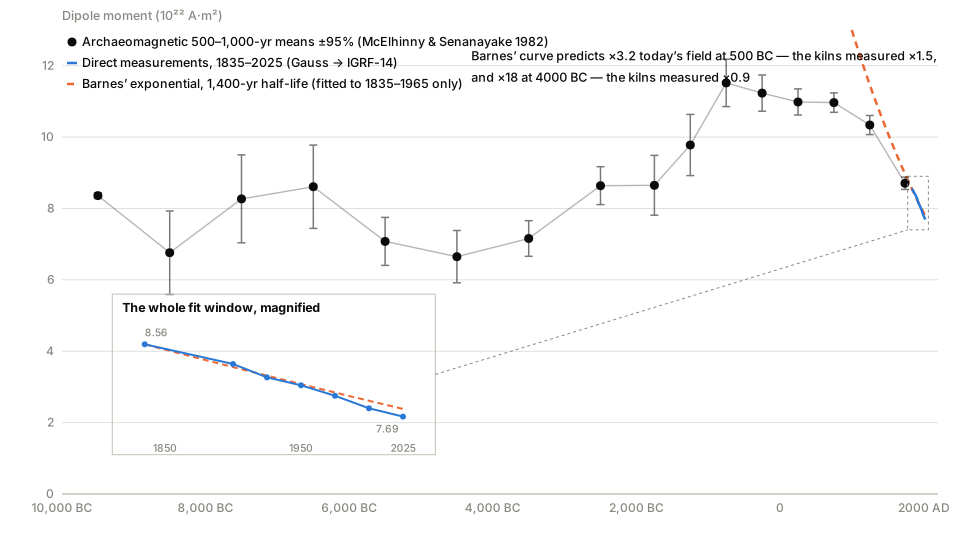
The whole argument in one picture. Black points: global archaeomagnetic dipole means with 95% confidence limits, from 1,175 fired-clay and pottery measurements compiled by McElhinny & Senanayake.7 Blue: direct measurements, Gauss 1835 through IGRF-14 2025. Orange dashed: Barnes' exponential, which was fit to the sliver of data magnified in the inset and predicts a field ×3.2 stronger at 500 BC and ×18 at 4000 BC. The kilns record ×1.5 and ×0.9.
What the kilns record
When clay is fired past its magnetic blocking temperatures and cools, its iron-oxide grains lock in a record of the field's strength at that moment. Archaeologically dated pottery, kilns, hearths, and bricks therefore give field intensity readings back through the Holocene, checked across continents. This is thermoremanent magnetization — the same physics by which Humphreys expects Mercury's crust to hold magnetization, so the method itself is not one creationists can reject wholesale.
The standard global compilation (1,175 measurements over the last 12,000 years) shows the dipole moment rising from about 6.6×10²² A·m² around 4500 BC to a broad maximum of about 11.2–11.5×10²² between 1000 BC and 1 BC, then declining to today's 7.7×10²².7 The compilation's authors put it plainly: "The overall data suggest a maximum in the dipole moment occurred around 2500 B.P. (500 B.C.) and this is preceeded by a minimum around 6500 B.P. (4500 B.C.)."7 Later and larger compilations — 3,243 results in Yang et al., 3,648 in ArcheoInt — keep the same shape while adding finer structure.1920 Reconstructions extending further back find the dipole lower than today through most of the last 50,000 years on the conventional timescale, with a mean of 4.44×10²² for 15,000–50,000 years BP.7 The present decline is the downslope from the ~500 BC peak — Gubbins calls it "periods of rapid fall, as at present, interspersed with periods of little or no activity."21
Set Barnes' curve against this. At a 1,400-year half-life, the field at 500 BC should have been about 3.2 times the 1835 value. Measured: about 1.35 times. At 4000 BC it should have been about 18 times. Measured: about equal to today. The extrapolation is falsified inside the historically dated era — no assumptions about deep time required, only that Egyptian and Mesopotamian pottery is roughly as old as the archaeology says. Even the young-earth timescale accommodates fired clay back to ~2500 BC, and the curve is already wrong by then.
Barnes' answer was to reject archaeomagnetic intensity data along with reversal data.15 Humphreys' answer was to accept the data and abandon constant decay: in his model the field decayed smoothly only until the Flood, reversed rapidly during it, fluctuated "for several thousand years" afterward — producing the archaeomagnetic hump — and resumed steady decay "from about the time of Christ to now."22 That move saves the phenomena, but notice what it concedes: the observed 190-year decline is no longer a measured sample of a 6,000-year monotonic process. Only the last ~2,000 years decay steadily even in Humphreys' own history, and the argument's extrapolation shrinks from "the data show decay since creation" to "a model in which energy always declined can be fit over the data." Those are different claims, and the second one cannot date anything by extrapolation.
There is also a subtler problem with the starting point. The claim that the dipole was already decaying before 1840 rests on an assumption, not a measurement. The standard historical field model, gufm1, states it outright: "before 1832 our model can give only the field morphology, and requires a scale factor to fix its intensity... this fixes g10(t) to decay at a rate of 15 nT yr⁻¹ for t < 1840."23 When Gubbins and colleagues instead constrained the pre-1840 dipole with 315 paleointensity measurements, they found it "nearly constant" from 1590 to 1840 — a slope of 2.28 ± 2.72 nT/yr against 15 nT/yr afterward.21 A later reanalysis with a different error treatment disputes this and finds decay back to 1590,24 so the pre-1840 record is genuinely contested — but "contested between flat and declining" is already fatal to a curve that requires the field to have been 25% stronger in 1590 than in 1840.
The physics: free decay is 20 times too slow
Barnes' mechanism fails independently of the record. His fossil-current model requires the observed decay to be free ohmic dissipation, and the free-decay rate of the core is set by its size and electrical conductivity: τ = μ₀σR²/π². With the core conductivity measured by modern first-principles calculations (which came out two to three times higher than older estimates25), the slowest decay mode has a time constant near 55,000 years. Finlay and colleagues state the consequence exactly: "The obvious explanation of a free Ohmic decay process, resulting from the finite electrical conductivity of the core, is untenable as it is about 20 times too slow. Free decay of the dipole would take ~55,000 years."26
Run that both directions. If the field were freely decaying, the present decline should be 20 times slower than observed. Conversely, Barnes' fitted 2,000-year time constant requires a core conductivity around 4×10⁴ S/m — roughly 25 times below the measured value, and that is in fact the conductivity Barnes derived from his fit.16 Either way the "decaying fossil current" model is excluded by measured material properties. What actually drives the modern decline is known in some detail: growth and poleward migration of reverse-flux patches under the South Atlantic, with "almost all of the dipole decay" coming from the Southern Hemisphere.21 Crucially, this mechanism "involves the transfer of magnetic energy from the axial dipole to other field components, rather than a direct loss to heat via Ohmic dissipation."26 The dipole number falls without the field's energy leaving the core.
The reversals Barnes denied
The case that the field has reversed polarity hundreds of times does not rest on one method. Basalt erupted at mid-ocean ridges cools through its blocking temperatures and locks in the field's direction; as the seafloor spreads, this produces stripes of alternating polarity symmetric about the ridge — predicted by Vine and Matthews in 1963 and mapped globally since.27 Sediment cores on the continents record the same sequence of polarity intervals, and the two records correlate worldwide with radiometric dates. The standard polarity timescale contains at least 183 reversals in the last 83 million years of the conventional timescale alone.28 Lava flows in Oregon, Nevada, and Hawaii record fields frozen at intermediate directions — reversals caught in the act.
By the 1980s this evidence was strong enough that Humphreys broke with Barnes publicly. His invited 1988 CRSQ paper told creationists the reversal data "is indeed credible," noting that "until recently they have generally questioned the credibility of the data."29 Barnes never accepted it; his printed comment on Humphreys' 1986 conference paper still insisted "we have different criteria for 'proof' of dipole reversals."22 Every major creationist organization now follows Humphreys. Readers should understand what this means for the argument's history: the version of the magnetic-field argument promoted for its first two decades depended on denying data that the movement itself now concedes is real.
Humphreys' Flood-reversal model
Since reversals are real and (in his view) the field cannot be old, Humphreys proposed in 1986 that the reversals happened during the Genesis Flood — driven by convective plumes in the core, at a rate of "about one reversal per week," since "roughly 50 reversals are recorded" in the rocks.22 He worked out real physics for this: the two-week cycle penetrates only ~3 km into the core (the skin-depth problem, which he acknowledged), the mechanism needs upflows faster than 3 m/s, an electromotive force around 100 kilovolts, and billions of amperes.2230 For the energy source he suggested "God greatly increased the rate of radioactive decay during the Flood year."22 He also made a falsifiable prediction: thin lava flows that cooled in weeks should occasionally record a reversal in progress.22
The Steens Mountain rise and fall
Three years later the prediction seemed to come true, and this episode deserves an honest telling because both sides have handled it badly. In 1989 Robert Coe and Michel Prévot reported a Miocene lava flow at Steens Mountain, Oregon, whose magnetization varied systematically with height, implying the field changed direction at ~300 nT/day while the flow cooled; their 1995 Nature follow-up reported "astonishingly rapid field change of six degrees per day."3132 Humphreys cited it as a fulfilled prediction for the next two decades, and creationist articles still do.233
In 2014, Coe himself — with new co-authors, resampling the same flow — took it back. Continuous thermal demagnetization "disproves an earlier hypothesis that an episode of extraordinarily fast field change is recorded in the remanent magnetization of a single lava flow." The striking pattern was a normal-polarity overprint that conventional stepwise heating had itself promoted to higher blocking temperatures. The paper's stated highlight: "The case for extraordinarily rapid field change at Steens Mountain is now untenable."10 Note what this was: not a retraction under ideological pressure, but a better measurement by the original discoverer, published with the diagnosis of exactly how the earlier method fooled itself. Humphreys' response was to attribute the reversal-of-findings to two decades of social pressure on Coe and to suggest the new method might invalidate "75 years' worth of paleomagnetic conclusions" — while simultaneously relying on those paleomagnetic methods everywhere else in his model.34 That is not a tenable position, and this article declines to defend it.
Humphreys' fallback evidence is a lake-sediment record at Sulmona, Italy, where the last reversal's directional flip appears in one thin layer, implying less than a century — possibly less than 13 years.3536 Three cautions. The claim is contested: workers who resampled the same outcrops concluded "the observed magnetic pattern, as a whole, is not an accurate record of geomagnetic field behaviour" and that the sub-decade reading "cannot be regarded as firmly established."37 The synthesis of lava, sediment, and ice-core records for that reversal finds the full process — intensity collapse, excursion, recovery — "spans at least 22 ka," with even the final directional change taking up to 4,000 years.38 And Humphreys needs the record to be authentic and 100–1,000 times faster than its own dating, which he gets by invoking accelerated nuclear decay to speed the sedimentation — the record is only evidence for his model after the model has been assumed.34
What fast-field-change evidence actually survives
Fairness requires stating the other half. Genuinely fast field behavior is real at the years-to-centuries scale. The Laschamps excursion (~41,000 years ago conventionally) shows directional transitions of roughly 250 years, a reversed phase of only ~440 years, and intensity dropping to a few percent of today's.3940 Simulation-plus-observation studies put the ceiling on local directional change near 10° per year during weak-field intervals — about 100 times faster than today's rates, and about 200 times slower than the retracted Steens figure.41 A reversal's typical directional change takes ~7,000 years, longer at high latitude — and that latitude dependence is itself evidence that transitions are what dynamo models say they are: the axial dipole decaying through zero while non-dipole components persist, not a rigid flip.42 Nothing surviving scrutiny supports global 180° reversals in days or weeks, and every fast event sits inside a millennia-long intensity collapse. Independent of all magnetization records, beryllium-10 — produced by cosmic rays at a rate set by field strength — spikes in sediments, loess, and ice at the last reversal in a pulse lasting thousands of years; a week-long dip cannot produce it.43
One more internal problem: Humphreys sized his model for "roughly 50" reversals.22 The documented count in the Cenozoic–Late Cretaceous alone exceeds 180, with hundreds more in older rocks, and his own analysis says each reversal bleeds field energy.30 The budget was strained at 50.
"Still losing energy" — the strongest decay claim
Humphreys' most careful paper (2002) answers the classic rebuttal head-on. The rebuttal, from Dalrymple and ultimately McDonald & Gunst: the dipole's decline is "almost completely balanced by a corresponding increase in the strength of the nondipole field," so the total field is roughly constant.2 Humphreys computed the energies from IGRF coefficients and found the balance only partial: from 1970 to 2000 the dipole lost 235 ± 5 petajoules while the non-dipole field gained 129 ± 8, a net loss of 1.41 ± 0.16% of observable field energy in 30 years — an energy half-life of 1,465 ± 166 years.22
Three things should be said for this paper. It computes rather than asserts. It is right that the strong "complete balance" claim was overstated — the 1971 Verosub & Cox analysis itself found only partial offset (non-dipole gain 3.8 vs dipole loss 5.1 ×10²² erg/yr) and flatly said that over ~2,000-year spans "conservation of the total magnetic energy stored outside the earth's core is not indicated."44 And its data-quality complaints about the 1967 non-dipole analysis were fair.2
But the argument proves far less than it claims, for three reasons.
The bookkeeping only covers the visible field. "All observable parts of the field" means the poloidal field outside the core. The toroidal field inside the core is invisible from the surface, and the modern mechanism for the dipole's decline moves energy from the axial dipole into other components rather than dissipating it.26 Humphreys argues the toroidal reservoir should be small,2 but his own model leans on the mirror-image move — when the archaeomagnetic record shows surface field strength rising for millennia before 500 BC, he places the balancing energy in unobservable higher modes. Whatever hidden-energy arguments are worth, both sides need them, and a quantity that can hide cannot anchor a chronology.
A 30-year net loss does not establish 6,000 years of monotonic loss. The external-field energy scales as the square of the dipole moment. If the dipole was ~6.6×10²² A·m² around 4500 BC and is 7.7×10²² today, the external dipole energy is about 35% higher now than then. On the directly recorded archaeomagnetic era, "the field has rapidly and continuously lost energy ever since God created it"2 is contradicted by the visible part of the field — the only part anyone can measure — unless the unobservable modes carried the difference, which is the concession just described.
The rate is not unique, and the field is not dying. Holocene reconstructions find rates like the present 5% per century "do not appear unique,"45 the present dipole remains above its long-term average,46 and mainstream workers who take an imminent excursion seriously still put any transition 500–1,000 years out.47 A fluctuating quantity caught on a downswing supports no extrapolation in either direction.
The planetary predictions — the argument's best card
In December 1984, Humphreys published a creation model of planetary magnetism: God created each body as water, with a fraction k of its nuclear spins aligned; the collapsing alignment left a circulating current whose field then decayed ohmically over 6,000 years.8 From this he computed present-day dipole moments. For the two planets not yet visited he wrote, before Voyager 2's flybys (January 1986 and August 1989): "the present dipole moment of Uranus would be of the order of 10²⁴ J/T," and Neptune "similar."8 Voyager measured 3.86×10²⁴ for Uranus and 2.0–2.1×10²⁴ for Neptune.948 Both landed inside his stated window. That is a documented, pre-registered prediction that came true, published 14 months before the first flyby, and skeptics who pretend otherwise are not engaging the record.
Now the caveats, which are also part of the record.
- The window was two decades wide. The printed 1984 prediction is an order of magnitude; Humphreys' own 1990 gloss says he meant 10²³–10²⁵.49 The narrower "2 to 6 ×10²⁴" range he later quoted appears nowhere in the 1984 paper.
- The theory's parameters are free. k was set to 0.25 "in the absence of any better criterion," but Jupiter requires k ≥ 0.87, and core radii and conductivities are adjustable.8 Tim Thompson's critique lands: with Earth at 7.9×10²² and Saturn at 4.3×10²⁵ already known, "anything in the 10²³ to 10²⁴ range is an obvious guess" for planets intermediate in size — interpolation reproduces the prediction with no theory at all.50
- The falsification test had enormous headroom. His stated failure criterion — a field above the k = 1 cap of 8.2×10²⁵ (Uranus) — sat 21 times above the measured value.8
- Mainstream ranges also bracketed the answer. Published pre-encounter estimates ran from 1.3×10²⁴ to 5.4×10²⁵ (Desch & Kaiser's plausible range) with central values 3–10 times too high (magnetic Bode's law ~1.3×10²⁵; Hill & Dessler "at least 0.6 gauss, and more probably several gauss").5152 The fair statement is that Humphreys' central value beat the mainstream central values, while both frameworks' ranges contained the answer.
- Nobody predicted what was actually surprising. Uranus' and Neptune's fields are tilted 60° and 47° from their spin axes and offset from center by 0.3 and 0.55 radii — Ness's abstracts call it "surprisingly" both times.948 Humphreys' bar-magnet-style model did not predict this; his later displaced-core explanation is post-hoc and has never been made quantitative. Mainstream theory produced a working quantitative account in 2004 — thin-shell convection above a stratified interior — which is also post-hoc, 15 years after the fact.53
The rest of the planetary scorecard is weaker for the model than creationist articles report.
Mercury's decay: predicted, not confirmed. The 1984 paper predicted Mercury's moment would be 1.8% smaller in 1990 than in 1975; by 2008 Humphreys predicted MESSENGER would find a 4–6% decrease, and in 2012 he claimed the field was "fading fast," 7.8 ± 0.8% weaker.85455 The 2012 claim came from reading two points off published figures. When the MESSENGER team applied one consistent model — offset dipole plus magnetopause currents — to both spacecraft's data, Mariner 10's 1975 flyby gave 188 nT·R³ and MESSENGER's orbital data gave 190: "consistent with no secular variation."11 Changes up to ~10% remain allowed by Mariner 10's sparse coverage, so Humphreys' slow-decay rate is not strictly excluded — but his published claims of a detected decrease did not survive, and the paper he first cited for a decrease actually reported consistency "to within an estimated uncertainty of 10%."56
Crustal magnetization: hits with little discriminating power. The 1984 paper predicted old igneous rocks on Mercury and Mars should carry remanent magnetization.8 Mars Global Surveyor found intense crustal magnetization in 1999; MESSENGER found Mercury's in 2015.5758 Both are genuine hits. But any model in which these bodies once had stronger fields — including the mainstream extinct-dynamo picture — makes the same prediction, and the discoveries came packaged with age estimates: Mercury's magnetization dates to 3.7–3.9 billion years on crater chronology, a figure the creationist claim articles do not mention.58 The prediction discriminates "once had a field" from "never had one"; it does not discriminate 6,000 years from 4.5 billion.
Ganymede: not a prediction. The 1984 tables contain no moons of Jupiter. When Galileo found Ganymede's field in 1996, Humphreys accommodated it after the fact — in the same passage accommodating Titan's lack of a field, since "a factor of only two in the half-life... can make the difference."54 A framework equally comfortable with a field and its absence gains no credit from either.
The Moon: qualitatively right, quantitatively wrong. Humphreys' model has the Moon's field decaying to nothing within centuries of creation, and indeed the Moon has ancient crustal magnetization and no field today — a real 1984 puzzle for dynamo theory.8 But the paleointensity record shows an Earth-strength lunar field persisting from 4.25 to 3.56 billion years ago before declining59 — a billion-year plateau, not a 300-year exponential, unless all radiometric chronology is discarded first.
Can anything power the field for billions of years?
This is the deepest question in the topic, and both sides usually cheat it. Young-earth articles quote a mainstream concession and stop. Skeptical articles say "the dynamo explains it" and stop. Neither is the state of the science, so this section walks through it: what the rock record demands, why the power bill is the problem, every rescue currently on the table, and what each side may honestly conclude.
What the rock record demands
On its own timescale, the paleomagnetic record requires a magnetic field for most of Earth's history. Single silicate crystals from South African rocks record a field 3.4–3.45 billion years old at "approximately 50 to 70% that of the present-day field."60 A bolder claim pushes the field back to 4.2 billion years using magnetic inclusions in Jack Hills zircons,61 but that one is contested within the mainstream — a 2020 reanalysis concluded "the existence and evolution of the geodynamo before 3.5 Ga ago remains unknown."62 The conservative statement is a continuously operating field for at least ~3.5 billion years. The record also has structure: around 565 million years ago the field collapsed to "the lowest value yet reported... more than ten times smaller than the strength of the present-day field" — about 0.7×10²² A·m² — before recovering.63 Any model of the field must produce all of this: early strength, multi-billion-year persistence, a deep late-Precambrian minimum, and recovery to today's above-average field.
The mechanism is not the problem — the power bill is
Dynamo theory was genuinely incomplete for decades. Cowling proved in 1933 that no axisymmetric field can sustain itself, and for a generation it was unclear whether any working dynamo existed; Humphreys' 1986 complaint that "no one has yet proven that a self-sustaining dynamo can actually work in the earth's core" was defensible when he wrote it.22 It stopped being defensible in 1995, when Glatzmaier and Roberts' three-dimensional self-consistent simulation "maintains a magnetic field for over 40,000 years" — more than 20 free-decay times — and spontaneously produced "a successful reversal of the dipole moment."64 Sustaining today's field is not in doubt: the core's magnetic Reynolds number is ~1,000–2,000 against a critical value of ~40.65 Given power, a dynamo runs indefinitely. The question is the power.
The power problem is real and quantitative. A dynamo needs the core to convect, and convection needs the core to shed more heat than conduction alone can carry. First-principles calculations in 2012 found core thermal conductivity two to three times higher than assumed,25 meaning conduction carries away most of the heat budget and convection starves — especially before the inner core existed, because a growing inner core releases latent heat and buoyant light elements that power convection for free. Olson named it "the new core paradox."66 The 2023 review by Driscoll and Davies quantifies it: with nominal parameters (conductivity 70 W/m/K, no core radioactivity, standard starting temperature), the model "produces an unsuccessful solution where the dynamo is dead from 0.4 to 3.9 Gyr" — dead, that is, for most of the interval where the rocks record a field.12 Caltech's David Stevenson, on the record in 2014: "We do not understand how the Earth's magnetic field has lasted for billions of years. We know that the Earth has had a magnetic field for most of its history. We don't know how the Earth did that."3 The 2022 review in Nature Reviews Earth & Environment opens the same way: "the mechanism that has sustained the geodynamo for over 75% of Earth's history remains debated."67
Two honest sharpenings. First, the budget was strained even before the conductivity revisions: Davies wrote in 2007 that it "seemed to be not possible simultaneously to reconcile the energy requirements of the geodynamo, the evidence for a magnetic field through most of Earth's history, the present size of the inner core and geochemical and cosmochemical constraints on the potassium content of the Earth."68 Second, the framework's history has moving parts: a paleointensity jump at 1.3 billion years was once read as the inner core's birth signal and has since been reassigned, with high-conductivity models now favoring an inner core "less than 0.7 billion years old."69
The rescues on the table
So is there a secular model that keeps the field alive for billions of years? There are several candidates. Their status, one by one:
- The conductivity is lower after all. If the 2012 calculations are wrong, the paradox dissolves. A 2016 direct laser-heated diamond-anvil measurement found conductivity "near the low end of previous estimates, at 18–44 watts per metre per kelvin" — a result its authors note "is in agreement with palaeomagnetic measurements indicating that Earth's geodynamo has persisted since the beginning of Earth's history, and allows for a solid inner core as old as the dynamo."70 But the back-to-back paper in the same issue of Nature measured electrical resistivity and concluded the opposite: high conductivity, "rapid core cooling and a young inner core less than 0.7 billion years old."69 Ten years on, the experimental dispute is unresolved; proposed values span 18 to ~250 W/m/K, and the 2022 review's threshold is that convection alone works "if the thermal conductivity is lower than 100 W m⁻¹ K⁻¹."67 Status: genuinely open — this rescue would work, and might simply be true, but the measurements disagree.
- Exsolution. If magnesium or silicon oxides precipitate out of the cooling core at its top, their removal leaves denser fluid behind and stirs the core gravitationally, with no inner core needed. Proposed independently in 2016, the energy released is "comparable to, if not more than, that produced by inner-core growth, resolving the conundrum posed by the existence of an ancient magnetic field prior to the formation of the inner core."7172 Status: promising but contested — the core must cool fast for exsolution buoyancy to beat thermal stratification, and later experiments suggest "the core may not contain enough lithophile elements to produce any exsolution."12 The 2022 review's verdict: the exsolution rate "remains poorly constrained."67
- A hotter early core. Driscoll and Davies' own parameter search found one fully "successful" thermal history at realistic high conductivity: start the core-mantle boundary near 6,000 K — hotter than standard formation models — and take the core's melting temperature at the low end of published estimates. In that model the dynamo runs continuously, the inner core nucleates at ~630 million years ago and grows to exactly its present size, and the dynamo is "marginal just prior [to] inner core nucleation."12 They call the required temperatures "on the extreme end of typical estimates, but should not be ruled out."12 Status: a working end-to-end model with defensible-but-extreme inputs. Note one striking cross-check: it predicts the field should have been weakest just before ~630 million years ago, and the measured record's all-time minimum sits at ~565 million years ago.63
- A basal magma ocean. A hot early Earth would keep the bottom of the mantle molten for a billion years or more. That layer helps in two distinct ways. In one family of models it regulates heat flow out of the core so that a core dynamo runs from ~4 billion years ago onward.12 In a bolder 2020 proposal the molten silicate layer is the early dynamo: computed electrical conductivity of silicate liquid at those conditions "exceeds 10,000 S/m," the magnetic Reynolds number clears the dynamo threshold, and "the Archean field was produced by the basal magma ocean" until the core dynamo took over.73 Status: active research; the core-dynamo variant only works at conductivity ≤70 W/m/K, and the silicate-dynamo variant is a simulation-based proposal awaiting independent test.
- Mechanical stirring. Precession-driven flows "are too weak to drive the geodynamo"; tidally driven flows "could have been strong enough in the early Earth, before 1.5 billion years ago," when the Moon was closer and Earth spun faster.67 Status: a partial contributor at best.
- Radioactive heating in the core. Enough potassium in the core (~3 TW today) would fix everything, but the required concentration is "unsatisfactory given the expected lithophilic nature of the main radiogenic elements" — geochemistry puts potassium in the mantle and crust, not the iron core.12 Status: generally regarded as unrealistic.
What each side may honestly conclude
The answer to the section's question is: not yet, but plausibly. No consensus model currently powers the field for 4.5 billion years — "typical models fail," in the reviewers' own words.12 But this is not a blank wall. At least one complete thermal history succeeds using parameters inside published uncertainty ranges; one live experimental result (low conductivity) would dissolve the paradox outright; and the mainstream's own summary verdict is that "convection, possibly aided by the exsolution of light elements, remains the mechanism most likely to have sustained the geodynamo," while the mechanisms "remain under scrutiny."67 A field this active — where the two decisive conductivity measurements in one journal issue contradict each other — is unfinished, not falsified.
What the young-earth side may claim from this is substantial but bounded. It is fair to say, with citations, that the discipline has not established what powered the field for the first three billion years of its own timeline; that the paradox was created by the mainstream's own improving physics; that the rescues are post-hoc and mutually inconsistent; and that "the dynamo explains the field's age" is an overdrawn summary of a genuinely open problem. That is a real epistemic point against treating deep-time geophysics as settled.
What it may not claim is the paradox as evidence for a young field, because the argument self-destructs: the paradox exists only because rocks record a field operating for billions of years. No ancient record, no paradox. A young-earth writer who cites Stevenson's "we do not understand how the Earth's magnetic field has lasted for billions of years" is citing a sentence whose subject is the field lasting billions of years. The concession and the timescale come as a package. Within the young-earth framework the entire question dissolves anyway — a 6,000-year-old field needs no multi-billion-year power source — so the paradox is strictly an argument about the coherence of the mainstream picture, not support for decay-since-creation. And there is a mirror obligation: the young-earth model has its own unsolved power problem, since Humphreys' Flood reversals require an energy source he fills by miracle ("God greatly increased the rate of radioactive decay during the Flood year"22), with the attendant heat problem that proposal carries. Neither framework currently closes its energy books with measured physics alone.
Objections and responses
"The decay is measured fact; extrapolating it is just taking data seriously." The measured fact spans 190 years. The archaeomagnetic record — also measured fact, by physics the young-earth model itself relies on — shows the trend reversed sign twice within the last 6,000 years. Extrapolating the recent downslope through a measured peak is not taking data seriously; it is preferring a curve to the data the curve is fit to.
"Archaeomagnetic intensities are too unreliable to refute the decay." This was Barnes' position, and it is no longer available to the movement: Humphreys' model uses archaeomagnetic data (the post-Flood fluctuations, the Iron Age spikes creationists cite approvingly74) and paleointensity data (the reversals). The same laboratories, methods, and error analyses produce the rising-then-falling Holocene curve. Accepting the data where the model needs it and rejecting it where the model fails is not an error theory; it is special pleading.
"Total field energy has decreased ever since measurements began, exactly as free-decay predicts." Over 1970–2000 the observable external energy fell 1.4%.2 But free decay of the whole field is excluded by the measured core conductivity (20× too slow), the decline is driven by identified reverse-flux patches under the South Atlantic rather than uniform decay, and the visible field's energy today is well above its mid-Holocene value. A 30-year budget of the visible 10% of the system, during a downswing, is not a 6,000-year law.
"Humphreys predicted Uranus and Neptune; dynamo theorists failed. His framework earned trust." The prediction was real and this article credits it. But one order-of-magnitude hit — from a model whose key parameter is free, whose windows spanned two decades, and whose value matches simple interpolation between Earth and Saturn — earns limited trust, and the framework's subsequent sharp tests went badly: the Mercury decay detection failed, the rapid-reversal centerpiece was withdrawn by its discoverer, and the Ganymede "confirmation" was a retrodiction. Predictive success is cumulative, and the cumulative record is one hit, several low-information hits, and no confirmed risky prediction since 1989.
"Rapid reversals during the Flood explain the seafloor stripes." The stripes are recorded not only in quickly-chilled surface basalt but through slowly-cooled crustal layers; a signal reversing weekly cannot be recorded by rock that takes years to cool through its blocking temperatures, and most reversal records would require exactly that.50 Transition records show structured intermediate directions and latitude-dependent durations, matching a collapsing-and-rebuilding dipole rather than a fast flip.42 The beryllium-10 pulses at reversals last millennia.43 And the model was built for ~50 reversals when the record holds 180+ in its youngest quarter alone.28
"Mainstream science can't explain the field either, so the models are on equal footing." The difficulties are not symmetric. The mainstream problem is a power-budget shortfall billions of years ago, with several candidate solutions under active test. The young-earth problem is that the model's quantitative claims about the recent, directly measured past — monotonic energy decay, detectable Mercury decay, week-scale reversals — have each failed or lost their evidence. An open research problem and a failed prediction record are different conditions.
"This article concedes the field can't last billions of years — isn't that the whole argument?" No. Stevenson's quote is about theorists' current inability to balance the ancient energy budget, in a discipline that has already once (2016) produced a viable new energy source candidate.72 The rock record of a field persisting through hundreds of reversals is evidence the field did last, whatever powers it. An unexplained persistence is not a measured decay.
Verdict
| Claim | Status |
|---|---|
| Dipole has declined ~9% since the 1830s | True, undisputed |
| Decline is free decay of a fossil current (Barnes) | False — 20× faster than free decay allows; conductivity mismatch both directions |
| Exponential extrapolation dates the field ≤ 10,000 yr | Fails inside the archaeologically dated era; field peaked ~500 BC, was weaker than today ~4500 BC |
| Field never reversed (Barnes) | False; conceded within the movement since 1988 |
| Total field energy monotonically declining (Humphreys) | Unproven — holds for visible field over 30 yr; contradicted by visible field over 6,000 yr unless energy hides in unobservable modes |
| Reversals fit in the Flood year | Contradicted by transition structure, cooling times, ¹⁰Be pulses, and the reversal count |
| Rapid-reversal lava evidence (Steens) | Withdrawn by its discoverer, 2014 |
| Uranus/Neptune moments ~10²⁴ (1984, pre-flyby) | Confirmed — genuine predictive hit, with wide windows and free parameters noted |
| Mercury field measurably decaying | Not confirmed; claimed detections superseded by joint reanalysis |
| Mercury/Mars crustal magnetization (1984) | Confirmed, but low discriminating power |
| Dynamo theory has no open problems | False — the new core paradox is real and admitted |
| A secular model can power the field for 4.5 Gyr | Open — several rescues (lower conductivity, exsolution, hot early core, basal magma ocean); at least one full model succeeds with extreme-but-defensible parameters; none established |
The argument as retailed — "the field is decaying, therefore the earth is young" — should be retired. Its Barnes form is refuted three independent ways. Its Humphreys form is a serious model whose distinctive evidence has eroded since 1990 and whose surviving strength, the ice-giant predictions, supports at most the modest claim that a clever physicist beat the field's central guesses once. What remains genuinely useful to a young-earth writer is narrower and should be stated precisely: planetary magnetism has repeatedly surprised dynamo theory, the pre-1840 dipole history is contested, and the discipline has not yet settled what powered the field for the first three billion years of its own timeline. Those are real cracks. They are not a clock.
Sources
- 1.
McDonald, Keith L., and Robert H. Gunst. “An analysis of the earth's magnetic field from 1835 to 1965.” ESSA Technical Report IER 46-IES 1. U.S. Government Printing Office. Jul 1967. Page 1: “Since the time of Gauss' measurements the earth's dipole moment has decreased, sensibly linearly, at approximately the rate of 5% per hundred years. Assuming these rates to persist, our analysis discloses that the dipole moment will vanish in A.D. 3991.” A 1967 U.S. government technical report by two authors that analyzes the earth's magnetic field from 1835 to 1965. Its measure is the dipole moment, the strength of the field's main bar-magnet-like part, and it found that this moment had fallen at about 5% per hundred years. The article uses it because Barnes took his data from this survey. ↩ ↩
- 2.
Humphreys, D. Russell. “The Earth's Magnetic Field Is Still Losing Energy.” CRSQ 39(1):3–13. Jun 2002. A 2002 paper in the Creation Research Society Quarterly by D. Russell Humphreys, whose title states its claim that the earth's magnetic field is still losing energy. The article uses it as Humphreys' most careful paper on that question, because it answers the standard objection head-on.
- 2a.
Quoting Dalrymple 1983: “this decrease has been almost completely balanced by a corresponding increase in the strength of the nondipole field, so that the strength of the total observed field has remained about constant.” ↩
- 2b.
Section Abstract: “from 1970 to 2000, the dipole part of the field steadily lost 235 ± 5 billion megajoules of energy, while the non-dipole part gained only 129 ± 8 billion megajoules.” ↩
- 2c.
From the body of the paper: “an energy decay time of 2113 ± 239 years, or an energy half-life of 1465 ± 166 years... In 30 years, 1.41 ± 0.16% of all the observable magnetic energy disappeared.” ↩ ↩ ↩
- 2d.
Cites Coe & Prévot as: “evidence in thin lava flows confirming my 1986 prediction.” ↩
- 2e.
Quotes McDonald & Gunst's own caveat about the 1967 non-dipole analysis: “small errors in the harmonic coefficients are unduly amplified”. ↩
- 2f.
Citing Lanzerotti et al. 1985 on small mantle currents as: “removing such fields as a significant reservoir for energy disappearing from the dipole part.” ↩
- 2g.
Conclusion: “these data are quite consistent with the face-value Biblical age of the earth, about 6000 years”. Section Abstract: “the field has rapidly and continuously lost energy ever since God created it about 6,000 years ago”. ↩
- 2a.
- 3.
Folger, Tim. “Journeys to the Center of the Earth.” Discover. 2014. Stevenson says: “Right at this moment, there is a problem with our understanding of Earth's core... The problem is a serious one. We do not understand how the Earth's magnetic field has lasted for billions of years. We know that the Earth has had a magnetic field for most of its history. We don't know how the Earth did that.” A magazine feature in the July/August 2014 issue of Discover on Earth's core and the magnetic field it powers. It quotes Caltech's David Stevenson. The article opens with Stevenson's remark that the field's survival for billions of years is not yet understood. Mirror: Archive.org ↩ ↩
- 4.
Alken, P. et al. “International Geomagnetic Reference Field: the thirteenth generation.” Earth, Planets and Space 73:49. 2021. “At Earth's surface in 2020, the contribution from the dipole terms g10, g11, h11 accounts for over 93% of the power in the main geomagnetic field.” A 2021 paper by the international working group that maintains the International Geomagnetic Reference Field, a standard mathematical model of the earth's internal magnetic field. It gives the thirteenth generation's coefficients, the numbers that define the model, for 2020, derived from satellite, observatory and survey data. The article uses it as the source for its dipole-moment figures. ↩ ↩
- 5.
Barnes, Thomas G. “Decay of the Earth's Magnetic Moment and the Geochronological Implications.” Creation Research Society Quarterly 8(1):24–29. Jun 1971. A 1971 article in a creationist journal by Thomas G. Barnes, a professor of physics. It argues that the earth's magnetic moment decays exponentially with a half-life of 1400 years, runs that rate backward, and concludes that the field's origin is much less than 20,000 years ago. This is where the argument examined here begins.
- 5a.
Pages 25, 29: Data from McDonald & Gunst 1967, Table 3: the 1835 moment was 8.558×10²² A·m² and the 1965 moment was 8.017×10²². ↩
- 5b.
Pages 26–27: ln(8.558/8.017) over 130 years gives time constant T = 2000 yr. “the half life... is 1400 years.” ↩
- 5c.
Page 27: At 20,000 BC his curve gives a field of 1.8 tesla, which Barnes says is. “stronger than the field between the pole pieces of the most powerful radar magnets”. The Joule heating is. “250 million times greater than it is now”. His conclusion is. “It would appear from these arguments that the origin of the earth's magnetic moment is much less than 20,000 years ago.” Table 2: His Table 2 runs to 1,000,000 BC, where the field is 3×10²¹⁵ tesla, and he wrote. “impossible, of course.” ↩ ↩ ↩
- 5d.
Page 26: Barnes states the premise of his model. “It is this author's contention that Lamb's solution for the earth's main magnetic field is reasonable as a first approximation; that freely decaying currents are the source of the earth's main magnetic field.” He adds: “Since there seems to be no dynamo or other energy source in the earth that can generate these currents, the current that does exist in the core must be decaying exponentially.” ↩
- 5a.
- 6.
Snelling, Andrew A. “#5 Rapidly Decaying Magnetic Field.” Answers. Oct 1, 2012. “10 Best Evidences from Science That Confirm a Young Earth”. A popular article by Andrew Snelling of Answers in Genesis, number 5 of 10 best evidences from science that confirm a young earth. It says the field's total energy has decayed 5% per century since 1845, and that the field, and so the earth, could be no older than 20,000 years. The article uses it as the current popular form of the argument, which keeps Barnes' conclusion but drops his details. ↩ ↩
- 7.
McElhinny, M. W., and W. E. Senanayake. “Variations in the Geomagnetic Dipole 1: The Past 50,000 Years.” Journal of Geomagnetism and Geoelectricity 34:39–51. 1982. A 1982 analysis of archeomagnetic data, which are measurements of Earth's field strength recorded in fired clay and pottery as they cooled, covering the past 50,000 years. It combined 1,175 results for the last 12,000 years, which the authors note are heavily concentrated in the northern hemisphere between 0 and 90 degrees east (64% of the data). The article uses its global means as the measured record of the dipole moment, the strength of Earth's main bar-magnet-like field, which was higher around 500 BC and lower around 4500 BC.
- 7a.
Section Abstract: “Over the period 15,000 to 50,000 years B.P. the earth's dipole moment was low, the 14 results available having mean value 4.44x10²² Am².” The same abstract says the ten 1,000-year means average 8.75×10²² A·m², with a standard deviation (a measure of scatter) of 18%. ↩
- 7b.
Table 2: Global 500/1,000-year means, in 10²² A·m²: 8.71 (AD 1500–1980), 10.34, 10.97, 10.98, 11.23, 11.52 (1000–500 BC), 9.78, 8.65, 8.64, 7.16, 6.65 (4000–5000 BC), 7.08, 8.61, 8.27, and sparse earlier values. These are the black points in the figure above. ↩ ↩
- 7c.
Page 42: “The overall data suggest a maximum in the dipole moment occurred around 2500 B.P. (500 B.C.) and this is preceeded by a minimum around 6500 B.P. (4500 B.C.).” The abstract's "broad maximum about 6,500 years B.P." is a misprint for this minimum; the body, figures, and all later compilations agree. ↩ ↩
- 7a.
- 8.
Humphreys, D. Russell. “The Creation of Planetary Magnetic Fields.” Creation Research Society Quarterly 21(3):140–149. Dec 1984. A 1984 paper in the creationist journal by D. Russell Humphreys, a physicist at Sandia National Laboratories. It proposes that God started planetary magnetic fields by aligning atomic nuclei, so that the currents this produced decay over thousands of years, and it says its values agree with a 6000-year age for the solar system. It was received on 3 January 1984, before both Voyager 2 flybys, so its predictions for Uranus and Neptune were made in advance, and the article credits it as the strongest young-earth item on this topic.
- 8a.
Section Abstract: “by creating the original atoms of the planets with many of their nuclear spins pointing in the same direction... The currents and fields would decay steadily over thousands of years, as Barnes has pointed out.” ↩
- 8b.
“In the absence of any better criterion, let us assume that k = 0.25 unless we find out otherwise.” For Jupiter: “The minimum alignment fraction which will give the present field is 0.87.” ↩
- 8c.
Section Conclusions, prediction 3: “The upcoming Voyager 2 encounters with Uranus and Neptune should show planetary magnetic moments less than the k = 1.0 limit: 8.2 x 10²⁵ J/T for Uranus and 9.7 x 10²⁵ J/T for Neptune.” Falsifiability: “If either of the two planets has a field stronger than the k = 1.0 limit, it would be evidence against the creationist theory.” ↩
- 8d.
Page 146: “the present dipole moment of Uranus would be of the order of 10²⁴ J/T”. Page 147: “we would expect Neptune to have a similar present magnetic moment, of the order of 10²⁴ J/T.” ↩ ↩
- 8e.
Section Conclusions, prediction 2: “Mercury's decay rate is so rapid that some future probe could detect it fairly soon. In 1990 the planet's magnetic moment should be 1.8 percent smaller than its 1975 value.” ↩
- 8f.
Section Conclusions, prediction 1: “Older igneous rocks from Mercury or Mars should have natural remanent magnetization, as the Moon's rocks do.” ↩
- 8g.
Table II, section Moon: Created lunar moment 1.73×10²² J/T; present upper limit <1.3×10¹⁵ forces a decay time under ~364 years. ↩
- 8a.
- 9.
Ness, N. F. et al. “Magnetic fields at Uranus.” Science 233:85–89. 1986. “The dipole moment of 0.23 gauss R³(U)”. “the surprisingly large value.” A 1986 Science paper by Ness and colleagues reporting the magnetic field of Uranus. Its dipole moment is 3.86×10²⁴ A·m², tilted 60° from the rotation axis and offset 0.3 R from the centre, where R is the planet's radius. The article cites it for the Voyager measurement of Uranus. ↩ ↩ ↩
- 10.
Coe, Robert S. et al. “Demise of the rapid-field-change hypothesis at Steens Mountain: The crucial role of continuous thermal demagnetization.” Earth and Planetary Science Letters 400:302–312. 2014. A 2014 laboratory paper by Robert Coe, who made the 1989 measurements, with three co-authors. They heated samples from a lava flow at Steens Mountain, Oregon, continuously and quickly, at about 40 °C per minute. That removed a later normal-polarity magnetism which conventional stepwise heating had made harder to remove, and which had produced the misleading pattern. The article cites it as Coe's own withdrawal of the claim that the flow recorded very fast field change. Mirror: Ipgp.fr
- 10a.
Section Abstract: “Rapid continuous thermal demagnetization in a Triaxe vibrating sample magnetometer disproves an earlier hypothesis that an episode of extraordinarily fast field change is recorded in the remanent magnetization of a single lava flow... normal-polarity secondary remanent magnetization... is responsible for the misleading pattern of directions.” Section Highlights: “The case for extraordinarily rapid field change at Steens Mountain is now untenable.” ↩ ↩
- 10a.
- 11.
Philpott, L. C. et al. “Constraints on the secular variation of Mercury's magnetic field from the combined analysis of MESSENGER and Mariner 10 data.” Geophysical Research Letters 41:6627–6634. 2014. Same model fit to both datasets: Mariner 10 (1975) 188 nT·R³, MESSENGER 190 nT·R³. “consistent with no secular variation”. With up to ~10% change in g₁⁰, the main term of the field, still permitted by Mariner 10's coverage. A data study of Mercury's magnetic field that uses two sets of spacecraft data, from Mariner 10 (1975) and from MESSENGER. The authors fit one model to both sets and find them consistent with no slow change in the field over those years. The article uses it to show that Humphreys' 2012 claim of a fading Mercury field does not survive one consistent analysis of the data. ↩ ↩
- 12.
Driscoll, Peter, and Christopher Davies. “The 'New Core Paradox': Challenges and Potential Solutions.” JGR Solid Earth 128:e2022JB025355. 2023. A computer modelling study of how Earth's core and mantle cooled over 4.5 billion years, which counts a run as successful only if the inner core ends at its present size and the dynamo stays alive. With nominal settings the runs do not succeed, and the authors find three ways to keep the dynamo alive, two of them unrealistic and the third at the extreme end of estimates; the paper is at https://doi.org/10.1029/2022JB025355. The article uses it because it puts numbers on the problem that a highly conducting core creates for the dynamo.
- 12a.
Section Key Points: “Using nominal thermal evolution parameters the geodynamo is predicted to die prior to inner core nucleation.”
- 12b.
Section Plain Language Summary: “In agreement with previous studies, we confirm that typical models fail to reproduce the thermal and magnetic evolution found in the geological record.” ↩ ↩
- 12c.
Section Abstract: “The dynamo can be kept alive by assuming an unrealistically low thermal conductivity of 20 Wm⁻¹K⁻¹ or an unrealistically high core radioactive heat flow of 3 TW... We identify a third scenario... a hot initial CMB temperature of ∼6,000 K... on the extreme end of typical estimates, but should not be ruled out.” ↩
- 12d.
Section 4. Discussion: The paper says that raising the core's conductivity to the nominal 70 W/m/K. “produces an unsuccessful solution where the dynamo is dead from 0.4 to 3.9 Gyr.” Gyr means billions of years. ↩
- 12e.
Section 4. Discussion: The paper says: “Perhaps the most promising solution we have found... is with a hot initial core temperature of Tcmb,0 ∼ 6,000 K, mantle viscosity ratio of fν = 5, and low central melting temperature of Tmelt,cen = 5550 K. In this particular model the inner core nucleates at ∼630 Ma, grows to the correct final inner core radius, and achieves an ohmic dissipation rate at inner core nucleation that is very close to zero, implying the dynamo is marginal just prior inner core nucleation.” Ma means millions of years ago. The melting temperature is. “colder than most estimates but is within the range of 5,120 ± 390 K of Sinmyo et al. (2019)”. the starting temperature is. “higher than most estimates from core formation models... but given the lack of direct constraints on the initial thermal state of the core such a scenario should not be ruled out and deserves further scrutiny.” ↩
- 12f.
Section 1. Introduction: On exsolution, the paper says: “the core must cool relatively quickly for the exosolution-driven buoyancy to overcome any thermal stratification (Du et al., 2017, 2019) and the core may not contain enough lithophile elements to produce any exsolution (Chidester et al., 2022).” On the basal-magma-ocean-regulated core dynamo, citing Davies & Greenwood 2021, the paper says: Section 4. Discussion: “enhanced heat flow out of the BMO allowed magnetic field generation (EJ > 0) to begin around 4 Ga,”. Ga means billions of years ago. “this successful solution does not exist for k > 70 W/m/K.” On core radioactivity, the paper puts the needed radioactivity at ~2.5 TW present-day, which it gives as about 340 ppm potassium, and says these solutions are. “unsatisfactory given the expected lithophilic nature of the main radiogenic elements,”. A possible way out is a. “hidden reservoir”. in the lower mantle, which the paper says is. “highly debated.” ↩ ↩ ↩
- 12a.
- 13.
Sarfati, Jonathan. “The earth's magnetic field: evidence that the earth is young.” Creation 20(2):15–17. Mar 1998. “Barnes calculated that the current could not have been decaying for more than 10,000 years, or else its original strength would have been large enough to melt the earth”. “The clear decay pattern shows the earth could not be older than about 10,000 years.” A popular article by Jonathan Sarfati for the creationist site creation.com, first printed in the magazine Creation in March 1998 and here in its web version, updated in 2023. It restates Barnes' decaying-current argument, says the field has decayed about 5% per century since 1835, and says the decay limits the earth's age to about 10,000 years. The article uses it as the Creation Ministries International version of that 10,000-year limit. ↩ ↩
- 14.
Barnes, Thomas G. “Young Age vs. Geologic Age for the Earth's Magnetic Field.” Creation Research Society Quarterly 9(1). 1972. Section Abstract: The abstract says the reversal evidence is. “fraught with inconsistencies and incapable of providing acceptable evidence for a long age.” A 1972 article by Barnes in the same creationist journal, which reviews the technical literature on reversals recorded in ancient rocks and calls that evidence unreliable. The article uses it for Barnes' rejection of the reversal evidence. ↩
- 15.
Barnes, Thomas G. “Earth's Young Magnetic Age: An Answer to Dalrymple.” Creation Research Society Quarterly 21(3):109–113. Dec 1984. A 1984 reply by Barnes to G. Brent Dalrymple, a research geologist at the U.S. Geological Survey, who had argued that the earth is 4.5 to 4.6 billion years old. Barnes argues that the moon cannot be 4.5 billion years old, so Dalrymple's own method points to a younger earth, and that isochron dating is unreliable. The article uses it for Barnes' answer to the archaeomagnetic and reversal data.
- 16.
Barnes, Thomas G. “Electromagnetics of the Earth's Field and Evaluation of Electric Conductivity, Current, and Joule Heating in the Earth's Core.” Creation Research Society Quarterly 9(4):222–230. 1973. “no reversal of the magnetic field can take place before the magnetic field is completely gone.” A 1973 paper by Barnes in the same creationist journal, which works out the currents and fields in an earth with a conducting core from Maxwell's equations. He fits the measured decay to derive the core's conductivity, about 4×10⁴ S/m, and the article uses that figure to test the decaying-current model against measured core conductivity. ↩ ↩
- 17.
“Arguments we think creationists should NOT use.” creation.com. Feb 7, 2006. Retrieved Aug 2026. A list on the creationist site creation.com of arguments that its writers think creationists should not use. The article uses it because the magnetic-decay argument does not appear on that list. ↩
- 18.
Humphreys, D. Russell. “Earth's Magnetic Field Is Decaying Steadily—with a Little Rhythm.” CRSQ 47(3):193–201. 2011. Section Abstract: The abstract gives an exponential time constant of. “1611 (± 10) years”. for 1900–2010, plus a 66-year sinusoid. A 2011 paper in the Creation Research Society Quarterly by D. Russell Humphreys, whose title says the earth's magnetic field is decaying steadily, with a little rhythm. The article uses it for Humphreys' own fitted decay time, which it compares with its own calculation. ↩
- 19.
Yang, S. et al. “Variations in the geomagnetic dipole moment over the last 12 000 years.” Geophysical Journal International 140:158–162. 2000. A 2000 compilation of 3,243 archaeointensity results, which are measurements of the field's strength recorded in baked clay and other fired materials. It shows the same rise to a peak and then decline as the earlier compilations. The article uses it, with Genevey et al., as a later and larger compilation that keeps the same overall shape while adding finer detail. ↩
- 20.
Genevey, A. et al. “ArcheoInt: An upgraded compilation of geomagnetic field intensity data for the past ten millennia.” Geochemistry, Geophysics, Geosystems 9:Q04038. 2008. A 2008 compilation of geomagnetic field intensity data, called ArcheoInt, holding 3,648 data. It finds finer structure in the last two millennia, with a minimum at ~0 AD and a maximum at ~300 AD. The article uses it, with Yang et al., as a later and larger compilation that keeps the overall shape of the record while adding finer detail. ↩
- 21.
Gubbins, David et al. “Fall in Earth's Magnetic Field Is Erratic.” Science 312:900–902. 2006. A 2006 Science paper by David Gubbins, Adrian L. Jones and Christopher C. Finlay. It combined a global model of the field's direction with 315 paleointensity measurements from rock samples and archaeological remains, to estimate how the field's strength changed from 1590 to 1840. It found the strength nearly constant in that period, and traced the fall in strength to patches of reverse magnetic flux in the Southern Hemisphere. The article uses it for those two points.
- 21a.
Section Abstract: “We found that magnetic field strength was nearly constant throughout this time [1590–1840], in contrast to the later period.” In the body, the slope of 2.28 ± 2.72 nT/yr differs from the post-1840 15 nT/yr. “with better than 99.999% confidence”. The authors say the result is vulnerable to systematic paleointensity errors. ↩
- 21b.
“the fall in strength originated in patches of reverse magnetic flux in the Southern Hemisphere”. Hemispheric split (−0.1, 16.2) nT/yr: “almost all of the dipole decay has come from the Southern Hemisphere.” ↩
- 21c.
“Paleomagnetic data from the past 2500 years suggest a 40% fall in moment, or 1.6% per century. This is smaller than the present fall (5% per century) and is consistent with periods of rapid fall, as at present, interspersed with periods of little or no activity, as during 1590 to 1840 A.D.” ↩
- 21a.
- 22.
Humphreys, D. Russell. “Reversals of the Earth's Magnetic Field During the Genesis Flood.” Proceedings of the First International Conference on Creationism 2:113–126. Edited by R. E. Walsh, C. L. Brooks and R. S. Crowell. 1986. A 1986 conference paper by D. Russell Humphreys of the Institute for Creation Research, presented at the creationist conference in Pittsburgh. It proposes that convection in the core reversed the earth's field rapidly during the Flood, that the field then fluctuated for several thousand years, and that steady decay resumed later. It is Humphreys' answer to the reversal evidence, which he accepted as real, and the article uses it as the creationist model that accepts reversals.
- 22a.
“since roughly 50 reversals are recorded in the rocks, our model must average about one reversal per week (one full cycle every two weeks).” ↩ ↩
- 22b.
Section Conclusion: “(1) Creation of the field along with the earth, (2) Steady decay for nearly 2,000 years until the Flood, (3) Rapid reversals during the year of the Flood, (4) Large fluctuations continuing for several thousand years after the Flood, and (5) Resumption of steady decay from about the time of Christ to now.” ↩
- 22c.
“a field reversing with a period of two weeks would be attenuated by a factor of 0.37 as it diffused up through about 3 km of core fluid”. “To build up a current of billions of amperes through an inductance of one henry within days requires an electromotive force of the order of a hundred thousand volts.” ↩
- 22d.
“One possibility I am considering is that God greatly increased the rate of radioactive decay during the Flood year, gradually tapering it down to the present rate.” ↩ ↩
- 22e.
In the printed discussion Barnes wrote: “We have different criteria for 'proof' of dipole reversals.” Carrigan adds: “it is hard to know if such a model is consistent with physical principles because of its singular element.” ↩
- 22f.
“we could look for distinct lava flows thin enough that they would have to cool below the Curie temperature (500–700 °C) within a few weeks. If any such flows contained a full reversal...” ↩
- 22g.
Section Closure: “After four decades of work by hundreds of theorists and experimentalists, the theory is still incomplete. No one has yet proven that a self-sustaining dynamo can actually work in the earth's core.” ↩
- 22a.
- 23.
Jackson, Andrew et al. “Four centuries of geomagnetic secular variation from historical records.” Philosophical Transactions of the Royal Society A 358:957–990. 2000. Pages 966–967. A 2000 paper by Andrew Jackson and two colleagues that presents gufm1, a model of the earth's magnetic field at the core-mantle boundary for 1590 to 1990. It is built from a large new set of historical observations, most of them unpublished readings by mariners. The authors say it is the longest continuous model of the field available. The article uses it as the standard historical field model. ↩
- 24.
Suttie, N. et al. “Consistent treatment of errors in archaeointensity implies rapid decay of the dipole prior to 1840.” Earth and Planetary Science Letters 304:13–21. 2011. Summarized in Laj & Kissel 2015: “a decay rate of ~11 to 15 nT/yr in the period since 1590.” A 2011 paper in Earth and Planetary Science Letters, whose title says that treating archaeointensity errors consistently implies rapid decay of the dipole before 1840. The article uses it as the later reanalysis of the pre-1840 field. ↩
- 25.
Pozzo, Monica et al. “Thermal and electrical conductivity of iron at Earth's core conditions.” Nature 485:355–358. 2012. “We find both conductivities to be two to three times higher than estimates in current use. The changes are so large that core thermal histories and power requirements need to be reassessed.” A 2012 Nature paper on how well iron conducts heat and electricity at the conditions inside Earth's core. Its authors found both conductivities two to three times higher than the estimates then in use. The article cites it twice: for the electrical conductivity that sets how fast the core's field can decay, and for the thermal conductivity that makes it hard for the core to convect. ↩ ↩
- 26.
Finlay, Christopher C. et al. “Gyre-driven decay of the Earth's magnetic dipole.” Nature Communications 7:10422. 2016. A 2016 paper in Nature Communications by Christopher Finlay, Julien Aubert and Nicolas Gillet. It proposes that a planet-wide circulation in the liquid outer core, a gyre, controls the decay of the axial dipole, which is 9% weaker than it was in 1840. It finds that this circulation accounts for most of the decay, with magnetic diffusion adding a smaller, steady part, and says the current decline looks set to continue for at least the next few decades. The article uses it to show why free decay is ruled out and how the modern decline works.
- 26a.
“The obvious explanation of a free Ohmic decay process, resulting from the finite electrical conductivity of the core, is untenable as it is about 20 times too slow. Free decay of the dipole would take ~55,000 years based on the latest estimates of core conductivity.” ↩
- 26b.
“This meridional flux advection mechanism operates even in the absence of magnetic diffusion, and involves the transfer of magnetic energy from the axial dipole to other field components, rather than a direct loss to heat via Ohmic dissipation.” ↩ ↩
- 26a.
- 27.
Vine, F. J., and D. H. Matthews. “Magnetic Anomalies Over Oceanic Ridges.” Nature 199(4897):947–949. 1963. A short 1963 article in Nature on magnetic anomalies, small local changes in the field, over ocean ridges. It uses a survey of the Carlsberg Ridge in the Indian Ocean as its main example, and finds that one of two volcano-like features it examined gave a reversed pattern, which the authors read as reversed magnetization. The article cites it for the prediction that seafloor spreading would leave stripes of alternating polarity, which have been mapped globally since. ↩
- 28.
Cande, S. C., and D. V. Kent. “Revised calibration of the geomagnetic polarity timescale for the Late Cretaceous and Cenozoic.” Journal of Geophysical Research 100:6093–6095. 1995. A 1995 revision by Cande and Kent of the table that dates the field's polarity intervals back to the Late Cretaceous. The table lists 93 normal-polarity intervals in the last 83 Myr (through chron C33n), implying about 185 polarity reversals, on average one per ~450,000 years. The count leaves out cryptochrons and the ~35 Myr Cretaceous Normal Superchron that precedes the sequence. The article cites it for the number of reversals in the last 83 million years. ↩ ↩
- 29.
Humphreys, D. Russell. “Has the Earth's Magnetic Field Ever Flipped?” CRSQ 25(3):130–137. 1988. “Until recently they have generally questioned the credibility of the data... In this paper I review the evidence for reversals in order to show that it is indeed credible.” An invited review in the Creation Research Society Quarterly, a creationist journal, by a physicist at Sandia National Laboratories. It goes through the paleomagnetic evidence, starting with Matuyama's 1926 samples from Japan, that the earth's field has reversed its polarity many times. The article uses it to show when Humphreys accepted reversal data that creationists had questioned. ↩
- 30.
Humphreys, D. Russell. “Physical Mechanism for Reversals of the Earth's Magnetic Field During the Flood.” Proceedings of the Second International Conference on Creationism 2:129–142. Edited by R. E. Walsh and C. L. Brooks. 1990. “the upflows had to have been faster than 3 m/s and larger than 5 km in diameter, and (b) each reversal would decrease the strength of the field slightly... the field is less than 9,000 years old.” A paper given at the Second International Conference on Creationism in 1990, by D. Russell Humphreys. It is an analysis, not a measurement, of how upward flows of the electrically conducting fluid in the earth's core could make the field reverse quickly. The article uses it for the physical requirements of the Flood reversals and for the point that each reversal weakens the field. ↩ ↩
- 31.
Coe, R. S., and M. Prévot. “Evidence suggesting extremely rapid field variation during a geomagnetic reversal.” Earth and Planetary Science Letters 92:292–298. 1989. A 1989 paper by Coe and Prévot that inferred an extremely fast change of the field within a single cooling lava flow, at about 300 nT per day. The article cites it as the start of the Steens Mountain episode, which Humphreys later cited as a fulfilled prediction. ↩
- 32.
Coe, R. S. et al. “New evidence for extraordinarily rapid change of the geomagnetic field during a reversal.” Nature 374:687–692. 1995. “astonishingly rapid field change of six degrees per day.” A 1995 Nature paper by Coe, Prévot and Camps, which the article treats as the follow-up to the 1989 study. The article cites it for the claim that the paper reported a very rapid change in the field during a reversal. ↩
- 33.
Snelling, Andrew A. “More Evidence of Rapid Geomagnetic Reversals Confirms a Young Earth.” Answers in Genesis. Jan 8, 2015. “new untried rapid-heating technique.” A 2015 article by Andrew Snelling of Answers in Genesis, which argues that rapid reversals of the earth's field confirm a young earth. It still cites the Steens Mountain figure of 6°/day after the 2014 withdrawal of that figure. The article uses it as an example of creationist writing that still cites the figure, and it calls continuous thermal demagnetization a. ↩
- 34.
Humphreys, D. Russell. “Earth's rapid magnetic field reversals.” creation.com feedback. 2014. “Coe has been under tremendous pressure to retract for the last two decades”. “If the new method is right, it might call into question nearly 75 years' worth of paleomagnetic conclusions”. Accelerated decay would make Sulmona's deposition. “more like 4 cm/year... That would reduce the transition time to just a few months.” A 2014 feedback piece on the creation.com website, in which Humphreys discusses Coe's retraction and what accelerated decay would do to the Sulmona sediment record. The article uses it as Humphreys' fallback evidence for rapid reversals. ↩ ↩
- 35.
Sagnotti, L. et al. “Extremely rapid directional change during Matuyama-Brunhes geomagnetic polarity reversal.” Geophysical Journal International 199:1110–1124. 2014. “estimated to be less than 2° per year,”. “in a time interval comparable to the duration of an average human life.” A 2014 paper by Sagnotti and colleagues on the Matuyama–Brunhes geomagnetic polarity reversal. The article cites it with the 2016 paper for the claim that the last reversal took less than a century. ↩
- 36.
Sagnotti, L. et al. “How fast was the Matuyama–Brunhes geomagnetic reversal? A new subcentennial record from the Sulmona Basin, central Italy.” Geophysical Journal International 204:798–812. 2016. “less than 13 ± 6 yr”. “260 ± 110 yr”. A 2016 paper by Sagnotti and colleagues that rebuilt the reversal from a new record in the Sulmona Basin, central Italy. It gives two estimates for the transition, depending on whether a hidden volcanic-ash layer, a cryptotephra, remagnetized part of the section. The article cites it with the 2014 paper for the claim that the last reversal took less than a century. ↩
- 37.
Evans, M. E., and A. R. Muxworthy. “A re-appraisal of the proposed rapid Matuyama–Brunhes geomagnetic reversal in the Sulmona Basin, Italy.” Geophysical Journal International 213:1744–1750. 2018. “the observed magnetic pattern, as a whole, is not an accurate record of geomagnetic field behaviour”. “cannot be regarded as firmly established.” A 2018 re-appraisal by Evans and Muxworthy of the proposed rapid reversal in the Sulmona Basin, Italy. It judges the sub-decade reading of the flip, the claim that it took less than ten years, to be unsettled. The article uses it as the main objection to the Sulmona evidence. ↩
- 38.
Singer, Brad S. et al. “Synchronizing volcanic, sedimentary, and ice core records of Earth's last magnetic polarity reversal.” Science Advances 5:eaaw4621. 2019. “The entirety of this M-B reversal process... spans at least 22 ka and perhaps as long as 30 ka”. A 2019 paper by Singer and colleagues that matches volcanic, sedimentary and ice-core records of the last magnetic polarity reversal. It dates the final flip to 773 ± 2 ka, that is, 773,000 ± 2,000 years ago. The article cites it for the claim that the whole reversal process took at least 22,000 years. ↩
- 39.
Nowaczyk, N. R. et al. “Dynamics of the Laschamp geomagnetic excursion from Black Sea sediments.” Earth and Planetary Science Letters 351–352:54–69. 2012. “lasting only an estimated ~250 years”. A 2012 study by Nowaczyk and colleagues that used Black Sea sediments to track the Laschamp geomagnetic excursion, a brief episode in which the field's direction swung around, with a fully reversed phase of ~440 years. The article cites it as an example that the field can change fast on a years-to-centuries scale. ↩
- 40.
Cooper, Alan et al. “A global environmental crisis 42,000 years ago.” Science 371:811–818. 2021. “a recent, relatively short-duration (<1000 year) reversal”. “as little as 0 to 6%”. A 2021 Science paper by Cooper and colleagues. It used ancient kauri trees from New Zealand to reconstruct atmospheric radiocarbon across the Laschamps Excursion, then ran a global chemistry-climate model of the effects. Its intensity figure is given as a share of today's field. The article cites it for how short and how weak the Laschamps reversal was. ↩
- 41.
Davies, Christopher, and Catherine Constable. “Rapid geomagnetic changes inferred from Earth observations and numerical simulations.” Nature Communications 11:3371. 2020. “Maximum rates of directional change reach ~10° yr⁻¹, typically during times of decreasing field strength.” A 2020 paper by Davies and Constable that combines observations of Earth's field with computer simulations to estimate how fast the field can change. The article cites it for the ceiling of about 10° per year on local directional change during weak-field intervals. ↩
- 42.
Clement, Bradford M. “Dependence of the duration of geomagnetic polarity reversals on site latitude.” Nature 428:637–640. 2004. “These records yield an average estimate of about 7,000 years for the time it takes for the directional change to occur,”. “predicted by simple geometrical reversal models, in which non-dipole fields are allowed to persist while the axial dipole decays through zero.” A 2004 Nature study by Clement that compared how long reversals took at sites at different latitudes. The directional change was shorter at low latitudes and longer at mid-to-high latitudes. The article cites it for the typical time a reversal takes, about 7,000 years, and for the way that time depends on latitude. ↩ ↩
- 43.
Simon, Q. et al. “Increased production of cosmogenic ¹⁰Be recorded in oceanic sediment sequences... over the Matuyama–Brunhes transition.” Earth and Planetary Science Letters 489:191–202. 2018. A 2018 paper by Simon and colleagues on extra cosmogenic beryllium-10 (¹⁰Be, the form made by cosmic rays) recorded in ocean sediments. The extra production spanned millennia during the collapse of the dipole moment, and the same pattern matches marine sediments, Chinese loess and Antarctic ice (Raisbeck et al., Nature 444:82, 2006). The article cites it for the claim that the beryllium-10 pulses at reversals last millennia. ↩ ↩
- 44.
Verosub, Kenneth L., and Allan Cox. “Changes in the Total Magnetic Energy External to the Earth's Core.” Journal of Geomagnetism and Geoelectricity 23(2):235–242. 1971. Section Abstract: “over time intervals of the order of 2000 years, conservation of the total magnetic energy stored outside the earth's core is not indicated... an increase in nondipole energy at a rate of 3.8×10²² ergs/year has partly balanced a decrease in dipole energy at a rate of 5.1×10²² ergs/year.” A 1971 paper by two authors from the Stanford University geophysics department. It tests the claim by McDonald and Gunst that the loss of magnetic energy as the dipole weakened over the past 50 years was balanced by an equal rise in the energy of the nondipole field. The article uses it for the authors' finding that the balance was only partial, and that conservation is not indicated over about 2,000 years. ↩
- 45.
Knudsen, M. F. et al. “Variations in the geomagnetic dipole moment during the Holocene and the past 50 kyr.” Earth and Planetary Science Letters 272:319–329. 2008. “the recently observed rates of change (5% per century) do not appear unique”. “appears to represent a critical threshold below which geomagnetic excursions and reversals occur.” A 2008 reconstruction of the dipole moment, the strength of Earth's main bar-magnet-like field, through the Holocene (the present warm period) and the past 50 kyr. It gives ~4×10²² A·m² as a threshold for the dipole's strength. The article cites it for the claim that the recently observed rate of change, 5% per century, does not look unique in the Holocene record. ↩
- 46.
Olson, Peter, and Hagay Amit. “Changes in earth's dipole.” Naturwissenschaften 93(11):519–542. 2006. “The dipole moment of Earth's magnetic field has decreased by nearly 9% over the past 150 years and by about 30% over the past 2,000 years according to archeomagnetic measurements... the dipole moment is stronger today than its long time average, indicating that polarity reversal is not likely unless the current episode of moment decrease continues for a thousand years or more.” A 2006 paper by Olson and Amit on how the strength of the earth's dipole moment, the main bar-magnet-like part of its field, has changed. The article cites it for the claim that today's dipole is still stronger than its long-term average. ↩
- 47.
Laj, Carlo, and Catherine Kissel. “An impending geomagnetic transition? Hints from the past.” Frontiers in Earth Science 3:61. 2015. “the Earth's magnetic field intensity has been diminishing at an average rate of 5% per century, about an order of magnitude faster than the rate expected for simple decay by diffusion”. “a reversal or an excursion should not be expected before 500–1000 years.” A 2015 paper in Frontiers in Earth Science by two researchers at French laboratories. It compares sediment and cosmogenic-nuclide records from 20 to 75 thousand years before the present with today's field. It finds some similarities with the Laschamp excursion, about 41 thousand years ago, and argues that a reversal or an excursion should not be expected before 500–1000 years. The article uses it for the mainstream view that any transition lies centuries away. ↩
- 48.
Ness, N. F. et al. “Magnetic fields at Neptune.” Science 246:1473–1478. 1989. “an offset tilted magnetic dipole... displaced from the center of Neptune by the surprisingly large amount of 0.55 R(N) and inclined by 47 degrees... The OTD dipole moment is 0.133 gauss-R(N)³”. A 1989 Science paper by Ness and colleagues reporting the magnetic field of Neptune. Its dipole moment is 2.0×10²⁴ A·m², and refined models give ~2.1×10²⁴. The article cites it for the Neptune measurement, which fell inside Humphreys' stated window. ↩ ↩
- 49.
Humphreys, D. Russell. “Good News from Neptune: The Voyager 2 Magnetic Measurements.” CRSQ 27(1):15–17. 1990. A short article in the Creation Research Society Quarterly by D. Russell Humphreys, a physicist. It says the Voyager 2 measurements of Uranus and Neptune confirmed a creationist theory of planetary magnetic fields. The article uses it to show what Humphreys later said his 1984 prediction for the planets meant.
- 49a.
Page 15: “I widened my prediction to 'of the order of 10²⁴ Am²,' by which I meant that the magnetic moments would be between 10²³ and 10²⁵ Am². Both planets came within these bounds.” ↩
- 49a.
- 50.
Thompson, Tim. “Creation Science and the Earth's Magnetic Field.” TalkOrigins Archive. 1997. The critique also says that Barnes. “simply assumed that the decay was exponential”. with an unweighted fit, which gives every measurement equal weight. Section Current Creationist Status: “the dipole values for Uranus and Neptune must be larger that Earth's 10²² and smaller than Saturn's 10²⁵, so that anything in the 10²³ to 10²⁴ range is an obvious guess anyway... it is my position that Humphreys' theory cannot be confirmed, since it predicts at once every possible observed field.” A critique of Thomas G. Barnes's 1973 book, which argues that the decay of Earth's magnetic field shows the Earth is no more than about 10,000 years old. The author addresses only the first edition, because the author had not seen the second edition. The article uses it on two points: that Humphreys' theory is too flexible to be tested, and that rapid reversals cannot explain the seafloor stripes. ↩
- 50a.
Section Current Creationist Status: “The vast majority of the known examples would have required the entire reversal to take place while the lava flows were still hotter than the Curie temperature, or worse yet, argue against rapid reversal by recording what appear to be the intermediate stages of a single reversal event.” ↩
- 50a.
- 51.
Desch, M. D., and M. L. Kaiser. “Predictions for Uranus from a radiometric Bode's law.” Nature 310:755–757. 1984. A 1984 paper by Desch and Kaiser of NASA's Goddard Space Flight Center that predicted Uranus' magnetic moment from the radio emission its magnetosphere was expected to give, before Voyager 2 arrived. Its pre-flyby plausible range was 0.1–4.0 G·R³ (1.3×10²⁴–5.4×10²⁵ A·m²), with a central magnetic-Bode estimate of ~1 G·R³. The article cites it for the mainstream pre-encounter range, which the article says contained the answer. Mirror: Ntrs.nasa.gov ↩
- 52.
Hill, T. W., and A. J. Dessler. “Remote sensing of the magnetic moment of Uranus: predictions for Voyager.” Science 227:1466–1469. 1985. “Uranus has a surface magnetic field of at least 0.6 gauss, and more probably several gauss”. A 1985 Science paper by Hill and Dessler that predicted Uranus' magnetic field from remote measurements ahead of Voyager. The predicted value is 3–10 times the measured 0.23 G. The article cites it as one of the mainstream predictions, whose central values were too high. ↩
- 53.
Stanley, Sabine, and Jeremy Bloxham. “Convective-region geometry as the cause of Uranus' and Neptune's unusual magnetic fields.” Nature 428:151–153. 2004. “produces magnetic fields similar in morphology to those of Uranus and Neptune.” A 2004 Nature paper by Stanley and Bloxham that ties the unusual fields of Uranus and Neptune to the shape of the region where their interiors convect. The article cites it as the mainstream quantitative account of those fields, which came 15 years after the Voyager measurements. ↩
- 54.
Humphreys, D. Russell. “The Creation of Cosmic Magnetic Fields.” Proceedings of the Sixth International Conference on Creationism, 213–230. Edited by A. A. Snelling. 2008. “the Messenger spacecraft now on its way to Mercury should record a magnetic moment 4.4 (± 0.4) % lower than Mariner did in 1974.” A 2008 paper in the proceedings of a creationist conference, by D. Russell Humphreys of the Institute for Creation Research. It applies his theory, in which God created water with the spins of its hydrogen nuclei aligned, to the solar system, the larger moons, and stars and galaxies. It says the theory "appears to be able to explain" the magnetic fields of all heavenly bodies for which there is magnetic data. The article uses it for Humphreys' predictions about Mercury and his later handling of Ganymede. ↩
- 54a.
“Ganymede has a remarkably large magnetic field, clearly generated internally. That was a rude shock to dynamo theorists... A factor of only two in the half-life (that is, in σRc²) can make the difference, as it apparently did for Ganymede and Titan.” ↩
- 54a.
- 55.
Humphreys, D. Russell. “Mercury's magnetic field is fading fast—latest spacecraft data confirm evidence for a young solar system.” Journal of Creation 26(2):4–6. 2012. “My result: Mercury's dipole is 7.8 (± 0.8)% weaker in 2011 than it was in 1975.” The method, given in his footnote 16, was reading single data points off published figures. A 2012 article in Journal of Creation, a creation science journal, by D. Russell Humphreys. Its title says that Mercury's field is fading fast, and that the latest spacecraft data confirm evidence for a young solar system. The article uses it for Humphreys' 2012 claim that the field was fading fast. ↩
- 56.
Anderson, B. J. et al. “The structure of Mercury's magnetic field from MESSENGER's first flyby.” Science 321:82–85. 2008. “The field strength is consistent to within an estimated uncertainty of 10% with that observed near the equator by Mariner 10.” A 2008 Science paper by Anderson and colleagues on Mercury's magnetic field as measured on MESSENGER's first flyby. The article cites it for that result, which it sets against Humphreys' predicted 4–6% decrease. ↩
- 57.
Acuña, M. H. et al. “Global distribution of crustal magnetization discovered by the Mars Global Surveyor MAG/ER experiment.” Science 284:790–793. 1999. A survey of the crust of Mars by the MAG/ER experiment on the Mars Global Surveyor spacecraft. It found crustal sources of up to 1.3×10¹⁷ A·m², which correlate with ancient cratered terrain and are absent from the large impact basins. The article cites it with the 2015 MESSENGER result as a genuine hit, noting that any model with a stronger early field would make the same prediction. ↩
- 58.
Johnson, C. L. et al. “Low-altitude magnetic field measurements by MESSENGER reveal Mercury's ancient crustal field.” Science 348:892–895. 2015. “we have detected remanent magnetization in Mercury's crust. We infer a lower bound on the average age of magnetization of 3.7 to 3.9 billion years.” A study of Mercury's magnetic field, measured from low altitude by the MESSENGER spacecraft, which found that the crust holds remanent magnetization, magnetism that rock keeps from an earlier field. The authors give the age of that magnetization as at least 3.7 to 3.9 billion years, and the article counts the discovery as a genuine hit for the 1984 paper's prediction, which other models also make. ↩ ↩
- 59.
Weiss, Benjamin P., and Sonia M. Tikoo. “The lunar dynamo.” Science 346:1246753. 2014. “The dynamo field persisted from at least 4.25 to 3.56 billion years ago (Ga), with an intensity reaching that of the present Earth.” Ga means billions of years ago. A paper on the lunar dynamo, the magnetic field the Moon once generated. It reports that the field lasted from at least 4.25 to 3.56 billion years ago. The article uses it against Humphreys' model, which has the Moon's field decaying within centuries of creation. ↩
- 60.
Tarduno, John A. et al. “Geodynamo, solar wind, and magnetopause 3.4 to 3.45 billion years ago.” Science 327:1238–1240. 2010. “single silicate crystals bearing magnetic inclusions that record a geodynamo 3.4 to 3.45 billion years ago. The measured field strength is approximately 50 to 70% that of the present-day field.” A study of single silicate crystals from ancient rock that carry magnetic inclusions, which record the strength of the geodynamo 3.4 to 3.45 billion years ago. The article uses it for the field's strength at that time, which the authors put at 50 to 70% of today's field. ↩
- 61.
Tarduno, John A. et al. “A Hadean to Paleoarchean geodynamo recorded by single zircon crystals.” Science 349:521–524. 2015. “Data from zircons between 3.3 billion and 4.2 billion years old record magnetic fields varying between 1.0 and 0.12 times recent equatorial field strengths.” A study of single zircon crystals that record the strength of the field between 3.3 and 4.2 billion years ago. The article cites it for the bolder claim that the field reaches back to 4.2 billion years, a claim it treats as contested within the mainstream. ↩
- 62.
Borlina, Cauê S. et al. “Reevaluating the evidence for a Hadean-Eoarchean dynamo.” Science Advances 6:eaav9634. 2020. “We show that the existence and evolution of the geodynamo before 3.5 Ga ago remains unknown.” Ga means billions of years ago. A reexamination of the evidence for an early dynamo, which concludes that whether the geodynamo existed before 3.5 billion years ago is still unknown. The article cites it against the bolder claim of a field 4.2 billion years ago, saying the reanalysis leaves the early field unresolved. ↩
- 63.
Bono, Richard K. et al. “Young inner core inferred from Ediacaran ultra-low geomagnetic field intensity.” Nature Geoscience 12:143–147. 2019. Single crystals from the Sept-Îles intrusion give. “a time-averaged dipole moment of ~0.7 × 10²² A m², the lowest value yet reported for the geodynamo from extant rocks and more than ten times smaller than the strength of the present-day field.” The paper opens by noting that plausible conductivity values. “lead to inner core growth initiation ages that span 2 billion years, from ~0.5 to >2.5 billion years ago.” A study of crystals from a rock body dated to about 565 million years ago, which argues that a very weak field then points to a young inner core. The article cites it on the structure of the paleomagnetic record and on the case for a young inner core. ↩ ↩
- 64.
Glatzmaier, Gary A., and Paul H. Roberts. “A three-dimensional self-consistent computer simulation of a geomagnetic field reversal.” Nature 377:203–209. 1995. “maintains a magnetic field for over 40,000 years... and then, near the end of the simulation, a successful reversal of the dipole moment.” A three-dimensional computer simulation of the Earth's magnetic field, run long enough to show a reversal of the field. It kept a magnetic field going for over 40,000 years and produced a reversal of the dipole moment, the strength of the field's main north-south part. The article cites it as the point where the claim that no working dynamo had been shown in the core stopped being defensible, after Humphreys' 1986 complaint. ↩
- 65.
Olson, Peter. “The geodynamo's unique longevity.” Physics Today 66(11):30–35. 2013. A short article on the unusual longevity of Earth's geodynamo, the process in the core that generates the magnetic field. The article uses it for the point that sustaining today's field is not in doubt.
- 65a.
Rm is the magnetic Reynolds number, a ratio of how fast moving fluid stretches magnetic field lines to how fast the field leaks away. “Theory, laboratory experiments, and numerical simulations show that the critical Rm for dynamo action is about 40... That approach yields Rm between 1000 and 2000, well above the critical value.” Olson also writes: “Extrapolating backward in time to first nucleation, the predicted age of the inner core is less than 1 billion years, far younger than Earth itself.” ↩
- 65a.
- 66.
Olson, Peter. “The New Core Paradox.” Science 342:431–432. 2013. “Recent results show that Earth's core has a large thermal conductivity, raising questions over how the geodynamo evolved.” A two-page piece in Science that names a problem created by a highly conducting core, which Olson called the new core paradox. The article credits Olson with the name and uses the problem to show why a conductive core makes a dynamo hard to run before the inner core existed. ↩
- 67.
Landeau, Maylis et al. “Sustaining Earth's magnetic dynamo.” Nature Reviews Earth & Environment 3:255–269. 2022. “This geodynamo has operated for over 3.4 billion years. However, the mechanism that has sustained the geodynamo for over 75% of Earth's history remains debated.” A paper in Nature Reviews Earth & Environment, a journal of review articles, on what keeps Earth's magnetic dynamo running. The article uses it in its survey of the proposed mechanisms, where it treats the question as open. ↩
- 67a.
“Flows driven by precession are too weak to drive the geodynamo. Flows driven by tides could have been strong enough in the early Earth, before 1.5 billion years ago... Yet, convection could supply enough power to sustain a long-lived geodynamo if the thermal conductivity is lower than 100 W m⁻¹ K⁻¹. Exsolution of light elements from the core increases this upper conductivity limit by 15% to 200%, based on the exsolution rates reported so far. Convection, possibly aided by the exsolution of light elements, remains the mechanism most likely to have sustained the geodynamo. The light-element exsolution rate, which remains poorly constrained, should be further investigated. The mechanisms that sustain Earth's long-lived geodynamo remain under scrutiny.” ↩ ↩ ↩ ↩
- 67a.
- 68.
Davies, Geoffrey F. “Mantle regulation of core cooling: A geodynamo without core radioactivity?” Physics of the Earth and Planetary Interiors 160(3–4):215–229. 2007. Davies wrote that. “it has seemed to be not possible simultaneously to reconcile the energy requirements of the geodynamo, the evidence for a magnetic field through most of Earth's history, the present size of the inner core and geochemical and cosmochemical constraints on the potassium content of the Earth.” A 2007 paper on how the mantle regulates the cooling of the core, asking whether a geodynamo can work without radioactivity in the core. The article cites it as an early sign that the energy budget was strained even before the conductivity revisions. ↩
- 69.
Ohta, Kenji et al. “Experimental determination of the electrical resistivity of iron at Earth's core conditions.” Nature 534:95–98. 2016. “The low electrical resistivity of iron indicates the high thermal conductivity of Earth's core, suggesting rapid core cooling and a young inner core less than 0.7 billion years old. Therefore, an abrupt increase in palaeomagnetic field intensity around 1.3 billion years ago may not be related to the birth of the inner core.” A laboratory measurement of how strongly iron resists the flow of electricity at Earth's core conditions. The article sets it against the conductivity measurement of Konôpková and colleagues, which came out lower, and cites it for the 1.3-billion-year paleointensity jump, a rise in the field's strength as recorded in ancient rock, which the authors say may not relate to the inner core's birth. ↩ ↩
- 70.
Konôpková, Zuzana et al. “Direct measurement of thermal conductivity in solid iron at planetary core conditions.” Nature 534:99–101. 2016. “Our measurements place the thermal conductivity of Earth's core near the low end of previous estimates, at 18–44 watts per metre per kelvin. The result is in agreement with palaeomagnetic measurements indicating that Earth's geodynamo has persisted since the beginning of Earth's history, and allows for a solid inner core as old as the dynamo.” A laboratory measurement of how well solid iron conducts heat at the pressures and temperatures of Earth's core. The article cites it for the case that the high 2012 values may be wrong, which would dissolve the paradox. ↩
- 71.
O'Rourke, Joseph G., and David J. Stevenson. “Powering Earth's dynamo with magnesium precipitation from the core.” Nature 529:387–389. 2016. A 2016 Nature paper proposing that magnesium separating out of the core could power an early dynamo. The article cites it with Badro and colleagues' paper as two proposals made independently in 2016, whose energy is comparable to that from inner-core growth. ↩
- 72.
Badro, James et al. “An early geodynamo driven by exsolution of mantle components from Earth's core.” Nature 536:326–328. 2016. Magnesium-oxide exsolution generates. “gravitational energy... comparable to, if not more than, that produced by inner-core growth, resolving the conundrum posed by the existence of an ancient magnetic field prior to the formation of the inner core.” A 2016 Nature paper proposing that an early dynamo was driven by exsolution, the separating out of mantle components from Earth's core. The article cites it alongside O'Rourke and Stevenson's 2016 paper as one of two proposals made independently that year, and calls the idea promising but contested. ↩ ↩
- 73.
Stixrude, Lars et al. “A silicate dynamo in the early Earth.” Nature Communications 11:935. 2020. Computed electrical conductivity of silicate liquid at basal-magma-ocean conditions. “exceeds 10,000 S/m, more than 100 times that measured in silicate liquids at low pressure and temperature. The magnetic Reynolds number computed from our results exceeds the threshold for dynamo activity... We therefore conclude that the Archean field was produced by the basal magma ocean.” A calculation of how well molten silicate rock at the base of the mantle conducts electricity, and whether that is enough to drive a dynamo. The authors conclude that the early field came from that molten layer itself, which they call a silicate dynamo. The article cites it as a bolder proposal that the molten layer was the early dynamo, and calls the work active research. ↩
- 74.
Thomas, Brian. “Magnetic Field Data Confirm Creation Model.” ICR News. Dec 28, 2010. A 2010 ICR News item by Brian Thomas, whose title says magnetic field data confirm the creation model. It cites Iron Age spikes in archaeomagnetic intensity as support for that model. The article uses it as an example of creationists citing those spikes approvingly. ↩