"He also, in some cases—in a procedure that can only be called fraudulent—simply copied the same figure over and over again." — Stephen Jay Gould, 20001
"Haeckel's drawing was unconventional, reckless even, but there was no intent to deceive and he had little interest in cheating." — Nick Hopwood, historian of science, 20162
Summary
Ernst Haeckel's embryo pictures raise two questions: what Haeckel did, and what it proves. They have different answers.
- What he drew. In the first edition of Natürliche Schöpfungsgeschichte (1868), Haeckel printed one woodcut three times, captioned as the embryos of a dog, a chicken and a turtle "genau aus demselben Entwickelungsstadium," from exactly the same stage.3 He replaced the triple with a single figure in 1870.4 His famous 1874 grid of 24 embryos in Anthropogenie was accurate in its later rows and idealised in its first, where he deleted limb buds from young embryos he copied from other embryologists.56
- Who charged him. Ludwig Rütimeyer of Basel in 1868, Wilhelm His of Leipzig in 1874, and Arnold Brass and Franz Keibel in 1908 and 1909. In December 1908 Haeckel conceded that "perhaps 6 or 8 per cent." of his embryo drawings were "falsified" in Brass's sense, meaning gaps filled by hypothesis.7 In 1910 he called that confession ironic.8
- There was no Jena court. The story that five professors charged him and "a university court at Jena" convicted him traces here to a popular book of 1984.9 His most hostile contemporaries describe only newspaper declarations, and deny that any tribunal was formed.7 Richardson and Keuck call the conviction "apparently false."6
- Richardson's re-check. Michael Richardson's team photographed real embryos in 1997, found "a greater than 10-fold variation in greatest length," and concluded that Haeckel's top row shows "a stylised amniote embryo."10 The same paper called von Baer's point, that embryos diverge later, "clearly true."10
- Was it fraud? Stephen Jay Gould called the repeated woodcut "fraudulent." Robert Richards calls the charge "not proven." Nick Hopwood, the historian of the pictures, finds "no intent to deceive." The limb-bud deletions are the strongest evidence of intent, and Richards does not address them.
- The textbooks. Copies ran from Romanes (1892) to Molecular Biology of the Cell (1994) and Raven and Johnson's Biology (1999). Gould called it "the century of mindless recycling."1 After 1997 textbooks replaced them with photographs.11
- The creationist literature is right about the plates and the textbooks, but several authors claim a court conviction that has no record, or call intent proven where historians disagree.
Verdict. The 1868 triple woodcut was indefensible, and the 1874 plates were idealised toward Haeckel's theory without saying so. The textbooks were at fault for reprinting them as data for a century after experts objected. Neither fact settles the embryology. Karl Ernst von Baer's observation of 1828, that related embryos look more alike than their adults, still holds, and the mid-development likeness is now measured without drawings, as Embryonic Leftovers shows.
Part 1: What Haeckel drew
1868: the woodcuts. Natürliche Schöpfungsgeschichte, "natural history of creation," was a book of popular lectures. On page 248 of the first edition three figures stand side by side: "Fig. 9. Embryo des Hundes. Fig. 10. Embryo des Huhns. Fig. 11. Embryo der Schildkröte." The caption says all three are taken from exactly the same stage of development.3 They are three prints of the same block. Six pages earlier the same was done for eggs: three identical figures labelled the egg of a human, of an ape and of a dog.3 The text drew the conclusion. At this stage not only all mammals but "alle Wirbelthiere überhaupt," all vertebrates whatever, can be told apart "entweder gar nicht oder nur durch ihre Größe," either not at all or only by their size, or by quite insignificant features.3 The same edition had a plate at page 240 showing dog, human, turtle and chick embryos, drawn after figures by other embryologists.12
1870: the correction. The second edition printed one figure with an honest caption: "Embryon eines Säugethieres oder Vogels," the embryo of a mammal or bird. The claim shrank too, to "mindestens," at least, the reptiles, birds and mammals.4
1874: the grid. The famous picture is the fold-out of plates IV and V in the first edition of Anthropogenie. It shows 24 embryos: eight species in columns (a bony fish, a fire salamander, a turtle, a chick, a pig, a cow, a rabbit and a human) and three stages in rows.
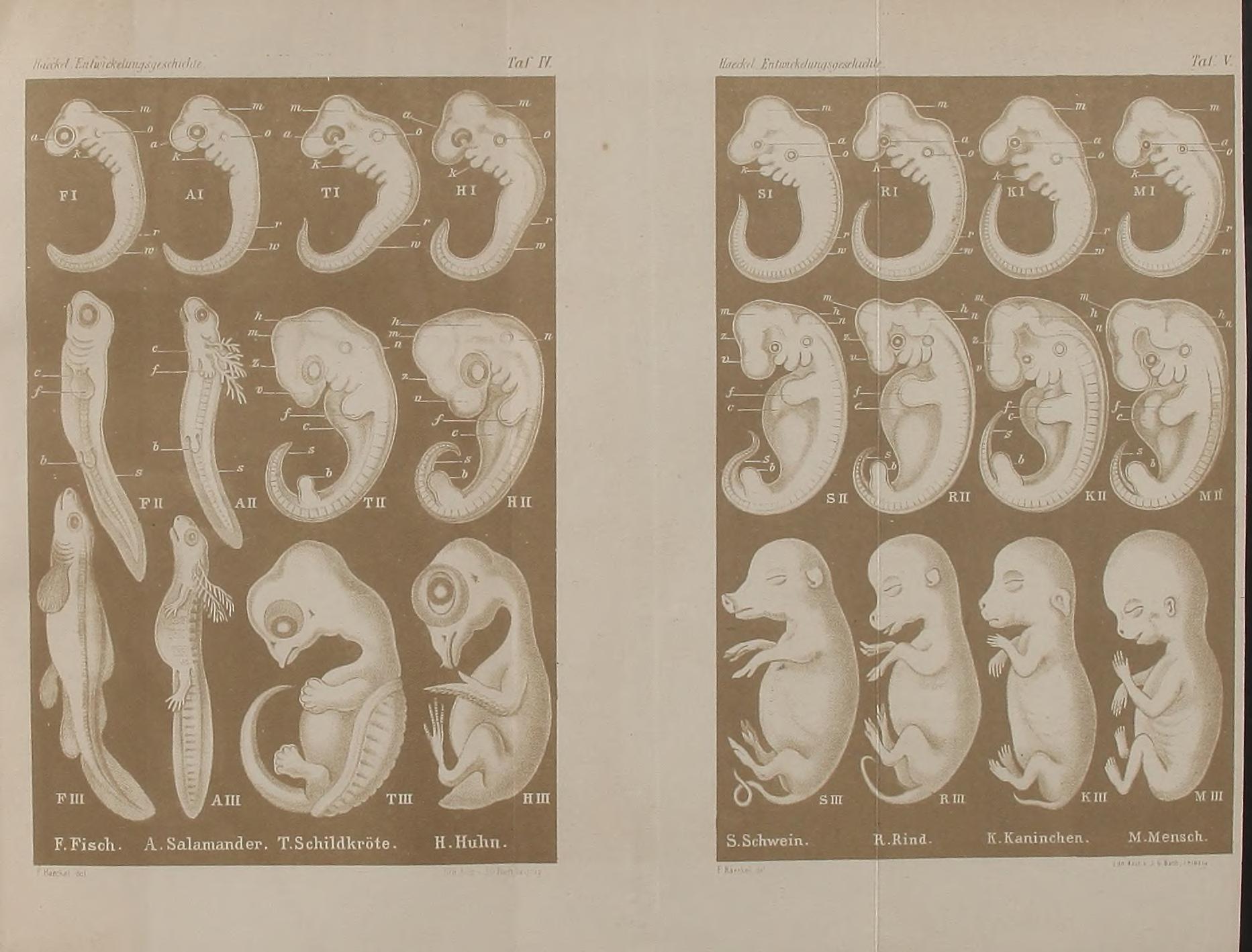
Haeckel's caption said what he had done. The amnion, yolk sac and allantois "sind weggelassen," are left out, and all are reduced "auf nahezu dieselbe Grösse," to nearly the same size, for better comparison. It did not call the figures schematic.13 The text claimed a great deal for the top row, where the head and gill arches are laid down but "die Gliedmaassen aber noch gänzlich fehlen," the limbs are still entirely absent. There, the embryos of all vertebrates from the fish up to man are "theilweise nur ganz unwesentlich, theilweise noch gar nicht verschieden": partly only quite insignificantly, partly not at all different.13
Anthropogenie went through six editions between 1874 and 1910.2 The grid grew with them, from 8 species to 20 by the fifth edition.14
Part 2: What he altered
Five kinds of change are documented. Each rests on a critic comparing Haeckel's figure with its source.
- One block for three species. The 1868 triple is not in dispute. Haeckel admitted it in 1891 as "an imprudent folly" due to lack of time, in Richardson and Keuck's translation.6 Hopwood renders the phrase "extremely rash foolishness."2 Richards, Haeckel's chief modern defender, agrees that he "egregiously erred."14
- Free copies. His compared the 1868 plate with its sources. The supposedly four-week-old dog was Bischoff's embryo of 25 days, and the human was Ecker's, given there with no age. They were "Copien in freier Behandlung," copies treated freely, and the liberties taken were "der Art, dass sie eben der gewünschten Identität zu statten kommen," of the kind that serves the desired identity. On the page, the dog's forehead region is 3½ mm longer than Bischoff's. The human's is 2 mm shorter than Ecker's and narrowed by moving the eye a full 5 mm, and its tail is doubled in length.15
- Invented figures. Of the 1874 plates His wrote: "Erfunden ist die Mehrzahl von den Figuren der Embryonentafeln IV u. V." Most of the figures are invented. His crude example was fish and amphibian embryos drawn with the brain flexure of turtle, chick and mammal embryos.15 His calls the amphibian a frog; Haeckel's caption says salamander.
- Deleted limb buds. This is the most specific charge. Richardson and Keuck compared Haeckel's young echidna embryo, in the fifth edition of 1903, with its source, Richard Semon's monograph of 1894: "he removed the limbs ... This cut was selective, applying only to the young stage. It was also systematic because he did it to other species in the picture."5 Haeckel defined his top row as the stage "ohne Beine," without legs.13 The deletion made the embryos fit the definition.
- Species mixed or duplicated. Haeckel's 1891 "alligator" embryos "are in fact a mixture of Alligator and Crocodylus species." Richardson and Keuck suspect that his top-left fish and salamander both derive from one drawing of a blenny by Rathke: "this would be another example of a single picture being duplicated by Haeckel to represent different species."6
Richardson and Keuck also report what was accurate. "We believe that many of the drawings in the bottom two rows of the Anthropogenie set (i.e. the later stages) have been copied entirely accurately. The same is not always true of the earlier stages, which often appear to have been modified to increase similarity among species."6 The changes sit where the theory needed them.
Part 3: The charges, and what "censured at Jena" means
No body at Jena ever ruled on the drawings, as far as any source found here shows. The critics were scientists at other universities, writing in print.
Rütimeyer, 1868. Ludwig Rütimeyer of Basel reviewed the book the year it appeared. He expected that a researcher would not "willkürlich modelliren oder generalisiren," arbitrarily model or generalise, his originals for speculative purposes, as had demonstrably happened with the plate at page 240. The page-248 triple, "ein und derselbe ... Holzschnitt dreimal nebeneinander und unter drei verschiedenen Titeln," one woodcut shown three times side by side under three titles, could only be called "Spieltreiben mit dem Publicum und mit der Wissenschaft," playing games with the public and with science.12 He protested that Haeckel's text did not call the figures rough schemata, but told readers they would "nicht im Stande sein, einen Unterschied wahrzunehmen," not be able to see a difference.12 This was a two-page review in Archiv für Anthropologie, not a proceeding.
His, 1874. Wilhelm His, the Leipzig anatomist, gave one letter of his book Unsere Körperform to Haeckel. Haeckel had "drei Cliches desselben Holzstockes unter drei verschiedenen Titeln aufgetischt," served up three prints of one block under three titles. Instead of withdrawing them he had "schwere Schmähungen auf Prof. Rütimeyer gehäuft," heaped heavy abuse on Rütimeyer, in the prefaces of later editions.15 His's conclusion was a personal verdict: "Es bleibt das Verfahren von Prof. Häckel ein leichtfertiges Spiel mit Thatsachen," a frivolous game with facts. By his manner of fighting, Haeckel had "selbst auf das Recht verzichtet, im Kreise ernsthafter Forscher als Ebenbürtiger mitzuzählen": he had himself forfeited the right to count as an equal among serious researchers.15
Brass and Keibel, 1908 to 1909. The later storm was over different pictures: embryo plates in Haeckel's Das Menschenproblem (1907).6 The zoologist Arnold Brass said in a Berlin lecture on 10 April 1908 that Haeckel "has had the misfortune to put a human head on an ape embryo, and vice versa."7 Pressed, he named "two cases of misrepresentation": the embryos of a gibbon and of a human.7 The embryologist Franz Keibel reviewed the same plates in 1909. Some figures were schematised copies; others were "figments of the imagination." Yet Keibel agreed "that embryonic resemblance provides evidence for evolution."6
Haeckel's statement. Haeckel answered in the Berlin Volks-Zeitung. The Jesuit authors J. Assmuth and Ernest Hull translated it in 1915: "the contrite confession that a small fraction of my numerous drawings of embryos (perhaps 6 or 8 per cent.) are really, in Dr. Brass's sense, falsified—all those, namely, for which the present material of observation is so incomplete or insufficient as to compel us ... to fill up the gaps by hypotheses". He would feel "condemned and annihilated," he said, were it not for the "hundreds of fellow-culprits" beside him, "many of the most trusted observers and most esteemed biologists."7 In 1910 he dated the statement 24 December 1908, though Assmuth and Hull give 29 December. He said it now seemed unsatisfactory to him and that he had regretted it. He called its "reumütige Geständnis," contrite confession, ironic, and said many hasty readers had taken it seriously.8 Whatever tone he meant, it concedes unlabelled reconstruction, not copying one block for three animals.
The declarations, and the tribunal that never met. In 1909, 46 professors signed a declaration in the Münchener Allgemeine Zeitung. They did "not approve of the method of schematising which Haeckel has in some instances made use of," and condemned "in the sharpest manner the warfare waged against Haeckel by Brass and the Kepler-Bund."7 A counter-declaration gathered 37 names, from 19 institutions, "including Haeckel's own university, Jena."7 Assmuth and Hull mention a tribunal only to deny it: the 46 had "suspected—though wrongly—" that one "was in process of formation among the Kepler-Bund."7 Their verdict that Haeckel "has been convicted of 'shameless frauds and forgeries'" rests on those 83 signatures.7 Assmuth and Hull wrote a book to prove Haeckel a forger; had any court convicted him, they would have said so. Haeckel remained professor of zoology at Jena until he retired in 1909.16
Where the court story comes from. The earliest printed source found here is Michael Pitman's Adam and Evolution (1984): "Charged with fraud by five professors and convicted by a university court at Jena, he agreed that a small percentage of his embryonic drawings were forgeries".9 Richardson repeated the story in 1997 and later withdrew it. In 2002 he and Keuck wrote that his critiques had "perpetuated an old claim, apparently false, that Haeckel was convicted of fraud over the embryo drawings."6
Part 4: Richardson's re-check, and the argument over intent
The 1997 survey. Richardson and six colleagues photographed tailbud-stage embryos "from a wide range of vertebrate groups." They found variation "due to allometry, heterochrony, and differences in body plan and somite number," and "a greater than 10-fold variation in greatest length." The drawings "depict not a conserved stage for vertebrates, but a stylised amniote embryo."10 They are "highly inaccurate, exaggerating the similarities among embryos, while failing to show the differences."10 Haeckel left out groups that would have looked different, such as frogs, and "fails to give scientific names, stages or source of the specimens illustrated."10
The paper did not use the word fraud. The news story in Science did, quoting Richardson: "It looks like it's turning out to be one of the most famous fakes in biology."14 As Richards notes, "The authors, though, accused no one of fraud."14
Richards's defence, 2009. Robert Richards, a historian of science at the University of Chicago, calls the charge "logically mischievous, historically naive, and founded on highly misleading photography."14 His strongest evidence is Haeckel's own caption. Haeckel "explicitly indicated that he pictured his specimens without yolk, allantois, and amnion," and stated that he "reduced all of the images to the same size."14 A photograph at true size with the yolk sac attached does not test those two features fairly. Richards is right about that. Haeckel never claimed the embryos were the same size.
His defence has a gap. It cites Richardson and Keuck's 2002 review only for its abstract, and never mentions the limb-bud deletions they had published in 2001.14 Removing yolk sacs was disclosed and applied to every figure alike. Removing limb buds from the young stage only was neither disclosed nor neutral. Richardson and Keuck: "one could argue that such selective schematisation is no different from fraud."6
Hopwood's history. Nick Hopwood, a historian of science at Cambridge, wrote the full history of the pictures, Haeckel's Embryos (2015). His own summary: "compared with the standard practice of his day, Haeckel's drawing was unconventional, reckless even, but there was no intent to deceive and he had little interest in cheating. Even to give Haeckel a fair trial, however, we would have to consider how friend and foe negotiated what would count as fraud."2 He adds that "no German professor used Haeckel's drawings for decades."2
Gould, 2000. Stephen Jay Gould, no friend of creationism, was blunter. Haeckel "exaggerated the similarities by idealizations and omissions," the repeated figure was "fraudulent," and his drawings "never fooled expert embryologists, who recognized his fudgings right from the start."1
So the triple woodcut was dishonest by any standard, and was withdrawn at the next edition. The 1874 plates were idealised in one direction, with changes the caption did not disclose. Whether that was deception or reckless schematising is a judgement about Haeckel's mind, and the historians who have read the most disagree.
Part 5: How far the pictures travelled
The plate became a standard illustration by being copied. George Romanes printed it as Figs. 57 and 58 of Darwin, and after Darwin (1892), captioned "(After Häckel.)"17 Richardson and Keuck call that version "the commonest secondary source."6 Three later textbooks, checked here against the books themselves:
| Book | Edition | What it printed | Page |
|---|---|---|---|
| Alberts et al., Molecular Biology of the Cell | 3rd, 1994 | Haeckel's 1874 plate: "The early stages (above) are very similar"; "The earliest stages are drawn roughly to scale" | 3318 |
| Futuyma, Evolutionary Biology | 3rd, 1998 | Romanes's 1901 version, as "An illustration of von Baer's law" | 65319 |
| Raven and Johnson, Biology | 5th, 1999 | "Notice that the early embryonic stages of these vertebrates bear a striking resemblance to each other" | 118120 |
The Alberts caption is the worst case. It adds a claim Haeckel never made, that the early stages are "drawn roughly to scale." Its text later says "the scale and general form are much the same for a fish, a salamander, a chick, or a human."18 Haeckel had said he reduced them all to the same size.13 Richardson's team measured a tenfold range.
Richardson and Keuck found the grid in "numerous standard works" and "countless student texts" of the 1990s.6 Gould wrote in 2000: "we do, I think, have the right to be both astonished and ashamed by the century of mindless recycling that has led to the persistence of these drawings in a large number, if not a majority, of modern textbooks!"1
After 1997 the pictures went. Some texts first added disclaimers.6 Futuyma's Evolution (2005) replaced the drawings with Richardson's photographs, captioned "the similarities — and differences."11 The same book concedes that "Evolutionary biologists (not creationists) first revealed that Haeckel did 'improve' his drawings of embryos."11 Hopwood: "The diagrams were expunged from the textbooks."2 Textbooks printed after 2005 were not surveyed for this article.
Part 6: The creationist literature in its own words
Russell Grigg, Creation, 1996. Grigg writes that Haeckel "manufactured the 'evidence' by fraudulently changing the drawings of embryos by two other scientists." His summary of His's measurements, "3.5 mm" added to the dog's head and "2 mm" taken off the human's, with the tail doubled, matches His's page 170.16 Grigg quotes the 1908 confession from a Melbourne tract of 1911 and dates it to a letter of 9 January 1909, not to Haeckel's own date of 24 December 1908.16 He makes no court claim.
Jonathan Wells, Icons of Evolution, 2000. Wells writes that "biologists have known for over a century that Haeckel faked his drawings."21 He is careful with the word: "Whether or not Haeckel was guilty of fraud — that is, deliberate deception — there is no doubt that his drawings misrepresent vertebrate embryos."21 He makes no court claim either. His list of textbooks is accurate for the three checked in the table above.
Answers in Genesis and the Institute for Creation Research. Elizabeth Mitchell of Answers in Genesis grants that "Some see Haeckel's illustrations as blatant frauds, and others say he took artistic liberties to emphasize a point." Later in the same article she settles the question herself: "Haeckel knew they didn't when he made them."22 No document cited here shows what Haeckel knew. Randy Guliuzza of the Institute for Creation Research writes that the drawings "have been incorporated into nearly every major biology textbook ever since."23 Gould's estimate, "a large number, if not a majority," is the more careful one.
The court story. Jerry Bergman's review in the Creation Research Society Quarterly (2000) introduces "Cambridge University biologist Pitman" and quotes his "convicted by a university court at Jena" without comment.24 Wayne Jackson of Apologetics Press writes that Haeckel "was charged with fraud by five professors, and ultimately convicted in a university court. During the trial, Haeckel admitted that he had altered his drawings".25 Neither cites a court record. When Wikipedia said no verifiable source existed, Paul Price of Creation Ministries International (2020) called its wording "playing politics to whitewash over this fiasco" and replied: "Not so! He was forced to admit that he falsified the drawings in order to make his case."26 The admission is real. It is not a court record, and it admits less than Price says.
E. van Niekerk, Journal of Creation, 2011. This is the fullest creationist answer to Richards. Van Niekerk uses Richardson and Keuck's limb-bud evidence correctly, and concedes Richards's size point as "one of the only valid objections by Richards."27 He overstates twice. He says fraud "was ultimately shown to be the case," though no finding of intent exists.27 And he writes that the book "only went through five editions," so that the first three are "the majority"; Anthropogenie went through six.272
What they get right and wrong. The creationist authors are right about the inaccurate plates, the triple woodcut, the objections from 1868 on, and the textbooks. They overstate when they claim a conviction, when they call intent proven, and when they treat the fall of the plates as the fall of embryological evidence for common descent.
Part 7: Why the fraud does not settle the embryology
Haeckel's plates illustrated two claims, and Richardson's team separated them. "First, that differences between species typically become more apparent at late stages. Second, that vertebrate embryos are virtually identical at earlier stages. This first claim is clearly true. Our survey, however, does not support the second claim".10 The first claim is von Baer's, from 1828, three decades before Darwin's Origin.
Haeckel's contemporaries drew the same line. His, the harshest critic, wrote that the biogenetic law "niemals wörtlich verstanden werden darf," must never be taken literally, but that "ein gewisser Grad von Näherungswahrheit," a certain degree of approximate truth, usually belongs to it.15 Keibel agreed that embryonic resemblance "provides evidence for evolution."6 Wells grants the core fact: "vertebrate embryos become somewhat similar midway through development," and though Haeckel "greatly exaggerated the similarities at this stage, some similarities are there."21
The modern form of the claim uses no drawings. Naoki Irie and Shigeru Kuratani compared gene expression through development in the mouse, chicken, frog and zebrafish, and found that "the pharyngula stage is most conserved, whereas earlier and later stages are rather divergent."28 That result, its limits, and how common design and common descent each account for it are weighed in Embryonic Leftovers. The same article shows that recapitulation of adult ancestors, the idea Haeckel's plates were drawn to support, was abandoned by evolutionary biologists by 1940.
So the fraud argument proves less than it seems to. It shows that one famous piece of evidence was bad and was taught badly. It does not show that the pattern the picture exaggerated is absent.
Objections and responses
"A university court at Jena convicted Haeckel of fraud." No record of such a court has been found. The earliest source traced is Pitman in 1984.9 Assmuth and Hull, writing to prove Haeckel a forger, say the tribunal was "wrongly" suspected.7 Richardson, who repeated the story, withdrew it.6 The claim should be dropped.
"Haeckel confessed to fraud." He conceded that 6 or 8 per cent of his embryo drawings filled gaps by hypothesis without saying so, and later called the confession ironic.87 It is fair to quote it. It is not an admission of deliberate deception.
From the skeptic: "They were schematic diagrams, and Haeckel disclosed his method." The caption disclosed two things: membranes removed and sizes equalised.13 It did not disclose invented figures, duplicated species, or limb buds deleted from the young stage only. And the text said some top-row embryos were "noch gar nicht verschieden," not at all different, which is a claim about real animals.13
From the skeptic: "Richardson's photographs were unfair to Haeckel." Partly true: yolk sacs and true size were features Haeckel openly removed.14 But differences in somite number, body plan and limb buds do not depend on yolk or scale.10 The size point hurts Molecular Biology of the Cell, which called the early stages "drawn roughly to scale," more than it hurts Haeckel.18
From the skeptic: "This is old news." To specialists, yes. To students it was news for a century, in "a large number, if not a majority, of modern textbooks."1
"If textbooks relied on a fake for a century, embryology is no evidence for evolution." The fake was near-identity at the earliest stage. The later divergence and the measured mid-stage likeness stand without Haeckel, and a design account has to explain them.1028
Issues and unanswered questions
- Hopwood's book was not read. Haeckel's Embryos (2015) and his 2006 Isis article, the fullest histories, have no open or archive.org copy. His view is quoted from his own 2016 essay. JSTOR was not used.
- The 1908 statement is quoted in a hostile translation. The German text, in the Volks-Zeitung and in Heinrich Schmidt's 1909 collection Haeckels Embryonenbilder, was not found online. Brass's 1908 pamphlet and Keibel's 1909 review were not obtained either; Keibel is quoted in Richardson and Keuck's translation.
- The court story's origin before 1984 is not traced. The 1998 letters in Science in which Klaus Sander and Roland Bender took up the story, and Richardson clarified it, could not be downloaded.
- Intent cannot be settled from the documents found. Hopwood finds no intent to deceive. Richardson and Keuck say the selective deletions are hard to tell from fraud. Gould calls the repeated block fraudulent. This article reports that disagreement rather than resolving it.
- The textbook survey is partial. Five textbooks were checked against the books. Later editions and school texts were not.
- The young-earth case against Haeckel is strong only in its narrow form. The evidence it is often used to dismiss, a conserved mid-development stage within the vertebrates, still needs a design account, as the parent article sets out.
Verdict
Haeckel did three things wrong. In 1868 he printed one woodcut as three animals and told readers they could see no difference. In 1874 he drew the first row of his grid more alike than the embryos are, deleted limb buds, and gave no species names or sources. And he answered his critics with abuse, not with better figures. Whether he meant to deceive is disputed by serious historians, and no court or university ever ruled on it.
The textbooks did a fourth thing wrong. They reprinted the plate as data for about a century after the leading embryologists of Haeckel's own day had objected, and at least one added a size claim Haeckel had not made.
Neither wrong settles the embryology. Von Baer's observation that embryos of related animals resemble one another more than their adults do is real, and the mid-development likeness is now measured without drawings. Creationists should keep the Haeckel story, drop the court, and answer the data that replaced his pictures.
Sources
- 1.
Gould, Stephen Jay. “Abscheulich! (Atrocious).” I Have Landed: The End of a Beginning in Natural History. Harmony Books, New York. 2002. Copyright. Chapter 22, first published in Natural History, March 2000, pp. 42–49. A print-disabled archive.org item read through its search-inside service, not stored. Printed page equals leaf minus 18, anchored on the reader's page map at leaves 50 (p. 32), 323 (p. 305) and 400 (p. 382), and on the essay's running heads (leaf 325, p. 307).
- 1a.
Page 310: “To cut to the quick of this drama: Haeckel exaggerated the similarities by idealizations and omissions. He also, in some cases—in a procedure that can only be called fraudulent—simply copied the same figure over and over again. At certain stages in early development, vertebrate embryos do look more alike, at least in gross anatomical features easily observed with human eyes, than do the adult tortoises, chickens, cows, and humans that will develop from them. But these early embryos also differ far more substantially, one from the other, than Haeckel's figures show. Moreover, Haeckel's drawings never fooled expert embryologists, who recognized his fudgings right from the start.” ↩ ↩
- 1b.
Page 311: “We should therefore not be surprised that Haeckel's drawings entered nineteenth-century textbooks. But we do, I think, have the right to be both astonished and ashamed by the century of mindless recycling that has led to the persistence of these drawings in a large number, if not a majority, of modern textbooks!” ↩ ↩ ↩
- 1a.
- 2.
Hopwood, Nick. “Copying Pictures, Evidencing Evolution.” The Public Domain Review. May 18, 2016. Text licensed CC BY-SA 4.0. Saved to the source library; cited by paragraph. Hopwood is Reader in History of Science and Medicine at Cambridge and the author of Haeckel's Embryos: Images, Evolution, and Fraud (University of Chicago Press, 2015), which was not obtained.
- 2a.
Paragraph 2: “The more embryological Anthropogenie managed six editions between 1874 and 1910 and was twice Englished as The Evolution of Man.” ↩ ↩
- 2b.
Paragraph 4, beginning The Schöpfungsgeschichte had not been out a year: “Infamously, Haeckel had had single woodblocks printed three times to represent the embryos of a mammal, a bird, and a reptile. He corrected this sharp practice in the second edition and eventually admitted his "extremely rash foolishness". More debatable are the plates, on which he was charged with skewing the evidence by drawing the embryos more similar than they really are.” ↩
- 2c.
Paragraph beginning The controversies generated by the forgery charges: “I can answer: compared with the standard practice of his day, Haeckel's drawing was unconventional, reckless even, but there was no intent to deceive and he had little interest in cheating. Even to give Haeckel a fair trial, however, we would have to consider how friend and foe negotiated what would count as fraud.” ↩ ↩
- 2d.
Paragraph beginning Yet an image does not become iconic: “But there are significant absences: no German professor used Haeckel's drawings for decades and some of his staunchest defenders played safe by assembling their own embryo groups instead.” ↩
- 2e.
Paragraph beginning Haeckel's diagrams still became standard textbook illustrations: “in 1997 one accused him of fraud — in ignorance of the long history of forgery charges. Many biologists now rejected the pictures, and the neo-creationist advocates of so-called intelligent design forced some publishers to take them out.” Paragraph containing This set the scene for the latest round of forgery charges: “The diagrams were expunged from the textbooks, but creationists did not want to remove all trace.” ↩
- 2a.
- 3.
Haeckel, Ernst. Natürliche Schöpfungsgeschichte. Gemeinverständliche wissenschaftliche Vorträge über die Entwickelungslehre. Georg Reimer, Berlin. 1st edition. 1868. Public domain. Boston Public Library scan. The Fraktur text layer is unusable, so pages were read from the page images, with folios from the printed page heads: page/n267 is p. 242 and n273 is p. 248. Page 248 is saved beside this article as sources/haeckel-1868-natuerliche-schoepfungsgeschichte-p248.jpg. Translations for this article.
- 3a.
Page 248: “Fig. 9. Embryo des Hundes. Fig. 10. Embryo des Huhns. Fig. 11. Embryo der Schildkröte. Alle drei Embryonen sind genau aus demselben Entwickelungsstadium genommen, in dem soeben die fünf Hirnblasen angelegt sind.” Translation: Fig. 9. Embryo of the dog. Fig. 10. Embryo of the chicken. Fig. 11. Embryo of the turtle. All three embryos are taken from exactly the same stage of development, in which the five brain vesicles have just been laid down. The three figures are visibly one block printed three times. ↩ ↩
- 3b.
Page 242: “Das Ei des Menschen … Das Ei des Affen … Das Ei des Hundes … Alle drei Eier sind hundertmal vergrößert.” Figs. 5 to 7. Translation: The egg of man, of the ape, of the dog. All three eggs are magnified a hundred times. ↩
- 3c.
Page 245: “In diesem Stadium der Entwickelung, in der ersten Anlage des Keims oder Embryo, sind nicht allein alle Säugethiere mit Inbegriff des Menschen, sondern sogar alle Wirbelthiere überhaupt, alle Säugethiere, Vögel, Reptilien, Amphibien und Fische, entweder gar nicht oder nur durch ihre Größe, oder durch höchst unbedeutende Merkmale in Form und äußerem Umriß von einander zu unterscheiden.” Translation: At this stage of development, in the first rudiment of the germ or embryo, not only all mammals including man but even all vertebrates whatever, all mammals, birds, reptiles, amphibians and fishes, can be told apart either not at all, or only by their size, or by quite insignificant features of form and outline. ↩
- 3a.
- 4.
Haeckel, Ernst. Natürliche Schöpfungsgeschichte. Georg Reimer, Berlin. 2nd edition. 1870. Public domain. Bayerische Staatsbibliothek scan, read from the page images n311 (p. 270) and n312 (p. 271). Page 271 is saved beside this article as sources/haeckel-1870-natuerliche-schoepfungsgeschichte-p271.jpg.
- 4a.
Page 271: “Fig. 7. Embryon eines Säugethieres oder Vogels, in dem soeben die fünf Hirnblasen angelegt sind.” Page 270: “Denn die Embryen der verschiedenen Schädelthiere (mindestens der drei höheren Klassen, der Reptilien, Vögel und Säugethiere) sind in dem, Fig. 7 dargestellten Stadium noch gar nicht zu unterscheiden.” Translation: Fig. 7. Embryo of a mammal or bird, in which the five brain vesicles have just been laid down. For the embryos of the various craniates (at least of the three higher classes, the reptiles, birds and mammals) cannot yet be told apart at all at the stage shown in Fig. 7. ↩ ↩
- 4a.
- 5.
Richardson, Michael K., and Gerhard Keuck. “A question of intent: when is a 'schematic' illustration a fraud?” Nature 410:144. Mar 8, 2001. Copyright. A letter to Nature. The author's copy of the printed page, through the Wayback Machine, in the source library; its two columns interleave with a neighbouring letter in the text layer and were read by column. Mirror: Archive.org
- 5a.
Page 144: “When we compare his drawing of a young echidna embryo with the original, we find that he removed the limbs (see Fig. 1). This cut was selective, applying only to the young stage. It was also systematic because he did it to other species in the picture. Its intent is to make the young embryos look more alike than they do in real life.” The drawing is in the fifth edition of Anthropogenie (1903), plate XI; the original is Semon 1894. ↩ ↩
- 5a.
- 6.
Richardson, Michael K., and Gerhard Keuck. “Haeckel's ABC of evolution and development.” Biological Reviews 77(4):495–528. 2002. Copyright. The authors' PDF, through the Wayback Machine, in the source library. PDF page n is printed page 494 + n, checked on the printed folios. The translations of Haeckel, His and Keibel quoted here are the authors'. Mirror: Archive.org
- 6a.
Page 515: “The most widely reproduced of Haeckel's embryo drawings are the set in the first edition of Anthropogenie (Haeckel, 1874 a). … numerous standard works (e.g. Alberts et al., 1994; Collins, 1995; Gilbert, 1997) and in countless student texts … The version in Darwin and After Darwin (Romanes, 1892) is the commonest secondary source”. ↩ ↩
- 6b.
Page 516: “acknowledged the truth of this 'story of the three woodcuttings' saying that it was 'an imprudent folly' due to lack of time”. Of Haeckel's Apologetisches Schlußwort of 1891. ↩
- 6c.
Page 516: “The second and third stages are figments of the imagination, in which embryos of Tarsius and Semnopithecus have been used to a greater or lesser extent”. Page 517: “While Keibel supports Haeckel's practice of filling in gaps in the embryonic series by speculation, he criticises him for not making it clearer to the reader that he was presenting hypothetical forms. Even in popular works, says Keibel, this is 'unscientific'. Nonetheless he agrees with Haeckel to the extent that embryonic resemblance provides evidence for evolution.” Keibel 1909, on plates II and III of Das Menschenproblem, in Richardson and Keuck's translation and summary. ↩ ↩
- 6d.
Page 518: “Several textbooks added disclaimers to their use of Haeckel's figures (e.g. Guttman, 1999; Pennisi, 1997).” ↩
- 6e.
Page 519: “They overlooked the extent of previous criticisms made against the drawings, and also perpetuated an old claim, apparently false, that Haeckel was convicted of fraud over the embryo drawings (Richardson, 1997, 1998; Sander and Bender, 1998). Clarifications were issued when the historical facts became clearer (Richardson, 1998, 2000 a).” Of Richardson's own earlier critiques. ↩ ↩ ↩
- 6f.
Page 519: “We believe that many of the drawings in the bottom two rows of the Anthropogenie set (i.e. the later stages) have been copied entirely accurately. The same is not always true of the earlier stages, which often appear to have been modified to increase similarity among species.” ↩ ↩
- 6g.
Page 519: “this would be another example of a single picture being duplicated by Haeckel to represent different species. … Thus we find that his 'alligator' embryos (Haeckel, 1891: plate 6, Figs KI–III) are in fact a mixture of Alligator and Crocodylus species”. The first sentence concerns Rathke's drawing of a blenny as a possible source for the top-left two embryos of the 1874 set. ↩
- 6h.
Page 519: “Similar charges, of mixing species, were made by Braß (1909) in relation to drawings in Haeckel's (1907) Menschen-Problem.” ↩
- 6i.
Page 519: “The schematisation defence is not easy to reconcile with the observation that limb buds were removed by Haeckel from some early embryos (Richardson and Keuck, 2001). Indeed, one could argue that such selective schematisation is no different from fraud.” ↩
- 6a.
- 7.
Assmuth, J., and Ernest R. Hull. Haeckel's Frauds and Forgeries. Examiner Press, Bombay. 1915. Public domain. Both authors were Jesuits; Assmuth was professor of biology at St Xavier's College, Bombay. A hostile source, used here for the documents it translates and for what it does not claim. Archive.org text in the source library; folios print at the head of each page, checked on the page image of p. 14.
- 7a.
Page 12: “Likewise some of the resemblances of embryos, as maintained by Haeckel, are based on erroneous views; and Haeckel himself has had the misfortune to put a human head on an ape embryo, and vice versa.” Brass's Berlin lecture of 10 April 1908, as reported in the press. ↩
- 7b.
Page 13: “pointed out specifically two cases of misrepresentation perpetrated by Haeckel: the embryos of a Gibbon and of man in Haeckel's Problem of Man”. Brass's reply of 25 April 1908. The text layer reads Hacckel's. ↩
- 7c.
Page 14: “So nothing remained but to make an open confession, which he published in the Berliner Volkszeitung of December 29th, 1908.” Pages 14–15: “the contrite confession that a small fraction of my numerous drawings of embryos (perhaps 6 or 8 per cent.) are really, in Dr. Brass's sense, falsified—all those, namely, for which the present material of observation is so incomplete or insufficient as to compel us, when we come to prepare a continuous chain of the evolutive stages, to fill up the gaps by hypotheses, and to reconstruct the missing-links by comparative synthesis”. Page 15: “I should be obliged to consider myself "condemned and annihilated," if I had not the consolation of seeing side-by-side with me in the prisoner's dock hundreds of fellow-culprits, among them many of the most trusted observers and most esteemed biologists.” Assmuth and Hull's translation. The first line of the confession is garbled in the text layer and was read from the page image of p. 14. ↩ ↩ ↩
- 7d.
Page 19: “This joint declaration was published in the Münchener Allgemeine Zeitung, No. 8, 1909 … "The undersigned professors, directors of laboratories, etc., herewith declare that they do not approve of the method of schematising which Haeckel has in some instances made use of. At the same time, in the interests of science and professional freedom, they condemn in the sharpest manner the warfare waged against Haeckel by Brass and the Kepler-Bund.” Page 20: “They declare moreover that the evolutionist idea can suffer no detriment from a few inaccurately produced embryo-diagrams."” The text layer reads Minchener and embryo-diagrains. ↩
- 7e.
Page 20: “they secured the signatures of twenty-six specialists in various branches of biology, and of eleven other prominent men—representing altogether nineteen universities, botanical laboratories, etc., in Germany, Switzerland and Austria, including Haeckel's own university, Jena—thirty-seven names in all.” ↩
- 7f.
Page 22: “no tribunal in the world has any right to censure him." Such a tribunal "the forty-six" suspected—though wrongly—was in process of formation among the Kepler-Bund.” The first clause is Assmuth and Hull's report of the 46's motive, in their informant's words. ↩ ↩ ↩
- 7g.
Page 23: “the methods of Haeckel, in the instances which had been exposed, were condemned by 46 plus 37—that is, by eighty-three men of good position in various branches of science and learning, besides others who published their comdemnations apart. Thus the outcome of the Brass-Haeckel controversy is an additional corroboration of the intrinsic evidence that Haeckel has been convicted of "shameless frauds and forgeries."” Comdemnations sic in the text layer. ↩
- 7a.
- 8.
Haeckel, Ernst. Sandalion. Eine offene Antwort auf die Fälschungs-Anklagen der Jesuiten. Neuer Frankfurter Verlag, Frankfurt am Main. 1910. Public domain. Archive.org text in the source library; the folio markers in the text layer head each page. Translations for this article.
- 8a.
Page 22: “am 24. Dezember 1908 unter obigem Titel in Nr. 607 der „Volkszeitung" … erscheint mir heute selbst unbefriedigend; ich habe sie nachträglich sehr bedauert. … Verhängnisvoll wurde mir besonders das ironische „Reumütige Geständnis" ( — Zeichnungen „gefälscht" zu haben! — ), das viele flüchtige Leser unbegreiflicherweise für ernst nahmen.” Translation: on 24 December 1908 under the above title in no. 607 of the Volkszeitung … today seems unsatisfactory even to me; I have since regretted it very much. … Particularly fateful for me was the ironic contrite confession (of having falsified drawings!), which many hasty readers incomprehensibly took seriously. The title was Fälschungen der Wissenschaft. ↩ ↩ ↩
- 8a.
- 9.
Pitman, Michael. Adam and Evolution. Rider, London. 1984. Copyright. A print-disabled archive.org item read through its search-inside service, not stored. Leaf 122 is p. 120 on the reader's page map, an offset of 2 that also holds at leaves 20 (p. 18) and 250 (p. 248); Bergman 2000 cites the same page.
- 9a.
Page 120: “To support his case he began to fake evidence. Charged with fraud by five professors and convicted by a university court at Jena, he agreed that a small percentage of his embryonic drawings were forgeries; he was merely filling in and reconstructing the missing links when the evidence was thin”. ↩ ↩ ↩
- 9a.
- 10.
Richardson, M. K. et al. “There is no highly conserved embryonic stage in the vertebrates: implications for current theories of evolution and development.” Anatomy and Embryology 196(2):91–106. 1997. Copyright. The publisher's PDF from the author's site, through the Wayback Machine, in the source library. Pages from the printed folios. Mirror: Archive.org
- 10a.
Page 91: “We present here the first review of the external morphology of tailbud embryos, illustrated with original specimens from a wide range of vertebrate groups. We find that embryos at the tailbud stage – thought to correspond to a conserved stage – show variations in form due to allometry, heterochrony, and differences in body plan and somite number. These variations foreshadow important differences in adult body form. Contrary to recent claims that all vertebrate embryos pass through a stage when they are the same size, we find a greater than 10-fold variation in greatest length at the tailbud stage. Our survey seriously undermines the credibility of Haeckel's drawings, which depict not a conserved stage for vertebrates, but a stylised amniote embryo.” ↩ ↩ ↩
- 10b.
Page 92: “His drawings are also highly inaccurate, exaggerating the similarities among embryos, while failing to show the differences”. ↩
- 10c.
Page 104: “Haeckel inexplicably omitted these species from his figures. It is hard to believe that he could not have obtained embryos of a common anuran such as Rana temporaria. Furthermore he fails to give scientific names, stages or source of the specimens illustrated.” ↩
- 10d.
Page 105: “This idea is implicit in Haeckel's drawings, which have been used to substantiate two quite distinct claims. First, that differences between species typically become more apparent at late stages. Second, that vertebrate embryos are virtually identical at earlier stages. This first claim is clearly true. Our survey, however, does not support the second claim”. ↩ ↩ ↩
- 10a.
- 11.
Futuyma, Douglas J. Evolution. Sinauer, Sunderland, Mass. 2005. Copyright. A print-disabled archive.org item read through its search-inside service, not stored. Leaf 76 is p. 56 and leaf 555 is p. 535 on the reader's page map, matching the index entry for Haeckel at p. 56.
- 11a.
Page 56: “Figure 3.11 Micrographs show the similarities — and differences — among several vertebrate embryos at different stages of development. Each begins with a similar basic structure, although they acquire this structure at different stages and sizes. As the embryos develop, they become less and less alike. (Adapted from Richardson et al. 1998; photo courtesy of M. Richardson.)” ↩ ↩
- 11b.
Page 535: “Evolutionary biologists (not creationists) first revealed that Haeckel did "improve" his drawings of embryos. But the various vertebrate embryos really do share profoundly important similarities (such as the notochord and pharyngeal pouches, often misnamed "gill slits") and really are more similar, overall, than the animals are later in development.” ↩
- 11a.
- 12.
Rütimeyer, Ludwig. “E. Haeckel, Natürliche Schöpfungsgeschichte.” Archiv für Anthropologie 3:301–302. 1868. Public domain. A book review in the Referate section. Read from the page image with printed folio 302 (page/n309), saved beside this article as sources/rutimeyer-1868-review-haeckel-p302.jpg; the transcription was checked against that image. Rütimeyer taught at Basel. Translations for this article.
- 12a.
Page 302: “wohl aber durfte man erwarten, dass ein Forscher, der sehr genau weiss, dass auf keinem Gebiete Zeichnungen, zumal wenn so weittragende Schlüsse darauf gebaut werden sollen, grössere Scrupulosität und Gewissenhaftigkeit erheischen, als auf diesem, seine Vorlagen nicht zu speculativen Zwecken willkürlich modelliren oder generalisiren werde, wie dies bei Vergleichung der Embryos zu Pag. 240 mit den zu Grunde gelegten Zeichnungen aus Bischoff (Hund, vierte Woche), Ecker (Mensch, vierte Woche), Agassiz (Schildkröte) etc. nachweisslichermassen geschehen ist. Vollends aber kann das auf Seite 248 angewendete Verfahren, wo ein und derselbe, überdies unrichtig interpretirte Holzschnitt dreimal nebeneinander und unter drei verschiedenen Titeln, als Embryo des Hundes, des Huhnes, der Schildkröte dem Leser vorgeführt wird, nicht anders genannt werden als Spieltreiben mit dem Publicum und mit der Wissenschaft.” Translation: one might well have expected that a researcher who knows very well that in no field do drawings demand greater scrupulousness and conscientiousness than in this one, especially when such far-reaching conclusions are to be built on them, would not arbitrarily model or generalise his originals for speculative purposes, as has demonstrably happened with the embryos at p. 240 when compared with the drawings they are based on, from Bischoff (dog, fourth week), Ecker (man, fourth week), Agassiz (turtle) etc. But the procedure used on page 248, where one and the same woodcut, wrongly interpreted besides, is shown to the reader three times side by side under three different titles, as embryo of the dog, of the chicken, of the turtle, can only be called playing games with the public and with science. ↩ ↩
- 12b.
Page 302: “im Text Pag. 249 dann überdies nicht etwa diese Zeichnungen als rohe Schemata bezeichnet, sondern hinzufügt: „Wenn Sie die jungen Embryonen des Hundes, des Huhnes und der Schildkröte in Figur 9, 10, 11 vergleichen, so werden Sie nicht im Stande sein, einen Unterschied wahrzunehmen,"”. Rütimeyer quoting Haeckel 1868 p. 249. Translation: then in the text on p. 249 does not call these drawings rough schemata, but adds: If you compare the young embryos of the dog, the chicken and the turtle in figures 9, 10, 11, you will not be able to see a difference. ↩
- 12a.
- 13.
Haeckel, Ernst. Anthropogenie oder Entwickelungsgeschichte des Menschen. Gemeinverständliche wissenschaftliche Vorträge. Wilhelm Engelmann, Leipzig. 1st edition. 1874. Public domain. Thomas Fisher Rare Book Library, Toronto, scan. Pages from the folio lines in the text layer, checked on the page image of p. 260. The fold-out of plates IV and V (page/n282) is saved beside this article as sources/haeckel-1874-anthropogenie-plates-iv-v.jpg. Translations for this article.
- 13a.
Page 256: “Die erste (oberste) Querreihe, I., stellt ein sehr frühes Stadium dar, mit Kiemenspalten, ohne Beine. … Die Hüllen und Anhänge des Embryo-Körpers (Amnion, Dottersack, Allantois) sind weggelassen. Sämmtliche 24 Figuren sind schwach vergrössert, die oberen stärker, die unteren schwächer. Zur besseren Vergleichung sind alle auf nahezu dieselbe Grösse in der Zeichnung reducirt.” Erklärung von Tafel IV und V, between pp. 256 and 257. Translation: The first (top) row, I., shows a very early stage, with gill slits, without legs. The membranes and appendages of the embryo body (amnion, yolk sac, allantois) are left out. All 24 figures are slightly enlarged, the upper ones more, the lower ones less. For better comparison all are reduced to nearly the same size in the drawing. The columns are a bony fish, a fire salamander, a turtle, a chick, a pig, a cow, a rabbit and a human. ↩ ↩ ↩ ↩
- 13b.
Page 255: “In dem ersten Stadium (in der ersten Querreihe oben, I.), in welchem zwar der Kopf mit den fünf Hirnblasen und den Kiemenbogen schon deutlich angelegt ist, die Gliedmaassen aber noch gänzlich fehlen, sind die Embryonen aller Wirbelthiere vom Fische bis zum Menschen hinauf theilweise nur ganz unwesentlich, theilweise noch gar nicht verschieden.” Translation: In the first stage (the top row, I.), in which the head with the five brain vesicles and the gill arches is already clearly laid down but the limbs are still entirely absent, the embryos of all vertebrates from the fish up to man are partly only quite insignificantly, partly not at all different. ↩ ↩
- 13a.
- 14.
Richards, Robert J. “Haeckel's embryos: fraud not proven.” Biology and Philosophy 24:147–154. 2009. Copyright. The author's PDF, in the source library; pages from the printed folios. Richards is a historian of science at the University of Chicago. Mirror: Home.uchicago.edu
- 14a.
Page 147: “It looks like it's turning out to be one of the most famous fakes in biology”. Richardson, as quoted in E. Pennisi, Haeckel's embryos: fraud rediscovered, Science 277:1435 (1997), which could not be downloaded; quoted here from Richards. ↩
- 14b.
Page 148: “The historical and biological evidence, however, shows the charge against Haeckel to be logically mischievous, historically naive, and founded on highly misleading photography.” ↩
- 14c.
Page 148: “Though Richardson never retracted this judgment, he seems to have moderated his view in a subsequent article (see Richardson and Keuck 2003).” Footnote 1. Richards dates the Biological Reviews article 2003; it is volume 77, 2002. The paper nowhere mentions limb buds or Richardson and Keuck 2001. ↩
- 14d.
Page 149: “The authors, though, accused no one of fraud. That charge was made in the Science article, and then only against Haeckel.” ↩
- 14e.
Pages 149–150: “Haeckel, however, quite explicitly stated in the caption to his illustration that he reduced all of the images to the same size to facilitate structural comparisons (Haeckel 1874, p. 256).” Page 150: “Haeckel explicitly indicated that he pictured his specimens without yolk, allantois, and amnion (Haeckel 1874, p. 256).” ↩ ↩
- 14f.
Page 150: “the illustration in question expanded the comparison from 8 species of embryo to 20 by the 5th edition (1905).” The fifth edition's title page, and Richardson and Keuck, date it 1903. ↩
- 14g.
Page 153: “In the first edition (1868) of his wildly popular Natürliche Schöpfungsgeschichte (Natural history of creation), he used the same wood cut three times to represent the initial formation of embryos of dog, chicken, and turtle. … He nonetheless recognized that he egregiously erred and immediately corrected the text in the next edition two years later.” ↩
- 14a.
- 15.
His, Wilhelm. Unsere Körperform und das physiologische Problem ihrer Entstehung. Briefe an einen befreundeten Naturforscher. F. C. W. Vogel, Leipzig. 1874. Public domain. Letter 14, Das biogenetische Grundgesetz, pp. 168–171. Pages from the running heads in the text layer. Page 170 was also read from the page image (page/n187), which gives the 3½ mm that the text layer garbles. His was professor of anatomy at Leipzig. Translations for this article.
- 15a.
Page 169: “Es hat uns mit anderen Worten Häckel je drei Cliches desselben Holzstockes unter drei verschiedenen Titeln aufgetischt! … Statt dessen hat Häckel in der Vorrede seiner spätern Auflagen schwere Schmähungen auf Prof. Rütimeyer gehäuft”. Translation: In other words, Häckel has served up to us three prints each of the same woodblock under three different titles! … Instead, Häckel in the preface of his later editions heaped heavy abuse on Prof. Rütimeyer. ↩
- 15b.
Page 170: “Allein es sind Copien in freier Behandlung, und zwar sind die genommenen Freiheiten der Art, dass sie eben der gewünschten Identität zu statten kommen. Oder ist es ein Versehen des Lithographen, dass beim Häckel'schen Hundeembryo gerade der Stirntheil des Kopfes um 3½ Mm. länger gerathen ist, als bei Bischoff, beim Menschenembryo aber gegen Ecker der Stirntheil um 2 Mm. verkürzt, und zugleich durch Vorrücken des Auges um volle 5 Mm. verschmälert ist, und dass dafür der Schwanz des letzteren zur doppelten seiner originalen Länge sich emporschwingt?” The same page identifies the sources as Bischoff's plate XI, 42 B, a dog embryo of 25 days, and Ecker's Icones physiologicae plate XXX, 2, given there without an age. Translation: But they are copies treated freely, and the liberties taken are of the kind that serve the desired identity. Or is it an oversight of the lithographer that in Häckel's dog embryo the forehead part of the head has come out 3½ mm longer than in Bischoff, but in the human embryo the forehead part is shortened by 2 mm against Ecker and at the same time narrowed by moving the eye forward a full 5 mm, and that the tail of the latter soars up to double its original length? ↩
- 15c.
Page 170: “Erfunden ist die Mehrzahl von den Figuren der Embryonentafeln IV u. V, auf denen, um nur ein grobes Beispiel zu citiren, Fisch- und Froschembryonen ebenso unbefangen eine Scheitelkrümmung des Gehirns zur Schau tragen, wie die Embryonen der Schildkröte, des Huhnes und der Säugethiere.” Translation: Invented are the majority of the figures on embryo plates IV and V, on which, to cite only one crude example, fish and frog embryos display a cranial flexure of the brain as unconcernedly as the embryos of the turtle, the chick and the mammals. ↩
- 15d.
Page 171: “Es bleibt das Verfahren von Prof. Häckel ein leichtfertiges Spiel mit Thatsachen, gefährlicher noch als das früher gerügte Spiel mit Worten. … selbst auf das Recht verzichtet, im Kreise ernsthafter Forscher als Ebenbürtiger mitzuzählen”. Translation: Professor Häckel's procedure remains a frivolous game with facts, more dangerous still than the game with words criticised earlier. … himself forfeited the right to be counted as an equal among serious researchers. ↩
- 15e.
Page 171: “dass derselbe niemals wörtlich verstanden werden darf, dass ihm indess ein gewisser Grad von Näherungswahrheit zuzukommen pflegt”. Of the biogenetic law. Translation: that it must never be understood literally, but that a certain degree of approximate truth usually belongs to it. ↩
- 15a.
- 16.
Grigg, Russell M. “Ernst Haeckel: evangelist for evolution and apostle of deceit.” Creation 18(2):33–36. Mar 1996. Copyright. Creation Ministries International web copy, saved to the source library; cited by section heading.
- 16a.
Section opening biography: “was professor of zoology at Jena from 1865 until his retirement in 1909”. ↩
- 16b.
Section The Infamous 'Fish Stage' in Human Embryos: “Never one to let lack of evidence stand in his way, Haeckel manufactured the 'evidence' by fraudulently changing the drawings of embryos by two other scientists. … Prof. Wilhelm His showed in 1874 that Haeckel had added 3.5 mm to the head of Bischoff's dog embryo, taken 2 mm off the head of Ecker's human embryo, doubled the length of the human posterior, and substantially altered the details of the human eye.” ↩
- 16c.
Section Haeckel's Confession of Fraud: Grigg quotes the confession as a letter to the Münchener Allgemeine Zeitung of 9 January 1909, "possibly 6 or 8 in a hundred", and sources it in his note 17 to "The Truth about Haeckel's Confession", The Bible Investigator and Inquirer, Melbourne, 11 March 1911. ↩
- 16a.
- 17.
Romanes, George John. Darwin, and after Darwin. An Exposition of the Darwinian Theory and a Discussion of Post-Darwinian Questions. Volume 1: The Darwinian Theory. Longmans, Green and Co., London. 1892. Public domain. Archive.org text in the source library. Pages from the List of Illustrations and the running head 154 that follows the captions.
- 17a.
Page 152: “FIG. 57. — A series of embryos at three comparable and progressive stages of development (marked I, II, III), representing each of the classes of vertebrated animals below the Mammalia. (After Häckel.)” Page 153: “Another series of embryos, also at three comparable and progressive stages of development (marked I, II, III), representing four different divisions of the class Mammalia. (After Häckel.)” Figs. 57 and 58. The text layer reads Hackel for Häckel. ↩
- 17a.
- 18.
Alberts, Bruce et al. Molecular Biology of the Cell. Garland, New York. 3rd edition. 1994. Copyright. A print-disabled archive.org item read through its search-inside service, not stored. Printed page equals leaf minus 48, anchored at leaf 92 (p. 44) and leaf 1097 (p. 1049); p. 33 also matches Richardson et al. 1997's citation of this figure.
- 18a.
Page 33: “Figure 1-36 Comparison of the embryonic development of a fish, an amphibian, a reptile, a bird, and a selection of mammals. The early stages (above) are very similar; the later stages (below) are more divergent. The earliest stages are drawn roughly to scale; the later stages are not. (From E. Haeckel, Anthropogenie, oder Entwickelungsgeschichte des Menschen. Leipzig: Engelmann, 1874. Courtesy of the Bodleian Library, Oxford.)” ↩ ↩
- 18b.
Page 1049: “the scale and general form are much the same for a fish, a salamander, a chick, or a human (see Figure 1-36).” ↩
- 18a.
- 19.
Futuyma, Douglas J. Evolutionary Biology. Sinauer, Sunderland, Mass. 3rd edition. 1998. Copyright. A print-disabled archive.org item read through its search-inside service, not stored. Printed page equals leaf minus 22, anchored on the reader's page map (leaf 675 is p. 653) and on the index entries Hadley cells, 60 and Haldane's rule, 460.
- 19a.
Page 653: “FIGURE 23.1 An illustration of von Baer's law: three stages in the development of several vertebrates. All the vertebrate classes share many common features early in development; many distinguishing features of the classes and orders appear later. (From Romanes 1901.)” ↩
- 19a.
- 20.
Raven, Peter H., and George B. Johnson. Biology. WCB/McGraw-Hill, Boston. 5th edition. 1999. Copyright. A print-disabled archive.org item read through its search-inside service, not stored. Printed page equals leaf minus 34, anchored on the index entry Haeckel, Ernst, 76, 1180 at leaves 110 and 1214. The caption was read; the drawing itself was not seen.
- 20a.
Page 1181: “Embryonic development of vertebrates. Notice that the early embryonic stages of these vertebrates bear a striking resemblance to each other, even though the individuals are from different classes (fish, amphibians, reptiles, birds, and mammals).” ↩
- 20a.
- 21.
Wells, Jonathan. Icons of Evolution: Science or Myth? Regnery, Washington. 2000. Copyright. A print-disabled archive.org item read through its search-inside service, not stored. Chapter 5, Haeckel's Embryos. Printed page equals leaf minus 18, anchored on the book's index entries phylotypic stage, 98, 100 at leaves 116 and 118, and Haeckel, Ernst: biogenetic law of, 87-90 at leaves 105 to 108.
- 21a.
Page 82: “Yet biologists have known for over a century that Haeckel faked his drawings; vertebrate embryos never look as similar as he made them out to be.” ↩
- 21b.
Page 91: “Whether or not Haeckel was guilty of fraud — that is, deliberate deception — there is no doubt that his drawings misrepresent vertebrate embryos.” ↩
- 21c.
Page 98: “Surprisingly, after developing quite differently in their early stages, vertebrate embryos become somewhat similar midway through development. It is this midway point that Haeckel chose as the "first" stage for his drawings. Although he greatly exaggerated the similarities at this stage, some similarities are there.” ↩
- 21a.
- 22.
Mitchell, Elizabeth. “Recapitulation Theory: How Embryology Does Not Prove Evolution.” Answers in Genesis. Sep 5, 2020. Copyright. Republished from The New Answers Book 4, Master Books, 2013. Saved to the source library; cited by section heading.
- 22a.
Section Seen and Unseen: “Some see Haeckel's illustrations as blatant frauds, and others say he took artistic liberties to emphasize a point.” Section Phylogeny and the Return of Haeckel: “Haeckel's diagrams do not represent observable embryologic reality, and Haeckel knew they didn't when he made them. And he intended them — doctored though they were — to be data in support of his evolutionary ideas.” ↩
- 22a.
- 23.
Guliuzza, Randy J. “Major Evolutionary Blunders: Haeckel's Embryos Born of Evolutionary Imagination.” Acts & Facts, Institute for Creation Research. Oct 31, 2016. Copyright. Saved to the source library.
- 23a.
Paragraph 1: “Remarkably, Science notes that some embryologists of Haeckel's day had doubts about the drawing's accuracy, and his peers actually got him to admit he used "artistic license." Yet these drawings (or similar reproductions) have been incorporated into nearly every major biology textbook ever since.” ↩
- 23a.
- 24.
Bergman, Jerry. “The Rise and Fall of Haeckel's Biogenetic Law.” Creation Research Society Quarterly 37(2):110–122. Sep 2000. Copyright. PDF saved to the source library; page from the printed folio in the page head.
- 24a.
Page 113: “Cambridge University biologist Pitman even claimed that after Haeckel formulated his 'fundamental biogenetic law' in 1868 he … Charged with fraud by five professors and convicted by a university court at Jena, he agreed that a small percentage of his embryonic drawings were forgeries”. PDF page 4, folio 113. ↩
- 24a.
- 25.
Jackson, Wayne. “Frauds in Science.” Apologetics Press. Dec 23, 2009. Copyright. Web copy saved to the source library.
- 25a.
Section Haeckel paragraph: “Haeckel was exposed by professor L. Rutimeyer of Basle University. He was charged with fraud by five professors, and ultimately convicted in a university court. During the trial, Haeckel admitted that he had altered his drawings”. ↩
- 25a.
- 26.
Price, Paul. “Exploring the 'Evidence for Evolution' … in 1970.” Creation Ministries International. Sep 16, 2020. Copyright. Updated 6 October 2020. Saved to the source library.
- 26a.
Section embryonic recapitulation: “Shockingly, however, modern sources are still playing politics to whitewash over this fiasco. … Not so! He was forced to admit that he falsified the drawings in order to make his case.” Price is answering Wikipedia, which he quotes: "While it has been widely claimed that Haeckel was charged with fraud by five professors and convicted by a university court at Jena, there does not appear to be an independently verifiable source for this claim." ↩
- 26a.
- 27.
van Niekerk, E. “Countering revisionism—part 1: Ernst Haeckel, fraud is proven.” Journal of Creation 25(3):89–95. 2011. Copyright. Creation Ministries International web copy, posted 2013, saved to the source library; cited by section heading.
- 27a.
Section Introduction: “fellow scientists felt it was at best a misrepresentation of reality, at worst deceptive and fraudulent. (The latter was ultimately shown to be the case.)” ↩
- 27b.
Section Issues with editions of Anthropogenie: “Richards fails to mention that the original sketches are found even in the 3rd edition! Seeing the fact that the book only went through five editions, it represents the majority of them.” ↩
- 27c.
Section Issue with sizes of embryos: “Haeckel did indeed mention, in brackets in the explanatory descriptions of the plates of Anthropogenie, that he reduced all the embryo illustrations to the same size for comparison. So, this may be one of the only valid objections by Richards.” ↩
- 27a.
- 28.
Irie, Naoki, and Shigeru Kuratani. “Comparative transcriptome analysis reveals vertebrate phylotypic period during organogenesis.” Nature Communications 2:248. 2011. CC BY-NC-SA 3.0. Read from PubMed Central for the parent article, Embryonic Leftovers. Corrected in 2014. Mirror: PMC
- 28a.
Section Abstract: “Here we perform a quantitative comparative transcriptome analysis of several model vertebrate embryos and show that the pharyngula stage is most conserved, whereas earlier and later stages are rather divergent.” The editor's summary names the species: the pharyngula stage is conserved between mice, chickens, frogs and zebrafish. ↩ ↩
- 28a.