Summary
About half of Jewish men in first-century Palestine were called by about a dozen names. Simon and Joseph alone covered roughly one man in six. Diaspora Jews used a different set: in Egypt, Cyrenaica and Rome the common names were Shabtai, Dositheus, Aurelius and Alexander.
The personal names in the Gospels and Acts match the Palestinian pattern, not the diaspora one. There are 8 Simons, 6 Josephs, 5 Judases, 5 Johns and 5 Jameses among 79 named men. Richard Bauckham published this in 2006 and argued that a fabricator, especially one writing outside Palestine, could not have produced it.1
Since 2023 the claim has been in a live statistical fight in the journals, and this article takes both sides seriously. Its conclusions:
- The pattern is real. Our own re-analysis puts the odds against "names picked with no knowledge of Palestinian usage" at roughly 1036 to 1, and the Gospel names fail to fit the diaspora distribution at p = 4.29 × 10⁻¹³.
- The critics' one piece of positive counter-evidence does not survive. Kamil Gregor and Brian Blais argue the Gospels contain too few rare names, at a probability of 1.1%. That 1.1% is a product of one smoothing constant in their model. Change it to another standard choice that solves the same problem and the number becomes 21% — an ordinary fluctuation.
- The argument proves less than apologists usually claim. A sample of 79 names cannot tell a genuine Palestinian sample from an inventor with a slightly hazy sense of which names were common. And on the critics' own data, their corpus of apocryphal texts fits the Palestinian distribution about as well as the Gospels do.
- The famous "41.5% versus 40.3%" pair is arithmetically wrong. Bauckham divided by the wrong number. The corrected figures are 46.7% and 40.5%.
What the names establish is that the Gospel writers were not making names up out of nothing, and that they were not doing it from Alexandria or Rome. What they do not establish is that every named character is historical. Bauckham's own defenders say so.2
The Argument
Where the data comes from
Tal Ilan's Lexicon of Jewish Names in Late Antiquity, Part I: Palestine 330 BCE–200 CE (Mohr Siebeck, 2002) catalogues every Jew named in a Palestinian source from that period. Its sources are Josephus, the New Testament, the Judean Desert and Masada texts, Jerusalem ossuary inscriptions, and the earliest rabbinic writings. Ilan describes it as "both an onomasticon and a prosopography… In this respect it bears the character of a modern telephone book."1
Ilan counts 2,826 securely identified people bearing names.1 Bauckham re-tabulates her catalogue on his own judgment of which entries are statistically valid and reports "2953 occurrences of 521 names, comprising 2625 occurrences of 447 male names and 328 occurrences of 74 female names."1 He counts occurrences of a name rather than people, so a man with a Hebrew and a Greek name counts under both.
The top of Ilan's list and the top of Bauckham's differ only because of his stricter filter:1
| Rank | Bauckham | Ilan | ||
|---|---|---|---|---|
| 1 | Simon | 243 | Simon | 257 |
| 2 | Joseph | 218 | Joseph | 231 |
| 3 | Eleazar | 166 | Judah | 179 |
| 4 | Judah | 164 | Eleazar | 177 |
| 5 | Yohanan | 122 | Yohanan | 128 |
| 6 | Joshua | 99 | Joshua | 103 |
Six of the nine commonest male names belong to the Maccabean family — Mattathias and his sons John, Simon, Judas, Eleazar and Jonathan. Bauckham reads this as patriotism.1
The comparison
Bauckham's Table 8 lists 79 occurrences of 45 Palestinian Jewish male names in the Gospels and Acts, and Table 9 lists 18 occurrences of 13 female names.1 Set the two distributions side by side and they track each other.
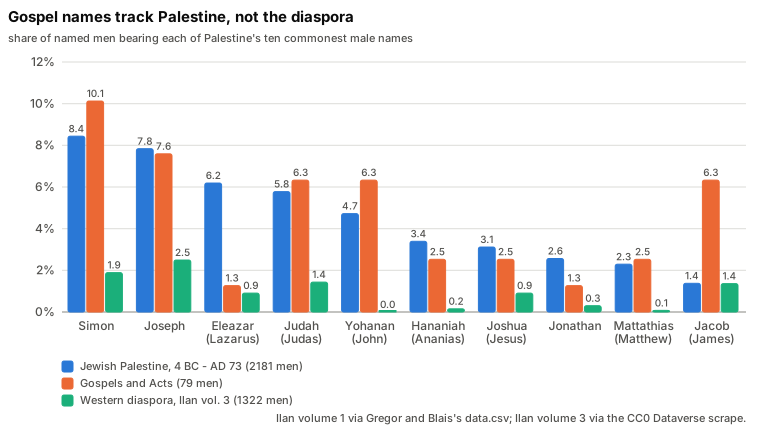
The bars use a dataset neither Bauckham nor his critics dispute: Gregor and Blais's own extraction of Ilan for the window 4 BC – AD 73, which holds 2,181 men bearing 454 names.3 Palestine's ten commonest names cover 45.7% of Palestinian men and 46.8% of the men named in the Gospels and Acts. In the western diaspora the same ten names cover 9.5%.
| Name (New Testament form) | Jewish Palestine | Gospels + Acts | Western diaspora |
|---|---|---|---|
| Simon | 8.4% (184) | 10.1% (8) | 1.9% (25) |
| Joseph | 7.8% (171) | 7.6% (6) | 2.5% (33) |
| Eleazar / Lazarus | 6.2% (135) | 1.3% (1) | 0.9% (12) |
| Judah / Judas | 5.8% (126) | 6.3% (5) | 1.4% (19) |
| Yohanan / John | 4.7% (103) | 6.3% (5) | 0.0% (0) |
| Hananiah / Ananias | 3.4% (74) | 2.5% (2) | 0.2% (2) |
| Joshua / Jesus | 3.1% (68) | 2.5% (2) | 0.9% (12) |
| Jonathan | 2.6% (56) | 1.3% (1) | 0.3% (4) |
| Mattathias / Matthew | 2.3% (50) | 2.5% (2) | 0.1% (1) |
| Jacob / James | 1.4% (30) | 6.3% (5) | 1.4% (18) |
Two rows do not fit. Eleazar, the third commonest name in Palestine, appears once in the whole New Testament — Lazarus of Bethany. Jacob/James is far commoner in the Gospels than in Palestine. Both are discussed below; neither side ignores them.
The heart of the claim
Bauckham's own restatement, added in the 2017 second edition after critics accused him of a simpler argument, is the version to hold him to:
"What the evidence shows is that there were quite a small number of extremely popular and a very large number of much less common names, many of them attested only once or twice. The names of Palestinian Jews in the Gospels and Acts span this range… To a quite remarkable extent, in view of the small number of names in the Gospels and Acts compared with the very large number in the whole database, the relative frequency of names in the Gospels and Acts corresponds to that in the other sources."1
And the reason he thinks a forger could not do it:
"while contemporaries would realise that some names were common and others rare, they are unlikely to have known, even with the degree of accuracy our database of three thousand individuals can give us, the relative proportions of name usage. They would not necessarily know that John was more popular than Jesus or Joseph than Judas. In any society, such things are only known by gathering and analysing. There was no Jerusalem Times that at the end of the year listed the most popular names given to babies that year."1
He also stresses that no single author is responsible for the result. Four writers each produced part of the list; the frequency match only appears when all four are added together.1
The Diaspora Contrast
This is the strongest leg of the argument, and it is easy to check.
Bauckham used W. Horbury and D. Noy's Jewish Inscriptions of Graeco-Roman Egypt — a thin base of only 45 male name occurrences.1 Ilan's third volume, covering the western diaspora, is much larger. Its commonest male names are Shabtai 155, Aurelius 101, Simon 92, Dositheus 81, Alexander 62.4 Only Simon is shared with Palestine's top ten. Restricted to the same window the Gospels occupy, the diaspora list runs Shabtai 56, Dositheus 37, Joseph 33, Alexander 26, Ptolemaius 26, Simon 25.5
Bauckham notes the asymmetry runs both ways: "Male names such as Jairus, Nathanael, Malchus, and Nicodemus, and female names such as Susanna and Elizabeth are all attested, though infrequently, in the database of Palestinian Jewish names, but not attested at all in the Diaspora. Conversely, some of the most popular names in the Jewish Diaspora, such as Isaac, Samuel, Shabbetai, Dositheus, Sarah, and Julia, do not appear at all in the Gospels."1
When Jason Wilson and Luuk van de Weghe put this through a formal test, the Gospels-Acts sample fits Palestine at p = 0.8556 and fails the western diaspora at p = 4.29 × 10-13.2 That is the largest effect size anywhere in this literature.
Peter Williams draws the practical conclusion: "someone living in another part of the Roman Empire would not simply be able to think of Jewish names familiar to him and put them into a story, resulting in a plausible group of names for Palestinian Jews."6
Note what this does and does not show. It bears on where the names were chosen, not on whether they were chosen. A Palestinian fiction writer is not excluded by it.
Peter Williams and the Disambiguation Pattern
Peter Williams, principal of Tyndale House, Cambridge, added a second observation that does not depend on counting frequencies.6
When half a population shares a dozen names, a bare name does not identify anyone. Real speech therefore attaches qualifiers — a father's name, a home town, a trade, a nickname — and it attaches them to the common names, not the rare ones. Williams' rule: "disambiguators are used with the most common names and not with the less common ones."6
His clearest demonstration is Matthew's list of the twelve apostles, annotated with Bauckham's frequency ranks:
"The names of the twelve apostles are these: first, Simon [1], who is called Peter, and Andrew [>99] his brother; James [11] the son of Zebedee, and John [5] his brother; Philip [61=] and Bartholomew [50=]; Thomas [>99] and Matthew [9] the tax collector; James [11] the son of Alphaeus, and Thaddaeus [39=]; Simon [1] the Zealot, and Judas [4] Iscariot, who betrayed him."6
Every name in the top eleven carries a qualifier. Thaddaeus, Bartholomew, Philip and Thomas — ranked 39th or lower — carry none. Williams concludes: "So not only are the names authentically Palestinian, but the disambiguation patterns are such as would be necessary in Palestine, but not elsewhere."6
His own contribution is sharper still: narrators use bare names, characters inside the story do not. A narrator can write "John," because the reader knows which John. A person speaking inside first-century Palestine could not. In Matthew 14 John the Baptist is named five times — three times by the narrator as plain "John," twice by characters as "John the Baptist." Williams: "If Herod had really heard about Jesus and said to his courtiers, 'This is John,' their reply would naturally have been 'Which John?'"6
Williams is honest about the exceptions. The criminal on the cross says only "Jesus, remember me" (Luke 23:42), and the man born blind says only "The man called Jesus" (John 9:11). His explanations for both are plausible but unfalsifiable, and a skeptic is entitled to say so.
No published critique of Williams' disambiguation argument exists. That means it is untested, not that it is proved.
What Bauckham Did Not Do
Three concessions belong here, before any objection is answered.
He ran no statistical test. Gregor and Blais: "on the one hand, Bauckham makes very strong claims about what his data demonstrate, but on the other hand, he performs virtually no statistical analysis. Most importantly, he does not formally investigate the statistical significance of his findings, which is indispensable because of the relatively very small sample size of the Gospels-Acts names."7 This is simply correct. Peter Williams was equally frank in 2018: "I am not here claiming a formal statistical correlation."6
His summary percentages are wrong. Bauckham prints that 41.5% of Palestinian men bore one of the nine commonest male names against 40.3% in the Gospels and Acts.1 That pair is quoted in a thousand apologetics presentations. Recomputing it from his own Table 6 shows what happened: the nine commonest names cover 1,227 men, and 1,227 ÷ 2,625 is 46.7%, not 41.5%. He divided by 2,953 — the male and female total — and called the result a percentage of men. The same wrong denominator reproduces all three of his male figures to two decimal places:
| Figure | Bauckham prints | ÷ 2,953 | ÷ 2,625 (correct) |
|---|---|---|---|
| Men with one of the 2 commonest names | 15.6% | 15.61% | 17.56% |
| Men with one of the 9 commonest names | 41.5% | 41.55% | 46.74% |
| Men with a name attested only once | 7.9% | 7.92% | 8.91% |
Gregor and Blais caught the first figure and van de Weghe the second, but neither published the cause.7 8 The corrected comparison is 46.7% against 40.5%. With 79 names the standard error on the Gospel figure is 5.6 points, so a 6.2-point gap is about one standard error — the match still holds, but it is not the near-identity the popular retellings claim.
Correcting the female denominator moves the other way and helps him. Bauckham thought his women's data matched poorly and blamed the small sample.1 On his own Table 7 the population figure for the two commonest female names is 39.0% against the Gospels' 38.9% — the tightest single number in the dataset. His apology was unnecessary.
His tables cannot be reproduced. Gregor and Blais: "Despite our best efforts, we were unable to replicate Bauckham's tables of name popularity from Ilan's original data."7 His Table 6 credits four occurrences of the name Eros to the Gospels and Acts. There is no Eros in the Gospels or Acts. Michael Strickland caught it in 2014 and it survives in the 2017 edition.9 None of this touches the substance — later workers rebuilt the data from scratch and got the same qualitative result — but it means the specific percentages in circulation come from tables their author could not reproduce.
The Objections
Since 2023 four journal articles have gone back and forth. The critics are Kamil Gregor, a classicist at Charles University in Prague, and Brian Blais, a statistician at Bryant University. The defenders are Luuk van de Weghe, an independent scholar with a doctorate from Aberdeen, and Jason Wilson, a statistician at Biola University.
"The sample in dispute is only 53 names, and that is too small"
This is Gregor and Blais's central move and their best one. Nobody thinks Herod the Great was invented. Strip out every Gospel figure independently attested — six in Paul's undisputed letters, twelve more in Josephus, eight more granted from the fragments of Papias — and Bauckham's 79 occurrences shrink to "a sample of only 53 Gospels-Acts name occurrences in contention of being invented, consisting of 32 names. Twenty-four of these names only appear once."7
Their verdict: "most of the Gospels-Acts data is entirely uninformative and cannot support Bauckham's thesis. It is statistically indistinguishable from 'white noise' generated entirely randomly without any information about name popularity."7
Their reasoning is that for every single name, the range of counts you would expect from a genuine Palestinian sample of 53 overlaps the range you would expect from names drawn at random. That is arithmetically true. We checked it: at a sample size of 53, all 454 names overlap.
But it is true of any text. The overlap is a property of the sample size, not of the Gospels. Wilson and van de Weghe's reply is that a 53-name slice of Josephus would be declared "consistent with random invention" by the same method — "No one thinks Josephus' writings were 'not statistically significantly different' from anonymous community transmission — yet GB's methodology would conclude this if he had merely written less!"10 Our own re-analysis confirms this: at every sample size from 40 to 400, essentially every name's interval still overlaps. The diagnostic never touches the Gospel counts at all.
"Apocryphal gospels and the Talmud fit just as well"
This is the strongest objection, and it is aimed exactly where Bauckham left himself open. He admitted the argument had no control group: "Ideally it would be good to test my approach on a work of ancient literature that is both set in Jewish Palestine in the Second Temple period and is generally agreed to be fictional. Unfortunately, there does not seem to be such a work with sufficient names to serve this purpose."1
Gregor and Blais built one anyway, out of the Clementine Homilies, the Acts of Pilate, Solomon of Bosra's Book of the Bee, and the Babylonian Talmud. Their published finding: "name popularity distributions in these two corpora do not correspond to the distribution among first-century Palestinian Jews statistically significantly worse than the distribution in Gospels-Acts. Moreover, the two corpora paradoxically align better in some respects because they do not exhibit a disproportional representation of specific names observed in Gospels-Acts."11
Gregor put it as a challenge on video: show three unlabelled frequency charts — Gospels-Acts, Christian apocrypha, Babylonian Talmud — and pick out the historical one. "As you can see there is no detectable difference, because you just can't detect the presence of even a large number of fictional characters this way."12
Three answers, of decreasing force.
- On a proper goodness-of-fit test, the two fictional corpora fail and the Gospels pass. Wilson and van de Weghe report the apocryphal sample at p = .00004 and the Talmud sample at p = .00263, against .2749–.8556 for the Gospels on three different name lists.10
- The apocryphal corpus is carried by one late Syriac text. Wilson and van de Weghe argue that Gregor and Blais took 25–30 names out of the Book of the Bee that came from the canonical Gospels in the first place, while omitting that text's obviously invented Jewish-sounding names — Labbaeus, Bar Kubba, Addai, Aggai, Zabdon, Zakron, Thorus, Abrazon. They also concede the difficulty cuts both ways: "Distinguishing between historical characters, fictional characters with historical Jewish names, and allegedly historical Jewish characters with non-Jewish names becomes, to say the least, deeply problematic."10
- The Babylonian Talmud is not a narrative. It is "a multi-generational, redacted anthology of rabbinic debate and tradition," so it is a poor model of what a Gospel fabricator would produce.10
Answer 1 is the load-bearing one, and our own re-analysis does not reproduce it. Running the same chi-squared test against Gregor and Blais's own baseline, using the apocryphal counts in Blais's own spreadsheet, gives the apocryphal corpus p = 0.359 against the Gospels' 0.376. See the section below. The blind-chart challenge lands harder than the defenders admit.
"Ilan's data is skewed"
Everyone agrees on this; the question is how much it matters.
Ilan's Palestinian material is heavy on Jerusalem ossuaries and on Josephus, whose literary audience pushed him toward Greek names. Ilan herself writes that literary texts "record the lives of the more affluent and worldly," while the epigraphic record "documents a wider variety of people."2 Gregor and Blais's own resigned statement: "nothing can be done to compensate for systematic biases present in Ilan's data since their statistical properties are unknown. We are, therefore, forced to treat the data as if it were a truly random sample of all ancient Jewish names."10 Wilson and van de Weghe call the observation "correct" and "a valid observation," and reply by splitting Ilan into three source strata: the Gospel names fit ossuaries at p = .3093, other inscriptions and papyri at .5753, and literary sources at .2701.10
A second version of the objection is chronological. Ilan's window spans 530 years. Sylvie Honigman, reviewing the Lexicon in Scripta Classica Israelica, made the sharpest form of the point: some names in it "co-exist only in the Lexicon; they did not co-exist in real life."13 Both sides of the modern exchange now restrict the data to a window around the first century, which answers the objection for the current literature but not for Bauckham's own printed numbers. Our own check found the narrowing barely matters: over the top 25 names, Bauckham's 530-year table and Gregor and Blais's 77-year table correlate at Spearman 0.975.
"The lexicon contains the texts being tested"
If the Gospels are part of the reference distribution, comparing the Gospels to it is circular. This is a fair worry and it is measurable.
Of the 2,181 men in the standard 4 BC – AD 73 extract, 272 (12.5%) come from Josephus and 79 (3.6%) from the Gospels and Acts.3 Counted a different way, over all 3,975 volume-one entries in the complete public-domain scrape of Ilan, canonical New Testament citations supply 133 — 3.3% — against 506 from Josephus.5 So the Gospels are about one part in thirty of their own reference distribution, and Josephus is nearly four times the contaminant the New Testament is.
Strip both out and the fit survives. Removing every Josephus-derived and NT-derived individual leaves about 1,830 completely independent occurrences, mostly ossuaries, ostraca and Judean Desert documents, and the Gospel sample fits them slightly better than before (p rises from 0.383 to 0.423). Details below.
A different scholar's window gives a different order
Claude Cohen-Matlofsky, who built her own prosopography of Roman Palestine, rejects Ilan's 530-year window as too wide. "In terms of chronology, my window is 63 BCE to 138 CE." On her 549-name sample the order shifts: "in my results Yochanan (and variables) comes as the second most common name after Shimon; Yeshua(with Yaaqob) is the least common male name in my list. I also come up with many more variables of the name Shlomsion than Ilan does; therefore, in my chart, it is the most common female name before Maria (and variables)."14
Her male counts: Shim'on 43, Yehochanan 41, El'azar 37, Yehoseph 31, Yehudah 27, Yehonathan 13, Ya'aqob 10, Yehoshua' 10. Her female counts: Shlomsion 26 ahead of Miryam 24.
This is the honest counter-datum. It does not overturn the argument — Simon is still first, and the same handful of names still dominates — but it shows the exact rank order is a function of which scholar's judgment calls you adopt. Anyone quoting "Joseph was the second most popular name" as a hard fact should know that a specialist working from the same primary sources puts John there instead.
Tuckett: the argument needs a premise it does not have
The most damaging objection is the oldest, and it is not statistical. Christopher Tuckett, then at Oxford, reviewed the book in 2007:
"Bauckham's claim that it would be 'impossible to explain' the names in the Gospels as inventions from outside Palestine is based on the usage of actual names outside Palestine, but what would be needed for such a claim would be evidence of the knowledge and/or awareness, or rather lack of any awareness, of Palestinian names by those outside Palestine (rather than actual names used in the Diaspora), and such evidence by its very nature would be hard to find."15
The inference needs "diaspora fabricators did not know Palestinian name frequencies." The evidence offered is what names diaspora Jews gave their own children. Those are different propositions. Tuckett's other line is the memorable one: "One does not need to be a literary genius or, for that matter, an exact contemporary of the events concerned, to avoid giving names such as Wayne or Sharon to characters in a story set in nineteenth-century England or in modern-day Japan!"15
Bauckham's answer, added in 2017, is that he is not arguing from appropriateness but from proportions: "these scholars are attributing to me a simplistic argument that I would never have thought of advancing. Of course I am aware that fictional writers often choose contextually appropriate names."1 That answers the Wayne-and-Sharon line. It does not answer the premise problem. Nobody has produced positive evidence of diaspora ignorance.
Gregor and Blais press the gap with four routes by which a later writer could have absorbed Palestinian frequencies: the Maccabean names were famous through 1 Maccabees; Paul's letters already carry Jerusalem Christians' names; Mark's two name-clusters (the Twelve at Mark 3:16-19 and Jesus' brothers at Mark 6:3) supply a ready-made pool weighted about right; and Luke may have read Josephus. All four converge on precisely the names over-represented in the Gospels — Simon, Joseph, James, Jude, John — and on none of the Palestinian names the Gospels underuse, chiefly Eleazar.
That last point is elegant and it deserves a straight answer. The honest one is that the third and fourth routes are strong. A second-century writer with Mark and Josephus open in front of him has a sampled name pool already weighted roughly like the real population. What that hypothesis does not explain is the disambiguation pattern, which requires knowing not just the names but which of them needed qualifying.
Strickland: a second-century apocryphal gospel already passed
Michael Strickland tested the Protevangelium of James, which Bauckham himself dates to second-century Syria. "Of the 14 names appearing in PJ, all 14 are among Ilan's list of popular names… Even so, with only 1 uncommon name out of 14, this compares favorably to the 3 names in Mark's gospel which are not among the most popular names… Thus, the author of PJ could be said to be at least as talented as the author of Mark at finding believable names for his characters."9
Four of the Protevangelium's names — Joachim, Reuben, Judith, Samuel — belong to characters it invented outright, and all four are attested Palestinian Jewish names.
Bauckham's reply is that 14 names, each different, cannot test a distribution at all: "since the individuals in the Protevangelium of James all bear different names, there is no way, within the text, of distinguishing popular from unpopular names."1 That is technically right. Gregor and Blais's rejoinder is that a hypothetical canon with the Protevangelium substituted for Matthew would have almost the same name distribution as the real one — which shows how coarse the test is.
Carrier: the names look mythical
Richard Carrier, the best-known advocate of the view that Jesus never existed, argues the data refutes Bauckham: "the Gospels' peculiar failure to match real name frequencies among the people encountered is evidence their narratives are fabricated." His specific complaints are that there should be more Lazaruses and Matthews and fewer Jameses, and that "rare names (as a combined category) are attested over 500 times: so there should be over ten times more rare names than Jameses attested in the Gospels."16
The rare-names-versus-James point is real, and Gregor and Blais quantified it two years later. Most of the rest does not survive. Carrier says Ananias, Jonathan, Menahem and Annas are "mysteriously missing" from the Gospels; Ananias appears three times in Acts (5:1, 9:10, 23:2), Annas in Luke 3:2, John 18:13 and Acts 4:6, and Manaen in Acts 13:1. He says Jesus "never once meets anyone else named Jesus," which passes over Jesus Barabbas at Matthew 27:16-17 and Bar-Jesus at Acts 13:6. Engage Gregor and Blais on this; Carrier's version is the weakest of the serious ones.
The Defenders' Replies — Including What They Concede
Van de Weghe and Wilson ran the test Bauckham never ran: a chi-squared goodness-of-fit test with six equal-frequency bins, eighteen tests in total, judged against a Bonferroni-adjusted benchmark of 0.05 ÷ 18 = 0.0028.2
| Sample | vs Palestine (Ilan I) | vs western diaspora (Ilan III) |
|---|---|---|
| Gospels and Acts | 0.8556 | 4.29 × 10⁻¹³ |
| Josephus | 0.0655 | 2.20 × 10⁻¹⁶ |
| Ben Hur + The Spear (historical novels) | 6.52 × 10⁻¹⁵ | 2.20 × 10⁻¹⁶ |
| Occurrences Ilan marks fictitious | 2.20 × 10⁻¹⁶ | 2.20 × 10⁻¹⁶ |
| Names drawn at random | 1.69 × 10⁻¹⁵ | 4.81 × 10⁻⁵ |
Their summary: "Chi-squared goodness-of-fit testing establishes that name occurrences in the Gospels and Acts fit into their historical context at least as good as those in the works of Josephus."2
Three concessions in their own papers matter as much as the table.
Josephus fails their other test. They also tested name origin — how many names are Biblical, Semitic, Greek or Latin. There, Josephus does not fit Palestine at all (p = 1.09 × 10⁻¹²), and the Gospels only scrape past the benchmark at p = 0.0034, well below the ordinary 0.05 threshold. Their explanation of the Josephus failure is historical, not statistical: he writes for a Hellenized elite audience.2 And the Gospel figure is fragile: without the six Hellenists of Acts 6:5 it is .0587, and counting Cephas instead of Peter moves it to .3915 or .0159 depending on the same choice.2
They retracted one of their own published results. In 2024 they reported that Lew Wallace's novel Ben Hur fails the test at p = 9.071 × 10⁻⁶. In 2025 they wrote: "Van de Weghe and Wilson also incorrectly identified several names from Ben Hur due to orthographic variants, and contrary to their published claim (2024: 205), the revision of this data causes this fictional novel to pass the goodness of fit test (p-value .1113)."10 A novel passes.
The test does not work below about forty names. The Clementine Homilies, with 20 names, passes at p = .4139.10 Their rule is van de Weghe's: "Typically, you need around forty names to determine patterns that can be compared with data from prosopographies."8 By that rule John's Gospel, with about twenty names, cannot be tested on its own, and van de Weghe says elsewhere that Matthew shows the pattern only because of material taken over from Mark.
They also state plainly what the argument cannot show: "a mere statistical analysis could not prove that every name in GA is historical, and a statistical analysis is not needed to disprove this point. For our purpose, we suggest that the name statistics in GA support 'historicity' to the extent that they demonstrate a level of information retention typical of ancient Greco-Roman historiography versus ahistorical and novelistic samples."2
This Site's Own Analysis
Both sides published their data. Gregor and Blais released a spreadsheet of 2,181 individuals; van de Weghe and Wilson released their full working data into the public domain on Harvard Dataverse. Behind both sits Hayim Lapin's machine-readable edition of Ilan's lexicon, which every analysis in this debate ultimately draws on.3 5 17 18 So the arithmetic can be checked independently, and this site checked it. Every figure below comes from a script whose complete output is on file.
Start with what we could not shake.
Every published number of Gregor and Blais's reproduces
Their model is a Dirichlet-multinomial, which has an exact closed form. Computed that way, their reported probabilities come back to three decimal places: 8 or more Simons 0.0285 (they print 2.9%), 3 or more Jameses 0.0213 (2.1%), 6 or more Josephs 0.1257 (12.7%), more than one Eleazar 0.7691 (76.9%), four or fewer rare names 0.0111 (1.1%). Their arithmetic is clean and their data is auditable, which is more than can be said for Bauckham's tables.
But their headline diagnostic never looks at the Gospels
Their central claim is that no single name's expected range separates the historical model from random invention. Every one of the 454 names overlaps at a sample of 53 — true. But the calculation uses only the reference distribution and the sample size. The Gospel counts are never fed into it. Sweeping the sample size shows the overlap is a property of n: at n = 40, n = 53 and n = 79 all 454 names overlap; even at n = 272, the size of the Josephus sample, 446 of 454 still do.
A test that does use the data behaves completely differently. Simulating draws from a name list picked with no knowledge of popularity, a standard goodness-of-fit test catches it every time from a sample of twenty names upward. Almost all of that power lives in one place: 12.2% of real Palestinian men bear a name attested only once, against 57.9% of a randomly assembled list. Separating 12% from 58% takes very few draws.
What a 79-name sample can and cannot detect
That is the good news for the argument. Here is the bad news, and it is the honest core of this section.
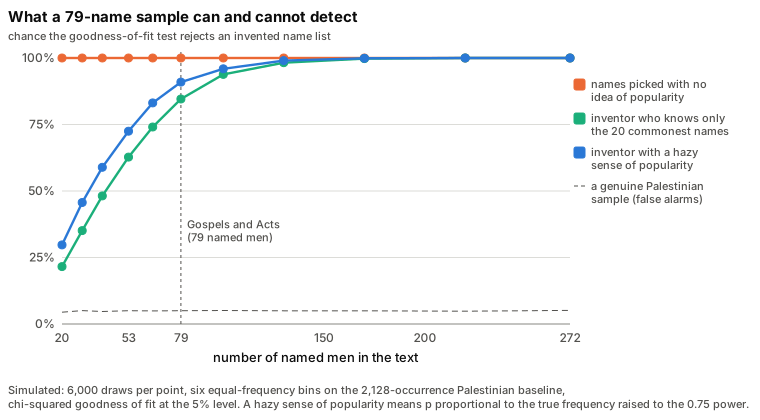
Three models of a fabricator were simulated against the real Palestinian distribution. At the Gospels' own sample size of 79 named men, a test catches names picked with no idea of popularity 100% of the time, catches an inventor who knows only the twenty commonest names 85% of the time, and catches an inventor with a hazy sense of popularity 91% of the time. Push the haziness closer to reality and the test goes blind:
| Fabricator's knowledge | share on the top 9 names | chance of being caught at n = 79 |
|---|---|---|
| none at all | 2.0% | 100% |
| very hazy | 12.4% | 100% |
| hazy | 25.8% | 90% |
| slightly hazy | 36.5% | 22% |
| exactly right | 44.3% | 5% (false alarms) |
| slightly exaggerated | 62.8% | 82% |
So the argument rules out a great deal — invention in ignorance, knowledge truncated to fewer than about twenty names, and any distribution that puts more than about 55% or less than about 26% of its weight on the top nine names. It cannot rule out a writer whose sense of Palestinian names was slightly off, or one who knew the top fifty to a hundred names in roughly the right proportions. That is exactly the space Gregor and Blais's "channels of exposure" hypothesis occupies, and no further statistics on this data will close it.
One thing the test does catch: a diaspora-shaped name list. Building a surrogate from Bauckham's own Egyptian figures — the same rank-frequency curve, different names on top — the test detects it 95% of the time at 53 names. Bauckham's diaspora contrast is not a small-sample illusion.
The rare-name result depends on one number in the model
Gregor and Blais's only positive statistical evidence against Bauckham is that the Gospels contain too few rare names: "there is a 95% probability that we draw between five and 17 occurrences of a rare name. However, the observed number of rare names in the sample of contested Gospels-Acts characters is only four (Aeneas, Agabus, Bartimaeus and Timaeus). The probability of so few rare names being present in Gospels-Acts on Bauckham's thesis is only 1.1%!"7
Three of those four names — Agabus, Bartimaeus, Timaeus — are attested nowhere in first-century Palestine except the Gospels themselves. Under the historical model they have probability exactly zero, which would make the calculation impossible. Gregor and Blais fix this by adding one artificial occurrence to every one of the 454 names. That is standard Laplace smoothing and it is not unreasonable in itself. But it adds 454 invented occurrences to a real baseline of 2,128 — a 21% inflation — and nearly all of it lands on the rare names, whose weight doubles. The share of the pool sitting on once-attested names jumps from 12.2% to 20.3%.
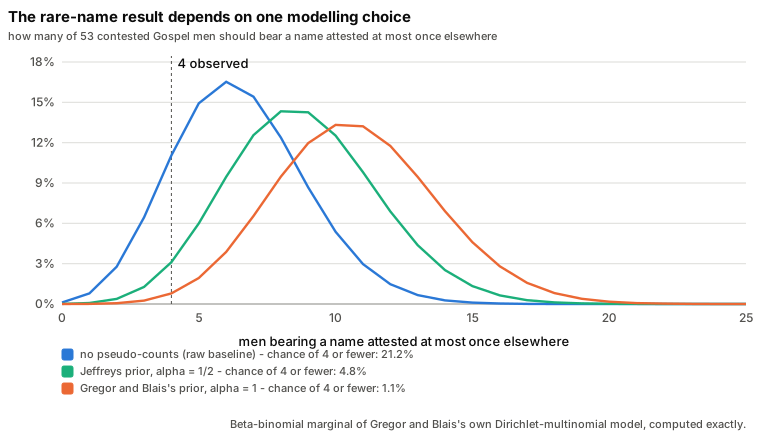
| Smoothing added | rare names expected | probability of 4 or fewer |
|---|---|---|
| none (raw baseline) | 6.5 | 21.2% |
| one occurrence in total, spread over all names | 6.5 | 21.0% |
| Jeffreys prior, half an occurrence per name | 8.8 | 4.9% |
| Gregor and Blais, one occurrence per name | 10.7 | 1.1% |
The published 1.1% is the bottom row. Take the pseudo-counts away and the same statistic gives 21%. Four observed against 6.5 expected is an ordinary fluctuation. And the zero-probability problem that motivated the smoothing is solved just as well by adding one occurrence spread across all 454 names, which moves the answer by 0.2 percentage points.
The same prior cuts the other way on Simon. It shrinks Simon's expected share, which makes 8 Simons look more surprising than they are. Their published 2.9% becomes 6.9% with no smoothing, and 34% on the full 79-name Gospel sample rather than the contested 53. Wilson and van de Weghe reached the same ballpark by hand.10
There is also a multiple-comparisons problem. Gregor and Blais report tail probabilities for four hand-picked names. Testing all 454 on their own model, exactly five names trip an ordinary 5% threshold — and one of them, Alphaeus, is more extreme than Simon and goes unreported. About 23 names would be expected to trip it by chance alone. Under any standard correction, nothing survives.
The circularity is real but small, and the argument survives without it
Ilan's lexicon is built partly from the texts under test. Stripping the contamination out:
| Reference distribution used | size | Gospels-Acts fit |
|---|---|---|
| all of Ilan, minus the 53 contested names | 2,128 | p = 0.345 |
| all of Ilan, minus all 79 Gospel names | 2,102 | p = 0.383 |
| minus all 79 Gospel names and all 272 from Josephus | 1,831 | p = 0.423 |
The last row is about 1,830 occurrences drawn almost entirely from ossuaries, ostraca and Judean Desert documents — evidence with no literary relationship to the Gospels at all. The Gospel names fit it, and fit it slightly better than they fit the contaminated version. Across the top five names the shares barely move: Simon 8.44% → 8.47%, Joseph 7.84% → 8.14%, Eleazar 6.19% → 6.50%.
The result that cuts against our own side
The cleanest single statistic in this debate asks how closely a text tracks real Palestinian frequencies, on a scale where 0 means the names were picked with no idea of popularity and 1 means they match Palestine exactly.
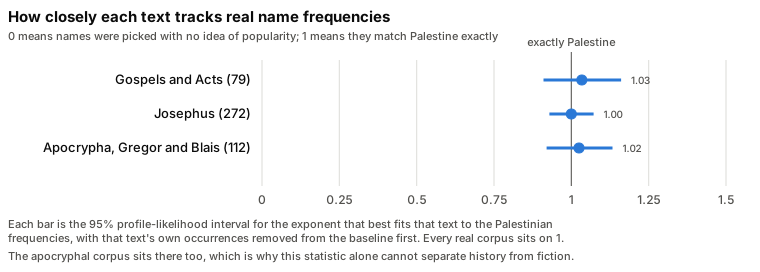
The Gospels and Acts land at 1.03, with a 95% interval of 0.91 to 1.16. Josephus lands at exactly 1.00. Both are enormous distances from 0. Gregor and Blais's complaint that the Gospel interval is wide is correct; their conclusion that the sample is indistinguishable from white noise is not. Measured as a Bayes factor, the Palestinian distribution beats invention-in-ignorance on the 53 contested names by odds of about 1036 to 1.
But Gregor and Blais's apocryphal corpus lands at 1.02, with an interval of 0.92 to 1.13. And on the chi-squared test, run against their own baseline with the apocryphal counts from Blais's own spreadsheet, that corpus scores p = 0.359 against the Gospels' 0.376. Its share of rare names is 12.5% against a 12.5% expectation — closer to the mark than the Gospels are.
This does not match the p = .00004 Wilson and van de Weghe publish for the same corpus. The two runs differ in which baseline is used (their revised 2,185-occurrence Ilan against Gregor and Blais's 2,128) and in how the corpus itself is reconstructed (112 occurrences in Blais's spreadsheet against 83 in theirs). Which reconstruction is right is a philological question, not a statistical one, and this site cannot settle it. What can be said is that the "apocrypha fails, Gospels pass" result is not robust to whose data you use. Anyone citing it should say so.
Two further results also cut against the strongest apologetic framing. Two rival models — an inventor who slightly over-uses famous names, and one who knows the top fifty names in roughly the right proportions — fit the contested 53-name sample marginally better than the true Palestinian distribution does. And the shortfall of rare names in the Gospels, while not statistically significant, is real: 5.1% of Gospel men bear a singly-attested name against 12.0% of Palestinian men.
The Verdict
What the names show. The personal names in the Gospels and Acts were not invented by people ignorant of first-century Jewish Palestine. The evidence for that is overwhelming, it survives removing every trace of the Gospels and Josephus from the reference data, and it is not an artefact of sample size. The diaspora contrast holds too: a name list weighted like Egyptian or Cyrenaican Jewry is detectable at the Gospels' own sample size, and the Gospels are nothing like it. Anyone arguing that the Gospel names were freely accumulated in second-century Rome or Alexandria has to explain this, and no critic has.
What they do not show. They do not show that every named character existed. They do not distinguish a truthful report from a well-informed Palestinian writer, or from a later writer working with Mark and Josephus in front of him. Bauckham's "could not possibly have resulted" and "impossible to explain" are rhetorically stronger than the data supports, and Tuckett's objection — that the argument needs evidence of diaspora ignorance and offers evidence of diaspora usage — has never been answered.
What is genuinely unsettled. The two sides have not agreed on a method. Gregor and Blais reject the chi-squared test outright for unordered name data; van de Weghe and Wilson build their entire reply on it; neither engages the other's reasoning at the level a statistician would want. Gregor and Blais have published no reply to the 2024 and 2025 rebuttals, and Blais has unpublished code implementing a much better model than the one he published.19 Bauckham has an unpublished revision of his own data restricted to 50 BC – AD 135. Anyone who tells you this debate is over is not reading it.
Where the argument still has room to grow. Peter Williams' disambiguation observation is the part no frequency test touches, because it requires knowing not just which names existed but which ones needed qualifying. It has never received a published critique. That makes it untested, not proven — but it is the most interesting open question in the field, and the one a skeptic should be pressing hardest.
One last datum, because it is the single sharpest thing in the whole exchange and both sides read it opposite ways. Eleazar was the third commonest male name in Palestine and appears exactly once in the New Testament. Gregor and Blais compute a 76.9% probability that a genuine sample would contain more, and read it as evidence against Bauckham. Jonathan McLatchie reads the identical fact the other way: "This reveals that the onomastic congruence that exists in the gospels is not intentional on the part of the evangelists — otherwise one would expect all names with disambiguators to be more highly represented."20 Neither cites the other. Both readings are live.
Sources
- 1.
Bauckham, Richard. Jesus and the Eyewitnesses: The Gospels as Eyewitness Testimony. Eerdmans. 2nd edition. 2017. Page xviii: “made no changes to the text of the first edition”. A scholarly book arguing that the Gospels rest on named eyewitnesses. Its names chapters, 3 to 5, set the personal names of Palestinian Jews from Tal Ilan's lexicon against the names in the Gospels and Acts, with tables at pages 85–92 and a reply to critics at pages 542–545; the author says he changed nothing in the text of the 2006 first edition, so the tables and percentages are identical in both editions. The article's main source for the claim that the Gospel names match Palestinian usage, which Bauckham argues a writer outside Palestine could not have faked.
- 1a.
Pages 67–68: Quoting page 1 of Ilan's lexicon: “both an onomasticon and a prosopography. It is an onomasticon in as far as it is a collection of all the recorded names used by the Jews of Palestine… It is a prosopography, in as far as it collects not just names but also the people who bore the names. In this respect it bears the character of a modern telephone book.” ↩
- 1b.
Page 69: Citing Ilan's lexicon, page 55, Table 4: 2,826 persons (2,509 male, 317 female) bearing 831 different names. Bauckham argues the pairing is misleading, since the person count uses only statistically valid entries while the name count includes names borne only by invalid ones. ↩
- 1c.
Page 71: “My calculations produce the following total figures: 2953 occurrences of 521 names, comprising 2625 occurrences of 447 male names and 328 occurrences of 74 female names.” ↩
- 1d.
Page 70: The six most popular male names in Bauckham's tabulation and in Ilan's. ↩
- 1e.
Pages 74–78: Bauckham also argues that five of the eight most popular male names were heard as beginning with the divine name, and that Moses, David and Elijah were not used at all in this period. ↩
- 1f.
Table 8, pages 90–91: 45 male names, 79 occurrences, counting a bracketed Jonathan from a variant reading at Acts 4:6. Table 9, page 92: 13 female names, 18 occurrences. ↩
- 1g.
Pages 71–72: “15.6% of men bore one of the two most popular male names, Simon and Joseph. 41.5% of men bore one of the nine most popular male names. 7.9% of men bore a name that is attested only once in our sources.” For the Gospels and Acts: “18.2%… 40.3%… 3.9%.” ↩
- 1h.
Page 72: “The percentages for men in the New Testament thus correlate remarkably closely with those for the population in general. It is not surprising that the percentages for women do not match those for the population in general nearly as closely. The statistical base for women's names is considerably smaller than that for men, both in the New Testament and in the sources in general.” ↩
- 1i.
Page 73: Using W. Horbury and D. Noy, Jewish Inscriptions of Graeco-Roman Egypt (Cambridge University Press, 1992). Bauckham's Egyptian table rests on 45 male name occurrences, eleven of them from the single site of Leontopolis. ↩
- 1j.
Page 84: “This correspondence is very unlikely to have resulted from addition of names to the traditions, even within Palestinian Jewish Christianity, and could not possibly have resulted from the addition of names to the traditions outside Jewish Palestine, since the pattern of Jewish name usage in the Diaspora was very different… All the evidence indicates the general authenticity of the personal names in the Gospels.” ↩
- 1k.
Page 543. ↩
- 1l.
Page 543. ↩
- 1n.
Page 544. ↩
- 1o.
Pages 542–543: Replying to Jens Schröter and Christopher Tuckett: “these scholars are attributing to me a simplistic argument that I would never have thought of advancing. Of course I am aware that fictional writers often choose contextually appropriate names. (I read as much fiction as I do history.)” ↩
- 1p.
Page 544. ↩
- 1q.
Pages 544–545: “Not only is this far too small a sample for useful comparison with the Gospels; it also has nothing to say about the relative frequencies of the popular names… since the individuals in the Protevangelium of James all bear different names, there is no way, within the text, of distinguishing popular from unpopular names.” ↩
- 1a.
- 2.
van de Weghe, Luuk, and Jason Wilson. “Why Name Popularity is a Good Test of Historicity: A Goodness-of-Fit Test Analysis on Names in the Gospels and Acts.” Journal for the Study of the Historical Jesus 22(2):184–214. 2024. A statistical reply to Gregor and Blais, written by Jason Wilson of Biola University's Department of Math and Computer Science and Luuk van de Weghe, an independent scholar. It runs a chi-squared goodness-of-fit test (a test of whether a sample's name counts match a reference distribution) on name occurrences from the Gospels and Acts, Josephus, fictional sources and modern historical novels. It finds that the Gospels fit the Palestinian name statistics at least as well as Josephus does, and better than the fiction. The article relies on its test for the claim that the Gospel names fit Palestine and fail the western diaspora. ↩
- 2a.
Section Abstract: “Chi-squared goodness-of-fit testing establishes that name occurrences in the Gospels and Acts fit into their historical context at least as good as those in the works of Josephus. Additionally, they fit better than occurrences derived from ancient fictional sources and occurrences from modern, well-researched historical novels.” ↩
- 2b.
Table 3: Eighteen tests against a Bonferroni-adjusted benchmark of 0.05 ÷ 18 = 0.0028. Power for every test is reported as 0.999 or higher. ↩
- 2c.
“One surprising result of our analysis, therefore, is that Josephus' name origin data statistically does not fit Ilan-1 due to a proportionately high occurrence of Greek and Latin names versus Biblical and Semitic Hebrew names.” “even though we accept that Josephus' names do not match Ilan-1's origin distribution, we do not therefore conclude that the sample is not historical, rather we see a historical reason for his over-representation of Greek names.” ↩
- 2d.
Note 55 of the paper. Without the six Hellenists of Acts 6:5 the name-origin p-value is .0587; combining the two Semitic categories gives .065 or .0037 depending on the same choice; counting Cephas rather than Peter gives .3915 or .0159. ↩
- 2e.
- 2f.
Quoting Ilan's Lexicon, page 40: “The literary texts record the lives of the more affluent and worldly, who chose names for their children from the culture by which they were influenced. The epigraphic record documents a wider variety of people and shows that this apparent trend in the literary sources was much less popular in the wider population.” ↩
- 2a.
- 3.
Gregor, Kamil, and Brian Blais. bauckham-onomastics. Mar 2025. A data file of 2,181 rows, one per named man in Palestine from 4 BC to AD 73, flagged for the 53 contested Gospel names and the 272 men attested in Josephus. Every figure in this article's own analysis is derived from it. The article uses it because Bauckham and his critics both accept its data. Mirror: Github.com ↩ ↩ ↩
- 4.
Ilan, Tal. Lexicon of Jewish Names in Late Antiquity, Part III: The Western Diaspora 330 BCE–650 CE. Mohr Siebeck. 2008. A reference lexicon of Jewish names in the Western Diaspora of late antiquity. Over all 4,005 male entries in Part III the commonest names are Shabtai 155, Aurelius 101, Simon 92, Dositheus 81, Alexander 62, Theodorus 60. The article sets it against Bauckham's Egyptian base of only 45 male names, which it calls thin, and notes that Ilan's third volume is much larger. ↩
- 5.
van de Weghe, Luuk, and Jason Wilson. “Gospels, Acts, and Ilan Name Frequencies.” Harvard Dataverse. 2024. A dataset of name records from Ilan's four-volume lexicon, released by the two authors who replied to Gregor and Blais. It holds a complete scrape of all four volumes (14,930 person records) plus the curated Palestinian and diaspora reference sets, and its diaspora sheet, the one used for this article's chart, holds 1,322 men bearing 569 names. The article uses it for its diaspora name counts and for the count of New Testament citations in the full Ilan tally. ↩ ↩ ↩
- 6.
Williams, Peter J. Can We Trust the Gospels? Crossway. 2018. A book for lay readers that defends the Gospels, written by the principal of Tyndale House, Cambridge. Its names section, chapter 3 at pages 64–79, packages Bauckham's name data for a lay reader and adds an observation about speech that is Williams' own. The article uses it for that observation and for his conclusion that a writer far from Palestine could not have produced a plausible set of Palestinian names. ↩
- 6a.
Page 67: “This is what we find in the Gospels: disambiguators are used with the most common names and not with the less common ones.” ↩
- 6b.
Pages 68–69: Annotating Matthew 10:2-4 with the ranks from Bauckham pages 85–88. His footnote concedes: “Of course, Andrew is a rare name and is contextually disambiguated, but this is only to explain his relationship with Simon Peter.” ↩ ↩
- 6c.
Pages 70–71: On Matthew 14:1-11: “If Herod had really heard about Jesus and said to his courtiers, 'This is John,' their reply would naturally have been 'Which John?' It was the fifth most common name in Palestine, according to Bauckham's figures.” ↩
- 6d.
Page 65: In his note 29: “I am not here claiming a formal statistical correlation.” ↩
- 6e.
Page 67: “someone living in another part of the Roman Empire would not simply be able to think of Jewish names familiar to him and put them into a story, resulting in a plausible group of names for Palestinian Jews.” ↩
- 6a.
- 7.
Gregor, Kamil, and Brian Blais. “Is Name Popularity a Good Test of Historicity? A Statistical Evaluation of Richard Bauckham's Onomastic Argument.” Journal for the Study of the Historical Jesus 21(3):171–202. 2023. A statistical re-analysis by two authors, Kamil Gregor of Charles University in Prague and Brian Blais of Bryant University. Their abstract says Bauckham's thesis gives no advantage over a model of anonymous community transmission, and that their analysis finds some, albeit weak, evidence against it. The article draws on it for three critiques: Bauckham ran no significance test, his tables cannot be reproduced, and only 53 of the 79 Gospel name occurrences are in contention.
- 7a.
“This is remarkable given that, on the one hand, Bauckham makes very strong claims about what his data demonstrate, but on the other hand, he performs virtually no statistical analysis. Most importantly, he does not formally investigate the statistical significance of his findings, which is indispensable because of the relatively very small sample size of the Gospels-Acts names. We feel particularly compelled to address what we see as serious methodological issues because the notion of the chapter being based on 'hard data' might give a false impression of rigor.” ↩
- 7b.
“Out of the 79 Gospels-Acts name occurrences, six are attested in the authentic Pauline epistles and 12 more by Josephus. Additionally, we grant to Bauckham that the extant fragments of Papias sufficiently attest to eight additional name occurrences. This leaves us with a sample of only 53 Gospels-Acts name occurrences in contention of being invented, consisting of 32 names. Twenty-four of these names only appear once; three names appear twice, and five more than twice.” ↩
- 7c.
“Therefore, most of the Gospels-Acts data is entirely uninformative and cannot support Bauckham's thesis. It is statistically indistinguishable from 'white noise' generated entirely randomly without any information about name popularity.” ↩
- 7d.
“Specifically, contested Gospels-Acts characters bearing rare names are statistically significantly underrepresented in comparison with the distribution of name popularity in the contemporary population. If we draw 53 name occurrences from the pool of 2,582 occurrences weighted by the distribution of name popularity in the contemporary population, there is a 95% probability that we draw between five and 17 occurrences of a rare name. However, the observed number of rare names in the sample of contested Gospels-Acts characters is only four (Aeneas, Agabus, Bartimaeus and Timaeus). The probability of so few rare names being present in Gospels-Acts on Bauckham's thesis is only 1.1%!” ↩
- 7e.
“Despite our best efforts, we were unable to replicate Bauckham's tables of name popularity from Ilan's original data. This is because Bauckham insufficiently specifies how exactly he applied the exclusion criteria outlined above and due to what appear to be numerous instances of either miscalculation or typographical error… For example, Bauckham states: '15.6% of men bore one of the two most popular male names'. However, the corresponding percentage calculated from his figures is (243 + 218) ÷ 2625 = 17.6%.” ↩ ↩
- 7a.
- 8.
van de Weghe, Luuk. “Name Recall in the Synoptic Gospels.” New Testament Studies 69(1):95–109. 2023. A journal article by Luuk van de Weghe of the University of Aberdeen. It compares the names in the Synoptic Gospels with those in twenty-five non-canonical works and five prosopographies, which are catalogues of the people named in a group of ancient sources, and finds that the Synoptic Gospels share the name patterns of early historical biographies. The article uses it for van de Weghe's correction of Bauckham's arithmetic and for his rule that a name test needs about forty names.
- 8a.
Page 97: In his note 14: “Typically, you need around forty names to determine patterns that can be compared with data from prosopographies, and ideally some of these names will involve qualifiers.” ↩
- 8b.
Page 104: “A more concerning issue is that Bauckham's maths does not seem to be correct. The top nine male names, according to his own tally of Ilan's numbers, are given to a total of 1227 males… But 1227 is not 41.5% of 2625; it is 46.7%.” ↩
- 8a.
- 9.
Strickland, Michael. “What's in a Name? Richard Bauckham, First-Century Palestinian Jewish Names, and the Protoevangelium of James.” American Theological Inquiry 7(2):35–42. 2014. A journal article by Michael Strickland, Assistant Professor of Theology at Amridge University, that tests the names in the Protoevangelium of James against Ilan's list of popular names. The journal is for scholars who affirm the historic Christian creeds, and it finds that all 14 names in the text are among Ilan's popular names if Anna's servant is Judith. The article uses it for that test and for its correction of a name error in Bauckham's Table 6. Mirror: Archive.org
- 9a.
“Of the 14 names appearing in PJ, all 14 are among Ilan's list of popular names assuming that Anna's servant is Judith… Even so, with only 1 uncommon name out of 14, this compares favorably to the 3 names in Mark's gospel which are not among the most popular names. Of the 20 names in Mark Bartimaeus, Timaeus, and Rufus are not among the top 100 male names… Thus, the author of PJ could be said to be at least as talented as the author of Mark at finding believable names for his characters.” ↩
- 9b.
Strickland catalogues errors in Bauckham's Table 6, including the four occurrences of the name Eros credited to the Gospels and Acts. van de Weghe notes the error survives into the second edition ("Name Recall," page 100, note 36). ↩
- 9a.
- 10.
Wilson, Jason, and Luuk van de Weghe. “Re-Examining the Statistical Methodology and Onomastic Claims of Gregor and Blais' Argument from Name Popularity.” Journal for the Study of the New Testament 48(3):760–781. 2025. A reply to Gregor and Blais's 2024 article, arguing that their first statistical method is invalid and their second is the wrong tool for the job. It defends the chi-squared test the same two authors used in their earlier paper and adds 87 new name finds from ossuaries, ostraca and documentary papyri to Ilan's lexicon. The article relies on it for the claim that, on a proper goodness-of-fit test, the fictional corpora fail and the Gospels pass.
- 10a.
“No one thinks Josephus' writings were 'not statistically significantly different' from anonymous community transmission – yet GB's methodology would conclude this if he had merely written less!” ↩
- 10b.
Gospels-Acts on Bauckham's name list .6106, on Gregor and Blais's contested list .2749, on van de Weghe and Wilson's list .8556 (revised to .7939 in version 3 of their data); Gregor and Blais's Talmud sample .00263; their apocryphal sample .00004. ↩
- 10c.
Note 22 of the paper, quoting Gregor and Blais: “Van de Weghe and Wilson also incorrectly identified several names from Ben Hur due to orthographic variants, and contrary to their published claim (2024: 205), the revision of this data causes this fictional novel to pass the goodness of fit test (p-value .1113).” ↩
- 10d.
“while Gregor and Blais' combined apocryphal sample has a very low p-value (.00004), the Clementine Homilies by itself, with only 20 names, has a p-value of .4139, well above the standard threshold.” And on Ben Hur, quoting Gregor and Blais: “contra Van de Weghe and Wilson, Ben Hur by itself, with only 31 names, is not statistically distinguishable from a historical text.” ↩
- 10e.
“Distinguishing between historical characters, fictional characters with historical Jewish names, and allegedly historical Jewish characters with non-Jewish names becomes, to say the least, deeply problematic.” ↩
- 10f.
“the Babylonian Talmud, despite Gregor and Blais' contention (2024: 287), does not represent a good parallel for what a fictionalizing author of the Gospel tradition could or would accomplish particularly because it is neither a historical nor a fictional narrative, but a multi-generational, redacted anthology of rabbinic debate and tradition.” ↩
- 10g.
Quoting Gregor and Blais 2024, page 278: “nothing can be done to compensate for systematic biases present in Ilan's data since their statistical properties are unknown. We are, therefore, forced to treat the data as if it were a truly random sample of all ancient Jewish names.” Wilson and van de Weghe's own concession: “For now, Ilan is the best historical reference we have, and we note, in agreement with Gregor and Blais, that any argument hinges upon it representing the true name distribution.” ↩
- 10h.
Gospels-Acts against Ilan split by source type: ossuaries .3093, other inscriptions and papyri .5753, literary sources .2701. Wilson and van de Weghe also grant that: “the overall observation concerning the Jerusalem provenance of most ossuary inscriptions is correct.” ↩
- 10i.
“using the proportion of Simons in the historical data, 184/2185 = 8.4%, the theoretical calculation gives a 7.4% chance of randomly selecting 8 or more Simons in a random sample of 53 people… Using the actual 82 figures in Gospels-Acts, there is a 38.6% chance of randomly selecting 8 or more Simons. Thus, depending on the assumptions, the probabilities range from 2.9% to 7.4% to 38.6%, which goes from unlikely to quite plausible.” ↩
- 10a.
- 11.
Gregor, Kamil, and Brian Blais. “Re-Examining Richard Bauckham's Argument from Name Popularity in Light of Apocryphal and Talmudic Evidence.” Journal for the Study of the New Testament 47(2):271–296. 2024. A 2024 journal article by the same two authors that re-examines Bauckham's name argument in light of apocryphal and Talmudic evidence. The article uses it for their finding that these corpora do not fit the Palestinian name distribution statistically significantly worse than the Gospels and Acts do. ↩
- 12.
Paulogia. “What This Scholar Got WRONG About Bible Names (feat Kamil Gregor & Brian Blais).” YouTube. Oct 17, 2023. A YouTube video by Paulogia featuring Kamil Gregor and Brian Blais. The quotation gives Gregor's own framing of the blind-chart challenge, and the published version of the claim is the 2024 Journal for the Study of the New Testament article. The article uses it for Gregor's challenge to pick the historical chart out from three unlabelled frequency charts. ↩
- 13.
Honigman, Sylvie. “Review of Tal Ilan, Lexicon of Jewish Names in Late Antiquity, Part I.” Scripta Classica Israelica 22:342–344. 2003. A review of the first volume of Ilan's lexicon by Sylvie Honigman of Tel Aviv University, who calls it "monumental" and "indispensable." She finds the pre-Herodian period poorly documented: of 179 occurrences of Judas only nine are pre-Herodian, and of 231 occurrences of Joseph only eleven. The article uses her review for the objection that some names in the lexicon never existed together in real life. ↩
- 14.
Cohen-Matlofsky, Claude. “Onomastics and Statistics in Second Temple Judaism.” Bible and Interpretation, University of Arizona. Jul 2012. An online essay by Claude Cohen-Matlofsky, drawn from her prosopographical study (a collective study of individuals in one period) "Les Laïcs en Palestine d'Auguste à Hadrien: étude prosopographique" (Paris, 2001). Her sample of 549 names covers 63 BCE to 138 CE and draws on Josephus, rabbinic sources, the New Testament, the Judean Desert documents and the funerary inscriptions. The article uses it because she rejects Ilan's 530-year window as too wide, and her 549-name sample orders the names differently. ↩
- 15.
Tuckett, Christopher. “Review of Richard Bauckham, Jesus and the Eyewitnesses.” Review of Biblical Literature. Dec 2007. A review of Bauckham's book by Christopher Tuckett, who was then Professor of New Testament at Oxford. He grants that the Gospels read as life-like stories but doubts that the details of individual names are shown to be historically authentic. The article uses it to answer Bauckham's claim that the names could not have been invented outside Palestine, since the inference needs an assumption about what diaspora writers knew that the evidence does not test. Mirror: Archive.org
- 15a.
Page 4. ↩
- 15b.
Page 4: “It shows that the Gospels represent life-like stories. That is rarely doubted (in many respects). But whether the details about individual names are in fact historically authentic is quite another matter. (One does not need to be a literary genius or, for that matter, an exact contemporary of the events concerned, to avoid giving names such as Wayne or Sharon to characters in a story set in nineteenth-century England or in modern-day Japan!)” ↩
- 15a.
- 16.
Carrier, Richard. “A Few More Attempts to Rescue Jesus.” richardcarrier.info. Feb 2021. A blog post by Richard Carrier, who holds a doctorate in ancient history from Columbia and argues that Jesus never existed. Its name-frequency argument is in the section headed "Argument from Name Frequency." The article uses it because Carrier is the best-known advocate of the view that Jesus never existed, and he argues that the name data refutes Bauckham. ↩
- 17.
Wilson, Jason, and Luuk van de Weghe. “Replication Data for: Re-Examining the Statistical Methodology and Onomastic Claims of Gregor and Blais' Argument from Name Popularity.” Harvard Dataverse. 2025. The replication data for the 2025 reply to Gregor and Blais. It contains their apocryphal and Talmudic test corpora, reproduced sheet by sheet, and the authors' revised Ilan reference set, with 87 additions and 73 removals. The article cites it as proof that both sides published their working data. ↩
- 18.
Lapin, Hayim. “ilanNames.” GitHub. n.d. A machine-readable TEI edition (a markup format for scholarly texts) of Ilan's lexicon, in 3,882 name files. Every statistical analysis in this debate ultimately draws on it. The article uses it to show that both sides rest on the same underlying data. ↩
- 19.
Blais, Brian. “comparing-frequencies.” GitHub. Jun 2025. Unpublished computer code by Brian Blais implementing a Bayesian mixture model (a statistical model that treats the names as drawn from several mixed groups) of the same problem. It chooses how many of the commonest names a corpus appears to "know" by BIC (a score that rewards simpler models) and by leave-one-out cross-validation (a check on data the model was not fitted to). No paper accompanies the code, and the article cites no results from it. The article uses it to say that Blais has unpublished code implementing a much better model than the one he published. ↩
- 20.
McLatchie, Jonathan. The Evidential Value of John's Gospel to the Case for Christianity. Jun 2025. Section Onomastics: “Given the relatively low sample size of named persons in the gospels, it is to be expected that there would be anomalies — i.e., deviations from the standard pattern. And, yet, even in those cases, they are assigned a disambiguator. For example, there is only one individual by the name of Lazarus who is represented as an historical figure in the gospels, despite Lazarus being the third most popular Jewish male name in Palestine at this time — identified by John as Lazarus of Bethany (Jn 11:1). This reveals that the onomastic congruence that exists in the gospels is not intentional on the part of the evangelists — otherwise one would expect all names with disambiguators to be more highly represented.” A web essay by Jonathan McLatchie on the evidence that John's Gospel gives for Christianity. The article uses it because McLatchie reads the same name fact the opposite way from Gregor and Blais, arguing that the overlap of names is not intentional on the part of the evangelists. ↩