"The idea that Tiktaalik was an immediate predecessor of the tetrapods must thus be discarded." — Per Ahlberg, 2019. Ahlberg is one of the leading researchers on this transition and is not a creationist.1
"Late-surviving relics rather than direct transitional forms." — Nature's own editorial summary of what the Polish trackways did to the elpistostegids.2
The four best-known Devonian tetrapods are "nearly 30 million years younger than the oldest known tetrapod footprints." — the describers of Parmastega, in Nature, 2019.3
Summary
In 2004 a team led by Neil Shubin found Tiktaalik roseae on Ellesmere Island in the Canadian Arctic. It is a flat-headed lobe-finned fish with a neck, a wrist, and ribs — the best-known intermediate between fish and four-limbed animals.
They did not stumble on it. They predicted where it would be and went there.
In 2010 a team working a quarry at Zachełmie in Poland published trackways made by an animal with four limbs and digits, in rock older than Tiktaalik.
Both of those things are true, and this article reports both. Almost every popular account gets one of them wrong.
What this article concludes
- The prediction was real, specific, and costly. It is one of the few genuine successful predictions in vertebrate paleontology and it should be stated at full strength before anything is said against it.
- Its timing premise was falsified, and mainstream researchers said so first. Nature's own editorial summary called the known elpistostegids "late-surviving relics rather than direct transitional forms."2 Per Ahlberg, one of the field's leaders, wrote in 2019 that the idea of Tiktaalik as an immediate predecessor "must thus be discarded," and described the record of this transition as "very poor" and "mostly gaps."11
- That does not make Tiktaalik a non-transitional form. It makes it a late-surviving member of a lineage that had already produced tetrapods. This is ordinary in paleontology and the article explains why.
- "Tiktaalik is just a fish" should be retired. It is a description, not an argument, and it concedes nothing the other side needs.
- The creationist numbers are sixteen years out of date. The famous "eighteen million years" is the 2010 figure. The same Polish group's 2018 paper revised the age and the margin. Our side is still recycling the old number. The revision came from a recalibrated timescale, not from re-dating the rock: the tracks stayed in the same conodont zone.
- The Zachełmie age control is weaker than either side reports, and the reason is interesting enough to be worth a section. The order of the tracks below Tiktaalik is fossil order matched between continents, which a young-earth writer may use, but its force is only as good as that age control, and the looseness cuts against his use of it as much as against the mainstream's.
- Among the bones, the order fits the tree closely. A rank correlation of −0.90 between each branch's place on the tree and its first appearance in the rock. The footprints are the exception, and against the bones alone, on the describers' own placement of the trackmaker, they are a statistically significant one.
- A young-earth explanation of the order exists, and this article states it in its own words. Kurt Wise explains the series as animals living where pre-Flood zones met, buried in turn by the advancing Flood. It fits the direction of the order, but it was built after the order was known, it is untested, and other young-earth geologists dispute its habitat. A 2018 creationist baraminology study finds a statistical gap between the fish-like elpistostegids and the first tetrapods, at the very interval that has no body fossils, so the gap fits both readings.
- Romer's Gap — a classic creationist "missing interval" — has been filled. Say so.
What this article rests on
The evidence here is body fossils, trace fossils, and the primary papers that describe them. Every quotation was checked against a source that was actually opened, and the ones that could not be checked are named and left out.4
Two things are worth stating before the argument starts.
Radiometric dating is not used as evidence anywhere in this article. That is a deliberate constraint across this series: ages in years and durations belong to the dating articles. Every claim here works from relative order, meaning what sits above what in one section and which fossils match between distant sections. Young-earth geology accepts both. Where an absolute date appears, it is the mainstream figure under discussion, not something this article is asking a reader to believe. As it happens the Zachełmie age is not a radiometric age at all. It is biostratigraphy, and Part 3 takes it apart.
The stratigraphic positions were pulled from the Paleobiology Database rather than copied from a summary. Every age bracket in the table in Part 4 came from a live query on 3 August 2026, and the query is printed with it.5 The same database supplies the number that limits what a creationist may claim from Zachełmie: across 2,001,053 occurrence records there are zero tetrapods in Silurian or older rock.6
The rank question, stated up front
Young-earth biology accepts common ancestry within a created kind, roughly around the family level. So a fossil series only counts against that view if it crosses a higher boundary.
This one does, and it is not close. A lobe-finned fish and a four-limbed land vertebrate are not two members of one family. Nobody on either side treats a coelacanth and a salamander as the same created kind. Whatever else is disputed here, the rank is not.
The best-credentialled young-earth paleontologist alive conceded the point thirty years ago. Kurt Wise took his doctorate at Harvard, where he studied under Stephen Jay Gould.7788 In 1995 he wrote in a creationist journal that stratomorphic series have been confirmed, that creationists have to accept it, and that traditional creation theory predicted none of it — and the fish-to-tetrapod series is one of the examples he names, sourced to mainstream literature rather than to creationist works.9
Part 1 — The prediction, at full strength
The honest version of this story is more impressive than the popular one, so here it is with the details.
The three criteria
Shubin's team did not reason from evolutionary theory in the abstract. They reasoned from rocks that had already been dug.
Age. Rocks in East Greenland of about 365 million years old had produced Jennifer Clack's animals — four-legged, with necks, ears and legs. Rocks of about 385 million years old produced animals that are fish in every respect: fins, conical heads, scales, no neck. Shubin's conclusion is that it is "probably no great surprise" that the team should look in rock about 375 million years old.10 The stated working interval was 380–365 million years.
Rock type. Volcanic and metamorphic rock destroys bone, so both were ruled out. The target was sedimentary rock — laid down in oceans, lakes or streams. By the end of that reasoning the search was restricted to sedimentary rock of roughly 375 to 380 million years.10
Exposure. The rock had to be at the surface and walkable: little soil, little vegetation, few roads and towns. Shubin's own summary is that finding rock of the right age, of the right type, and well exposed is the whole trick of designing a fossil expedition.10
The map
The target came out of an undergraduate textbook. A diagram in R. H. Dott and R. L. Batten's Evolution of the Earth — figure 13.1 of the 1988 McGraw-Hill edition, which Shubin reproduces — showed three regions of Devonian freshwater rock with river-delta systems.10 East Greenland, where Clack worked. Eastern North America — the Catskill Formation of Pennsylvania, where Shubin and Ted Daeschler had already found the tetrapod Hynerpeton. And the Canadian Arctic.
They chose the Arctic, for four stated reasons. The exposures are enormous, treeless and unvegetated. Canadian government geologists — Shubin names Ashton Embry — had already mapped rock he describes as similar in many ways to Pennsylvania's. The Arctic rocks are slightly older than the Greenland and Pennsylvania beds, putting them nearer the middle of the window. And no vertebrate paleontologist had ever worked them, so nothing had been picked over.
That is three criteria — age, depositional environment, exposure — fixed before the digging, recoverable from the published record, and capable of being wrong.
What it cost
The expedition record is where the popular retelling goes soft, and it should not.
- 1999. First season, on Melville Island in the western Canadian Arctic. Wrong. The rock was rich in fish, but the depositional environment turned out to be a deep ancient ocean rather than the shallow streams and lakes the prediction called for.10
- 2000. Moved east to Ellesmere Island on Embry's geological analysis, because the rock there held ancient streambeds. Fish bone appeared almost at once, and a better site was located near the end of the season.
- 2001–2003. Two further summers exposing that site. The fish recovered turned out to be species already well known from Eastern Europe, and not close relatives of land animals.
- 2004. A do-or-die return, with the Arctic programme otherwise about to be abandoned on cost. Tiktaalik came out over four days in early July.
Shubin's own line on the arithmetic, after quoting a grant referee who wrote that the odds of finding new fossils in the Arctic were worse than a needle in a haystack: "It took us four expeditions to Ellesmere Island over six years to find our needle. So much for serendipity."10
That is a real prediction with a real cost attached, and it succeeded. Any treatment of this subject that does not say so plainly is not worth reading. Two consequences follow, and both belong in an honest account.
First, the prediction was falsifiable and nearly falsified. The 1999 season tested it in the wrong depositional setting and failed, and the project came within one season of being shut down.
Second, Shubin himself warns against over-reading the method. His own first important discoveries came from a Pennsylvania roadside chosen because the team could not afford to go anywhere else.10 The design worked here. It is not a machine for producing fossils on demand.
Collecting continued at the same locality in 2006, 2008 and 2013.11
What was found
| Name | Tiktaalik roseae Daeschler, Shubin & Jenkins, 2006. The genus name is Inuktitut, supplied by elders of Nunavut. |
| Holotype | NUFV 108, recovered 2004 in three blocks. The block described in 2006 held the head and the front of the body; the other two were mechanically prepared later and proved to contain the pelvis and pelvic fin. |
| Locality | Site NV2K17, N77°09.895′ W86°16.157′, near Bird Fiord, southern Ellesmere Island, Nunavut, Canada. |
| Formation | Fram Formation, Late Devonian, early Frasnian. |
| Other material | Isolated pelves of four further individuals from the same site, from the 2006, 2008 and 2013 seasons; the 2006 papers describe three specimens. |
| Not preserved | The tail. Everything else is known. |
| Repository | Nunavut Fossil Vertebrate Collection, Canadian Museum of Nature, after temporary housing at the Academy of Natural Sciences of Drexel University. |
The describing paper's stated reason the find mattered is worth having exactly: the origin of the major tetrapod features had remained obscure for lack of fossils documenting the sequence of change.12 What Tiktaalik supplied was a mosaic nobody had seen on one animal. Body scales, fin rays, lower jaw and palate are those of a more primitive lobe-finned fish. On the same skeleton sit a shortened skull roof, a modified ear region, a mobile neck, and a functional wrist joint. The habitat was inferred as shallow water, marginal and partly subaerial.
The second 2006 paper describes the pectoral fin as morphologically and functionally transitional between a fin and a limb: an expanded array of distal endochondral bones, synovial joints resembling the distal limb pattern of basal tetrapods, and the capacity to hold a substrate-supported stance with shoulder and elbow flexed.13 Length estimates run up to about 2.5 metres.1
How the field described it at the time
Jennifer Clack and Per Ahlberg wrote the Nature News & Views piece on the two papers. Its opening line concedes exactly the thing at issue: "A project designed to discover fossils that illuminate the transition between fishes and land vertebrates has delivered the goods."14
That sentence is the prediction claim, made by two people who had no stake in Shubin's method. It is printed here and nothing else from that article is, for a reason given in the Sources note at the end.
Part 2 — The Polish trackways
In January 2010 Grzegorz Niedźwiedzki, Piotr Szrek, Katarzyna Narkiewicz, Marek Narkiewicz and Per Ahlberg published trackways from a quarry at Zachełmie in the Holy Cross Mountains of south-central Poland.15 The tracks show digits. They were made by an animal walking on four limbs.
And they are older than Tiktaalik.
The site is an abandoned dolomite quarry. The tracks come from three separate horizons — labelled A, B and C — in the Lower Complex of the Wojciechowice Formation, and the beds are Eifelian, in the early Middle Devonian.16 The paper's own summary of the consequence is that the tracks "force a radical reassessment of the timing, ecology and environmental setting of the fish–tetrapod transition, as well as the completeness of the body fossil record."15
What the tracks are, physically
A reader should know what is actually on the rock, because almost every dispute in this article turns on it. The description below is Ahlberg's, who has handled the material and reproduces the photographs.1
- They are quadrupedal trackways, with distinct hand and foot impressions, not isolated marks. There are several trackways, plus numerous isolated footprints on scree.
- Digit impressions are present. Ahlberg describes short, triangular toes, with no claws, no webbing, and no separate pads for the individual finger joints.
- Some prints carry sole-pad impressions. Some carry long sole impressions that appear to record the underside of the lower leg as well as the foot.
- The prints are deeply impressed, which Ahlberg reads as meaning the animal's weight was not fully carried by water even where the tracks were made underwater.
- Track size implies animals up to more than two metres long.
- One trackway — specimen Muz. PGI 1728.II.16 — records a lateral sequence walk, the diagonal gait of a modern salamander. Ahlberg estimates it captures no more than about fifteen seconds of one small animal's life. Other Zachełmie trackways are bilaterally symmetrical rather than lateral-sequence.
That mixture matters later. Zachełmie is not one clean walking trackway. It is an assemblage with more than one gait pattern in it, and one of those patterns is a walk.
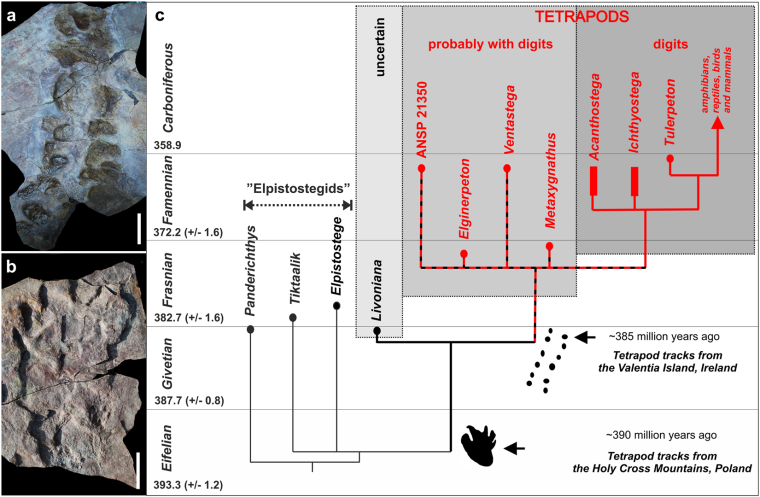
Panel (c) is the whole argument of this article in one picture, drawn by the people who made the discovery.16 Panderichthys, Tiktaalik and Elpistostege all sit above the Zachełmie tracks, and above the Valentia Island tracks as well. Among the bones, the textbook sequence runs in the same order in morphology and in rock, and Part 4 gives the measured fit. The footprints are what run against it.
It is not one quarry
An article that leaves a reader thinking the whole case rests on a single Polish site has misled them. Ahlberg lists four Devonian track sites he regards as defensible.1
| Site | Age | First reported | What is there |
|---|---|---|---|
| Zachełmie Quarry, Poland | Eifelian, ~390 Ma | Niedźwiedzki et al. 2010 | Digit impressions; several trackways; subaqueous, in ephemeral coastal-plain lakes |
| Valentia Slate, Valentia Island, Ireland | Givetian, minimum 384.9 Ma | Stössel 1995 | Several localities, numerous long quadrupedal trackways, unambiguous lateral sequence walks; some made on land; trackmakers up to about 1 m |
| Tarbat Ness, Scotland | Late Devonian, probably Frasnian | Rogers 1990 | Short, lacking anatomical detail; on a salt-flat surface about 100 km from the sea, so terrestrial |
| Genoa River, Victoria, Australia | Late Devonian, probably Famennian | Warren & Wakefield 1972 | Digit impressions; lateral sequence walk; the only Gondwanan site |
Two things follow that are easy to miss.
Valentia Island is the quiet problem, not Zachełmie. It is bracketed by a dated volcanic ash bed, it is far less disputed than Zachełmie, and it shows long, unambiguous lateral-sequence walking with some trackways made on dry land. Ahlberg notes that the Valentia tracks are still slightly older than Panderichthys, the least tetrapod-like of the elpistostegids.1 So even a critic who threw Zachełmie out entirely would still have tetrapod tracks preceding the whole elpistostegid body-fossil record.
Ahlberg declines two older claims that would have helped him. Reported tracks from Kalbarri in Western Australia and Glenisla in Victoria are older still, and he refuses to count them because he is not convinced they show diagnostic tetrapod characters.1 That is a mainstream author turning down evidence in his own favour, and it is worth noticing.
What this actually did
Nature did not bury it. The journal's own editorial summary described the consequence for the known fish-like intermediates: they are "late-surviving relics rather than direct transitional forms."2
Per Ahlberg — who worked on Ichthyostega and Ventastega and is among the two or three most important researchers on this transition — put it plainly in 2019: the idea that Tiktaalik was an immediate predecessor of tetrapods "must thus be discarded." In the same open-access paper he calls the fossil record of this transition "very poor" and "mostly gaps."11
So the strongest statement of the problem comes from inside the field, in its own journals, from people with no interest in helping creationists.
What it did not do
It did not show that Tiktaalik is not transitional.
A transitional form is an animal with a mixture of characters from two groups. Whether it is an ancestor is a separate question, and usually unanswerable. Species persist after their descendants appear — a coelacanth is alive now, and its fossil relatives are not younger than the first amphibian.
So the Zachełmie result relocates Tiktaalik on the tree. It does not remove its anatomy. Nothing about the Polish trackways changes one bone. Tiktaalik still has fish scales, fish fin rays, a fish lower jaw and a fish palate on the same skeleton as a mobile neck, a flattened crocodile-like skull, reduced gill-cover bones and a wrist that can be flexed against a substrate. Being anatomically intermediate is a fact about the animal, not about the date stamped on its rock.
The clearest statement of that point in the literature is Ahlberg's own, and he reaches for the other most famous transitional sequence to make it. He compares the elpistostegids to feathered non-flying theropods such as Microraptor, which lived alongside real flying birds for tens of millions of years. Such an animal, he writes, is a highly informative morphological intermediate that illuminates the origin of birds, but it is "in no sense a temporal intermediate or ancestor of birds."1 He concludes that roughly fifteen million years of overlap between elpistostegids and tetrapods is not implausible.
That is the same structure creationists invoke for Archaeopteryx-grade animals, deployed here by a mainstream paleontologist in a peer-reviewed journal, against his own field's popular story.
What Zachełmie does damage is the neatness of the textbook story. The celebrated prediction was confirmed by an animal that turned out to arrive after the event it was predicted to precede. That is a real embarrassment for the popular telling, and it is a fair thing to point out — as long as the anatomical claim is not overstated along with it.
The numbers our side keeps getting wrong
Creationist writing on this still quotes "eighteen million years older than Tiktaalik." That is the 2010 figure and it has been superseded.
Here is the whole arithmetic, old and new, in one place.
| Quantity | 2010 paper | Same team, 2018 |
|---|---|---|
| Age of the Zachełmie tracks | ~397 Ma | ~390 Ma |
| Older than the earliest tetrapod body fossils by | 18 Myr | ~14 Myr |
| Older than the earliest elpistostegid (Panderichthys) by | 10 Myr | ~5 Myr |
The 2018 figures come from Qvarnström, Szrek, Ahlberg and Niedźwiedzki — four of the five authors of the original paper, restating their own result.16 Ahlberg's 2019 review uses the same age.1
The offset from Tiktaalik itself is smaller again, and creationist writing rarely gives it at all. Tiktaalik is early Frasnian, which Ahlberg puts at two to four million years younger than Panderichthys, and Panderichthys is about five million years younger than the tracks.1 So the tracks predate Tiktaalik by roughly seven to nine million years, not eighteen.
Sixteen years on, our side is still recycling the first number. If an argument is worth making, it is worth making with the current figures. The gap is still large: the earliest tetrapod evidence precedes the earliest tetrapod bone by about fourteen million years, and precedes Tiktaalik by more than half that again. The honest number is simply smaller than the famous one.
And here is what Zachełmie is not
This is the distinction the argument has to get right, and creationist writing usually gets it wrong.
Zachełmie is not a fossil out of order in any sense a flood model can use. It does not put a tetrapod anywhere impossible. It moves a first-appearance date from the Frasnian back into the Eifelian — about fourteen million years, entirely inside the Devonian, and inside the interval the tetrapod lineage was already inferred to occupy. Across 2,001,053 records in the Paleobiology Database there are zero tetrapod occurrences in Silurian or older rock.6
What Zachełmie is evidence for is the incompleteness of the fossil record and the unreliability of first-appearance dates as evolutionary timings. That is a narrower claim than "the sequence is worthless," and it is the one the data support. It is also a claim made, on mainstream authority, about the single sequence most often held up as the best case for reading the fossil record as a record of ancestry.
Part 3 — How well is Zachełmie actually dated?
This section exists because the answer is more interesting than either side reports, and because it matters to this series' method.
What the age rests on
The Zachełmie tracks are dated by conodonts — microfossils — not by radiometric dating. The reason is on the author list: Katarzyna Narkiewicz is a conodont specialist. That is convenient for an article that has excluded radiometric dating from its evidence. It also means the age rests on biostratigraphy, which is exactly the kind of claim this series is willing to examine.
And the discovery team's own 2018 paper reports three things that weaken it. Describing the Lower Complex that contains all three track horizons, they record that the body-fossil record there is very poor and consists of conodonts, foraminifers, ostracods and small bivalve remains, all of them restricted to narrow intervals above and below the track-bearing beds rather than in them. Those marine fossils are "generally poorly preserved and clearly fractured from reworking," which the authors read as episodic transport of material in from a neighbouring marginal-marine environment, possibly during storms. And in their own words: "there is a complete absence of marine body fossils in the interval with tetrapod tracks."16
Reworked fossils constrain an age in one direction only. A bed can be no older than the youngest fossil washed into it, but it can be younger. So the constraint is genuinely looser than a clean in-place assemblage would give.
The bracket is tighter than the 2010 paper alone showed, though. In 2015 the same group, with Gregory Retallack, one of the critics of the original marine reading, as co-author, reported conodonts from the base of the section, below the track-bearing interval, as well as from its top. On that evidence they assign the whole section, tracks included, to a single conodont zone: the costatus Zone of the Eifelian, "probably its lower part."17
None of this shows the age is wrong. Conodont zonation across the Eifelian is well established, and this is a normal marine-influenced carbonate succession, not an exotic setting. What it means is that the age control is a chain of inferences rather than a measurement on the track surface, and a reader deserves to know where the links are rather than being handed the word "securely."
The number has moved twice
The age of these tracks has appeared in print in three different forms, and the one in current use is the third.
| Where | Figure |
|---|---|
| Niedźwiedzki et al. 2010, the describing paper | ~397 Ma |
| Nature's own news story on the paper, the same week | ~395 Ma |
| Qvarnström et al. 2018, four of the same five authors | ~390 Ma |
None of those moves is large, and none of them changes the stage. But an argument that leans on this date should say out loud that the date has been revised, twice, by the people who published it — because that is the whole point the article is making about first-appearance data, applied to its own evidence.18
What moved the number: the clock, not the rock
The age was re-examined by Marek and Katarzyna Narkiewicz in a short 2015 note in Lethaia, which Qvarnström and colleagues cite, with the stratigraphic chart, for their five-million-year gap between the tracks and Panderichthys.19 That note could not be obtained. Its companion paper of the same year, by the same first authors, could, and it answers the question the note was supposed to settle.
The rock was not re-dated. The timescale was. The 2015 paper keeps the tracks in the same conodont zone as before and says where the new number comes from: "The age of the studied strata is 390–391 Ma according to the latest version of the Geological Time Scale (Becker et al., 2012) and the recent revision of the Devonian geochronology by De Vleeschouwer and Parnell (2014)."17 The chart moved under a fixed zone. In 2010 the International Commission on Stratigraphy's chart put the Eifelian between 397.5 and 391.8 million years, as Tas Walker noted at the time.20 The chart in use since 2012 puts it between 393.3 and 387.7.21 The base of the stage alone moved about four million years younger on paper. The tracks sit low in the stage, so they moved with it, and the further Devonian recalibration the 2015 paper cites accounts for the rest.
So the move says nothing about the reworked conodonts or about any doubt over which zone the tracks belong to. It moved the numbers for Panderichthys and Tiktaalik in the same direction, because they are read off the same chart. The relative order of the tracks and the bones is exactly what it was in 2010.
A creationist prediction, scored exactly
Within days of the 2010 publication, Tas Walker of Creation Ministries International wrote a piece on the discovery. Buried in it is something worth crediting: he identified, correctly, that the age came from conodonts in nearby strata rather than from isotopic dating of the track beds, and he predicted that paleontologists would look hard at re-dating the site.20
He also said what he expected. For the problem to go away, he argued, the rocks would have to move at least three stages younger, into the Famennian.
Score it exactly. Walker described the method accurately, including the step that later moved the number: once the rocks are assigned to a stage, he wrote, "it is just a matter of looking the dates up on a chart."20 He predicted that paleontologists would look again at the fossils behind the assignment, and they did. The re-examination found more conodonts, below the tracks this time, and kept the tracks in the same zone.17 The published figure did later fall by about seven million years, but that was the chart being recalibrated, as the section above shows, not the rock being moved. So the re-dating he expected came out against him. Walker gets credit for naming the pressure point and for describing the method more accurately than most commentary on either side. He gets no credit for the outcome, and the seven-million-year drop should not be counted as a partial hit.
A parallel case that collapsed
In 2002 Nature published footprints from Argentina with clearly bird-like characters, in rock the authors placed in the Late Triassic — at least fifty-five million years before the first bird skeleton.22 The structure of the argument is identical to Zachełmie's: a trackway moving a first-appearance date, with no body fossil anywhere near it.
The authors retracted the paper in 2013. Radiometric dating of the sequence, by then renamed the Laguna Brava Formation, "indicated a Late Eocene age."23 Not Late Triassic. Wrong by roughly 180 million years.
The lesson is narrow and should stay narrow. A trackway can move a first-appearance date with no body fossil at all, which is a real strength. It can also be wrong about its own age, which is a real weakness, and in one high-profile case in the same journal it was. Nobody has published a claim that Zachełmie is out by a stage, let alone by an era. But an article that cites Zachełmie should say what the date rests on, and should not present a biostratigraphic assignment from reworked microfossils in adjacent beds as though it were a radiometric age on the track surface.
The four published challenges, and where each one stands
Zachełmie has been attacked in print four separate times. All four attacks are secular. None is creationist. Anyone who wants to know whether the result survived should read them rather than the press coverage.
1. The setting was marine, so a walking land animal is implausible. The 2010 paper itself called the depositional setting a "marine tidal flat," and that phrase did most of the damage. Retallack argued in 2011 for a woodland setting instead; Marek Narkiewicz with Retallack in 2014, and Narkiewicz and colleagues in 2015, argued for a lagoon.24
Status: settled against the marine reading — by the discovery team itself. Qvarnström and colleagues restudied the section with 34 new thin sections and concluded that the track beds record "a succession of ephemeral lakes with a restricted and non-marine biota, rather than a marginal marine environment as originally thought."16 Read that carefully. It is the authors of the 2010 paper publishing a correction of their own environmental interpretation eight years later, in the direction that makes the objection go away — but the correction also makes their tetrapod interpretation easier, which is why the correction is worth naming rather than glossing.
2. Lungfish can make tetrapod-like traces. In 2011 a team filmed African lungfish walking and bounding along the floor of a tank using their pelvic fins, and argued that substrate walking predates tetrapods and even predates limbs.25 Neil Shubin, who found Tiktaalik, is a co-author of that paper. In 2016 Falkingham and Horner went further and had a lungfish move across aerially exposed mud, producing actual sediment traces.26
3. The structures are fish nests and feeding traces. This is the strongest published rejection, and it comes from Spencer Lucas in a 2015 review of every reported Devonian tetrapod footprint.27 His method is to set three criteria for recognising one: hand and foot impressions matching known Devonian tetrapod skeletons, hand smaller than foot, and the alternating pattern produced by a lateral sequence walk. Applied across the literature, that test kills most of the record. Thinopus antiquus from Pennsylvania — the first Devonian tetrapod track ever reported — becomes, in his reading, most likely an impression of fish droppings. Only three sites survive his review: Genoa River, Easter Ross in Scotland, and Valentia Island.
On Zachełmie he is blunt: "no convincing case has been made that the Zachełmie structures are tetrapod tracks. Instead, they are reinterpreted as fish nests/feeding traces."27
4. The known Devonian tetrapods could not have walked like that. In 2012 Pierce, Clack and Hutchinson modelled Ichthyostega's joints in three dimensions and concluded that its limbs had tightly constrained arcs of movement.28 It could not rotate its limbs enough for a lateral sequence walk. Their reconstruction has it moving by a symmetrical forelimb "crutching" motion, like a very large mudskipper, with the hind limbs used as paddles.
This is the subtlest objection and the one least often reported. It does not deny that the tracks are tetrapod tracks. It denies that an animal built like the tetrapods we have bones for could have made them — which, if right, means the trackmaker is an animal nobody has ever found.
Where it stands in 2026
The trackway identification is upheld in the mainstream literature. The objections have not carried the field, and the reasons given are specific rather than dismissive.
Ahlberg reviewed the lungfish and fish-trace arguments in 2019 and stated that "none of these claims stands up to scrutiny."1 His grounds:
- Against the lungfish films — the resemblance is an artefact of how the contact points were recorded on a Perspex sheet, and the published video shows the fish's throat in constant contact with the tank floor. A real sediment trace made that way would carry a continuous body drag. The Devonian trackways do not.
- Against the mud experiment — the lungfish trace fails to reproduce the regular pattern, the footprint shape, or the digit impressions, and the comparison figure used a tectonically deformed stretch of the Valentia trackway without saying so.
- Against Lucas — feeding traces and droppings cannot produce deep, morphologically consistent digit impressions arranged in trackways. Actual Devonian lungfish mouth-feeding traces have since been found in Poland, and they look nothing like tetrapod tracks.
Qvarnström and colleagues make the same argument from the other end: digit imprints, plus the absence of body drags in unambiguously four-footed trackways, exclude both an elpistostegid trackmaker and fish resting traces.16 In 2022 the site was designated one of the IUGS "First 100 Geological Heritage Sites," which is weak evidence but real: it indicates the identification is not treated as a live controversy.29
Three caveats travel with all of that, and this article prints them rather than waiting to be shown them. Ahlberg is a co-author of the paper he is defending, so his review is not a neutral referee's. Lucas's full text is paywalled and was not read for this article; only his abstract was, and it is quoted from there.27 And Ahlberg wrote in 2019 that a detailed description of the Zachełmie track assemblage was forthcoming and would address these issues. Nothing matching that description could be found published as of August 2026.
The strongest sceptic still leaves the problem standing
Here is the detail that any creationist reaching for Lucas would be foolish to omit.
Lucas concludes that the oldest tetrapod record is the Givetian trackway from Valentia Island — in his own words, "the oldest Devonian tetrapod trackway is Givetian and this is the oldest record of a tetrapod."27 Givetian precedes the early Frasnian. Tiktaalik is early Frasnian.
That is worth sitting with. The most determined published sceptic of the Zachełmie tracks does not restore the textbook order. He relocates the problem to a different set of tracks. And his surviving three sites lead him to a conclusion that is stronger on Devonian terrestriality than the standard aquatic-origin scenario allows: he reads them as recording fully subaerial walking in freshwater settings, driven by the hind limbs.
What a young-earth reader may take from Zachełmie
The Zachełmie result is fossil order matched between continents. The tracks are in the Świętokrzyskie Mountains of Poland. Tiktaalik is on Ellesmere Island, in the Canadian Arctic, about four thousand kilometres away. Saying that one lies lower in the column than the other joins two rock sequences with nothing physically in common, and superposition alone cannot do that. The join is made by fossils: on the Polish side, the conodont zonation this Part has just examined.
That kind of matching is open to a young-earth writer. It is older than radiometric dating and does not depend on it. Kurt Wise and Donna Richardson, both young-earth creationists, concluded from their own work on the Paleobiology Database that "the global biostratigraphic column seems to be real."30 So a creationist who says the tracks lie below the fish that was supposed to precede them is making a legitimate kind of argument, on the same footing as the mainstream's own use of the order. The one writer who cannot make it is the one who calls biostratigraphic zonation circular, because the order he would be citing is that method's output. The companion article on bird origins reaches the same conclusion about the temporal paradox.31
The argument's force rests on how loose the conodont control is, and that cuts both ways. The reworked conodonts and the empty track interval loosen the placement of the tracks. The twice-revised figure does not: it is the timescale moving under a fixed zone, and it moved the bones' numbers too. Reworked fossils allow a bed to be younger than reported, so a looser placement weakens the claim that the tracks lie below Tiktaalik, whoever makes it. A young-earth writer who leans on that looseness to criticise the mainstream weakens his own use of the order by the same amount. As published, the order still stands: every revision kept the tracks in the Eifelian, the 2015 re-examination kept them in the same conodont zone, and Tiktaalik is early Frasnian, with the Givetian between them. The move Walker said would make the problem go away, three stages younger into the Famennian, would have reversed the order, and it has not happened.
The internal criticism stands on its own. The mainstream accepts the correlation, staked a widely publicised prediction on it, and then published a result that overturned the prediction on its own terms. Everything this Part says about how the age control works is a statement about the confidence with which that field reported its own evidence. Read as an argument about mainstream overclaiming, Part 3 stands. Read as a young-earth datum about which animal came first, it is fair to use, and it is exactly as strong as the conodont control behind it.
Part 4 — What the anatomy shows
The transition is not one fossil. The relevant animals include Eusthenopteron, Panderichthys, Tiktaalik, Elpistostege, Ventastega, Acanthostega, Ichthyostega and Tulerpeton.
Across them the fin becomes a limb: the fin rays are lost, digits appear, the wrist and ankle differentiate, the humerus develops processes for muscle attachment, the pelvic girdle attaches to the vertebral column, the opercular series is lost so the head can move on a neck, and the rib cage strengthens.
Before any of that, it is worth knowing exactly what the fossils are. Popular diagrams show a row of complete skeletons. The reality is a row in which two animals are complete, three are partial, and the rest are jaws and shoulder blades.
The specimens, one by one
| Taxon | Described by | Material and completeness | Formation and place |
|---|---|---|---|
| Eusthenopteron foordi | Whiteaves, 1881 | Abundant; the whole animal is known. Not an elpistostegid — a tristichopterid, and the standard outgroup. The "before" picture, not a link. | Escuminac Fm., Miguasha, Québec |
| Panderichthys rhombolepis | Gross, 1941 | Nearly the whole animal is known. A classic specimen was re-read by CT in 2008 and the earlier interpretation of its fin overturned. | Gauja and Lode Fms., Latvia |
| Tiktaalik roseae | Daeschler, Shubin & Jenkins, 2006 | Holotype NUFV 108, three blocks. Everything but the tail. Isolated pelves of four further individuals; three specimens described in 2006. | Fram Fm., Ellesmere Island, Nunavut |
| Elpistostege watsoni | Westoll, 1938 | Fragments only for seventy-five years — a partial skull and partial vertebral column, in which the ribs were once misidentified as neural arches. A 1.57 m articulated specimen was found in 2010 and described in 2020. | Escuminac Fm., Miguasha, Québec |
| Qikiqtania wakei | Stewart et al., 2022 | Partial upper and lower jaws, pharyngeal elements, a pectoral fin, scales. Same rocks as Tiktaalik, same project. | Fram Fm., Canadian Arctic |
| Elginerpeton pancheni | Ahlberg, 1995 | Lower-jaw fragments together making up almost a whole ramus, premaxillae, shoulder-girdle and pelvic fragments, a probable femur. All of it broken, with clear evidence of transport. With Obruchevichthys, the oldest stem tetrapod known from bone. | Scat Craig, near Elgin, Scotland |
| Ventastega curonica | Ahlberg, Lukševičs & Lebedev, 1994 | Skull, an exceptionally preserved braincase, shoulder girdle and partial pelvis. No limb bones are known. Pelvis and shoulder girdle partly unossified. | Pavari and Ketleri, Latvia |
| Parmastega aelidae | Beznosov et al., 2019 | Three-dimensional material allowing reconstruction of skull and shoulder girdle. The oldest tetrapod that can be reconstructed at all. | Sosnogorsk Fm., Komi Republic, Russia |
| Acanthostega gunnari | Jarvik, 1952 | Fragments until a 1987 expedition found a mass-death deposit. Monographed 1996. Every known individual is a juvenile. | Britta Dal Fm., East Greenland |
| Ichthyostega spp. | Säve-Söderbergh, 1932 | Multiple specimens including a mass-death horizon quarried in the mid-twentieth century without sedimentological notes. Complete enough to reconstruct — and repeatedly re-reconstructed. | Britta Dal and Aina Dal Fms., East Greenland |
| Tulerpeton curtum | Lebedev, 1984 | Postcranium, including a six-digit limb. Limb morphology already approaching that of post-Devonian tetrapods. | Kovanshchina Fm., Andreyevka-2, Tula, Russia |
| Pederpes finneyae | Clack, 2002 | In 2002, the only articulated tetrapod skeleton known from the whole Tournaisian. Five robust digits on the foot, plus a very small extra digit on the hand. | Ballagan Fm., Dumbarton, Scotland |
| Casineria kiddi | Paton, Smithson & Clack, 1999 | One specimen only — part and counterpart, NMS G 1993.54.1p and 1993.54.1cp. Headless: the skull is unknown. | Gullane Fm., Cheese Bay, East Lothian, Scotland |
Beyond that list, the Devonian record thins out fast. Ymeria denticulata is a jaw and palate. Hynerpeton bassetti and Densignathus rowei, from Red Hill in Pennsylvania, are fragmentary, and the same site produced an isolated humerus, ANSP 21350, that Ahlberg reads as the least tetrapod-like tetrapod humerus known. Tutusius umlambo and Umzantsia amazana come from Waterloo Farm in South Africa, at a Devonian latitude south of 70°. Sinostega pani, Metaxygnathus denticulatus, Jakubsonia livnensis, Obruchevichthys gracilis and Webererpeton are all fragments.1
The honest summary is one sentence, and Ahlberg puts it in print: of roughly a dozen named Devonian tetrapods, exactly two — Acanthostega and Ichthyostega — are complete enough for a reliable whole-body reconstruction.1 Ventastega, Tulerpeton and now Parmastega are partly reconstructable. Everything else is jaws, girdles and isolated bones.
Where they sit in the rock
The stratigraphic positions below were pulled live from the Paleobiology Database rather than copied out of a review.5 Each occurrence in that database carries an age bracket, not a point, so both ends are printed.
| Taxon | Interval | Age bracket (Ma) | Formation |
|---|---|---|---|
| Panderichthys rhombolepis | late Givetian | 383.4 – 382.31 | Gauja |
| Tiktaalik roseae | early Frasnian | 382.31 – 379 | Fram |
| Elpistostege watsoni | Frasnian | 382.31 – 372.15 | Escuminac |
| Ventastega curonica | Famennian | 372.15 – 358.86 | Ketleri |
| Parmastega aelidae | Famennian | 372.15 – 358.86 | Sosnogorsk |
| Acanthostega gunnari | Famennian | 372.15 – 358.86 | Britta Dal |
| Ichthyostega spp. | Famennian | 372.15 – 358.86 | Britta Dal |
| Tulerpeton curtum | late Famennian | 365.2 – 358.86 | Kovanshchina |
| Pederpes finneyae | Ivorian (Tournaisian) | 353.7 – 346.7 | Ballagan |
| Casineria kiddi | Asbian (Viséan) | 339.9 – 335.9 | Gullane |
The Zachełmie trackways, at about 390 million years, sit before every row in that table.
How well the bones fit the tree has been measured, and the answer cuts both ways. In 2011 Matt Friedman and Martin Brazeau ranked each branch along the tetrapod stem by how close it sits to living tetrapods, then compared that rank with when the branch first appears in the rock. Using bones alone, the two line up closely: a Spearman rank correlation of −0.90, with a probability of 0.00000048 of a fit that good arising by chance. For the elpistostegids and the digited tetrapods taken alone the correlation is −0.83 (p = 0.0017). The fit fails only lower down the stem, among the "osteolepiform" fishes, at −0.42, which is not significant (p = 0.35).32 Then they asked whether the Zachełmie tracks fit that bone record. If the trackmaker sits where its describers put it, the answer is no: the tracks fall outside the 95% credible interval drawn from the bones (p = 0.0015), which they call "statistically inconsistent with our previous understanding of the stratigraphic distribution of early digit-bearing tetrapods." If it sits at the most fish-ward position the anatomy allows, it is not a significant outlier (p = 0.077), and the anomaly is often no longer significant once the Valentia Island tracks are counted too.32
That settles two overstatements, one on each side. A young-earth writer should not say the rock contradicts the anatomy: among the bones it fits it strongly. A mainstream writer should not call the tracks statistically unsurprising: against the bones alone, on the describers' own placement, they are not.
One more number from the same queries is worth having, because it is the raw scale of the evidence. A search of the entire database for Devonian tetrapods returns six occurrences worldwide. A search for the wider group that includes the lobe-finned fish returns forty-three — and it silently misses Tiktaalik, Elpistostege and Eusthenopteron, which are all in the database under their own names.5 The database is a record of what has been published, not of what is in the ground. But the order of magnitude is real: the entire global body-fossil record of this transition is a few dozen localities, and several of the famous animals are single collections. That is the empirical basis for Ahlberg's line about gaps.
The young-earth account of that order, in its own words
The strong fit between bones and tree is a fact a young-earth model has to explain, and the model's leading paleontologist says so. Kurt Wise listed "the tetrapod series" among the confirmed stratomorphic series in 1995, meaning a run of fossils in which each is intermediate in form between the ones below and above it in the rock.9 His next words were "Creationists therefore need to accept this fact."9 Paul Garner and Jonathan Asher, young-earth creationists writing in 2018, reach the same verdict on this series in particular: despite what they call "possibly conflicting data, such as the Zachełmie trackways", the agreement between phylogeny and stratigraphy "seems fairly robust and the fish-tetrapod series thus provides a good example of a stratomorphic series sensu Wise (1995)."33
He then offered an explanation, on the same page. Before the Flood, he proposed, living communities were arranged in zones from the sea inland. The Flood advanced over them and buried them in the order it reached them. Animals intermediate in form between two zones lived where the zones met, so the water buried them between the two. In his words, many stratomorphic intermediates are "geographic intermediates (morphological intermediates between animals of two adjacent biozones which — probably because of their intermediate morphology — lived in the geographical zone lying at the contact of the two biozones) buried by transgressing Flood waters as stratigraphic intermediates," and his examples include "the early tetrapod series."9
In 2003 Wise gave those zones a habitat. His floating-forest hypothesis pictures a huge mat of vegetation growing out over the pre-Flood ocean, with plants arranged from the open-water edge inward and animals arranged with them, including "the Devonian aquatic tetrapods (like Ichthyostega) in pools on thinner portions of the forest floor and a wide variety of large amphibians (including the labyrinthodonts) on the thicker sections of the forest."34 The Flood broke the mat up from its edges inward. Wise claims this would explain "the stratigraphic position, the environment, and the morphology" of the animals that look like intermediates between fish and amphibians.34 He states the cost of the evidence plainly: "The first appearances of fish, amphibians, and reptiles as well as the position of morphological intermediates between fish and amphibians are in exactly the order predicted by evolution."34
How strong is it?
- It explains the direction of the order. A sea-to-land sequence of zones buried by a rising flood puts aquatic fishes first, water-margin animals next and land animals last, which is the order observed. It also explains why the intermediates are intermediate in both form and position, which a purely random burial would not.
- It was built after the order was known. Wise says so himself: "It certainly CANNOT be said that traditional creation theory expected (predicted) any of these fossil finds."9 It is an accommodation of the data, not a prediction of it. Nobody has tested it against the tetrapod record the way Friedman and Brazeau tested the evolutionary tree.
- Its habitat is disputed among young-earth geologists. Timothy Clarey and Jeffrey Tomkins studied the lycopod stumps of Fossil Grove in Glasgow, read them as a forest rooted in soil, and "strongly recommend that the floating-forest hypothesis be abandoned by the creationist community."35 Wise replied in 2018 that the same stumps "were allochthonously deposited well into the Flood," that is, carried in rather than rooted.36 The dispute is open. The zoning idea of 1995 does not need the floating forest; the specific habitat does.
- It does not yet handle the trackways. Both papers predate Zachełmie. A defender can say that a trackway records where a living animal walked, not where it was buried, so footprints below Tiktaalik do not break a burial sequence. But the model still has to say how a four-footed animal was walking on Eifelian sediment before the zone of the fish-like intermediates was buried, and it has not.
- The track beds themselves are a problem for flood geology. The 2015 restudy describes lagoons "undergoing periodic desiccation";17 the 2018 one, "a succession of ephemeral lakes," across three separate track horizons.16 Repeated drying has to fit inside the Flood year. Young-earth geologists do not agree that it can. In 2003 Paul Garner and four other British creationists argued that "the fact that the vertebrate track record is essentially unbroken from the Devonian (one third up the Phanerozoic) right up to the present day is surely clear evidence that the latter two thirds of the Phanerozoic (at least) is post-Flood."37 Wise's model places these rocks inside the Flood. Both cannot be right, and the 2018 young-earth study described next mentions the Zachełmie tracks only as possibly conflicting data, with no flood-model account of them.
Net: a young-earth account of why this series lies in order exists, it fits the direction of the order, and it is stated by a Harvard-trained paleontologist who conceded the data first. It is also untested, accommodative, built on a habitat its own side disputes, and silent on the oldest evidence in the subject.
A creationist test of the rank question
Young-earth biology has its own method for asking whether two groups are one created kind: statistical baraminology, which measures whether animals form one continuous cloud of shared characters or separate clouds with a gap between them. In 2018 Garner and Asher applied it to this transition, to test Garner's own earlier claim that a gap separates the most fish-like tetrapods from the most tetrapod-like fishes. They ran baraminic distance correlation and multidimensional scaling on six published character matrices built by mainstream workers, from Ahlberg and Clack in 1998 to Clack and colleagues in 2016. Their result: "little evidence of continuity, and significant evidence of discontinuity, between the elpistostegids and tetrapods such as Ichthyostega and Acanthostega."33 Only one analysis linked one elpistostegid, Tiktaalik, to one tetrapod, and the link vanished when that analysis was rerun with fewer taxa and more characters. They conclude: "Minimally, therefore, our results suggest the presence of two apobaramins: tetrapods and elpistostegids."33 An apobaramin is a group with a gap around it, which may itself hold more than one created kind.
This is original quantitative work, done with the mainstream's own data, and it is the strongest creationist answer to the rank question in this subject. Its authors list its limits themselves: one matrix scores only jaws and another only limbs, several share sources, three have poor bootstrap support, and they removed outgroup fishes because those taxa were "swamping discontinuities that were otherwise evident among the Devonian forms."33
The skeptic's best reply is about what the method measures. It finds gaps among the animals sampled. The interval in which the transition is supposed to have happened, the Eifelian and early Givetian, has no elpistostegid or tetrapod bone anywhere in the world.1 So a gap between the two groups is what an evolutionary reading of this record predicts as well. Phil Senter applied the same creationist method to the dinosaur-bird transition and found continuity between Archaeopteryx, other early birds and non-avian dinosaurs. He proposed the method as a tool for "the tracing of the progressive filling of morphological gaps in the fossil record through successive years of discovery."38 Garner and Asher's result therefore shows a real gap and offers a separate-ancestry reading of it. It does not show which reading is right, and a future Givetian body fossil could close it.
The fin becomes a limb, feature by feature
The order of the changes matters more than the list, because the order is what a sequence claim has to get right.1
Fin rays. Bony fin rays — lepidotrichia — are present and complete in Eusthenopteron, Panderichthys, Tiktaalik and Elpistostege. They are absent in tetrapods, where digits take their place. This is the sharpest single dividing line in the whole subject, and it is the definition Ahlberg uses throughout: a tetrapod is a vertebrate with digit-bearing limbs rather than paired fins. He also corrects the popular Tiktaalik story here. The claim that Tiktaalik's fin rays were shortened is, in his reading, an artefact of incomplete preservation at the end of the fin; complete, they were probably little different from Panderichthys's.1
Digits. See the next two sections. The short version is that they appear abruptly in the body-fossil record, in animals that already have eight of them, and that a fin containing both digits and fin rays was described in 2020.
The elbow. Eusthenopteron, Panderichthys and Tiktaalik have a straight elbow with no olecranon — no bony process for the triceps to pull on — and some capacity to hyperextend. Tetrapods have a flexed elbow with the triceps attached to an olecranon. Two corrections belong with that. Ahlberg found in 2011 that Acanthostega does have an olecranon, small and poorly ossified, which undoes the "primitive elbow" reading that had supported treating Acanthostega as primitively aquatic. And the isolated Pennsylvania humerus ANSP 21350 achieves a flexed elbow by an entirely different anatomical route — rotating the whole far end of the bone rather than remodelling the ulna. So the flexed elbow evolved at least twice, in parallel, among Devonian tetrapods.1 Parallelism inside the transition series is mainstream and published, and it is a real complication for reading the series as a ladder.
The wrist. Tiktaalik's contribution is an expanded array of small bones at the end of the fin, with joints that work like the joints in a basal tetrapod's wrist.13 Elpistostege's 2020 specimen goes further, with four rows of radials running out along the fin, two of them including branched wrist bones.39
Humeral processes. The upper arm bone carries the muscle attachments that reveal what the limb was for. Acanthostega's humerus has a deltopectoral crest essentially like a human's. Ichthyostega's has separate deltoid and pectoral processes with a gap between them — a condition that aligns it with Tiktaalik, Panderichthys and ANSP 21350 rather than with Acanthostega.1 That is the observation behind the argument in the last section of this part.
The pelvic girdle and the sacrum. In lobe-finned fish the pelvis is tiny. In Eusthenopteron the largest measured ratio of pelvis length to body length is one to twenty, with the hip socket facing backwards, no ischium, and no sacral rib.11 Tiktaalik's pelvis is greatly enlarged, with a broad blade and a deep socketed hip joint — but it still has no sacral attachment and no ischium. Tetrapods add the ischium, rotate the hip socket to face sideways, and create a contact between a modified rib and the pelvis. Ahlberg treats that sacral contact as the decisive marker of weight support, and notes that no living fish has evolved a true sacrum.1 The nearest analogue anywhere is a cave-dwelling Thai loach, Cryptotora thamicola, which has a pelvis-to-backbone connection and climbs waterfalls.
The ribcage. Very small ribs in Eusthenopteron. Longer, blade-like ribs in the elpistostegids. A real ribcage with long overlapping ribs in Ichthyostega. Short, undifferentiated ribs in Acanthostega — which is one of several places where Acanthostega and Ichthyostega refuse to line up.
The gill cover and the neck. Panderichthys keeps a complete bony gill cover. Tiktaalik has lost the two main gill-cover bones but keeps the large plates under the throat — and that loss is what frees the head from the shoulder girdle and produces the mobile neck the 2006 paper advertised. Tetrapods lose the bony gill cover altogether. Ahlberg reads the retained throat plates in Tiktaalik as evidence that suction feeding still mattered to it.1
The eyes. Lateral in Eusthenopteron; on top of the head and proportionally larger in the elpistostegids and tetrapods. A 2017 optical study — cited approvingly by Ahlberg — simulated what a larger eye buys an animal, and found no advantage in typical fresh water but a large gain in air.40 That makes the eye shift an adaptation to seeing above the water, not to walking.
The lateral line, and the ear. Well-developed lateral-line canals — the pressure-sensing system fish use — persist in every known Devonian tetrapod. Ahlberg treats that as decisive proof they stayed tied to water, since a lateral-line canal is useless in air and is damaged by drying.1 The canals fade specifically on the top of the skull, which fits an animal that habitually held its eyes above the surface.
The spiracle, and a warning. The enlarged spiracle — a breathing hole behind the eye — in Panderichthys and Tiktaalik is commonly presented as a neat first step towards the middle ear of land vertebrates. This article does not tell that story, because the primary papers behind it were not obtained and because the one early tetrapod ear that has actually been examined does not fit it. In 2003 Clack, Ahlberg and colleagues used newly collected material and high-resolution CT to interpret Ichthyostega's previously unreadable ear region, and concluded it was a highly specialised hearing device for use in water — "a structurally and functionally unique modification of the tetrapod otic region, unlike anything seen in subsequent tetrapod evolution."41 The earliest tetrapod ear anyone can examine is not an incipient land ear. It is an aquatic specialisation on a side branch.
Where digits came from
The old objection was that fin radials and digits are different things, so calling one the ancestor of the other is word-play. Two results have moved that argument, and both are recent.
The Elpistostege specimen, 2020. The 1.57-metre articulated fish found at Miguasha in 2010 and described a decade later was CT-scanned at high energy. Its pectoral fin carries four rows of radials running outward, two of which include branched wrist bones, plus two further rows organised as digits and probable digits. And the fin still carries lepidotrichia beyond them.39 The describers conclude that the vertebrate hand "arose primarily from a skeletal pattern buried within the fairly typical aquatic pectoral fin of elpistostegalians."
So the sharpest fish/tetrapod line — fin rays versus digits — is crossed by an animal that has both at once. For an argument about transitional forms, that is the single best specimen-level fact in this subject, and it is from 2020.
The Panderichthys dispute, 2008 — a real disagreement between named specialists. Before 2008, Panderichthys's fin was described as lacking digit-like radials, and that absence was used as evidence against the homology of digits and radials. A CT study of a classic specimen by Boisvert, Mark-Kurik and Ahlberg found the earlier interpretation was wrong: the digit-like radials are there.42
The interesting part is what came with it. Boisvert and colleagues also argued that Panderichthys's fin skeleton is in some respects more limb-like than Tiktaalik's — a long ulna and a short ulnare, against similar-sized bones in Tiktaalik — which cuts against the tidy progression, because Panderichthys is the older and less tetrapod-like animal. Ahlberg accepted the point in his 2019 review: in life, Panderichthys's fin lobe probably had a sharper division between "forearm" and "wrist" than Tiktaalik's did. He balances it by noting that Tiktaalik has the enlarged pelvis.1
This article does not characterise that as a feud, because it could not find Shubin's published reply. What the disagreement legitimately supports is the narrower point: the sequence is a mosaic, not a ladder. Different characters became tetrapod-like in different animals in different orders. The popular diagrams that show one animal improving on the last are misleading, and the specialists say so in print. "Therefore the transition did not happen" does not follow, and this article does not claim it.
The developmental genetics
Two experimental results come from Shubin's own laboratory, and both should be reported at full strength rather than waved away.
Enhancers, 2015. Stretches of DNA that switch on wrist-and-digit genes in mice were shown to drive expression in the far end of a fish's fin.43 The regulatory machinery is shared.
Hox knockouts, 2016. Nakamura and colleagues used CRISPR/Cas9 to delete the HoxA and HoxD gene clusters in zebrafish, and traced where the cells went. The mutant fish grow fewer fin rays and more of the internal bone that limbs are made of.44 Nature's own summary of the paper says it establishes homology between the developmental programs that build fin rays and those that build wrists and digits.
What that is worth, stated precisely. It shows that the developmental programs are shared and interconvertible. It does not show that a particular fossil lineage made the change. Two honest observations travel with it in both directions.
Against the tidy story: fin rays and digits were long treated as non-homologous, and the pre-2008 reading of Panderichthys was used to support that. Both have now been revised in the same direction, which is a pattern worth noticing.
Against the creationist reply: shared developmental machinery is also what a common-design account would predict, so this evidence discriminates less sharply than it is usually presented as doing — but do not lean on that too hard. The 2016 result is not a similarity claim. It is the observation that removing gene function converts one structure toward the other, which is a claim about developmental transformation, and a common-design account has to say something about it.
Two results that cut against the tidy story
The earliest tetrapods had more than five digits. Acanthostega has eight and Ichthyostega seven. Five was assumed to be the primitive number, and it is not.
This is worth flagging for a specific reason: it was an evolutionists' self-correction, published in 1990. It overturned an assumption that had been in textbooks for decades, and it came from the people working on the fossils.
The paper is Michael Coates and Jennifer Clack's, in Nature. Their counts: eight digits on Acanthostega's forelimb, seven on Ichthyostega's hindlimb, and six on Tulerpeton, the only other Devonian tetrapod limb then known. Their own conclusion is one line: "We challenge pentadactyly as primitive for tetrapods."45
Stated for a reader who has not met the history: five-fingeredness had been treated as a deep and almost defining property of land vertebrates, and comparative anatomy had spent a century trying to derive every tetrapod limb from a five-rayed archetype. The earliest limbs turned out to have eight, seven and six. Five is a later stabilisation, not the starting condition. And the tidying-up was not instantaneous either: Clack found a very small, possibly extra digit on the hand of the Tournaisian Pederpes, and concluded that polydactylous tetrapods may have survived past the end of the Devonian and that "pentadactyly cannot be assumed for the pes."46
And they may not have walked on land. Jennifer Clack's work indicates Acanthostega was fully aquatic despite having limbs with digits. That reverses the classic narrative — limbs did not evolve for walking on land and then get used in water; they appear to have evolved in water and been recruited for land later.
That is a substantial change to the story every schoolchild is taught, and it is mainstream. Coates and Clack said it in the same 1990 abstract: the morphology suggests digited limbs "may have been adaptations to an aquatic rather than a terrestrial environment."45 The supporting evidence accumulated through the 1990s and 2000s:
- Internal gills, with deeply grooved gill bars in both Acanthostega and Ichthyostega.
- A large, deep, leaf-shaped tail fin stiffened with fin rays — a swimming organ.
- A well-developed lateral-line system, useless and damaged in air.
- Small limbs and girdles, short undifferentiated ribs, an unossified sternum.
- Fin-spine fragments of a shark or acanthodian lodged in the lower jaw of one Acanthostega individual, MGUH VP 1300a — direct evidence of eating fish.
- And a result from 2016 that changes the animal: synchrotron scanning of limb-bone histology showed that most known specimens come from a single mass-death assemblage and that all of them are juveniles. The largest was at least six years old and still not adult.47
Read that last one twice. The standard reconstruction of Acanthostega is a reconstruction of a juvenile, and no adult of the best-known Devonian tetrapod has ever been found. It is honest self-correction by the field, and it is a serious limit on how much weight the reconstruction can bear.
And the field has now reversed itself twice
This is the newest part of the story and the least known, and it is the reason the article does not simply repeat "limbs evolved in water" as settled.
In his 2019 review Ahlberg argues against the aquatic-origin scenario — the position of his own former supervisor.1 His grounds are worth having, because they are functional rather than cladistic:
- The aquatic-origin scenario cannot explain why a persistently aquatic animal would not simply remain a fish. Digits, flexed elbows, sideways-facing limbs and a sacrum all make an animal worse at swimming in open water, and a sacrum is a weight-supporting structure with no underwater function.
- The humeral evidence points against the consensus tree. Acanthostega's humerus is the more tetrapod-like of the two, and Ichthyostega's aligns with the less tetrapod-like animals. Ahlberg reads that as evidence that Acanthostega is actually the more crownward of the pair, against the consensus of recent phylogenies.
- Therefore Acanthostega may be secondarily aquatic — a reversal from a more terrestrially capable ancestor, and the earliest known case of an animal becoming less terrestrial.
- And the trackways record subaerial walking before the end of the Middle Devonian, which no known body-fossil animal was thought capable of.
So there are now three positions in the literature, and this article prints all three rather than picking one.
| Position | Held by | Core claim |
|---|---|---|
| Terrestrial drive | Pre-1990 textbooks | Fins became limbs because limbs are useful for walking on land |
| Aquatic origin of limbs | Clack and Coates; standard since about 1995 | Digits, enlarged pelvis and sacrum evolved in water; terrestriality came later |
| Terrestrial drive with aquatic reversals | Ahlberg, 2019 | Limbs evolved for weight support and shallow-water walking; Acanthostega's aquatic habit is secondary |
Note the shape of that history. The field's flagship account of why limbs evolved has been reversed twice in thirty years, on the same fossils. That is a documented statement about how much interpretive weight fossil functional morphology can carry. It is not a statement that the fossils are fake or that the transition did not occur, and it should not be inflated into one.
Two mainstream items limit how far the aquatic reading can be pushed, and both belong here. Some of the Valentia Island trackways and the Tarbat Ness trackway were made on land, not underwater; Tarbat Ness is a salt-flat surface roughly a hundred kilometres from the nearest sea.1 And a micro-CT study of a radius of the Australian tetrapod Ossinodus found a healed break interpreted as the result of a fall from a height onto the front leg — direct evidence of activity on land, in an animal only slightly more derived than Acanthostega.48
Reconstructions that turned out to be wrong
The audit genre requires this list, and it is longer than a reader would expect. Every correction on it came from inside the field.
- Ichthyostega. Erik Jarvik's monographs, from 1952 to 1996, left a braincase Ahlberg calls incomprehensible, a humerus unlike any other early tetrapod's, and an ankle so odd that Robert Carroll's 1988 textbook replaced it with a reconstruction made without reference to the fossil. Clack's expeditions in 1987 and 1998, plus re-examination of Jarvik's own material, vindicated Jarvik's ankle and reinterpreted the braincase, the humerus and the axial skeleton.1 The most famous early tetrapod in the world was substantially mis-reconstructed for decades.
- Acanthostega. Every known individual is a juvenile, established in 2016 and not before.47
- Elpistostege. In the 1985 description of the vertebral column, the ribs were identified as neural arches.1
- Panderichthys. The fin was described as lacking digit-like radials until a 2008 CT study found the earlier reading was in error.42
- Tiktaalik. The 2006 description had no pelvis, and the animal was presented as effectively front-wheel drive. Two of the three holotype blocks were prepared out later and turned out to contain the pelvis and pelvic fin, published by the original authors in 2014.11
- Qikiqtania. A 2022 animal from the same rocks as Tiktaalik, collected by the same project, has a pectoral fin that lacks the processes, joint orientations and muscle scars that indicate support on a hard substrate, and instead shows swimming specialisations found in no other lobe-fin. Its describers read it as "a secondary return to open water, near the origin of limbed vertebrates."49
That last one deserves a sentence on its own. The reversal-and-re-reversal pattern in this story is not a creationist gloss on the data. It is the published interpretation of the discovery team, in Nature, about a fossil they found themselves.
Part 5 — Objections, one at a time
"Tiktaalik is just a fish."
True and useless. It is a lobe-finned fish. It is also a lobe-finned fish with a neck, a wrist and weight-bearing ribs. Calling it a fish does not address what is inside the fin. This argument should be retired from our side — it sounds like a rebuttal and concedes everything.
Note who agrees. The describing paper's own title calls it a tetrapod-like fish.12 A transitional form between fish and tetrapods is necessarily going to be classified as one or the other under any scheme, so pointing out which one is not an argument about anything. The substantive question is whether the animal is anatomically intermediate, and Part 4 answers it.
"Zachełmie proves Tiktaalik was not transitional."
Overstated. It bears on whether Tiktaalik is an ancestor, not on what its anatomy is. Use the accurate version: the prediction's timing premise failed, mainstream researchers say so in their own journals, and the record of this transition is described by its own leading workers as poor and mostly gaps. That is enough. It does not need inflating.
The recurring failure in creationist writing on this subject is a slide from "the sequence is not in temporal order" to "the sequence is worthless." Those are different claims. The first is true and is conceded by the discoverers. The second is contradicted by the anatomy, which nobody has revised. Ahlberg, who makes the first claim as forcefully as anyone alive, calls the phylogenetic evidence placing the elpistostegids immediately below the Devonian tetrapods compelling, and says so on the same page as the sentence creationists quote.1
"There are no body fossils, only footprints."
False as written. There are body fossils across this transition, including the ones listed above.
The claim comes from Tas Walker's 2010 article, which states that evolutionists have at present no body fossils at all to illustrate the transition.20 Panderichthys, Tiktaalik, Elpistostege, Ventastega, Parmastega, Acanthostega, Ichthyostega and Tulerpeton all exist, and all still document the morphological transition.
There is a true version of that claim, and it is stronger than the false one. There are zero tetrapod and zero elpistostegid body fossils older than the Zachełmie tracks. The interval in which the transition actually occurred has no body-fossil record at all. Ahlberg says exactly this: the elpistostegids are completely absent from the fossil record through the Eifelian and early Givetian, and there is no evidence at all as to where they were.1 Cite him, not Walker.
"Creationists were right all along."
Also false as written, and this article will not print it. Nobody predicted the Zachełmie tracks from a creationist model. The result was found, published and interpreted by mainstream paleontologists — and it was reported to creationist and intelligent-design audiences within days by writers working from press quotes.2050
What popular creationist writing said before 2010 was that Tiktaalik was not a transitional form at all.51 That was not the only creationist position: in 1995 Kurt Wise, the young-earth paleontologist, had already told creationists that the tetrapod series was real and had to be accepted, and had offered a flood-model explanation for it (Part 4). What Zachełmie showed is that the transition happened earlier and faster than thought, and that the record of it is worse than thought. That is a chronology correction inside an evolutionary framework. Claiming vindication for it is claiming credit for a prediction nobody made.
The one place a creationist did make a checkable call — Walker on the dating method — is scored in Part 3. He described the method correctly, and the re-examination he expected kept the tracks where they were.
"Romer's Gap shows the record fails exactly where it matters."
This one is dead, and our side should stop using it. Romer's Gap was a roughly twenty-million-year interval after the earliest tetrapods with almost no fossils. It has been filled: Smithson's work in 2012, five new Tournaisian tetrapods described by Clack and colleagues in 2016, and Otoo's material in 2018. The old explanation — that atmospheric oxygen was too low — was also undercut by evidence that oxygen was stable across the boundary.
Because this is the clearest case in the whole file of an argument dying, it is worth the detail.
What the gap was. Romer's Gap is the interval at the start of the Carboniferous — the Tournaisian, roughly 359 to 347 million years on the mainstream scale — in which tetrapod fossils were essentially absent, while aquatic Devonian forms are known below it and terrestrial mid-Carboniferous forms are known above it. Clack's own description in 2002 called it a twenty-million-year gap covering the crucial early period when many key features of land tetrapods were acquired.46 It was a real, large, well-known hole, named after a real paleontologist who noticed it. It was not a creationist invention.
How it closed. In 2002 Clack described Pederpes finneyae from the Ballagan Formation at Dumbarton in western Scotland — at the time, the only articulated tetrapod skeleton from the entire Tournaisian.46 Ten years later Timothy Smithson, Stanley Wood, John Marshall and Clack reported the first substantial Tournaisian tetrapod and arthropod faunas, from the same formation in the Scottish Borders, through a deliberately targeted collecting programme.52 In 2016 Clack and colleagues named five new Tournaisian tetrapods in a single paper — Perittodus apsconditus, Koilops herma, Ossirarus kierani, Diploradus austiumensis and Aytonerpeton microps.53 In 2018 Otoo and colleagues described the fauna at Burnmouth on the Scottish coast: two named tetrapods with at least two more represented, buried in a low-energy debris flow on a vegetated floodplain.54
And the standard explanation for the gap died with it. The long-favoured account was that atmospheric oxygen through the Tournaisian was too low to support terrestrial animals. Clack and colleagues reported in the same 2016 paper that oxygen was stable across the Devonian–Carboniferous boundary, so it did not inhibit the move to land.53
What that means for the argument, honestly. A gap that a creationist article listed as evidence of discontinuity was filled, within about fifteen years, by people going out and digging in one Scottish formation. A gap that closes after we publish a list of gaps is the standing hazard of this whole style of argument. This one closed.
The interesting residue runs the other way, and is worth keeping. Clack's 2016 phylogenetic analysis recovered three of the five new animals as stem tetrapods interspersed among Devonian and Carboniferous forms and two as stem amphibians, which implies that the deep split among modern tetrapod groups had already happened in the Tournaisian.53 Filling the gap did not produce a gradual ramp. It pushed the diversification earlier.
"Living lungfish and coelacanths show lobe-fins never became anything."
They show that some lobe-finned lineages persisted unchanged. That is a fact about those lineages, not about the others. The coelacanth's survival is exactly the phenomenon that makes Tiktaalik's late date unremarkable.
The historical part of this argument is accurate and worth keeping: Latimeria, found alive in 1938, was hyped as a walking fish and turned out to use its fins for manoeuvring while swimming.51 But the version usually deployed — that fleshy fins are therefore functionally irrelevant to walking — does not survive contact with the current evidence. African lungfish have been filmed walking and bounding along the substrate on their pelvic fins, in a paper co-authored by the man who found Tiktaalik.25 The little skate has a Hox-dependent limb-innervation program apparently homologous with the tetrapod one, which puts basic underwater walking very deep indeed.1 And the Thai cave loach Cryptotora thamicola has a functional sacrum analogue and climbs waterfalls with a tetrapod-like gait.1
What survives, and it is worth keeping: living lobe-finned fish with fleshy fins, and even with walking behaviour, have produced no terrestrial descendants in the time available. Having the raw material does not entail making the transition. That is a legitimate limit on inference from anatomy alone. What does not survive is the claim that the raw material is not there.
"Evolutionists appeal to five digits as evidence of common ancestry, but their own earliest tetrapods had eight."
The facts are right and the argument misfires. The digit counts are exactly as stated, and they come from Coates and Clack, who wrote the sentence challenging pentadactyly themselves.45 But no current evolutionary argument depends on five digits being primitive. That assumption was abandoned in 1990 because of these fossils. Using a 1990 self-correction as a 2026 objection is out of date by thirty-six years.
Where it keeps real force is as a case study in confidence: a wrong conclusion held for a century on comparative-anatomy grounds, overturned in one paper by fossils. Frame it that way or not at all.
"The limb series is not a clear progression."
Substantially correct on the facts, and conceded by the specialists — see the Panderichthys dispute in Part 4. The conclusion usually drawn from it is too strong. A mosaic distribution of characters is what a branching phylogeny predicts; it is not evidence against one. The defensible claim is that the series is a mosaic rather than a ladder, and that the popular ladder diagrams misrepresent it. "Therefore the transition did not happen" is not a defensible claim and this article does not make it.
Part 6 — What is genuinely weak here
The audit genre requires this section, and on this topic it is substantial.
The record is poor and its own specialists say so
Ahlberg's "very poor" and "mostly gaps" is not a creationist gloss; it is the assessment of a leading researcher in an open-access paper.1
Four independent statements of the same thing, all from mainstream sources, are worth having in one place.
- Preservation rates. Friedman and Brazeau computed genus-level preservation rates for Devonian digited tetrapods and their close relatives and got 0.025 to 0.073 per lineage-million-years — an order of magnitude below species-level rates for groups usually considered densely sampled. Their 95% intervals for the origin of digit-bearing tetrapods run back into the Early Devonian and beyond.32 That is a quantified incompleteness figure, computed by authors writing in defence of the mainstream picture.
- The gap between footprints and bones. The describers of Parmastega state it flatly: the four Devonian tetrapods on which the standard picture rests are all late Famennian, ten million years younger than the oldest tetrapod fragments and "nearly 30 million years younger than the oldest known tetrapod footprints."3
- How many animals are actually reconstructable. Two, out of roughly a dozen named Devonian tetrapods.1
- The interval where it happened is empty. There is no tetrapod or elpistostegid bone from the Eifelian or early Givetian anywhere in the world.1 The correction to the textbook order required a trace fossil, because twenty years of deliberate, targeted, well-funded body-fossil prospecting did not produce one and still has not.
A creationist should not overread that. It is a statement about sampling, not about whether the animals existed. But it is the honest reason the confident diagrams in textbooks are more confident than the evidence.
A recent result makes it worse
A 2025 Nature paper reports early-Tournaisian trackways attributed to crown amniotes, which would push amniote origins back by thirty-five to forty million years, and concludes that the Devonian tetrapod record is "much less complete than has been thought."55 Two honest caveats travel with that: it is one year old, and it is a trackway claim rather than a body-fossil claim — which is precisely the category this article has just spent a section urging caution about.
The detail is worth having, because the claim is large. A single track-bearing slab from the Snowy Plains Formation in Victoria, Australia, carries footprints the authors read as made by a crown-group amniote with clawed feet, probably a primitive reptile.55 If that is right, the amniote crown node cannot be much younger than the Devonian–Carboniferous boundary, the tetrapod crown node sits deep inside the Devonian, and every stem-tetrapod and stem-amniote lineage must have originated within the Devonian.
For calibration, the paper reports that thirty recent molecular studies give a median amniote crown age of 319 million years, spread 308.5 to 334.7. The new tracks sit outside that cluster entirely.
And the caveats are real. As of August 2026 the paper is one year old, has nine citing works, and has drawn no Matters Arising, comment or published rebuttal that could be found.55 It has not been through the community's response cycle. Its evidence is trackways with no body fossils — the same evidential structure as Zachełmie, and as the Argentine bird tracks that were retracted. If it holds, it is a mainstream statement in Nature that the Devonian tetrapod record is far worse than anyone thought. That is the strongest version of the incompleteness argument available anywhere, and it is made by evolutionists about their own record. It is also, at this moment, untested.
One specimen, twenty years: the case of Casineria kiddi
This is the best illustration in the whole subject of how much weight a single incomplete fossil can carry, and it is better than any of the famous hoaxes, because nobody did anything wrong.
What was published. In 1999 Paton, Smithson and Clack described Casineria kiddi in Nature, from Cheese Bay on the East Lothian coast of Scotland.56 They reported a small, highly ossified, terrestrially adapted, amniote-like tetrapod, with what they called the earliest known five-fingered hand. They placed it close to undisputed amniotes. The implication, stated in the paper, is that amniotes had a long unrecorded history back into the Viséan.
What it rests on. One specimen. Part and counterpart of a single individual — NMS G 1993.54.1p and NMS G 1993.54.1cp, in National Museums Scotland. The skull is unknown. The animal is headless.
What happened twenty years later. In 2019 David Marjanović and Michel Laurin published a hundred-page re-analysis of Paleozoic limbed-vertebrate phylogeny in PeerJ, for which Marjanović examined the only known Casineria specimen directly.57 Three findings matter.
First, their analyses place Casineria far from amniote origins, in a grade of animals nobody would call amniotes.
Second, in their matrix Casineria and Caerorhachis come out indistinguishable — echoing an earlier unpublished finding by Pawley — and they raise the possibility that Casineria, once redescribed, is the same animal as Caerorhachis or its closest relative.
Third, and most instructive: the 1999 argument leaned on two features, the vertebral construction and the claws. On the vertebrae, Marjanović and Laurin find the condition closer to Caerorhachis, Proterogyrinus, or even a temnospondyl, than to anything amniote. On the claws, their finding is blunt. The terminal finger bones "are neither pointed as expected of a claw, nor rounded as incorrectly shown in the interpretative drawing by Paton, Smithson & Clack (1999: fig. 3b). Instead, their ends are squared off."57
The diagnostic claws had been drawn wrong.
That is not a fraud. It is a drafting error in a published figure, on a unique specimen, in a paper by careful and respected workers — and it stood for twenty years, shifting a first-appearance datum while it stood. It is a better illustration of the limits of this evidence than any of the famous hoaxes, and it is a standard this article applies in both directions. A creationist argument that rests on a single specimen deserves exactly the same treatment. The companion article on fossil reconstruction and fraud develops the general case.58
The interpretation has been reversed twice, on the same fossils
Part 4 sets this out. It is repeated here because it belongs on the list of genuine weaknesses. The field's account of why limbs evolved went from terrestrial drive, to origin in water, to terrestrial drive with a secondary aquatic reversal — three positions in thirty years, argued from the same bones. The current dispute is between Ahlberg and the position of his own former supervisor. Fossil functional morphology carries less interpretive weight than popular accounts imply, and this is the cleanest demonstration of it available.
And the series is a mosaic, not a ladder
Panderichthys's fin is more limb-like than Tiktaalik's in the forearm, while Tiktaalik has the enlarged pelvis. The flexed elbow evolved at least twice by different anatomical routes. Acanthostega and Ichthyostega disagree about ribs, humeri and digit counts. The describing authors of Tiktaalik themselves conceded shared characters with the unrelated rhizodontids.
Every one of those is a published, mainstream observation. Together they say that no single animal in this series is a step up from the last one. That is a fair criticism of the diagrams. It is not a criticism of the transition, and this article does not pretend otherwise.
What would change this verdict
- A tetrapod body fossil older than the Zachełmie trackways, which would settle the age question the tracks currently carry alone.
- An independent age for the Zachełmie interval from in situ, unreworked material.
- Narkiewicz and Narkiewicz's 2015 note itself. Its companion paper of the same year answers the question it was expected to settle: the shift from about 397 to about 390 million years is a recalibration of the timescale, not a re-dating of the rock (Part 3). The note's own conodont data have still not been read for this article.
- Resolution of the Lucas objection — either confirming the structures as trackways or establishing them as fish traces. Note that on Lucas's own account the Valentia Island tracks still predate Tiktaalik.
- The promised full description of the Zachełmie track assemblage, announced in 2018 and not found published as of August 2026.
- A published response to Long et al. 2025, in either direction. A one-year-old trackway claim with no response cycle is not settled science.
- A tested young-earth account of why the fin-to-limb series occurs in stratigraphic order. One exists, Wise's sea-to-land zoning buried by an advancing Flood (Part 4), but it has not been tested against the tetrapod record the way Friedman and Brazeau tested the evolutionary tree, its floating-forest habitat is disputed by other young-earth geologists, and it does not yet say how tetrapods walked in the Eifelian before the fish-like intermediates were buried. The test matters because the order article on this site audited twenty-nine claimed out-of-order fossils and found not one verified case of an organism deposited in rock below the groups it must postdate. That is the narrow claim, and it is the one that article asks to be quoted: it is not a claim that all 2.0 million occurrence records have been checked for every possible violation.
Sources
Research dossier, with the full specimen inventory, the Zachełmie literature traced, and every objection assessed: research/tetrapod-sequence.md.
Two quotations in this project's own research notes are not printed here. One is attributed to Philippe Janvier and Gaël Clément's 2010 Nature commentary on the Zachełmie paper. The other is attributed to Jennifer Clack and Per Ahlberg's 2006 Nature commentary on Tiktaalik. Both Nature pieces are paywalled and only their opening lines could be opened, and neither opening line contains the words in question. The Janvier and Clément passage was traced to an intelligent-design blog, and the Clack and Ahlberg passage to creation.com. Quoting a secular author through a creationist or intelligent-design site is exactly the chain-of-custody defect this series exists to remove, so both are left out until somebody opens the originals. One link in the same notes is a paste-bin standing in for a Nature paper; that is not a citation either.
What was read in the original, and what was not. Ahlberg 2019, Qvarnström et al. 2018, Long et al. 2025, Marjanović and Laurin 2019, Otoo et al. 2018, Smithson et al. 2012, Sanchez et al. 2016, Shubin et al. 2014, King et al. 2011 and Falkingham and Horner 2016 were obtained and read as full texts. Shubin's Your Inner Fish chapter 1 was read as page images. For roughly twenty further papers — including the 2010 Zachełmie paper itself, both 2006 Tiktaalik papers, Coates and Clack 1990, Cloutier et al. 2020 and Lucas 2015 — only the abstract could be reached, and every footnote above says so where it applies. Two papers central to the age question could not be reached at all.
- 1.
Ahlberg, Per E. “Follow the footprints and mind the gaps: a new look at the origin of tetrapods.” Earth and Environmental Science Transactions of the Royal Society of Edinburgh 109:115–137. 2019. Ahlberg is a co-author of the Zachełmie paper he is defending, so his review of the objections to it is not a neutral referee's; he is also the person arguing most forcefully in print that Tiktaalik is not the ancestor, which is the opposite of a self-serving position. A review of the fish-to-tetrapod transition by Per Ahlberg, a leading researcher in the field, which argues that tetrapods were walking on land before the end of the Middle Devonian and lived alongside the fish-like elpistostegids for at least 15 million years. The article treats it as its single most important source, and draws its account of the Zachełmie trackways and the Devonian track sites from it.
- 1a.
Page 131: The idea that Tiktaalik was an immediate predecessor of the tetrapods: “must thus be discarded if the footprint evidence is accepted”. He recasts Tiktaalik and Elpistostege as late survivors of the elpistostegid radiation, and notes that the idea he is discarding was promulgated both in the scientific literature and in innumerable popular presentations. ↩ ↩ ↩
- 1b.
Page 131: Of the fossil record of the fish–tetrapod transition, he writes: “is actually very poor and consists mostly of gaps.” He calls this the single most important message of his survey. ↩ ↩ ↩
- 1c.
Page 121: The Tiktaalik length estimate. Page 117: The observation that the described material covers all of the animal except the tail. ↩
- 1d.
Pages 122–124: The physical description of the Zachełmie prints and trackways. Page 117: The lateral-sequence trackway Muz. PGI 1728.II.16 and the fifteen-second estimate. Page 125: The note that other Zachełmie trackways are bilaterally symmetrical. ↩
- 1e.
Page 122: Ahlberg's summary of the four defensible Devonian track sites, with their primary references: Zachełmie (Niedźwiedzki et al. 2010; Qvarnström et al. 2018); Valentia Island (Stössel 1995, Journal of the Geological Society 152:407–413; Stössel, Williams & Higgs 2016, Palaeogeography, Palaeoclimatology, Palaeoecology 462:16–40); Tarbat Ness (Rogers 1990; Marshall et al. 1996); Genoa River (Warren & Wakefield 1972; Clack 1997). Ahlberg's refusal to count the Kalbarri and Glenisla claims is on the same page. ↩ ↩
- 1f.
Page 131: The Valentia tracks are slightly older than Panderichthys, and Tiktaalik is two to four million years younger than Panderichthys. ↩ ↩
- 1g.
Page 132: On the Microraptor comparison, he writes that such a theropod is. “in no sense a temporal intermediate or ancestor of birds.” Ahlberg draws the conclusion that roughly fifteen million years of elpistostegid–tetrapod coexistence is not implausible. ↩
- 1h.
Page 127: “An Eifelian locality dated to approximately 390 Ma”. ↩
- 1i.
Page 123: “none of these claims stands up to scrutiny.” The three specific rebuttals summarised in the body are on the same page. The Polish lungfish mouth-feeding traces he cites are Szrek et al. 2016. His statement that a forthcoming detailed description of the Zachełmie track assemblage will address these issues is also on this page. ↩
- 1j.
Pages 128–130: The fragmentary Devonian taxa and the transport evidence at Scat Craig. Primary descriptions of the taxa listed: Ymeria, Clack et al. 2012; Tutusius and Umzantsia, Gess & Ahlberg 2018, Science 360:1120–1124; ANSP 21350, Ahlberg 2011. Page 129: The statement that only Acanthostega and Ichthyostega are complete enough for a reliable whole-body reconstruction, and the Ichthyostega mass-death horizon dug without sedimentological notes. Page 119: The Elpistostege rib-versus-neural-arch error in Schultze & Arsenault's 1985 description. ↩ ↩ ↩ ↩
- 1k.
Pages 118–121: Fin rays, the gill cover and the neck, and the correction on Tiktaalik's lepidotrichia, which Ahlberg attributes to incomplete distal preservation in the material Shubin et al. 2006 described. ↩ ↩ ↩
- 1l.
Pages 124–125: The elbow, the olecranon correction to Coates 1996, and the two independent routes to a flexed elbow. ↩
- 1m.
Pages 130–131: The humeral argument, and the case that Acanthostega is secondarily aquatic. Ahlberg's own phrase for the humeral evidence is that it is fairly compelling that Acanthostega is more crownward than Ichthyostega, notwithstanding the consensus of recent phylogenies. ↩ ↩
- 1n.
Pages 125–126: The sacrum as the marker of weight support, Cryptotora thamicola as the only fish analogue, the persistence of lateral-line canals in every Devonian tetrapod, and the terrestrial Valentia and Tarbat Ness trackways. ↩ ↩ ↩ ↩
- 1o.
Page 121: Ahlberg's acceptance of the Boisvert et al. reading of the Panderichthys fin lobe, balanced against Tiktaalik's enlarged pelvis. ↩
- 1p.
Page 116: The history of Ichthyostega reconstructions, Carroll's 1988 substitution, and the vindication of Jarvik's ankle by Clack's expeditions. ↩
- 1q.
Page 118: Ahlberg describes the phylogenetic evidence placing the elpistostegids immediately below the Devonian tetrapods as compelling, on the same page as his account of Hox-dependent appendage innervation in the little skate Leucoraja, which he reads as putting basic underwater walking at or near the jawed-vertebrate crown node. ↩ ↩
- 1r.
Page 132: The elpistostegids are completely absent from the fossil record during the Eifelian and early Givetian, and Ahlberg states there is no evidence as to where they were. ↩ ↩ ↩
- 1a.
- 2.
Nature. Editorial summary accompanying Niedźwiedzki et al. (2010). 2010. The journal's own editorial summary of the 2010 trackway paper, written on the day of publication, so it is the journal speaking in its own voice, not a creationist gloss. It says the finds "suggest that the elpistostegids that we know were late-surviving relics rather than direct transitional forms, and they highlight just how little we know of the earliest history of land vertebrates." The article uses it because the journal itself drew the consequence for the known fish-like intermediates. ↩ ↩ ↩
- 3.
Beznosov, Pavel A. et al. “Morphology of the earliest reconstructable tetrapod Parmastega aelidae.” Nature 574:527–531. 2019. The four genera they mean are Ichthyostega, Acanthostega, Ventastega and Tulerpeton, all of late Famennian age. A description of Parmastega aelidae, a Devonian tetrapod known from 106 bones and bone assemblies found within a small area of one site in Russia, with its skull reconstructed. Its phylogenetic analyses place it as the sister group to all other tetrapods in most trees. The article uses it for the authors' statement that the four late Famennian tetrapods on which the standard picture rests are nearly 30 million years younger than the oldest footprints. ↩ ↩
- 4.
Research dossier behind Tiktaalik and the Fish-to-Tetrapod Transition. n.d. The research file published beside this article. It holds the full specimen inventory, the Zachełmie trackway literature traced paper by paper, and a ledger of thirty-one quotations, each with a verdict, including the ones the article leaves out. ↩
- 5.
Paleobiology Database. n.d. No diversity curve should be computed for this group from the database without checking taxon by taxon. A public database of fossil occurrences, where each occurrence carries an age bracket rather than a point estimate, which the article queried genus by genus. Its higher-taxon assignments for this interval are unreliable, a caution the article prints: a query for Devonian Tetrapodomorpha returns 43 occurrences worldwide and misses Tiktaalik, Elpistostege and Eusthenopteron, though it holds them under their genus names, while a query for Devonian Tetrapoda returns six. The article takes its stratigraphic positions from the database rather than from a summary, and uses the database to limit what a creationist can claim from Zachełmie. ↩ ↩ ↩
- 6.
Berean Archive. The Order of the Fossil Record. n.d. Land vertebrates in Silurian or older rock: zero, across all 2,001,053 occurrences. A piece from this archive that sets out the strict test for whether a fossil is out of order: an occurrence counts as out of place only if its entire age bracket falls past the boundary. The article uses it for that strict test and for its count of zero tetrapod occurrences in Silurian or older rock. ↩ ↩
- 7.
In Six Days: Why Fifty Scientists Choose to Believe in Creation. Master Books, Green Forest, Ark. Edited by John F. Ashton. 2001. An anthology of essays by fifty young-earth scientists, each saying why they accept a six-day creation, with a short author note before each chapter. Kurt Wise wrote one of the chapters, so its author note is the movement's own account of his training. ↩
- 7a.
Page 351: The author note to Wise's chapter: “an M.A. and Ph.D. in geology from Harvard University. He studied under Professor Stephen Jay Gould.” ↩
- 7a.
- 8.
Numbers, Ronald L. The Creationists: From Scientific Creationism to Intelligent Design. Harvard University Press, Cambridge, Mass. expanded edition. 2006. The standard history of American creationism, by a historian of science, drawn largely from the creationists' own papers and correspondence. It is cited here as an outside historian's account of Wise's training at Harvard. ↩
- 8a.
Page 310: “None acquired greater celebrity than the Harvard-trained Kurt P. Wise (b. 1959), protégé of the archcritic of creation science, Stephen Jay Gould.” “In 1981 he graduated from the University of Chicago with honors in the geophysical sciences and immediately headed east to work with Gould at Harvard.” ↩
- 8a.
- 9.
Wise, Kurt P. “Towards a Creationist Understanding of 'Transitional Forms'.” CEN Technical Journal (now Journal of Creation) 9(2):216–222. 1995. Wise sources his tetrapod example to Thomson 1994 and to Ahlberg & Milner, Nature 368 (1994): 507–514, which are mainstream literature rather than creationist works, so a reader can check him without touching a creationist source. A short paper by a creationist paleontologist, published in a creationist journal, on how creationists should handle the argument over transitional forms. It urges creationists not to spend scarce resources on that argument, while its abstract grants that fossil evidence read as transitional forms can be understood to strongly support macroevolutionary theory. The article uses it because Wise names the fish-to-tetrapod series among his examples and sources that example to mainstream literature. ↩
- 9a.
Page 218, right column: “Darwin’s fourth expectation — of stratomorphic series — has been confirmed by such examples as the early bird series, the tetrapod series, the whale series”. ↩
- 9b.
Page 219, left column, top: “Evidence for not just one but for all three of the species level and above types of stratomorphic intermediates expected by macroevolutionary theory is surely strong evidence for macroevolutionary theory. Creationists therefore need to accept this fact. It certainly CANNOT be said that traditional creation theory expected (predicted) any of these fossil finds.” ↩ ↩
- 9c.
Page 219, left column: “pre-Flood ecosystems were probably more tightly structured than today and strongly biozoned … The Flood was transgressive — burying plant-animal communities in the sequence they were encountered”. Foot of left column into right column: “Other stratomorphic intermediates are probably geographic intermediates (morphological intermediates between animals of two adjacent biozones which — probably because of their intermediate morphology — lived in the geographical zone lying at the contact of the two biozones) buried by transgressing Flood waters as stratigraphic intermediates, … for example, Baragwanathia, the early tetrapod series, the mammal-like reptiles, and the bird series.” ↩
- 9a.
- 10.
Shubin, Neil. Your Inner Fish: A Journey into the 3.5-Billion-Year History of the Human Body. Pantheon, New York. 2008. Chapter 1. A popular book by one of the paleontologists on the Arctic fossil hunt that found Tiktaalik, written for general readers. Its first chapter tells how the team chose where to search, and the article uses it as the paleontologist's own account of the reasoning behind that choice.
- 10a.
Page 10: The bracketing argument, and the 380–365 Ma window. “probably no great surprise”. The rest of the sentence says that the team focused on rocks about 375 million years old. ↩
- 10b.
Pages 10–12: Rock type is on pp. 10–11, exposure on p. 12. The warning against over-reading the method is on the same page: Shubin's own first important discoveries came from a Pennsylvania roadside chosen because the team could not afford to go anywhere else. ↩ ↩ ↩
- 10c.
Pages 15–16: Shubin credits the map to figure 13.1 of R. H. Dott and R. L. Batten, Evolution of the Earth (New York: McGraw-Hill, 1988), and reproduces it on p. 16. The four reasons for choosing the Arctic, including Ashton Embry's mapping and the fact that no vertebrate paleontologist had worked the exposures, are on p. 15. ↩
- 10d.
Pages 18–21: The 1999 Melville Island failure, the 2000 move to Ellesmere, the two intervening summers, and the do-or-die 2004 season are on these pages. The needle-in-a-haystack referee and the two-sentence quotation are on p. 18. ↩ ↩
- 10a.
- 11.
Shubin, Neil H. et al. “Pelvic girdle and fin of Tiktaalik roseae.” PNAS 111(3):893–899. 2014. Section Materials and Methods, page 898: The locality data, the three holotype blocks, and the 2006, 2008 and 2013 field seasons are set out here. A research paper by the team that found Tiktaalik, in PNAS, the journal of the National Academy of Sciences, describing the pelvis and pelvic fin of the animal, including pelves recovered as isolated pieces and a complete pelvis with a partial fin in the type specimen. The article uses it for the field seasons at the site, and for the later preparation of two holotype blocks that turned out to hold the pelvis and pelvic fin. ↩ ↩ ↩
- 12.
Daeschler et al. “A Devonian tetrapod-like fish and the evolution of the tetrapod body plan.” Nature 440:757–763. 2006. The describing authors call the animal a fish in the title. A Nature report describing Tiktaalik, written by the team that found it. The article uses it for the authors' own statement of why the find mattered. ↩ ↩
- 13.
Shubin et al. “The pectoral fin of Tiktaalik roseae and the origin of the tetrapod limb.” Nature 440:764–771. 2006. A Nature report by the same team on the pectoral fin of Tiktaalik, printed in the same volume, on the pages after the description. The article uses it for the fin's transitional character, with its expanded array of small bones and joints that work like those of a basal tetrapod's wrist. ↩ ↩
- 14.
Clack, Jennifer, and Per E. Ahlberg. “A firm step from water to land.” Nature 440:747–749. 2006. A short piece by two researchers in the field, Jennifer Clack and Per Ahlberg, published in Nature in 2006. The article uses it for its opening line, which concedes the point at issue. ↩
- 15.
Niedźwiedzki, Grzegorz et al. “Tetrapod trackways from the early Middle Devonian period of Poland.” Nature 463:43–48. 2010. A 2010 Nature paper that reported trackways from a quarry in Poland. Its abstract calls the tracks "well-preserved and securely dated," from "Polish marine tidal flat sediments of early Middle Devonian (Eifelian stage) age that are approximately 18 million years older than the earliest tetrapod body fossils and 10 million years earlier than the oldest elpistostegids." The same team revised both of those figures, and the marine setting, in 2018. The article uses it because its own summary says the tracks force a reassessment of the timing and setting of the fish-to-tetrapod transition. ↩ ↩
- 16.
Qvarnström, Martin et al. “Non-marine palaeoenvironment associated to the earliest tetrapod tracks.” Scientific Reports 8:1074. 2018. A 2018 study by four of the five authors of the 2010 trackway paper, reinterpreting the rocks at Zachełmie Quarry in Poland that hold the earliest tetrapod tracks. It used new field data from the three track horizons and a restudy with 34 thin sections, which are very thin slices of rock examined under a microscope. It concludes that the track beds formed in temporary lakes, not a marine shore, so the trackmaker could walk on land, and the article uses it as the discovery team's own revision of the marine reading, including the weaknesses its authors admit. ↩
- 16a.
Page 2: The three track horizons, A, B and C, in the Lower Complex of the Wojciechowice Formation. ↩
- 16b.
Page 1: The tracks are given as. “approximately 390 million years old”. The earliest definite tetrapod body fossils are stated to be about 14 million years younger than the tracks. Panderichthys is stated to be contemporary with the Valentia Island tracks and therefore about 5 million years younger than Zachełmie. ↩
- 16c.
Page 5: On the Lower Complex, the marine body fossils are. “generally poorly preserved and clearly fractured from reworking”. The authors' own reading of the reworking is episodic transport of conodont and shelly material from a neighbouring marginal-marine environment, possibly during storms. They also say. “there is a complete absence of marine body fossils in the interval with tetrapod tracks”. ↩
- 16d.
Page 1: The restudy with 34 new thin sections reaches its ephemeral-lakes conclusion, which is. “a succession of ephemeral lakes with a restricted and non-marine biota, rather than a marginal marine environment as originally thought”. The same page states that digit imprints together with the absence of body drags in unambiguously quadrupedal trackways imply an early tetrapod trackmaker and exclude elpistostegid tracks and fish resting traces. ↩ ↩ ↩
- 16a.
- 17.
Narkiewicz, Marek et al. “Palaeoenvironments of the Eifelian dolomites with earliest tetrapod trackways (Holy Cross Mountains, Poland).” Palaeogeography, Palaeoclimatology, Palaeoecology 420:173–192. 2015. A field and laboratory study of the 30-metre Zachełmie section that holds the tracks, using 114 thin sections, geochemistry, stable isotopes and palaeomagnetism, by the discovery team with Gregory Retallack, an earlier critic of their marine reading. It reconstructs the track-makers' habitat as shallow lagoons behind sparsely vegetated islands and spits that dried out from time to time. The article uses it for the conodont zone of the tracks and for its plain statement that the 390-million-year figure comes from the revised timescale.
- 17a.
Page 174, left column, section 2: “Narkiewicz and Narkiewicz (2010) described a characteristic, almost monospecific conodont assemblage of the Lower–Middle Eifelian costatus Zone in the uppermost part of this section. Later conodont investigations (Narkiewicz, in press) furnished additional material from the basal part of the section, below the track-bearing interval. This constrains the age of the entire studied section to the costatus Zone, probably its lower part (Narkiewicz and Narkiewicz, in press). The age of the studied strata is 390–391 Ma according to the latest version of the Geological Time Scale (Becker et al., 2012) and the recent revision of the Devonian geochronology by De Vleeschouwer and Parnell (2014).” ↩ ↩ ↩
- 17b.
Page 173, abstract: “The reconstructed tetrapod habitats comprised shallow-water lagoons separated from an open marine basin by sparsely vegetated islands and spits. The lagoonal waters were well-aerated and a few metres deep at most, undergoing periodic desiccation.” ↩
- 17a.
- 18.
Dalton, Rex. “Discovery pushes back date of first four-legged animal.” Nature news. Jan 6, 2010. A Nature news story on the tracks, published online 6 January 2010. Its body gives the age as ~395 Ma (million years ago), and its sub-headline reads "But controversy surrounds 400-million-year-old fossilized tracks." The article cites it for two facts: that a third age figure was in circulation in the first week, and that Nature's own news desk flagged controversy on day one. ↩
- 19.
Narkiewicz, Katarzyna, and Marek Narkiewicz. “The age of the oldest tetrapod tracks from Zachełmie, Poland.” Lethaia 48:10–12. 2015. A three-page note by the conodont specialists of the Zachełmie team on the conodont age of the track-bearing beds. Qvarnström and colleagues cite it, with the international stratigraphic chart, for their figure that Panderichthys is about five million years younger than the tracks. Its conclusion is reported here from the same authors' companion paper of the same year. ↩
- 20.
Walker, Tas. “Tetrapods from Poland trample the Tiktaalik school of evolution.” creation.com. Jan 11, 2010. “Are the tracks dated too old?” A popular article by the creationist writer Dr Tas Walker, published on creation.com on 11 January 2010 and later in Journal of Creation 24, no. 1. Its section on dating contains the conodont observation, that the age came from conodont fossils (small tooth-like microfossils used to date rock) in nearby strata rather than from direct dating of the tracks, and the Famennian proposal, that re-dating would need to move the rocks at least three stages younger, to the Famennian stage, which he calls quite a large move. The article credits the conodont observation, and says two other claims in the same piece do not survive: that the result vindicates creationism, and that there are "absolutely zero body fossils" for the transition, both dealt with in its Part 5. ↩ ↩ ↩
- 20a.
Section Are the tracks dated too old?: “From their fossil content the rocks were classified as the Eifelian stage of the Devonian system, and the dates for this stage have been assigned by the International Commission on Stratigraphy as between 391.8 and 397.5 million years.” “Once the rocks are classified it is just a matter of looking the dates up on a chart.” ↩ ↩
- 20a.
- 21.
Cohen, K. M. et al. International Chronostratigraphic Chart, v2023/09. International Commission on Stratigraphy. 2023. The official chart of geological stages from the International Commission on Stratigraphy, giving the conventional age of each stage boundary in millions of years. Its Devonian values are those of the 2012 Geologic Time Scale: the Eifelian runs from 393.3 ± 1.2 to 387.7 ± 0.8 million years and the Frasnian begins at 382.7 ± 1.6. The article uses it only to show that the chart, not the rock, moved the Zachełmie figure; the ages are the mainstream's attributed figures. ↩
- 22.
Melchor, Ricardo N. et al. “Bird-like fossil footprints from the Late Triassic.” Nature 417:936–938. 2002. A 2002 Nature paper whose title describes bird-like fossil footprints from the Late Triassic. The article uses it for the same structure as Zachełmie: a trackway that moves a first-appearance date, with no body fossil anywhere near it. ↩
- 23.
Melchor et al. “Retraction Note: Bird-like fossil footprints from the Late Triassic.” Nature. 2013. A retraction notice by the original authors, withdrawing their 2002 paper. The article uses it as the retraction of that claim, which it says was wrong by roughly 180 million years. ↩
- 24.
Retallack. “Woodland hypothesis for Devonian tetrapod evolution.” Journal of Geology 119:235–258. 2011. A 2011 paper arguing for a woodland setting for the Devonian tetrapods. Two later papers are cited with it: Narkiewicz and Retallack, "Dolomitic paleosols in the lagoonal tetrapod track-bearing succession of the Holy Cross Mountains," Sedimentary Geology 299 (2014): 74–87, and Marek Narkiewicz et al., Palaeogeography, Palaeoclimatology, Palaeoecology 420 (2015): 173–192. The article uses the three together to show that the setting has been argued more than one way, as woodland in 2011 and as lagoon in 2014 and 2015. ↩
- 25.
King, Heather M. et al. “Behavioral evidence for the evolution of walking and bounding before terrestriality in sarcopterygian fishes.” PNAS 108(52):21146–21151. 2011. A laboratory study of African lungfish in a tank, which used their pelvic fins to walk and bound along the bottom in 20 trials. The fish lifted their bodies clear of the floor, but on average their steps did not meet the strict definition of a walk, although some trials did include walking. The article uses it for the claim that walking on the bottom predates tetrapods and even predates limbs, and it notes that Neil Shubin, who found Tiktaalik, is a co-author. ↩ ↩
- 26.
Falkingham, Peter L., and Angela M. Horner. “Trackways Produced by Lungfish During Terrestrial Locomotion.” Scientific Reports 6:33734. 2016. A study that recorded one 35 cm African lungfish moving over mud and sand in ten trials. The fish planted its head and pivoted its body, leaving a row of alternating head impressions that bear some similarity to fossil traces interpreted as footprints. The article uses it for the 2016 step of its argument: a lungfish on aerially exposed mud left real sediment traces, which could be mistaken for tetrapod ones. ↩
- 27.
Lucas, Spencer G. “Thinopus and a Critical Review of Devonian Tetrapod Footprints.” Ichnos 22:136–154. 2015. A 2015 critical review of Devonian tetrapod footprints, with a verdict on Thinopus. His reinterpretation assigns the Zachełmie structures to the ichnogenus Piscichnus, a genus of trace fossils. The article uses it as the strongest published rejection of the Zachełmie tracks. ↩ ↩ ↩
- 27a.
“The oldest Devonian tetrapod trackway is Givetian and this is the oldest record of a tetrapod.” He also concludes that bona fide Devonian tetrapod tracks come from non-marine facies and record pelvic-limb-propelled, fully terrestrial locomotion in freshwater environments by at least some Devonian tetrapods. ↩
- 27a.
- 28.
Pierce et al. “Three-dimensional limb joint mobility in the early tetrapod Ichthyostega.” Nature 486:523–526. 2012. A 2012 Nature study of three-dimensional limb joint mobility in Ichthyostega, an early tetrapod. The article uses it to argue that Ichthyostega could not rotate its limbs enough for a lateral sequence walk, and that its reconstruction has it moving by a symmetrical forelimb crutching motion. ↩
- 29.
International Union of Geological Sciences. The First 100 IUGS Geological Heritage Sites. 2022. A list of the first 100 IUGS Geological Heritage Sites, published in 2022. It is weak evidence, and offered as weak evidence: it shows the identification is not treated as an open controversy by the relevant international body, not that the identification is correct. The article uses it because the Zachełmie site was designated one of these sites. ↩
- 30.
Wise, Kurt P., and Donna Richardson. “What Biostratigraphic Continuity Suggests about Earth History.” Proceedings of the Ninth International Conference on Creationism 9:611–625. 2023. A paper by Kurt Wise, a young-earth creationist with a Harvard paleontology doctorate, and Donna Richardson, doing original quantitative work on the Paleobiology Database. At each of 114 globally defined stratigraphic boundaries they counted the species found in the stage just below and just above the boundary within two degrees of latitude and longitude of each other, and checked the counts at 1°, 3° and 4°. This article cites it for their verdict that the global column is real, which makes fossil order matched between continents, such as Zachełmie against Tiktaalik, open to a young-earth writer.
- 30a.
Page 623, right column: “the global biostratigraphic column seems to be real.” Their conclusion on the column itself. ↩
- 30a.
- 31.
Berean Archive. Archaeopteryx and the Origin of Birds. n.d. Section What relative order between continents shows, and who may use it: Unlike the temporal paradox, the Zachełmie order still stands on the published evidence. A companion article from this archive on bird origins. Its Part 4 judges the temporal paradox on fossil order matched between China, Germany and North America, finds that kind of matching open to both sides, and finds the paradox refuted by the same order. It also finds that a writer who calls the column circular cannot use such an argument at all, the point this article makes about Zachełmie. ↩
- 32.
Friedman, M., and M. D. Brazeau. “Sequences, stratigraphy and scenarios: what can we say about the fossil record of the earliest tetrapods?” Proceedings of the Royal Society B 278:432–439. 2011. A statistical study, written in response to the Zachełmie tracks, of how well the early tetrapod record fits its own family tree. It compares each branch's rank on the tree with its first appearance in the rock, estimates preservation rates under several models of diversification, and asks whether the tracks are an outlier against the bone record. It finds a strong fit among the bones, finds the tracks a significant outlier against the bones alone on the describers' placement but often not once other dated trackways are counted, and puts the origin of digited tetrapods in the Early Devonian or earlier. The authors are mainstream paleontologists, so its incompleteness figures come from a source with no interest in a creationist use of them. ↩
- 32a.
Page 435, figure 2 caption and section 3a: “When all taxa are considered, FAD and cladistic rank are strongly correlated with high degrees of statistical significance (Spearman rank-order correlation; ρ = −0.90, p = 4.8 × 10⁻⁷). There is excellent congruence between stratigraphy and phylogeny for ‘elpistostegalians’ and digited tetrapods (ρ = −0.83, p = 0.0017; cf. [8]), but not when ‘osteolepiforms’ are considered in isolation (ρ = −0.42, p = 0.35).” FAD is first-appearance datum. The text of section 3a adds that the correlation uses skeletal remains only. ↩
- 32b.
Page 436, section 3b, left column: “This is not the case for scenarios II and III, both of which posit more crownward placements of the trackmaker. In each case, the age of the footprints falls outside the 95 per cent credible interval (p = 0.013 and 0.0015, respectively; figure 3b,c). This result indicates that the age of these trackways is statistically inconsistent with our previous understanding of the stratigraphic distribution of early digit-bearing tetrapods and their fish-like relatives”. Scenario III is the placement preferred by the describers of the tracks. Under scenario I, the most fish-ward placement, the trackways do not represent a statistically significant departure (p = 0.077). The abstract, p. 432, adds that the effect is less drastic, and often not statistically significant, when other reliably dated trackways are taken into account. ↩
- 32a.
- 33.
Garner, Paul A., and Jonathan Asher. “Baraminological analysis of Devonian and Carboniferous tetrapodomorphs.” Proceedings of the Eighth International Conference on Creationism, 458–471. Edited by J. H. Whitmore. 2018. Original statistical work by two young-earth creationists of the Biblical Creation Trust. They ran baraminic distance correlation and three-dimensional multidimensional scaling, the standard tools of creationist biosystematics, on six character matrices published by mainstream paleontologists between 1998 and 2016. They report a gap between the elpistostegid fishes and the Devonian tetrapods that held across all six matrices, and list the limits of their own data. The article uses it as the strongest creationist answer to the rank question for this transition.
- 33a.
Page 461, left column: “Despite some possibly conflicting data, such as the Zachełmie trackways in the Middle Devonian and the poorly-known taxon Livoniana, which seems ‘more derived’ than Panderichthys but is contemporary with it (Ahlberg et al. 2000), the agreement between phylogeny (inferred from morphology) and stratigraphy seems fairly robust and the fish-tetrapod series thus provides a good example of a stratomorphic series sensu Wise (1995).” ↩
- 33b.
Page 458, abstract: “The results reveal little evidence of continuity, and significant evidence of discontinuity, between the elpistostegids and tetrapods such as Ichthyostega and Acanthostega, consistent with the creationist claim of separate ancestry.” ↩
- 33c.
Page 467, left column, Discussion: “There was only one analysis (Clack et al. 2016 with 13 taxa) in which a single elpistostegid (Tiktaalik) was positively correlated with a tetrapod (Ymeria), and when this analysis was re-run with fewer taxa and more characters even this positive correlation vanished. Minimally, therefore, our results suggest the presence of two apobaramins: tetrapods and elpistostegids.” ↩
- 33d.
Page 468, left column: “Our rationale for removing these taxa is that they represented multiple families so different from the Devonian taxa in which we were particularly interested, that their presence in our analyses was swamping discontinuities that were otherwise evident among the Devonian forms.” The passage, which begins on p. 467, also lists the study's other limits: matrices that score only part of the skeleton, overlapping sources among the matrices, and poor bootstrap values in three of the analyses. ↩
- 33a.
- 34.
Wise, Kurt P. “The pre-Flood floating forest: a study in paleontological pattern recognition.” Proceedings of the Fifth International Conference on Creationism, 371–381. 2003. A conference paper by the young-earth paleontologist Kurt Wise proposing that the Paleozoic land plants and their animals lived in a vast floating mat of vegetation on the pre-Flood ocean, arranged in zones from its open-water edge inward, and were buried in that order as the Flood tore the mat apart. It starts from the plant record, which it finds too consistent with evolutionary branching order to be random, and extends the model to the Devonian tetrapods. The article uses it as the young-earth model's own account of why the fish-to-tetrapod series lies in order.
- 34a.
Page 371, abstract: “It is also suggested that living in the floating forest was a succession of animals (the Paleozoic ‘land’ animals). This would have included the large Paleozoic insects as well as the Devonian aquatic tetrapods (like Ichthyostega) in pools on thinner portions of the forest floor and a wide variety of large amphibians (including the labyrinthodonts) on the thicker sections of the forest.” ↩
- 34b.
Page 376: “The permanent destruction of the floating forest biome would explain why virtually all Paleozoic 'land' animals are extinct. It would also provide a reasonable explanation for the stratigraphic position, the environment, and the morphology of the animals which appear to be fully functional morphological intermediates between fish and amphibians (e.g. Ichthyostega).” ↩
- 34c.
Page 377, Conclusion: “Evolutionary theory suggests that land plants evolved from marine green algae and that land animals evolved from marine fish. The first appearances of fish, amphibians, and reptiles as well as the position of morphological intermediates between fish and amphibians are in exactly the order predicted by evolution.” ↩
- 34a.
- 35.
Clarey, Timothy L., and Jeffrey P. Tomkins. “An investigation into an in situ lycopod forest site and structural anatomy invalidates the floating-forest hypothesis.” Creation Research Society Quarterly 53(2):110–122. 2016. A field and anatomical study by two young-earth scientists at the Institute for Creation Research of the Fossil Grove lycopod stumps in Glasgow, which they read as a forest rooted in soil, together with an argument that lycopod trunks and roots were not hollow. It is the main young-earth case against the floating forest on which Wise's 2003 account of the tetrapod series depends.
- 35a.
Page 110, abstract: “Based on data presented in this paper, combined with that given in a previous report, we strongly recommend that the floating-forest hypothesis be abandoned by the creationist community.” ↩
- 35a.
- 36.
Wise, Kurt P. “Fossil Grove and other Paleozoic forests as allochthonous Flood deposits.” Answers Research Journal 11:237–256. 2018. Wise's reply to Clarey and Tomkins. He re-examines the same Fossil Grove stumps against twelve criteria for telling rooted from transported trees and argues that they, and other Paleozoic fossil forests, grew in water and were carried in and buried during the Flood. The article uses it to show that the floating-forest dispute among young-earth geologists is open.
- 36a.
Page 237, abstract: “Unlike Clarey and Tomkins’ (2016) claim, Fossil Grove stumps were allochthonously deposited well into the Flood.” ↩
- 36a.
- 37.
Garner, Paul A. et al. “Dinosaur footprints, fish traces and the Flood.” Journal of Creation 17(1):54–59. Apr 2003. A letter by five British young-earth creationists answering John Woodmorappe. It argues that the abundance of genuine vertebrate trackways, many at successive horizons and on surfaces marked by drying, cannot be fitted into a Flood that laid down most of the Phanerozoic rock, and so places the end of the Flood low in the column. The article uses it as a young-earth statement, in its authors' own words, of the problem that trackways like those at Zachełmie pose for flood geology.
- 37a.
“Thus the fact that the vertebrate track record is essentially unbroken from the Devonian (one third up the Phanerozoic) right up to the present day is surely clear evidence that the latter two thirds of the Phanerozoic (at least) is post-Flood.” ↩
- 37a.
- 38.
Senter, Phil. “Using creation science to demonstrate evolution: application of a creationist method for visualizing gaps in the fossil record to a phylogenetic study of coelurosaurian dinosaurs.” Journal of Evolutionary Biology 23(8):1732–1743. 2010. A study by a mainstream paleontologist who applied classic multidimensional scaling, a tool creationist baraminologists use to find gaps between created kinds, to a published character matrix of coelurosaurian dinosaurs. It finds an unbroken spread of form from non-avian dinosaurs through Archaeopteryx to other early birds. The article uses it as the skeptic's reply to creationist gap-finding studies such as Garner and Asher's.
- 38a.
Page 1732, abstract: “Other uses of CMDS for evolutionary biologists include the identification of taxa with much missing evolutionary history and the tracing of the progressive filling of morphological gaps in the fossil record through successive years of discovery.” ↩
- 38a.
- 39.
Cloutier et al. “Elpistostege and the origin of the vertebrate hand.” Nature 579:549–554. 2020. A 2020 Nature study of an articulated Elpistostege specimen, a 1.57 metre fish found in 2010 and prepared over years. Its authors also propose Elpistostege as potentially the sister taxon of all other tetrapods. The article uses it for the specimen's fin, which goes further than Tiktaalik, with four rows of radials and two of them including branched wrist bones. ↩ ↩
- 40.
MacIver et al. “Massive increase in visual range preceded the origin of terrestrial vertebrates.” PNAS 114:E2375–E2384. 2017. A 2017 PNAS paper on visual range before vertebrates reached land. Its result comes from optical simulation, not from fossils. The article uses it because Ahlberg cites it approvingly, and because it finds no advantage from a larger eye in typical fresh water but a large gain in air. ↩
- 41.
Clack et al. “A uniquely specialized ear in a very early tetrapod.” Nature 425:65–69. 2003. A 2003 Nature study of the ear of a very early tetrapod. Its interpretation rests on material collected in 1998 and high-resolution CT. The article uses it because the one early tetrapod ear that has been examined does not fit the story that the spiracle, a breathing hole behind the eye, became the middle ear. ↩
- 42.
Boisvert et al. “The pectoral fin of Panderichthys and the origin of digits.” Nature 456:636–638. 2008. A 2008 Nature study of the pectoral fin of Panderichthys. The journal's own summary says the old interpretation was in error and that Panderichthys did have digit-like radials. The article uses it for a real disagreement between named specialists: an earlier reading had used the fin's lack of digit-like radials as evidence against the homology of digits and radials. ↩ ↩
- 43.
Gehrke et al. “Deep conservation of wrist and digit enhancers in fish.” PNAS 112:803–808. 2015. A 2015 PNAS study on the deep conservation of wrist and digit enhancers in fish. Enhancers are stretches of DNA that switch genes on. The article uses it for enhancers that switch on wrist and digit genes in mice and drive expression in the far end of a fish's fin, so the regulatory machinery is shared. ↩
- 44.
Nakamura et al. “Digits and fin rays share common developmental histories.” Nature 537:225–228. 2016. A 2016 Nature study of the developmental histories of digits and fin rays. The authors used CRISPR/Cas9 knockouts of the HoxA and HoxD clusters in zebrafish, plus cell-lineage fate mapping (tracing where cells end up). The mutants show reduced fin rays and increased endochondral elements, the bones that form from cartilage and make up limbs. The article uses it for the journal's own summary, which says the paper establishes homology between the developmental programs that build fin rays and those that build wrists and digits. ↩
- 45.
Coates, and Clack. “Polydactyly in the earliest known tetrapod limbs.” Nature 347:66–69. 1990. A 1990 Nature paper that counts the digits on the earliest known tetrapod limbs and challenges pentadactyly, the five-digit limb, as the primitive pattern for tetrapods. The article uses it to show that the five-digit assumption was given up in 1990 because of these fossils. ↩ ↩
- 45a.
Of limbs with digits, the abstract says they. “may have been adaptations to an aquatic rather than a terrestrial environment.” They also note the digit pattern fits a developmental model in which digit number is not specified in advance. ↩
- 45a.
- 46.
Clack, Jennifer. “An early tetrapod from 'Romer's Gap'.” Nature 418:72–76. 2002. “pentadactyly cannot be assumed for the pes.” A 2002 Nature report by Clack describing Pederpes, which was then the only articulated tetrapod skeleton known from the Tournaisian stage of the Carboniferous. Fully described by Clack and Finney 2005, Journal of Systematic Palaeontology 2:311–346. The article uses it for the gap itself, for Pederpes and for the point that five digits cannot be assumed for the pes, the hind foot. ↩ ↩ ↩
- 47.
Sanchez, Sophie et al. “Life history of the stem tetrapod Acanthostega revealed by synchrotron microtomography.” Nature 537(7620):408–411. 2016. A 2016 Nature paper that scanned the four humeri (upper arm bones) from one mass-death deposit of Acanthostega in East Greenland, using synchrotron microtomography, a non-destructive X-ray scan of internal bone structure. It found that even the largest individuals were juveniles: a long early stage with unossified limb bones, then a slow-growing late stage with ossified limbs that lasted at least six years in some individuals. Limb-bone ossification began very late, after a cartilaginous-limbed juvenile stage probably lasting several years, and the authors suggest the juveniles were exclusively aquatic. The article uses it for the finding that every known Acanthostega is a juvenile. ↩ ↩
- 48.
Bishop, P. J. et al. “Oldest pathology in a tetrapod bone illuminates the origin of terrestrial vertebrates.” PLoS ONE 10:e0125723. 2015. A 2015 paper on a healed fracture in the radius, a bone of the forearm, of Ossinodus, a tetrapod from the Viséan stage of the Carboniferous in Australia. The article uses it as direct evidence of activity on land: a healed break interpreted as the result of a fall from a height onto the front leg, in an animal only slightly more derived than Acanthostega. ↩
- 49.
Stewart et al. “A new elpistostegalian from the Late Devonian of the Canadian Arctic.” Nature 608:563–568. 2022. A 2022 Nature paper describing a new elpistostegalian, a fish of the group that Tiktaalik belongs to, from Late Devonian rocks in the Canadian Arctic. The article uses it for an animal from the same rocks as Tiktaalik whose pectoral fin lacks the features of support on a hard bottom and shows swimming adaptations, which its describers read as a secondary return to open water. ↩
- 50.
Luskin, Casey. “Tiktaalik Blown 'Out of the Water' by Earlier Tetrapod Fossil Footprints.” Evolution News, Discovery Institute. Jan 2010. A January 2010 commentary by Casey Luskin on the Discovery Institute's website, written in the first week after the paper appeared and relying on press quotes. Its central claim is that the footprints make Tiktaalik a late side branch, a claim that the Zachełmie paper's own senior author later made in stronger terms. The article cites Ahlberg and Nature for that claim rather than Luskin, and cites Luskin to show that creationist and intelligent-design audiences heard about the footprints within days through press quotes. ↩
- 51.
Sarfati, Jonathan. “Tiktaalik roseae — a fishy 'missing link'.” creation.com. Apr 13, 2006. A 2006 commentary on creation.com, which argues that Tiktaalik is not a transitional fossil. Its objections are that the fin was not connected to the main skeleton and so could not have supported the animal on land, that the coelacanth fin, once hoped to walk, was found to be used for manoeuvring while swimming, and that the five-digit pattern is claimed as ancestral although Acanthostega had eight and Ichthyostega seven. The original authors answered the first objection in 2014, although a narrow version survives, because Tiktaalik still has no sacral attachment and no ischium. The article uses it as the source of the coelacanth argument, the pentadactyly argument and the detached-fin objection. ↩ ↩
- 52.
Smithson, Timothy R. et al. “Earliest Carboniferous tetrapod and arthropod faunas from Scotland populate Romer's Gap.” PNAS 109(12):4532–4537. 2012. A 2012 PNAS research paper reporting tetrapod, lungfish and arthropod fossils from four Tournaisian localities in southern Scotland. Tetrapod remains occur in five horizons within about 40 metres of strata, and the most significant is a small five-digited hand or foot that the authors say strongly suggests a terrestrial tetrapod. The authors conclude that the gap in the fossil record was an artifact of collection failure. The collecting programme is the TW:eed Project, Tetrapod World: early evolution and diversification. The article uses it as the discovery that closed Romer's Gap: the first substantial Tournaisian tetrapod and arthropod faunas, found by targeted collecting. ↩
- 53.
Clack et al. “Phylogenetic and environmental context of a Tournaisian tetrapod fauna.” Nature Ecology & Evolution 1:0002. 2016. A 2016 paper in which Clack and colleagues name five new Tournaisian tetrapods: Perittodus apsconditus, Koilops herma, Ossirarus kierani, Diploradus austiumensis and Aytonerpeton microps. Three of the five are recovered as stem tetrapods and two as stem amphibians, implying a deep crown-tetrapod split already present in the Tournaisian. The paper also reports stable atmospheric oxygen across the Devonian–Carboniferous boundary. The article uses it for the oxygen result, which undercuts the old explanation for the gap, and for the early split among tetrapod groups. ↩ ↩ ↩
- 54.
Otoo, Benjamin K. A. et al. “A fish and tetrapod fauna from Romer's Gap preserved in Scottish Tournaisian floodplain deposits.” Palaeontology 61:225–253. 2018. A 2018 Palaeontology paper describing the fish and tetrapod fossils from a one-metre interval of the Tournaisian Ballagan Formation at Burnmouth, Scotland. Microfossils suggest brackish conditions, and the rock records a low-energy debris flow on a vegetated floodplain. Aytonerpeton and Diploradus are named, and at least two further tetrapods are represented. The article uses it for the Burnmouth fauna and the setting in which it was buried. ↩
- 55.
Long, John A. et al. “Earliest amniote tracks recalibrate the timeline of tetrapod evolution.” Nature 641. 2025. “It seems that tetrapod evolution proceeded much faster, and the Devonian tetrapod record is much less complete, than has been thought.” A 2025 Nature article reporting footprints from one slab of the Snowy Plains Formation on Taungurung Country in Victoria, Australia, dated to the early Tournaisian. The authors read the prints as made by a crown-group amniote with clawed feet, most probably a primitive sauropsid. The TimeTree calibration figures in the same paper, from 30 studies, give a median amniote crown age of 319 Ma (million years ago), spread 308.5–334.7, and the figures for the tetrapod crown node, from 32 dates, give a median of 352 Ma, spread 333.3–395.0. The article uses it as the strongest mainstream statement that the Devonian tetrapod record is incomplete, and as a trackway claim that it treats with caution. ↩ ↩
- 55a.
The paper has nine citing works, and no Matters Arising, comment or published rebuttal in Nature or elsewhere could be found. ↩
- 55a.
- 56.
Paton et al. “An amniote-like skeleton from the Early Carboniferous of Scotland.” Nature 398:508–513. 1999. A 1999 Nature paper by Paton, Smithson and Clack. The specimen comes from Cheese Bay, in the Gullane Formation of East Lothian, Scotland, and is dated to the Asbian stage of the Viséan. That is later than Romer's Gap proper, but it is always discussed with it. The specimen is part and counterpart of one individual, NMS G 1993.54.1p and NMS G 1993.54.1cp, in National Museums Scotland. The article uses it as the source of the 1999 claims about Casineria kiddi, an amniote-like tetrapod with what its authors called the earliest known five-fingered hand. ↩
- 57.
Marjanović, David, and Michel Laurin. “Phylogeny of Paleozoic limbed vertebrates reassessed through revision and expansion of the largest published relevant data matrix.” PeerJ 6:e5565. 2019. A 2019 PeerJ re-analysis of the largest published data matrix for early limbed vertebrates, which the authors revised and expanded. Marjanović examined the only known Casineria specimen in person. Their analyses place it in a gephyrostegid–chroniosuchian grade, far from amniote origins, and they find it and Caerorhachis indistinguishable in the matrix, echoing Pawley 2006, and raise synonymy as a serious possibility. The article uses it because it re-examines the 1999 argument, which leaned on the vertebrae and the claws, and finds the claws blunt. ↩
- 57a.
On the terminal phalanges, the last bones of the digits. “are neither pointed as expected of a claw, nor rounded as incorrectly shown in the interpretative drawing by Paton, Smithson & Clack (1999: fig. 3b). Instead, their ends are squared off (Fig. 6).” ↩
- 57a.
- 58.
Berean Archive. Fossil Reconstruction and Fraud. n.d. The companion article in this series, on reconstruction errors, over-restored specimens and genuine hoaxes. It puts the Casineria case in the first category, reconstruction errors, rather than the third, genuine hoaxes, and gives it a section of its own. That section includes the fact that Marjanović studied the only specimen for a full day, and that Pawley's 2006 thesis anticipated the result by thirteen years. The article uses it for the standard it applies to creationist arguments that rest on a single specimen. ↩