"It was totally shocking," Schweitzer says. "I didn't believe it until we'd done it 17 times."1
"The existence in fossils of materials derived from blood vessels, cells, and biomolecules is fully compatible with an old-earth view and in no way validates" a young earth.2
"DNA has a 521-year half-life."3
Summary
Soft, stretchy tissue and what several laboratories identify as fragments of original proteins have been recovered from dinosaur bones dated to tens of millions of years. The structures are real and published in Science, Nature, and PNAS. Whether the protein signal is original to the animal is still argued. Fazale Rana, a biochemist at the old-earth ministry Reasons to Believe, grants that the material is authentic and endogenous.2 A 2016 team of protein specialists led by Beatrice Demarchi wrote that the dinosaur claims "have not been satisfactorily substantiated."4
The honest tension is narrower than most creationist articles claim, and sharper than most skeptics admit. Measured decay rates for DNA and ordinary bone collagen say these molecules should be gone in thousands to a few hundred thousand years at the burial temperatures dinosaurs actually experienced. Sixty-six million years is two to four orders of magnitude too long. The finds are a genuine anomaly against that baseline.
But an anomaly is not a proof. Mainstream researchers answer with real chemistry: close molecular packing, binding to bone mineral, and iron-driven cross-linking that can turn tissue into something more like a fixed, tanned residue than fresh flesh. The weakness on their side is that no proposed mechanism has been demonstrated past about two years in a lab. Priced out, though, the gap is temperature-sensitive. The iron experiment slowed tissue breakdown more than 200-fold. If the bone spent 66 million years as warm as the critics of the T. rex work assumed for Hell Creek, above 20 °C, that falls short by dozens of orders of magnitude. If its long-run temperature was near 11 °C, the same factor would leave 1% of the collagen. No source found for this article reconstructs which. The weaknesses on the young-earth side are that its decay clock is itself a long extrapolation from lab heat, that the amino acids that can be checked in dinosaur bone and eggshell have flipped to the mixture deep time predicts, and that its most dramatic claims are the parts that fail under scrutiny. Radiocarbon in dinosaur bone is real, but it sits in rock that carries as much or more, so it cannot be read as an age. "Dinosaur DNA" is stains and antibodies, never a sequence.
This article lays out what was found, does the decay arithmetic in the open, answers Rana's book point by point, and marks plainly where each side is strong and where each side is bluffing.
What was actually found
The modern story starts with Mary Schweitzer, a paleontologist in Jack Horner's lab. Working on a Tyrannosaurus rex femur from the Hell Creek Formation of Montana (specimen MOR 1125), she dissolved away the bone mineral and found something that should not have been there. Her 2005 Science paper reports "transparent, flexible, hollow blood vessels" and bone matrix that "possesses elasticity and resilience," with three populations of "cell-like" microstructures.5 The bone, colleagues noted, still smelled organic; Schweitzer said it "smelled just like one of the cadavers we had in the lab."6
Since then the finds have piled up across independent labs, specimens, and methods. That breadth is the strongest fact in the whole debate, because it defeats the easy dismissal that one careless lab saw one contaminated sample:
- Sequenced protein, not just shapes. In 2007 Schweitzer and John Asara used mass spectrometry to recover actual amino-acid sequences of collagen from the T. rex bone. Asara's team concluded the "peptide bonds were remarkably stable,"7 and the sequences grouped the dinosaur with birds. In 2009 the same approach on a second dinosaur, the hadrosaur Brachylophosaurus canadensis, "robustly support[ed] the bird-dinosaur clade" and confirmed "that molecular preservation in Cretaceous dinosaurs is not a unique event."8 Cleland's 2015 proteomics of Brachylophosaurus vessels was "not consistent with a bacterial, cellular slime mold, or fungal origin."9
- Ordinary fossils, not just prize specimens. In 2015 a materials-science group at Imperial College led by Sergio Bertazzo examined eight scrappy, unremarkable museum fossils. They found collagen-like fibers with the "~67 nm banding" that is collagen's fingerprint, plus structures resembling red blood cells — in bones that "are not exceptionally preserved and show no external indication of soft tissue."10 Co-author Susannah Maidment put it bluntly: "The ones we tested are crap... not the sorts of fossils you'd expect to have soft tissue."11 If even junk fossils carry traces, preservation may be common rather than freakish.
- Other animals, other tissues. A mosasaur (an extinct marine reptile) yielded collagen antibodies and the 67 nm banding, with a spectral signature that "differ[s] significantly" from bacterial contaminants.12 A ~130-million-year-old bird retained β-keratin in its feathers.13
- Cells and their contents. Schweitzer's 2013 study reported proteins specific to bone cells (osteocytes) — actin, tubulin, PHEX, histone H4 — plus staining "consistent with" DNA inside those cells.14
One more find deserves its own line because of who made it. Mark Armitage, a microscopist and a young-earth creationist, published soft, cell-bearing sheets from a Triceratops horn in the mainstream Elsevier journal Acta Histochemica in 2013.15 His paper makes no claim about the age of the earth; it reports osteocytes with delicate "filipodial extensions" showing "no evidence of any permineralization." It cannot be waved away by attacking the journal, and we cite it for exactly what it measured — nothing more.
A crucial calibration, in Rana's own words. Nobody has found fresh dinosaur meat or a dinosaur genome. What survives is fragmentary and chemically altered. Jack Horner's caution, quoted approvingly by Rana, is the honest description: what Schweitzer saw "would, if they were real, be remnants of red blood cells with some of the original chemicals remaining, and some of the structure, but with other parts changed forever."2 The antibodies bind short pieces, not whole proteins; the sequences are of fragments, not full molecules. Any article that shows you a picture of a stretchy "blood vessel" and implies it is fresh tissue is misleading you.
How long should biomolecules last?
Here is the young-earth argument's real engine, and almost all of it comes from secular labs. Biological molecules break down by ordinary first-order chemistry, so the amount surviving falls off exponentially with time. The rate depends on temperature through the Arrhenius equation. Four equations carry the whole argument:
Arrhenius:     k = A · e^(−Ea/RT)         R = 8.314 J/mol·K,  T in kelvin
First-order:   N(t) = N₀ · e^(−k·t)       fraction left  f = e^(−k·t)
Half-life:     t½ = ln 2 / k
Temperature:   k(T₂)/k(T₁) = e^[(Ea/R)(1/T₁ − 1/T₂)]
The cleanest number is not a lab extrapolation but a direct field measurement. In 2012 Morten Allentoft and colleagues measured DNA decay in 158 radiocarbon-dated moa bones from one region of New Zealand. Plugging the paper's per-site rate (k = 5.5×10⁻⁶ per year) into the half-life formula for its 242-base-pair target reproduces the published answer exactly:3
k(242 bp) = 1 − e^(−242 × 5.5e-6)  =  1.33e-3 per year
t½        = ln 2 / 1.33e-3         =  521 years   (at 13 °C)
DNA is therefore the strongest case against deep-time survival. Extend that curve. Even short readable fragments should be gone in well under a million years — one model puts the practical ceiling near 100,000 years for amplifiable DNA.16 Allentoft's own paper, at an ideal −5 °C, "predicts that no intact bonds... will remain in the DNA 'strand' after 6.8 Myr," which shows "the extreme improbability of being able to amplify a 174 bp DNA fragment from an 80–85 Myr old Cretaceous bone."3 That last clause is about dinosaur-age bone specifically. The 2023 review of the field notes that the oldest genuine genome ever reconstructed is a 1–2-million-year-old mammoth, and the oldest isolated DNA is ~2-million-year-old Greenland sediment.17 The record holders are thirty times younger than any dinosaur. This agrees with two decades of chemistry: Lindahl showed in 1993 that hydrated DNA shreds itself in thousands of years,18 and Pääbo made the same point that water, oxygen, and background radiation set hard limits well under a million years.19
Collagen is tougher than DNA, so it sets the outer bound for proteins. Its degradation activation energy is often given as about 173 kJ/mol. With that value the temperature formula says a 10 °C warming makes collagen decay about 12 times faster, so burial temperature matters enormously. A group of 27 scientists, replying in Science to the T. rex collagen claim, gave collagen a half-life of about 2,000 years in the warm (above 20 °C) Hell Creek ground, against 130,000 years for a mastodon lying at 7.5 °C.20 Six and a half half-lives leave 1%, so the T. rex bone should lose all but 1% of its collagen in about 13,000 to 14,000 years; Rana reports the figure as 14,000.2 Heating experiments on modern cattle and human bone extrapolate to 0.2–0.7 million years to reach that same 1% at a cooler, constant 10 °C.21
This is where Rana's biggest quantitative claim fails. He points out, correctly, that a 12-ton T. rex started with an enormous amount of collagen — perhaps "21 lbs" even at the 1% level.2 But exponential decay does not care how much you start with.
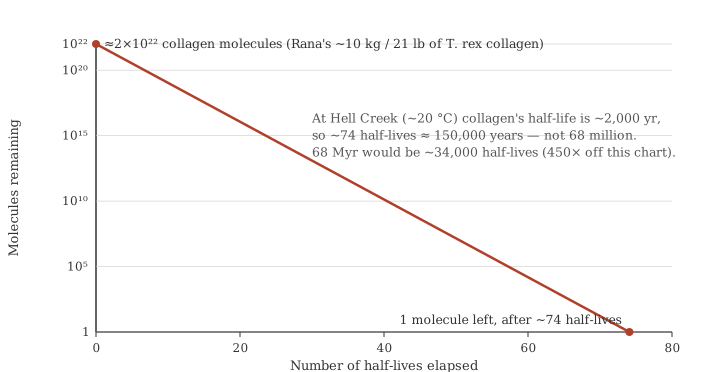
First-order decay of collagen at Hell Creek's estimated burial temperature. Even ~10 kg of collagen (Rana's figure) is ≈2×10²² molecules, and that is only ~74 half-lives above a single surviving molecule. At a ~2,000-year half-life that is ~150,000 years — while 68 million years is ~34,000 half-lives. The starting amount buys you a few dozen half-lives; it cannot buy 34,000. (This assumes native collagen kinetics — the whole dispute over preservation mechanisms, below, is whether that half-life still applies to chemically altered material.)
The table below gives predicted maximum survival times. Read it honestly, because it also contains the young-earth argument's soft spot:
| Molecule | Warm burial ~10 °C | Near-freezing ~0 °C |
|---|---|---|
| Readable DNA fragment | ~10–100 thousand yr | ~125 thousand yr |
| Bone collagen | ~0.2–0.7 million yr | ~2.7 million yr |
| Osteocalcin (a bone protein) | ~7.5 million yr | ~110 million yr |
| Dinosaur bones, for comparison | 66–150 million yr | 66–150 million yr |
Every figure here is a laboratory-kinetics extrapolation, not a number read off an old fossil: the DNA row is Allentoft's rate from radiocarbon-dated moa bones, the collagen and osteocalcin rows are from heated-bone experiments (Buckley & Collins; Collins et al.) projected to burial temperatures, as tabulated by Nielsen-Marsh, whose primary is paywalled. Treat them as order-of-magnitude ceilings.22 23 3 21
Notice the osteocalcin row, and read it honestly, because it is softer than it looks. That ~110-million-year figure is a laboratory result, not a fossil one: Collins and colleagues heated modern bone at 75–95 °C, measured how fast osteocalcin broke down, and extrapolated the rate to freezing. It is not back-calculated from any old-dated fossil, so it is not circular — but their actual conclusion was only that survival of the mineral-bound core of the protein "cannot be excluded on kinetic grounds," not that it has been shown to last that long.22 And no one has ever recovered verified osteocalcin from deep-time bone; the osteocalcin-in-dinosaur reports that first motivated the estimate were later abandoned as antibody false positives.24 So a blanket "no biomolecule can last 66 million years" would be wrong, but the honest, defensible claim is narrower and still forceful: DNA and ordinary collagen, in bone that did not stay cold, should be long gone — and the dinosaur soft-tissue finds come from the Montana badlands, not permafrost.
Preservation mechanisms: the mainstream answer
If the molecules should be gone, why aren't they? The scientists who found the tissue — every one of whom accepts the 66-million-year age — treat this as a preservation puzzle, not a dating error. They have proposed real, testable chemistry.
Molecular shielding. When Schweitzer's collagen fragments were mapped onto the collagen structure, they clustered in the regions "protected by the close packing of collagen molecules," a non-random pattern the authors argue points to genuine dinosaur origin and "a chemical mechanism for survival."25 The most buried parts of a tightly packed fiber degrade slowest.
Iron and Fenton chemistry. Schweitzer's best-known proposal is that iron released from blood after death drives free-radical reactions that cross-link proteins, acting like formaldehyde in a specimen jar. Her 2014 experiment soaked ostrich blood vessels in concentrated hemoglobin. The result: hemoglobin "increased tissue stability more than 200-fold, from approximately 3 days to more than two years at room temperature."26 Iron particles (goethite) were found stuck to the fossil tissues. Follow-up work on T. rex vessels concluded that "non-enzymatic crosslinking pathways likely contributed to stabilizing, and thus preserving" them.27
What the iron effect would have to do. The 200-fold figure can be set against the gap, with two cautions. It measures how long a whole vessel held together at 25 °C, not how fast collagen's peptide bonds break. And "more than" makes it a floor: the treated vessels were still intact when the two years ran out. Granting it anyway, the answer turns on temperature. At Buckley's Hell Creek half-life of 2,000 years, 66 million years is 33,000 half-lives. A 200-fold slowdown cuts that to 165, which still leaves about 10-50 of the collagen. Keeping 1% would take a slowdown near 5,000-fold. Keeping a single molecule out of the whole animal's 2×10²² would take about 450-fold. At the mastodon's 7.5 °C the picture reverses. The native half-life there is 130,000 years, 66 million years is 508 half-lives, and a 200-fold slowdown would leave about a sixth of the collagen.28 On Buckley's own activation energy, the 200-fold effect keeps 1% of the collagen if the bone's long-run temperature averaged about 11 °C or less, and keeps a trace up to about 21 °C. Buckley's 2,000-year figure corresponds to about 24 °C. So the iron rescue fails by dozens of orders of magnitude at the critics' temperature, and works a dozen degrees cooler. No source found for this article reconstructs the temperature of Hell Creek bone across 66 million years, and that is the measurement that would decide it. The same arithmetic cuts against an overstatement on the young-earth side: the 33,000 half-lives assume unaltered collagen in warm ground for the whole time, and neither assumption is safe.
Transformation, not survival. The most aggressive mainstream reframing says much of the "soft tissue" is not surviving protein at all. Jasmina Wiemann's 2018 study argues the brown flexible material is a diagenetic product: "Advanced Glycoxidation and Lipoxidation End Products, a class of N-heterocyclic polymers generated via oxidative crosslinking."29 On this view the shape of a vessel is preserved while the original molecules are chemically rebuilt into something new. If Wiemann is right, pointing at a stretchy vessel proves nothing about molecular survival. Her evidence is Raman spectra, though, and in 2021 Julien Alleon and five colleagues argued that the Raman signatures in her paper and five others "are actually instrumental artefacts resulting from intense background luminescence."30 Wiemann and Derek Briggs replied in 2022 in defence of the method.31 The dispute is open, and it cuts both ways: if Alleon is right, the transformation model loses the spectra it rests on, and the chemistry of the vessels is an open question again.
Notice what this means for how a careful young-earther should argue. The pliable vessels and "blood cells" are the weakest evidence, because oxidative-crosslinking and even bacterial-biofilm models can mimic their shape. The strongest evidence is the sequenced peptides (Asara 2007, Schweitzer 2009, San Antonio 2011, and the 2025 Edmontosaurus work below), because a specific amino-acid sequence is much harder to generate by accident or by polymer chemistry. Lead with the sequences, not the pictures.
Answering Fuz Rana
Rana's Dinosaur Blood and the Age of the Earth (2016) is the most substantial old-earth Christian reply, so it deserves a direct answer. Disclose the affiliation up front: Rana writes for Reasons to Believe, Hugh Ross's day-age ministry, and his stated purpose is "to help Christians understand why it makes sense... for soft tissue remains to be preserved in fossils that date to several hundred million years."2 Symmetrically, the authors we lean on against him — Armitage, Brian Thomas — are young-earth advocates, some writing in young-earth journals. Everyone here has a position; the question is who has the better chemistry.
Rana concedes both of the young-earth argument's factual pillars. The tissue "does indeed appear" to be "authentic endogenous materials."2 And he reports the fast decay data himself, including the ~14,000-year figure for Hell Creek.2 His entire case rests on a single move: durability chemistry can slow decay enough to bridge the gap. Four responses:
-
He never puts a number on his own mechanism. Rana's strongest paragraph accuses Brian Thomas of confusing thermodynamics with kinetics — decay may be favorable yet frozen, "just like diamonds do not turn into graphite."2 This is a fair chemistry lesson. But it cuts both ways: the whole question is how frozen. Thomas cites measured rates and extrapolates a survival time. Rana answers with an analogy and no rate, no measured activation energy for the altered material, and no curve reaching 66 million years. A plausibility argument cannot beat a measurement just by being plausible.
-
His headline experiment ran two years, not millions. Rana leans on the iron result: after two years the hemoglobin-soaked vessels "remained intact, but the ones in water fell apart."2 True, and it is genuinely suggestive. But it is a two-year result at constant 25 °C, in a sealed tube, using purified hemoglobin plus an anticoagulant so the iron could spread evenly. Stretching two years to 66 million is a seven-order-of-magnitude leap with no published rate model. Priced in the section above, the factor it shows would carry collagen through deep time only if the bone stayed about a dozen degrees cooler than the critics assume for Hell Creek. Rana does raise temperature, but only with the rule of thumb that reaction rates "roughly double each time the temperature increases by 10°C."2 For collagen, Buckley's activation energy gives about twelve-fold per 10 °C, a much steeper curve that would help Rana's case if the bone stayed cool and sink it if it did not. He prices neither. Honesty requires saying this cuts against both sides: the experiment neither proves deep-time survival nor proves youth.
-
The "21 pounds of collagen" point answers the wrong question. Rana argues that because a T. rex held so much collagen, detecting a trace after a million years is unsurprising.2 That explains detectability given some survival; it does nothing for survival time. As the figure above shows, exponential decay at Hell Creek temperatures erases even 10 kg of native collagen in about 150,000 years. The starting mass is irrelevant across 34,000 half-lives.
-
He barely engages DNA — the one molecule his mechanism can't save. This is the sharpest gap, and Armitage names it: "osteocytes are not collagen. They are delicate cells with no cross-linking in their structure. For that matter, neither is DNA, with no cross-linking whatsoever."32 Every mechanism in Rana's chapter — packing, mineral binding, iron cross-linking — is about cross-linking stable, fibrous, or mineral-bound molecules. DNA has none of those defenses, its decay is measured and steep, yet Schweitzer reports DNA-consistent signal inside dinosaur cells. Rana's book does not resolve this.
We should not overstate Armitage's point, though. His "no cross-linking whatsoever" is itself too strong: DNA-protein and sugar-protein (Maillard) cross-links are real, and Schweitzer's own 2014 title covers "cells and molecules," not just vessels. Treat DNA as the open problem that most pressures deep-time preservation models — not as a knockout blow.
DNA: the hardest case for deep time
The DNA thread is where the young-earth argument is most interesting and where it is most easily oversold. Both must be said in the same breath.
What Schweitzer's 2013 paper actually reports is that antibodies to DNA and to histone H4, plus the DNA-binding stains propidium iodide and DAPI, bound to material inside dinosaur osteocytes.14 A 2020 study went further, reporting cell structures "consistent with" nuclei and chromosomes, with the same DNA stains, in ~75-million-year-old Hypacrosaurus cartilage.33 On measured decay kinetics, endogenous DNA should not be there at all. That is a real anomaly, published in mainstream journals.
But it is stains and antibodies binding to something DNA-like — never a recovered sequence. Schweitzer herself stresses that only a sequence could prove the DNA is original to the animal. No dinosaur DNA sequence exists. So the honest claim is bounded: endogenous DNA would be inconsistent with a 66-million-year age if the signal is what it appears to be — not that "dinosaur DNA proves a young earth." Contamination from bacteria, fungi, or handling is a live possibility for any trace-level DNA signal, and Saitta's work (below) shows dinosaur bone is full of modern microbial DNA.
Radiocarbon in dinosaur bone: real, but not an age
Brian Thomas of the Institute for Creation Research and Vance Nelson had 16 fossil samples radiocarbon dated, including dinosaur bones, and found carbon-14 in every one. Their conclusion, in their own words: fossils throughout the rock record "contain measurable amounts of radiocarbon that is most probably endogenous."34 Thomas's 2018 Liverpool thesis gathers 21 Mesozoic results from nine dinosaurs at five laboratories. They run from 0.57 to 6.61 pMC (percent of modern carbon), which read as radiocarbon ages of about 41,500 and 21,800 years.35
The measurements are real, and a mainstream team has now matched them. The question is where the carbon-14 came from. This article does not read it as an age, for three reasons.
1. The rock around the bone carries it too, often more of it. In 2019 Evan Saitta's team dug a Centrosaurus bone out of the ground with aseptic methods and dated the carbon in it. The bone read 1.49 pMC, inside Thomas's range. The Cretaceous mudstone touching the bone read 5.73 pMC, mudstone 23 metres higher read 6.28, and the topsoil above read 76.6.36 Saitta's reading: "this suggests an influx of more modern C (i.e. not radiocarbon dead) into the fossil."36 The same bone held a living microbial community unlike the one in the surrounding rock. Thomas's own table shows the same pattern. The rock around his Triceratops femur GDFM03.001 read 8.48 pMC, more than any fraction of the bone itself (1.38 to 4.83), and the humic acids and concretion with his hadrosaur read 72.7 and 78.5 pMC.35 A young-earth reader can fairly reply that the mudstone was laid down in the Flood too and should carry radiocarbon for the same reason as the bone. But the numbers show the bone sits in an open system with modern carbon a few metres away, and in an open system a measured ratio is a mixture, not a date.
2. Uranium does not make it. Fossil bone really does soak up uranium from groundwater, and uranium and thorium do make neutrons that can turn nitrogen into carbon-14. Phil Senter's 2020 article for biology teachers lists "bacterial activity and uranium decay" among the ways fossil bone "incorporates new radiocarbon."37 The uranium route fails when it is priced. With every input set in its favour, it supplies 228 to 6,500 times too little carbon-14 to explain Thomas's 21 values, and it reaches a steady level in about 38,000 years, so it could not tell a young bone from an old one anyway.38 Thomas reaches the same verdict on uranium in his thesis.35 Of Senter's routes, recrystallization of the bone mineral and bacteria remain; uranium does not.
3. Contamination is shown in the bone, but not measured specimen by specimen. When Johan Lindgren's team dated a 70-million-year-old mosasaur bone, they measured "4.68%±0.1 of modern 14C activity," an apparent age of 24,600 years, and judged it to "most likely reflect bacterial activity near the outer surface of the bone." They added the caveat in the same sentence: "no bacterial proteins or hopanoids were detected," though one bacterial DNA sequence and bone-boring cyanobacteria were found.12 Thomas and Nelson answer that "the study authors suggested, but did not show convincing evidence, that bacterial contamination caused their result,"34 and on that narrow point they are right: Lindgren's attribution is a likely explanation, not a demonstration. Thomas also argues that results from five laboratories and three bone fractions, in "a relatively tight range," rule out incomplete cleaning.35 That range spans a factor of eleven in carbon-14, and the matrix and humic values in his own table sit outside it on the modern side. Provenance is a further problem: the two hadrosaur bones in the 2015 study were acquired from "a professional fossil dealer."34
The young-earth reading predicts carbon-14 in every fossil, and so does contamination of an open system. The measurements so far do not separate the two. The rock around the bones carries as much carbon-14 or more, which contamination expects and a Flood model can also accommodate, and the bone hosts the living microbes and modern carbon that contamination needs. A test that could tell them apart would date a sealed fraction that groundwater cannot reach. Until then, radiocarbon in dinosaur bone cannot be read as an age, and the explanation with a demonstrated route into the bone, contamination, is the more economical one. The full treatment is in this site's radiocarbon article.
Contamination and the biofilm challenge
The strongest naturalistic objection is not about mechanism at all; it is that the structures might not be original. Thomas Kaye argued in 2008 that the "vessels" and "cells" are modern bacterial biofilms: slime that coats the inside of hollow bone spaces, then survives as a cast that "mimic[s] real blood vessels and osteocytes."39 In 2019 Evan Saitta's team excavated dinosaur bone with aseptic methods and found it hosts "an abundant microbial community" and "recent organic material," living contamination in an open system where proving any molecule is original is genuinely hard. Their bone's "soft tissues" also "differed from collagen chemically and structurally."36 Buckley showed in 2017 that modern contamination can even masquerade as a plausible fossil peptide sequence.40 And a 2021 reanalysis reinterpreted Bertazzo's "blood cells" as diagenetic mineral structures.41
These are serious, and they are the reason the sequenced peptides matter more than the pictures. The discoverers' replies are also on the record: biofilm does not explain the 67 nm collagen banding, the antibody specificity, or why the spectra differ from known biofilms.12 The debate is unsettled, and a fair article leaves it unsettled.
The most recent evidence
The literature since 2018 has both strengthened and complicated the picture, and a credible article reports both directions.
Strengthening the "original biochemistry" side: in 2025 a paper in the mainstream ACS journal Analytical Chemistry reported collagen peptides plus immunoassay results from a Cretaceous Edmontosaurus.42 It is worth attention precisely because it ran the modern methods and passed peer review — though its co-authors include the Institute for Creation Research's Brian Thomas, which we disclose. We also disclose the embarrassment that followed: the authors had to publish a correction after a control spectrum in a figure turned out to be "the Edmontosaurus data set reformulated and stretched" by their plotting software.42 The correction is itself a mark of a working process, but it is the kind of error a skeptic will rightly seize on.
Complicating it: Wiemann's transformation model29 and Saitta's living-microbiome result36 are the mainstream's answer, and both accept deep time. Brian Thomas's 2018 University of Liverpool PhD thesis is real original work — spectroscopy across Devonian-to-Cretaceous bone — and should be cited as such, with the disclosure that its author works for a creationist institute.35 His CRSQ isotope paper with Chadwick and Taylor (2025) reports new stable-carbon measurements but appears in the Creation Research Society's house journal, whose members must affirm young-earth conclusions in advance, so we treat it as a disclosed curiosity, not as independent confirmation.43
What deep-time protein looks like elsewhere. Two mainstream results set the benchmark, and a skeptic will cite both. Demarchi's team read protein sequences from ostrich eggshell at Laetoli, Tanzania, 3.8 million years old by the conventional dates, held in place by binding to the calcite crystal. They put its thermal age at the "equivalent to ~16 Ma at a constant 10˚C."4 In 2025 Daniel Green's team recovered fragments of four enamel proteins from 16- and 18-million-year-old teeth in Kenya's Turkana Basin, "one of the persistently warmest regions on Earth."44 So protein can outlast the native kinetics in the table above, and the young-earth argument must not say otherwise. The honest reply is about what survived and where. Both are proteins sealed inside dense mineral crystals, not collagen in porous bone that groundwater and microbes move through. Green's fragment counts fall steadily with age. And Green's team accepted as high-confidence fossil peptides only those that "are not collagens," listing collagens among the merely "putative" ones, even at 18 million years.44 Collagen is the protein most often reported from dinosaur bone, which is about four times older. By the standards of the field's own best results, those collagen peptides are either contamination, as Buckley and Saitta argue, or a real anomaly, as the young-earth side argues. The benchmarks do not make them routine.
Racemization runs the other way. Amino acids come in left- and right-handed forms. Living things build proteins from the left-handed form only, and after death the amino acids slowly flip until the two forms are equal, a process called racemization. In 1999 Jeffrey Bada measured a Tyrannosaurus bone from Montana and found "highly racemized aspartic acid and alanine."45 In 2024 Saitta, with Demarchi and Kirsty Penkman, analysed amino acids sealed inside the calcite of titanosaur eggshells from Argentina. Some of the slowest-flipping amino acids were "fully racemic," and mass spectrometry found no dinosaur peptide at all. The authors conclude the proteins had most likely broken down completely to single amino acids.46 That is what tens of millions of years predicts at ordinary temperatures. Heat is the only young-earth way out, and it can be priced for the fastest case. By Bada's own rate law, aspartic acid in bone goes fully racemic within 4,500 years at a constant 36 °C,47 which is warm but not absurd for buried sediment. So the aspartic acid in Bada's T. rex does not demand deep time by itself. His alanine, which flips more slowly, and the slow amino acids in Saitta's sealed eggshells need more heat than that, and no young-earth source found for this article prices it. This is a real weakness for the young-earth reading. The site's amino acid racemization article treats it in full.
Strengths and weaknesses
Laid out plainly, because the point of this archive is that you can check us.
Where the young-earth argument is genuinely strong:
- The finds are real, cumulative, independent, and mainstream. An old-earth biochemist concedes they are authentic, though palaeoproteomics specialists still dispute it.
- The decay kinetics are secular, quantitative, and steep. For DNA and unstabilized collagen, measured rates predict destruction thousands of times over before 66 million years.
- No proposed preservation mechanism has ever been demonstrated over deep time. The best experiment reaches two years. The leap to 66 million is unvalidated in either direction, and that is the single most honest and durable card the argument holds.
- The field's own best deep-time protein results, Demarchi's eggshell and Green's 18-million-year enamel, come from sealed mineral crystals, decline with age, and do not accept collagen as high-confidence. Collagen peptides from bone four times older sit outside what they show.
Where it is weak, and where careful people should stop:
- "No biomolecule survives 66 million years" is false by the young-earther's own sources; a tough protein near freezing might, and mineral-sealed protein fragments are reported at 18 million years in hot Kenya. Restrict the claim to DNA and warm-buried collagen.
- The kinetic clock is itself an extrapolation from lab heat and Holocene bone, projected far outside where it was measured. The finds show these molecules last longer than baseline predicts — a real anomaly, not a refutation of dating.
- "Dinosaur DNA" is stains and antibodies, never a sequence. Overstating it discredits everything around it.
- Radiocarbon in dinosaur bone is real, but the rock and soil around the bones carry as much or more, and the bone is an open system with living microbes. It cannot be read as an age. Uranium is not the reason: in-situ production falls 228 to 6,500 times short.
- Amino acids from dinosaur bone and from sealed dinosaur eggshell are racemized, as deep time predicts. Heat can explain the fastest of them in a few thousand years; for the slowest, no young-earth source has priced it.
- The iron rescue is not hopeless for the mainstream. Its measured factor would preserve collagen if the bone's long-run temperature stayed near 11 °C. The young-earth case depends on the bone having been warmer, and no source found for this article reconstructs it.
- Every scientist whose data this rests on accepts the conventional ages and reads the finds as a preservation puzzle. Using their measurements while rejecting their conclusion is legitimate — but it must be done in the open, not by hiding that they disagree with us.
Conclusion
Soft tissue in dinosaur bones is a real, well-documented anomaly. On measured chemistry, DNA and ordinary collagen should not survive 66 million years, and they seem to anyway. That genuinely pressures deep-time models of molecular preservation, and the mainstream's rescue mechanisms are real chemistry that has never been shown to work over the required timescale.
It is not, by itself, proof of a young earth. The decay clock is an extrapolation; a preservation mechanism that works would dissolve the problem; the DNA claims are unconfirmed; the radiocarbon in the bone cannot be read as an age; and the amino acids that can be checked are racemized. The strongest, most defensible statement is the modest one: these molecules survive far longer than baseline kinetics predict, no one has demonstrated a mechanism that reaches deep time, and that unsolved gap is a real and growing problem for the standard story. That is enough to make the question live. It is not enough to close it — and saying more than the evidence allows is how you lose a skeptic who was willing to listen.
Sources
- 1.
Stokstad, Erik. “Tyrannosaurus rex Soft Tissue Raises Tantalizing Prospects.” Science 307:1852. 2005. Schweitzer is speaking. “It was totally shocking... I didn't believe it until we'd done it 17 times.” A news item in Science that reports the soft tissue found in Tyrannosaurus rex. The article uses it for Schweitzer's reaction to the find. ↩
- 2.
Rana, Fazale. Dinosaur Blood and the Age of the Earth. RTB Press, Covina CA. 2016. A popular book by Fazale Rana, a biochemist with Reasons to Believe, an old-earth (day-age) Christian ministry. Its stated purpose is to explain why soft tissue can be preserved in fossils several hundred million years old. The article uses it for Rana's concession that the soft tissue is authentic, and for the decay figures and claims he reports. The ISBN is 978-1-886653-18-4.
- 2a.
Page 30: “it does indeed appear that the soft tissue remnants isolated from a wide range of fossilized specimens are authentic endogenous materials, despite the protests of some skeptical paleontologists.” ↩ ↩
- 2b.
Page 12: “This leads us to the purpose of this book; namely, to help Christians understand why it makes sense—from a biochemist's standpoint—for soft tissue remains to be preserved in fossils that date to several hundred million years in age.” ↩
- 2c.
Page 70: Jack Horner's words, quoted by Rana: “would, if they were real, be remnants of red blood cells with some of the original chemicals remaining, and some of the structure, but with other parts changed forever.” Rana's own words: “They have not isolated intact, unaltered proteins, but fragments.” ↩
- 2d.
Page 34: Reporting the Manchester team's estimates: “the burial temperatures (20°C) for the T. rex specimen unearthed at Hell Creek Formation would have insured the loss of all the collagen (save for 1 percent) on the order of 14,000 years”. Pages 33–34: “200,000 and 700,000 years for 99 percent of the original collagen to decay”. The second figure is for a temperature of 10 °C. ↩ ↩
- 2e.
Page 67: Rana identifies an error by Thomas: “error: failing to distinguish between thermodynamically controlled and kinetically controlled chemical reactions”. Rana adds: “all the diamonds in the world should spontaneously transform into graphite. But they do not and they will not.” ↩
- 2f.
Page 65: “After two years, the blood vessels in the hemoglobin bath remained intact, but the ones in water fell apart. So, it looks as if iron does indeed play a role in preserving soft tissues in dinosaur bones after they die.” ↩
- 2g.
Pages 69–70: A 12-ton T. rex would hold ~2,100 lb of collagen, so even 1% survival is. “21 lbs”. Rana also says: “diagenesis will produce chemically altered forms of collagen that will persist in animal remains well beyond a million years.” ↩ ↩
- 2h.
Page 72: “The existence in fossils of materials derived from blood vessels, cells, and biomolecules is fully compatible with an old-earth view and in no way validates YEC.” ↩
- 2i.
Page 65: “The rates of chemical reactions roughly double each time the temperature increases by 10°C (18°F).” ↩
- 2a.
- 3.
Allentoft, Morten E. et al. “The half-life of DNA in bone: measuring decay kinetics in 158 dated fossils.” Proceedings of the Royal Society B. 2012. A field study that measured how fast DNA breaks down in 158 moa bones, each dated by radiocarbon. A half-life is the time for half of the molecules to break apart. It found that a 242 bp fragment of mitochondrial DNA has a half-life of 521 years at 13.1 °C, and it gives a per-site fragmentation rate of k = 5.5×10⁻⁶/yr. The article uses it as the cleanest measured rate for DNA decay, because it comes from dated bones and not from a laboratory extrapolation. Mirror: Media.longnow.org ↩ ↩ ↩
- 3a.
A Nature News write-up of this study, from 2012: https://www.nature.com/articles/nature.2012.11555. The quoted words are its headline, not the paper's own wording. “DNA has a 521-year half-life”. ↩
- 3a.
- 4.
Demarchi, Beatrice et al. “Protein sequences bound to mineral surfaces persist into deep time.” eLife 5:e17092. Sep 27, 2016. A multi-laboratory study led by Beatrice Demarchi and Matthew Collins that sequenced the protein struthiocalcin from ostrich eggshell at Laetoli (3.8 million years) and Olduvai (1.3 million years) in Tanzania, and used molecular simulations to show that the surviving part is the part that binds most strongly to the calcite crystal. It is the best mainstream evidence that mineral binding preserves protein over millions of years, and its authors judge the dinosaur soft-tissue claims unproven. The article uses it both ways. Mirror: Cdn.elifesciences.org
- 4a.
Page 2, section Introduction: “Claims for exceptional preservation in the fossil record have been put forward in a number of studies (Towe and Urbanek, 1972; Bertazzo et al., 2015; Schweitzer et al., 2013; Cleland et al., 2015), but these have not been satisfactorily substantiated.” ↩
- 4b.
Page 2, section Abstract: “Thermal age calculations demonstrate that the Laetoli and Olduvai peptides are 50 times older than any previously authenticated sequence (equivalent to ~16 Ma at a constant 10˚C).” ↩
- 4a.
- 5.
Schweitzer, Mary H. et al. “Soft-Tissue Vessels and Cellular Preservation in Tyrannosaurus rex.” Science 307:1952–1955. 2005. “Transparent, flexible, hollow blood vessels”. “elasticity and resilience”. A research paper on soft tissue from Tyrannosaurus rex specimen MOR 1125 (PubMed ID 15790853). The article treats it as the start of the modern story of dinosaur soft tissue. ↩
- 6.
Yeoman, Barry. “Schweitzer's Dangerous Discovery.” Discover Magazine. Apr 2006. Schweitzer, on the T. rex bone: “It smelled just like one of the cadavers we had in the lab who had been treated with chemotherapy before he died.” A magazine article about Schweitzer's discovery in a Tyrannosaurus rex bone. The article cites it for Schweitzer's remark that the bone smelled organic. Mirror: Archive.org ↩
- 7.
Asara, John M. et al. “Protein Sequences from Mastodon and Tyrannosaurus rex Revealed by Mass Spectrometry.” Science. 2007. A laboratory study that used mass spectrometry, a machine that identifies molecules by weighing their pieces, to read collagen peptides (short chains of amino acids) from a 68-million-year-old Tyrannosaurus rex bone. It found that the peptide bonds were remarkably stable. The article uses it to show that actual protein sequences, not just shapes, were recovered from a T. rex. ↩
- 8.
Schweitzer, Mary H. et al. “Biomolecular Characterization and Protein Sequences of the Campanian Hadrosaur B. canadensis.” Science 324:626–631. 2009. “robustly support the bird-dinosaur clade”. “confirm that molecular preservation in Cretaceous dinosaurs is not a unique event.” A research paper that reports protein sequences, the order of amino acids that build proteins, from Brachylophosaurus canadensis, a duck-billed dinosaur (PubMed ID 19407199). The article cites it as the case in which real protein sequences were recovered, not only shapes. ↩
- 9.
Cleland, Timothy P. et al. “Mass Spectrometry and Antibody-Based Characterization of Blood Vessels from Brachylophosaurus canadensis.” Journal of Proteome Research. 2015. The authors' conclusion was that the vessel peptides were: “not consistent with a bacterial, cellular slime mold, or fungal origin”. A study of blood vessels from Brachylophosaurus canadensis, using mass spectrometry and antibodies to identify the proteins in them. Its data were deposited in the ProteomeXchange database under PXD001738. The article uses it as the proteomics result on these vessels. Mirror: PMC ↩
- 10.
Bertazzo, Sergio et al. “Fibres and cellular structures preserved in 75-million-year-old dinosaur specimens.” Nature Communications 6:7352. 2015. The authors describe the fossils as: “are not exceptionally preserved and show no external indication of soft tissue.” A materials-science study by researchers at Imperial College. It found collagen-like fibres with about 67 nm banding, the repeating pattern that is collagen's fingerprint, and structures resembling red blood cells. The article uses it to show that ordinary fossils, not just prize specimens, can carry these traces, so preservation may be common. ↩
- 11.
Sample, Ian. “75m-year-old dinosaur blood and collagen discovered in fossil fragments.” The Guardian. Jun 9, 2015. Susannah Maidment, co-author of Bertazzo et al. 2015, speaking: “The ones we tested are crap, very fragmentary, and they are not the sorts of fossils you'd expect to have soft tissue.” A newspaper report on the 2015 study by Bertazzo and colleagues. The article uses one co-author's words about the fossils to show that they were ordinary specimens, not prize ones. ↩
- 12.
Lindgren, Johan et al. “Microspectroscopic Evidence of Cretaceous Bone Proteins.” PLoS ONE 6(4):e19445. 2011. The fibrils. “differ significantly in spectral signature”. from bacterial biofilms. The study also measured the radiocarbon in the 70-million-year-old bone, finding. “4.68%±0.1 of modern 14C activity”. and attributed it to. “bacterial activity near the outer surface.” A study of microscopic structures in a mosasaur (an extinct marine reptile) bone. It found collagen antibodies and 67 nm D-periodicity, the repeating banding pattern of collagen. The article uses it for the collagen result, and for the radiocarbon measurement that the authors attribute to contamination. ↩ ↩
- 12a.
Section Discussion, subsection on excluding fungal growth and animal glue: “Likewise, the amount of finite carbon was exceedingly small, corresponding to 4.68%±0.1 of modern 14C activity (yielding an age of 24 600 BP), and most likely reflect bacterial activity near the outer surface of the bone (although no bacterial proteins or hopanoids were detected, one bacterial DNA sequence was amplified by PCR, and microscopic clusters of bone-boring cyanobacteria were seen in places along the perimeter of the diaphyseal cortex).” ↩
- 12a.
- 13.
Pan, Yanhong et al. “Molecular evidence of keratin and melanosomes in feathers of the Early Cretaceous bird Eoconfuciusornis.” PNAS 113(49). 2016. A study of molecular traces in the feathers of Eoconfuciusornis, an early Cretaceous bird. It found β-keratin, the protein that makes up feathers, retained in a feather about 130 million years old. The article uses it as its example of a protein surviving in a feather from a 130-million-year-old bird. Mirror: PMC ↩
- 14.
Schweitzer, Mary H. et al. “Molecular analyses of dinosaur osteocytes support the presence of endogenous molecules.” Bone 52(1):414–423. 2013. “consistent with”. A study of osteocytes, the cells that live inside bone, taken from dinosaur fossils. It found proteins specific to bone cells (actin, tubulin, PHEX and histone H4), and anti-DNA antibodies and the DNA dyes propidium iodide (PI) and DAPI bound inside the cells, a signal consistent with DNA but not a recovered sequence. The article cites it as an anomaly: DNA-like signals that measured decay rates say should not survive. ↩ ↩
- 15.
Armitage, Mark H., and Kevin L. Anderson. “Soft sheets of fibrillar bone from a fossil of the supraorbital horn of the dinosaur Triceratops horridus.” Acta Histochemica. 2013. The paper's words about the extensions: “showing no evidence of any permineralization.” A paper in a mainstream journal published by Elsevier. It reports bone cells (osteocytes) with soft filipodial extensions in a fossil Triceratops horn. Lead author Mark Armitage is an openly young-earth creationist, but the paper itself makes no claim about the age of the earth. The article uses it because a peer-reviewed paper in a mainstream journal reports these cells, and the journal cannot be waved away as a creationist outlet. ↩
- 16.
Hebsgaard, Martin B. et al. “Geologically ancient DNA: fact or artefact?” Trends in Microbiology. 2005. A paper that models how long DNA can survive in ancient material. It sets a practical survival ceiling near 100 thousand years for short DNA fragments that can be amplified (copied in the laboratory). The article cites it for that one model, which puts the practical limit for amplifiable DNA near 100,000 years. ↩
- 17.
Dalén, Love et al. “Deep-time paleogenomics and the limits of DNA survival.” Science. 2023. A Science paper on how far back DNA can be recovered. The oldest reconstructed genome comes from a 1–2-Myr mammoth. The oldest isolated DNA comes from ~2-Myr Greenland sediment, which is the empirical ceiling on DNA survival and ~30× younger than dinosaurs. The article uses it to show how old the oldest genome and the oldest DNA actually are. Mirror: PMC ↩
- 18.
Lindahl, Tomas. “Instability and decay of the primary structure of DNA.” Nature. 1993. On multi-million-year DNA claims, the paper says they are. “incompatible”. with DNA's chemistry. A chemistry paper on how the structure of DNA breaks down. Hydrated DNA degrades to short fragments within thousands of years. The article uses it for the chemistry that rules out DNA lasting for millions of years. ↩
- 19.
Pääbo, Svante. “Ancient DNA.” Scientific American 269(5):86–92. Nov 1993. A general article on ancient DNA. It explains that water strips bases, the chemical letters of DNA, from the molecule, and that oxygen plus background radiation set hard survival limits well under a million years. The article uses it for those limits on how long DNA can last. ↩
- 20.
Buckley, Michael et al. “Comment on 'Protein Sequences from Mastodon and Tyrannosaurus rex Revealed by Mass Spectrometry'.” Science 319:33. 2008. A technical comment by 27 ancient-protein and ancient-DNA researchers, led by Michael Buckley and Matthew Collins, on the 2007 T. rex and mastodon protein sequences. It sets the collagen half-life expected from heated-bone kinetics, with an activation energy of 173 kJ/mol, against each fossil's burial temperature, and finds survival plausible for the mastodon and implausible for the T. rex. It also raises contamination and the statistics of the peptide matches. The article uses its two half-lives as the baseline that any preservation mechanism has to beat. Mirror: PMC
- 20a.
Section Likelihood of collagen survival: “The packing which stabilises collagen fibrils (6) also increases the temperature sensitivity of degradation (Ea 173 kJ mol-1; Fig. 1). Collagen decomposition would be much faster in the T. rex buried in the then megathermal (>20 °C) (7) environment of the Hell Creek formation (collagen t ½ ~ 2 ka) than it would have been in the mastodon lying within the Doeden Gravel Beds (present day mean temperature 7.5 °C; collagen t ½ 130 ka; Fig. 1).” ↩ ↩
- 20a.
- 21.
Buckley, Michael, and Matthew J. Collins. “Collagen survival and its use for species identification in Holocene–lower Pleistocene bone fragments.” Antiqua 1(1):e1. 2011. The heating figures are summarised as: “90 °C heating, 0.2–0.7 Myr to 1% collagen at 10 °C”. A study of collagen survival in bone, used here to estimate how long collagen lasts at burial temperatures. Its figures come from heating bone to 90 °C, and they give 0.2–0.7 Myr for 1% of collagen to remain at 10 °C. The article uses them for the cooler-burial estimate, next to the Hell Creek figure of roughly 14,000 years. ↩ ↩
- 22.
Collins, Matthew J. et al. “Slow rates of degradation of osteocalcin: green light for fossil bone protein?” Geology 28(12):1139–1142. 2000. Their conclusion for the mineral-bound γ-carboxylated mid-region of the protein was: “cannot be excluded on kinetic grounds”. A laboratory study that heated modern bone powder at 75–95 °C, followed three regions of the protein osteocalcin with a monoclonal antibody, and extrapolated the breakdown rates down to lower temperatures. The article uses it as the laboratory source behind its osteocalcin figure, which is an upper limit rather than a demonstrated survival. ↩ ↩
- 23.
Nielsen-Marsh, Christina. “Biomolecules in fossil remains.” The Biochemist 24(3):12–14. 2002. A compilation of the upper limits on how long proteins survive in fossil remains: about 2.7 million years for collagen, and about 110 million years for osteocalcin at 0 °C. The article takes its collagen and osteocalcin figures from its comparison table. ↩
- 24.
Wadsworth, Caroline, and Michael Buckley. “Proteome degradation in fossils: investigating the longevity of protein survival in ancient bone.” Rapid Communications in Mass Spectrometry 28:605–615. 2014. “was even thought to survive in Mesozoic dinosaurs until the aforementioned issues with immunological studies of fossil proteins were realised”. A paper on how long proteins survive in ancient bone. It records that osteocalcin, a bone protein, was once thought to survive in Mesozoic dinosaurs, and that those deep-time detections were later abandoned as antibody false positives. The article cites it when it says that no one has ever recovered verified osteocalcin from deep-time bone. ↩
- 25.
San Antonio, James D. et al. “Dinosaur Peptides Suggest Mechanisms of Protein Survival.” PLoS ONE 6(6):e20381. 2011. “protected by the close packing of collagen molecules”. A research paper that compared short protein chains (peptides) recovered from dinosaur tissue with collagen, a structural protein, and its fibrils, the fibers it forms. The peptides map to fibril regions that are protected by the close packing of collagen molecules, a non-random pattern. The article cites it for the idea that the most buried parts of a tightly packed fiber degrade slowest. ↩
- 26.
Schweitzer, Mary H. et al. “A role for iron and oxygen chemistry in preserving soft tissues, cells and molecules from deep time.” Proceedings of the Royal Society B 281:20132741. 2014. “increased tissue stability more than 200-fold, from approximately 3 days to more than two years at room temperature (25 °C)”. A laboratory experiment that used ostrich blood vessels as a model and tested how purified hemoglobin, the oxygen-carrying protein in blood, affects how long tissue lasts at room temperature. The experiment also used K3EDTA, an anticoagulant that stops blood from clotting, and the authors found goethite, an iron mineral, on fossil tissues. The article uses it for the proposal that iron released from blood after death drives chemical cross-linking, like formaldehyde in a specimen jar. ↩ ↩
- 27.
Boatman, Elizabeth M. et al. “Mechanisms of soft tissue and protein preservation in Tyrannosaurus rex.” Scientific Reports 9:15678. 2019. The authors conclude: “non-enzymatic crosslinking pathways likely contributed to stabilizing, and thus preserving, these T. rex vessels.” A study of how soft tissue and proteins were preserved in Tyrannosaurus rex fossils. The article uses it because its authors conclude that chemical cross-linking, a reaction that binds molecules to each other, probably helped keep the vessels intact. ↩
- 28.
Computed with research/decay-pricing.ts. Inputs: Buckley's collagen half-lives of about 2,000 years for Hell Creek and 130,000 years at 7.5 °C, with his activation energy of 173 kJ/mol;20 Schweitzer's "more than 200-fold";26 and the 2×10²² collagen molecules the figure above takes from Rana's 10 kg. The fraction left is one half raised to the number of half-lives, over 66 million years. At Hell Creek: 33,000 half-lives native, leaving 10-9,934; 165 with the 200-fold effect, leaving 10-50; slowdown needed for 1% left about 4,970-fold, for one molecule left about 445-fold. At 7.5 °C: 508 half-lives native, 2.5 with the 200-fold effect, leaving about 16%. On the Arrhenius curve through Buckley's 7.5 °C point, the 200-fold effect leaves 1% at an effective 11.2 °C and one molecule at 20.9 °C, and Buckley's 2,000-year Hell Creek figure falls at 24.2 °C. ↩
- 29.
Wiemann, Jasmina et al. “Fossilization transforms vertebrate hard tissue proteins into N-heterocyclic polymers.” Nature Communications 9:4741. 2018. They are described as. “Advanced Glycoxidation and Lipoxidation End Products... generated via oxidative crosslinking”. A research paper arguing that much of what is called soft tissue in fossils is a diagenetic product, meaning a product of chemical change after burial. On this view the shape of the tissue is preserved while the original protein is transformed. The article cites it as the most aggressive mainstream reframing of the soft-tissue finds, and adds that later workers question whether her method uniquely identifies these polymers. ↩ ↩
- 30.
Alleon, Julien et al. “Pushing Raman spectroscopy over the edge: purported signatures of organic molecules in fossil animals are instrumental artefacts.” BioEssays 43(4):2000295. 2021. A methods critique by Raman spectroscopists and palaeontologists. It reanalysed spectra from six studies that reported fossil biomolecules by Raman microspectroscopy, Wiemann's 2018 bone paper among them, by wavelet analysis and by repeating one experiment on a fossil from the same locality, and concludes that the reported bands are ripples from background luminescence. The article uses it as the published challenge to the evidence behind the transformation model. Mirror: Iris.unil.ch
- 30a.
Section Abstract: “Here, we show that the putative Raman signatures of organic compounds in these fossils are actually instrumental artefacts resulting from intense background luminescence.” ↩
- 30a.
- 31.
Wiemann, Jasmina, and Derek E. G. Briggs. “Raman spectroscopy is a powerful tool in molecular paleobiology: An analytical response to Alleon et al.” BioEssays. 2022. The reply by Jasmina Wiemann and Derek Briggs to Alleon and colleagues, defending the Raman method used in the 2018 paper. The article cites it so the reader knows the dispute has two sides. ↩
- 32.
Armitage, Mark H. “A critique of Dinosaur Blood and the Age of the Earth.” Journal of Creation 31(1):45–50. 2017. A critique of Fazale Rana's book by Mark Armitage, published in the journal of Creation Ministries International, a young-earth creationist ministry. It points out one checkable chemical fact: osteocytes (bone cells) and DNA have no cross-linking, the chemical bonds that Rana's mechanisms depend on. The article uses it for that one point only. ↩
- 33.
Bailleul, Alida M. et al. “Evidence of proteins, chromosomes and chemical markers of DNA in exceptionally preserved dinosaur cartilage.” National Science Review 7(4):815–822. 2020. The structures are described as. “consistent with”. nuclei and chromosomes. A study of cartilage from a dinosaur about 75 million years old, Hypacrosaurus. The authors tested it with two stains that bind DNA, propidium iodide (PI) and DAPI. The paper reports that it found DNA markers, not a recovered DNA sequence. The article uses it as a mainstream report of DNA markers in dinosaur tissue, which measured decay rates say should not survive. ↩
- 34.
Thomas, Brian, and Vance Nelson. “Radiocarbon in dinosaur and other fossils.” Creation Research Society Quarterly 51(4):299–311. 2015. A young-earth research paper in the Creation Research Society's journal. It reports AMS radiocarbon results on 16 fossil samples, among them dinosaur bones, fish and wood, all with measurable carbon-14, and plots them with published results on fossils and coal, 43 in all. The article uses it as the young-earth case for endogenous radiocarbon, in the authors' words.
- 34a.
Page 299, section Abstract: “we report detectable amounts of radiocarbon in all 16 of our samples.” “We conclude that fossils and other carbonaceous materials found throughout Phanerozoic strata contain measurable amounts of radiocarbon that is most probably endogenous.” ↩
- 34b.
Page 303: “In 2013 we acquired two hadrosaurid bones from the Lance Formation from a professional fossil dealer in the U.S. with a large personal network of fossil excavators.” ↩
- 34c.
Page 306: “The study authors suggested, but did not show convincing evidence, that bacterial contamination caused their result.” ↩
- 34a.
- 35.
Thomas, Brian D. Collagen remnants in ancient bone. University of Liverpool. 2018. A PhD thesis that uses spectroscopy, the measurement of how materials absorb or scatter light (SHG, FTIR and Raman), on bone from the Devonian to the Cretaceous, and that compiles radiocarbon results on Mesozoic bone from five laboratories. Its author works for the Institute for Creation Research. The article treats it as original work and the most careful young-earth radiocarbon compilation, and reads its own table of surrounding rock and humic acids against its conclusion. ↩
- 35a.
Table 7.1, page 206: Mesozoic bone values in pMC run from 0.57 (HRS08267, unidentified dinosaur, apatite) to 6.61 (CM00088, stegosaurid, apatite). The Triceratops femur GDFM03.001 reads 2.08 and 4.83 (apatite), 2.16 (collagen) and 1.38 (bulk, beta counting). The same table lists. “Matrix (Triceratops)”. at 8.48 pMC, and for the hadrosaurid GDFM04.001. “Humics”. at 72.7 and a concretion at 78.5. ↩ ↩ ↩
- 35b.
Table 7.4, page 220, note d: “U decay cross sections are far too low to produce even 1pMC.” ↩
- 35c.
Table 7.4, page 220, note e: “testing at five different labs and three separate bone fractions, yielding a relatively tight range of (6.61 pMC (21830 C years) to 0.57 (41490 C years), is inconsistent with incomplete removal of organics as a contaminating source.” ↩
- 35a.
- 36.
Saitta, Evan T. et al. “Cretaceous dinosaur bone contains recent organic material and provides an environment conducive to microbial communities.” eLife 8:e46205. 2019. A field and laboratory study of a Centrosaurus bone and the mudstone around it, dug out with aseptic methods in Alberta and tested by amino acid analysis, radiocarbon, DNA sequencing and spectroscopy. The bone held an abundant microbial community unlike the rock's, and its organic carbon was not radiocarbon-dead, so it is an open system in which proving a molecule original to the animal is hard. The article cites it for that contamination problem and for its radiocarbon values, the first from a mainstream team on aseptically collected dinosaur bone. ↩
- 36a.
Page 1, section Abstract: “Fossil ‘soft tissues’ differed from collagen chemically and structurally”. “16S rRNA amplicon sequencing revealed that dinosaur bone hosted an abundant microbial community”. The phrase recent organic material is from the paper's title. ↩
- 36b.
Table 2, page 11: F14C of the organic fraction, where 1 is modern: subterranean Centrosaurus bone 0.0149; adjacent mudstone matrix 0.0573; mudstone 23 m above 0.0628; topsoil 0.766; surface-eroded Cretaceous bone 0.0422. “Matrix-surrounded subterranean Centrosaurus bone core (surface scraped prior to powdering)”. ↩
- 36c.
Page 17, section Discussion, Radiocarbon: “As the C in the dinosaur bone is not radiocarbon dead, this suggests an influx of more modern C (i.e. not radiocarbon dead) into the fossil.” The authors add that the bone's lower value than its matrix suggests some old, possibly endogenous carbon. ↩
- 36a.
- 37.
Senter, Phil. “Radiocarbon in Dinosaur Fossils: Compatibility with an Age of Millions of Years.” The American Biology Teacher 82(2):72–79. 2020. A teaching article by a vertebrate palaeontologist, written for biology teachers whose students meet young-earth arguments from radiocarbon in dinosaur bone. It argues that bone mineral takes up new carbon-14 after burial, so fossil bone gives falsely young radiocarbon ages. The article cites it as the standard skeptical answer, and accepts two of its routes while rejecting the uranium one on the numbers.
- 37a.
Section Abstract: “Fossil bone incorporates new radiocarbon by means of recrystallization and, in some cases, bacterial activity and uranium decay.” ↩
- 37a.
- 38.
Computed by this site's in-situ radiocarbon calculator and worked in full in the radiocarbon article. Every input favours in-situ production: permineralised bone at 100 ppm uranium inside a 44 ppm uranium granite, and collagen fractions at the full 16% nitrogen. The ceiling is 9.5 × 10⁻³ pMC for a collagen fraction and 1.0 × 10⁻³ pMC for an apatite fraction. Set fraction by fraction against Thomas's 21 values,35 the shortfall runs from 228-fold (a collagen fraction at 2.16 pMC) to about 6,500-fold (an apatite fraction at 6.61 pMC). Production and decay reach a steady level in about 38,000 years, after which burial time drops out. To reach even 0.57 pMC a bone would need about 4% uranium by weight. ↩
- 39.
Kaye, Thomas G. et al. “Dinosaurian Soft Tissues Interpreted as Bacterial Biofilms.” PLoS ONE 3(7):e2808. 2008. The authors' words on the structures: “mimic real blood vessels and osteocytes.” A paper that argues the soft structures in dinosaur bone are modern bacterial biofilms, slime layers built by microbes, rather than original tissue. The article cites it for the strongest naturalistic objection, that the structures may not be original. ↩
- 40.
Buckley, Michael et al. “A fossil protein chimera; difficulties in discriminating dinosaur peptide sequences from modern cross-contamination.” Proceedings of the Royal Society B. 2017. A cautionary paper showing that modern contamination can produce a peptide sequence that looks like a plausible fossil one. The article uses it to show that modern contamination can even imitate a plausible fossil peptide. ↩
- 41.
Korneisel, Dana E. et al. “Putative fossil blood cells reinterpreted as diagenetic structures.” PeerJ. 2021. A reanalysis of the structures that Bertazzo's team called blood cells. It reinterprets them as diagenetic structures, meaning mineral features formed by chemical change after burial. The article cites it among the objections that the structures may not be original. ↩
- 42.
Tuinstra, L. et al. “Evidence for Endogenous Collagen in Edmontosaurus Fossil Bone.” Analytical Chemistry 97(2):2618. 2025. A paper in Analytical Chemistry, a journal of the American Chemical Society, that reports collagen peptides, short pieces of collagen protein, found with LC-MS/MS (a method that separates molecules and identifies them by mass) and an immunoassay (a test that uses antibodies), from a Cretaceous hadrosaur. Co-authors include Brian Thomas of the Institute for Creation Research and Stephen Taylor of the University of Liverpool. The article cites it as a paper that ran the modern methods and passed peer review. ↩
- 42a.
A correction notice that fixes a figure error in the authors' 2025 paper on collagen in Edmontosaurus. The article cites it as the authors' own disclosure of that error. Cited here as url https://pmc.ncbi.nlm.nih.gov/articles/PMC12079633/. The notice concerns the control spectrum labeled. “turkey”. and says it. “was mistakenly the Edmontosaurus data set reformulated and stretched by the Origins graph plotting program.” ↩
- 42a.
- 43.
Thomas, Brian et al. “Isotopic and molecular preservation in Cretaceous fossils.” Creation Research Society Quarterly 62(2):114–128. 2025. It is original measurement: fifteen new stable-carbon-isotope measurements, the ratio of two stable forms of carbon, from six Cretaceous dinosaur bones. The journal is the Creation Research Society's house journal, whose members affirm young-earth conclusions as a condition of membership, and a field provenance and chain-of-custody caveat applies. The article cites it as a result it has treated as a disclosed curiosity, not as independent confirmation. ↩
- 44.
Green, Daniel R. et al. “Eighteen million years of diverse enamel proteomes from the East African Rift.” Nature 643:712–718. Jul 9, 2025. A palaeoproteomics study that sampled the interior enamel of fossil mammal teeth from Turkana Basin sites dated 1.5 to 29 million years, by mass spectrometry with buffer controls and stated confidence criteria. It recovered fragments of enamelin, ameloblastin, MMP20 and DMP1 from 16- and 18-million-year-old rhinocerotid and proboscidean teeth, with fragment counts falling in older fossils. The article uses it as the mainstream benchmark for how far protein reaches in a hot place, and for the standard it applies to collagen.
- 44a.
Page 712, section Abstract: “Diagenetiform counts decline in progressively older fossils”. “The discovery of protein sequences within dense enamel tissues in one of the persistently warmest regions on Earth promises the discovery of much older proteomes”. ↩
- 44b.
Page 714, figure 2, caption: “We classify some peptides that are not collagens as derived from fossils with high confidence if NCBI blast searches reveal clade specificity to the sampled fossil, or few or no matches to known microbial products”. “Putative diagenetiforms also include AMELX, AMTN and several collagens.” ↩
- 44a.
- 45.
Bada, Jeffrey L. et al. “Preservation of key biomolecules in the fossil record: current knowledge and future challenges.” Philosophical Transactions of the Royal Society B 354(1379):77–87. 1999. A review, by the chemist who developed amino acid racemization dating and two colleagues, of how amino acids, proteins and DNA degrade in fossils, with their own measurements on dinosaur bone and eggshell. The article uses its Tyrannosaurus result as the direct racemization test on dinosaur bone. Mirror: Europe PMC
- 45a.
Page 82: “The Tyrannosaurus bone from Montana contains highly racemized aspartic acid and alanine”. Page 83: “the dinosaur eggshells and bones we analysed contain only trace amounts, if any, of their original amino acids, along with exogenous components.” ↩
- 45a.
- 46.
Saitta, Evan T. et al. “Non-avian dinosaur eggshell calcite can contain ancient, endogenous amino acids.” Geochimica et Cosmochimica Acta 365:1–20. 2024. A study by 27 authors of Late Cretaceous titanosaur eggshell from Argentina, with eggshell from Spain and China for comparison, by microscopy, Raman, pyrolysis GC-MS, amino acid racemization and LC-MS/MS proteomics. The amino acids sealed inside the calcite are fully racemic and no dinosaur peptide was found, so the original proteins appear to have broken down completely. The article uses it as a closed-system test in dinosaur material, and one that fits deep time. Mirror: Eprints.whiterose.ac.uk
- 46a.
Section Abstract: “their intra-crystalline fraction can be enriched in some of the most stable amino acids (Glx, Gly, Ala, and possibly Val) and are fully racemic, despite being some of the slowest racemising amino acids, indicating ancient origin.” “Selective preservation of certain fully racemic amino acids, which do not racemise in-chain, and the concentration of free amino acids suggests likely complete hydrolysis of original peptides.” “Liquid chromatography-tandem mass spectrometry supports this hypothesis by failing to detect any non-contamination peptide sequences from the Mesozoic eggshell.” ↩
- 46a.
- 47.
Computed with research/decay-pricing.ts from Bada's rate law for aspartic acid in bone.48 Full racemization is taken as k·t = 3.31, which gives a D/L ratio of about 0.997 in the table of this site's amino acid racemization article. Setting k = 3.31 / 4,500 per year gives T = 308.8 K, or 35.6 °C. Bada's fit includes living human teeth at body temperature, so 36 °C lies inside the range his data cover. Alanine and the other amino acids flip more slowly and would need a higher temperature. ↩
- 48.
Bada, Jeffrey L. “Amino acid racemization dating of fossil bones.” Annual Review of Earth and Planetary Sciences 13:241–268. 1985. A review of amino acid racemization dating of fossil bone by the chemist who developed it. It fits an Arrhenius rate law for aspartic acid to heated modern bone, fossil bones and living human teeth. The article uses that rate law to price how warm a bone would have to be to racemize in a few thousand years. Mirror: Articles.adsabs.harvard.edu
- 48a.
Page 248, figure 4, caption: “plotted in the form of the Arrhenius equation. Also included is the in vivo”. “A least-squares fit of these data yields the equation”. The equation is ln k = 56.6 − 19,700/T, with k per year for aspartic acid and T in kelvin. ↩
- 48a.